ONE STITCH = THREE FEET
I was out webwalking again and came upon this:
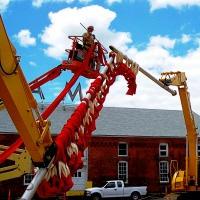
It’s a report of a bit of performance art/industrial control/knitting
that boggles the mind. The artist is directing the production of
a knit US flag, using aluminum street light poles as needles and giant
strips of felt for yarn. The actual knitting was performed by two
John Deere excavators, handled with amazing delicacy and
precision. The image is from a story on iBerkshires.com, reporting about the event which took place at the Massachusetts Museum of Contemporary Art.
The artist in question is David Cole.
This isn’t the first exploration of knitting (giant or human scale)
he’s done. He’s also done a previous bit of oversize knitting
with construction machinery, working up fiberglass insulation into a
giant slouchy teddy bear. His other works can be seen at his
website.
I can’t say that the gauge of the flag was in fact 1 st=3 feet, but one
has to admit that it’s pretty huge. I’m especially boggled at the
thought of someone deconstructing the movements to produce a knitting
stitch, then reproducing that series behavior using the controls of the
excavators. I’d love to applaud not only Mr. Cole (for his
imagination in thinking up this concept), but also the equipment
operators. "Knit a flag" is an incredible thing to put on one’s
equipment resume, and is quite a testament to their skill.
VISITOR PARADE
Where are all you people coming from? Not literally, of course, but I have been wondering of late.
Blog City has introduced new statistics tools. Among the other
things it does is maintain a list of the top read blog pages since the
feature came on line. The list is pretty much what I
expected. The poncho write-up is
my most popular, fueled in part by the fact that the link has been
widely collected by people maintaining pattern indexing sites. My Stupid Stitch Marker Tricks piece and the one on double-edged I-cord strips has also been in mailing list and other blogs’ discussions of late – no surprise there. Make your own stitch holders also has had lots of traffic, as had the column on the history of the Kitchener Stitch name.
In fact, all the bits I’ve marked as "Reference" both on the right hand
margin, and in the categories index are things I expect to see visited
often. Reference pieces are bits I think might be more broadly
useful than the rest of the drivel I usually post. But there are
also some surprises on the list.
The piece I did on the baby booties
has had a huge readership, with most of the hits coming from Japanese
websites. My guess is that the step by step photos have helped
Japanese knitters who were struggling with the English
instructions. Another page that has had a phenomenal number of
hits (almost all of them occurring in the last 10 days) has been the
More Knitting Fun piece. That one I just don’t understand.
I can’t find any referrers to it, and the write-up itself is rather
plain. It’s just an all-prose report on
stumbling across a remarkable knitted object – a knit-covered
bicycle. Yet in the past week or so it has had over 2,000
visitors. That’s more than double the number who looked at the
poncho page in the same period.
Go figure…
Of course, the Referring Web Pages tool that shows up on each page of the site should be giving me a clue. I do know from that roughly where people are hopping in from, at least for some of the pages. Thanks go to QueerJoe, the first blogger to send traffic my way; Curmudgeon Marilyn, who’s prickly writings I enjoyed for a long time, and whom I’ve not yet managed to annoy; to Wendy, crossroads of the blogworld; and to all the other leaping off spots that launch people in this general direction.
MARVELS OF MODERN TECHNOLOGY
I’m sure others have blogged about this already – needles with built-in sensors that
log the stitch count for you. There’s a base station that
displays the count, and appears to have holders to park the needles
when they’re not in use.
I can’t find any confirmation that this has moved beyond prototyping
into the realm of a real product, but regardless of development stage I
would have some questions for the maker:
- Are the sensors adaptable to any size needle, or is the knitter locked into using only one size?
- What is that size, and how long are the needles?
- Does it equally sense the movements of both throwers and pickers (British/American and Continental styles)?
- How does it handle complex stitches?? For example, would it
log a SSK as one stitch or three – counting the three movements it
takes to produce it as separate stitches? - Can you dial up or down to readjust stitch count and compensate for multiple movement stitches?
- Is there a memory function?? For example, if I sit down and knit today will it remember where I left off yesterday?
- Is it possible to get interim counts, kind of like the way you
can use trip set on a car odometer to record smaller intervals??
This might come in handy if one wanted to track a repeat in addition to
tracking total stitch count. - Does it handle row count?? (For most knitters, row count is a far more annoying tracking problem than is stitch count).
- Is there an upper limit? For example, if I work a flat piece in a
tiny yarn, I could easily have a couple hundred stitches across, even
on a 14-inch straight. - Does the count span rows, or is it set up to track on a single row basis?
- How sensitive is it to spurious movements?? For example, if
I bobble the needles as I reach for something or flip the work over, will that increment the
count?
I’m not about to run out and buy something like this, even if my
questions were all answered, but it’s very interesting to see some
creativity and technology applied to the problem.
For me, low tech is still the way to go:? my stitch marker abacus
for tracking rows, and for those projects where I need to know count
across at all times (very few and far between), a series of stitch
markers placed every 10 or 25 stitches (or between repeats), as counted
out from the center.
NOTHING DOING HERE, MOVE ALONG
There’s nothing like a flurry of activity at work to make one feel
appreciated. I feel very appreciated right now. My
priorities being in the right place, there’s been precious little
knitting here since my return from vacation. I anticipate things
returning to the chaos that passes for normalcy here by next week.
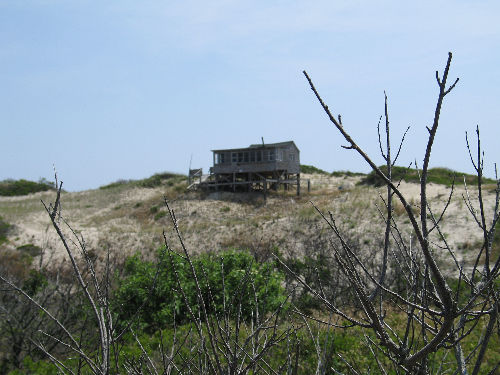
Even though I have no knitting or stitching goodies to share today, I can’t let you wander off unrewarded. Here’s another beach picture to contemplate.
This one was taken last Tuesday by The Resident Male, of a beach shack perched in
the dunes of the National Seashore near Provincetown, Massachusetts.
RETURN TO REALITY
The only problem with starting out the summer with one’s vacation is that while there’s lots for the kids to look forward to in July and August, to me it feels like summer is already over.
While we had great fun on our week away, the weather wasn’t ideal. I didn’t mind the wet and cold because I was at my favorite place on earth – the beach in North Truro on Cape Cod. This is sunset over Provincetown, as seen from the deck of our room on one of the nicer days.

We had a couple of good beach days at the start of the week, then the weather turned cold and nasty. Luckily we were there with friends, and between good companionship and copiously applied wine, were able to keep both warm and entertained.
I did get in some knitting, but progress was slow. I was re-creating my North Truro counterpane pattern – invented in the very same spot – from my sketchy notes. I got off to a couple of false starts, regraphed some probelm areas, made some of the lines of the piece crisper, and played with various methods of joniing that avoid some need for seaming. Here’s the result:
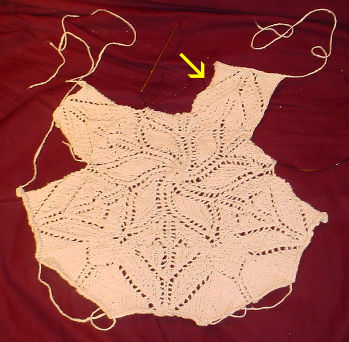
As you can see, I’m mid-motif. The initial unit is the hex in the center. I knit that starting on some 3mm DPNs, moving to a circ as it got larger. Instead of binding off, I purled my final row, and left the thing on the circ. Then I attached my yarn at what looked to be a good corner point, and holding the thing with the reverse side front, knit one side’s worth of stitches. That produced the appearance of two rounds of purl on the front at the base of my soon-to-be-knit side square. I then worked the side square out using two DPNs. I worked my side squares attached like this, one at a time. After I got a couple done, I knit a side triangle separately (it’s worked base to tip) and sewed it into place.
I also experimented with skewing the attachment of the square unit. Since it really doesn’t matter where on the center hex the sides begin and end, I knit one square on katywumpus – aligning its center to the point of the star instead of to the center of the leaf motif in between the star arms. You can see it above. It’s the lone square that I’ve pointed out with the arrow. I’ve decided I like the original orientation better and left it intact just long enough to photograph.
Well and good. Things look like they’re working out. I’ve avoided working all those squares separately and the seams joining them to the hex in the center. My bargain basement Webs-find yarn is working out well, with a very soft slubby cotton hand. I like it a lot. Compare it to my first iteration of this idea:

I don’t know if you can see it, but the older yarn is MUCH heavier. It’s a very dense cotton worsted – almost a twine. The newer yarn is a 90% cotton, 10% acrylic blend, and is somewhere between DK and sport in thickness, plus it’s much less densely structured than the older stuff. The lighter yarn drapes better, plus it shows off the motifs better. All in all, things look quite promising!
KITCHENER STITCH
I’m working (albeit in the background) on a project to get "Kitchener
Stitch" and "to Kitchener" into the Oxford English Dictionary.
I’ve already corresponded with an OED committee member and he is
fascinated by the historical connection. Should we find
sufficient documentation he would be glad to nominate the term for
inclusion.
I’ve gone on? about this before – mostly noting that until
knitters on both sides of the Atlantic began talking to another via the
‘Net, no one really noticed that that this term for grafting
(especially in sock toes) was far more common in the U.S. and Canada
than it was in the U.K.
This is in spite of the fact that Earl Horatio Herbert Kitchener was a
prominent British military figure in WWI, and a pre-1900 hero of the
Sudan Wars. He’s also the guy after whom the Sirdar yarn company
was named (a pal of his owned it and named it after Kitchener’s title
during his tenure in the Sudan). You’ve all seen Kitchener’s
picture, he’s the guy in the major league mustache who figured so
prominently in British WWI recruitment posters.

So far research has turned up some tantalizing facts:
Just before and in the early part of WWI, Lord Kitchener was in charge
of updating the British military kit, and oversaw the development of
standards for all items of battle dress and equipment, including
socks. Whether or not he (or his staff) issued military
specifications for socks that included seamless toes is still a tidbit
we have not pinned down.
Grafting as a technique to close up sock toes appears to not have been
widespread before the 1920s, and with very, very few exceptions is not
documented before 1920. We are still looking for exact,
research-grade citations for the earliest specific mention of grafting
(with a technique description) to close up sock toes. We’ve got
some anecdotal references, but nothing we can take to the committee.
The term "Kitchener Stitch" or "Kitchener Grafting" is still not pegged
down, although other sources lead me to believe that it was first used
in a socks-for-the-troops pamphlet issued by the Canadian Red Cross
circa 1916 – possibly from Kitchener, Ontario. This theorized
pamphlet has not yet been found. One pebble in the gears of this
theory is that Kitchener, Ontario was only named in 1916. (It
changed its name from "Berlin" at that time as part of the general
anti-German sentiment common during the War.). ?? Again, any
leads on this (with research grade citations) are most welcome.
We’ve got one from around 1923 or so as our earliest.
Jean Miles in Edinburgh is investigating another theory – that Lord
Kitchener (or someone acting in his name) either endorsed or submitted
a sock pattern? to those knitting for British Expeditionary Forces
at the outset of WWI. Again she’s got no true citations, and is
looking for leads.
As far as the technique of grafting in general – it appears to be rare
before 1920, if in fact it was done at all. Socks of that era
usually had round toes of some kind, and were terminated with a simple
draw the yarn end through the last several stitches type closure.
Some used variants of the three-needle bind off, but grafting (under
any name) is absent in museum samples before 1920 or so. Deborah
Pulliam wrote to me to say that in the course of her research she has
examined hundreds of pre-1900 and post-1900 socks and stockings, plus
hundreds of early knitting manuals and instruction sheets, and she has
not yet found a grafted toe prior to 1920. She also states that
flat toes were extremely rare prior to 1910, and are totally
unrepresented in socks and stockings prior to 1850.
There is another style of sock, I believe it is a full sole re-footable
one that was called a Kitchener Sock sometime around the late teens,
early 1920s, but it does not resemble the socks common today, nor has
the use of any grafting to make that sock been noted. Once more,
a good citation is lacking.
By research grade citations, I mean full annotation – name of author,
name of publication, date and place of publication, page number of the
citation, and a quotation of the paragraph in which the term appears.
So if you’ve got access to a local research library or Red Cross
archive and have nothing better to do, please poke around and let me
know the result. You might be the person responsible for
correcting this grievous oversight and getting Kitchener into the OED.
PROOF THAT I EXIST
… that I’m not sylph-thin, and that I do finish wearables:
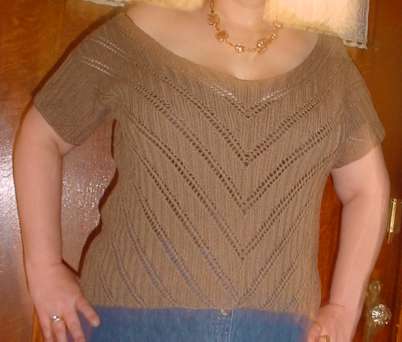
This rather blurry picture was taken by the 6-year old, which explains the
low center of reference and focus quality. (Bloggers have no shame, and willingly press even small children into service.) I’m tallish and some say intimidating, but not THAT tall or intimidating.
The item being worn is my Raiisa tee. So far I haven’t gotten a good photo of the thing, either on or off a wearer. I’ve provided the pattern but the charts for it are massive, and not for the faint of heart. I’m very pleased with the end product. Sausage arms and barrel body aside, it’s one of the more flattering summer knits in my closet.
As to the short lines, odd line breaks and general strange formatting here on String – I’m not quite sure what’s going on. Blog-City had a major upgrade earlier this week, and all sorts of minor things have gone awry. Please bear with me.
UPDATE:
Several people have written to say that this photo doesn’t prove that I exist, as it could have been taken of any random headless person. I concur, and would be happy to continue to be just a figment of everyone’s imagination, except for this. (I suppose I should update that page, as the gnome is now finishing up first grade.)
BAG LADY
What makes a good knitting bag?? That depends on the knitter. Some like the granny-style standers – those bags on a frame. Some like backpacks. Others live and die for the absolute latest Vera Bradley?design. While I’m probably closest to the backpack set, I have my own ideas. For me it’s about minimalism and function, not style – so a parade of freebies has mostly been what I’ve used.
I’m thinking about this today because The Resident Male just returned from a conference at which he received an excellent bag. I snarfed it up immediately. He didn’t stand a chance.
What I want to find:
- Ample, roomy interior deep enough to hold a large project
- Pierce-proof sides
- Sturdy bottom square enough to sit up on its own
- Wide enough to accommodate long single points
- Light weight
- At least one large width zippered pocket for safe pattern stowage
- Comfy handles long enough to sling over my shoulder
- A zippered top, so that when the thing is tossed in the back seat of the car, nothing tumbles out
- Additional inside pockets to hold notions
- Not looking like a knitting bag (no prissy, cutesy or country-kitchen themed patterning)
- Low cost.
Here’s my (very boring) new bag:

It hits all the high points – lacking only interior pockets, plus it’s mostly waterproof/water resistant. It may be boring but it’s 99.5% perfect as a knitting bag. I’m delighted.
Here are several others from my collection.
 |
 |
 |
 |
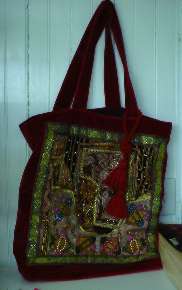
The red velvet one covered with embroidery and bits of wedding saris is beautiful and capacious. It was also a highly appreciated gift. It’s extremely fragile, as the sequins and jewels have a habit of shedding. Plus it’s very floppy. Too beautiful and too delicate to schlep around, this one lives in the living room, lounging around on display and holding my upstairs project of the moment. (Yes, I have different projects in different rooms, and often work on what’s closest rather than my primary project.)? Gorgeous, but a B- mostly?for limited utility.
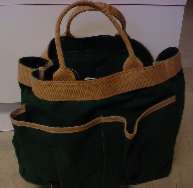
The little green canvas tool bag was one I went out and bought. It’s rugged, with lots of pockets around the outside. I loved the style, but didn’t think hard about how useful it would actually be. Unfortunately it’s too shallow for a big project, the splayed outer pockets spill their contents, and the handles are too short to make carrying it around comfortable. As a knitting bag it rates a C-.
The small blue embroidered bag was a find at the Gore Place Sheep and Wool Show. For the past several years there has been a Hmong family from Viet Nam displaying and selling hand made items? – bags, pillow covers, hangings and other pieces decorated with traditional cross stitch and quilting. This little bag is just big enough for one pair of socks in progress. It’s quilted, so it (mostly) resists needle point penetration. It’s got a small zipper pocket on the outside that holds notions. The straps are long enough that I can sling it over a shoulder and knit directly from it while standing. I’ve got a couple of these, each holding socks in progress. One lives at home and one lives at work. They’re ideal take-alongs for doctors appointments, the infrequent lunch break, waiting on post office lines, and knitting during other bits of found time. A solid A-. A specialty bag, excellent for socks or other small projects;?downgraded a bit because I tend to use ridiculously small (and sharp) steel DPNs that can stab through both it and me.
And the last bag – the woefully dirty el cheapo cotton trade show special is the type of bag I use most often: souvenir nerdbags from technical conferences. ? No pockets, no sturdy bottom, no zippered top, no point-proof sides, but ultra abundant. This particular one might be considered a Geek Collectible. It’s from the very first release of Oracle for the Macintosh. It was already old when I began using it to pack extra clothes to accompany The Older Daughter to day care, and she’s now 14. This type of bag merits a solid B+. Not the best by far, but serviceable, and best of all – free.
MARKING TIME (AS IF I HAD ANY)
Just a quick post today. I’m running around shepherding my kid to an awards ceremony (her poster was singled out in a competition run by the regional water authority); and getting ready for The Other Daughter’s birthday party this weekend. May is birthday dense in this house, with both girls and I all inhabiting the last couple of weeks of the month. It’s hectic to say the least.
I’m surprised that there hasn’t been more written about Alcazar on the Web. I suspect it’s because its photo doesn’t display as well in small format. For example, the outer edging on the sample piece is done in a darker color yarn. It’s difficult to see. As a result it hasn’t attracted as much attention as its showier sisters. While I’m sure that lots of other people have knit it, I suspect that I might be among the first to blog about it. So far it’s quick. I’m another iteration of the base pattern into the thing. I suspect that mine will be considerably smaller than the five-foot diameter piece one gets by using the recommended yarn and needle size. But no matter…
No progress today on Rogue. I’m still waiting for those golden moments needed to decipher where the heck I am. Sigh.
PASSION AND GUSHING; KID REPORT
O.K. I’ve gotten quite a few notes disagreeing with the opinion I posted on Friday. That’s fine.
Don’t mistake me though. I’m not against passion or enthusiasm. Both are part of falling in love with a hobby, craft, or other pursuit. Passion is great. It’s the fire in the furnace that feeds us all. To torture the metaphor, mindless gushing is the annoying component of the fire’s smoke that hurts one’s eyes. Sure, tell the world how much fun you’re having. But if you want people to 1) read your comments; and 2) take you seriously, try to limit the LOLs, the "me-too-ism" and group-think, the over-use of "!!!," all caps, the run-on sentences, and mindless statements like, "I love it SOOOOO much, I’m dying." A blush of enthusiasm is like spice; too much is overpowering and swamps any content you may wish to convey.
Kid Report – Learn to Knit Afghan
The Larger Daughter has just started a new knitting project. She’s already done several foofy scarves, a felted bag, and a pair of fingering weight wristlets. She wants to learn a bit about things beyond basic knits and purls. To do this, she’s going to march through Barbara Walker’s Lean to Knit Afghan Book.

Walker presents a series of patterns for squares that can be assembled into a blanket. Each square is for a different texture or colorwork pattern. They’re (more or less) arranged in a sequence, with each new square introducing a new skill or technique. If you work your way through the entire set you’ll have experienced a wealth of styles and stitches, and will have gained valuable experience in following knitting directions.
Yes, one could compose a project like this on one’s own – taking stitch dictionaries and selecting interesting patterns from them. In fact all of the stitches in the Walker book are in either her own stitch treasuries, or in her other books. The advantages of having them in this one volume are portability of the directions (no lugging around a suitcase of books to choose the next square); having the repeats and cast-on numbers pre-calculated to produce a set of (mostly) same size squares; and having the lessons presented in a logical order, with new skills building on previously learned skills. There are other people who have or are writing about this project on the Web. /p[eu]rls of wisdom?/ has been blogging the project, and has a particularly nice set of finished squares up for the enjoyment of all.
The Larger Daughter is going to make her blanket from many shades of green, accented by cream and possibly another framing color to be chosen later. She’s using Cascade 220, 100% wool, and is knitting on US #6 needles. She’s on Square #1 right now – plain striped garter stitch, and is breezing through it. My role in this is to stay on the shelf as a benign source of last-resort help, not interfering unless she’s got a specific question. That and buying the yarn, of course.
 String-Or-Nothing