ELIZABETHAN BLACKWORK SMOCK
O.k. I know a few of you want me to do a blow by blow travelogue of our London trip. But that’s not my forté. I’ll wander over and cover some of that material several posts, but mostly want to write about specific things we saw, this being one of the first times I’ve been able to get relatively up close and personal with historical artifacts. Besides, The Resident Male is a much better travel writer than I am.
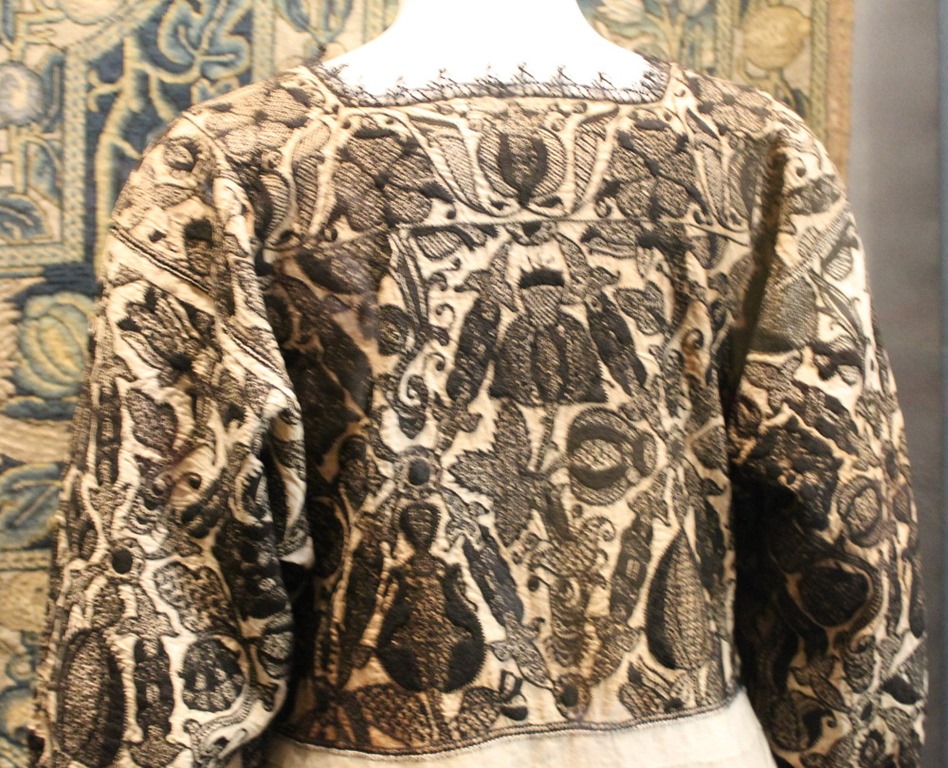
First off, to satisfy my stitching readers, is this blackwork smock, currently on exhibit at the Victoria and Albert Museum:

The full citation cites it as being of British make, and stitched some time during 1575 to 1585. They posit home manufacture rather than a professional house. If you read through the full description, you’ll find out that the top part (the stitched bodice) was done on fine linen, and the unseen and unstitched lower part was also linen, but of a much coarser fabric. The plain lower skirt and the needle lace around the neckline and cuffs are modern reproductions. The accession number is T.113 to 118-1997.
I tried to take pix of this artifact to show the details. It’s basically three large rectangles, with underarm gussets (each sporting a flower, and unseen here). One rectangle for each sleeve, plus a larger one with head hole for the front, back and shoulders. I wanted to see if that center strip was seamed from smaller parts, but I wasn’t able to do so based on my examination.
One thing that delighted me was the use of various techniques for the fills. Some were done on the count. It looks like the grid may be 4×4 threads. I can’t estimate the stitch per inch count, but it’s roughly comparable in look to between 20 and 25 stitches per inch. The thread does look finger spun from floss silk, with some areas more tightly twisted than others, and some variation in thickness.
Some filling placements were eyeballed, and done freehand (note the trailing vines and spot motifs that follow the flower forms rather than marching rigidly in diagonals). The solid bits look to have been done in satin stitch or a stitch in the Romanian couching family. The dark borders around the shapes look to be either outline or stem stitch in some places, and in other places possibly whipped or threaded back stitch. There may be knot stitches in there, too, (especially the knotted line stitches that sport little side stitch “legs”) but my eyes couldn’t pick them out for absolute identification.
Effort was made to use the same filling in matching areas of symmetrical designs, but some variations do occur. In fact, the occasional lapses in attention to detail on the fills, and that some are presented in a couple of variations (see below) are charming, and makes me think that my guess that the fillings were thought up on the fly, rather than being copied from canonical works may be true. (Filling inventors, take heart.)
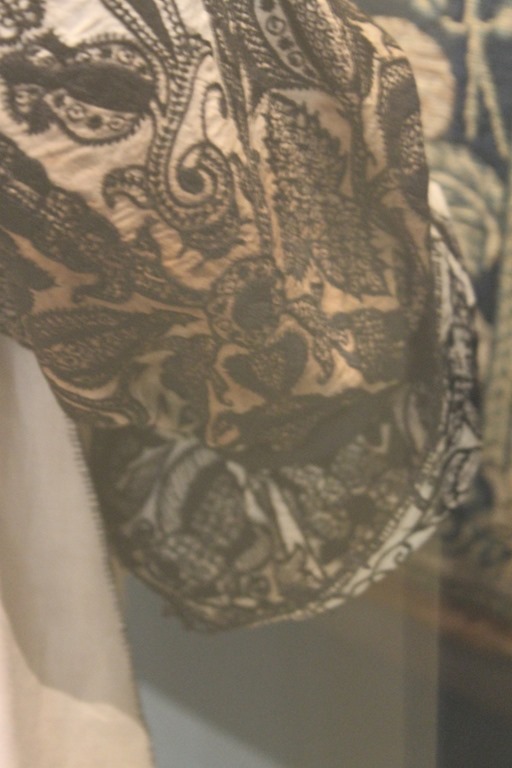
I tried to get very close to the turned back cuffs to determine whether or not they were exactly double sided, with both front and back identical. Well, they’re close but not absolute. My pictures aren’t good enough to show it, but there are (barely) detectable knots on the inside of the cuff. The double running stitch fills and solid areas (satin stitch in this case) are certainly worked very neatly, especially compared to the relative chaos of the back sides of other contemporary work, but they are not spot on exactly the same front and back, although they are presentable and nicely done, for sure.
Here are some more pix of the thing. These shots were taken by Elder Daughter, with her superior camera skills and equipment:


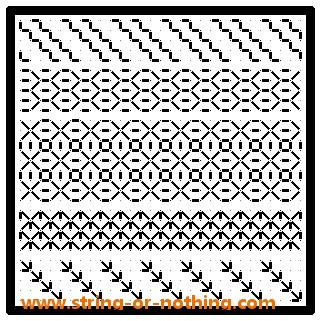
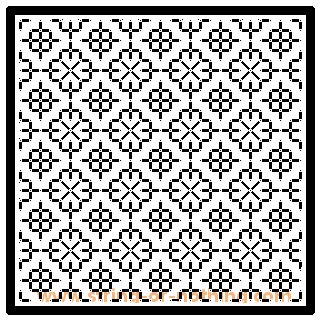
And finally, to satisfy the people who pointed out that I did not include exact citations for every fill in my free-to-download Ensamplario Atlantio collection, here is a set of 10 plates with fills sourced specifically to this artifact.


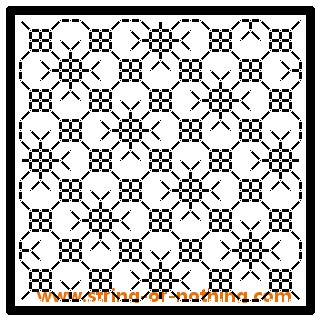
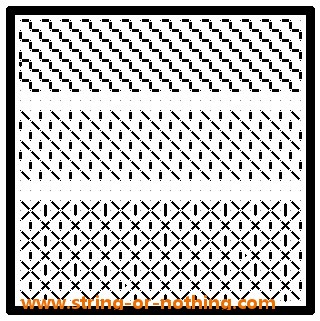


So much for facts. I have to say there were several items on display that caused me to hyperventilate like a Twilight fangirl. Blackwork geek that I am, this was one. It’s in excellent condition, with the stitching, dense, the threads shiny, and minimal wear or damage. The overall effect was one of understated opulence, but not splendor. For one, there is an aspect of “loving hands at home” to this piece, especially in the composition and heaviness of the fills.
But what struck me the most was that the standard of excellence in this piece is entirely achievable today. Yes, it’s exacting, and acquiring the materials would be difficult, but it’s not miles beyond the capability and reach of modern amateur needleworkers. It’s time we stop bowing to “the ancients” and banish our temporal craftsmanship insecurities The best of us are darned good (no pun intended), and many of the contemporary projects I see on the web are just as well executed as this prime piece from the 16th century.
IN WHICH WE BUY EMBROIDERIES–PART V
It occurs to me that before I can begin writing about our holiday week London trip, complete with meet-up with Elder Daughter, plus all sorts of interesting sights at various museums, historical places, and theater performances, I have to finish my posts about our November trip to Agra and Delhi. Apologies for the delay, I plead computer woes, spotty connectivity, and ennui (in no particular order).
Here’s the prize piece from our big India trip – a tamboured Pashmina jacket, made in Kashmir, but purchased in Agra.
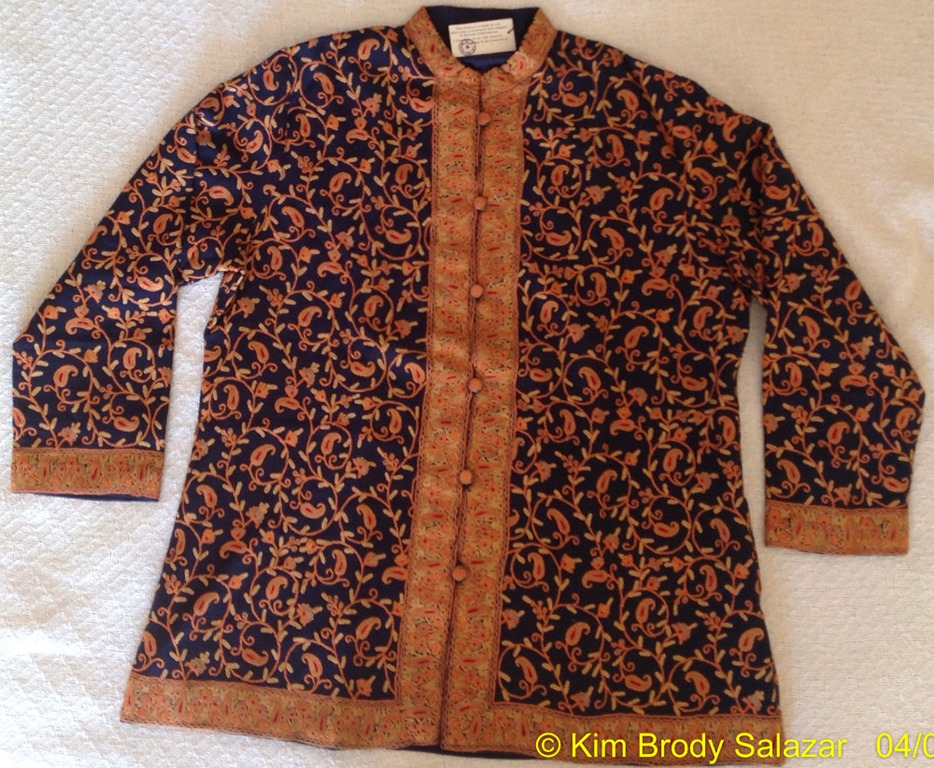

It is one of the nicest, most finely worked tambour items I’ve handled. The colors in these shots are pretty true, but they glow a bit more in person. The golds, oranges, reds, and browns twinkle against the cobalt blue ground. The edging isn’t trim – it’s more densely packed tambour work, done on the same piece of cloth as the scrolling vines of the main body. The buttons are cloth, covered with more stitching. The thread is all Pashmina wool, too. No metallics or glitter. You can see the surface sheen from the fine, densely packed chain stitches in the button placket.
I will say that this was an indulgent gift from The Resident Male – the price made me giddy, even after he bargained it down from the stratosphere. But for work of this quality, the price was fair. I adore my luxury present, and am looking forward to wearing it in cooler climates.
I am still looking for other good examples of Indian needlework, more within my budget. Sadly, as with so many handcrafts, bad drives out good. Since most of the tourist market does not recognize or reward quality craftsmanship, artisans pursue greater revenue and higher volume over better artifacts.
Pieces that show skill and solid artisanry are few and far between, but I’ve seen endless piles of poorly stitched shisha (mirror) work cushions, sloppy satin stitch hangings that look like they were done in one evening, and beadwork that sheds its sequins after a light shake. I can’t fault the makers – they are pressed to provide income for their families. But I won’t buy those things, either. So the hunt continues…
IN WHICH WE BUY EMBROIDERIES–PART IV
I’m not done yet!
Here’s another piece we found on our Delhi/Agra trip. This came from a dealer in Agra, and not the fair trade market in Delhi.
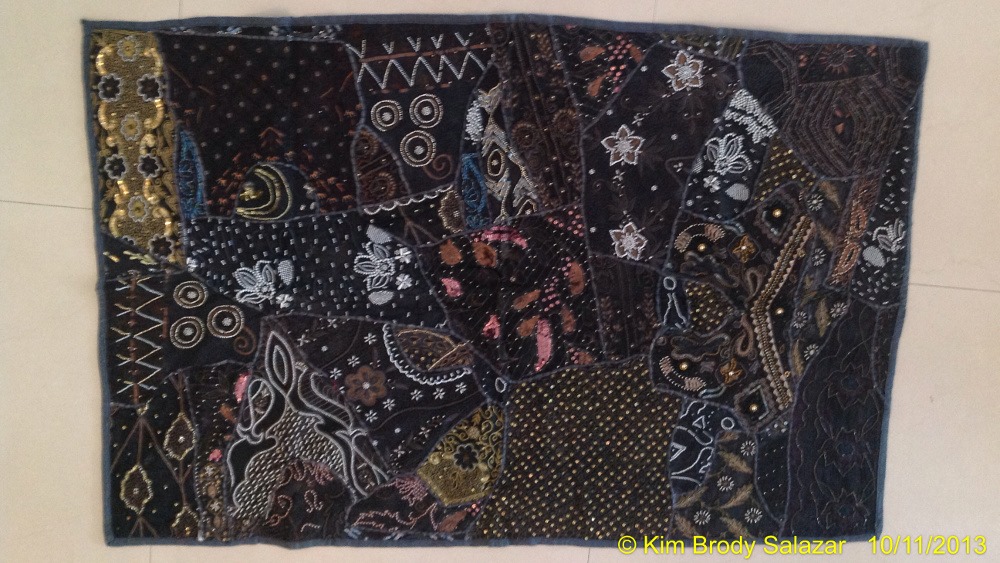
This is a patchwork wall hanging. It’s sort of in Crazy Quilt style, although the piece is one huge block, roughly 4 feet x 2 feet. It’s made up of fragments of highly embellished antique textiles, much of it overdyed in black; plus some newer pieces to eke things out. The fragments are appliqued to totally cover a background, and that ground cloth is in turn backed by another heavier cotton cloth. There is minimal quilting between the layers to hold them together – mostly some tacking stitches along the rolled borders between the fragments.
Close up you can see the amount of beadwork, sequins, gold stitching and other encrustations:
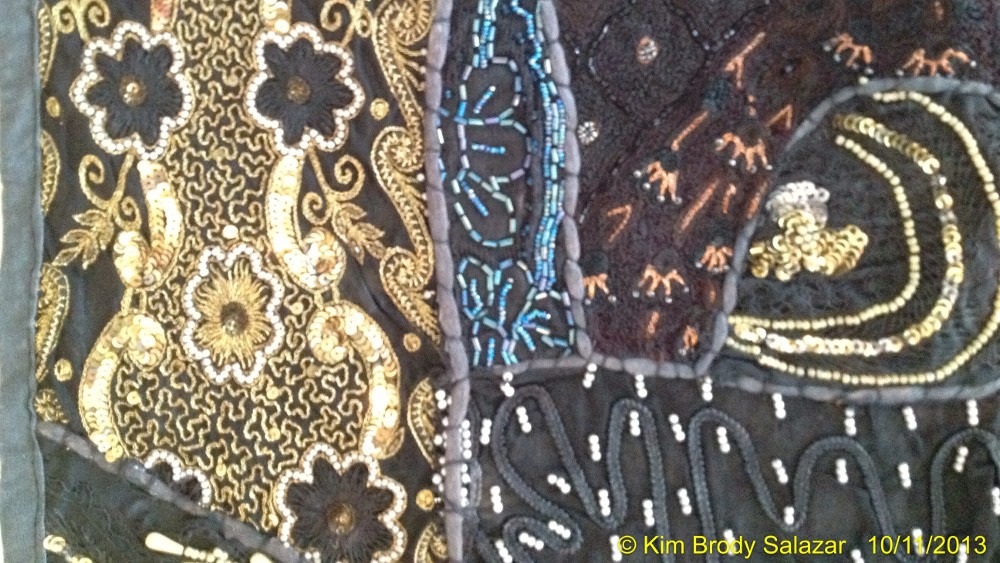
The dealer had several like this. Believe it or not – this was the plainest. It was also the one in best condition. One problem with antique pieces is that often the cloth is not stable. Silk is friable, and crackles with age. All the more so when it has been overdyed. Threads securing hand-hammered sequins or rough edged metal beads can break easily. I looked long and hard at the five offerings, and picked the one in the best shape from a curator’s perspective.
The number of techniques in this piece is hard to estimate. There’s tambour in silk, cotton and metal threads; beadwork and sequins applied in myriad ways; satin stitch, laid couching of various types; buttonhole stitch; something very much like or nuée, with gold threads affixed with colored silks in patterns or to create shaded effects; appliqued lace; some very old mirror work (shisha); and heaven knows what else.
The way this piece is put together reminds me a lot of a cherished gift at home. Jackie of the late and lamented Wild & Woolly, gave me this knitting bag for services rendered when I helped her with a major home reorganization:

It’s also of Indian origin, assembled patchwork style from small pieces of sari borders and other embroidered snippets. In this case the backing fabric is cotton velour, instead of heavy flat-woven matte-finish cotton. I have a feeling that this bag is somehow related to the black hanging, if only distantly.
But as jaw-dropping as the black piece is, it’s not our ultimate acquisition (so far). You’ll have to wait until the next post to see that!
IN WHICH WE BUY MORE TEXTILES–PART III
O.k. So technically, these aren’t embroideries. But they are still textiles.
Among the various indulgent purchases we made on our Agra-Delhi vacation was this Kashmiri rug, bought after much hard bargaining from a traditional Smiling Rug Merchant:
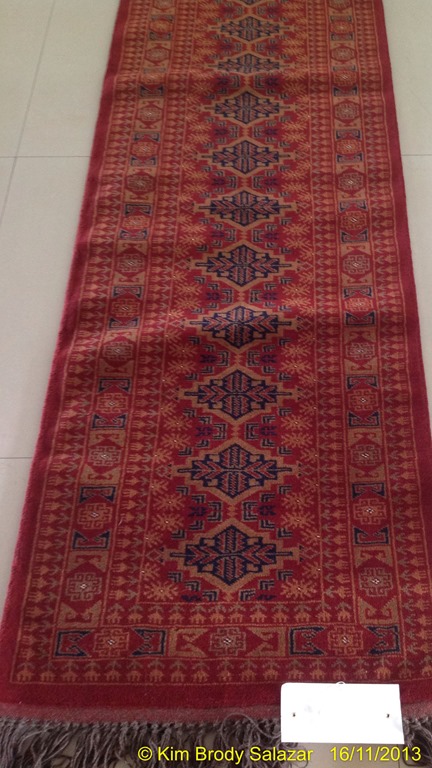
The bargaining is part of the theater. I don’t believe for a minute the merchant’s protestations that we were taking bread out of the mouths of his children (their graduation photos from US universities were behind his desk), but the play of price, offer, counter offer, reticence and commitment must be played out for any large purchase. It’s like high school dating, but for merchandise.
This piece is a runner, for use in the long hall outside our library. It’s an heirloom quality, all-wool warp hand knotted rug, with long, luxuriant fringes, and dyed with traditional vegetable colors. It’s hard to say how such muted reds and tumerics glow, but they do. We’ll probably leave it out for a couple of days to admire, then roll it back up in its muslin bag to await shipment home with the rest of the household goods, come June.
The next day we bought some woven pieces at Dilli Haat as gifts and souvenirs.

The small woven bags and coasters are cotton and straw. The four larger hobo-style soft tote bags are cotton with inset hand-woven bands. If my notes are correct, these are backstrap-loom produced pieces from Nagaland, near Assam.
[UPDATE] I’ve done some research on the small woven straw clutches. I didn’t write down the region of origin when I bought them, but I’ve now pegged them to the c0astal region of Orissa. They are made of sabai grass and cotton, and are part of an economic initiative that assists families in flood-ravaged areas reclaim economic self-sufficiency.
These smaller items we did not bargain for, other than putting together a group and asking for a price for the larger purchase, rather than toting up each item individually. All were quite reasonably priced, and sold as they were by the village or guild co-ops, we were happy to provide fair recompense directly to the crafting artisans themselves.
I’m not done yet. There are more pix of textiles to come. And if you want to see the larger sights of our trip, the husband has posted an excellent two-parter on our trip to the Taj Mahal.
IN WHICH WE BUY EMBROIDERIES–PART II
Here’s the second group of purchases.
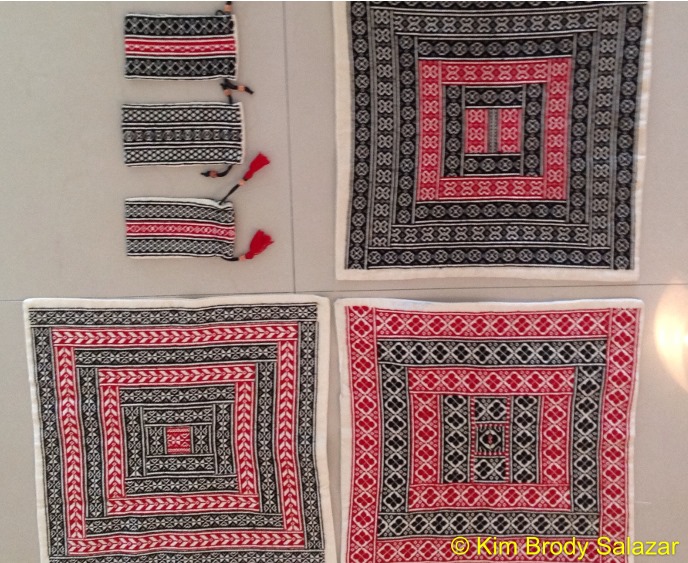
These are three cushion covers and three small glasses-case-sized pouches, all done in pattern darning. We also got these in Dilli Haat, in Delhi; from a Government-registered ethnic arts stall. In this case, the pieces were done by a Toda cooperative. The Toda people are from South India in the Niligiri Hills and surrounding areas. Their traditional culture is pastoralist, centering on dairy herds.
Their stitching, seen on a Toda’ woman’s outfit below, has been adapted for retail sale. The Dilli Haat vendor was selling the square cushions and small bags I bought, plus tote bags, larger throws, and bolster cushion covers (think cylinders, with the stitching going around the circumference).

Image credit for the lady above: 6 Assago via the Fair Trade Forum – India, which also works with Toda cooperatives to market their crafts.
Anyone who is familiar with my love of black, red and white geometrical stitching will know I was especially delighted to find these pieces. It will be difficult for me to part with any of them, even though I bought them as gifts.
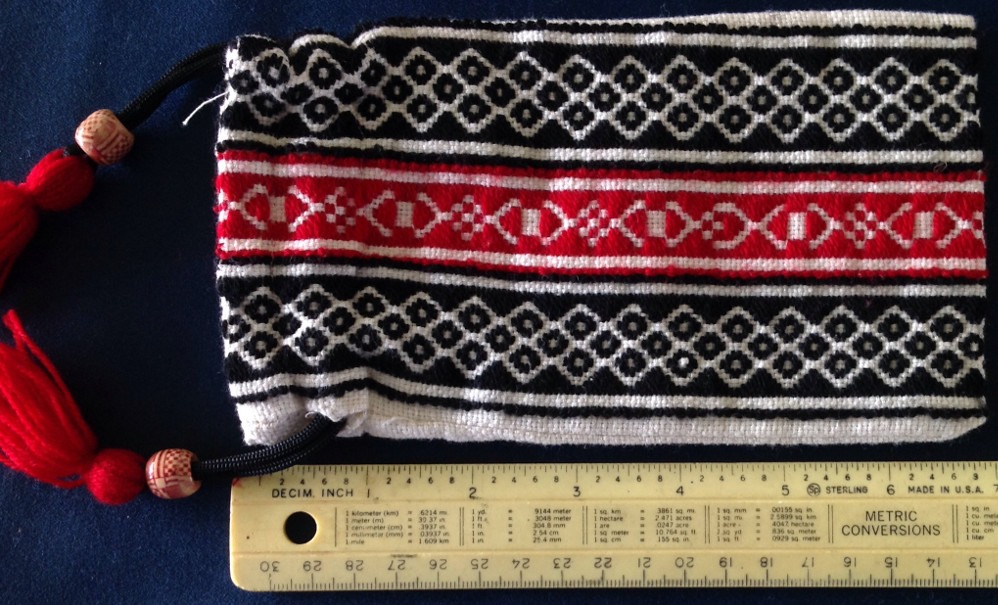
In terms of technical specs, the white ground cloth is a bit like Aida cloth, even weave with a well defined “stitch here” hole structure; at roughly 20 doubled threads per inch. The thread used looks to be an acrylic lace-weight plied yarn. It’s a bit friable, so gentle care is in order to minimize surface fuzzing. The pouches and cushion covers are lined, so seeing the reverse is problematic.
Now, there are several embroidery styles in India that use pattern darning. For example, Kasuthi also employs Negi (weaving) stitch for individual stand-alone motifs or for borders in which the stitches form the foreground. But the Toda style is a bit different. It’s characterized by strips of uniform patterning, with the stitching making up a solid background against which the unworked ground cloth peeps through in geometric designs.
And I love it.
IN WHICH WE BUY EMBROIDERIES – PART I
Just back from a five-day Diwali break trip to Agra and Delhi. In Agra we toured the Taj Mahal, Agra Fort, Ram Bagh (a magnificent Mughal era garden), and Chini Ka Rauza (mausoleum of Shah Jehan’s prime minister Afzal Khan Aalmi, himself a noted poet). In Delhi, we did a hilarious, whirlwind auto-rickshaw tour of Government center area, including the India Gate, houses of Parliament, and the embassy area; then a day in the National Museum, the Crafts Museum (a must-see if you are a weaving or textiles fan), the Red Fort, and at the end – a shopping trip to Dilli Haat. If you are ever in Delhi, insist on going to Dilli Haat. Your driver may try to steer you to a different crafts or souvenir store, but stand firm. You’ll find better quality goods at much lower prices, and without the “foreigner tax” so often encountered elsewhere.
The week was unforgettable, and I’m sure I’ll be posting some select tourist pix over the coming week. But folk here are reading for needlework content, so I’ll lead with that.
I wanted to bring home examples of Indian needlecraft that are a bit more interesting than the usual items sold to tourists – the hastily stitched pieces of sketchy construction in lurid colors. I had wanted to find examples of Kasuthi, of course, but so far, I haven’t. Perhaps when we go a bit south in Maharashtra later in the spring I’ll find some. But other than the iconic piece at the National Museum, pictured on the cover of my Kasuthi book, I haven’t seen a single example. Nor did I find quality shisha (mirror) work, although I did see a couple of pieces locally here in Pune that I may go back to buy. In crafts, like in all other areas of economic opportunity, bad drives out good. It’s hard to find honest quality pieces when less well executed items command the same price. But I did look hard, and we did buy several items, almost all from government designated regional or ethnic artisanal cooperatives in fair trade markets or sponsored cooperative stores. Here is the first selection:
My dodo curtain. Now anyone can find elephants or peacocks,even tigers, on cloth here. They’re everywhere. But this cotton curtain (about the size of a king size bedspread) is totally covered with roundels inhabited by dodos. Why dodos, I haven’t a clue. But in addition to the pudgy charm of the off-beat motifs, it was the best stitched and best composed of the large pieces I saw. My big disappointment is that I didn’t get a provenance on it, but I suspect Uttar Pradesh from the style:


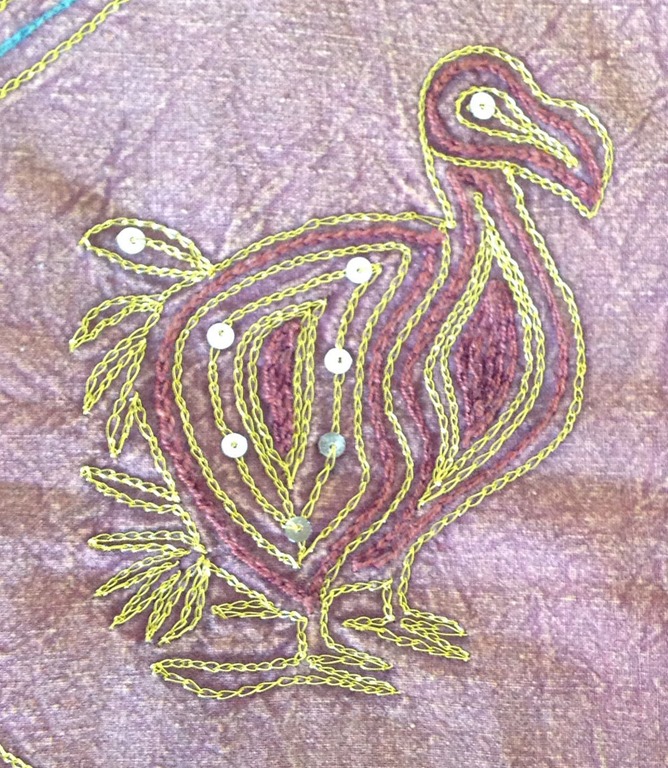
The pictures above look rather pinkish, but the actual background color is more dun than salmon or orchid. The dodos are worked in tambour-worked chain stitch in gold and brick, olive and mustard perle cotton on a double-thick cotton ground, then heavily washed. The sequins are affixed along the lines of the gold stitching. That along with the treatment of threads on the back clinches the working method for me.
I hope to mount this as a room divider curtain on a brass rod between our living room and dining room. Long ago there was just such a brass rod in that wide opening, and now I have something worthy of replacing it.
Long live the dodo!
KASHMIRI TAMBOUR-EMBROIDERED CARPET
Mary Corbet over at Needle n’ Thread has just posted an interesting piece contrasting tambour needle produced chain stitch with the same stitch produced by a traditional threaded needle. She notes the speed, density and coverage factor of tambour stitching. I present a truly huge sample to corroborate her observations.
I have an entire room-size floor carpet done in tambour work.
For those of you who don’t know what tambour is, it’s a method of producing an even embroidery stitch with a chained appearance, by plunging a hook through a base fabric, catching a loop of decorative thread, then repeating the process to create a line. The hook used (called arhi, here) looks a bit like a fine crochet hook, but the end of the hook is a bit more pointed, to make piercing the ground fabric easier. Mary offers up some excellent discussions of the technique, so I’ll skip doing so.
In any case, Mary’s piece made me think about the rug we recently purchased:
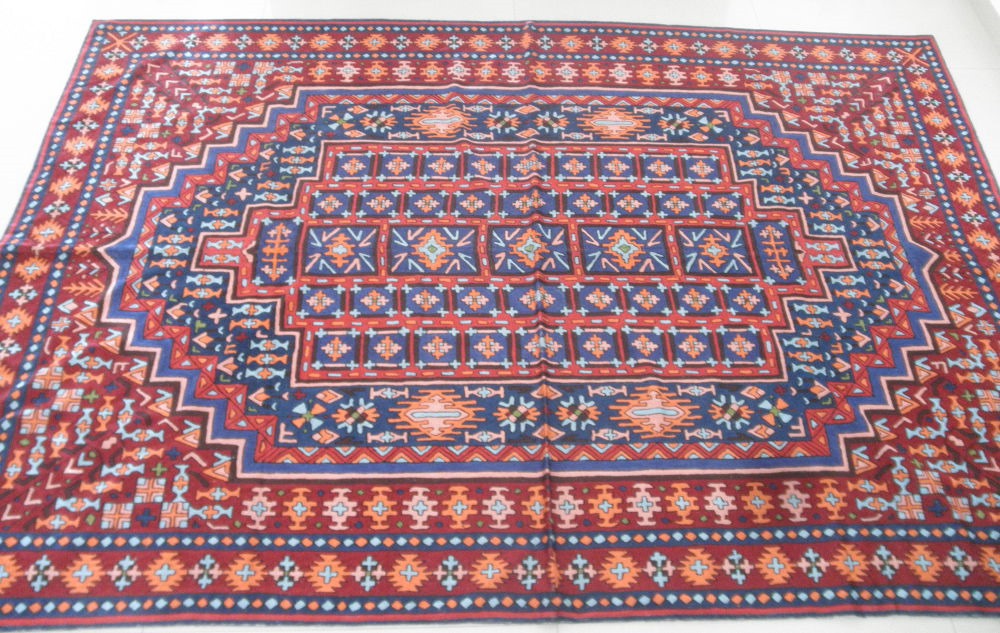
This piece is roughly 6’ x 9’ (1.8 x 2.7 meters). Everything you see here is stitching. The white cotton ground is totally covered by vibrant, dense-pack chain stitch in jewel colored cotton:

By getting close up with my gauge square, I can see that the stitch count varies between 10 and 12 stitches per inch, with the longer stitches being in the plain areas like the simple straight pink and brown runs at the bottom of the detail, above. For width, about three rows of stitching equals 1/3 of an inch, with the longer stitch areas being a bit narrower in addition to leggier. Perhaps the less skilled stitchers were assigned the boring border areas, and the more skilled artisans did the intricate motifs. In any case, because of the variability of stitch length and some small mistakes here and there, I am pretty confident that this rug was done by hand and not with a sewing machine.
If I flex the heavy canvas ground cloth, I can see some pencil lines behind the stitching that mark off major design areas, but not every area or motif is indicated. Finally, the entire piece is backed with another layer of cotton sheeting, slightly thinner than the natural color ground cloth.
Our rug came from the Kashmiri area further north, the source of so many of the handcrafts available here in Pune. It’s a bit unusual because this type of stitching is more commonly done in wool. Namdas for example, are tambour stitched rugs worked in wool (or sometimes today, wool/acrylic blend or even cotton) on a felted wool ground cloth. I’ve seen them both here, and occasionally in import stores in the US.
Back to our carpet – how long did it take to make? Tambour is speedy, but 6’ x 9’ is a huge amount of handwork. The crafts merchant who sold it to us said that these pieces were the product of family manufacture. It typically takes several people (I’m thinking four to six, more can’t easily fit around the cloth to work) about two weeks to make one this size. I base this on the fact that he says one family can produce between two and four big pieces per month. Ours was one of the largest. Most of the other samples of cotton tambour were about half this size. To my stitcher’s eye, ours was also the most accomplished of the four available cotton rugs. It was the most evenly and densely stitched, with the best color balance and patterning.
The stitched surface is holding up nicely to moderate traffic, although we are careful with it. We do not wear shoes in the house, and I do not subject this piece to the vacuum. Instead I light surface sweep with a soft plastic broom, and supplement that with occasional shake-outs. Thankfully, nothing has spilled on it. Yet.
We bought this piece because we fell in love with the brilliant color, intricate patterning; and because I appreciated the skill that it took to produce, and the magnitude of labor it represents. It’s time and care, rendered in cotton, and will be one of my favorite keepsakes, long after we return home.
THE TWAIN DO MEET
That old adage “East is East, and West is West, and never the twain shall meet,” is hogwash. The more I nose around and see new things, the more echoes and possible connections turn up.
First it was the early modelbooks, mostly German and Italian of the early 1500s, some of which appear to have copied textiles or ornament from further south and east. In TNCM, I pointed out that some designs in Schonsperger’s 1526 Ein Neu Modelbuch were possible transcriptions of Islamic Kufic script, often used in woven and stitched Tiraz bands (TNCM 18:2). A knit cushion from the tomb of Fernando de la Cerda of Castile (d. 1275) is another example of similar script (Richard Rutt, History of Hand Knitting,1987, p. 41, and TNCM 18:4).
The Islamic link in elaborate stepped double running stitch embroidery – the precursor to European blackwork strapwork styles – is now well documented. The talented Mathilde Eisenbach presents a summary and samples of Medieval Egyptian counted work (among others).
But it didn’t start there. Double running stitch done in steps and little squares may well have its origins further east, and European style blackwork most definitely has an Indian cousin, with its own long and murky history.
It’s pretty obvious that double running stitch is one of the simplest of all embroidery stitches. It can be used both on the count and “free” to produce linear designs of all types, with the advantage of producing double-sided work. Most of the strapwork and counted styles I favor lean upon it heavily, either alone, or in combo with other stitches. I’ve often noted its persistence through time and across distance. It’s so common a stitch that it’s extremely difficult to say its use in one locale or culture predates another, but it’s so tempting to find parallels and relationships among its various incarnations.
First, time out for megathanks to new knitting/stitching penpal Jayashree Madan Gopal, who took the time to get me started on this path.
Meet Kasuthi (Kasuti, Kashida), an embroidery style now practiced as a traditional art in Karnataka, India. This style is not very well known in the West, with the phrase “Indian embroidery” more often invoking thoughts of shisha mirror work, tambour chain stitch, or shadow work. But it should be better known, especially among those interested in the historical roots and cousins of European Medieval and Renaissance stitching.
Kasuthi embroidery is a style that many sources claim dates back to Persian influences in the 7th century, which found a home in the northern Karnataka region. According to Jayashree’s research, it spread during the Chalukya period, and was considered one of the fine arts of accomplishment (the 64 Kalas). Kasuthi embroidery, also called Karnatak Kashida, is still practiced widely today, traditionally worked on bridal saris, cholis (sari blouses) given to expectant mothers, and in contemporary works – shawls, bedspreads, cushion covers and other decorative textiles and wearables.
Many of the designs used in Kasuthi have become traditional motifs – recognizable icons with commonly accepted names linked to flowers, birds, animals, architecture (temples) and devotional items.
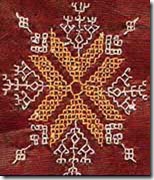
Kasuthi incorporates double running, squared stitches (DR done in squares or as tiered step diagonals); pattern darning; and cross stitches. Although it’s totally geometrical, and has strong associations with its counted thread origins, today’s Kasuthi is not always worked on a discernible even weave ground. It is occasionally done stitched freehand, on fine silk grounds, following markings. The following images have been shamelessly reposted from various sites – please click on them to be taken to their sources:


In a research paper shared by Jayashree, she and Anita Choudapurkar outline some early history of Kasuthi. Their findings are abstracted below.
Karnataka is an area on the west side of India, inland from the Goa region, and north of Mysore and Bangalore. The region famous for the stitching is closer to Goa than Bangalore. Persian influences were strong in this area’s Chalukyan empire, in the 7th century. Jayashree/Anita’s paper discusses the transmutation of these influences into the Kasuthi style, incorporating elements of ritual architecture, religious symbolism and ornament, and the style’s codification into a cherished folk tradition.
Like many traditional styles of ornament, Kasuthi motifs are conservatively interpreted over time, and “collectable,” in that they are recognizable, and often bear specific names and associations. An excellent collection of motifs is presented in the book Karnataki Kashida by Anita Chawadapurkar (yes, the same person who co-authored the paper above, spellings of transliterated names often vary), and Menaka Prakashan.

The only drawback of this magnificent little volume is that it is written in Marathi. I hope to find someone to read and translate parts of it for me, soon.
For the record, I bought my copy at a local Crosswords, which is Pune’s shopping mall bookstore, similar to a B. Dalton, or Barnes & Noble in the US and didn’t order from the hyperlinked site, above.
For your further delectation, on line collections of Kasuthi motifs and/or work samples can be found at
- IsisCat/Maya Heath
- Sarah’s Hand Embroidery Tutorials
- Mridula Nagarajan
- Indus Ladies
- Click Hubli.com
- Komal53
- Kasuti Tutorial
- Story of Kannadiga, Kannada and Karnata
Now, how does this style link in with Western blackwork? If I had to posit, I’d say that the northern Persian origin is highly plausible. A good many things spread through the same area during the rough time window cited by Jayashree’s paper: stirrups, and chess are two examples of this cultural and technological “bundle.” I would not be surprised to find that the Ur-ancestor of Kasuthi was part of that migration.
I suggest that the ancestor style made its way down to India, and over trade routes to the Levant and Egypt, where it informed other styles that persisted over long spans of time. For example, here’s an Egyptian snippet of the 13th to 16th century, in the collection of the Museum of Fine Arts, Boston. And here is my re-use of the pattern on a book cover:
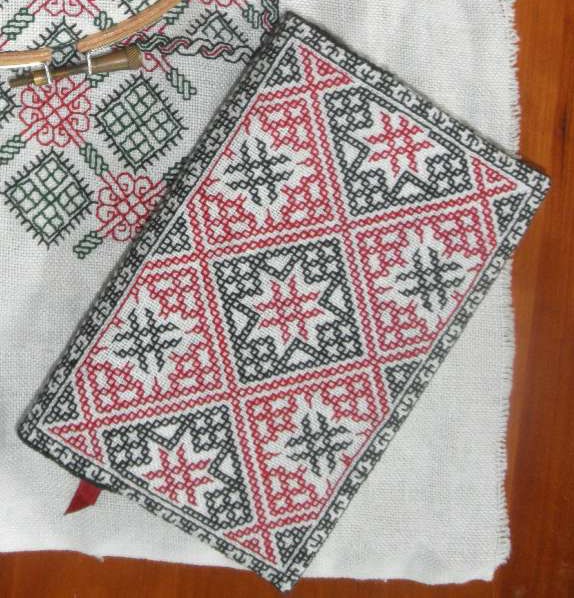
Aside: I stitched this while I was on my first trip to India. As I worked in the hotel lobby waiting for my car, two people asked me if I had taken a class in Kasuthi work, and whether I was in India to study it, since I was so obviously working on some.
From the eastern Mediterranean across North Africa, and up trade routes to the wreckage of Byzantium, across the Aegean – these are also established vectors of trade and cultural dissemination. I would not be surprised to find double running stitch traditions further east on the Silk Road, too.
After wandering the world paralleling conquest, trade, and the Islamic expansion, double running stitch hitchhiked into Britain, where it undoubtedly was already known. But it was “rebranded” as Spanish Stitch or Spanish Work – popularized through association with the Spanish princess and first bride of Henry VIII, Katherine of Aragon. We often know it under the name Holbein Stitch, named after the court painter who depicted it with exact detail on so many portraits.
So, after our own long wander – we see a possible pan-cultural spread of a stitching style, in which many now separately named types of embroidery have common roots. Would that people today recognize a similar fraternity of time and origin…
HISTORY THROUGH NEEDLEWORK
I was wandering through the free-for-public-use pictures collection recently opened up by the National Archive of the Netherlands, looking for interesting photos of needlework or knitting. “Merklap” is the Dutch word for sampler. Using it, I stumbled across these:


Clicking on each image above will bring you to the original archive site, complete with a very useful zoom feature for close inspection.
Now, from what I understand from the captions, these three unusual counted thread pieces were stitched by Her Majesty, Queen Ingrid of Denmark, consort to King Frederick IX of Denmark. The archives captions says that the three samplers bear images relevant to her life with her parents, King Gustav VI of Sweden, and Princess Margaret of Connaught, and the photos were collected in 1954 (One of the pieces bears a date of 11 November 1952.)
Queen Ingrid was born in 1910 and died in 2000. Reading through the bio snips available, she was an early feminist and thoroughly remarkable woman, widely respected for personal courage and support of the Danish people during the German occupation of Denmark during World War II.
Historical context aside, just look at those motifs! Worked in double running or back stitch, with the background done in cross stitch, the items shown are full of exquisite detail. That horse in the center of the second sampler is on my list for regraphing, for sure. I love the humor, the juxtaposition of high heraldry and honors with the totally mundane.
The first sampler bears Swedish heraldry (the three crowns), and honors her parents. The other two seem to be about her own life and interests, with her seal, and images of her education, sports and leisure activities; and pursuits including art, biology, horticulture (she redid many formal gardens), geology, and antiquities. How can you not be charmed by a Queen who stitches a box of spaghetti, fishing lures, a pilot’s wings, Canasta cards, and a cabin in the woods?
In short, Ingrid may have been a highly influential and important person, but these pieces now offered up to the public make an instant connection to her as an individual with curiosity, energy, and humor. I’ll seek out some better books on her life and times. And I’ll think of her the next time I have spaghetti with a salad, with candy canes (polka grisar) for dessert.
HALFWAY!
I had occasion to unroll the big green sampler last night in order to adjust the padding that was between the layers of previously stitched work. While it was out and open, I took some progress pix:


You can see that the entire piece spans the width of my dining room table. I’m more or less at the centermost strip, and at (more or less) the middle of that strip. The penny on the shot at the right will give you an idea of scale. I’m pleased with the density and patterning so far. I’m also pleased with the pulled background of the latest bit. But it is taking a VERY long time to stitch, and I’m looking forward to figuring out what will be next. Perhaps something in quick-to-finish double running, perhaps something a bit more geometric and very open. We’ll see!
In other news, I’m continuing to add both knitting and embroidery patterns to the patterns buttons at the top of the page. I’m going back through prior posts and standardizing formats, putting everything into convenient buckets for ready access. If you’ve got a request, let me know and I’ll bump it up in priority. Enjoy!
 String-Or-Nothing