UPDATES CONTINUE
Added several more rescued patterns from wiseNeedle to the Knitting Pattern link above, including:
- Firefighters’ Socks
- Impossible Socks
- Pine Tree Toe Up Socks
- Jelly Bean Toe Up Socks
- Ch’ullu Hat
- Knot-a-Hat Earwarmer Band
- Spring Lightning Lacy Scarf
Will continue to plug away. Reminder – please, if you are thinking of linking to these, please link to the source page rather than the individual PDF. I can’t guarantee that the PDF links won’t change.
KNITTING PATTERN PAGE UPDATED
Ported over patterns for
- Kombu Scarf
- Justin’s Octagon Crib Counterpane
- Mountain Laurel Crib Counterpane
- Kids’ “Chain Mail” Coif and Hauberk
- Simple Toe-Up Socks in Four Sizes
Click at “Knitting Patterns” link at top of this page to view.
Stay tuned! More are coming.
BABY HAT TO MATCH ANN KRECKEL’S BABY BOOTIES
UPDATE: THIS PATTERN IS NOW AVAILABLE IN AN EASY-TO-PRINT PDF FORMAT, AT THE KNITTING PATTERNS LINK, ABOVE.
Yes, it’s been dark here longer than usual at String. My life has not been my own, with raging work-related deadlines consuming every inch of me. But in spite of those, I had a special commission from The Resident Male. He asked me to do some baby knitting for a workpal of his, whose wife is expecting. So I whipped out my needles and made up a pair of standard booties, from the Ann Kreckel pattern I favor, and improvised a matching hat. I’ve posted about the booties many times before, including an illustrated tutorial.
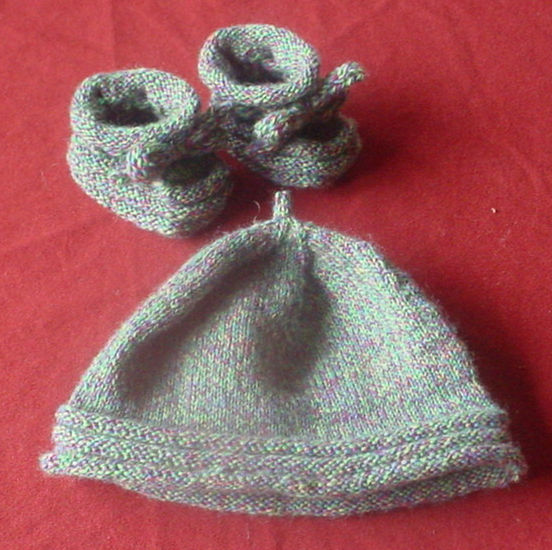
My matching hat is a simple beanie shape knit in the round, with three welts around the bottom edge to match the three welts that run around the sides of the stay-on bootie. I know that many other people enjoy making these booties, so I share the matching hat pattern here.
Baby Beanie to Match Jane’s Stay-On Booties
Materials:
50g fingering weight or sock yarn
1.5 mm (US #000) double pointed knitting needles (can be worked on 1 or two circs if preferred)
4 or 5 stitch markers
Tapestry needle for darning in ends
Gauge
9 stitches = 1 inch on 1.5mm needles
Finished dimensions
Measured across the opening, unstretched = approx. 7 inches
Notes
For the record, my hat is on the small side and should fit a petite newborn. I haven’t tried it yet, but using a 1.75mm (US #00) or a 2mm (US #0) at a slightly less extreme gauge should produce a hat for a larger newborn and 3 month size, respectively. If you want to work this at a standard gauge of 7 stitches per inch but end up with the same size hat as I made, cast on 100 stitches, and place your markers every 20 stitches. Follow the instructions as written EXCEPT that instead of following the (K23, K2tog), (K22, K2tog) or (K21,K2tog) directions instead ALWAYS knit until two stitches remain before your marker, then knit those two stitches together. I had plenty of yarn left over from my hat and booties from my one 50 gram skein of sock yarn, you shouldn’t run out even if you knit a larger hat or a hat at a less extreme gauge.
Directions
Using a very stretchy cast on (I used half-hitch) cast on 120 stitches and divide among your needles. If you are using one or more circs, mark the beginning of the row with a stitch marker for convenience.
Knit 12 rounds. Purl 4 rounds. Knit 4 rounds. Purl 4 rounds. At the end of this, counting the self-rolling bit of stockinette around the hat’s edge, you should have the appearance of three welts at the hat’s bottom edge.
Continue knitting until the hat measures 2.5 inches from the bottom. (Measure this with the curling edge curled. Don’t flatten it out.) On the next row knit 24 stitches, place a marker, then repeat. If you’re using DPNs, you’ll have 4 markers in your work, with the division point for the last one being the break between needles that aligns with the dangly cast-on end. If you’re using circs, you’ll have five markers in your work.
On the next round, (knit 23, K2tog). Do this five times total to complete out the round. Each decrease will occur JUST BEFORE a marker. Knit 4 rounds.
On the next round (knit 22, K2tog). Do this five times total to complete out the round. Knit 3 rounds.
On the next round (knit 21, K2tog). Do this five times total to complete out the round. Again each decrease will occur just before a marker. Knit 2 rounds.
On the next round knit to two stitches before the marker, then knit 2 tog. Do this five times total to complete out the round. Knit 1 round.
From here on in every round is the same – Knit until two stitches before a marker, knit those two stitches together. Repeat to complete out the round. Keep doing this until only five stitches remain on your needles. When only five stitches remain, work them I-Cord style for five rounds, then end off. Darn in both ends.
PATTERN – RED DIAMONDS BABY BLANKET
UPDATE: THIS PATTERN IS NOW AVAILABLE AS AN EASY TO PRINT PDF AT THE KNITTING PATTERNS LINK, ABOVE.
It’s finished and about to be mailed to the target recipient, so I can post my final pattern for this simple knit/purl texture, quick knit, lap size baby blanket.
RED DIAMONDS BABY BLANKET

Finished dimensions:
About 26.6″ x 36″
Materials:
Approximately 550 yards (about 500 meters) of a lofty wool/acrylic blend super bulky weight yarn, with a native gauge of 12 stitches and 18 rows to four inches. Washable is better.
One US size 10.5 circular needle at least 24 inches long.
Four stitch markers.
Tapestry needle for darning in ends.
Project Gauge:
Just over 2 stitches per inch in stockinette. (Approximate gauge is good enough on a blanket).
Method:
Cast on 77 total stitches but to make life easier when knitting the repeats cast on 5, place marker, cast on 22, place marker, cast on 22 place marker, cast on 23 place marker, cast on 5.
Slip the first stitch purlwise, then continue across the row in K1, P1 seed stitch; knit the last stitch of the row the back of the loop (In seed stitch you make a bumpy texture. If knitting in the flat, you knit every stitch that presents as a purl, and purl every stitch that presents as a knit. If you get ribbing you need to rip out your offending row and begin it again using a knit if you started with a purl or a purl if you started with a knit). Repeat this start-up row 7 times for a total of 8 rows of seed stitch. This will make a nice no-curl lower edge with a neat slip stitch selvedge.
Continuing in seed stitch pattern and making sure to continue the slip stitch selvedge, work seed stitch until you reach marker #1. Then work the white stitches in Row #1 of the following chart. On the final repeat just before the final marker, work the blue stitch in Row #1, then finish with seed stitch, continuing the established pattern of the lower edge.
Flip the work over. Remember that you’re going to be working the wrong side of the blanket and on this row (Row #2 of the chart) and all even side rows thereafter, you need to follow the WRONG SIDE directions for the chart. Again slip that first stitch, work seed to the first marker, now work the blue stitch on the chart (wrong side version), and continue across the chart Row #2. After the last marker finish the row out in seed stitch, knitting the final stitch of the row through the back of the loop.

Click on pix above for a larger version of the chart.)
Continue in this manner until you have worked four full vertical repeats of the chart.
Finish off the blanket with another 8 rows of seed stitch with slip stitch edges, and bind off loosely. Darn in all ends.
EYELET DETAIL
UPDATE: THIS SPOT MOTIF CAN BE FOUND AS AN EASY TO PRINT PDF AT THE KNITTING PATTERNS LINK ABOVE.
Return to knitting!
Here’s a minor detail from the chart I’m working now. It’s a six petal daisy eyelet, but cleverly done in the original to make a nicely defined motif. The German language note accompanying the chart had a notation about dropping one of the three YOs in each triple YO set, but it’s hard to tell the difference between a numeral one and a lower case l in the reproduction volume, so a bit of confusion ensued.
I’ve redacted this to modern notation, and graphed it with the motif centered as a stand-alone. This motif can be spotted all over a surface, placed willy nilly in other framing units, or can be used as either vertical or horizontal panel repeats. The chart contains evil gray no-stitch boxes. Ignore them when you are working. They’re just there to maintain logical presentation, and serve no other purpose. Click on the chart for a full size copy, but it’s rather large and may challenge folk with slow connections.

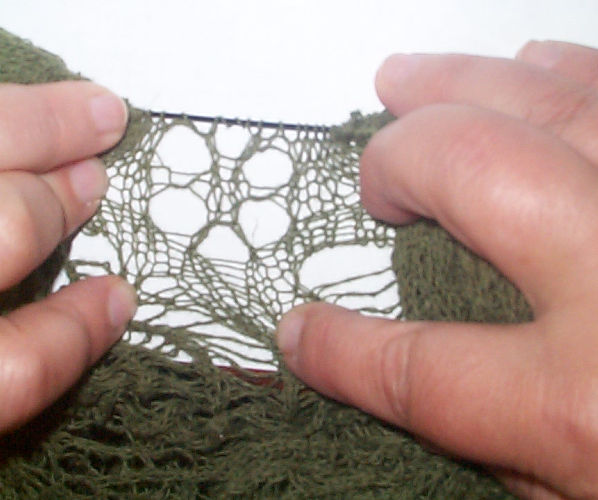
In any case, as you can see, I’m still plodding away on Olive Tablecloth…
DOUBLE DIAMOND EYELET INSERTION PANELS
UPDATE: THESE CHARTS ARE NOW AVAILABLE AS AN EASY TO PRINT PDF, UNDER THE KNITTING PATTERNS LINK, ABOVE.
As promised, and thanks to the Tofutsies sock recipient, here are pix of that pair. She’s a far better photographer than I’ll ever be, so for once shots on String have an element of clarity:
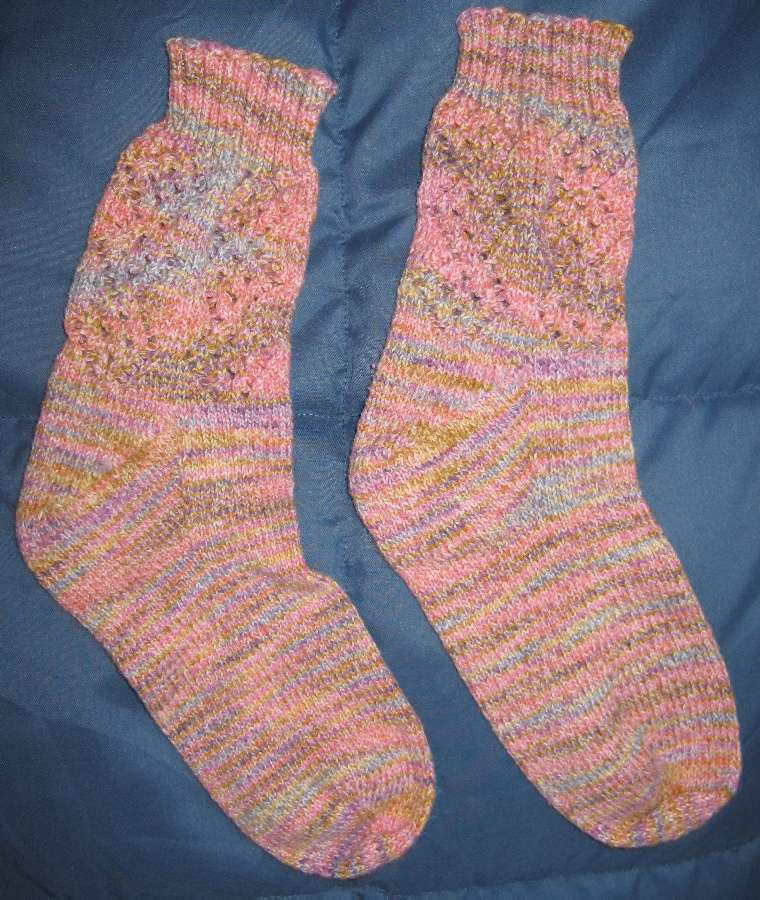
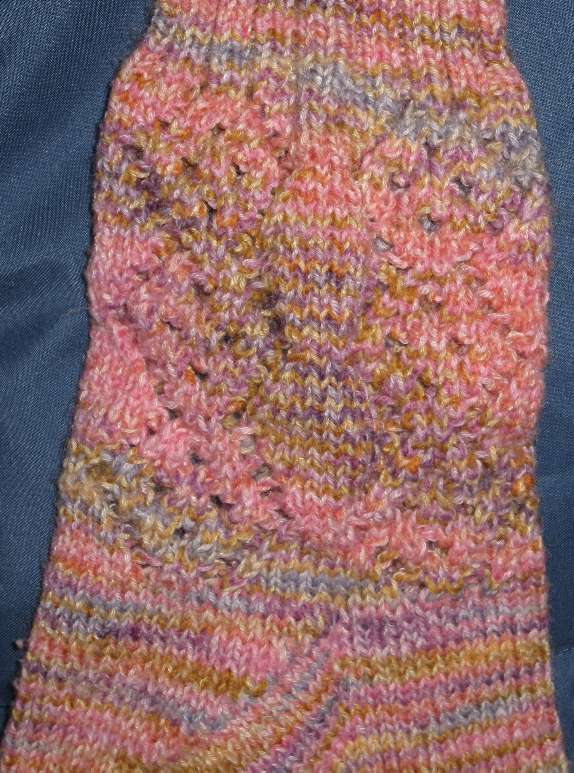

Thanks, Merlyn! You can actually make out the diamonds of eyelets. And thanks again to Kathryn for the Tofutsies yarn. (I feel especially enabled today.)
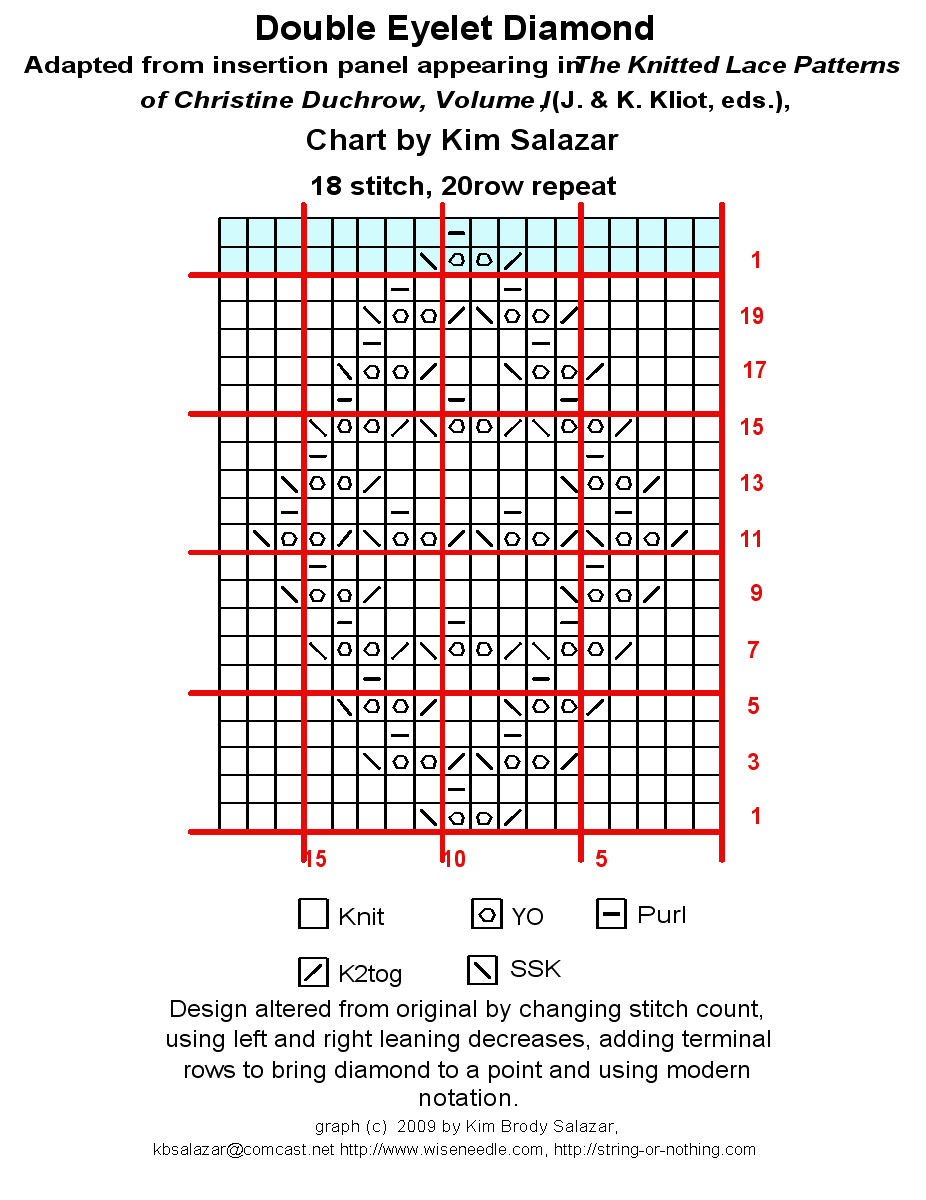
To make life easier for future reference, here’s the chart for the ankle pattern. It’s repeated four times around the sock, a convenient one panel per needle if you’re knitting with four needles holding 18 stitches each, or two circs with 36 each (a sock circumference of 72 stitches, the count for the largest gauge I knit for myself). This can also be worked as side by side panels of 16 stitches by eliminating columns 1 and 18 (a sock circumference of a more usual 64 stitches). The astute will be able to pick out from the excellent photo that I followed the pattern as presented in Duchrow, but my chart below offers up several modifications to the original:
Or if you’re adventurous, here’s my own riff on the same idea to make an argyle-like diamond studded all-over repeat – this time requiring a fixed multiple of 18 stitches (It can also be worked as a single panel of 18):
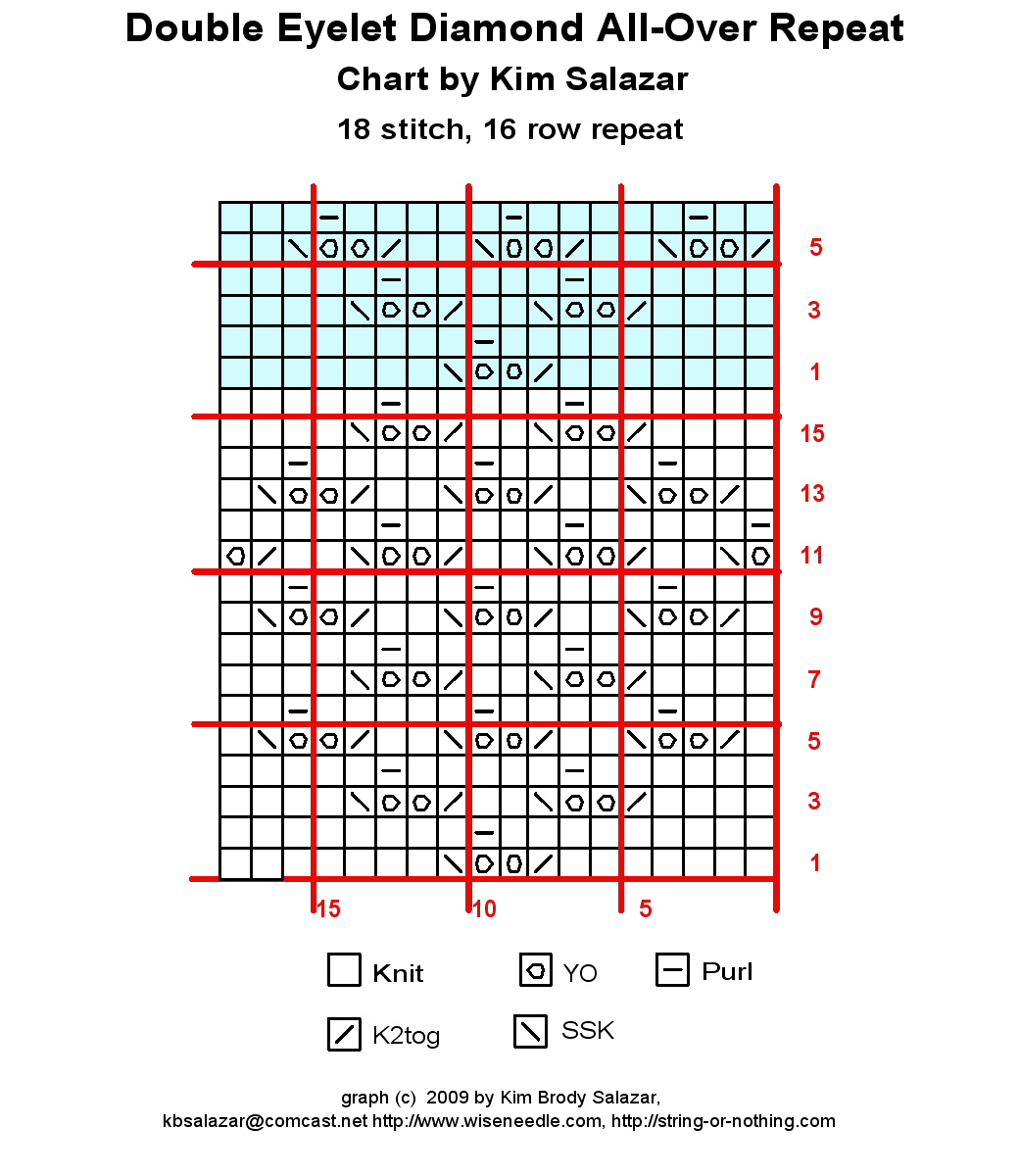
This adaptation is so blindingly obvious that it must be presented in other stitch sources. For example, without running to my library I am pretty sure that Walker presents a diamond of double YO eyelets in her second Treasury. Which is another way of saying that there’s little new in knitting, and most invention is more of a process of rediscovery than virgin creation.
BRAIN CRAMP OUTSIDE OF BOSTON
UPDATE: THIS TEXTURE DESIGN IS NOW AVAILABLE AS AN EASY TO PRINT PDF UNDER THE KNITTING PATTERNS LINK, ABOVE.
Here I am. Remember me?
As occasional readers here have noted before, extended periods between posts usually mean that my professional life has up and swallowed my personal life, and that I’m hard pressed by work-related deadlines. The past couple of months has been no exception. I will say that even though I get swamped, I do try to grab a little relaxation time, but when I do I usually stick to autopilot rather than challenging knitting.
Which is all a round about excuse for why nothing has been done on my Sempre pullover of late. I haven’t had time to sit down and draft out the fulll size mockup. I’ll get around to it, but not until after I decompress. In the mean time I’ve been sticking to nice, boring sock knitting.
Long Time Needlework Pal Kathryn surprised me with a nifty gift – two skeins of lively, variegated pink SWTC Tofutsies, a wool/cottom/soy silk/crab shell chitin fingering weight yarn. I was pleasantly surprised by the Tofutsies. I’m not a fan of cotton sock yarns, and usually stick to all wool or wool/nylon. To me cotton is unstretchy to knit, and both clammy and pebbly underfoot. Not so the Tofutsies. It knits up nice and soft, not pebbly at all. It is however not as stretchy as wool – sort of somewhere in between wool and cotton in total stretch. Because I favor toe-ups with short row heels which rely heavily on total stretch for their ankle to instep fit, I was hesitant to use the Tofutsies for my standard issue sock. Instead I adapted Wendy’s toe up gusset heel for my stitch count. It worked perfectly, making a sock with more than enough depth and with for comfortable fit, even with the un-stretchy yarn. For the decorative ankle part, I adapted yet another one of the simplest double yarn over eyelet insertion strips from Duchrow, Vol. 1. This one featured diamonds of eyelets, embedded in an 18 stitch repeat. I wish I had pix, but I gave the pair to a pal who was thirsty for warm socks in a sprightly, spring pink. She has promised to take some snaps though which I will eventually post.
And for those who are dying to ask, no. This yarn does not smell like crab shells. If anything, it smells like cotton yarn, not wool yarn, even though it has twice as much wool in it as it does cotton.
My Tofutsies pair was a super-quick knit, so I started a second pair of socks out of another sock yarn new to my stash. This time it was Berroco Sox, in color #1425 (called John Moores on the B. website, and from the grouping named after the UK entrepreneur or Liverpool-based university, not the US baseball team owner), working my standard toe-up with short-rowed heel. I like this yarn. Although I did find one knot in the skein, the rest of the thing was comparable in feel and gauge to Regia or Fortissima. Very nice, indeed. Especially considering that it was slightly less expensive than those Euro-labels. (The yarn itself is imported.)
The color run repeated roughly twice between toe and heel for me, and with each stripe being very shallow and the color patterning being hard to discern in skein, was fun to watch build. You can’t really see it in the standard issue lousy String pix below, but I knit the feet smooth and introduced an ultra simple diagonal lacy detail on the ankle:
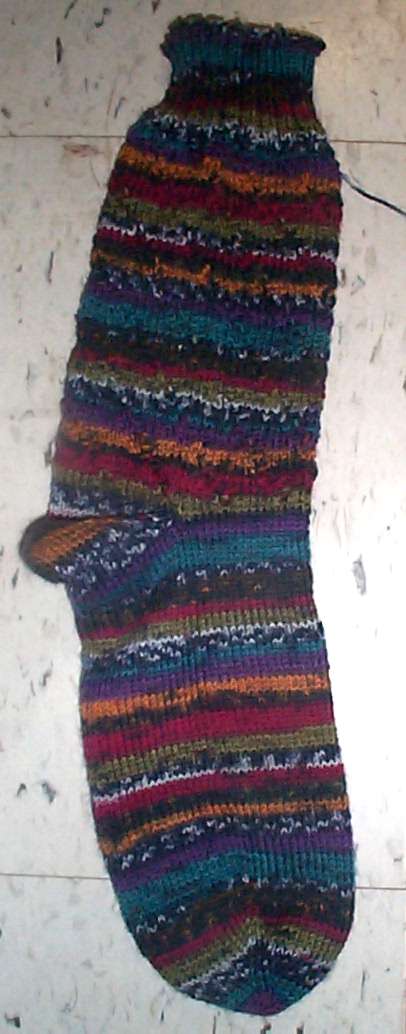
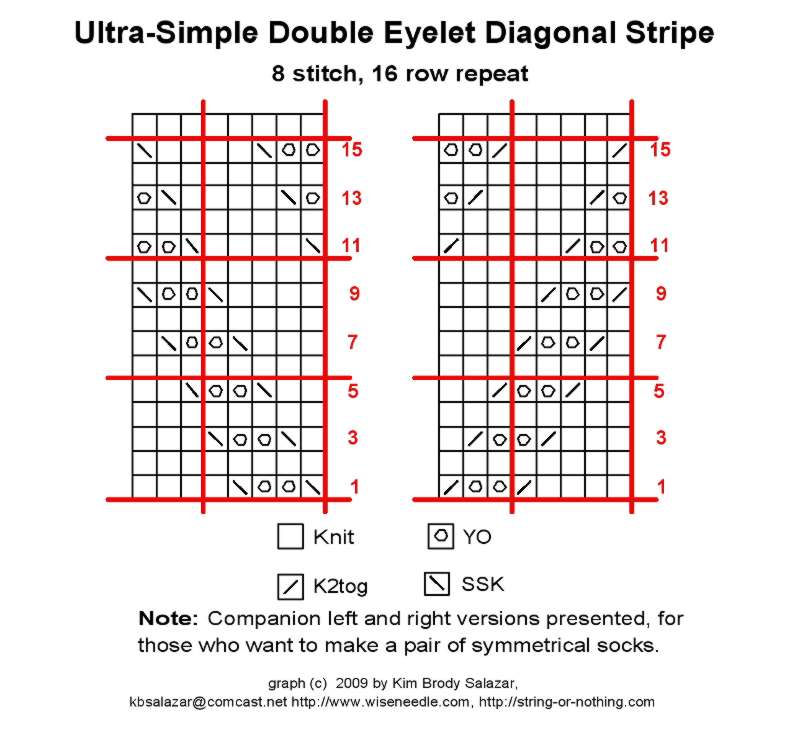
It’s a simple double yarn over diagonal, done on an 8 stitch repeat (my socks are usually 72 or 80 stitches around). The idea was to leave enough solid to let the color repeat play, but keep me from dying of boredom knitting miles of plain stockinette. Here’s left and right hand varinants of the thing, just in case you want to make a pair of complementary socks, too:
MINT BLANKET TUTORIAL – PATTERN CHOICE AND FINISHED SIZE
In the last post we considered yarn choice and needle choice. Now on to pattern choice and rough dimensions.
The whole point of this small baby blanket (or lap blanket, or pet blanket) project is to try out some new technique or knitting approach in a low-stress project that produces a useful result, and that doesn’t take a ton of time to finish. Because both sides will be visible and the curling inherent in stockinette isn’t desirable, it’s a great place to try out texture patterns, provided there’s a suitable balance between knits and purls – especially in the edge-most two or so inches all the way around. Working a two or three inch border of garter stitch or moss stitch all the way around is a standard approach to fighting curl that results in a pleasing frame around whatever center patterning is chosen. But I’m in the mood to be a bit more adventurous, and to encourage folk to try some lacy knitting and a knit-on border, even if they’ve never done either before, so I’m going to use a lacy knitting pattern with a garter ground. The whole blanket will be in garter stitch, pierced by eyelets, so curling won’t be a problem and the thing will look (mostly) identical on both sides.
On to pattern selection. If we’re going to work the blanket back and forth as one unit, the easiest thing to incorporate is an insertion strip or pattern panel, rather than a large spot motif that needs to be centered north/south. An insertion strip can be begun and worked until the desired length is accomplished. Sometimes there may be a logical endpoint so that the insertion’s larger motifs display in whole units, but for the most part, strips are easy to place with minimal calculation.
There are tons of lacy strip and panel patterns out there. Some are right here on String and wiseNeedle (hit the Patterns link at the right), but there are lots of excellent choices out there in pattern treasury books and on line, written up as stand alone designs and as part of larger patterns to produce other finished objects. Feel free to pick something you like.
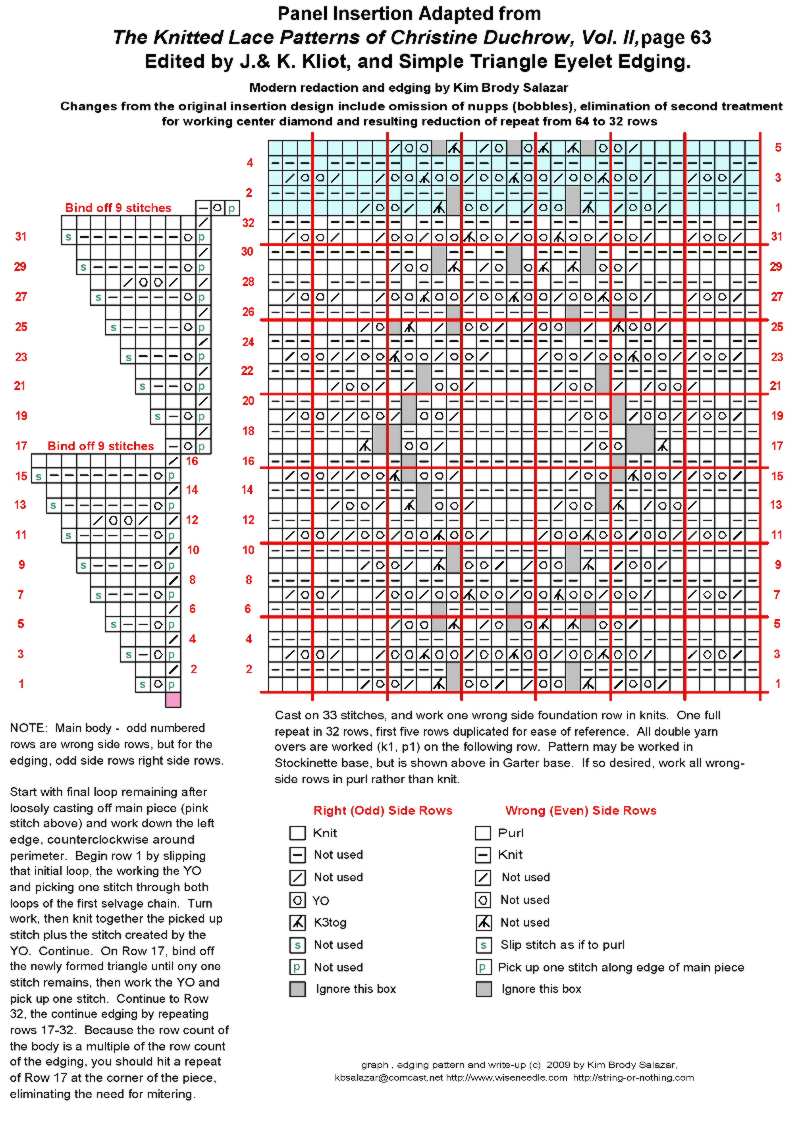
I’ve chosen a 33 stitch wide lace insertion panel – yet another design from Duchrow V. II. Here’s a simplified version of the design in modern notation (the original that I’m following is a 64 row repeat, and features two different treatments for the large center diamond area) plus some bobble-like nupps. I worked the original, so you’ll see some differences between my finished item and results from the chart below (caution – it’s a big file):
Now how to take a repeat and stuff it onto a blanket?
Easy. Even without doing a gauge swatch, we can make a rough guesstimate of project width. Remember – our blanket only has to hit a window of “usable size.” That gives us lots of wiggle room. I know that in plain garter stitch with lots of eyelets, I’m likely to get about 4 stitches per inch at the absolute most in a worsted yarn using size 8 needles. I know this because I know that using 7s, I usually hit 5 stitches per inch on the dot. Garter on bigger needles is likely to make a slightly looser fabric, so I estimate 4 spi just for the garter. But my chosen design has lots of eyelets. Because of the airy looseness that heavy use of eyelets produces, my end product will in all probability be a tad wider than this estimate. Since precision is optional here, I’m going to wing it but base my calculations on the 4 spi figure.
33 stitches at 4 spi works out to about 8.25 stitches across my panel. I could center one panel on my blanket, but I think that two panels might look nicer. Two repeats will cover 16.5 inches. (Any result over 21 inches before adding an edging would be workable.) Two repeats of my panel would eat 16.5, leaving 4.5 inches to eke out to hit my goal – about 18 stitches at my gauge. If I want to place two panels on a piece that’s roughly 21 inches across (before adding an edging), that means I’ll have to put some of these stitches in a band between the two panels, and some along the left and right sides:

I could put those extra stitches anywhere, on one edge to make an asymmetrical layout, all down the center, or I could distribute them differently, with fewer between the panels and more on the outside edge (or vice versa). I chose to divide them in half, placing half down the center, and splitting the remainder along the right and left edges. When you compose your blanket, you can do whatever you wish. And that includes using more than one texture or lacy pattern to make up your width.
So now we’ve leapt off the pier into the deep water of design and have violated most of knitting’s “must do” rules. We’re starting an original project with only the vaguest notion of yarn quantities, no precise grasp of gauge, and the barest nod to final dimension. But we are serene, none the less.
The next step is casting on and knitting. For this you’ll need yarn, needles, and enough markers to indicate the beginning and end of each section (see diagram above). I find it very useful to mark the first transition point on my right side row with a marker of special color, size or other easily recognizable appearance. It’s very easy to lose track of what side is being worked in garter stitch. Having the quick visual clue of “distinctive marker = beginning right side row” is a big help.
LOG CABIN BLANKET EDGING
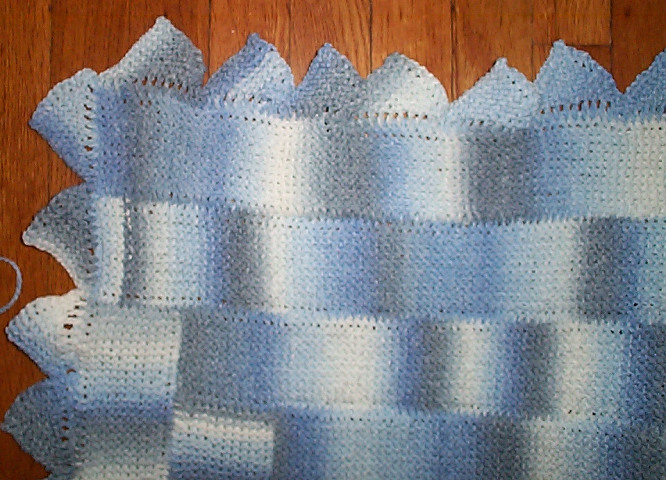
Moving on with the modular log cabin baby blanket, I decided to take the center square and finish it off as a rectangle, in order to end up with a more usable object. Due to yarn quantity constraints this is a small basket/car seat size blanket – not a crib size throw. It measured about 20.25″ x 31.5″ before I began adding the simple edge triangles. It’s a bit smaller than the blankets I made recently however I’m not worried. I found with my own kids that small blankets were supremely useful for traveling and naps, and were indispensable parts of the lug-around baby support kit.
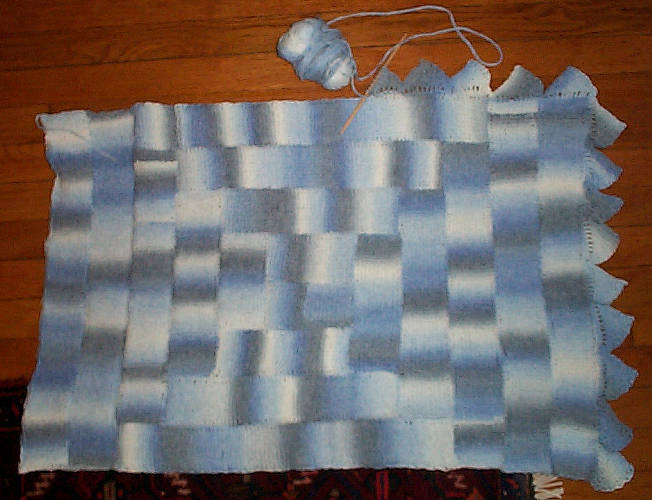
I started with 10 balls of the Batika. I’m working from the ninth right now, and will probably dip into the last one. If I have enough, I’ll make a hat to match from the last ball.
Again, the blues are a bit boring, but I really like the way the strips play with this yarn’s shading. I mixed starting at the center and the outside of my yarn balls, to magnify the helter-skelter effect. I also tried to minimize ends. I was able to join yarn throughout by taking a needle and threading the new strand through the center of this chainette for a couple of inches, then tugging the new strand until its end was completely buried in the center of the working strand.
When I worked the final two non-circumference strips at left and right, to avoid having to cut the yarn and begin again, I worked the outermost strips picking up my attachment points purlwise instead of knitwise, to keep all the “seams” on the reverse. I will have only four ends total to darn in at completion: my cast-on end, the cast-off end on the outermost strip at the left, and the end resulting from rejoining the yarn to make the two final strips on the right. I even started my edging at the bind off point for the final right-most strip, and began my edging without breaking off the yarn. Every other end is already buried.
The edging is super simple. There’s no point in doing anything fancy with the garter stitch texture and the native shading of this yarn. I used the same pull the loop through attachment method I used on all of the strips. About the only thing I did that was in the slightest bit creative was to move the increase point from the outermost stitch of my triangles to the inside attachment edge. I did this in order to keep the edges of the triangles firm and to avoid little baby finger trapping loops.
Because my blanket is made up of garter stitch strips that are 12 stitches wide by 12 ridges, I know for a fact that all of my edges will be multiples of 12. Therefore I’m working a simple edging that is also a multiple of 12. Doing so guarantees that I can avoid working complex corners or mitering. I begin and end each side at Row 1 of my edging, with one stitch on the needle. (If need be and the count of a side is off, I can fudge a stitch or two provided I spread any fudge points out and work them an inch or two before the corner). Super simple.
I’m not done with this concept. I plan to do another piece with a long-repeat yarn. Unfortunately my budget right now constrains me to work from stash for a while, so splurges on blanket quantities of Noro or other similarly demonstrative wild color yarns will have to wait.
Simple Garter Triangles Edging
Multiple of 12 rows
Cast on 1.
Row 1: With right side of your main item facing, pull a 12 inch long loop through the edge-most stitch of the item to be trimmed. Using the loop yarn turn the work over, then YO, K1. (You now have 2 stitches on the needle).
Row 2: Slip the first stitch purlwise, K1. Grab the yarn strand going back to the ball and pull the excess length of the loop to the back of the work, drawing the edging snugly up to the item to be edged, but taking care not to collapse the little “bride” (twisted threads) that will eventually form an arcade of eyelets between the main piece and the edging.
Row 3: Draw another working loop through the next stitch of the main piece. Turn the work over, YO, K2. (You now have 3 stitches on the needle)
Row 4: Slip one purlwise, K2, snug up excess loop length.
Row 5: Draw another working loop through the next stitch of the main piece. Turn the work over, YO K3. (You now have 4 stitches on the needle)
Row 6: Slip one purlwise K3, snug up excess loop length).
Continue rows 7-11 in this manner until you have 12 stitches on your needle, ending after finishing row 11.
Row 12: Bind off 11 stitches. You should have only one stitch left on your needle.
Repeat rows 1-12 as desired.
LOG CABIN MODULAR BLANKET WORKING METHOD AND CROCHETING ON
First, in answer to a question about how to draw up a loop, I do a normal pick-up one into one chain selvage (or bind off, or cast on) stitch, then I grab it and pull more yarn through, distending the newly made stitch until I’ve pulled a foot or more of yarn through. Once I’ve got the giant loop, I use it to knit the next two rows. When I’ve finished the two rows I grab the strand leading back to the ball and give it a firm tug to pull any left-over yarn back out of the loop, and to snick the newly knit piece up closely to the existing work. Here you see the loop being pulled through prior to knitting with it:

After much trial and error, I’ve hit on the best way to cast on for the strips in my modular knit Log Cabin Baby Blanket. (Wish I’d looked at yesterday’s comments before all that fiddling and seen Karen’s suggestion). Crocheting onto a knitting needle, like I do when I start off the waste chain for a provisional cast on, works nicely. It produces an even chain type edge, analogous to the strip’s bind off and chain selvage edges. I’ve described crocheting on before, but here’s another swag at it.
In the snap below I’ve stuck my crochet hook into the final stitch remaining after I’ve cast off the stitches on the last strip. I’m holding the working yarn BEHIND the target knitting needle, and I’m reaching OVER the needle with the crochet hook

I’m grabbing the working strand with the crochet hook and am about to pull the just-grabbed strand through the existing stitch (in effect, I’m making a crochet slip stitch).

Ignoring the errant strand of Smaller Daughter’s hair in the shot above, what we wind up with is a stitch on the knitting needle. I’ve moved the working strand to the back of the knitting needle again, and am poised to make another.
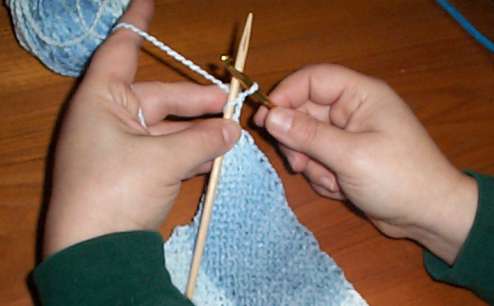
Crocheting on works especially nicely for provisional cast-ons. Instead of crocheting a long chain THEN fiddling with the bumps on the back of the chain, trying to pick them up, this method produces the chain edge and mounts the stitches in one step. It’s one of the core techniques I teach in my occasional “Crocheting for Knitters” workshop.
As you can see, my blanket is growing. According to the logic diagram, I’m in the middle of unit #7:


Finally, here’s the working method. It’s not a pattern because I am not giving yardage estimates, gauge or dimension. These log cabin blocks can be made to any size and assembled like a standard patchwork quilt, or the working logic can be used to make a larger object as a single square. For the record, I’m using Austermann Batika Color, a bulky weight yarn with a native gauge of 4 stitches per inch in stockinette, on 6mm needles. I’m getting roughly 4 stitches per inch and four garter ridges per inch in garter stitch on US #9s (5.25mm). My initial square was about 3×3 inches (roughly 7.6cm), and all my subsequent strips are about 3 inches wide.
The best way to join ends of Batkia when starting a new ball is to thread the new strand into a standard tapestry needle and stitch it through the center of the chainette for about 2 inches, like feeding an one eel to another. Once the doubled length has been knit, any flapping ends can be trimmed back without fear of raveling.
Working Method for Modular Log Cabin Square
First square:
Cast on 12 using crocheting on.
Row 1: Slip the first stitch purlwise, knit 10, k1b.
Repeat Row 1 until you form a square of garter stitch. In all probability there will be 12 chain selvage edge loops running up both sides of the square. Cast off 11. One stitch should remain. Do not break yarn.
Strips:
Using the last remaining loop, crochet on 12 stitches.
Row 1: Slip the first stitch purlwise, knit 10, k1b. Draw a loop through the first available chain selvage stitch on the previous square or strip (it will be the edge to the left of the new strip’s attachment point). Enlarge this loop until it’s big enough to knit with. Turn the work over.
Row 2: Pulling the loop tight and making sure you’re knitting with the anchored side rather than the side that runs free back to your ball of yarn, knit 11, k1b. Turn the work over.
Row 3: Slip the first stitch purlwise, knit 10, k1b.
Repeat Rows 2 and 3 until your new strip runs the whole width of your piece. The first time you do this, it will be a square of 12 stitches x 12 garter ridges. The second strip will be a rectangle of 12 stitches x 24 garter ridges and will run across the top of the first two squares.
Next row: Cast off 11. One stitch should remain. Do not break yarn.
Repeat the strip directions, always adding strips counterclockwise around the perimeter of the piece, with each strip running the full length of the available side.
 String-Or-Nothing