PAISLEY EDGING
After much noodling, doodling, and swatching, here’s the result. I didn’t bother taking photos of every generation of interim swatches. All that rejection is just too depressing. I’m using the tail end off the outside of my yarn ball to work my experiments. Since I need to be frugal, I’ve been ripping back the rejects as I go.
One important thing to note is the difference in the quad eyelet motif. I thought about it some more as I sat in traffic during yesterday morning’s commute. In the shawl body, that motif is presented in plain old north-south orientation, with the rows running horizontally. The motif spans six rows and begins with a single eyelet on the first. In the edging, the repeat is presented on the bias. The motif wouldn’t show in the same orientation. Plus the extra stitches added to form the repeat skew the stitch count. Therefore working the repeat as shown yesterday would not make a quad-eyelet design comparable to the one in the body. If stitch placement were adjusted, it would make a square of eyelets instead of a diamond. Unadjusted as is, it would make a snaky looking blob of eyelets.
Sure enough, by the time I was finally able to swatch tonight that all became painfully obvious. So I began playing. If you look at the body at a 45-degree angle, the eyelets appear as two stacked groups of two. If I were to work them that way perhaps when the edging was viewed in its natural orientation, the eyelets would resemble the ones in the body.
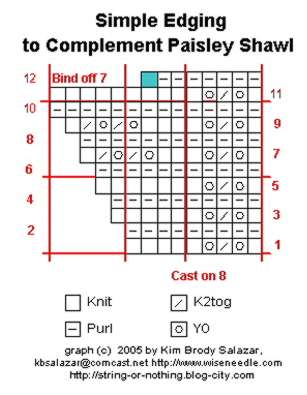
Again, sure enough it worked exactly that way. Working two right side rows with (YO, K2tog)2x produced the proper appearance. But then I had the problem of where to place that repeating unit. How close could I put it to the right hand YO columns before it lost its integrity? On which two right side rows should the unit be worked?
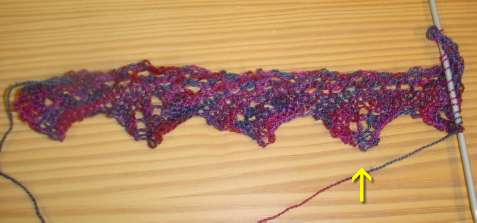
You guessed it. More swatching. You can see some of my spurious results here, with the last complete dag (marked with the arrow) being the one with the most optimal placement:
And here’s the final graph.
Now to go back to the shawl and begin to work the thing onto the live stitches around the edge. More on that tomorrow, guaranteed!
PERSEVERE!
My older daughter is new to knitting. She just began at the Boston Knit Out this past fall. So far she’s done several foofy garter scarves for herself and her friends (first lesson in casting on and the knit stitch); a 42-stitch hat (using DPNs to knit in the round, decreases); and a felted bag (more reinforcement of knitting in the round, plus making a larger project, and I-cord, and picking up along an edge).
You’ll notice that all of her finished items were all-knit/big yarn projects. She wanted to “graduate” from all-knit and learn purling. She also wanted to use smaller needles. So we talked it over, and she suggested doing a pair of ribbed fingerless mitts. In fingering weight yarn. On US #0s. Without a pattern.
Now, did I tell her that many adults break out in prickly heat at the thought of using DPNs, let alone size #0s? Or that a 56-stitch around wristlet can contain as many stitches as an entire big-needle sweater? Or that I’ve seen grown women cry when someone suggests they knit (gasp) without a pattern?
Naah. What she didn’t know couldn’t daunt her.
So she cast on and began knitting. And knitting. And knitting. She plugged away at her mitts every evening after homework, while we (as a family) played video games. At first, being new to purling, her stitches were loose and wobbly, with ladders in the corners between the DPNs. But practice soon took care of that:
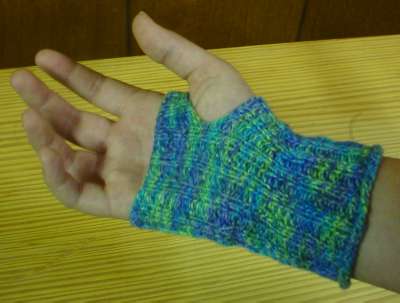
For everyone who has ever said to me, “I tried DPNs but I couldn’t manage them,” or “It takes too long to learn something new,” I present her learning progression. She worked the bottom one first, then the top one, both using the same yaran, stitch count and needles. You can see how her gauge, stitch accuracy and general neatness improved steadily throughout the project.

Sure, one’s bigger than the other, but both are wearable, and she does wear them proudly.
Knitting takes time to learn – there’s no getting out of that fact. Some people DO learn faster than others, but everyone who wants to learn IS capable of doing so. The key is practice. Unfortunately practice is a dirty word in today’s instant-dissolve, short attention span world.
Not satisfied with how something is turning out? Keep at it. Do something small and inconsequential that uses the same skills. Work out the kinks and bugs on the practice piece rather than the luxe yarn you chose for your “real” project. But keep going. You CAN do it. As the Target Child says “No stinking piece of string was going to defeat me!”
Here’s her pattern. (She?thinks her fingerless mitts look like the disc-shooting zapper gauntlets worn by a character in one of her favorite PS2 games).
Zapper Gauntlets
About 150 yards or so of a smooth non-itchy fingering weight sock yarn. This pair was knit in some remnants of On Line Linie 6 Supersocke 100 Cotton, but any sock yarn will do.
5 DPNs, Size US #0 (2mm)
Gauge: Approximately 9 stitches = 1 inch (2.5cm), measured over K2, P2 ribbing.
Cast on 56 stitches (14 stitches per needle). Join to continue working in the round. Knit six rows. Change to K2, P2 rib and work until piece measures approximately 4 inches long (10cm).
At the beginning of the next round, bind off 10 stitches. Continue working around wristlet. You should have one needle with 4 stitches on it, then three needles each with 14 stitches. When you get to the hole created by the bind-off, flip the work over and head back in the other direction. Work five more rows of K2, P2 rib this way – flat, ending at the right side of the growing thumb hole.
On the next row we return to knitting in the round. Start Needle #1 by casting on 10 stitches (all needles should have 14 stitches again). Continue in established K2, P2 ribbing pattern, working in the round until piece measures approximately 1 inch (2.5cm) measured from cast-on row above thumb opening. Bind off loosely in pattern, and darn in all ends.
That’s it!
(More in the cast-on series next week, I promise. Looking up all those links is more work than I have time for right now mid-deadline.)
ROGUE – PROGRESS; SOCK CLASS
UPDATE: FLEUR DE LYS DESIGN BELOW HAS BEEN ADDED TO THE PDF COLLECTION UNDER THE EMBROIDERY PATTERNS LINK, ABOVE.
Well, I did make some progress on Rogue over the past several days. I’ve finally gotten past the grief of the pocket (my fault); finished the equivalent depth of the body behind the pocket, and fused the two together.

Here you see the area adjacent to the nifty pretzel-terminated side panel, showing off the contrast between that knotwork design and the Little Dragon Skin patterning.
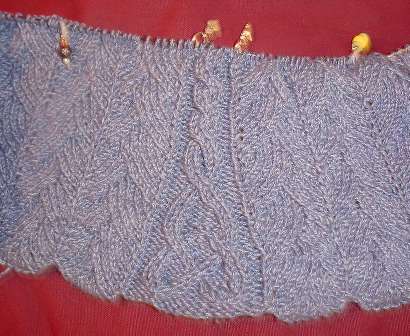
The pocket fusing step went off without a hitch. I remembered to bind off four stitches of the body at either side of the pocket fusing row, again to leave a notch inside which the zipper will be installed. Here’s a process shot, with the pocket stitches held on the pink needle, and the body on the silver circ. Because my right-side rows have so much shaping, I made sure to do the fusing on a wrong-side row – all purls in the patterned part.

Progress however has been somewhat less than it might have been because I’ve gotten two new needlework assignments since Thursday.
First, my mother has asked me to design a needlepoint pillow top for her that incorporates multiple Fleur de Lys motifs in wine, an off white background, and some sort of framing mechanism. She’s looking to make a piece on 16-count canvas. This is pretty much a “bring me a rock” assignment (one of those in which your efforts are greeted by the response “Wrong rock. Try again.”) Here’s my first attempt at just a single motif:

The second was a last-minute request from Wild & Woolly in Lexington, MA to cover a class in sock making. They has a workshop scheduled for March 20th that covers cuff-down socks on two circs and one oversized circ (aka “Magic Loop”), and the original instructor has had a last-minute conflict. I’m the designated hitter for this one. Which means that because my own favored method for socks is toe-up on DPNs, I have to do a bit of brushing up before I can demo and explain those methods to others. If you’ve signed up for this class, please don’t worry. I guarantee that in two weeks I’ll be fully confident in the material to be covered.
ROGUES WITH DRAGON SKIN
Having finally gotten my act together what with swatching, recalculating, and general pointless noodling, I’m embarking on the highly modified Rogue. As ten thousand others have noted, it’s a very completely written out pattern for a pocket front hoodie, by Girl from Auntie’s Jenna. I really like the organic way she has used closed form cables to highlight the piece, and how those shaped cables narrow and widen. Killer!
In spite of the beauty of the native version, I am trying to satisfy specifications issued by a child in The Picky Years, so modifications are necessary:
- Gauge. Target child has picked out a yarn that knits at 5 spi instead of the pattern’s 4.5. Math will be needed.
- Fiber. Nice springy wool works best and is easiest to use for cables, but the chosen yarn is 100% cotton. I’ve done complex cabling in cotton before. I’ll cope.
- Zip front. I won’t be the first to modify this and make a cardigan. The pattern’s own home page provides hints on cardigan-ization. I’ll be leaning on them.
- Texture for body. Kiddo is in love with the Dragon Skin all-over pattern (Walker II, p. 136). While I prefer the contrast between the smooth body and dense cables of the original, she’s set on my using the design. Unfortunately, the design as presented by Walker needs 26 stitches to manifest nicely. A bit wider than is convenient for this pattern.
So to start. How to start?
First I bought the pattern. (Always a good thing, as “sharing copies” is a pernicious, evil, illegal but all too often seen antisocial behavior).
Knowing that the Dragon Skin pattern in the original was too wide. I began to play with it, and eventually trimmed it down somewhat. Here’s the result:
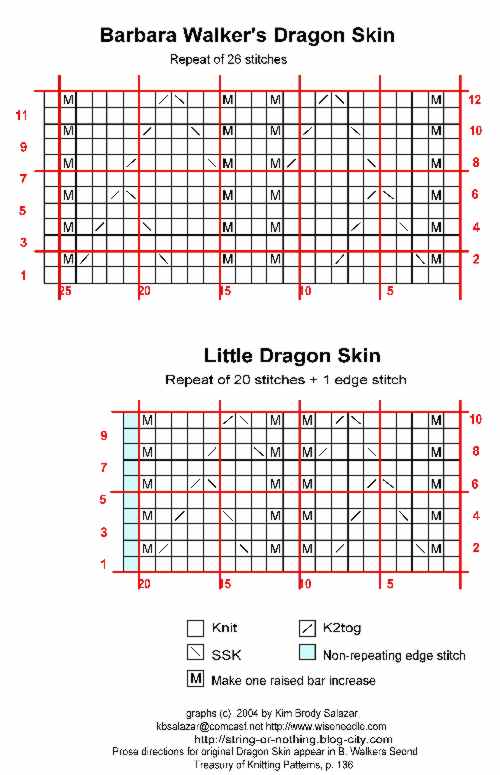
The original is definitely nicer, with wider vertical elements, but the slimmed down version is quite usable and recognizable as the other’s little brother. I’m still dithering whether or not to do the single stitch knit column between the make-ones as a normal or twisted knit stitch.
I swatched my yarn and established an unambiguous gauge for the stuff in my dragon skin patterns. I got a firm 5 stitches per inch total. Not the 4.5 spi the pattern specifies.
What to do?
First I looked at the size appropriate for Target Daughter in the original. Then I looked at the stitch counts of the next two larger sizes. I did the math to see if at 5 stitches per inch, they came anywhere near the circumference of the optimal original size. Serendipity! One did. I am using that size as the basis for all my stitch count estimations. I’ll use that size’s stitch count directions for anything relating to width, but will use the original size’s directions for length. Yes, I’m sure there will be fudging along the way, especially to eke out vertical repeats so that the cables up the side finish nicely, but I don’t think that those tweaks will be too difficult.
Can you take any pattern and do this? Yes and no. It’s relatively easy to translate between Worsted and DK (5 and 5.5spi) and Aran and Worsted (4.5 and 5spi), but harder to make this translation for larger gauge differences. Plus patterns that rely on row gauge like colorwork, or raglan shaping present additional challenges. It’s also easier to do this if you are not at either end of the range of sizes presented. If you already take the largest size in a pattern written for Aran weight yarn, and you wish to use Worsted, there aren’t any sizes left with higher stitch counts for you to play with. (If you were going the other way – you were faced with a Worsted weight 5 spi pattern that was just a tad too small – you might be able to eke out an additional size or two by using Aran weight yarn at 4.5 spi instead.)
I’ve got my basic stitch count now, adjusted for my finer gauge. The next mod is the cardigan one. The advice worked out by others suggests adding an extra stitch to the front and back so that the total stitch count can be divided by two, creating the center front break. I’m going to add three to the front, but two to the back. My width is just a bit skimpy, and I have a feeling that I’d like an extra selvedge stitch in the center front when zipper sewing and I-cord trim time comes. I’m adding one fewer stitches to the back because my new texture design has a center stitch, and I want it run down the center of the back.
The next step is to cast on. I’ll be working my Rogue back and forth rather than in the round (a loss there, I’d much prefer to work it in the round, but steeking would kill the elegance of the cables at the neckline). I note that the thing is written with a hem instead of ribbing. I like that for this cotton. Working it on smaller needles as directed should tame edge flare. Since I prefer a smooth finish inside when using a hem facing, I am using a provisional cast on – the same crocheted onto the needle one I used for Crazy Raglan. Using needles three sizes smaller than my body needles, I cast on the specified number of stitches for my chosen (larger) size, plus five more (three front, two back), and began knitting the facing.
On my first row of the facing, I decided to spot the left and right side areas in which the cable detail will happen. I did the count, figuring out which stitch will be the center sidemost stitch left and right, then counted out the required number for the first row of the cable detail chart, centered on those two stitches. I put markers in my work and left them there. While I’m not up to the post-facing bit yet, I can use the facing rows to re-count and confirm my marker placement. By the time I’m up to the first row of the main body, I should be 100% confident that those markers are in the correct places.
Next headache? Centering the Dragon Skin texture pattern repeat. On the back, I’ll identify the centermost stitch. That will be stitch #11 on my chart above. I’ll count back from that point, and begin my pattern panel on the appropriate stitch. On the fronts, I’ll also plan out from the center, working one plain stitch, then walking backwards from Stitch #21 to figure out where I have to begin my left front; and doing one plain knit then walking forward from Stitch #1 to place the pattern on the right front. One thing to take into consideration – to maintain a stable stitch count there must be an equal number of increases and decreases per row. Because the width of the back and front panels will require that I truncate the repeats, I’ll have to make sure to maintain that stitch count by fudging if that truncation cuts into an increase/decrease pair. I’m hoping that by happy coincidence, I’ll be able to work the pocket openings into the verticals naturally created in the Dragon Skin texture pattern. THAT would be nifty!
Now all that remains is to plug away at the knitting part. Like with all pattern manipulations, there’s no guarantee that my doing this will work out. I’m willing to wing it. By the time I get half-way up the body I’ll have a good idea whether or not finishing IS a good idea. If not – I’ll rip back and design something from scratch. (If you’ve read this far and noticed that I’ve screwed up my logic, please feel free to leave a comment and let me know.)
One final note – for those of you who are wondering how I can slap a copyright notice on a texture design from Walker – I am not copyrighting the pattern. She owns her prose write-up of the thing. I am asserting ownership of only my graphed representation. Have fun. Use it and other patterns shared here for your own knitting; but please do not repost or republish them without my permission.
MANY HAPPY RETURNS – NIGHT AND DAY SOCKS
Back from a business trip to Tucson, Arizona. No, I wasn’t there for the incredibly huge Gem and Mineral Show, but wandered by one of the show’s many pavilion complexes in the little bit of free time I had on Saturday.
In the knitting realm here’s what I got:
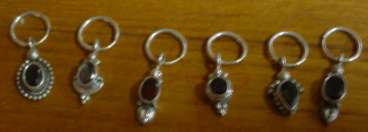
These are little silver mini-earrings – the kind some people line up by the half dozen along the edge of their ears. The dinglebobs (a technical term) hanging down are small faceted semiprecious stones – mostly garnets and pale amethysts, in small silver settings. They were incredibly inexpensive. (I’m sure somewhere in India there’s a whole village making these by the barrel full for next to nothing.)
While I was in Tucson, I happened to meet Dr. David Crawford, the Executive Director of the International Dark Sky Association. His group advocates for increased awareness of the problems caused by light pollution, and changes to local zoning/building regulations in favor of more efficient use of outdoor lighting. There are compelling reasons to improve outdoor lighting, including increased energy efficiency, reduced cost, and improved visibility where it is truly needed. There is also a growing body of research documenting how light affects people’s health and well-being, and the negative impacts that indiscriminant lighting can have on organisms of all types. When all of the other benefits are taken into consideration, the aesthetic and scientific benefits from preserving the dark night sky almost become secondary concerns.
In any case, Dr. Crawford’s impassioned (and sensible) ideas stuck with me on the over-long flight home. I turned out that the sock yarn I brought with me sort of fit the darkness and light theme, so I present Night and Day socks (still in process):

This particular yarn is Regia 4-Ply Ringel, Multi Effekt Color #5383. I’ve done a standard toe-up on US #00s, with 17 stitches on each needle (68 around). After the heel, I increased two stitches to a total count of 70. I did the increases where the corners of the short-rowed heel ends. Those two stitches help fill in the small hole that can form at that point. Normally I add a stitch on each side at that point anyway, then decrease it away on the next row. This time I just left them in.
The ankle pattern is a 10-stitch repeat I doodled up on the plane. I’m sure similar things exist in stitch dictionaries:

I hope that the the organization doesn’t mind having something as silly as a pair of socks dedicated to it. I’ll be writing up the pattern at greater length as I do Sock #2. If you decide to knit them, consider investigating (and making a donation to) Dark Skies.
Oh. The red jelly-bean looking things in the sock photo are lampwork glass ladybug beads, about to become a necklace for The Smallest Daughter. The other received earrings made from slices of a very small fossil ammonite, set in silver. My gift for myself was an unusual silver wire necklace thingy, meant to display large dinglebobs (see above). The ones I chose were rectangles of cobalt blue dichroic glass set in silver. (Dichroic glass is that iridescent stuff that looks like someone vitrified a peacock.) The Resident Male got an entire backpack full of various types of dried chili peppers – things that are hard to lay hands on here in this small corner of Massachusetts. He’s much happier with something edible.
HOODIE AND SOCKS
I’m still noodling on the hoodie project. Target child is waffling about her requirements. I’d rather wait until she settles into firm conviction before casting on. Some questions came in after Friday’s post:
Why start with Rogue instead of designing your own from scratch?
First, I really admire this particular pattern, its proportions and the way the cables are so cleverly used. Since it fits so closely with the original set of requirements and/or mods to it would not be difficult, why not start out with it? Cardigan-ization isn’t tough, nor would be knitting a smaller size to compensate for gauge differences. As for the rest – the texture pattern and saddle shoulders with a cable down the center of the arms, as Target Child looks over the photos of other people’s finished Rogues, she’s becoming less attached to those concepts.
You know you can use knitting design software to help.
Yup. I know that. I’ve got Sweater Wizard and the older Cochenille product. Hated the latter. I didn’t mind the non-standard format of the directions, better suited for knitting machines than for hand knitters, but I was totally turned off by the lack of technical insight provided by customer support. The thing wasn’t cheap, and I could never get it to run properly. Only one or two of the supplied templates produced any sort of output, and even they were unable to produce more than one or two of the available sizes. “Support” claimed that it was a problem unique to my set-up and there was nothing they or I could do about it aside from waiting for the next upgrade and seeing if that worked any better. Since we’ve got an average of six or seven working computers in this house at any one time (all with different processor/opsys/video card combos), and I tried the software on all of them and turned up exactly the same bugs, I rather doubted that one unique set-up was the problem.
Rather than throwing good money after bad, I decided not to spend close to $100 to upgrade Cochenille (with no guarantee that the new version would work any better. I switched over to Sweater Wizard. It’s got far fewer design templates and isn’t a full-size sloper drafting program, but what it has actually works, and is quite easy to use both during the design and knit-from phases. Which is refreshing compared to my previous experience. My only criticisms of the product have to do with personal preference and fit. I find the standard fit a bit tight for my taste, so I always add extra ease (which is verysimple to do).
My real desire though is to be able to produce the full-featured graphs of actual garment pieces, showing color or texture pattern placement like the ones in Rowan magazines. So far no knitting pattern design tools come close to that degree of integrated pattern shaping/motif placement. Yes, there are export features that allow customization of garment shapes for colorwork placement, but no total pattern maker that lets you tinker with all parameters in one interactive console. (If you gotta dream, dream big. [grin])
Meanwhile, Back at the Ranch
Although progress is slowly burbling along on the hoodie, there wasn’t enough to keep my fingers happy over the weekend. So I started a pair of quickie socks. Standard Figure-8 toe toe-ups with short-row heels. I’m using Lana Grossa Melienweit Fantasy, on US #00s, at the (for me) relatively large gauge of 9spi (68 stitches around). Ankle pattern is an impromptu feather and fan variant:

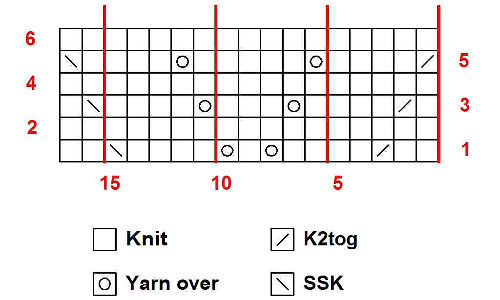
Here’s the graph for the ultra-simple six-row feather and fan variant used on the ankle. It’s 17 stitches wide and six rows long. I’m working my socks on five needles (four in the sock, one to knit with). Because each needle has 17 stitches on it, this graph is worked once per needle:
More info on knitting socks of this type, including basic how-tos for both the Figure-8 toe and short-rowed heel can be found in any of the sock patterns on wiseNeedle.
SUSAN’S IMPRESSIONIST BLUES ‘LEMONADE’
I managed to land in both a snow and knitting rich area. Many of my neighbors knit. One even holds an informal knitting circle that meets once a week. I’ve been going when I can, and have watched the creation of a really nifty project that happened as a late-course correction on what might have been a tragedy.
Susan The Architect has been knitting a magnificent impressionist blues/purples mohair stole to wear to a Very Important Event. She cast on plenty of stitches on a long circ because she was going to knit it the long way (rows running end to end) rather than across the narrow dimension. It was tough to get a fix on her gauge because so many stitches were on the circ, and she had forgotten that she had done her swatch on a smaller sized needle than the one she ended up using.
She knit happily away in K5, P5 rib until her stole was about 18 inches wide. Then she bound off and discovered that she’d made a strip 18 inches wide by 12 feet long!? Although she’s on the tall side, she’s not tall enough to carry off a 12-foot strip without constantly stopping to re-drape it or creating a tripping hazard for herself or those around her. Serious thought was needed, as ripping back mohair isn’t a pleasant experience.
Susan decided to keep what she had made, but engineer a new use for it. I apologize for not having a model photo of the final piece, but I didn’t have a camera with me. Here’s a schematic, though:

She folded roughly one foot up on each end of the piece, then stitched the resulting flaps down at the cast on and cast off edges. She also seamed about three quarters of the way along the top of the flaps. This made nice pocket ends. Then she folded the piece in half, and seamed down the cast-on edge approximately 18 inches from the center fold. This joined the back into a hood-like shape.
She wears the piece with the hood either draped down her back, or over her hair. The two ends hang down in front – each with a handy pocket end at her fingertips, or are worn with one end flipped up over the opposite shoulder. From the center back of the neck (the base of the hood) to the bottom edge is now about 3.5 feet (12 foot total length/2 = 6; 6-1 foot for pocket = 5. 5-1.5 feet for hood = 3.5 feet), a far cry from the dangling 6 foot from the collar length of the piece when worn as a plain stole. Very wearable, and if I might say so, very flattering, too. Here are directions if you want to make Susan’s Stole for yourself.
Susan’s Stole
4 skeins King Cole Luxury Mohair (110 meters each, approx 440 meters or 480 yards, total)
Size US #13 (9mm) circular needle, 36 inches long.
Tapestry Needle for sewing up.
Gauge = Approximately 8 stitches = 4 inches or 10cm
Cast on 285 stitches.
Row 1:? (K5, P5), repeat, end K5.
Row 2:? (P5, K5), repeat, end P5.
Repeat rows 1 and 2 until your piece measures approximately 18 inches across, or you run out of yarn. Cast off and darn in ends.
Fold left and right edges in towards center, making end flaps approximately one foot deep. Seam up cast on and cast off row edges. Seam approximately 2/3 of the top edge of the flap to form a pocket.
Fold piece in half so that pocket ends are opposite each other. Seam about 18 inches from fold towards free ends along cast-on edge (the opposite side from hand opening), to create a hood-like opening.
Final word:? Why ‘Lemonade?’? From the old adage that begins “If life gives you lemons…”
REPORT AND PATTERN – FINGERLESS WHATEVERS
UPDATE: REVISED PATTERN FOR FINGERLESS WHATEVERS IS NOW AVAILABLE AS AN EASY TO DOWNLOAD PDF AT THE KNITTING PATTERNS LINK, ABOVE.
On this 43rd day of the Great Monitor Dearth, and second day of post-blizzard digging out, I share these mitts:
Fingerless Whatevers
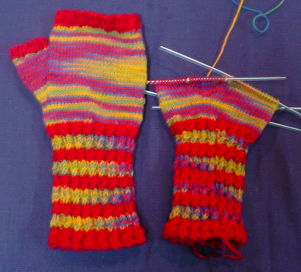
Approximately 200 yards of sock weight yarn – roughly one 50 gram skein. This pair looks to be using half a skein each of Lorna’s Laces Shepherd Sock and Dale Baby Ull. (I can’t guarantee that this is a spot on perfect quantity estimate as I am not yet done with the second mitt.) This would be a good project to use up odds and ends of several self-stripers, pairing them with one solid color common to them all. Five US #1 double pointed needles?(2.5mm). May be knit using the two circ method by considering each two-needle unit = 1 circ
Gauge in stockinette:? 9 st = 1 inch
Twisted cable ribbing:
Round 1: (K2, p2), repeat
Round 2: (K2, p2), repeat
Round 3: (Right twist using this method: [K2tog, leaving unit on left hand needle. Re-insert right hand needle tip into stitch closest to end of left hand needle. Knit this stitch. Slip entire now-twisted two-stitch unit to right hand needle], p2), repeat
Round 4 and 5: Repeat Rounds 1 and 2
Wristlet/Pulse Warmer or wrist part of Whatevers:
Cast on 64 stitches and knit one round, using the method described in yesterday’s post. You should have 4 dpns, each with 16 stitches (or two circs with 32 if using that method.) Work twisted stitch ribbing for 9 repeats (45 rounds). I alternated my two color yarns, switching colors after Row 5 and stranding up rather than breaking the yarn at every stripe. Note that you can end off right here and have a perfectly nifty pair of pulse warmers, instead of continuing on to make the thumb hole and palm part of these mitts.
Left Thumb Gusset and Palm (Mitt #1 only):
Knit 9 rounds in stockinette.
10th Round: Knit all the stitches from Needle #1. Knit 12 stitches from Needle #2. Place a marker. M1, K2, M1, place another marker. Knit remaining 2 stitches on Needle #2. Knit all stitches on Needles #3 and 4.
11th Round: Knit all stitches
12th Round: Knit to marker. Transfer marker to right hand needle. M1, Knit to marker, M1. Transfer marker to right hand needle. K2. ?Knit all remaining stitches on Needles #3 and 4.
13th Round: Knit all stitches.
Repeat rounds 12 and 13 until there are 24 stitches between the two markers.
Knit 2 tog at the beginning of Needle #1.Knit remaining stitches on Needle #1. You should have 15 stitches on Needle #1. Knit to marker. Slip the 24 thumb stitches onto a stitch holder or piece of string. Stranding very tightly to avoid gapping, knit the remaining two stitches of Needle #2 together. You should have 14 stitches on Needle #2. K2tog, knit remaining stitches on Needle #3. You should have 15 stitches on Needle #3. Knit all stitches on Needle #4. There will now be 60 stitches total.
Knit 10 rows. On 11th row begin working rounds 1-5 of Twisted Cable Ribbing (I chose to switch back to my solid color for this). You will find this easier to work if you slip the first stitch of Needle #2 to Needle #1 and the last stitch of Needle #2 to Needle #3 just prior to commencing this round. Bind off in pattern.
Right Thumb Gusset and Palm?(Mitt #2 only):
In theory you could just make two lefts, since there are no fingers in this piece to skew the fit one way or the other. But I think it’s more satisfying (and marginally better fitting) to do a mirror image. Plus it’s good practice for anyone planning on graduating from fingerless whatevers to real gloves.
Knit?9 rounds in stockinette.
10th Round: Knit 2. Place a marker. M1, K2, M1, place another marker. Knit remaining 12 stitches on Needle #1. Knit all stitches on Needles #2, 3 and 4.
12th Round:? Knit all stitches
13th Round:? Knit to marker. Transfer marker to right hand needle. M1, Knit to marker, M1. Transfer marker to right hand needle. K2. Knit all remaining stitches on Needles #2, 3 and 4.
14th Round: Knit all stitches.
Repeat rounds 13 and 14 until there are 24 stitches between the two markers.
Knit 2 tog at the beginning of Needle #1. Slip the 24 thumb stitches onto a stitch holder or piece of string. Stranding very tightly to avoid gapping, knit the remaining 12 stitches of Needle #1. You should have 14 stitches on Needle #1. Knit 14 stitches on Needle #2, K2tog, knit You should have 15 stitches on Needle #2. Knit all stitches on Needle #3, and 4. There will now be 60 stitches total.
Knit 12 rows. On 13th row begin working rounds 1-5 of Twisted Cable Ribbing (I chose to switch back to my solid color for this). You will find this easier to work if you slip the last stitch of Needle #1 to Needle #2 just prior to commencing this round. Bind off in pattern.
Thumb:
Evenly divide the 24 stitches of the thumb onto three DPNs. With a fourth work the following rounds of Twisted Cable Ribbing:
Round 1
Round 3
Round 5
I chose to work these in my solid color. Bind off in pattern. Darn in all ends, taking care to snick up the hole that has formed at the base of the thumb where the ribbing began.
Please note that this pattern is copyright 2005, by Kim Salazar, and may not be reproduced or distributed in any format without her permission. It is intended for private end-consumer use only. Please contact the author for permission if you intend to make up this item in quantity for sale or charitable donation.
Mailbag Questions
Michelene asks how I keep half hitch cast on stitches from loosening and turning into big loops. The answer is knitting them very slowly, firmly, and carefully. They will distend somewhat, but if your second row is neat and even, the cast-on row will snick itself back into reasonable shape. The long string gap between needles will also resolve itself; and the beginning/end round gap is addressed by the trading stitches trick also described.
Important note on this – If you try to work a normal purl on a half hitch cast on stitch, the cast on stitch will disintegrate because the motion of the purl undoes the twist that formed the stitch. That’s why the first round of the sock method described two days ago is all knits. If you MUST purl, do a twisted purl through the back of the loop. Awkward, yes – but it shouldn’t disintegrate.
On finding teeny size needles, I get most of mine at my LYS – Wild & Woolly, in Lexington, MA. They get them every now and again as part of their DPN order. When I see a set in a size I haven’t got yet, I buy it. I’ve also found some in yard sales and other yarn shops. If your local shop stocks Inox accessories they should be able to special order them for you. There are also lots of on-line sources for specialty needles. I’ve never dealt with either, but both Lacis and JKL Needles! both have quite extensive offerings.
QUESTIONS – BOTH INTERESTING AND ANNOYING
Interesting Question
Yesterday Marcia asked about the K2P2 rib I posted about. She wants to use it on a hat where the brim is worn folded up. She’d like to have the pattern visible on the flipped up part, and wants to have the twists on the hat body and brim oriented with the same leg on top.
I haven’t tried this, but I think that if this stitch were worked two-sided – with crossings on both sides, Marcia’s effect would be achieved. To do this you need to make it a six-row rather than a five row pattern. Marcia was also concerned with the leg direction, but if the thing is worked two-sided this way, when flipped up the reverse will display the cable twist crossings going in the same direction as the front. (Try it by making slash marks on both sides of a piece of paper, then folding it.)
To do it flat, I’d work:
Cast on a multiple of 4 stitches
Round 1: (K2, P2), repeat
Round 2: (K2, P2), repeat
Round 3: (Right twist using this method: [K2tog, leaving unit on left hand needle. Re-insert right hand needle tip into stitch closest to end of left hand needle. Knit this stitch. Slip entire now-twisted two-stitch unit to right hand needle], p2), repeat
Round 4: (K2, P2), repeat
Round 5: (K2, P2), repeat
Round 6: (Right twist using this method: [K2tog, leaving unit on left hand needle. Re-insert right hand needle tip into stitch closest to end of left hand needle. Knit this stitch. Slip entire now-twisted two-stitch unit to right hand needle], p2), repeat
In the round I’d work:
Round 1: (K2, P2), repeat
Round 2: (K2, P2), repeat
Round 3: (Right twist using this method: [K2tog, leaving unit on left hand needle. Re-insert right hand needle tip into stitch closest to end of left hand needle. Knit this stitch. Slip entire now-twisted two-stitch unit to right hand needle], p2), repeat
Round 4: (K2, P2), repeat
Round 5: (K2, P2), repeat
Round 6: K2, (Right purl twist using this method: [Skip the first stitch but retain it on the left needle and purl the second one, also retaining it on the left hand needle. Then purl together both the skipped stitch and the second stitch and move the resulting two-stitch unit to the right hand needle], repeat
Of course another way to deal with the problem is to knit the cuff area using the pattern as described yesterday. When it was deep enough, you’d add three rows of purls to make a welt (the fold line); then reverse direction and knit the cap part, using the opposite twist stitch wherever the original called to use one. That would put the right side of the cuff showing when folded up against the hat body.
Another Interesting Question
FeliciaSix says “Wow. Eyes. Monitor. Bright. Hurt. Why did you pick that most unsubtle of color combos for the Fingerless Whatevers?”
Because it’s cold, dark and dreary in the winter and I wanted to wear the opposite.
Annoying Questions
None of them are worth repeating. Some days I wish every computer came equipped to display this error message:

You can build your own error messages, too.
BY AND FOR, BY AND LARGE
UPDATE: THE PATTERN BELOW IS NOW AVAILABLE AS A QUICK DOWNLOAD PDF AT THE KNITTING PATTERNS LINK, ABOVE.
Sigh. Still no monitor. Perhaps today. At least today I’ve got Internet connectivity. Yesterday I experienced several hours of intermittent service interruptions (that’s why there was no Monday edition of String).
In the mean time, I’ve managed to get one of the other machines in this house to accept input from my bargain-basement digital camera. It’s blurry, but you get the idea:
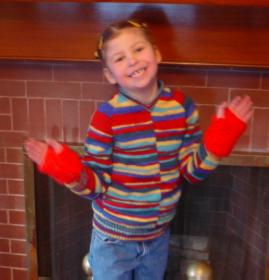
I finished the Crazy Raglan. Now it’s lurid and not my best effort, but it’s to the exact specifications of the target Small One, and she loves it. Perhaps this explains why:
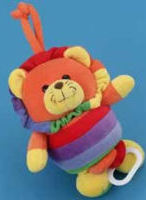
She’s got one of these. It’s been her favorite toy since she was only a couple of months old. Her Squeaky is now much less pristine than this catalog shot, and (mercifully) no longer plays a music box rendition of “Born Free.”? She?picked out the self striping yarn because she wanted a “Squeaky Sweater,” and now she’s got one. But I?think you have to be six to truly appreciate such things.
In terms of technical?performance and lessons learned – there were several. First, going back to mid-summer, there were all sorts of things to be experienced?managing the repeat and?width of the area being knit so as to best manipulate the striping. Second, I used?Sweater Wizard software to devise the basic raglan shape. I really like having that shortcut available to me, but I have to say that for kids sizes at least,?the templates do?run a bit small.I added both copious width/ease and length to make a custom fit on my string-bean kidlet, and it still turned out to be snug.
I’m not entirely pleased with the raglan angle. I should have made the armholes deeper. That would have changed the angles and made the sweater a bit more proportional. I also bowed to kid-preference and made a very shallow V-neck instead of a crew or deeper V, trimming it with a very narrow band of ribbing. She likes it, but I don’t – again the proportions are a bit off. Finally, I did a slip stitch selvedge edge on all pieces. I’ve done that before on raglans and had no problems, but they were solid color raglans, sewn with yarn of the same color. The mattress stitch seaming in the space dyed yarn – especially on the raglan seams – was VERY evident. I ended up taking it out and redoing it as pierced double running stitch to tighten up those shoulder seams and make them gap less. I also selectively cut bits of the darkest green to use for my redone seams. That helped a bit, too.
One thing I did do right was to use provisional cast-ons for the body and sleeves. I also knit both back and front at the same time, and both sleeves at the same time. After I sewed the seams, I went back and picked up the bottom edge stitches at body hem and cuffs, and knit the ribbing in the round. I did the body ribbing first, and liked the contrast between the narrow one-row stripes in it, and the wider stripes in the body. When I did the cuff and neckline ribbing I used two balls of yarn starting at two different points in the color cycle to ensure that they matched the waist ribbing.
So I post an equivocal success. The target audience was pleased, but I’m not enirely so.
Why “By and For?” in the title?? Because those little hand-mitt wristlets The Small One is wearing are a knitting product entirely of her own manufacture. They’re lumpen, odd little superbulky yarn paw-warmers but she’s very, very proud of them. Here’s the pattern. Such as it is:
Morgan’s Paw Warmers
Will fit a small child, age 6-10.
Small quantity of?leftover superbulky yarn. I can’t say what we used. I bought it years ago for holiday present ties. My guess is that it’s 100% acrylic.
US #10.5 straight single pointed needles. Tapestry needle for sewing up.
Gauge – roughly 2 stitches = 1 inch in garter stitch.
Cast on 16 stitches. Knit in garter stitch until piece measures about 6 inches long. Bind off four stitches, and knit across remainder of row. Knit next row, casting on four stitches at the end. On the next row, (K3, K2tog), repeat across the row, ending K1. Knit three more rows on the remaining 13 stitches. Bind off. Sew side seam, taking care to leave the thumb slit open.
 String-Or-Nothing