SHORT ROW HEELS
Turtlegirl asks what patterns I use for fingering weight socks. I shamelessly answer – my own. New readers here (and there appear to be many of them) may not know that I also am the keeper of wiseNeedle. wiseNeedle is the original yarn review site, active on the web as an all volunteer consumer to consumer, unsponsored service since 1995. In addition to the yarn review collection and a searchable glossary of knitting terms in 14 languages, I keep some patterns there, too. Among them is a slew of toe-up, short row heel socks in several yarn weights. There are three patterns there for fingering weight, and any of them can be used as-is, or by elimination (or substitution) of patterning on the ankle parts, made as simple or as complex as the knitter desires.
And in response to other requests, here’s a close-up of the short row sock heel, showing the mitering you can achieve with a little advance planning and a modicum of luck:
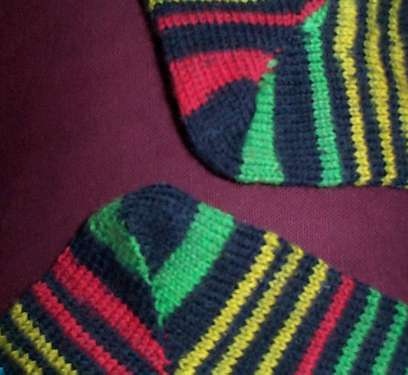
Why do they not match exactly? Because I didn’t take the time to make my socks identical twins. I started each sock off its own ball of yarn at the exact start of the ball. The repeats were slightly skew. I don’t have a problem with making these self stripers into fraternal rather than identical pairs.
Now, how to finagle this effect using a self striper? Lots depends on the width of the striped section. The narrower the stripe, the easier this is to do. You can better see what I did in the top sock, above. I knit the foot (on the left, heading up towards the top of the photo), ending it in synch with the completion of a red stripe. Then I began the back and forth short rowed section with the following section of black. I ended the decrease section of my short rows roughly half way through the black bit that followed the red, finishing up the black on the part of the short row section that re-awakens dormant stitches. Then I finished out my heel. This synch of the pattern to the printed repeat required that I fudge a bit on foot length. In a sock of this type, a row or two extra in the foot, combined with a heel a row shorter than normal isn’t going to make a major difference in fit. Since the repeat pattern is so narrow, I can get pretty close to perfect miters. On wider patterns it’s harder. In a wider pattern I do still try to end the foot at the completion of a stripe (or if it’s a VERY wide stripe, half way through a repeat). I let the short rowed section fall out as it may, hoping more for serendipity rather than planned perfection. Most of the time things work out well enough.
WHAT I’VE BEEN UP TO
The work crisis has not yet abated (in fact, it’s just settling in for the long haul). Even if I’m not writing about it, I AM knitting. Plain, boring, unadventurous, run of the mill, miles of stockinette, unchallenging (but comforting) knitting.
In my case, that usually means socks, and reverting back to the sock style I can do in my sleep – toe up with a figure-8 cast on, and short-rowed heel. I’ve been averaging completion of a pair every six days or so. I only knit for an hour or so each evening, so each sock is taking me three evenings to complete.
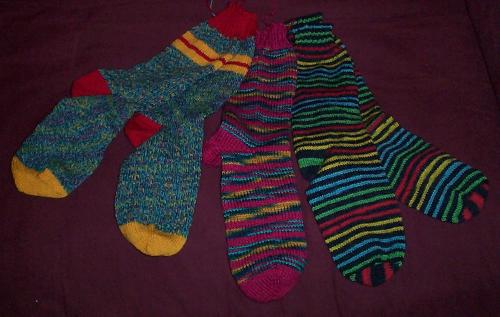
At the left what we’ve got is a pair of fingering weight socks composed from various leftovers. The vile mustard is a 100% wool yarn I’ve had forever. The label still lists the distributor with a pre-zip code address format. The tweedy green/blue is a partial ball of something (I know not what) I got in trade swapping leftovers with a friend, and the red is some Dale Baby Ull, left over from a sweater knit for the smaller daughter. This is the pair I was referring to when I wrote that in January my color taste departs, and I feel compelled to mismatch in the most garish ways possible. Perhaps it’s a seasonal longing for light and color that happens just after the holidays, when the world returns to winter-drab. In any case, the moire-like patterning of the red tweedy parts isn’t a camera artifact, it actually exists. For some reason the tweedy red bits worked themselves into swirls on the foot of one sock and the ankle of the other. I think they moved in and out of synchronicity this way because in this multi-ply yarn (a true 4-ply four ply), each ply was carrying the same set of colors. While the plies never aligned so that a blob of red hit across all four at the same time, it does appear that if two aligned **just right** I got my swirls. An unexpected effect to be sure, and one I would have preferred either lasted for the entire duration of both socks, or didn’t appear at all. Still, the things are garish enough to begin with, so the red striping is just another element of eye offense.
In the center is half a pair of light worsted weight socks. The other is still on the needles. In this case I had a skein of Little Lola, a variegated yarn. I’ve used it twice before to make Kombu scarves, but the colors for those were tamer. This particular skein presented a problem. The colors in it are less of a set, and more of a street fight, with fuschia, teal, olive, mustard and navy all scuffling for attention. I had set the skein aside when I used its two brothers because I didn’t know how exactly to use it. When I was rummaging through my stash to fuel my holiday knitting I came across two skeins of a yarn I got in a discontinued inventory sale back in 1994 or so, at the late lamented Yarn Shop in College Park Maryland. It’s Classic Elite Paisley Light, a mix of wool and rayon, and matches the all superwash wool Little Lola exactly in gauge and structure. In my case the Paisley Light also matched the fuschia in the Little Lola spot on. By working the toes, heels, and ribbing in Paisley, plus alternating stripes of three rows of Paisley and six of Little Lola, I’ve managed to tone down the discord of the variegated skein a bit. It’s still a riot, but more of a quiet one. (Review of Paisley Light coming soon to wiseNeedle).
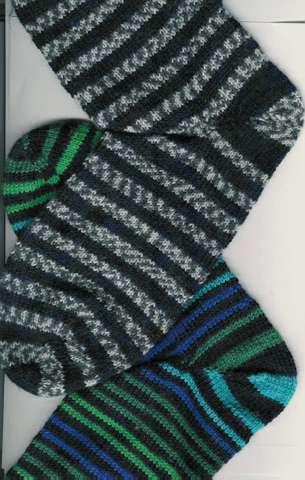
Finally the pair on the right is standard issue Regia Mini Ringel. Nothing special here whatsoever. Due to my bad photography you can’t even see the nifty way the stripes miter on the short-rowed heel.
One last bit of blather, the old fashioned way of doing stripes (actually using two skeins of yarn, alternating between them on some sort of fixed count) is a wonderful way to make socks match in length. It’s relatively easy to count four or six rows of color A, then some number of color B. Then when time comes to make sure that the second sock is the same length as the first, all that need be done is count the stripes. Much more accurate than eyeballing or measuring, and far less tedious than counting rows. A final hint, sometimes counting even a small number of rows in stockinette can be difficult if you’re using a dark color yarn, or one that’s highly variegated. Instead of counting on the front side, I take a needle tip and insert it into a column of purl bumps on the reverse side of my stockinette. It’s easy to count off my rows by counting the purl bumps.

TOPS UP AND DOWN
My convertible mittens are done. I have to admit, the joy of ending off ten fingers wasn’t a pleasure of the ages – but they’re finished.
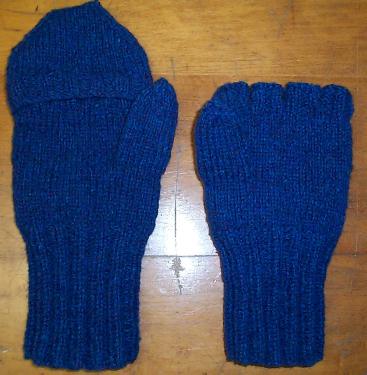
The rustic wool I used for these isn’t as soft and non-itchy as I would have preferred, but in this case the intended use trumps that problem. It’s my understanding that the recipient would be wearing ultrathin silk gloves inside these. Liners do away with itch.
If I were to make another pair of these mittens, I’d probably use a shaped thumb gusset instead of the afterthought thumb. While these do fit nicely, I find a shaped thumb area to be more comfortable. Award to recipient is this afternoon. I’m sure he’ll be pleased.
Next up in the gift parade is problematic. I had a Very Strong Hint shared with me yesterday. I don’t have the special materials on hand, so compliance will entail a lunch-time raid on my LYS. Now not everyone around me can get goodies just by idle hint. Hints must be 1) shared innocently, with little expectation that they will lead to the desired object; and 2) must be given by the deserving, and I get to decide who’s deserving. If I didn’t impose limits, I’d be chest deep in special requests.
Other items on parade include another pair of socks (probably not going to happen), and some ear warmers and hats. Plus some additional crocheted snowflakes for the tree. We’ll see what further stash excavation expeditions unearth.
Cookie report:
Rum balls this year turned into Scotch balls, as a last minute dearth of rum foiled my original plans. I’ve used bourbon before, but found the result too strong, so we’ll see how this year’s crop mellows. Peanut butter cookies are also finished. I’m happy to say that the spice cookies turned out exceptionally well. Thin, light, and gently spiced. A delicate cookie compared to many heavier riffs on the spice cookie theme.
FLIP TOP MITTS
Holiday shopping is now complete. My cookie list is done and supplies have been purchased. I turn again to knitting (in between the batches).
My hunter’s mittens (or shooting mittens, or flip top mittens, or convertible mittens) are more than three quarters done. I’ve finished the first one, and am up to the fingerettes of the second. I read through the list of patterns that I posted last week, and absorbed some general principles. In specific, I adopted the afterthought thumb and line of purls along the knuckles to make flap attachment easier from this one but mostly I just went along on instinct.
I’m using a rustic-type worsted weight wool. This particular bit is left over from a sweater I knit for myself from yarn I bought at a Gore Place Sheepshearing Festival, held annually in Waltham, Massachusetts. I’ve written about my No Math Pullover before. My normal gauge for this stuff is about 5 stitches per inch over stockinette on US #7s. For this project I wanted something tighter and more wind-proof, so I ratcheted down to a mix of 2s for the ribbing and #4s.
 |
 |
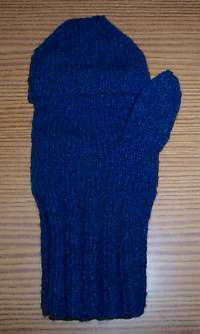
I worked about five inches of wrist ribbing in K2, P2, switched to stockinette, knit to the thumb point and introduced some waste yarn for the thumb opening. Then I knit to the knuckle ridge and purled the stitches on the back of the hand. After about four rows of spacer after the knuckle ridge, I worked some evenly spaced mini-fingers. Once they were complete, I picked up stitches along the knuckle ridge, cast on extras to go across the palm (I used cable cast-on for that to make a firm edge). Once I had my stitches for the mitten end established, I did several more rows of ribbing across the palm side to keep the edge from curling and stretching, then finished off the mitten end with a standard sock toe, ending it off with Kitchener grafting. Then I went back and worked a standard thumb.
The palm side is shown on the left. You can see the thumb and ribbed edge of the mitten end flap. The back of the hand is shown on the right, with the mitten flap end folded back to expose the fingers. I’m pretty happy with the result.
Now, some people have asked how I figure out the sizes for gift knits. I try to do it by nefarious means most of the time, but for this gift I admit I showed a partially done (and woefully oversized) mitten to the recipient. I knew I was so far off that the result would be laughable, so I spoiled my own surprise.
Nefarious means: For socks, I eyeball the target feet. I’ve been known to measure footprints in the snow, sneak looks at spare shoes when visiting, or note where the toe and heel line up when their owner is standing on a patterned rug,then return later and measure the interval. Hats are harder, but since knitting stretches, planning on a 21-inch head circumference to start with, then doing a plus or minus based on whether I think the person has a larger or smaller head than usual has always worked for me. For mittens, I usually contrive some sort of conversation that leads to a hand to hand comparison between the target and me. For example, I’ll ask about how comfortable the target finds his/her particular model of keyboard, note that my experiences vary, and posit a hand-size difference. That usually leads to a palm-to-palm comparison, which gives me a rough idea of size. I’m sure others have similar sneaky ways to evoke the needed data. I’d love to hear about them, too.
Side trip – I’ve had a request for the recipe for Oysters. I posted it last year around this time. Enjoy!
STRANGE PICKS
Sometimes having lots of dribs and drabs in one’s stash can lead to some strange picks as projects and available yarns are aligned. This week’s projects are case in point proof.
Knitterguy asks why on earth one would want to knit an acrylic/cotton blend scarf. I agree with him. Those fibers are far from warm and cozy, and there are lots of better choices for a warm neck wrap. In this case i plead a confluence of several factors:
- The screaming yellow color. The crossing guard in question will appreciate it.
- Having the yarn on hand
- The target recipient’s frequently repeated statements that she can’t wear wool
Now I don’t want to start the whole, "but of course she can" or the old warhorse perceived allergies vs. real allergies debates. I take her words at face value. She doesn’t want anything made of wool. She gets a nice, bright scarf in a color she favors and fiber type she believes is best for her, and I find an appreciative home for yarn I’ve held on to for upwards of ten years. But if I were knitting this for me, I’d be looking into a supersoft merino, or cashmere/merino blend for sure.
Next up appears to be a pair of flip-top mittens. I’d like to make something for a friend who has a predeliction for outdoor activities in the winter that occasionally require the use of bare fingers. A pair of these should be perfect. I note the presence of lots of free patterns on the web (convertible mittens, work mittens, two-way mittens, urban coping mechanism mittens I and urban coping mechanism II) plus several well regarded for-pay patterns (Pop-Up Paws, and Patons.) But in true String-or-Nothing tradition, I plan to leap off the cliff and improvise something on my own. I’ll probably start by looking over what’s out there, then messing about with the concept. Not sure if I’ll do a fingerless glove surmounted by removable finger end cap, or if I’ll do a fingerless mitten. I suspect the former will stay in place better, while the latter will be quicker to make.
As to what yarn to use – I’m not sure yet. This particular target recipient has an interest in historical things, so I may look at some of the more rustic looking 100% wools I have. For example, I’ve got some leftovers of Cestari light fingering weight 100% wool singles in both white and heathered barn red. I could combine the two into a Ragg-style looking DK equivalent. Hmm….
EVEN MORE HOLIDAY KNITTING
My stash diving and holiday knitting continue. Unfortunately, my camera and camera skills are far from the best (plus I’m still having some platform issues left over from my system upgrade), so you’ll have to use some imagination on this one.

Believe it or not, there are three strange and blurry objects above. At the top is a long scarf knit in the loopy mohair previously described. It’s in plain old garter stitch, but the resulting fabric looks a lot like the curly lamb stoles my great aunts wore four decades ago. It’s plush and lush. It also left precious little left over, but I contrived a simple beanie cap from the leftovers. That’s the shapeless black lump at the bottom of the photo.
In between is a simple knit/purl patterned scarf in screaming yellow. In this case, yellow is appropriate because the thing is a gift for a crossing guard. The pattern is a basketweave variant from B. Walker’s Fourth Treasury. The yarn is a well-aged stash resident – Brunswick Bermuda II. Bermuda is a cotton/acrylic blend, with a maker’s gauge of 5 stitches per inch on US #6 needles. I am not quite sure where I came by the five skeins of screaming taxicab yellow, but I suspect that this is a leftover from a project my mother made years ago. I can say that I am not fond of working with the stuff. It combines many of the worst features of both cottons and acrylics.
To start, Bermuda has a loosely twisted multi-strand construction, with about eight constuent plies. Eight point-trapping nuisances that make this yarn a nominee for "Worst Splitting Yarn I’ve Ever Used." The stuff is unstretchy as one would expect, but so much so that knitting evenly with it is a huge challenge. To keep my stitches uniform, I’m having to knit as tightly as possible, especially on the transitions between knits and purls. Even so, a knit/purl combo pattern is better than all stockinette for this yarn, as the texture doesn’t betray those "I’m knititng with an uncooperative cotton" occasional leggy bits. But I can go on… The texture of this stuff is string-like and hard in the fingers, very uncomfortable to use especially given the tightness I’m trying to achieve. I’ve knit up three skeins of Bermuda so far. One more should make the scarf a useable length, and any leftovers will become fringes. Ending this one off can’t come soon enough for me.
I’m not quite sure what stash diving I’ll do next, or what the next bit of knitting will be, but I suspect that there will be at least one more pair of socks between now and the holiday, plus some more snowflakes for the tree.
MORE HOLIDAY KNITTING
The socks are done, and I’m looking over all the possibilities for gift knitting that can actually be accomplished between now and when needed. So far I’ve stockpiled two pairs of socks, two scarves, and a pair of halfie mittens. This is an excellent opportunity to go through my small quantity stash box and identify things that can be pressed into service. So far I’ve found:
- A large ball of heavy loop mohair/wool blend in black, probably bought at a Maryland Sheep and Wool Festival from Tess Yarns. If I recall correctly the year I went Saturday night and Sunday morning were quite rainy. The Tess booth had the misfortune of experiencing tarp failure, and the stock got quite wet. Those of us who chanced by when the inventory was being packed up at the end of the day were treated to sizable discounts on sopping skeins. When knit up in garter stitch this stuff is a dead ringer for curly lamb or mouton. Perhaps a scarf and (if there’s enough) trim on a matching hat. Or perhaps if I feel adventurous (and there’s enough), a shaped shoulder shrug in imitation of a curly lamb stole of the 1950s. One drawback – mohair and I don’t get along very well. I’ll probably have to knit this wearing gloves, or put up with itchy, red hands for the duration. (I didn’t realize how poorly we got along until long after I had bought the stuff.)
- Some leftovers of cotton blend and cotton velor yarns – the dribs and drabs of kid sweaters long since completed and outgrown. Since I often buy yarn in bag quantity I almost always have extra. This stuff would be good for small seaman style inside the coat type scarves.
- Some sport weight Shetland two-ply yarn in cranberry, olive and muted blue, left over from a linen stitch sweater-suit my mother knit sometime in the mid 1960s and shamelessly stolen from her stash. The colors look quite good together and are not as out of favor as they have been in the past. Hats? Ear warmers? More halfie mitts, but with stranded patterns? No decisions yet, but the stuff is still in excellent condition and should be used
- Some fingering weight cotton blend sock yarn. I am not a fan of cotton socks, I find them cold, clammy and hard textured compared to wool or wool blend socks. But I have some sock weight cottons. These should make nice wrist warmers or ear bands. Or perhaps cell phone or iPod socks for the gadget-blessed who have requested such things. (Someone please tell me why anyone would want an cozy for a device upon which engineers have lavished man-years of effort to mitigate the problem of heat dissipation inherent in small scale electronics.)
And that’s just in the top layer of the box. Stay tuned!
TOE UP SOCK, PAST THE HEEL
First, an aside. I finally darned in the ends of my Alcazar shawl. I only end off ends when the final disposition of a piece has been decided. In this case it means I’ve decided that as much as I love my Alcazar, there’s someone who deserves it more. My shawl has now found its way to its new (and very appreciative) owner, and I beam with my own pleasure at joy with which it was received..
My socks continue. I’ve finished the first and am only a single evening away from finishing the second. I’ve placed the motif on the ankle. Because I chose to work it as a knit image on a purl ground, and the motif is made up of solid blocks and strips, unstretched the sock looks rather strange. The motif draws in like ribbing and the purl background puffs out compared to the rest of the stockinette sock. But when worn, it looks fine. The purl ground recedes, the proportions of the knit motif correct, and the draw-in so evident in the unstretched item goes away.
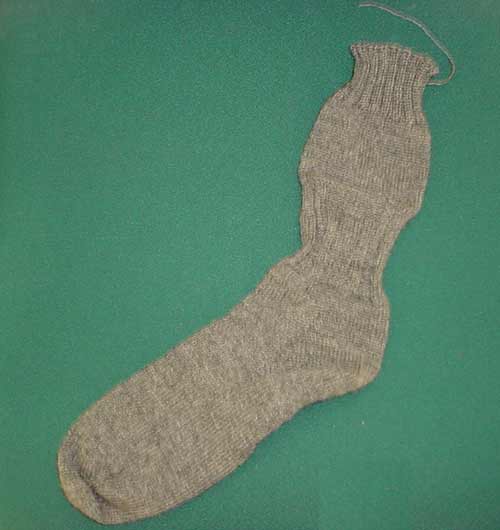
The motif on the ankle isn’t very visible in this photo, so here is the graph:
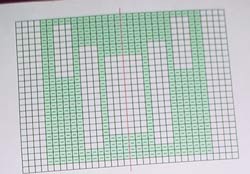
Yes, it has a specific meaning. A work-related meaning that a very small minority of the viewers here will recognize. And no – I didn’t stick to the graph in the absolute. My final version has the same height to width ratios as this visual, but because there is very little variation row to row, I repeated the center area rows and the upper end rows more times than they are shown here. I did that because my graph was done on square units, but my knit stitches are not 1:1 ratio. I needed extra rows to achieve these proportions.
In terms of placement, I centered the unit on the ankle bone, and repeated it on both sides of the sock. The red line marks the centermost point and the whole graph represents half the sock’s stitches. Because I work with four DPNs in the work and one in hand with an equal number of stitches on each of the four DPNs, finding that center point was very easy. I do admit that once I began the pattern panels I rearranged the stitches so that I held the motif and field stitches (the green ones) on a single DPN, eight stockinette stitches on a second, the other side’s motif on a third, and the final eight stitches on the fourth DPN. I did the reassortment to avoid the possiblity of a loose stitch marring the center of the motif. While I don’t have ladder-itis between DPNs in stockinette, I am less sure of myself in reverse stockinette, so I avoided the issue entirely. I planned my vertical placement so that the motif would occupy the center third of the sock measured from the bottom of the foot to the bottom of the ribbing. That means I worked a few rows after completing the heel and before starting the motif, and working my post-motif stockinette to the same depth as the patterned part.
Finally, I finished the sock off with plain old 2×2 ribbing, whick I did until I ran out of yarn in my standard issue Regia 4-ply 50g/210 meter ball. I’d say the resulting sock should fit from man’s shoe size 9.5 wide through 11 (possibly 12) medium width or so. With luck the target recipient has feet in that size range. If not, I’ve got an alternative recipient planned, and I’ll knit another smaller pair for target #1.
INVERTED HEEL – FURTHER EXPLORATIONS
?Thanks to everyone who left recommendations on inverting heel flap
heels for toe-up socks. There probably are lots of "official"
ways to do it. Leah mentioned one in Gibson-Roberts Ethnic Socks and Stockings. Kathryn says there’s one in Church’s Sensational Socks. Brigid sends us to the KnitSocks Blog.
Emily says just to do a plain old flap heel, as written for cuff-downs,
and Rob points out a totally different approach adapted from Rehfeldt’s
Toe Up Techniques for HandKnit Socks.
You know sometimes there’s a reason to bow to the giants who have gone
before. And sometimes for no reason other than personal
perversity and the joy of fiddling with something on one’s own, there’s
a reason to keep on plugging away despite all the world’s advice to the
contrary. I’ve been feeling contrary.
I worked my heel as described in yesterday’s post. Here’s the result:

I tried it on. It fit, but the sock ended up being too
long. Plus I wasn’t entirely satisfied with the location of the
gusset. it was centered too low on the foot, with too much above. Fabric sort of lumped up on top of the ankle. So in
this aspect at least taking a recommendation from Emily, I ripped my
sock back to about a half-inch below the heel and reknit the thing on
50% of the total stitches. I ended up picking up 15 stitches on
either side of my heel flap.

I like this better. I had thought that not having a heel cup (the
turning the heel bit) that I’d end up with little wings at the corners
of the heel flap. The sock unworn kind of looks that way, but
when worn, everything fills out and no little corners protrude.
Perhaps that’s because my feet are so wide. This particular pair
is a gift, so I’ll have to knit another pair using this heel and give
them a thorough wear testing. I am keeping this heel. (The color on this second photo is closer to Real Life.)
In any case, I’m now up to the ankle part and am about to place the
knit/purl motif I’ve drafted up. It’s a very simple geometric design
based on some rectangles. Thinking on the way knit/purl
patterning looks, I’ll work the foreground in knits, and the background
in purls. I’ll either place it in a stripe of purl that goes
completely around, or box the motif in a purl field. More on this
tomorrow…
INVERTED HEEL FLAP FOR TOE UPS
A couple of people wrote to me yesterday to report on faux chain mail
sightings – mostly in movies. With the exception of a couple of very
recent mega-budget fantasy and historical pictures, the majority of
movie mail is the fake stuff. For example, in Branagh’s Henry V,
a couple of the leads wear real chain (laughably without the padding
that actual use would require), but the majority of the cast including
some characters with significant screen time wear knit yarn mail.
On the knitting front, I am finally tinkering with the reverse Dutch heel flap for toe ups thought experiment
I wrote about back in March. I’m working a fingering weight sock on US
#0s, on 68 stitches around (17 stitches each on four DPNs). The method
I wrote about then looks confusing to me, even in retrospect, but
trying it out all became (sort of) clear.
I knit my foot until
I achieved the length I thought I’d need from toe to hard up on the
ankle. Then, taking care to center the pre-heel bottom of the foot
stitches on the bottom of the foot – I worked a protruding flap on
about 20% of the heel’s stitches (more on the figure later). I slipped
the first and last stitch of the flap to make picking up along it
easier, and knit it about 1.5 inches long. When the flap was that
length, and finishing with a knit row, I picked up the stitches along
the flap’s left side, then knit across the top of the foot, and picked
up the stitches on the flap’s right side. I then was ready to begin my
gusset decreases. I worked along for a while, decreasing at either side
of the picked up stitches every other row.
It quickly became
clear that this heel – although structurally correct, was flawed. I had
a narrow band of stitches along the center bottom of the foot, with two
prominent ridges made by picking up on either side of the heel. I had
extra depth in the ankle, but the heel itself was too shallow for a
comfortable fit. So I ripped back and began the heel again.
Right
now I’m inspired by Emily Cartier’s suggestion from the blog comment
she left on the entry cited above. She suggests working a reverse flap
heel on 50% of the available stitches rather than 20%. Bigger is most
certainly warranted here, but 50% looked a bit big to me. So
(apologies, Emily) I’m going to try a figure closer to 30%. Now I’m at
the large rumply yarn clot formed by ripping back, and naked foot
stitches just before the heel begins stage, but this is what I’ll do,
and how I’ll go about working the heel on 4 DPNs.
- I’ll
look at my toe and identify the center of the bottom of the foot (no
point in working a heel akimbo). That point will lie between two of my
DPNs, as I work my socks using a set of five. - I’ll arbitrarily
set my bottom of the foot flap at 22 stitches total. Since I’m working
with 17 stitches on each needle, I’ll slide six stitches from the
leftmost bottom of the foot needle left to the one that normally holds
only the top of the foot; and I’ll slide six stitches from the
rightmost bottom of the foot needle right onto the other top of the
foot needle. Finally, just to make things a little clearer, I’ll
consolidate all the heel flap needle onto one needle. I now have three
needles in my work: one holding 22 flap stitches, and two I’ll ignore
for a while, each holding 23 stitches. - I’ll knit back and
forth in stockinette on the 22 heel flap stitches, slipping the first
and knitting the last stitch on all rows (making chain selvedges on
both sides of the flap), until the flap is about 2 inches long. I’m not
sure how many rows this will be – I could do the row gauge computation,
but the exact number of rows is pretty much immaterial. - Once
I’ve decided my flap is long enough (some trying on may be required),
I’ll make sure I finish at the end of a knit row. Then I’ll pick
up stitches along the left hand edge of the flap, taking advantage of
the chain selvedge to do so. I’ll remember this number.
Then I’ll knit across the top of the foot, back to the base of the
flap, and pick up the same number of stitches I picked up before, this
time heading up the right side of the flap. - While I’m working the pick-up row I’ll reallocate my stitches
onto four needles. The two needles that hold the top of foot
stitches each have six extras. When I finish the pick up row, I
should return to having the 17 original stitches on each of the two top
of foot needles. The other two needles will each hold half of the
remaining stitches. They’ll be a bit crowded, but the goal will
be to work the gusset decreases until they too have 17 stitches each. - I’ll begin the gusset decreases by looking at my left-most heel
stitch needle, and noting which stitch is the last of the ones I picked
up along the heel flap. The stitch after that one – the first
stitch of the actual foot is the one that will be the top stitch of the
SSK decrease column on this side of the ankle. Likewise, the last
stitch of the actual foot will form the top stitch of the K2tog
decrease column on the other side of the ankle. - I’ll work in plain old stockinette until I get to the last picked
up stitch, identified above. I’ll do my SSK, then work across the
top of the foot. I’ll continue in stockinette until the last
actual foot stitch before the picked up stitches on the other side of
the heel flap. I’ll do a K2tog with this stitch and the first
picked up stitch, then finish out my round by knitting to the center of
the heel. - I’ll work a complete round in plain stockinette with no decreases.
- I’ll repeat the last two steps above until I have 17 stitches on each needle again. At that point the heel should be done.
Now, there’s no guarantee that things will actually work out as
planned. This is theory only. I have to try it out and see
if the heel flap is too narrow (solution – try again with more stitches
allocated to it); if the gussets are too shallow (fix – knit the
initial flap to be longer); or if the total heel is too deep (fix – rip
back a bit of the foot before starting the heel again).
Now – why is there no picture to accompany this grand experiment?
Because all I’ve got is a sock foot knit in solid gray Regia on four
needles, sitting next to a rat’s nest of rippled yarn. Not
exciting in the least. That and I’m still relegated to posting away from my base station because my computer is still in the throes of reassembly.
 String-Or-Nothing