BOOTIE SHAKING QUESTIONS
Questions, questions…
What’s lucet cord?
Making lucet cord is a craft that goes waaay, way back. The most common form is sort of a two-stitch I-cord, formed on a very graceful looking lyre-like gadget:
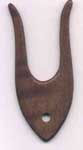
There are other forms of lucet that use frames with more prongs, and their output is even more similar to standard I-cord, or spool knitting (aka corking, knitting Nancy, horsereins). If you don’t have access to a talented and obliging woodworker or to a shop that specializes in obscure tools for historical needlework, you can attempt lucet on your fingers, or over the tines of a plastic fork with all but the two outermost prongs broken off.
The image above was shamelessly stolen from Phiala’s String Pages – a site dedicated to various forms of historical braiding and weaving. If you’ve ever lain awake at night wondering how you could distinguish among pieces produced by sprang, naalbinding, and tablet weaving, Phiala has tried them all and provides pictures. Here’s her lucet how-to.
Did you actually finish the pair, or just the one bootie shown?
How long did the pair take?
About as long as it took to watch the third Matrix movie on cable TV. It might have taken less time, but I kept jumping up to photograph my progress.
How much yarn did it take?
It’s hard to say. Very little, to be sure. I started with a partial skein of the green, and used less than half of that. I suspect around only 50-60 yards. Perhaps a bit more. I used to be able to get a pair of booties (without ties) out of what remained from two balls of Socka after I’d finished knitting socks for me.
Why is Rogue taking so long?
Because I don’t have a lot of time each day to knit. I usually only manage an hour or two at most in the evenings, while policing homework or watching TV. Less if other needs press.
I know some of you are writing to me in frustration because you’re trying to follow along with my progress, but there’s a reason why I neither participate in nor initiate knit-alongs. I knit on my main project when I can knit. Sometimes I choose to do other things – like reading, cooking, earning a living, accomplishing quick side projects, adding 150 yarns to the wiseNeedle database, or shoveling out the driveway instead.
Rogue progress tomorrow. I promise. Now I’ve got to go back outside and back to shoveling.
DIGRESSION – ANN KRECKEL’S BABY BOOTIES
A quick side trip. Faced with a need for a last-minute small baby gift, and having at my disposal some orphaned leaf green Dale Baby Wool provided by my pal Kathryn (Thanks, Kathryn!), I do up a quick pair of booties from a time-honored pattern.
Ann Kreckel posted this pattern for Janes Baby Booties to the KnitList in 1995. Her pattern was collected and preserved at Woolworks, itself (in Internet terms) a venerable Ur-source of knitting info – one of the first generation of knitting sites on the Web. Woolworks is now defunct as I update this post in 2021, but bits can still be found on the Internet Archive (aka The Wayback Machine).
Ann’s booties are a version of the classic Stay On Baby Bootie. Her pattern, though all text is clear and easy to follow. I can vouch for the fact that these booties do stay on. In fact of all the booties I knit for my spawn in their larval stages, these were the only ones that ended up being at all practical. (Thank you Ann, wherever you are today.) Other versions of this same basic idea exist, including ones published in the Taunton Press Knitting Tips & Trade Secrets book (1996, reprinting a letter to Threads circa 1991), and the XRX Socks, Socks Socks book (1999). Based on these sources and other hints of similar items, I suspect (but can’t document) that the fundamental design of these booties goes back through “knitting for charity and bazaars” leaflets and oral traditions that probably reach back to at least sometime between 1900 and 1920.
There used to be several websites around that showed pictures of the finished items. The only other one I can find is here, but it doesn’t show the eyelets and ties. I remedy the lack and post some interim progress shots as well.
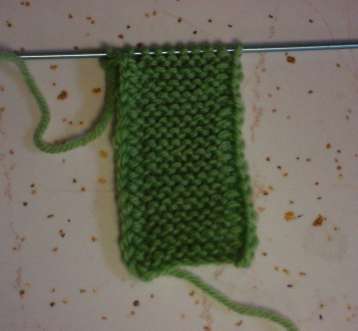
Knitting the first part – the strip of garter stitch that will become the sole. I used US #0 (2mm) needles to achieve a newborn size. I slipped the first stitch of each row purlwise. This made both counting my progress and picking up easier. When I had 18 edge stitches on both sides, it was time to begin the next step, with no need to sit down and count out 36 actual rows:
Here’s picking up around the outside edge. As you can see, I used a set of five DPNs. That allowed me to assign one needle to each side of the rectangle. Much easier than fiddling with dividing the stitches among fewer needles:

Here’s a photo after the completion of the knit and purl welts that form the sides of the foot box. These can be made a bit wider or narrower. (Hint: If I’m doing the purl welts in a contrasting color yarn, I switch on the LAST KNIT ROW before the new color welt begins):
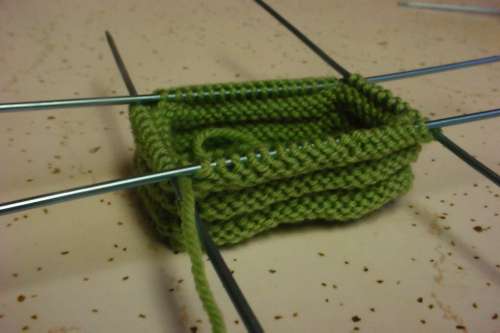
Yes, at this stage the bootie looks rather like a cozy for a tiny box of facial tissues. Don’t worry. Baby feet are small things with roughly the same proportion as bricks. These WILL fit, in spite of their boxy appearance.
Here’s working the top of the foot. Here I chose to do this part in stockinette. I find it easier to knit or purl the last stitch of the top of the foot along with the first stitch on the side needle by transferring the last stitch over to the appropriate side needle, then working the K2 (or P2) from the side needle.
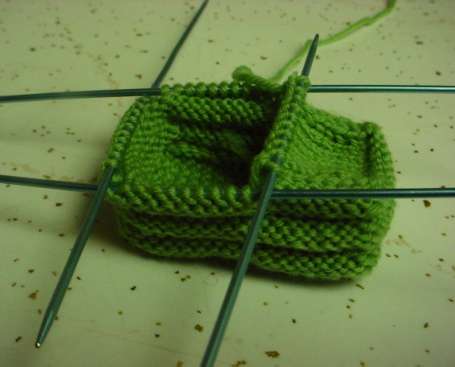
The next step is the transition to working the ankle. This is the only tricky bit in the booties, and Ann provided a very useful tip to get past it. There is a slight tendency for a hole to form at the indicated spot. I fudge this using Ann’s method. Just before working the last stitch of the first ankle round, I look at the spot I’m approaching – the first stitch of the round I am completing. I slip the loop of the stitch just below that first stitch onto my needle end, and when I work the last stitch of the round, I do it together with that “rescued” loop. Done this way there’s no chance for a little hole to form at the juncture point.
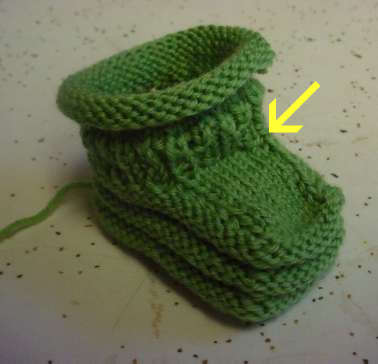
I often part company with Ann’s instructions after the eyelet rib section is completed. Here’s the spot to get playful. In this case I’ve opted for expedience instead of playfulness, and finished my bootie with ten plain rows of stockinette to make a simple roll-top. Sometimes I work a very small knit or crocheted edging onto this live stitch edge, working perpendicular to the established rows and attaching the edging as I go along.
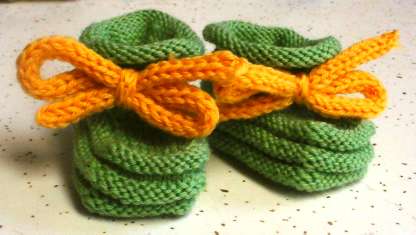
Once the booties are done I work my ties on my Strickmuhle I-cord machine. I used to do the I-cord by hand, but the ties often took as long to knit as did the pair of booties, so I switched. I’ve done braided, crocheted, ribbon-insert, and lucet style cords as ties, too but I like the clunky look of the I-cord the best. In this case I’ve used a bit of yellow Baby Ull left over from a previous project (There are no such things as leftovers, just bits of future projects waiting to be hatched.)
And the finished product, just in time for a spring baby:
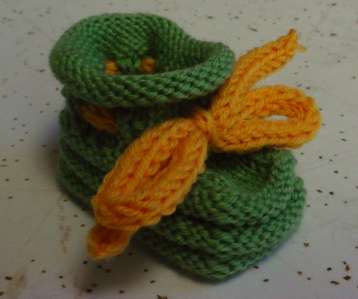
The yellow is actually paler and less mustardy than my lousy photography skills can show.
MANY HAPPY RETURNS – NIGHT AND DAY SOCKS
Back from a business trip to Tucson, Arizona. No, I wasn’t there for the incredibly huge Gem and Mineral Show, but wandered by one of the show’s many pavilion complexes in the little bit of free time I had on Saturday.
In the knitting realm here’s what I got:
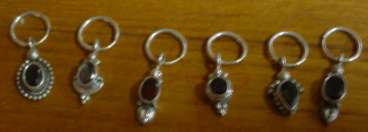
These are little silver mini-earrings – the kind some people line up by the half dozen along the edge of their ears. The dinglebobs (a technical term) hanging down are small faceted semiprecious stones – mostly garnets and pale amethysts, in small silver settings. They were incredibly inexpensive. (I’m sure somewhere in India there’s a whole village making these by the barrel full for next to nothing.)
While I was in Tucson, I happened to meet Dr. David Crawford, the Executive Director of the International Dark Sky Association. His group advocates for increased awareness of the problems caused by light pollution, and changes to local zoning/building regulations in favor of more efficient use of outdoor lighting. There are compelling reasons to improve outdoor lighting, including increased energy efficiency, reduced cost, and improved visibility where it is truly needed. There is also a growing body of research documenting how light affects people’s health and well-being, and the negative impacts that indiscriminant lighting can have on organisms of all types. When all of the other benefits are taken into consideration, the aesthetic and scientific benefits from preserving the dark night sky almost become secondary concerns.
In any case, Dr. Crawford’s impassioned (and sensible) ideas stuck with me on the over-long flight home. I turned out that the sock yarn I brought with me sort of fit the darkness and light theme, so I present Night and Day socks (still in process):

This particular yarn is Regia 4-Ply Ringel, Multi Effekt Color #5383. I’ve done a standard toe-up on US #00s, with 17 stitches on each needle (68 around). After the heel, I increased two stitches to a total count of 70. I did the increases where the corners of the short-rowed heel ends. Those two stitches help fill in the small hole that can form at that point. Normally I add a stitch on each side at that point anyway, then decrease it away on the next row. This time I just left them in.
The ankle pattern is a 10-stitch repeat I doodled up on the plane. I’m sure similar things exist in stitch dictionaries:

I hope that the the organization doesn’t mind having something as silly as a pair of socks dedicated to it. I’ll be writing up the pattern at greater length as I do Sock #2. If you decide to knit them, consider investigating (and making a donation to) Dark Skies.
Oh. The red jelly-bean looking things in the sock photo are lampwork glass ladybug beads, about to become a necklace for The Smallest Daughter. The other received earrings made from slices of a very small fossil ammonite, set in silver. My gift for myself was an unusual silver wire necklace thingy, meant to display large dinglebobs (see above). The ones I chose were rectangles of cobalt blue dichroic glass set in silver. (Dichroic glass is that iridescent stuff that looks like someone vitrified a peacock.) The Resident Male got an entire backpack full of various types of dried chili peppers – things that are hard to lay hands on here in this small corner of Massachusetts. He’s much happier with something edible.
LILLEHAMMER MYTHOLOGY
Posted in absentia. I’m off on a business trip, but left this behind.
A couple of people did write to say they would be interested in reading more about the symbols on the Lillehammer. Please bear in mind that this is just one person’s interpretation. I may be reading more into the little bits than the designers intended. And I am not someone schooled in this stuff. This is just one Avid Reader’s observations. Apologies if I’ve forgotten my Eddas and sagas, or have messed up the spellings.
Here’s my Lillehammer:
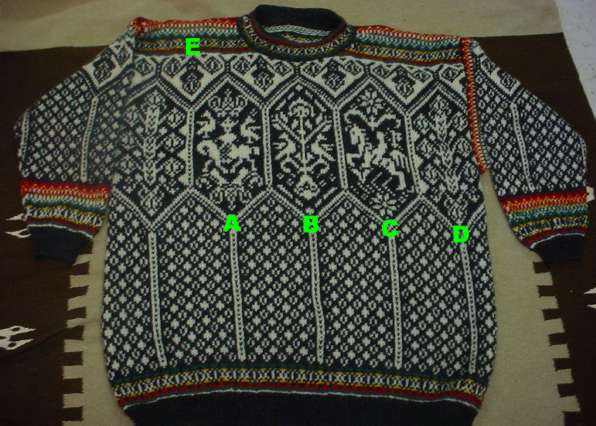
Starting with Lozenge C, just because I like to skip around, we see Odin chief and father of the gods, and god of battle and honorable death. He is riding on his ultra-speedy, eight-legged horse Slepnir (the extra legs are implied by the zig-zags). He carries his customary spear Gungnir (hard to see, but I think it’s here because he’s holding something long and thin in his hand) and has a raven following him. (More on Odin’s ravens below). I think he’s shown in profile because Odin has one eye (more on that below, too). The flower shapes might be an obscure reference to poetry (flowering words), as he was the source of bardic poetry and runic writing; and was the special protector of bards and poets.
Slepnir has a nifty parentage of his own, involving Loki masquerading as a mare to distract the dray stallion of a giant (the adversaries of the gods), to get him to default on a building deadline. The trick worked, the giant was unable to complete his project and received the penalty specified in the bargain, but Loki (a male god) was too tempting to the stallion, and ended up with foal.
Lozenge B carries Yggrdasil or Hoddmimir, the world tree. It’s a giant ash tree, most often described as white and covered with flowers. It grows from three roots in springs of knowledge, while its top shades all nine worlds, including Asgard (home of the gods), Midgard (where people live), Jotunheim (where the giants live) and Niflheim (the underworld). One of the roots was in the spring of Mimir. Mimir was an all-knowing god, whose head (some say skull) was thrown in the spring after he was beheaded. His knowledge though wasn’t lost, and some of it could be obtained by drinking from his spring. I see Mimir’s head in the ovoid object at the tree’s base.
On Yggdrasil are flowers that drip a honey-dew of inspiration, and are the ultimate source of all bees’ honey (and the exaltation that comes from drinking mead – a fermented honey-wine). Odin’s two ravens, Huginn and Munin perch on its branches. These two birds overfly the earth every day, observing everything and whispering that information back to Odin every night.
Odin is also closely associated with Yggdrasil because he sacrificed part of himself to obtain knowledge from the springs that feed the tree. In some tales he allows a raven sitting on the Yggdrasil to peck out one eye in exchange for a sip from Mimir’s spring. In others he hangs for nine days on the tree, transfixed to it by his own spear. During this ordeal he learns nine songs of power and the basic runes.
Lozenge A holds Freya, wife of Odin, and foremost female deity of the pantheon. Freya is a fertility goddess and wards agriculture and birth. I’m kind of stumped by the creature she’s riding because Freya’s mount was Hildesvini – a former lover disguised as a fierce boar. Either that or she got pulled around in a cart drawn by cats. The thing she’s riding on is way too long-legged to be a big pig. But the pattern calls out this motif set as being her, so I’ll try to find more in it. Freya did have the ability to transform herself into a bird by use of a magic cloak of bird feathers. She does have a large flat thing in her lap (perhaps the cloak); and there are birds around her. Perhaps the strange shapes at her mount’s feet are supposed to be cats as well. Her palace of Folkvang is supposed to be flower-strewn, so perhaps that’s a big flower below the cats. The royal crown above her is not uncommon on Norwegian embroideries, and so might signify her queenship over the gods.
Lozenge D and the partials up along the neck/shoulder line and sleeve tops all carry the same sort of organic growing thing. To me they look like fruit. The most famous fruit in this cycle of tales would be the apples of Idun. Idun was the goddess of youth, married to the Bragi, whose special charge was poetry. She kept a tree and stock of golden apples, which the gods ate to stay eternally youthful. Idun was once captured by a giant, and without her apples the gods aged quite quickly. There’s a whole cycle of stories about the quest mounted to get Idun and her apples back.
That’s about all the figural elements I can pick out from the design. The rest is just generally decorative. I do however particularly like the use of the close color banding at the top and edges. It looks reminiscent of tablet weaving, in a geometric that wouldn’t be inappropriate for before 1000AD. Likewise with the lozenge framing mechanism and brocade-like voided and filled dots. That’s not to say that knitting of this type was done back then (it wasn’t); but the style of the ornament on this sweater echoes weavings and textile decorative composition of a time when worship of these deities was widespread.
If you want to read more about Norse mythology, there’s always the public library – that wonderful resource in your own back yard. On line there’s also the Prose and Poetic Eddas, translations of which are both available on-line.
HOODIE AND SOCKS
I’m still noodling on the hoodie project. Target child is waffling about her requirements. I’d rather wait until she settles into firm conviction before casting on. Some questions came in after Friday’s post:
Why start with Rogue instead of designing your own from scratch?
First, I really admire this particular pattern, its proportions and the way the cables are so cleverly used. Since it fits so closely with the original set of requirements and/or mods to it would not be difficult, why not start out with it? Cardigan-ization isn’t tough, nor would be knitting a smaller size to compensate for gauge differences. As for the rest – the texture pattern and saddle shoulders with a cable down the center of the arms, as Target Child looks over the photos of other people’s finished Rogues, she’s becoming less attached to those concepts.
You know you can use knitting design software to help.
Yup. I know that. I’ve got Sweater Wizard and the older Cochenille product. Hated the latter. I didn’t mind the non-standard format of the directions, better suited for knitting machines than for hand knitters, but I was totally turned off by the lack of technical insight provided by customer support. The thing wasn’t cheap, and I could never get it to run properly. Only one or two of the supplied templates produced any sort of output, and even they were unable to produce more than one or two of the available sizes. “Support” claimed that it was a problem unique to my set-up and there was nothing they or I could do about it aside from waiting for the next upgrade and seeing if that worked any better. Since we’ve got an average of six or seven working computers in this house at any one time (all with different processor/opsys/video card combos), and I tried the software on all of them and turned up exactly the same bugs, I rather doubted that one unique set-up was the problem.
Rather than throwing good money after bad, I decided not to spend close to $100 to upgrade Cochenille (with no guarantee that the new version would work any better. I switched over to Sweater Wizard. It’s got far fewer design templates and isn’t a full-size sloper drafting program, but what it has actually works, and is quite easy to use both during the design and knit-from phases. Which is refreshing compared to my previous experience. My only criticisms of the product have to do with personal preference and fit. I find the standard fit a bit tight for my taste, so I always add extra ease (which is verysimple to do).
My real desire though is to be able to produce the full-featured graphs of actual garment pieces, showing color or texture pattern placement like the ones in Rowan magazines. So far no knitting pattern design tools come close to that degree of integrated pattern shaping/motif placement. Yes, there are export features that allow customization of garment shapes for colorwork placement, but no total pattern maker that lets you tinker with all parameters in one interactive console. (If you gotta dream, dream big. [grin])
Meanwhile, Back at the Ranch
Although progress is slowly burbling along on the hoodie, there wasn’t enough to keep my fingers happy over the weekend. So I started a pair of quickie socks. Standard Figure-8 toe toe-ups with short-row heels. I’m using Lana Grossa Melienweit Fantasy, on US #00s, at the (for me) relatively large gauge of 9spi (68 stitches around). Ankle pattern is an impromptu feather and fan variant:

Here’s the graph for the ultra-simple six-row feather and fan variant used on the ankle. It’s 17 stitches wide and six rows long. I’m working my socks on five needles (four in the sock, one to knit with). Because each needle has 17 stitches on it, this graph is worked once per needle:
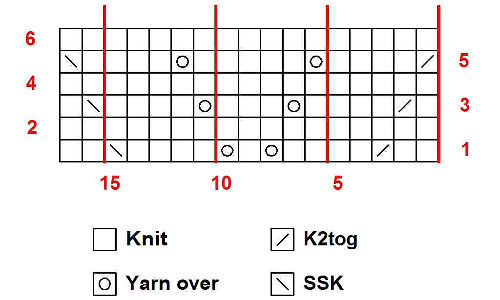
More info on knitting socks of this type, including basic how-tos for both the Figure-8 toe and short-rowed heel can be found in any of the sock patterns on wiseNeedle.
BY AND FOR, BY AND LARGE
UPDATE: THE PATTERN BELOW IS NOW AVAILABLE AS A QUICK DOWNLOAD PDF AT THE KNITTING PATTERNS LINK, ABOVE.
Sigh. Still no monitor. Perhaps today. At least today I’ve got Internet connectivity. Yesterday I experienced several hours of intermittent service interruptions (that’s why there was no Monday edition of String).
In the mean time, I’ve managed to get one of the other machines in this house to accept input from my bargain-basement digital camera. It’s blurry, but you get the idea:
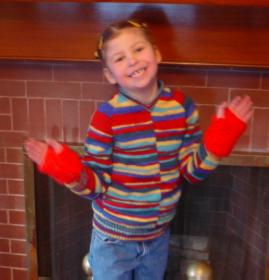
I finished the Crazy Raglan. Now it’s lurid and not my best effort, but it’s to the exact specifications of the target Small One, and she loves it. Perhaps this explains why:
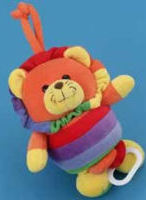
She’s got one of these. It’s been her favorite toy since she was only a couple of months old. Her Squeaky is now much less pristine than this catalog shot, and (mercifully) no longer plays a music box rendition of “Born Free.”? She?picked out the self striping yarn because she wanted a “Squeaky Sweater,” and now she’s got one. But I?think you have to be six to truly appreciate such things.
In terms of technical?performance and lessons learned – there were several. First, going back to mid-summer, there were all sorts of things to be experienced?managing the repeat and?width of the area being knit so as to best manipulate the striping. Second, I used?Sweater Wizard software to devise the basic raglan shape. I really like having that shortcut available to me, but I have to say that for kids sizes at least,?the templates do?run a bit small.I added both copious width/ease and length to make a custom fit on my string-bean kidlet, and it still turned out to be snug.
I’m not entirely pleased with the raglan angle. I should have made the armholes deeper. That would have changed the angles and made the sweater a bit more proportional. I also bowed to kid-preference and made a very shallow V-neck instead of a crew or deeper V, trimming it with a very narrow band of ribbing. She likes it, but I don’t – again the proportions are a bit off. Finally, I did a slip stitch selvedge edge on all pieces. I’ve done that before on raglans and had no problems, but they were solid color raglans, sewn with yarn of the same color. The mattress stitch seaming in the space dyed yarn – especially on the raglan seams – was VERY evident. I ended up taking it out and redoing it as pierced double running stitch to tighten up those shoulder seams and make them gap less. I also selectively cut bits of the darkest green to use for my redone seams. That helped a bit, too.
One thing I did do right was to use provisional cast-ons for the body and sleeves. I also knit both back and front at the same time, and both sleeves at the same time. After I sewed the seams, I went back and picked up the bottom edge stitches at body hem and cuffs, and knit the ribbing in the round. I did the body ribbing first, and liked the contrast between the narrow one-row stripes in it, and the wider stripes in the body. When I did the cuff and neckline ribbing I used two balls of yarn starting at two different points in the color cycle to ensure that they matched the waist ribbing.
So I post an equivocal success. The target audience was pleased, but I’m not enirely so.
Why “By and For?” in the title?? Because those little hand-mitt wristlets The Small One is wearing are a knitting product entirely of her own manufacture. They’re lumpen, odd little superbulky yarn paw-warmers but she’s very, very proud of them. Here’s the pattern. Such as it is:
Morgan’s Paw Warmers
Will fit a small child, age 6-10.
Small quantity of?leftover superbulky yarn. I can’t say what we used. I bought it years ago for holiday present ties. My guess is that it’s 100% acrylic.
US #10.5 straight single pointed needles. Tapestry needle for sewing up.
Gauge – roughly 2 stitches = 1 inch in garter stitch.
Cast on 16 stitches. Knit in garter stitch until piece measures about 6 inches long. Bind off four stitches, and knit across remainder of row. Knit next row, casting on four stitches at the end. On the next row, (K3, K2tog), repeat across the row, ending K1. Knit three more rows on the remaining 13 stitches. Bind off. Sew side seam, taking care to leave the thumb slit open.
WORKING REPORT: VARIOUS PROJECTS
Still no monitor, so I’m still photo-challenged here at String. Progress is being made on several fronts, in spite of the joyous accumulation of frozen precipitation that continues unabated.
First, I’m on to the sleeves of Crazy Raglan. I am knitting them flat, both sleeves at the same time, each from a single ball of the Regia Crazy. I had started the sweater body the same way, but being wider, I didn’t like the way the self-striper was manifesting itself. Those I did from two balls each, with an Intarsia-style join down the center front and back. I think the sleeves being narrower might look better done straight across. But as with the body, if I don’t like the way they look after a couple of inches, I’ll rip back and start again.
I’ve also completed a couple of pairs of socks that were sitting half-done in various small briefcase project bags. One is from a Lana Grossa Melienweit self striper, and is yet another standard toe-up, with a very ordinary ankle based on Old Shale. The other is a pair of kids’ toe-ups made from leftovers of several projects. One or both of these pairs will end up being donated to a charity auction.
I’m also finishing up my Cursed Socks. I’m well?past the heel of Sock #2. Unfortunately, I’ve misplaced my two Strickfingerhuts, and working without one is slowing me down. They’re in a knitting bag. Somewhere…
I’ve still got several UFOs in queue. But while I like to start off the year finishing up some of?the previous?year’s stalled efforts, it’s also fun to think on some new things. One idea I’m toying with is for a toy. Although I’m not a fan of Muppet-pelt furry novelty yarns, my kids adore them. They’ve asked if it’s possible to work up some patterns for stuffed pillows or floppy bed toys. But they don’t want licensed characters or recognizable creatures of any sort. They want fuzzy "Alien Pets" of their own devising. They’re scribbling madly away at their sketch pads even as I type this, adding extra limbs and/or tentacles, wings, and multiple eyes. We’ll see what develops…
And finally, I’m still working on the write-up for the lacy scarf. Yes, I know it’s taking a while, but I want to be sure that it’s as error free as I can make it.
MORE QUESTIONS – SNOWFLAKES AND FOOD
Did you crochet those snowflakes on your tree?
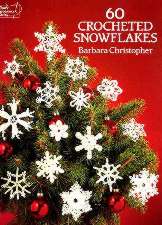
Yes. I’ve done them in several batches. I often invite holiday visitors to take one home with them, so replacement/supplement sets have been made. A couple of the flakes are my own invention, one or two are single motifs intended for bedspreads or tablecloths, but most are from these books:
 |
 |
Of the two, I like the patterns in the green Leisure Arts booklet better than the red American School of Needlework leaflet. The LA flakes are smaller, lacier and a bit more delicate. Both books are pretty easy for experienced crocheters to follow, but I’d recommend the red one if you’re relatively new to thread crochet. Warning – this IS thread crochet, although it’s pretty large scale for that style. These snowflakes all look better done with smaller threads and hooks. You can work them with relatively large threads, size 10 and bigger, but you won’t get flakes of a pleasing scale for hanging on a tree (they’ll look nice as door or window ornaments, though.) Mine were done with size 20 crochet cotton, although the next batch I’ll make will be with size 30 cotton, comparable to the stuff I used on the dragon curtain.
There are also lots of patterns for snowflakes on line, although I haven’t tried any of them yet. Noel Nevins maintains a nice index to them at her thread crochet website.
How was the cassoulet?
Wonderful. Worth the year’s wait. Beyond that, words fail me. And when that happens you know I’ve been conked royal.
Is cassoulet the most complicated thing you’ve ever cooked?
No. In what now seems like a previous life, The Resident Male and I were very active in the SCA (East Kingdom, Barony of Carolingia). Among the many things we did was host a Valentine’s Day event for the local group.
It was a themed day, and included several activities as well as a sit-down three course dinner for 125 people. The feast offered up nine main dishes from historical sources (of which I can only remember seven), plus three in-between-course sweets. The theme of the day was Chaucer’s Parliament of Fowles poem, in which the birds hold court to debate the nature of love. It’s more than 25 years ago, but as close as I can remember the “Feast of Fowles” ran something like this:
First course
- Ostrich eggs on salad nests – many chicken eggs cracked and separated, then the yolks poured into round golf ball sized molds and cooked to set. The whites were poured into huge half egg-shaped molds. When they were mostly cooked, the centers were set inside two half-whites.
- Not Chickens – a chicken skin with legs and wings intact, stuffed with a forcemeat style sausage, sewn back into chicken shape and roasted.
- A barley-thickened chicken soup with leeks (broth made from the bones and scraps from the Not Chickens)
- First sweet – spun sugar nests with tiny marzipan birds
Second course
- Ham dressed in pastry to resemble sleeping swans
- Chicken pies – the meat from the Not Chickens after the soup was made, cooked with onions, leeks and bread,?made into open face pies
- [memory fails on the third dish]
- Second sweet – Feather shaped shortbread cookies (again memory lapses, I think this was what we served)
Third course
- Roast duck stuffed with kasha and onions
- Beef birds – roulades of thinly sliced beef, wrapped around garlic and mushrooms, then braised
- [memory fails on the third dish]
- Third sweet – Peacock in its pride – three magnificently shaped and painted gingerbread cakes, each sporting heads, wings, and a fan of real peacock feathers behind.
There were also sallets (vegetable side dishes), brewed mead and ale, and nibbles offered earlier in the day. Before your mind boggles, please note that we didn’t offer these dishes in full-serving-per person portions. There was enough of each for everyone to have a fair taste, and to be full at the end of the meal, but not enough to stuff everyone silly (For example, for each table of ten we sent out one pie, one duck, one Not Chicken, etc.)
The Resident Male and I did not do all the cooking ourselves. Lots and lots of friends helped. They did the marzipan birds, the splendid peacock cakes, the beef roulades, the mead and ale, and half of the Not Chickens. Most of the rest we were able to cook together ahead of time and warm at the hall; the remainder we did on-site. RM ran the day-of kitchen, I ran the hall, the service, and arranged the entertainments, which included copious dancing (and flirting); a Court of Love adjudicated according to the rules of Capellanus; a poetry competition; and other gentle activities suited to the day and theme.
Needless to say, life has interfered with other pursuits and we don’t do this sort of thing much any more.
LAST OF THE HOLIDAY KNITTING; GENETICS
One last scarf to go. Since (at this point) I’m brain dead and desperate for something quick and easy, it’s a great thing that Knitty’s latest came with a fast-knitting piece that offers great bang for the time unit investment. Add me to the legion of folks doing up a Wavy Scarf.

I’m using that same sport-weight alpaca I used for the Kombu I finished last week. Because it’s of finer gauge than the standard-issue worsted written up in the pattern, I’ve added an additional six-stitch pattern repeat to make up the width. Mine is done on 48 stitches instead of 42. I’m also visually lazy, so I graphed out the pattern so I don’t have to rely on the prose write-up. Note that if you want to use a different weight yarn, modifying the thing is quick and easy – either add or remove multiples of six stitches.
In other knitting-related news, most of my knit presents are winging their way cross country right now, or are about to be distributed to those nearby. Once this scarf is done I’ll be done, done, done. (Huzzah!)
Cookie Liberation Front
Today’s cookie was an experiment – a coconut/oatmeal drop, based on a standard brown sugar drop cookie recipe, with toasted oatmeal and unsweetened coconut tossed in. Since I had some whole blanched almonds left over, each was topped with a nut. Younger Daughter said the rough-shaped cookies with almonds atop them looked like birds nests, so that is now their name.
Tomorrow’s cookies – Chocolate rounds stuffed with marzipan. I haven’t decided to do them flat or folded in half like little chocolate/almond gyoza yet. Also another experiment, but this one will be a shortcut cheat. I’ll be taking a sheet of frozen puff pastry, painting it with a beaten egg, then spreading it with sugar, cinnamon, and chopped pecans, folding it a bit and cutting it into elephant ears. Pix for sure, as this is something impressive looking even the Cookie Challenged could do.
Genetic Component of Crafting?
Marilyn the Knitting Curmudgeon posted an interesting thought the other day (one of many for her, I might add). She mused about whether or not the urge to do something like knit or make other crafts might have a genetic component to it. That got me thinking…
I’d guess that there would be a large inborn aspect to the desire to do these things. But I think there’s more than one influence at work here. To simplify, I’d guess that there are at least two:
- Some set of things governing the process that generates original ideas
- Some set of things that governs the "gotta-do-it" urge
I know people who have a strong concept-generation bent. They fairly sweat ideas, finding new viewpoints or perspectives, synthesizing disparate influences, or distilling previous exposures in innovative ways. The most affected of them sometimes have a hard time sticking to one idea long enough to bring it to full fruition, and may not have even mastered all of the skills necessary for optimal completion, but neither limitation strikes them as a problem. A person like that is off and running, captive to the next idea before the earlier one is completed.
I also know people who have the "gotta-do-it" urge, but the idea generation set in them is less strongly manifested. They are in constant motion, producing endless streams of items verbatim from directions or patterns. They often have extremely accomplished sets of technical skills, but can be stymied by roadblock problems. I have a friend who would seize upon an idea and explore it in hundreds of minute variations. She’d make wonderful little toys or identical baby sweaters by the dozens (in the case of toys – by the hundreds). All were beautifully crafted, yet it often seemed that once she started, "retooling" to make something else was difficult for her. She’d hum along happy to make even more of the item under current exploration rather than switching to a new thing. For her I think that fulfilling the "gotta-do-it" urge to keep busy was the true reward.
And then there are the folks who have both influences working on them in various proportions. Some feel particularly pressured or depressed because they have an inexhaustible source of new ideas and the urge to see each through to completion, but rarely have the time available to accomplish them all. Others are at constant war with themselves, reining in their urge to start something new before the item at hand is completed, and (sometimes) growing to hate the almost-finished item for blocking the beginning of the next.
Why do I think this might be genetic? Because I’ve seen these urges run through families. Not every person in the family need have the exact same hobby, but the mindsets do replicate through the generations. I know my father was a very compulsive "gotta-do-it" guy. Detail oriented in the extreme, he was a classic definition engineer. He never just sat still, he was always reading something, tinkering with something, or meticulously graphing something (he would have adored PCs and spreadsheets but died before they were sold). I know families where the parents or grandparents are method makers or idea shedders. Their households are sometimes chaotic places, but their kids also scatter innovation behind them and flit from project to project.
Why do I think these things are inborn rather than learned? Because in some cases I see these traits skipping generations; manifested in a household where the older influence was physically absent while the younger example was growing; or emerging later in life. Plus I know from experience it’s very hard to teach either creativity or perseverance. These are bents that people are born with. You can encourage these characteristics, but you can’t transplant them into someone who doesn’t lean that way to begin with.
I’ve got a very strong "gotta-do-it" bent. Perhaps it’s related to the milder forms of ADD, but I find HAVE to be making something, and I’ve been this way as long as I can remember. Even as a little kid I had all sorts projects underway (and heaven help the adult who put them away before I was done). I even fell into needlework at a very early age, and completed my first clumsy cross-stitch sampler before Kindergarten.
Just sitting has always been extremely difficult for me. Even just sitting and listening/watching something is hard. My hands have to be occupied. When my fingers are distracted, my mind is free and I concentrate better. Conversely, if my fingers are free, my mind is bound by the minutiae around me and zeroing in on some one thing in specific is harder. That fly buzzing around the lecturer’s podium; the interesting detail on the curtains behind her; the texture of the cracked wood at the edge of my seat; the air currents around my ankles; an amusing joke the guy sitting across the room told me last week; where I might be meeting with friends after the lecture; the faint sound of sirens outside the lecture hall; what color combo would be best for the thing I’m planning to make the day after tomorrow – all of these at once descend upon me and compete with the content being delivered in the lecture itself. Mindless autopilot knitting has always been my best defense against them.
I have to believe that I was born this way because I certainly didn’t learn this behavior from anyone. I can’t help this, it’s just the way I am and I’m glad to have found the coping mechanism of knitting. So I guess I agree with KC’s basic thought. There’s an enormous genetic component to many people’s affinity for crafts of all types. Why fight it?
Panforte, Piping, Presents, and Paeans
Panforte
I promised a post-tasting report. Yesterday I spread melted bittersweet chocolate over the tops of my two cakes, dusted them with cocoa, and stuck some left-over almonds on top as a decoration. Did I mention that for the past week, I’ve been drizzling rum over one of them – a little bit each day? No? The secret’s out now.
Wow.
This is an adult chocolate dessert. It’s not soft, gooey, and sweet. To be truthful, it’s hard and chewy from all the fruit and nuts. The taste however is out of this world. It’s spicy, more bitter than sweet, yet with just enough sweetness from the fruit to round out the flavor. The faint hint of rum was a good addition, and seemed to bring out more of the toasty notes from the nuts. We served our cakes with a selection of white wines. It would also be great with hot coffee or tea.
This one is a make-again keeper, but unless you’ve got a huge crowd coming or want to freeze or give away cake #2, I’d suggest halving the recipe. I’d also suggest sticking with the hazelnuts and almonds. You can use any dried fruit you wish (I used prunes, dried cherries and apricots because I don’t like citron and figs were too expensive), but I think that substituting walnuts or pecans would overwhelm the cocoa’s flavor and change the character of the cake.
Socks!
More holiday gift socks.
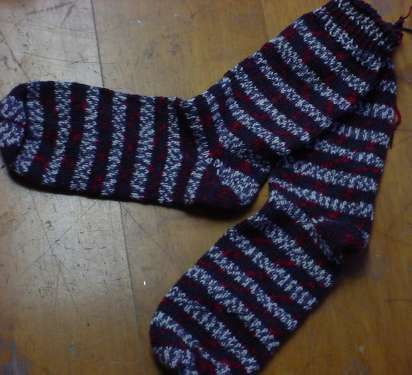
I knit these Saturday night from Lion Brand Magic Socks, while watching Present #1 below. These socks are worked at 7spi/10rpi on 2.5 mm needles (in between a US #2 and #3). The yarn is serviceable enough – a standard wool/nylon blend sport weight as opposed to fingering weight sock yarn. The color patterning is pretty uninspired compared to most. I get two speckled fake “Fair Isle” sections in this repeat, one in gray and white, the other in red and black. The entire repeat cycles in about 1 inch. Not terribly exciting, but at $7.00 US per 100g ball (enough to make up to about a man’s US size 11 shoe) – a very good value.
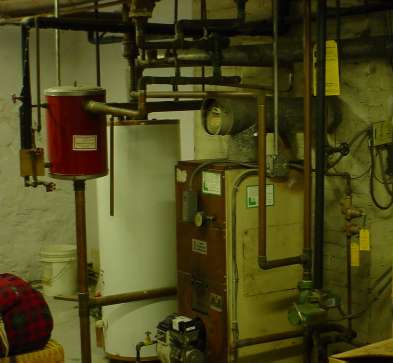
This pair is for a new neighbor who showed me how our 100-year old hot water heating system works, and helped me figure out the Rube Goldberg device that’s our boiler:
Presents and Paeans
The Resident Male and I buy gifts for the two of us together, but don’t wrap them or bother to save them for holiday debut. This year’s presents were the extended DVD edition of Return of the King (better than the theatrical version, but unsatisfying if you yearn for much of the books lesser themes and characters); the long awaited Lurulu by Jack Vance; and the Vance Integral Edition. The latter most was a major splurge that will count on the present roster for years to come.
Vance is writer whose works are easy to satirize because of his unique style, and who is dismissed all to lightly for it. At the same time, he has a devoted following of readers who appreciate them for what’s deeper underneath. His following in is bigger the UK and Europe than in the US.Vance appears to be especially popular in the Netherlands, Germany, and France – all in translation. That surprises me as so much of the texture of his prose is in his precisely worded detail and structured phrasing – things I wouldn’t think would move well from English to other languages. Even his old fashioned space opera style stories have a depth of character and sardonic insight into the ironies of human nature that push them beyond the genre.
If you’ve never read anything whatsoever by Vance, I’d suggest you start with the widely collected short story “The Moon Moth.” You can find a list of books containing “The Moon Moth” on this page. If you can’t find a copy, you can listen to a dramatization here. After that, pick up anything. His better known works include The Dragon Masters, the Demon Princes series, the Planet of Adventure series, Lyonesse and its sequels; the Alastor cycle; and the Dying Earth books. I’d start with his earlier, shorter works. They’re each masterpieces of tightly crafted plot construction, and fit an amazing amount highly evocative storytelling into some truly slim volumes. Enjoy!
 String-Or-Nothing