STARS OF THE BLOGIVERSE
I’d mentioned knitting the 42-stitch hats earlier. I’ve got them, they’re cute, but I thought they needed a certain something to make them truly special. I’ve got six now, two each of red, purple, and blue because each skein of Brown Sheep Burly Spun makes two hats with a tad left over. So I went looking for inspiration in several spots that have trims, embellishments and the like.
Of course I checked out Epstein’s Knitted Embellishments and her new Knitting on the Edge. I won’t be buying On The Edge, too much duplicates the KE book already on my shelf, plus I have most of the sources she drew upon, so there’s very little there new to me. Nice photos, though. Useful if your library isn’t as out of control as mine, or if visual inspiration is key to your thought process.
I also looked through Thomas’ Knitting Book to check out picot point knitting, and a couple of other books that had tassels or other freeform motifs. I even dipped into my crochet resources, but crochet in finger-wide bulky yarn looks ridiculous to me. I tried out several knit flower and leaf type motifs, but nothing quite hit the spot as being bold enough for the ultra-bulky hat.
Then while taking my daily blogstroll, in a fit of serendipity, I hit on Nanette’s Knitting in Color (she of the stranded colorwork book and bunny haven). There she’d posted some directions for knitted stars, worked from the outside edge in. Even in supergiant yarn with a distinctly ruffled look her stars are perfect for my hats!
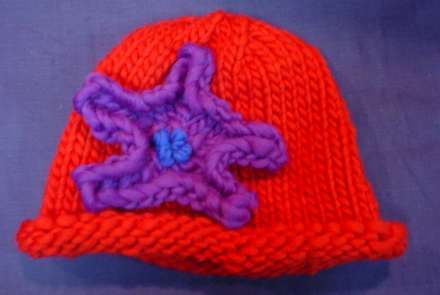
I played with them a bit, working them up in the round instead of flat to spare myself the joy of a purl side double decrease and a seam, and using a double decrease that leaves the centermost stitch on top. (This first pilot star was done with the decreases as described in the original directions). I had just enough left over from each skein of my Burly Spun to make two stars, plus have a bit extra for sewing and surface embroidery.
MORE SOCKS
More holiday gift socks. Nothing special, nothing exciting (and nothing learned).
I knit these last night from Schoeller+Stahl’s 6-ply version of Fortissima Colori/Socka Color. It’s a smidge lighter than DK weight. I’ve added into on the length of its color cycle to the striper repeat chart I posted earlier. All in all a very quick and satisfying pair. A bit heavy for my own sock wearing preferences (I prefer 4-ply regular sock weight yarn knit at tiny gauges), but nice none the less. Another blurry photo:
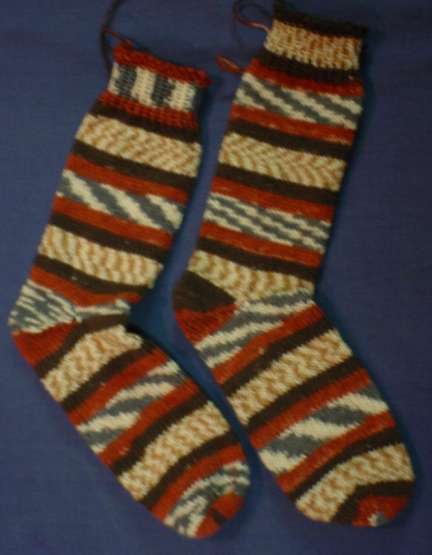
I find it easier to knit self-stripers when I’m watching TV or a computer game. Otherwise I’m tempted to watch my fingers and micro-adjust my tension to modify the striping effect. That never quite works out right. So I save this type of autopilot knitting for when I’m otherwise distracted.
Cookies
I’ve gotten some good-natured ribbing back on the cookies. For the record, I’m no domestic diva. Martha Stewart makes me think of those Victorian women’s magazines, filled with advice on decorating a status-conscious parlor, complete with directions for crocheted chair leg cozies and decorated cardboard toothpick holders. Then I shudder.
I’m more of a tallish, glasses-wearing, workbooted, aging grrlnerd with a weakness for needlework, history, books and good food. Not necessarily in that order.
SCARF-A-RAMA
My holiday knitting. I’m pleased to say the Hannukah socks were graciously received by someone who both knows and appreciates hand knitting.
The scarves aren’t scheduled for distribution until later this month, but as all are to be mailed, should be boxed up as soon as possible. Here they are:
First, the blue one for which I offered up the texture pattern earlier in the week.

Not terribly exciting, but soft and warm. And blue. I’m debating whether or not to fringe this one. Fringes aren’t my favorite edge treatment as they often look ratty too quickly, but I have a feeling that this recipient would like them.
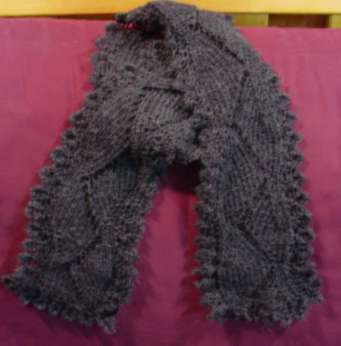
Second, the gray alpaca Kombu scarf is finished. Here’s another blurry photo to prove it:
And finally, after sitting completed (but never used) since earlier this summer, the Spring Lightning scarf joins its siblings in this year’s gift parade:
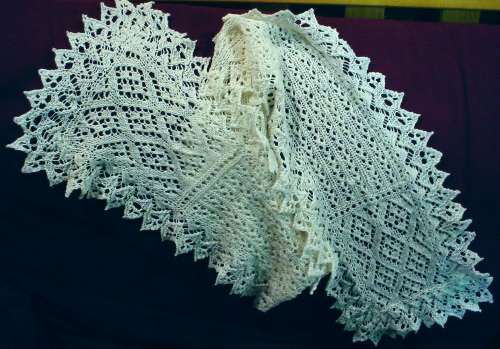
I love it, but I think the intended target will love it more. Plus, I can always make another. I did however want to take a final good picture of it for use in the pattern I plan on posting on wiseNeedle (which I’m still writing).
Two more hats and two more pairs of socks and I can return to my regularly scheduled knitting.
THE BEHINDER I GET
I can’t say I’m going any faster, but I’m in the swim of things with my gift knitting. I have to admit a tinge of guilt this year. In years past, I’d done a fair bit of it far in advance, sometimes using especially mindless gift knitting (like socks or scarves) as bliss-out-on-the-beach pieces during our summer vacation. Or I’ve doodled up little projects between larger ones, while I was waiting for my ideas to set. By this time I’ve usually got a basket of goodies ready for holiday giving. Unfortunately, this year nothing got done ahead of time, and I’ve been forced to do something I detest – knit to deadline.
I hate knitting to deadline because in my professional life, all I do is march to deadlines. I’m a proposal manager, and I’ve lived my career in 30-day increments. Other people will say things like, “Dear, remember ’91 – that was the year little Brunhilde was born,” or “Yeah, 91. Cousin Ildefonse was in Desert Storm.” I say, “Fall ’91. That was that big military IT/hardware support proposal, we had an extension that got eaten up by the sheer bulk of the revised reporting schedule requirements.” From this you can well deduce the heart-stopping excitement of my daily life.
Knitting has always been a blissful interlude, a no-deadline finish-it-whenever sort of pursuit. That’s one of the reasons why I’ve shied away from pursuing commercial publication for my patterns. Squeezing my knitting life into a tight deadline sucks all the joy out of it.
So here I am. Doing frantic knitting on a couple of Hannukah presents (it’s early this year, adding further complications). The Kombu scarf, four hats, and two pairs of socks are done. That leaves three scarves, two more pairs of socks, and possibly couple of kid’s size earwarmer bands to go.
Today I plan on casting on for a very simple scarf done in Sandnes Lime (a mostly cotton, very soft yarn) for a friend who is wool-sensitive. I’ve used and reviewed the stuff before and not been wildly pleased with it, but for a scarf it should work out fine. Although most of the detail will be obscured by the textured yarn, I’ll probably work it in this simple knit/purl pattern – just to give it a bit more interest:

I like this one for scarves because it adds a bit of loft and like all patterns with near equal amounts of knits and purls on each row – it lies nice and flat without curling.
WORKING REPORT – KOMBU SCARF
I’ll try to get a good shot of this one. It’s in a charcoal-grey alpaca, a notoriously difficult color to photograph.
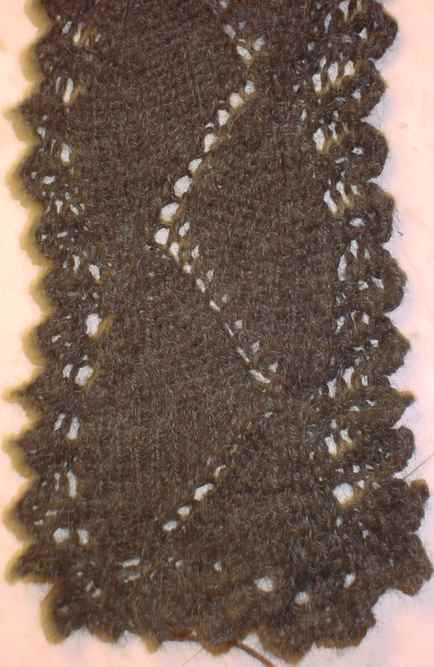
The stuff is sport weight. I mentioned before that I got it at a Maryland Sheep and Wool Show, circa ’95 or ’96. There was a big rainstorm that year, and many of the vendors in outdoor tents were soaked through and/or blown over. The Tess Designer Yarns booth was particularly hard hit. Sunday afternoon as the owner was packing there was still a large pile of sodden yarns laid out on a tarp that were being sold as-is. I bought this one-skein orphan, took it home and dried it out and wound it, and have been trying to figure out what to do with it ever since. There’s a ton of yardage on this 8 oz. ball. I’ve barely scratched the surface and could probably do another three or four scarves with what’s on there.
My gauge over my Kombu is K1, P1 rib is roughly 6spi , on US #4 needles. This gray scarf is about 6 inches wide, measured point to point. I’ve completed about three feet so far, averaging about eight inches per hour. Both the center pattern and lace edges are quick to memorize and knit. Alternate rows of the center are K1, P1 rib; alternate rows of the edgings are all knit. Because the scarf is based entirely on a combo of ribbing and garter stitch it lies absolutely flat, without curling.
I hate to brag, but I really like this pattern – even though it’s one of my own. It’s rare I go back and do another of anything I’ve finished. Even that Dreaded Second Sock can be agony, but this is the fourth Kombu I’ve done. Two were done in Little Lola (including the same photographed on the pattern website) at a slightly smaller gauge (befitting the slightly thinner yarn). The other was done on US #7s and a 4.5 spi in pink/turquoise/yellow/lime green Red Heart variegated, picked out by a (then) 4 year old. Both my eyes and fingers hurt doing that one, but the kidlet was delighted with the all too bright result after she decided that the yarn wasn’t so scratchy that she couldn’t wear it as an "outside the coat" type scarf.
WHAT’S A 42-STITCH HAT?
Several people wrote to ask about the 42-stitch hats I mentioned yesterday. I attempt to answer.
The pattern (such as it is) is widely available. Cleckheaton has a version that they authorize yarn shops to give away with purchase of Gusto 10 that’s written to be specific to the yardage of that product. I’ve also seen very similar hats in several of the beginners’ books so popular now, distributed as shop patterns by LYSs, and posted other places on the Web. Basically, it’s a hat boiled down to its barest essentials – a very large gauge stockinette tube with a crown formed by simple decreases. The brim is formed by the natural tendency of stockinette to roll.
1. Find at least 55 yards of yarn that knits up to about 9 or 9.25 stitches = 4 inches. I got 9 with Cleckheaton Gusto, and 9.25 with Brown Sheep Bulky Spun. The Bulky Spun hats measure a bit under 18.5 inches around the lower edge, and stretch for a comfy fit on adults. The Gusto hats are just under 18.7 inches around the lower edge.
2. Cast on 42 stitches, and knit stockinette in the round. I used plain old half-hitch cast on to avoid a tight edge, and to conserve yarn. I did the whole thing on a set of four size US #13 DPNs, but if you hate double points you could do it on two circs, or start on one short circ, then move to DPNs.
3. Knit tube until it’s long enough to both cover your ears and reach just under the crest of your head. That’s about 7.5 to 8.5 inches, including the rolled brim (which should be flattened out to measure). If you’ve only got 55 yards of a superbulky, don’t make this part deeper than 8 inches.
4. Divide the stitches into 6 groups of 6. If you’re on DPNs, that means placing a marker (or remembering the spot) in between the two center most stitches of each DPN. Finish the hat by working six consecutive rows of knit with decreases, always working a decrease just before a marker or (if you’re on DPNs), the needle’s end – that’s six decrease points around the hat. You can work either K2tog or SSK, as you prefer, choose one and work it throughout the piece. If you pick K2tog, the decreases should stack up and spiral in counterclockwise to the center. If you pick SSK, the spiral should end up running clockwise. When you’ve got only six stitches left, thread break off the yarn and thread them up on the tail, drawing them up purse style. Darn in ends.
Note that you can make this hat larger or smaller by adding multiples of six stitches. A little kid size hat out of the same weight yarn would start out on 36 stitches.
If you pick a lighter-weight yarn, increase the cast on number by units of six, how many will depend on your yarn. For example, if you’re using a yarn that’s 10 to 10.5 stitches = 4 inches, 42 stitches would probably be a bit small, I’d aim for 48 stitches and hope that the fit wouldn’t be too large.
I wouldn’t attempt this hat with yarn that’s much lighter than 2.75 stitches per inch (11 stitches = 4 inches) for two reasons. First, much of the charm of this rustic-looking funky hat depends on the bulk and body of the yarn used. The silky firmness of dense Gusto is more satisfying than the less-dense Bulky Spun. Lighter weight yarns would be even more floppy. Plus I’d need to do more experimentation to satisfy myself that every-row ratio of crown decreases would work out as nicely as it does on the heavier-yarn hats.

Finally I have to note that I don’t like knitting yarns at these huge gauges. I can knit non-stop for hours on sock weight yarn, but this big stuff tires out my fingers. Also this is the first project I’ve ever worked on DPNs where if you look closely, you can pick out where my DPNS met. Feh.
PROJECT – RIDGED RAGLAN
A break from the monolith of text that this blog has become.
I’ve been having an on-line chat with a knitter looking for something to do with a pile of small balls/many colors of worsted weight yarn salvaged from a ravelled back Intarsia sweater. I recommended the Ridged Raglan from Knitters Magazine #54,?Spring 1999 issue.
This is my 6-year old’s all-time favorite sweater:

Also please excuse the blurry photo. Some days the camera and I get along, others we war. Believe it or not, this is the best of ten shots.
This pattern is by Gerdine Crawford Strong, and in my opinion is the last thing?Knitters published that was a "gotta knit it" project, and the last thing I’ve made from their pages. But my disappointment in their current direction is food for another day’s post.
Ms. Strong’s pattern is pretzel-clever. It’s knit vertically, with the arm and front (or back) panel knit at the same time – decreases form the raglan lines. The "ribbing" bands at waist and cuff are actually garter stitch worked at the same time as the sweater arms/body. The idea is presented in sizes from little kid through adult XXL, and as both a pullover and as a cardigan. It calls for a worsted weight acrylic, but anything knitted to the same gauge can be used.
I hate to make more than one of anything, but I’ve done three of these sweaters. One was a two-blues cardigan in Encore (a mostly acrylic/wool blend); the one above is a pullover in three citrus colors of?Record 210, an Aran weight unmercerized cotton; and one was?a pullover in Tahki Cotton Classic, all in tiny balls salvaged from a five-pastel intarsia project abandoned by my mother. For the latter two I had to play a bit with the pattern to accommodate differences in gauge.
As you can see, there are tons of scope for fun with this project. It’s a great vehicle for using up bits and drabs. You need one color for the purl welts that?unite the piece as a whole (in my case, navy blue, orange and white respectively), but the individual stockinette stripes can be anything, from scraps leftover from several different projects to one of those hand-dyed yarns that can be so challenging to use effectively.
My only caution is that if you do choose to use cotton take care with the cuffs. Knit an extra garter stitch ridge, and try to work them loosely otherwise they can be too tight for quick dressing. Wool and wool blends however are naturally more elastic than cotton, and don’t present this problem.
If you go searching for the Knitters #54, Spring 1999, it looks like this:

A final note to US citizens – go vote or lose your right to complain for the next four years.
YES, I LIVE NEAR BOSTON
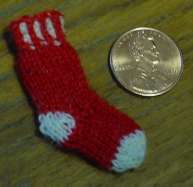
Fully fashioned toe-up, short row heel sock with corrugated ribbing, 16 stitches around. Knit from Froelich Special-Dekatur reinforcement yarn using US #00000 (1.0mm)needles. Approximately 1 inch (2.5cm) from top of cuff to bottom of heel, and approximately 13spi/20rpi. I may not be wearing my heart on my sleeve, but I will be wearing a tiny sock on my lapel.
PROJECT: WORMING HARLEKIN CARDIGAN
Here’s yet another cautionary tale. This one is about worming.
I’ve seen lots of questions about worming – what is it, why does it happen, how to avoid it. The what question is easy to answer. Here’s a quick little cotton/chenille cardigan I whipped up for The Smallest One this past spring:
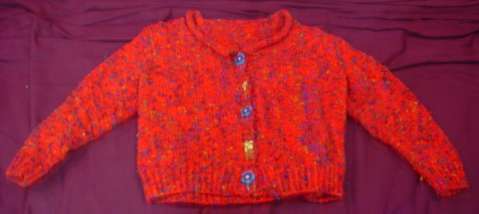
It’s knit from Stahl Wolle’s Harlekin Color, a rather plain generic raglan in stockinette, with a rolled collar and cropped waist. I did up the pattern (such as it is) using Sweater Wizard. That part and the knittingwent well, although the yarn split like crazy and was a *($# to knit. The thing is bright and cheerful.The Smallest One had fun picking out the pansy and bee buttons. I even went back and got more of this yarn with a navy base color and knit a raglanpullover for the larger daughter.
Things however began to go wrong shortly after completion of both projects. Both sweaters began to worm. The little chenille strands separated themselves from the cotton yarn and began poking up here and there. Hand washing however caused all restraint on worming to break. In spite of the lousy photo, the result can be seen here:
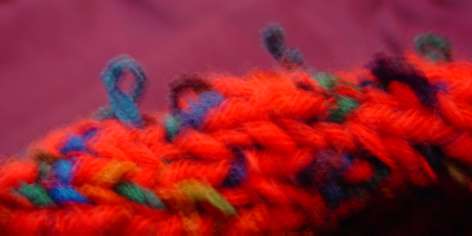
No I didn’t tease these loopies up, nor did I pick a particularly bad part of the piece. The entire surface is like this now – a ratty, trashy looking mess. The kidlet still likes her bee sweater because it’s soft, but it catches on everything it comes near and I shudder each time I look at it.
Moral of the story. Chenille isn’t worth the effort. That’s four for four projects I’ve attempted using chenille or chenille mix yarns that have ended up looking like hell within a fortnight of completion. It’s pretty andthe colors are great, plus Iknow some people love the stuff and swear that they can control the worming. I’ve tried knitting it more tightly than label gauge. I’ve tried knitting it in combo with something else. I’ve tried chenilles of different fiber compositions, but I’ve never had decent results. Buyer beware. This buyer will never purchase nor work with chenille in any of its forms ever again.
More Mags to Trade
Courtesy of a very generouspal, I find myself with duplicates of two Interweave Knits back issues: Fall, 2003 and Winter 2002/2003. I’ve got both in my library, and useful info shouldn’ sit idle.
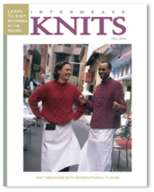
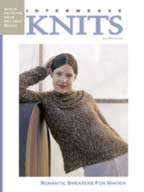
If you’re looking for these and would like to engineer a trade, please let me know. Preference will be given to folks outside the USA. I know that people In Other Countries often don’t get a chance to get these mags, and we here in the US often don’t get the treat of seeing needlework publications from other countries. I’d love to trade one or both of these for one or more knitting, embroidery, crochet, or other specialty needlework magazines published elsewhere in the world – language doesn’t matter. If you’re interested, please let me know.
RETURN OF THE PRODIGAL SOCK
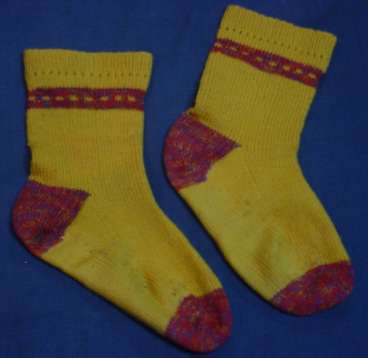
A long, long time ago, I sent in an entry to the Socknitters Museum of Odd Socks. In it I detailed the tragedy of losingone of the firstfingering weight yarn socks I ever knit – an eye-popping mustard yellow thing, with toe, heel, and ankle stripe in a tweedy red left-over. That must have been back in the summer of ’96, just after I moved to my last house, and (coincidentally) just after the sock bug bit me.
In all that time my missing sock never turned up. Although I was sure it would reappearbehind a bureau or underthe washing machine,I didn’tfind it when we moved out, although we left the old house broom clean and bare to the walls. I came within a hairs’ breadth of tossing the mate to my missing sock when I divested myself of others during The Great Sock Exorcism. At last minute though, I took my mustardy friend out of the toss-me pile and tucked it back into my sock drawer as a reminder of life’s eternal mysteries.
Yesterday I got an envelope in the mail. Itcontained the missing sock.
No note. No return address. The postmark was local, but not in town. My guess is that the new owners of my old house found it – where I haven’t a clue – and knowing I probably missed it, mailed it to me. Either that or the colorblind poltergeist finally had enough of the thing and decided to send it home.
 String-Or-Nothing