APPLIED STRIP EDGING WITH MITERED CORNER
I’ve played around some with methods of producing and applying the edge finish to the khaki vest. First I tried the separately knit/sewn on band method, using a couple of different approaches to the seaming (fold band longitudinally, sew the band up, then apply it; sew on both sides in one pass; sew on the display side, then do a separate seam to affix the facing side). Of all of them, the last method worked best, but it was the most effort intensive of them all.
So I looked further. Plain I-Cord (knit on or applied) was too narrow to stabilize the edge, and two courses of it would have been too bulky. I didn’t like the way that picking up along the edge then knitting out looked – especially along the curve of the armhole.
Even more experiments ensued. Finally I landed on knitting-on a strip parallel to the edge, then going back and seaming down the free side on the inside of the piece. Doing that I could produce an edge of any desired width, go around curves and even plan on mitering the vest point corner. Here’s a swatch with a mitered corner. Note that I haven’t sewn down the facing on the inside yet, but natural stockinette curl is keeping it nice and neat. (For some, the inside seaming might be optional, but I plan on doing it on my finished piece).

To miter the corner of this 8-stitch strip, I used short rows. Here’s how I did it:
Applied 8-stitch Strip Facing with Mitered Corner
Start with the public side of the work facing you, holding it with the bulk of the piece on the left, so that you’re working up the right side of the thing (upside down from the picture above). Using straight needles, cast on 9 stitches, then pick up one stitch in the edge of the piece being finished. While the strip is 9 stitches wide, one is consumed during joining, so the part that protrudes is really only 8 stitches wide.
Row 1 (wrong side): P8, k1.
Row 2: S1, k6, ssk, pick up one stitch in edge of swatch
Row 3: S1, p7, k1
Repeat Rows 2 and 3 until you reach the corner, having just completed an odd number (wrong side row)
Row 4: S1, k6, wrap and turn.
Row 5: Slip the wrapped stitch, p6, wrap and turn
Row 6: Ignoring any previously wrapped stitches, S1, k5, wrap and turn
Row 7: Ignoring any previously wrapped stitches, Slip the wrapped stitch, p4, wrap and turn
Row 8: Ignoring any previously wrapped stitches, S1, k3, wrap and turn
Row 9: Ignoring any previously wrapped stitches, S1, p2, wrap and turn
Row 10: Ignoring any previously wrapped stitches, S1, k2, knit the next stitch along with the loop around its base, turn
Row 11: Ignoring any previously wrapped stitches, S the stitch you just knit, p2, purl the next stitch along with the loop around its base, turn
Row 12: Ignoring any previously wrapped stitches, S1, k3, knit the next stitch along with the loop around its base, turn
Row 13: Ignoring any previously wrapped stitches, Slip the stitch you just knit, p4, purl the next stitch along with the loop around its base, turn
Row 14: Ignoring any previously wrapped stitches, S1, k5, knit the next stitch along with the loop around its base, turn
Row 15: Ignoring any previously wrapped stitches, Slip the stitch you just knit, p6, purl the next stitch along with the loop around its base, turn
The corner is complete, return to repeating Rows 2 and 3. Optional finish – seam down the inside edge of this facing.
I’ve stated applying this same edging to the armholes of my vest (having previously seamed the shoulders).
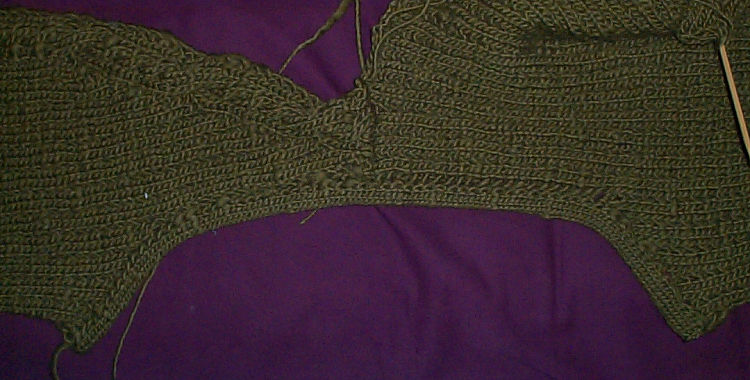
I plan to do the bottom edge next, incorporating the mitered corner on the vest points. But I haven’t played with the buttonhole band treatments yet. Sadly, I have misplaced my copy of InkKNitters. It’s here. Somewhere… Weekend plans include tossing my knitting library to find it.
Oh. Unless a monsoon is upon us, weekend plans also include attending the annual Gore Place Sheepshearing Festival in Waltham, Massachusetts. Not a big festival as fiber fairs go, but very local and lots of fun. Look for me with both Elder and Smaller Daughter in tow.
WAISTCOAT AGAIN
I have finished the major pieces of Older Daughter’s khaki waistcoat (adapted from the 1940 pattern hosted by the V&A Museum). Once I had the right gauge and measurements, they knit up quite quickly. Before I begin sewing them together add the edging, some serious industrial-grade blocking has to take place. Right now they’ve got that larval curled-up caterpillar look. Here is one of the two front panels:
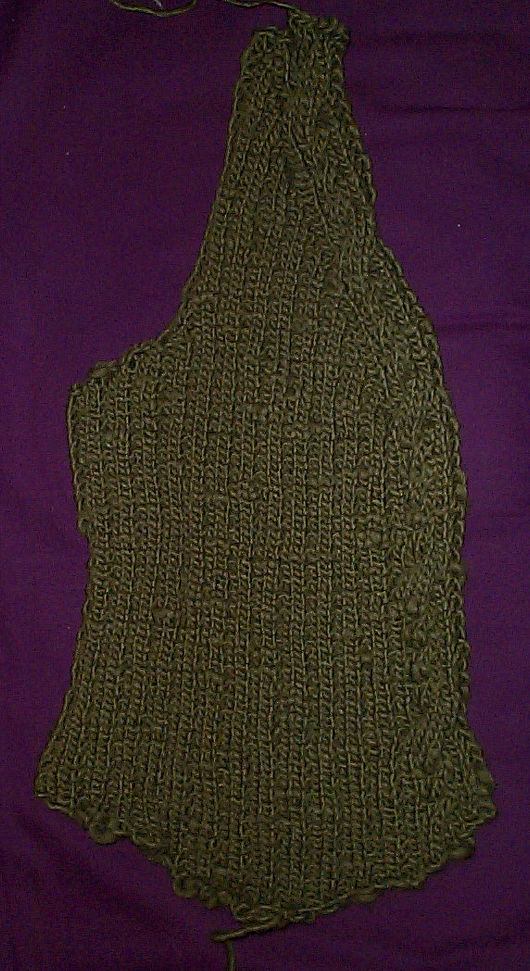
I am quite pleased with the way the cable on the neck edge worked out.
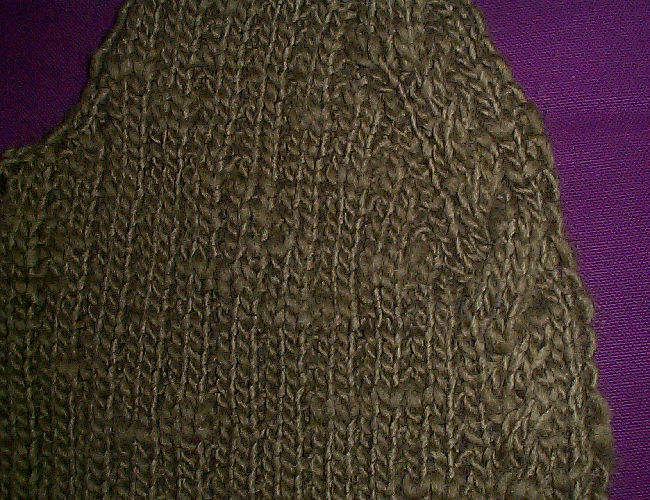
The cable itself is one pictured in Stanfield’s New Knitting Stitch Library. I’ve got quite a few stitch treasuries on my shelves. I leaf through them all, but when time comes to actually employ a stitch – this is one of the few that gets knit from most often.
The next step (after blocking) will be to knit and apply the bands around the armholes and the front. The original pattern suggests that the knitter work 8-stitch bands with slip stitch selvages right and left – 20 inches long for each arm, and 60 inches for the front. The bands are supposed to be folded in half and steamed flat, then sewn on, leaving periodic gaps on the appropriate side to create the buttonholes. Very labor-intensive.
I think I’m going to experiment. I’ll knit a body-like sacrificial swatch and some pilot-project edging to test out various configurations for creation and assembly.
For example – why not knit the edge onto the body pieces on the front side, incorporating a column of purls to make a turning edge down the center, then fold along that line and baste the free selvage down on the inside?
Or why not experiment with an extra-wide i-cord style strip, knit directly on?
Or how about picking up along the edge and knitting out, using mitering to make the waistcoat corners?
And while I’m at it – why not figure out how to move the buttonhole so that it’s centered in the edging rather than floating between the body and the border element? Lucy Neatby has an ultra-nifty buttonhole and band trick I’ve been dying to try. She sells leaflets and videos and holds workshops explaining the technique, and wrote a summary of it for the Fall ’04 edition of InKnitters.
INTARSIA IN THE ROUND
After yesterday’s post on my Galaga Hat, I’ve gotten a couple of questions about the method for working back and forth seamlessly to make a tube. In specific, some people wanted to see illustrated how I make the wrap and turn join. I try to oblige them (click on pix to see them larger):

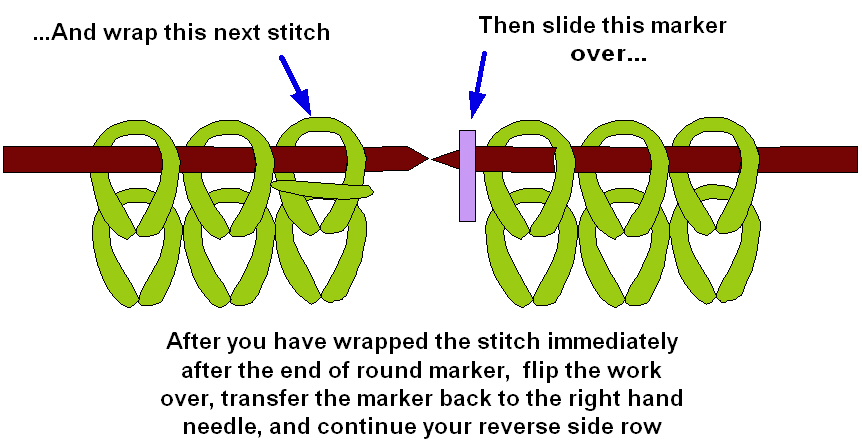
I’ve shown just the knit-side round. The purl side round works in exactly the same way. Work to the marker, making sure to work the last stitch before the marker along with the loop around its base, shift the marker over, wrap the stitch after the marker, flip the piece over, return the marker to the right-hand needle, and continue with the rest of the round.
Why go through all this trouble?
I don’t have enough yarn to strand around the entire piece. Nor do my motifs span the entire circumference of my hat. I am in effect working spot Intarsia motifs (actually I’m stranding between them, but limiting that stranding to the spot motifs). Rather than cut the yarn at the end of each motif, or stretch it back to the beginning of the spot design on each row, I am working the equivalent of flat knitting – going back and forth, alternating rows of knit and rows of purl. When I purl or knit back to my spot motif, my contrasting color ends are on the correct side of the motif for the next round. But I hate sewing up, and want to make a hat without seams. Rather than knit this totally flat (a valid option), I’m using wrap and turn to make the join at the end of each round.
RETURN FROM LIMBO
I’m back in place after a horrific spate of work-related deadlines, followed hard by a much needed vacation and its attendant flood of post-vacation laundry. We visited with family; took in the warm, sunny, Florida weather (in spite of all the locals shivering in what they perceived to be a cold snap); played golf; ate way too much; watched the kids splash at beach and pool; and tried to stay away from work and eMail.
I even had time to do a little bit of knitting, but I did not bring Older Daughter’s vest with me. I have finished the back and am about half-way through the vest fronts. With just the armhole/neck half left, a fair bit of blocking would be required before I could play with finishing and adding on the trim. Since there is generally not enough room on aircraft for aggressive blocking (or aggression of any sort), I left that project home and took the Galaga hat instead.
As you can see from this one-handed shot, I’m moving through the thing. It’s slow going, with a fair bit of more than two color stranding involved over 9 stitches per inch.
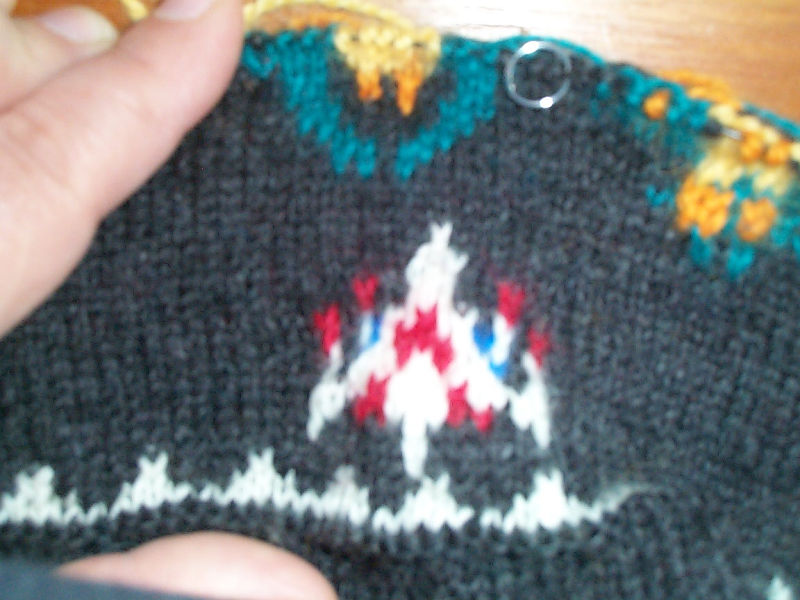
I used a provisional cast-on, then knit a plain gray self-facing about three inches deep (approximately the height of the first two courses of the motifs. Then I worked two purl rows as a turning edge, and the white triangles as the first visible bit that will be seen after the self-facing is fused back into the hat body. I placed two white ships on either side of the hat.
On this side the first course of bug-enemies will be in teal, using the larger bonus ones from the game – one splayed and one flapping. The other side has three, set somewhat skew to the ship. After this course is done, I’ll fuse the facing, then do a decrease and work the next tier. It will also be the larger bonus enemies, but in the other color combo. After that will come another round of decreases, and several tiers of the shorter non-bonus bugs. In between each tier will be another decrease round.
My biggest complication is that I am very short on the colors. I’m using scraps of Frog Tree Alpaca left over from Older Daughter’s rainbow hat and scarf. That’s why the enemies aren’t marching in full continuous rows around the whole hat. It’s also why I’m not working this truly in the round, although the piece is on circs. Yes, the piece is seamless, but I’m muddling my way through a variant combo of stranding and Intarsia in the round. On motif bearing rows, I’m working a knit row across all my stitches. When I reach the end of what would be the round instead of going forward and continuing in knit, I wrap that first stitch, return it to the left hand needle, then turn the work and head back the way I came. When I reach the end of this purl round, I purl the final stitch along with its wrap, wrap the next stitch (on the next needle). Then I return that wrapped stitch to the left hand needle, flip the work over, and head back on the knit side. When I get to the last stitch of the row, I knit it along with its wrap, wrap the next – and so on.
What I’m getting at the joining point is a bit of a thickening that were I working in a lighter color, might be more visible. But in my plain charcoal gray, it’s not very evident. This may not be among the approved methods for working something seamless on circs, but employing both knit and purl rows, but for me and for this project it’s fine.
KHAKI WAISTCOAT – BEGIN AGAIN
First, a celebration of a past project – the 1941 vintage vest redaction I knit for The Resident Male. Pre-season golf is an iffy thing in Massachusetts, but he and some pals went out this weekend past. His new vest came in handy:

I had to take a sanity break last night from my thundering herd of deadlines. I managed to get a whole half-hour’s worth of knitting in before exhaustion triumphed. Just enough to figure out that my piece was too narrow (the point of knitting the back first), and rip back to begin the whole thing again from scratch.
Why?
I discovered that the fabric of my 1940 waistcoat-style vest draws in more than I thought it would, and that to ensure that there will be enough width in the final product for the buttons to close without gapping, I need to tinker a bit with the stitch count, adding a few to the original specifications.
Sometimes swatching just isn’t enough. It wasn’t until I had the entire width of the back on the needles and knit to about 6 inches deep that I was able to get a good feel for the behavior of this particular yarn and its larger gauge in the designated rib pattern. My swatch measured out o.k., but my 6 inch square turned out to be less representational of the final fabric than is the norm. Which isn’t to say swatching is a bad idea. Instead it’s good to remember that changing as many variables as I am doing multiplies risk of ripping back, and if you do such things, you should be prepared for unexpected results.
Since the bulk of the body (front and back) is done in a simple K2, P1 broken rib, I added two ribs (6 stitches) across the back, increasing my cast-on number from 73 to 79. I think I’ll also have to add length. Target daughter is on the tall side, like me. The original dimensions plotted out on her frame look like she’s wearing something intended for her 8-year old sister. I intend to keep a fit on the snug side, and not lengthen the piece more than her height calls for. So all in all, I’ll be preserving the proportions of the original, but scaling it up a bit in all dimensions. Given that the original looks like a size small (33 inch bust and a very short bodied 16 inches collar to waist), and I’m both changing gauges and rewriting the thing to fit a 5’7″ tall size 14, such adaptations should be highly expected.
Now if only I hadn’t ripped out the swatch (I am a frugal swatch yarn re-user) and the back before writing this post. I could have illustrated this with a comparison between the two. Trust me to think from frustration rather than forethought in the middle of this hectic week…
BACK TO THE 1940s AGAIN – WOMAN’S WAISTCOAT
Thank you to everyone for all the suggestions! Elder Daughter has looked them over.
She does want a vest, and not something with a shawl collar. The retro ’70s belted sweater is nice, and something her classmates would wear, but not spot on for Elder Daughter.
Also she has fallen in love with the Tahki Saba yarn. Being a 4 to the inch bulky weight, the mass of additional pockets was not something she wants in this piece. But she does like the idea of lots of pockets with military type buttons, and has filed that away for future Mom-torture.
The Audrey sweater had promise if turned into a vest, but she didn’t like the placement of the cables and the way they ended before the shoulder. She liked the shape of the silver screen cardigan (not a knit pattern), but thought it was a bit overly dramatic for daily wear. She also liked the Lavold pattern Cul de Sac, but it would be difficult to adapt it to the much larger gauge yarn. Besides – that one is on my list to knit someday for ME. However the idea of a waistcoat instead of a horizontal bottom did stick big time.
By seeing everyone’s suggestions, she got the idea that there were other patterns available for browsing on the Web. So she made a sketch of her idea:
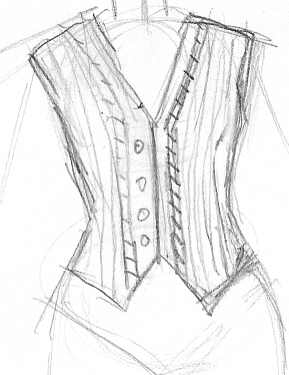
and we went looking.
Lo and behold, we found something that is pretty darn close:
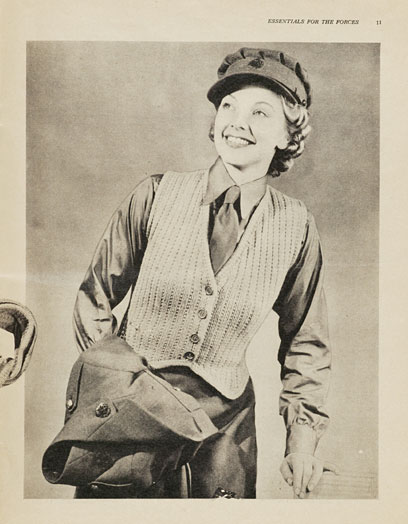
This pattern is from a 1940s vintage Jaeger troop knitting leaflet made available by the Victoria and Albert Museum as part of an on-line exhibit on knitting. In addition to the other items from this booklet, there are several more of similar vintage. There’s a link to a contemporary Rowan freebie there, too.
The original was written for worsted weight wool, and is presented in only one size, with a 33 inch measurement around the chest. But doing the math, working at 4 spi rather than 5 should yield a garment close to our target measurements.
Elder Daughter likes the broken rib texture of the original. It should work well with the texture of this particular yarn. BUT she’s still stuck on the idea of the cable running up the front on either side of the button band. I’ll oblige her, but I’ll play with it somewhat. Instead of forming the V by ending off at the neck edge, I think I’ll put the cable immediately next to body edge, moving the decrease point to inside it. The cable should then continue uninterrupted, and the wide ribs of the body should dead-end at the cable as it traverses them. Depending on how much the ribbing draws in, I might also add some kind of under-bust dart, narrowing away one rib at the narrowest point at the waist, then slowly reintroducing it above that point.
So there you have it. Another adaptation of a historical pattern. I’ve swatched and she’s busy casting on for the thing now (I promised her I’d let her work on as much as possible, given the restrictions of matching our gauges). I’ll do the back first and use it to confirm fit. If that goes well, I’ll noodle out the transformed front and go for it.
Oh. Should you wish to knit this one up yourself verbatim from the pattern instructions, you should know that the yarn, notation and needle sizes are true to the historical period. The yarn called for – 8 ounces of “Jaeger Spiral Spun” appears to be a standard worsted. I’d substitute Cascade 220 to get the pattern’s native gauge of 5 stitches and 7 rows per inch. The needles called for – #5 and #9 are old UK sizes. UK #5 is equivalent to 5.5mm, and #9 is equivalent to 3.75mm. Amusingly enough, 5.5mm is a US #9 and 3.75mm is a US #5. So you’ll still need a #5 and a #9, but you’ll need to flip the references to them where they appear.
Another feature of this pattern rarely seen today is that all of the edging bands – the buttonhole band and armhole edging included, are worked separately as strips on the smaller needle, and then seamed onto the finished piece. This is a rather fussy finishing detail that if done neatly makes a significantly more professional looking treatment than does picked up and knit out ribbing. We both like the look and I’ll try to do it properly.
More on this as we get deeper. Again thanks for all the hints!
END OF SQUEAKY; BEGINNING OF VEST
May all your finished objects be received with this kind of joy:

In terms of knitting experience, the Classic Elite Star worked up very quickly. It is a bit hard to knit because of its elastic component. I ended up stretching it as I went along. My stitch gauge was pretty close to target, but my row gauge was off, with more rows per inch than I thought I’d get. The crinkly finished look mostly obscures stitch texture. There’s no point using this for anything much more complex than stockinette or garter stitch. Intarsia type colorwork would work although it would look best with large, clean shapes rather than anything fussy. Stranded colorwork would probably be problematic, because of the uneven appearance of individual stitches, and the gauge complexity of using an elastic yarn evenly in stranding. Still, the yarn was enjoyable to work with. I’d use it again.
I have had very little knitting time over the past two weeks, but 10 minutes here and 10 minutes there, I did manage to finish the sleeves of Smaller Daughter’s Squeaky sweater. It’s urchin-baggy, just the way she wanted it, and I had **just** enough yarn to finish. I’ve got a half skein of a couple of the colors left over, but I used every scrap of dark blue, yellow, dark green and light green – which is why that last light green stripe on the shoulders is only half-height. Not only was I out of light green, but the color itself may have been discontinued. It was flat out unavailable from any of my usual sources, so I made do. The sleeves are just long enough. I may have to go back add length to them in future years as target child grows. Or not if this piece ends up being loved to death before it gets outgrown.
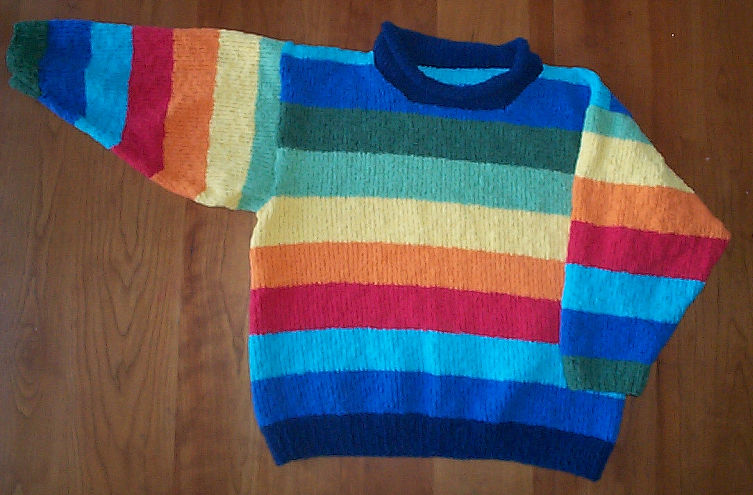

I will not be posting this pattern here. After the last post about it I was directed to KnitNet, where this month a similar looking toddler dress is being featured. Since my sweater looks a little bit like it, I’ll avoid stepping their toes. Besides, no one reported being interested anyway.
Larger Daughter is now clamoring for something. Her tastes run more to camo, black, and khaki – far more aggressive than the happy-unicorn-rainbow suite favored by Smaller Daughter. She has combed through my stash, and come up with this:

The Saba is an old Tahki yarn, probably from the late 1990s. It’s a thick/thin single-ply in construction, 100% wool 89 yards per skein. Recommended gauge is 4 stitches per inch on size 9 US. It’s very soft, and if I had to guess (not being sheepy myself), I’d guess that it has a high Merino content, though the type of wool is not marked. I got this lot for free via the local town on-line discussion list. Someone posted that they were putting it out on the curb, available to the first taker. Being just down the street, I zipped over and rescued the bag of 12 skeins steps ahead of the trash truck. 12 skeins is about 1,068 yards total.
The buttons were part of this year’s holiday haul. I ordered two 95-cent lots of assorted shank style military buttons from American Science & Surplus. Between the two lots, I got enough of three different button types/sizes to furnish four sweaters. This particular group of four bears Air Cadets Canada markings and insignia. The others I received had Soviet stars. My guess is that they’ll eventually end up on other sweaters for this same daughter.
What to make with this yarn? A vest has been requested. Something a bit on the long side, with waist shaping, a deep V-neck and (obviously) four buttons. Maybe with a simple cable running up both sides of the button band, and a hem facing on the bottom rather than ribbing at the bottom edge. Final decision on those last details has not been made. Since this yarn is relatively soft and a single, I am expecting it to pill somewhat. I haven’t swatched it yet to determine optimal gauge, but I wouldn’t be surprised to see that it looks better knit a bit tighter than the label directs. I’d hate to totally obscure the thick/thin texture though.
Open invitation: Style pointers for this project from those of tastes and ages similar to Older Daughter would be greatly appreciated, in part because anything I suggest has Mom-Taint attached. She’s far more likely to entertain suggestions from other sources than from me. The constraints are the limited quantity of this yarn, a rather shapely size 14 target currently in high school, four military buttons, and the basic concept of “buttoned vest with a deep V neck.”
Since my broken-field run through the deadline swarm at work is not lessening, I don’t anticipate quick progress on this project. But I’ll try to document some of the interesting bits and decision points as I go along.
SQUEAKY PROGRESS
The striped pullover in Classic Elite Star progresses. Karen however warns that in her experience Star can bleed in the wash. I’ll take that into consideration and treat it as a hand-washable.
I’ve completed the body and the collar, and am now starting on the sleeves.

I don’t have any more of the navy blue, so I’ve started the cuffs in the darker of the two greens. They’d make an incomprehensible and boring photo right now, all muddled up on a very springy circ, so I’ll spare you that image. The color progression on them will be (more or less) the same, but because they are three inches shorter, they will probably end with the deep green at the top, too. And yes – I did calculate the stripe widths so that the turquoise one that spans the top of the shoulders and that is seamed up the center is the same width as the other stripes after assembly.
The reason I have only one or two skeins of each color is that this mixed bag lot of Star was a thank-you gift from a friend who works at Classic Elite. A couple of summers ago I pitched in to help her complete several sweaters in their fall line when their scheduled finishers couldn’t make the photo shoot deadline. It’s been stash-aging a while. This sweater will probably end up almost all of what I have – 1 skein of yellow, navy, and light green, two skeins each of all the rest. It’s a good thing I started it now rather than wait any longer. Too much longer and the target child would have outgrown the available coverage.
If anyone is interested when I’m done and can incorporate any notes from production, I’ll post the pattern in this one size.
FUTURE HAT INVASION?
Yesterday I mentioned that I was working up two new projects. The second is still on the drawing board. While The Resident Male likes his crazed llama herder hat, he’s mentioned that it can be itchy, especially when wet. It’s also a bit tight on him. He’d like another that’s slightly larger, knit from softer wool than the first, but he still really likes the style and shape.
So I was thinking about what I could put on a hat for him, and what colors of sport and fingering I had on hand. I’ve got some small quantity leftovers from the rainbow scarf set. Not much, but enough for accents. Plus I really like the Camelia sport I’ve been using, which is about the same gauge but at my LYS is only available in very staid colors. So I began thinking about what would be mostly background with flashes of bright colors, yet would be guy-wearable. Then I saw the latest issue of Knitty. If someone can put Space Invader graphics on a sock, why not highly colorful Galaga spaceships on a hat?
For those of you born during or after Bush-the-Elder’s administration, Galaga was a very popular coin operated console video game of the Galaxian type – vintage 1981. You can play it here. It has been brought out for X-Box and some hand-helds (even phones!) but it’s not the same. It was also one of The Resident Male’s absolute favorites. (I preferred Tempest, but those vector based graphics wouldn’t chart up well for repro in knitting.)
So I set about graphing out the Galaga galaxy of sprites from screen shots preserved hither and yon. There are three enemies, each shown in two animation phases. One of the enemies repeats in a different color scheme. There’s also a separate sprite for the player’s ship, and a toggle that shows how many more player lives are available. Here’s one of the lower level enemies:

I’m not quite sure how I’ll fit these onto the hat, but I note that in my original, I buried all the decreases in the plain rounds in between the step-type pattern repeats. I had 10 decrease points per decrease round, and that the pattern repeats themselves were based on 10 stitch x 10 row units. Each decrease zone between bandings removed one entire repeat. That’s why I was able to repeat the pattern seamlessly as the hat narrowed.

I changed the rate of decrease as I moved along, narrowing the hat more steeply in the upper area not by increasing the number of decrease points, but by shortening the interval between them. You can see that the lower courses of the design are three pattern units tall, but the uppermost ones are only one unit tall. After that last unit was completed I didn’t have room to continue full design iterations, so I ended off with a solid color top.
My Galaga sprites are nine, thirteen and fifteen units wide, without background framing left and right. So I’m still on the drawing board for this one. Plus I can’t actually begin knitting until I finish my second Klein Bottle hat. Still, I’m armed and ready to begin.
SQUEAKY WHEELS GET SWEATERS
As I finish up the gray leaf pullover, and wander through the midpoint of a second Klein Bottle hat (solid navy, difficult to photograph), I plan my next set of two projects.
The first of these I’ve already begun. It’s a quick pullover for Smaller Daughter who has now outgrown the Regia Crazy Stripes raglan I made her two summers ago. I’ve mentioned her fascination with her favorite toy before.
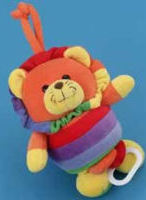
Squeaky is still with us, but he’s aged somewhat. His original colors are only a dim memory. The strings on his head were surgically reattached after a regrettable incident featuring scissors. His music box long ago gave up trying to play Born Free (a welcome change); and the retractable leg that triggered the play no longer draws back into the body. His shiny black nose was chipped back to its pink undercoat after being inadvertently slammed by in a closing car door. He’s going bald all over. More suspicious stains than I care to remember have added to his decoration. But he still is a source of comfort and inspiration.
Smaller daughter wants yet another striped Squeaky sweater. I had some Classic Elite Star stashed away, a skein or two in each of a bunch of crayon colors. It’s a cotton bound with lycra. Although the recommended gauge and fiber percentages are a bit different, it’s visually similar to the old Silk City Softball – a nubbly and cozy machine washable cotton boucle that knits up into a soft and interesting texture. In a departure for something I find buried in stash, Star is still in the current CE line. Armed with Sweater Wizard, I’ve noodled up a quick roll neck pullover, knit in the round, sized for a tall 8-year old who wants something with a generous, boxy fit. As you can see, I’m off to a quick start.
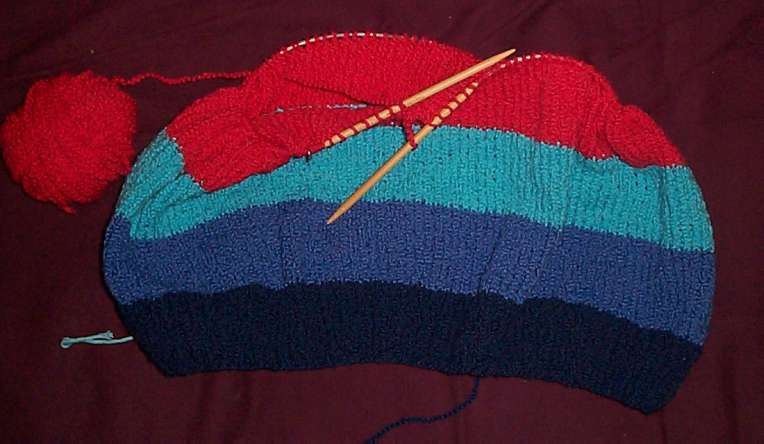
Orange, yellow and light green are next (I have no purple on hand). Stars being a lycra-enabled cotton is not necessarily a quick knit though. Care must be taken to always knit it with the same amount of stretch, or gauge can be affected. Also, it’s texture makes counting rows very difficult – something pointed out by the person who posted the Star yarn review. Since my stripes are each 20 rows deep, and it’s a pain to keep track on a separate piece of paper, I’m relying on a little trick to stay on track.
Every five rows (an easily grasped smaller unit), I flip a yarn color change tail to the front or back of the work.

These big “basting stitches” make counting simple – four groups of five and I’m ready to grab the next color. Later when I finish this piece it will be equally simple to tease these ends out to their points of origin and end them off inside.
One caution – this isn’t a yarn that crocks (sheds color on hands and needles). Were it so, I would not use the dangling tails for this purpose. Instead I might use a length of plain white smooth cotton string. That would give me something easy to remove later that would not run the risk of leaving contrasting color marks on the lighter areas.
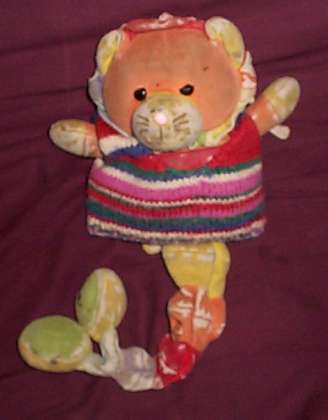
And Squeaky himself? In a bit of art-imitating-life-imitating-art, the toy that inspired the Regia Crazy Color sweater for the child has his own Regia Crazy Color sweater.

 String-Or-Nothing