WORKING REPORT: PATTERN WRITING – SPRING LIGHTNING SCARF
Face it, incremental progress on the Dragon is as boring to see day in and day out as it is to report. The thing is chugging along, but I’m past the part of the process that’s interesting. There are no new challenges or problems to overcome – just plain old slow and steady progress. On my other projects, I’m stll looking for the bag with the raglan and entrelac pieces. It’s here somewhere. Emphasis on the somewhere.
So I turn to another intellectual exercise with a challenge factor increased by prior laziness and poor timing: writing up a pattern for an object that I finished a while back, and on which I took very few working notes.
To be truthful, my Spring Lightning scarf is better documented than most of my efforts. Blogging does serve a purpose after all. I did find the scarf itself – a happy byproduct of my continuing quest for the striped raglan sweater.I’ve got the graphs I printed out to start with, although Providence alone knows where the copy I annotated as I worked has gotten to. And that city’s not talking.
I begin with a photo or two. I’ve posted these before. Unless people here think that these are adequate, I’ll have to take another that shows the piece relaxed and ready to wear. No I won’t take a shot modeling my scarf. I prefer to labor sight unseen.

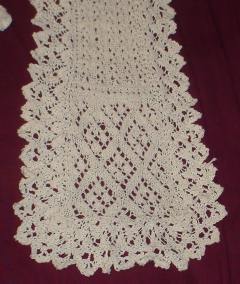
Now I can figure out my original cast-on number from my chart. I remember that I worked slipped stitch selvedge edges, because I used them when I was knitting the edging on to the finished strip. I didn’t document the little welted eyelet bits between the main pattern sections, but that’s easy to retro-engineer. My original charting didn’t include the long (but simple) zig-zag motif used the scarf’s center. I did that one up off the top of my head as I was working. I think I can re-create it though with minimal trouble. With luck my fingers will remember the pattern.
The edging I do remember playing with, so it’s not quite straightforward. I started with something that was much wider than the final version- arelatively deep lacy edging adapted from one in Heirloom Knitting, but I tinkered with it a bit. Plus I used the pull a loop through and knit with the slack method of knitting the edging onto the body that I learned doing the Forest Path Stole. I’ll have to figure out a way to write that up that’s both original and non-confusing. I think that will be the most tricky part.
So it’s off to boot up the house server, pull up the pattern template in DreamWeaver and Homesite, and code the thing up for wiseNeedle. One thing I won’t be doing this time is rewriting the entire pattern in prose format. I doubt that anyone who would want to knit a lace piece of this complexity is going to want to wade through prose directions. Plus there’s only so many hours in my day, even if I do stretch the definition of a day by being among the "sleep optional" part of the population.
PROJECT: WORMING HARLEKIN CARDIGAN
Here’s yet another cautionary tale. This one is about worming.
I’ve seen lots of questions about worming – what is it, why does it happen, how to avoid it. The what question is easy to answer. Here’s a quick little cotton/chenille cardigan I whipped up for The Smallest One this past spring:
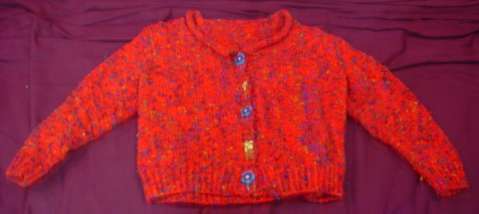
It’s knit from Stahl Wolle’s Harlekin Color, a rather plain generic raglan in stockinette, with a rolled collar and cropped waist. I did up the pattern (such as it is) using Sweater Wizard. That part and the knittingwent well, although the yarn split like crazy and was a *($# to knit. The thing is bright and cheerful.The Smallest One had fun picking out the pansy and bee buttons. I even went back and got more of this yarn with a navy base color and knit a raglanpullover for the larger daughter.
Things however began to go wrong shortly after completion of both projects. Both sweaters began to worm. The little chenille strands separated themselves from the cotton yarn and began poking up here and there. Hand washing however caused all restraint on worming to break. In spite of the lousy photo, the result can be seen here:
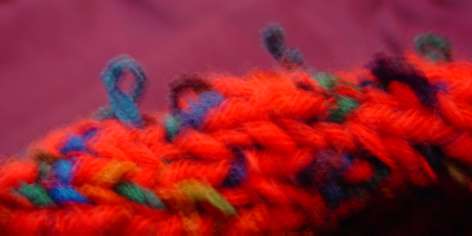
No I didn’t tease these loopies up, nor did I pick a particularly bad part of the piece. The entire surface is like this now – a ratty, trashy looking mess. The kidlet still likes her bee sweater because it’s soft, but it catches on everything it comes near and I shudder each time I look at it.
Moral of the story. Chenille isn’t worth the effort. That’s four for four projects I’ve attempted using chenille or chenille mix yarns that have ended up looking like hell within a fortnight of completion. It’s pretty andthe colors are great, plus Iknow some people love the stuff and swear that they can control the worming. I’ve tried knitting it more tightly than label gauge. I’ve tried knitting it in combo with something else. I’ve tried chenilles of different fiber compositions, but I’ve never had decent results. Buyer beware. This buyer will never purchase nor work with chenille in any of its forms ever again.
More Mags to Trade
Courtesy of a very generouspal, I find myself with duplicates of two Interweave Knits back issues: Fall, 2003 and Winter 2002/2003. I’ve got both in my library, and useful info shouldn’ sit idle.
If you’re looking for these and would like to engineer a trade, please let me know. Preference will be given to folks outside the USA. I know that people In Other Countries often don’t get a chance to get these mags, and we here in the US often don’t get the treat of seeing needlework publications from other countries. I’d love to trade one or both of these for one or more knitting, embroidery, crochet, or other specialty needlework magazines published elsewhere in the world – language doesn’t matter. If you’re interested, please let me know.
RETURN OF THE PRODIGAL SOCK
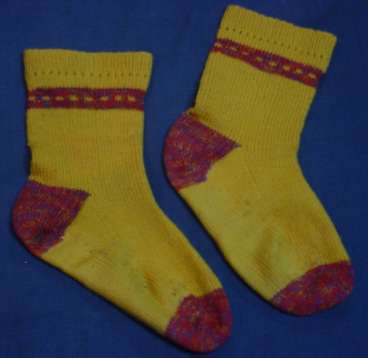
A long, long time ago, I sent in an entry to the Socknitters Museum of Odd Socks. In it I detailed the tragedy of losingone of the firstfingering weight yarn socks I ever knit – an eye-popping mustard yellow thing, with toe, heel, and ankle stripe in a tweedy red left-over. That must have been back in the summer of ’96, just after I moved to my last house, and (coincidentally) just after the sock bug bit me.
In all that time my missing sock never turned up. Although I was sure it would reappearbehind a bureau or underthe washing machine,I didn’tfind it when we moved out, although we left the old house broom clean and bare to the walls. I came within a hairs’ breadth of tossing the mate to my missing sock when I divested myself of others during The Great Sock Exorcism. At last minute though, I took my mustardy friend out of the toss-me pile and tucked it back into my sock drawer as a reminder of life’s eternal mysteries.
Yesterday I got an envelope in the mail. Itcontained the missing sock.
No note. No return address. The postmark was local, but not in town. My guess is that the new owners of my old house found it – where I haven’t a clue – and knowing I probably missed it, mailed it to me. Either that or the colorblind poltergeist finally had enough of the thing and decided to send it home.
PROJECT: MAGENTA’S COMING OVER!
No, the kids’ Blues Clues videos haven’t gotten to me. One of my all-time favorites is a sweater done in screaming magenta wool. I did it ages ago, back when I was a regular customer at Washington, D.C.’s late, lamented Woolgatherer in Dupont Circle.
There was a guy helping there who was fantastic. Back then I had the itch to knit, but a ramen noodle?budget. ?I’d walk in, pull my crumpled dollars and left-over laundry quarters out of my pocket and say "I want to make the most magnificent thing I can afford."? And he’d find it. Sometimes we’d find a luxe pattern and a budget yarn, pairing them against all likelihood of success. Sometimes there’d be an odd lot or strange color at an off price, and he’d spend the time to hunt down a project that could be made from that amount. On top of it all, he had fantastic color/style judgement. Not only were his recommendations fun to knit and in my price range, they were also great wardrobe additions in colors that always suited me. He’s gone now – yet another AIDS victim, but I think of him fondly whenever I wear the things he helped me with, or show someone else one of the pointers he shared. Alas, I am truly ashamed to admit that for all the times I visited and all the help I received, I never learned his name.
This item is proof of his expertise. Magenta?? Who can wear something that loud?? It turns out that I can. The yarn is Brown Sheep Lambs Pride. I knit this around ’86 or so from an Aarlan pattern appearing in one of their large-format magazines – possibly from that year’s fall or winter issue (I haven’t found the box with it yet, otherwise I’d be sure).This is?a case where cross-materials substitutions worked well. The original pattern was done in a linen/silk combo. The?yarn?was a very expensive yarn that would have cost me easily five times what the Lambs Pride did. I would never have thought of so drastic a departure back then.The gauges however matched, the wool showcased the texture stitches brilliantly, and the piece just clicked together with no problems whatsoever.
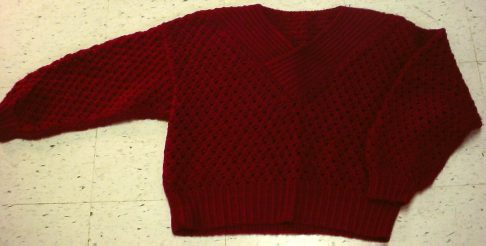
There are several details on it that I’d like to point out. First, note the ribbing. Remember how I said I always liked twisted stitches?? This is the piece that started it. The ribbing is done in P2, K1tbl. That’s what makes the nice, crisp, widely spaced verticals. The color on the detail shot below is closer to real life, although it’s a bit lighter than the original.
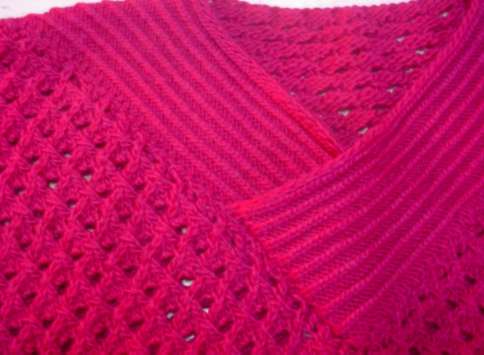
The body is entirely knit in a variant of Wide Waffle (Walker II, p. 152). That’s a stitch formed from a zillion twisted stitches (1×1 cables) plus YO eyelets. Although the pattern was fussy, it was quick to memorize and being on large needles (#9s) was fun and quick to knit. I especially like the contrast of the heavily diagonal, textured?body and the wide bits of crisp ribbing.
The neckline was also done in an unusual manner that was very common on Aarlan pattens of the time. The back of the piece is bound off straight across, with no shaping or edging whatsoever. The front is worked leaving a very wide Vee. Two strips of ribbing are worked as separate pieces (with slip stitch selvedges for neatness, since they show), and are then sewn on to the edges of the Vee, overlapping at the bottom point. It’s an unconventional treatment, and one I was afraid would pose problems of durability, but as you can see – this sweater is still going strong almost 20 years later.
Again, the moral of the story:? if you want your pieces to last, use the best quality materials you can afford; and you can’t go wrong with real wool. That and AIDS has claimed so many of our best and brightest. We miss them all.
ENTROPY IN ACTION – PINK BLANKET DEATH
All good things must come to an end, and it’s nearing that point for the baby blanket I knit 14 years ago for The Larger Child. It was the first piece of lacy knitting I attempted, and?is a combo of the double star keyhole motif from Phillips’?Knitting Counterpanes?(slightly modified); plus a perimiter trim I tinkered up from a standad leaf edging.
Pink?Blanket?wrapped?said child when we brought her home from the hospital, slept with her every night until she was?in Kindergarten,?accompanied us on every family vacation, served as a cape, costume, and tent, survived countless wash/use cycles, and even went off to summer camp with her for the past?four years. Now the nameless cotton it’s made from is finally giving up the ghost.
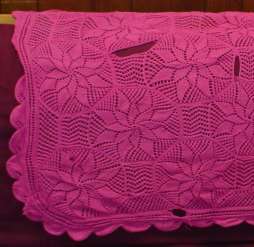
The simple slits between motifs where the stiching has come undone are quick and easy fixes. I’ve even grafted and re-knit bits of the border before?where it got snagged. The other holes in the ladder lace upper part of the trim, and in the motif in the lower left however are bigger deals. I’ve still got some of my nameless cotton if I want to try fixing Pink Blanket again. Amazingly, the piece has not faded over the years, so the color match is still good. Still, 14 years of hard wear for an odd-lot yarn bought at a long defunct yarn discount store in Maryland, and a first attempt at a knitting style – that’s not a bad return on my investment.
Follow-up – Blauband Blanket
To follow up yesterday’s Chest of Knitting HororsTM post, the fragment you see is about 80% of the finished blanket. I have enough yarn for two more courses of hexes, plus half-hexes to finish out the sides square. I’m looking for a coordinating yarn just to do a trim around the entire edge. But Nancy’s "outside the box" idea of edging with satin blanket binding rather than more knitting is well worth considering. Thank you!
Frivolity
A friend sent me a link to this game. If you’re into sheep and have time to kill, you can waste hours there.
THINKING – UNPLYING FOR NEW PONCHO
Several people asked how I was going to go about un-plying my three-strand Paternayan yarn. Siince I need to do it to swatch, here’s how I plan on doing it.
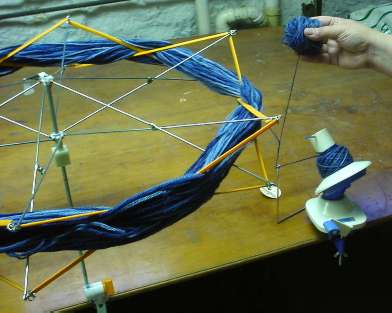
You can see the skein as the maker intended, set up on my swift. I’ve got my ball winder out, too. I usually don’t bother with it unless I’m?dealing with?lace or fingering weight yarn (that’s more yardage than I’ve got stamina for hand-winding). This time however I need it as an extra pair of hands. In fact, ideally I’d have an extra-extra pair of hands.
The plan is to let the skein of yarn spin freely on the swift, while I?take up two plies on the ball winder, and ball up the remaining ply by hand. Now you can see why a friend or biddable child to turn the crank on the ball winder would be a great convenience. As it is, I have to advance a bit on the machine-aided ball, then catch up to myself on the hand-wound single ply ball. All the while, I have to go gently, untwisting and untangling whenever things get too bound up. This is why I’d only attempt this foolhardy maneuver with a yarn as loosely constructed as this one. Even so the sharp-eyed can spot the stuff twisting back on itself just a bit at the point where the one ply is split off the main strand.
O.K. Now when I’ve finished, I’ll have a neat machine-wound little core sample of two-ply yarn, plus a hand-wound ball of one-ply. How to turn the one-ply back into a two-ply?? Simple. I repeat the paring down process on the other skein of yarn, then I place both skeins on the floor or in a box (I’ve heard that cutting the bottom of soda bottles and threading the strand through the neck works wonders). Then I use my ball winder to draw on both at the same time. Minor complication – the variegated won’t match up in color across both plies. I’ll just treat it as another color of variegated, and isolate it in its own stripes or other pattern segment.
Since my original yarn was really just paired rather than twisted together, I don’t think I really need to do a proper twisted plying on my newly formed composite. Of course there may be spinners out there recoiling in horror at this process and half-assed advice. I can envision them ready to leap forward with?sage interjections to save us all and teach us proper plying. I stand open to their suggestions.
THINKING – NEW PONCHO PROJECT
I’m still doing Dragon, but I’m also thinking about the poncho request I mentioned yesterday. I hope people find my?starting with so many unknowns and feeling my way through this project?will be useful.
My daughter went through my stash, and picked out a first and second choice. Her first choice is this lot:

(Apologies for the poor color registration. The photo looks dingy, yellow, and grey compared to the original hues.)? This is a mixed bag of Paternayan 100% wool I picked up at?my local?yarn store’s semi-annual?odd-lot sale. I’ve got?seven skeins – three mixed blues, two wegewood blues, and two smoke blues. The solids both coordinate with the variegated skeins. When I bought this stuff I thought I’d take the time to separate out the?three constituent loose?plies yielding three times?the original?yardage, then use the result to do a top for myself. That idea has sat idle for several years now, un-plying all that yarn having lost its initial appeal. But now I’ve got this bag of yarn of unknown yardage and weight, with no clue as to possible gauge. I have no pattern in mind other than "Small lacy poncho, mom."? ?
Today I’ll start by investigating the yarn. I’m afraid in this case, wiseNeedle’s yarn data/review collection is of no help at all. There’s no entry for the maker, let alone the yarn. I know that Paternayan yarn is usually sold for needlepoint and crewel embroidery, and doesn’t often come in large hanks like I have. So I head out to my old pal, Google.
I find these specs for Paternayan Persian Wool. It comes in 8 yard skeins; 1 ounce/40 yard skeins and?4 ounce 178 yard skeins. Wishing I knew where my kitchen scale ended up, I compare my skeins to other yarns I know comes in 4 ounce put-ups. It seems pretty close to me. Provided I’ve got seven true 4-ounce skeins?I should have?about 1246 yards. That in turn is enough to make about a?pullover of about 45 inches?around?in a worsted weight yarn (no fancy patterns, plain set-in sleeves, generous but not boxy fit). I got this number by playing "what if" using Sweater Wizard,? but I could also have used my yarn consumption KnitKard (a very handy thing).
I’m making a poncho, not a sweater, but it sounds like I’m in the realm of possibility, especially because the target kid doesn’t want a huge blanket thing. Perhaps I’ll go back to my original concept, and increase the yardage by unraveling back just one ply of each skein. For each two skeins of original 3 ply thickness (which I estimate is somewhere between worsted and Aran weight), I’ll end up with three skeins of 2 ply thickness. That would mean an extra 178 yards of each of the solid blues, plus 178+89=267 yards of the variegated (I’ve got three skeins of the variegated, so I’ll end up with?one and a?half-skein’s length if I strip one ply from each). 1246+178+178+267=1869 yards. 1869 of something that appears to hover between DK and Sport should certainly be enough.
You may have spotted?the fallacy in my thinking. "Doesn’t thinner yarn mean a finer gauge?? Why would using it as a two ply cover more ground than using the?yarn full thickness?"?
My out here is in the request for a lacy item. I’m not knitting up a solid garter or stockinette piece. I’m going to do something with lots of openwork. That means I will be using a much larger needle than I would choose were I to knit this stuff up solidly. The thinner yarn will end up going much further than it would were I to use it at a standard opaque sweater gauge. To get a comparable effect from a heavier yarn, I’d have to move up to an even larger needle to achieve a lacy look. While that would make the final piece bigger, I doubt I could find a needle size that would enlarge the piece by the equvalent amount to the?lacy stitch/big needle/finer yarn combo.
Now I haven’t a clue as to the dimensions of the finished piece, nor any idea whatsoever about garment shape (rectangles or knit out from the center), texture pattern, or how I’m going to deal with all the variants of blue; but I think I’ve got a solid enough "Go" to begin swatching. After all, there are no Poncho Police that will assess my final output to make sure it’s legal.
I’ll keep working on Dragon, but I’ll interpose thinkbits on this project as time and progress allow.
TWISTING THE NIGHT AWAY
I was showing something about twisted stitchesto a knitting pal the other day, and I thought that other knitters might like to see it too. I know that I’ve discussed them here before as part of the post about knitting backwards, but I’ll recap.

Twisted stitches are made when you knit or purl into the back as opposed to the leading leg of an existing stitch. Sometimes people make them inadvertently when they work a stitch as usual, but that stitch was mounted with the leading leg behind the needle:
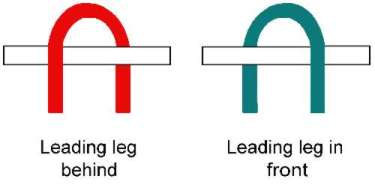
The person I was working with does exactly what my mother does – forming stitches so that she routinely ending up with leading legs behind after working a knit row, then untwisting the stitch on the purl row. Ifmom is working stockinettein the flat, the final product looks like everyone else’s knitting, but ifshe’s working stockinette in the round, they end up with all twisted stitches because there are no purl rows on which to de-twist. My knitting pal was having the same problem. We worked on being able to tell the difference between legs in front and legs behind so that she could choose to either compensate or alter her technique. While learning to recognize and compensate is certainly a good solution, it is a limiting one. To this day my mom prefers knitting in the flat and working intarsia to knitting in the round or doing texture patterns. She especially dislikes texture patterns that do not include rows of plain purling in between the rows in which other manipulations occur. With no plain purl rows to un-discombobulate her stitches, she runs into that same twisting problem.
But twisted stitches aren’t entirely bad. Sometimes there’s good reason to make them. They’re great decorative accents, and have structural uses as well. I happen to like using twisted stitches in my work. In terms of structure, Ifind them particularly useful for working ribbing on cottons, silks and linens because they are a bit firmer than regular knit stitches, and help the ribbings in those fibers keep their shape between washings. That firmness and crispness of line is also a great tool to use in surface decoration. Here’s an example from a pattern available on wiseNeedle.

The pattern is for a lacy blouse with a wide vee neck and clingy fit. The combo of the diagonal lines of openwork and the vertical ribs makes it especially flattering to the zaftig among us. Here the firmness of the twisted stitches is put to use making the cotton yarn hold its ribbed, body-hugging shape. Also the verticals formed by the twisted ribbing really stand out. I chose to do them synchopated, so that the K2, P2 ribs don’t line up after they’ve been intersected by the eyelet diagonal. That movement of line makes the piece more lively, with a more interesting total surface effect. (Or so I think.)
Here’s another nifty use for twisted stitches. In this case, I can take credit only for execution. The pattern is from Reynolds, and was put out around four years ago in a summer book for their Saucy Sport yarn. Look at the nifty way the twisted stitches are used to make the lobster’s outlines, feet, feelers, and to differentiate the textures of the filled-in areas in head, body, tail, and claws. All in all, a very clever design:

Apologies both for the quality of the photo, and for the wear-and-tear on the lobster. This is one of my favorite summer sweaters, and he’s no longer fresh from the trap.
What yarn are these two samples knit in? It so happens that I used the same yarn for both. It’s Silk City Spaghetti, a cotton sport-weight woven tape, now long discontinued. I love this stuff, and even though it does shrink in the wash(my lobster sleeves are now about an inch too short), I’d buy it in a flash were I to find it still available. I do have enough left over from my cones of the khaki and paprika that I might be able to do a shell out of each. Or if I could countenance the resulting color combo, combine them in some sort of a two-tone piece. The jury is still out on the color combo thing.
OTHER PROJECTS – MYSTERY OBJECT
Reaching back into time (and into the bottom of a box that surfaced during unpacking yesterday) I come up with my first-ever attempt at both knitting in the round on DPNs, and at stranded colorwork in the round:
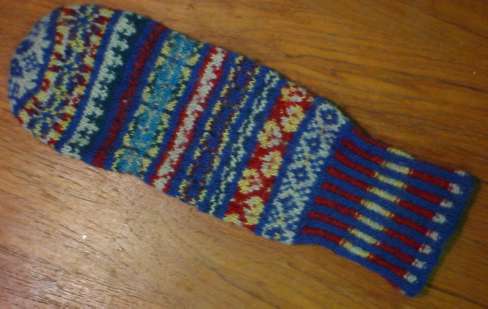
I did ita couple of yearsafter I started knitting, about the same time I began becoming rabid about knitting in general. I used a bunch of Shetland scraps raided from my mother’s stash. Like most samplers I do, I didn’t bother planning or charting anything out before hand, I just did it on the fly, experimenting with technique, color, size of floats, number of DPNs (I tried out everything from 3-6 on this piece), and pattern.
Now. Have you guessed what this thing is? It’s not a mitten or glove. It’s not a sock. It’s not a piece of gentleman’s intimate apparel, either (were it so, the size alone would make it pretty spectacular, athough the itch-factor might be somewhat limiting).
It’s a putter cover I made for The Resident Male. He took up serious golfing around the same time as I picked up serious knitting. No connection between the two pursuits other than this item.
There’s a social history lesson connected with this cover, too. I knit on this mostly at lunch hour at work, and on a couple of business trips because I wanted it to be a surprise gift. My boss at the time saw me knitting away on the thing in the airport, and upon our return to D.C., called me into his office.
He gave me a long lecture on why I should **never** let anyone who knew me in a professional capacity **ever** see me doing needlework. He went on to say that I should **never** wear or display my own products at work, because no one would take me seriously in the world of work if they connected me with domestic pursuits.
To be fair, even though it was the mid ’80s, I was working in a big-time construction/project management firm – in an extremely conservative industry largely devoid of women. But this particular workplace was backwards-thinking in the extreme. To illustrate the mindset there – I once got an employee recognition award given to me in public,with the introduction "And here’s the little lady who put the lie into the statement that you can’t have boobs and brains both."[shudder]
Back to knitting, I can report that I
- blissfully ignored his advice and kept knitting,
- moved on to another employer after it was explained to me that my promotion track as a fem was nil; and
- to this day, proudlywear and display my products everywhere I work.
For those of you born after the Carter administration, the attitude displayed by my former boss was common. Another oft-heard diatribe was that women shouldn’t do needlework, because all forms of needlework were artificesthat restricted women’s sphere of interest and creativity. This attitude was more hurtful, as it largely came from other women. (If you think I’m kidding about this, look into the book The Subversive Stitch by Rozsika Parker.) For a long time this attitude wasin part responsible for the decline in interest in knitting and stitching among younger women.
I am delighted today that things are on the upswing. I can be an aging grrlnerd, and have interests and accomplishments as diverse as fine embroidery, lace knitting, computer gaming,and SCA heavy list fighting, and no one will think the less of me for doing or having done any of them in particular. Now if only I could do something about that "aging" part, as it is having a real drag effect on employability…
IN ABSENTIA – CRAZY RAGLAN WORKING REPORT
I’m here but I’m not. Cut off from Real Communications, I’ve stored a couple of advance-dated posts. If you see this it’s because I’m running on autopilot, and have not had time to revisit these pages and do a proper write-up. In the mean time, here’s entertainment.
Crazy Raglan
That’s proceeding apace, too. I’ve now done about eleven inches of both the front and back. It’s hard to see because of the stockinette curl, but each is about 15 inches wide, making a total garment circumference of 30 inches, give or take. I like the wide stripes and the sort of strange seam down the front. Not for me, mind you, but for a six-year old it’s playful and fun:

Now, here’s something to which I wasn’t paying attention. When I do my Intarsia twist where the two yarn strands meet at the center front, I must be twisting in opposite directions on the knit and purl side. Instead of a little "barber pole" twist down the center, I’ve produced what looks like a column of purls, seen sideways:
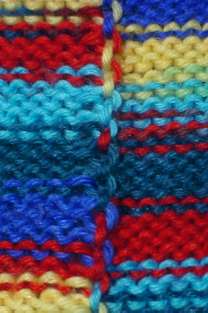
My "seam" looks good from the front, and isn’t spreading or distending oddly when stretched, but it is definately different. Not less satisfactory or wrong – just different. Anyone have any feedback/experience with this?non-standard Intarsia join??

