DOUBLE RUNNING STITCH LOGIC 104 – A REVIEW
Based on private notes of inquiry and discussions on various historical needlework-related boards and forums of late, I see that people are still confused about the working logic of linear stitching. In specific, how to determine if a design can be worked entirely two-sided.
First off – the two most popular historical methods for working thin linear designs are double running stitch and back stitch. The big difference between the two is the appearance of the reverse. Done meticulously, with care paid to invisibly terminating threads, double running stitch is almost indistinguishable front and back. Almost because a few people do produce a slight difference due to differential thread tension on each of the two passes required to produce a unbroken line, but that difference mostly settles out over time. Back stitch on the other hand produces a public side very much like double running, but the reverse of the work is heaver, and depending on the stitcher can look like outline or stem stitch, or even like a split or chain stitch if the needle pierces the previous stitch as a new one is made. Of necessity in back stitch there is twice as much thread on the back of the work as there is on the front.
 |
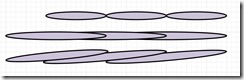 |
|
Double Running. |
Back Stitch. |
Double running stitch takes two passes to accomplish because it first lays down a dashed line, with the spaces between the dashes being filled in on the second pass. A back stitch line is completed in one pass, with no need to revisit areas previously stitched to complete the line.
Many people prefer back stitch because there IS no going back. They like the certainty of knowing exactly where they are at all times, over the pretzel logic of calculating how not to be caught in a cul de sac while retracing steps in double running. Personally, I prefer double running, and follow double running logic even if the piece I am working will not be seen on both sides. I find that path planning to be fun, and I appreciate thread economy, especially when working with more costly or difficult to source hand-dyed silks.
But for some one challenge of double running is knowing which designs can be worked in that stitch such that both sides can be made totally identical.
It’s easy. Any design that has no “floating elements” is a prime candidate. If true double sided is a total goal (including invisible termination of thread ends), any piece that has a floating element large enough to allow that burial is also a possibility. It doesn’t matter how complex a design is, so long as elements are all branches and detours off of one or more main baselines, they can be stitched double sided. And yes – there CAN be more than one baseline in a design. More on baseline identification is here. The logic of following detours and returning to the baseline is here. How to break up a large design into several smaller baselines is here.
Identifying floating elements
That’s easy. They are any ornament or detail that is discontinuous from the main line of the design.
Here are several that I’ve done in double running, based on one or more continuous baselines, with no floating element deviations. In these designs every part of every work is attached to every other part, at one or more points.


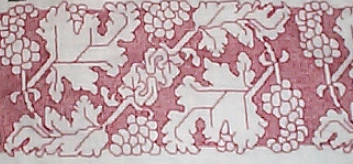


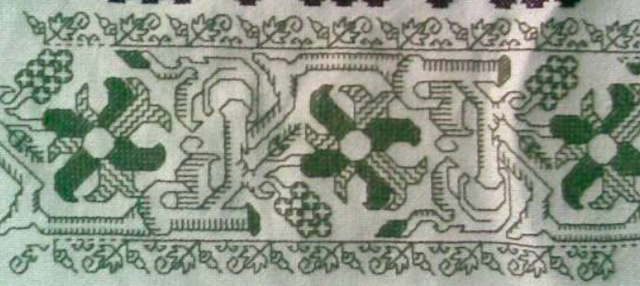
The last one has additional embellishment in long-armed cross stitch, and the final one includes two edge borders, each done as their own “line” separate from the main motif.
By contrast, here are several that have those “floating elements” called out.

The knot element in the all-over at left is not attached to the main pomegranate frame. It is however just large enough manage thread-end-hiding. So while its presence makes this a tedious and difficult pattern for double-sided double running stitch, it is not a deal breaker. However those little accent diamonds are deal breakers. Too small to hide the ends, and detached from the main design. The ladder element in the arms of the repeat at right is broken from the main design, and is too small for end-camouflage.
There are often short lines or sneaky little floating accents hidden in both simple and more complex repeats. Strawberry pips are notorious for this, although I haven’t any stitched examples to hand:

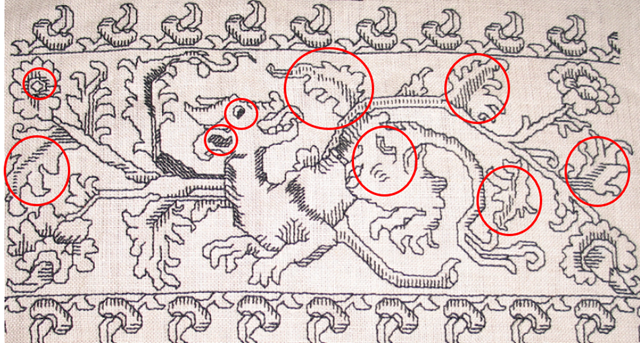
My dragonbeast, however lovely, has quite a few floating elements, making him a problematic choice for a fully double-sided work. (Eyes and faces are almost always difficult).
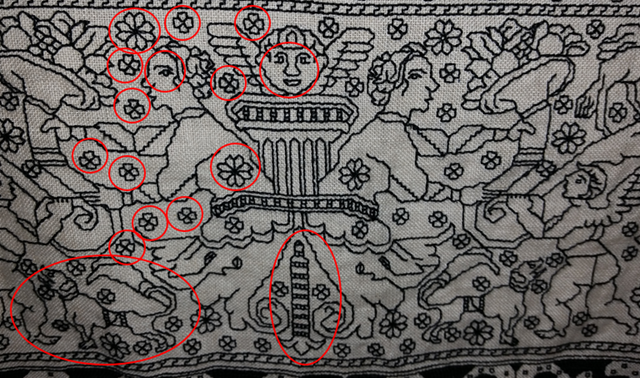
And this bit, stitched from a Lipperheide book, is the absolute poster child for discontinuity. I didn’t mark them all, but you get the idea. The spaniel and possibly that center bundle thing are the only bits large enough in which to bury the ends, if a fully two-sided result is desired.
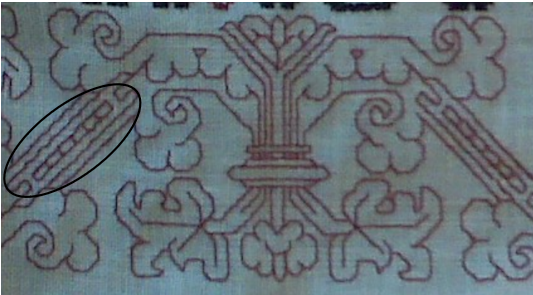
Here’s a tricky one. Look closely at the bit on the left.
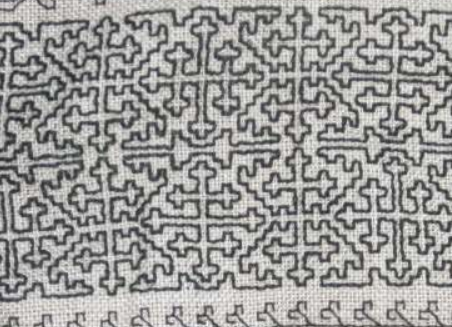
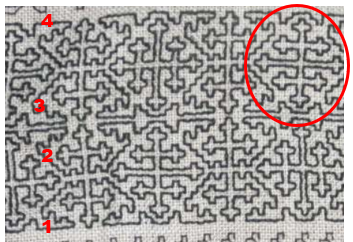
It looks continuous, but it’s not. There are in fact FOUR separate double-running baselines, AND a discontinuous element in the motif. He’s in the red circle on the right. Like the round knot in the first example this might be done double sided, provided that the stitcher was willing to terminate separate ends for that relatively large floating element.
So in short – it doesn’t matter how complex a design is, so long as all elements are continuous it CAN be stitched fully double sided, in double running stitch.
ASSORTED BLACKWORK HINTS
I’ve gotten lots of questions about blackwork, my methods, and products over the years. Some more than once. I’ll try to round some up and answer them here, for ease of reference. Feel free to post more in the comments, and if I have useful advice, I’ll answer them at a later date.
It looks so perfect! Do you make mistakes?
Lots. Continually. Sometimes at the same place in a design repeat, again and again. But for the most part, I carefully pick them out, using my needle tip, a really good pair of sharp tweezers, and if needed, something sticky (like blue painters’ tape) to tidy up any remaining surface fibers.
I find that clipping a few key stitches on the front, then withdrawing the snippets from the back leaves the front of the work a bit neater, than does doing all of the removal from the front.
![tweezers[1]](https://string-or-nothing.com/wp-content/uploads/2017/06/tweezers1.jpg "tweezers[1]")
Do you stitch guidelines to help with counting?
No, I don’t. Or not in the way the asker probably means. I don’t establish a grid over my entire ground cloth, but I do usually run a basting thread (but not in specific count) along the extreme edges of my stitching area, and at the center (both laterally and longitudinally), so I know where my margins and center are. For example, as I began my forehead cloth, you can see the line below the growing stitching that marks the boundary of my work (in this case, instead of stitching directly up to it, I decided to stitch no closer than three units of it); plus the diagonal that bisects the established bit. That line marks the center.
![kerchief02[1]](https://string-or-nothing.com/wp-content/uploads/2017/06/kerchief021.jpg "kerchief02[1]")
Sometimes on larger projects I might mark lines that divide my ground into quarters or thirds, too. It depends on the size of the project and what I am doing with it.
One thing to note – I have never stitched from a fully complete graph that shows the entire project. Yes, I know I published one here, but I am a “bungee jump stitcher” and more often than not, pick my patterns on the fly. The exception is of course, lettering. I do graph out my words or phrases, to work out problems in word or letter spacing, or to find the center of the motto (if I want the motto centered when stitched).
Then how do you keep things aligned?
I start from the center, as seen above, then work either right or left until I get to my desired width. Since most of my work is either a straight, or left-right or up-down mirror image or bounce repeat, I then go back and fill out the strip or pattern in the other direction, taking care to end at the same point in the repeat as the first edge.
Do you ever draw in or otherwise mark your designs?
Yes, but mostly for inhabited blackwork, not strapwork. Inhabited blackwork is the “outlines plus fillings” subtype. Strapwork is the substyle that produces long bands often used to edge household linens or garments.
I’ve used a couple of methods to establish outlines for fills. First, there’s simple drawing. Here, I’ve taped my line drawing to a window, with the ground cloth on top, prior to tracing the design onto the cloth using a pencil. You can just barely make out the outlines in the in-process shot.
![gane-3[1]](https://string-or-nothing.com/wp-content/uploads/2017/06/gane31.jpg "gane-3[1]")
![gane-2[1]](https://string-or-nothing.com/wp-content/uploads/2017/06/gane21.jpg "gane-2[1]")
And here I have established my design on the count, using small cross stitches to create the outlines for the shapes to be filled in. I finished off those heavy lines by overworking them with a nice, solid chain stitch because I wanted prominent outlines. I could have basted or done a lighter line of stitching instead. I’ve done that to make pounced chalk less transient, but I don’t have photos of in process works that employed chalk plus basting.
![coifdetail[1]](https://string-or-nothing.com/wp-content/uploads/2017/06/coifdetail1.jpg "coifdetail[1]")
Do you ever work in multicolor?
Sure. Lots. Here are a few. Starting at the left top: From 1973, in high school, prior to my involvement in the SCA – a happy mash-up of sampler bands, still unfinished; small stitched Moleskine type notebooks covers done as an East Kingdom largesse donation in 2012 (I wonder if they ever were received, and to whom they were given); a band sampler as engagement present circa 1985 or so, for a friend whose wedding plans expired prior to completion of the sampler, which explains that one still being unfinished; the Trifles sampler, done about a year ago, as a perpetual nag for Younger Daughter to take with her to college; and the Permissions sampler done as a present for our Denizen, the same year.
![misc-embroidery-3[1]](https://string-or-nothing.com/wp-content/uploads/2017/06/miscembroidery31.jpg "misc-embroidery-3[1]")
![book-cover-2[1]](https://string-or-nothing.com/wp-content/uploads/2017/06/bookcover21.jpg "book-cover-2[1]")
![strip[1]](https://string-or-nothing.com/wp-content/uploads/2017/06/strip1.jpg "strip[1]")
![trifles018[1]](https://string-or-nothing.com/wp-content/uploads/2017/06/trifles0181.jpg "trifles018[1]")
![permissions06[1]](https://string-or-nothing.com/wp-content/uploads/2017/06/permissions061.jpg "permissions06[1]")
Stitching Equipment Tips?
These recommendations are specific to the way I work. But my comfort level is not the same as everyone else’s, so if you do it differently, you are not wrong.
A frame helps. Preferably a hands-free frame. I like stiff tension on my stitching ground, so I prefer a nice, tight frame. But I stitch the fastest with one hand over and one hand below my work, so I am happiest with one that doesn’t require me to grow a third hand to hold it. My faves are my Millennium flat scrolling frame, held securely in my ancient Grip-It stand (I had to replace the bolts of the original to accommodate the Millennium’s thickness), and the Hardwicke Manor sit-upon round frame.
![zrtn_003n181cb7c5_tn[1]](https://string-or-nothing.com/wp-content/uploads/2017/06/zrtn_003n181cb7c5_tn1.jpg "zrtn_003n181cb7c5_tn[1]")
![fannyframel[1]](https://string-or-nothing.com/wp-content/uploads/2017/06/fannyframel1.jpg "fannyframel[1]")
If I am using a round frame, hand held or sit-on I ALWAYS pad at least one of the hoops with twill tape, stitched securely down on the hoop’s inside. This increases grip, and protects stitches that are “hooped over” after they are laid down.
![hoop[1]](https://string-or-nothing.com/wp-content/uploads/2017/06/hoop1.jpg "hoop[1]")
Since I am usually working on the count on relatively fine grounds (I prefer 32+ threads per inch, with 38-42 being my sweet spot, and 50+ just to show off), my stitches are usually short and not prone to damage from a round hoop. But if there is any doubt at all, I haul out the big boy and work flat.
Needle choice can avoid headaches. For this sort of work you want a blunt tip needle to avoid splitting ground cloth threads. You want the needle to glide between them and not force them, to avoid disarranging the ground threads more than needed to accommodate passage of the stitching thread. Many people use tapestry blunts, but for the gauges I work with, often with just one or two strands of floss or thread, I find the large holes in tapestry blunts to be annoying. The threads slip out all too easily. So instead I use these ball-point needles, intended for hand sewing on polyester knits. They are relatively easy to find in sewing stores where they are usually grouped with the regular (not embroidery) needles.
![ball_points[1]](https://string-or-nothing.com/wp-content/uploads/2017/06/ball_points1.jpg "ball_points[1]")
Wax. This is a love-it or hate-it issue. I love it. I almost always run my thread through beeswax prior to stitching. It strengthens threads, avoids fuzz and shedding, makes threading and maintaining even thread feed on multi-ply floss better, and makes them glide through the ground. Yes, even silk. Since my chosen style of stitching uses extremely short stitches, the sheen of silk over a long run (like in satin stitch) is minimal at best. If I think that the wax will have an effect on the final product, I may only do it lightly, or restrict waxing to the final two inches that will be threaded through the needle, but I still do it. I keep one lump of beeswax for light color threads, one for darker colors, and one for black. Threads do shed or crock onto the wax, and using several little blocks keeps the lighter colors clean. And it must be beeswax. Candle wax doesn’t have the same properties, and can stain.
Double sided?
Rarely. It’s a noble party trick, and useful for handkerchiefs, cuffs or collars viewed from both sides, but even historically, not always done. There are paintings that show different stitching patterns on the inside and outside of a collar band.
BUT
I do tend to use double-sided logic for most, but not all of my linear stitching. I find it saves thread, and I prefer the look and feel of the finished product. I’ve done some tutorials on how to determine baselines and stitching order (read from bottom up). I also confess to abject heresy if my pathing needs the jump and the final presentation form allows it.
Most designs have several possible stitching paths. Which one I take can vary from repeat to repeat, depending on how much thread I have left on my needle, where I am headed after the current bit, or even plain old experimentation. The path planning for me is very relaxing, and I rarely get lost or paint myself into a corner because I use tricks to idiot proof my path (being the biggest idiot stitching on my work at any time).
Tricks???
Yes. Here are some rules. All are occasionally broken, but for the most part they govern my path planning:
- Never go off on a long limb, establishing a very long line of stitching that branches off the main work. 90% of the mistakes I make fall out from this, especially if lots of diagonals are involved. I prefer to proof my work, by trying to do it by section adjacent to or in line with prior work. I constantly refer back to the established stitching to make sure I am not off count.
- There’s no reason to fret about having enough thread to make the return journey. Many people stitch double running out in one direction until half their thread is used, then do the second pass, filling in the remaining stitches on their way back to the starting point. But they often run out and have a section left over to complete using a second thread. Instead of there-and-back-again, I head out in one direction, taking all detours, until my thread is used up, then rethread the needle and start again from the beginning point to fill in the every-other stitches. And (gasp) there’s no shame in using TWO THREADED NEEDLES, leapfrogging yourself an inch at a time if that helps you keep your place.
- In general it’s preferable to take every detour as it is passed, especially if it’s a branching dead-end. If I run out of thread during a detour, I pick up again from that point and complete the detour to return to the baseline, rather than starting the next pass from the baseline itself. That way I don’t get stuck in cul de sacs.
- If there’s a joining that you don’t want to take as a detour, and it hooks up to the main design elsewhere (it’s not a branching dead end), it’s a good idea to work a stitch or two out on it, so there’s an attachment twig. When you come by later from the other direction, it’s lots easier to align with that twig than it is to judge proper place against an unbroken baseline.
- Those little spikes and shading lines that radiate from a baseline in the more complex designs are your friends. They make counting much easier. Work them on the first pass and use them as part of the proofing process.
- If you are using an even number of floss strands and thread grain isn’t a problem (and for most of short-stitch linear work, it isn’t) minimize knots by cutting your length twice as long as you need, folding it in half and waxing all but the loop just formed, and on the first stitch, catching the loop made to secure your end.
- If you are using an odd number of strands, or thread grain is an issue, and you don’t want to make a waste knot (which I rarely do for this kind of work), make a secure knot at the end of your thread, then use your needle to pierce the strand just below it, catching the thread in the same manner as #6 above. Your knot will be secured and will not pull through to the presentation side.
- Stitching over 2×2 threads is easiest. 3×3 and 4×4 are also doable, but look better on grounds that are at least 40 threads per inch. You can tame a skew ground – like a piece of inexpensive linen or linen look alike NOT sold as even weave – by stitching over an uneven count. If for example, your ground has more stitches north-south than east-west you might stitch over 3 threads in the north-south direction, but 2 in the east-west direction. This does make a project more exacting, and I don’t recommend it for someone who is just learning stitching logic.
More questions? Ask away!
FOREHEAD CLOTH/KERCHIEF PROGRESS
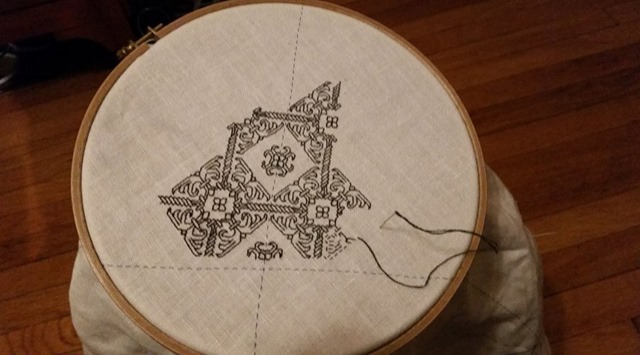
This is working up to be a quick stitch:
I attempt to answer questions submitted via email and on-line. If you have other questions, please feel free to post and ask. There are no secrets here.
Where/what is this pattern?
It’s one of the many designs in T2CM. It’s quasi-original, based on a 15th century strip pattern from my all time fave V&A sampler, the famous (and infamous) T.14.1931. I presented the strip in TNCM, but here have morphed it into an all-over. There are only two designs in T2CM that revisit some aspect of a pattern from the first book. This happens to be one of them.
Here is the original historical design in strip form, as worked on my Clarke’s Law sampler:

What stitch are you using?
Mostly double running, with short hops in “Heresy Stitch”. But I’m not being slavish about the double-sided/double running protocol. I am using knots, and I am strongly considering a muslin lining for my forehead cloth. I think it will help it wear better, by reducing stress on the ground fabric. Therefore, with the back well hidden, I am under no pressure to do a perfect double-sided parlor trick. That being said, I do tend to stick to double sided logic for best thread economy and minimal show-through.
What thread and ground are you using?
The ground isn’t fancy – it’s a prepackaged linen or linen blend even weave, with a relatively coarse thread count of 32 threads per inch. It is stash-aged, and parted company from the packaging long ago, so I am not sure of the brand name it was marketed under, or the retail source. I’m stitching over two threads, so that’s about 16 stitches per inch. I tried stitching over three, but thought the look was too leggy.
I am using a special treat thread – a small batch hand-dyed silk from an SCA merchant. I got it at Birka, and I hear it will be intermittently available at the Golden Schelle Etsy shop*. The thread is dyed with iron, tannin, and logwood, and is a warm black in color. In thickness it is roughly equivalent to two plies of standard Au Ver A Soie D’Alger silk, although it is not a thread that can be separated into plies.
Do you wax your thread?
Yes. For double running stitch work, even in silk, I wax my thread lightly with beeswax; paying special attention to the last inch for threading through the needle. While I would not as a rule wax the entire length of the silk for work that depends on sheen (like satin stitch), at the very short stitch lengths used in double running, loss of sheen is minimal. Waxing keeps the thread from fuzzing against itself as it is pulled through the same hole more than once, and (if you are working with multiple strands) minimizes the differential feed problem, without resorting to using a laying tool – which I find tedious for such short stitch lengths. Others adore laying tools, so use of them is a matter of personal preference.
What needles do you use?
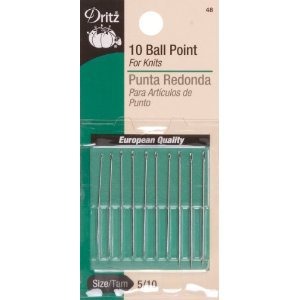
I favor a rather unorthodox choice for single strand double running – ball point needles intended for hand sewing on tricots and fine knits. They have a nice, rounded point, that slides neatly between the threads of my ground fabric, and a small eye. Blunt pointed needles intended for embroidery often have large eyes, which make thread management for a single strand unwieldy, allowing it to slip out of the eye too readily.
How do you know when to “go back again” in double running?
A lot of people think that working double running means you head in one direction, then turn back and retrace your steps. They carefully calculate the length of their stitching thread, and when they get to the half-consumed point, turn around and go back. This works, but tends to cluster thread ends. If you cluster your ends you end up with (for double-sided work) a large number of ends to hide in a very small space, or (for single sided, with knots) an untidy zone, with many knots and ends in the same place, which can show through to the front.
Instead I just keep going. I use up my length of thread, following my stitching logic, headed in one direction. Then I begin a second strand,staggering my starting point from my original start, first filling in the previously stitched path, and then extending the design further. Since I tend to do offshoots and digressions as I come to them and these do eat more thread as I trace them out from and then back to my main stitching line, I rarely have more than two ends at any one point in my work, and those two-end spots are widely distributed, rather than clustering in one small area.
How do you determine the baseline and stitching logic in an all-over?
There’s a little bit of catch-as-catch-can, but the basic concept is dividing the work into zones. In this piece the zone is flexible, and can be centered on either square area bordered by the spider flowers, connected by the twisted framing mechanism; or on the smaller area defined by the “root zone” of those spider flowers, again connected by the twisted framing. I go around either one of those, hopping between them as needed. In either case, the small center elements – the tiny quad flower, or the quad flower with the elongated tendrils, is worked separately, with no jumps back to the main motif.
And speaking of that tendril-flower – I am not entirely happy with it. I may pick it out and draft something else to go there. For the record, the nice, large square it inhabits would make a nifty place for initials, heraldic badges, whimsical creatures, original motifs, or other personal signifiers.
Why are you using a round frame?
Because I have two flat frames and one round (tambour) sit-on frame, in addition to several round in-hand hoops. I have works in progress on both flat frames, and don’t want to dismount them to do this quickie. My tambour frame has a padded bottom hoop, and when time comes to move the fabric and squash bits of just-done embroidery, I will pad the work with some muslin to protect it on the top as well as the bottom side. Again, working short stitches with no raised areas – even in silk – makes this a less risky proposition than it would be for other stitching styles.
Can I see the back?
In the next progress post I’ll include a shot of the back.
* In the interest of full disclosure (and the no-secrets here thing), the un-named proprietor of Golden Schelle is my Stealth Apprentice. Shhh. It’s a secret.
FINISHING OFF A HANGING SAMPLER
OK, I promised I’d write this up, and it has taken me a while, but here it is.
My thought here was to create a quick and easy way to finish off a hanging sampler, using a method that did no harm to the stitched piece, that was inexpensive to do, and required no special equipment or components that can’t be found in most crafts stores.
Why “no harm?” Because many inexpensive framing solutions do exactly that. They place fabric under stress, encase it in moisture-trapping glass, matt it or line it with acidic materials that over time discolor or eat away at the ground cloth, or place the fabric up against wood or metal that can corrode or mark the cloth.
This solution is far from ideal, but it manages tension to avoid stretch or strain in hanging, isolates the stitched piece from any wooden or metal framing elements, can be quickly picked out without harm to the original work, and is very inexpensive.
Here are several examples (the center one is mid-process):


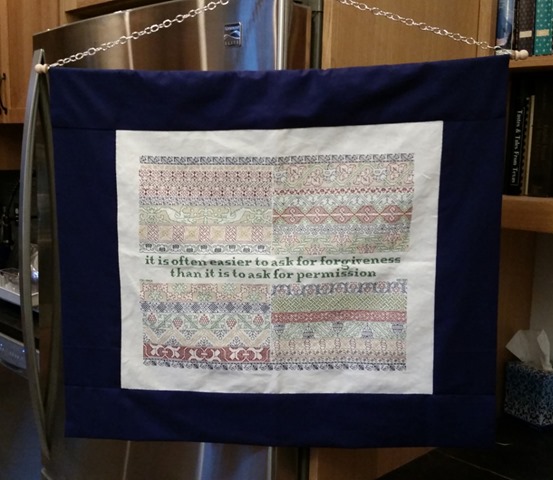
In all cases, a larger piece of backing fabric has been used to encapsulate the stitched item. The hanging bar (wood or metal) and bottom-weighting only touches the backing fabric. All are totally sewn by hand – no machine stitching.
Note that you don’t need to have actually stitched a sampler to do this. It would be useful to finish off a decorative tea-towel, heirloom doily, cloth map, or small pieced patchwork as a hanging, or (for my SCA pals) to mount a painted or printed banner for display.
To do this you need:
- Your display piece.
- Backing fabric. I used plain old quilting cotton. Any fabric will do, although for the “no harm” bit, I suggest washed cotton or linen rather than polyester or other synthetic. Size needed calcs below.
- Plain old cotton sewing thread that matches the backing fabric.
- A hand-sewing needle – a sharp with a small eye is recommended.
- A metal bar or wooden dowel for a top support (fancy finials are optional, but can be handy for fixing hanging strings or chains in place so that the hanging mechanism doesn’t compress the top edge of the hanging).
- The aforementioned hanging string or chain.
- An iron and ironing surface.
- A pair of scissors
- Straight pins
- A ruler and a tape measure
- Standard office stapler
- Optional weights for the bottom edge. I have used a length of brass chain, threaded onto an old ribbon, and small zinc drapery weights (small bars of zinc enclosed in a synthetic fabric envelope). These are sold in packs of two or six, in the curtain-notions department. Avoid the lead ones just on principle – the world does not need more free-range lead. In a pinch, coins sewn into little fabric pockets will do. If you are using drapery weights or coins, you only need two.
I found the backing fabric, dowel, wooden finials, the drapery weights, and the chain all in my local JoAnne’s fabric/crafts store.
First, decide how you want to frame your piece. A large area top and bottom, with narrower areas on the sides? Equal frame all the way around? The general size will inform your fabric purchase, although one yard of most quilting fabrics will be MORE than enough for all but the very largest samplers.
For the Permissions sampler, I decided I wanted a blue frame about 3.5 inches all the way around, and to preserve about 1 inch of unworked ground between the stitching and the edging I put pins in my sampler to mark that distance from my stitching, and measured the “to be shown” dimensions of my piece. About a half inch of my sampler, all the way around, will be hidden inside the backing.
Let’s call my display width 20 inches, and my display height 16 inches (to be truthful, I didn’t write down the real numbers). I know I want 3.5 inches of framing edge to show on all sides. Plus I need a hem allowance, let’s call that 0.5 inch. Here’s the logic:
| Hem |
Edge |
Display Area |
Edge |
Hem |
|
|
Width |
0.5” |
3.5” x 2 |
20” |
3.5” x 2 |
0.5” |
|
Height |
0.5” |
3.5” x 2 |
16” |
3.5” x 2 |
0.5” |
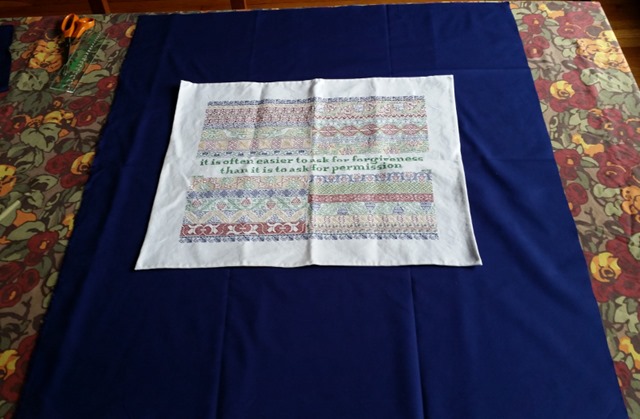
So, by doing the addition, I need to cut my backing cloth to be 35” wide, and 31” high, which is what you see is half-way done here (I’ve cut the width but not the height yet):
The next thing to do is iron in the 0.5” hem all the way around. Note that the “right side” of the backing fabric (such as it is, is DOWN). I chose to iron in mitered corners for tasty neatness, but that’s optional, and there are a ton of video tutorials on doing that.


Then I positioned my stitched piece on top of my backing fabric, making sure that it was correctly placed (the edge of my stitching was 8 inches from the now-folded edge of the backing – I should have left in my dimension measurement pins but I forgot, and took them out.)
Once the stitched piece was correctly positioned. I folded the left and right edges in, carefully aligning them (measuring the distance from my embroidery), and finger pressing them down and pinning. Because I stitched on even weave, I was able to use the count of my ground fabric for **perfect** alignment without having to mark the fold-to line on my sampler.
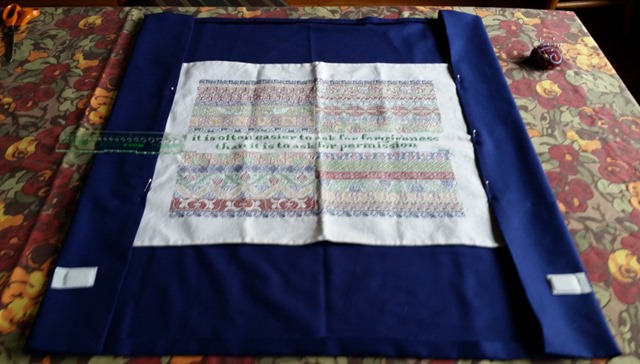
Those two little white tabs? Those are the drapery weights – note that they have little tab ends that are handy for stitching. That’s where they will go, encapsulated in the edging/backing, far away from the stitching. Next I folded in the top and bottom and pinned them, too. Once all edges were pinned, I lightly touched up the folds with my iron, to make them slightly crisper. Then I slid those drapery weights in and pinned them into place.
Here’s the thing, ready for hand stitching.

You’ll notice that there are simple lapped corners – I didn’t miter them. By doing this I can use the flap-over on the top as my hanging pocket. I do not need to engineer a separate hanging method for attaching the bar or dowel.
Now for the hand-sewing. Yes, I could have done this by machine, but hand stitching is easier to pick out in the future, and easier for me anyway to keep neat and aligned. There’s no real reason (other than speed) to do this by machine. And yes – I probably should have basted, but hey, what’s the fun without a tiny bit of risk. 🙂
Starting at the lower corner where the bottom and side flaps meet, and working first completely around the stitched sampler part, ignoring the flapped areas at the corners, I worked a simple hand appliqué stitch, catching a tiny bit of the edging, passing through the ground cloth but not the ultimate backing – at a diagonal, ready to make my next stitch. Here’s a tutorial on the appliqué stitch.

Note that I used the even weave’s threads to keep my hem nice and straight.
After I had worked the appliqué stitch around the entire visible area of my sampler, I used the same stitch to affix the two lower corners – the places where the bottom folded edge lapped up and over the folded-in sides. As I did each of these two corners, I worked from the visible sampler area back out to the edge. When I got to the side, I turned the corner and used a tiny whip stitch to seam together the front and back edges. When I got to the place where the weight was pinned, I wiggled it up so that I could just nip its flapped edge in as I was whip stitching:

I worked the top two corners similarly, but instead of working all the way down to the tip of the corner as I whipped the front to the back, I stopped about 0.5” from the top on both the left and the right. This left an opening through which I could pass my dowel. A small bit of finesse was needed to thread it through (I used another scrap of dowel to nose the hem allowance out of the way on the inside).
To make the hanging stick, I used a 1/4 inch dowel. I probably should have used a metal rod or a thicker dowel, but that’s what they had in the store. I bought a little pack of finials, and ended up having to shave down the ends of my dowel just a tiny bit so that they fit into the holes on the finials. I also bought a length of inexpensive craft chain, intended for chunky necklaces, with links large enough to fit around the dowel.
I cut the dowel to the width of my finished piece, plus about 0.5”. Using a regular office stapler, I stapled the chain to my dowel, about a quarter of an inch from the end. I dotted the inside of the first finial with wood glue and forced it onto the dowel and over a bit of the staple, so that the chain was butted up against it. Then I threaded the dowel through the top of the hanging, squishing up the hanging a bit to keep it away from my working end, I stapled the other end of the chain to the dowel, then forced on the second finial.
Taa daah!

THREAD THREAD
Based on questions from Elaine and others, here’s a bit more on the thread I’ve been using on both the Permissions and Trifles samplers.
As I’ve said before, my stash came from a small needlework/beading supply shop in Pune, India. It wasn’t current stock. The head clerk sent a boy scampering up into the storage attic for a VERY dusty box of odds and ends. I picked out the best colors left, avoiding pastels, and looking for what high impact/high contrast hues that still remained in quantities of 10+ skeins. I bought them all. They were very inexpensive – just a few rupees per skein. At the then-current exchange rate of 60 rupees per dollar, I think I spent less than $20.00 translated, and came away with a huge bag full, well over 200 skeins divided up among about 15 colors. Here’s just a sample:
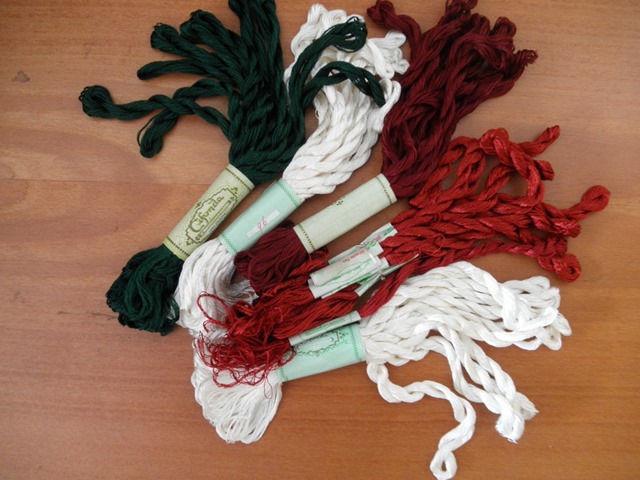

The name brand is Cifonda Art Silk. It’s not a spooled rayon intended for machine embroidery. As you can see, the put-up is more like cotton embroidery floss. And it turns out that the stuff is still being made, and is available in Australia, and even in the US – although mostly by special order.
The websites that offer this thread vary a bit in description. Some say it is a 35% silk/65% rayon blend. Others say it is all rayon. Contemporary put-ups specify 8 meter skeins. My vintage stash skeins are a bit longer, possibly 10 meters (I’ll measure tonight). The large bundles above are actually “super-packages” of ten individual skeins. You can see the bright red one at the left is broken open, with the single skein labels showing. On mine, color numbers are written on each skein by hand, not printed. There can be hue variances between the super-packages of the same color number, so I suspect that special care should be taken to buy all that’s needed at once, so that all is from the same dye lot.
Cifonda’s structure is that of standard floss – six strands of two-ply relatively loose twist. The individual strands are quite fine, two of them are roughly the equivalent of one ply of standard DMC cotton embroidery floss. The colors – especially deeper ones like red and indigo – do run when wet, although they do not crock (shed color on hands, ground cloth, or wax when stitching dry). I would not advise using this thread on clothing, table linen or other things likely to need laundering. It may be possible to set the colors before stitching using a mordant bath or long water soak, but I don’t have the experience, time, or materials quantity for experimentation.
I am pleased with the way the Cifonda looks in my work. It’s a bit shinier and finer textured than cotton floss, although it does not have the coverage of the true silk floss I’ve used (Soie d’Alger). My Cifonda is quite slippery. Two or more plies held together tend to disassociate and slide past each other for differential consumption, even when using short lengths in a small-hole needle. I tamed this by aggressive waxing – running the entire length of my threads over a block of beeswax before use. Since I’m doing linear counted work, any change in color or texture is not noticeable. Someone using this for satin stitch, long-and-short, or other surface stitches that maximize thread sheen would probably want to wax only the inch or so that threads through the needle.
Like all lightly twisted rayons, this thread does catch and shred a bit on rough skin. Care must be taken to use needles with very smooth eyes, and to hold the unworked length out of the way when taking stitches, because the stuff snags extremely easily. My own stash, well aged as it is, contains some colors that are a bit brittle. The bright yellow I’m using now, and the silver-grey I used on the last sampler are both prone to breaking under stress, and must be used in shorter lengths than the other colors.
I will continue to use up my India-souvenir thread stash, working smaller and smaller projects until it is gone. But in all probability, I will not seek out the Cifonda to replace that inventory as it is consumed.
Anyone else have experience or hints on using this rather unruly stuff?
BLACKWORK HERESY
We’ve all read about two stitches that are most commonly used in linear styles of counted stitching.
First comes double running stitch (aka Holbein stitch, Spanish stitch, and punto scritto, among others). Pretty straightforward and well known, it can be used with care to produce works that are absolutely identical front and back, although meticulous double-sided implementation isn’t mandatory unless there’s specific need.
Double Running.
Front and back are identical
Back stitch is the other big technique used for linear counted work, with lots of historical examples. If anything its even more well known than double running. Its appearance is different front and back. On the front, it looks exactly like double running. But on the back, a much heaver and thicker line is produced. Depending on the care of the stitcher and the thickness of the thread it can look like outline or stem stitch if the needle is introduced (uniformly) above or below the previous stitch on the reverse; or even chain or split stitch, if the needle splits the previous stitch on the reverse.
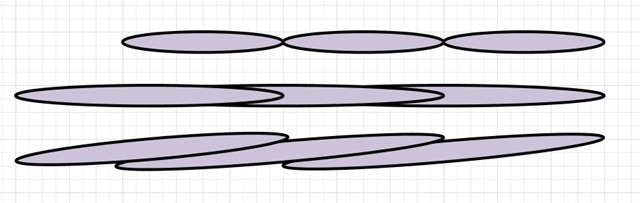
Back Stitch.
Looks the same as double running on the front (top), but different on the reverse.
Now, why would one pick one technique over the other?
Sometimes it’s a good thing to try to economize on thread use. Back Stitch uses about a third again as much yardage per distance embroidered than does Double Running. Therefore, if I wanted to conserve thread I might opt for Double Running over Back. Double Running is also the stitch of choice if double-sided presentation is a necessity, or if the fabric is so sheer that the heavier reverse side of Back Stitch might show.
On the other hand, Back Stitch can be much easier to work, especially on long runs that can befuddle even those familiar with the there-and-back-again logic of Double Running. In Back Stitch, there is no retracing of the path to fill in every other stitch. Work proceeds logically down a single path. Branches mean starting a new thread, rather than departing from a baseline and working back to it. Many people prefer the “I’m here” certainty of Back Stitch to the puzzle path approach of Double Running.
So I present this stitch hack – one known to just about every counted stitcher, although few would admit using it openly. I will arbitrarily call it “Wandering Running Stitch.” I am sure this is an “unvention,” and I’ve just promulgating something that’s already described under another name. For example, I would not be surprised to see this documented as a technique for quickly stitching durable seams in plain sewing.
Both a bit of heresy, and a chimera of sorts, Wandering Running Stitch neither plain Double Running, nor is it true Back Stitch. Advantages are that it looks like Double Running on the public side of the work; uses the same amount of thread as Double Running; and avoids now-how-do-I-go-back problem. It’s main disadvantage is that like Back Stitch, the reverse side looks different from the front. In this case, the reverse shows a discontinuous, dashed line of double-thickness. The overall effect is a bit heavier on the reverse than is plain Double Running, but is not as massive as Back Stitch.
 Wandering Running Stitch
Looks like double running on the front, but leaves spaced, doubled dashes on the reverse.
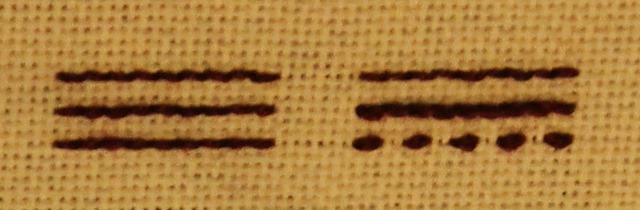
All three methods, for comparison. Front sides on left, reverse on right.
From top down – Double Running, Back Stitch, Wandering Running
The following sequence illustrates the stitching order.

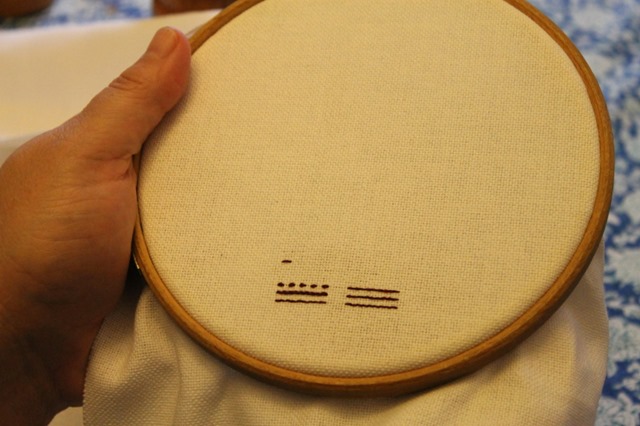
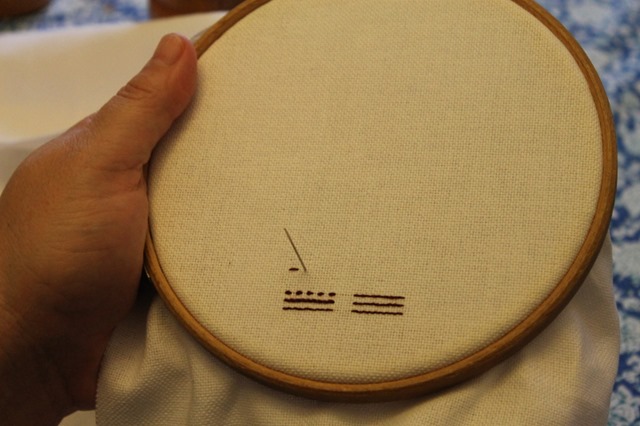
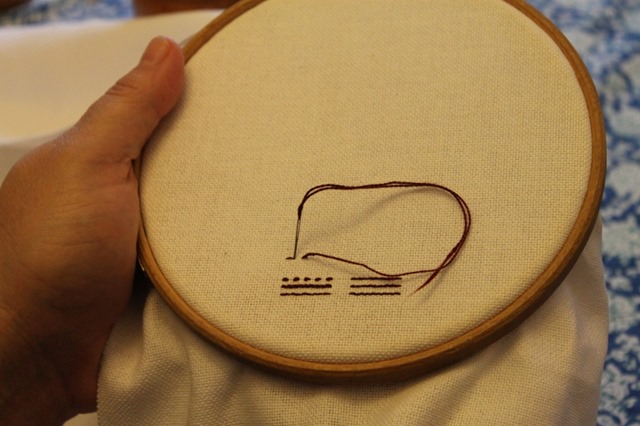


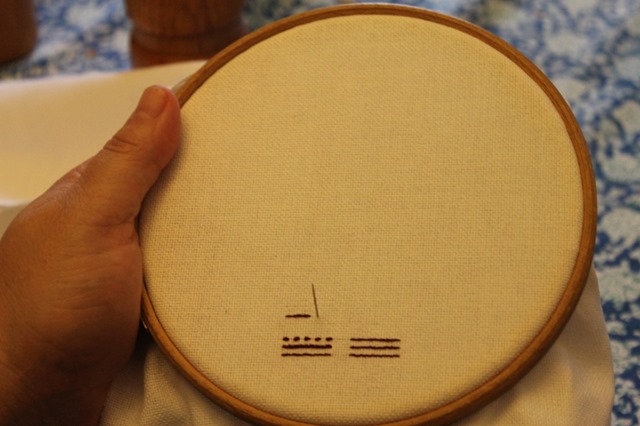


Now. How to use this hack.
First off, it’s not for reversible work. Nor is it for use on pieces sent to juried panels, where rules favor the use of traditional/historical stitches, and the state of the back side. There is NO precedent for or documentation of using this stitch in history that I know of, so I would not advise it for SCA pieces destined for Arts & Sciences competitions. However, for single sided work, or lined pieces, or items done for your own pleasure, or a project to help you get into the swim of a style that has frustrated you in the past – why not use an unorthodox approach if it makes life easier?
Because the active area is always at the needle with no half-worked baseline to retrace, Wandering Running would be especially good for stepped or continuous line patterns with no branching. It would be very useful to people who stitch in hand without a hoop or frame, and also for those who use a particularly small or round frame. In both cases, there’s no moving back over previously stitched paths, making it easier to tension in hand; or minimizing the need to remove and relocate a small hoop to revisit prior paths.
I think Wandering Running will be especially useful for people who have given up on blackwork because they find double running logic daunting, and have problems remembering where the baseline of their design is, or what direction they were heading. I also think that people who have tried Back Stitch instead of Double Running, but who were displeased with the heft or thickness of the reverse side might also find this technique interesting.
Another use is in completing the filling patterns used in inhabited blackwork, which are often not entirely suitable for full reversible treatment in the first place. I occasionally resort to Wandering when I’m working a filling into an oddly shaped area, and need to advance the working thread. I will plan out my path of attack and use Wandering to “walk” my working thread to the new area to be completed rather than ending off the thread and re-starting in that location.
In addition to the uses above, Wandering Running can be employed to render complex linear designs, in combo with more traditional Double Running. I can see using Wandering on the main baseline, moving along it until one encounters a side branch, then veering off to complete that side branch using traditional double-running methods, and returning to the baseline to continue on to the next point of departure. The biggest difference between this and a full Double Running treatment of the same design would be no “dashed line” of semi-completion along the baseline, making it easier to see where along the design path one is.
So. Have you seen this hack before? Does it have a name? Does it have a place in your repertoire, or does the merest thought of such heresy inflame you to the point of whipping out your Embroidery Voodoo Dolls* and using poison-tipped #24 tapestry needles to condemn me to my fate?
[*If demand is sufficient, I will consider sharing a design for Embroidery Voodoo Dolls. Suggestions for appropriate historical periods of attire for EVDs will be considered.]
VISIO KNITTING SYMBOL STENCILS, YET AGAIN
I’ve written about how I use Visio to graph my knitting charts before. Back in 2009 I reposted my original symbol set for what was then the latest version of Microsoft Visio. My original note about using Visio for graphing knitting dates back to 2005, although I was doing it for a quite a while before I wrote about it.
Microsoft Visio has evolved over the years. MS would tell us that this has been for our own good, and they’ve closed some pretty severe security holes in their Visio document formats that allowed entry of malicious code. That surgery has been so severe that the latest version of the program – part of the Microsoft Office 2013 suite – no longer accepts older file format stencils. But my graphing system, used to produce all of the knitting charts on this site was stuck in this older file format.
So. How to use the older stencils with the latest version of the program?
If you Google something like “Visio won’t open older file formats” you’ll find all sorts of advice. Some of it includes the intimidating step of editing your registry to bypass the security override.
I’ve done the work for you. Here is a ZIP file containing brand new stencils manufactured for Visio, MS Office 2013. It will work with the latest version, but not with older ones. The old-post links above will take you to pages where you can download the now-obsolete, earlier formats.
If you are lucky enough to have access to MS Visio (which is unconscionably expensive, but often available if you are a student, or have use of it via work) – you can now use my “tinkertoy” block building system to make charts like this:

For those of you who have other trusted stencils they need to resurrect and re-use with the latest version of the program, here’s what I did to rescue mine.
I found my original *.vss format files. I knew they were safe, containing no malicious macros.
Under the File tab, I clicked on “Options” in the blue bar at the left. On the pop-up Options menu, I clicked on “Trust Center” in the left hand menu bar. This opened a window with various privacy and security statements. In the main text area of that window, I clicked on the button “Trust Center Settings.”
This brought up yet another menu screen. I selected “Trusted Locations” and clicked on the “Add New Location” button at the bottom of that screen. I noted the default location Microsoft specified as the place where it first stores templates, and used that. I clicked “OK” to set trusted-status for that location, then kept clicking OK on the nested options windows to close them until I was back out at my main Visio window.
I copied my ancient *.vss stencils into the now trusted location that I had written down.
Visio could now open them, and I could use them, but I could not edit them, and saving the document could prompt dialog boxes keyed to the ancient stencil’s status. So I re-saved all of the stencil contents to the new *.vssx files you will find contained in the *.zip file above.
To do that, I used a drag-selection box to select all of the symbols in the available shapes sidebar, then right-clicked and chose “Add to My Shapes” from the pop-up action window. That pulled up yet another action dialog that gave me the option to save the selected shapes to a new stencil.
Yes, this is a long and overly technical post, but I do know there are a few folks who used my old Visio-based knitting notation system, who may have faced this problem. Now they have a work-around.
MARBLE ROLLED, EDGE TREATMENTS EXPLAINED
Yaay! The lap blanket knit from Marble is finished. Well, mostly. I do have to finish off the ends and block the thing. But all of the knitting is complete, and I grafted the edging’s last four stitches to its beginning, so that the seam is unnoticeable.

Aileen in Springfield asked me how I was filling in the half-motifs, because she’s working on a modular square piece, and prefers the look of the units tipped to present as diamonds. I’ll attempt to explain, but I won’t be publishing this as a full up pattern because of general lack of interest.
My treatment includes a nifty self I-Cord edging, worked as the piece progresses. It’s a nice, robust “hem” that stands up to wear and tear nicely. Here’s how.
I started on the REVERSE of the piece, so that any ridges formed by knitting the edging on would happen on the front, the same side as the native diagonal and vertical lines of the modular squares. I needn’t have bothered with this refinement, because as you can see in the photo above, the join lines are quite indistinct. Also note the slight ruffling of the edge triangles. That should steam-block out (mostly).
Starting at Point A – the rightmost corner point of the motif at the bottom right of the blanket.
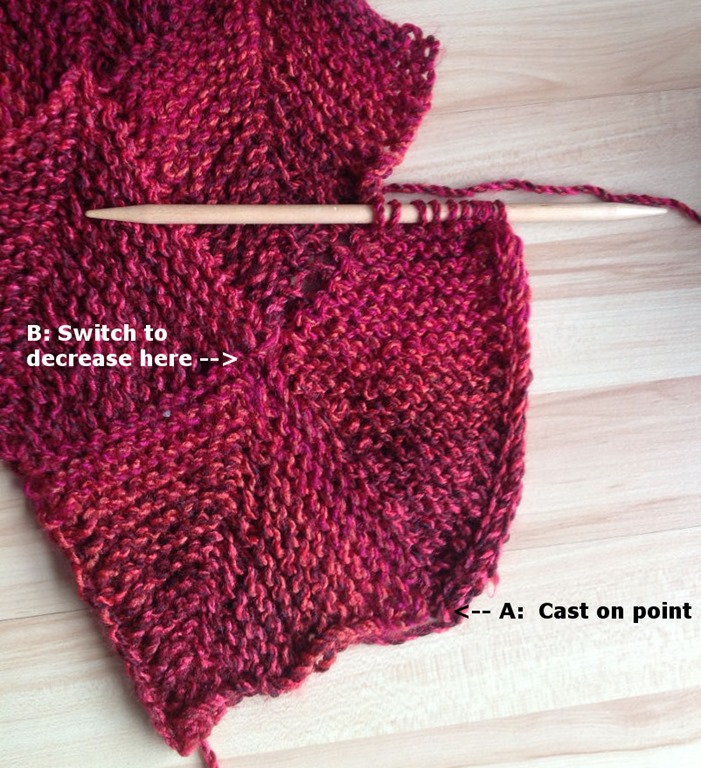
Increase progression:
Row 1: Cast on three stitches, then pick up one in the rightmost corner of the first motif.
Row 2: Slide all stitches to the right end of the needle, I-Cord style. Knit 4, and pick up one stitch in the next available selvedge stitch of the diamond motif. There should be 5 stitches on the needle.
Row 3: Flip the work over so you are working away from the main blanket. Slip the first stitch purlwise. Knit the second stitch. Slip the final three stitches one at a time, all purlwise.
Row 4: Flip the work over so you are working in from the edge, toward the main blanket. Knit the first three stitches VERY FIRMLY, pulling the yarn tight in classic I-Cord style. Knit the remaining stitches on the needle. Then pick up another stitch in the next available selvedge stitch of the diamond motif. There should be 6 stitches on the needle.
Row 5: Flip the work over again so you are working away from the main blanket. Slip the first stitch purlwise. Knit the second and third stitch. Slip the final three stitches one at a time, all purlwise.
Continue working rows 4 and 5, adding one stitch on every even row, until you have “used up” all of the available attachment points along the edge of your motif. The actual number of stitches will depend on the size of your motif. Mine was a 15×15 stitch square, so I had 14 attachment points along each diamond’s edge. After working your last Row 5 equivalent you will be ready to decrease
Decrease progression:
Row 1: Starting at the edge, working towards the main blanket. Knit the first three stitches very firmly, I-Cord style. Continue knitting across the row until only three stitches remain. Knit those three stitches together. Pick up one stitch in the first available selvedge stitch on the next motif.
Row 2: Working from the main body of the blanket back out to the edge. Slip the first stitch purlwise, knit until three stitches remain. Slip these three stitches one at a time, all purlwise.
Continue working Rows 1 and 2 of the decrease progression until you are back at the tip of Motif #2. At that point you should be down to four stitches. In the event that you have five when you reach the motif tip (which happened to me a couple of times, and I didn’t take the time to figure out why), on the last iteration of Row 2, just knit the first two stitches together instead of slipping. Fudging this way is invisible – the goal is to make sure that by the time you start down the increase section of the next motif, you begin at the point with only four stitches on the needle.
Now. How to use this same edge I-Cord idea on a straight edge? You can do it one of two ways, depending on whether you are working this at the same time as the main body, or adding it as a supplemental feature on a finished edge.
First, if you’re working a flat piece in garter stitch or stockinette and you want to add this at the same time as you are working the main body, just set aside the first three or four stitches at either end for the I-Cord curl. Or if you like, add some stitches for the treatment to your total count, but be aware that this will use more yarn and if you are working from a set pattern with a set amount, adding even six total to each row (3 left and 3 right) you will risk running out of yarn.
Once you have figured out how many to set aside or add, work each row as you usually do, BUT at the end of every row, slip your I-Cord designated stitches, and at the beginning of each row, KNIT them. You’ll notice that this edging is the same front and back, so if you are trimming both sides of your scarf or blanket, the left and right edges of your piece will look the same. This is pretty much the same thing I described as being useful for making straps for bags back in 2004, but with a whole blanket in between the I-Cord edges rather than just a couple of stitches.
If you want to add this I-Cord edge to a finished piece, it will be easier if you have worked a slip-stitch selvedge, so that the edge loops are crisply defined. But with fiddling this will also work on non-slip-stitch edges, and on cast on or bind off rows. Cast your desired number of stitches onto your needle, pick up one stitch in the body of the work to be trimmed. Flip the work over and heading back out from the body, knit the first two stitches together, then slip the rest purlwise, one at a time. Now working back from the edge towards the main body, knit the designated I-Cord stitches firmly, knit the attachment stitch, and then pick up another stitch in the main body. Continue in this manner, adding one stitch every “inwards” row, and knitting it together with the attachment stitch on the “outwards” rows. This is slightly different than the method I’ve described before for adding I-Cord to an edge, because it moves the attachment point one stitch away from the I-Cord itself, and makes a neater presentation with both sides looking more like each other.
AND BACK TO KNITTING
Now that the hustle of getting ready for our return is over, I have time in the evenings to sit and knit a bit.
I had planned to finish the large red throw prior to the trip, but I ran out of time. Luckily, I didn’t run out of luggage space, and I was able to take it with me:

As you can see, I have completed the center area of modular diamonds, and am now working around the edging. Or I was… More on that below.
I am trimming the thing out into a full rectangle, filling in the missing edge half-diamonds and completing it with an edging. I’m winging it, but have some notes if the world thinks it really needs yet another free pattern for a modular diamond throw. If you are part of that world, please let me know.
One thing of special note – the edging. I’ve used this before. It’s an “un-vention” – something I worked out on my own, but that I’m sure others have discovered before me. I am not a big fan of plain edges on stockinette or garter stitch. To me they look flabby and unfinished. When I do a scarf or blanket, I always try to include a lacy, hemmed or otherwise finished edge. This particular treatment is similar to an edge casing, sort of like a seam binding in sewing. It wraps the edge with I-cord, and is totally reversible (same on both sides). It’s worked at the same time as the body:
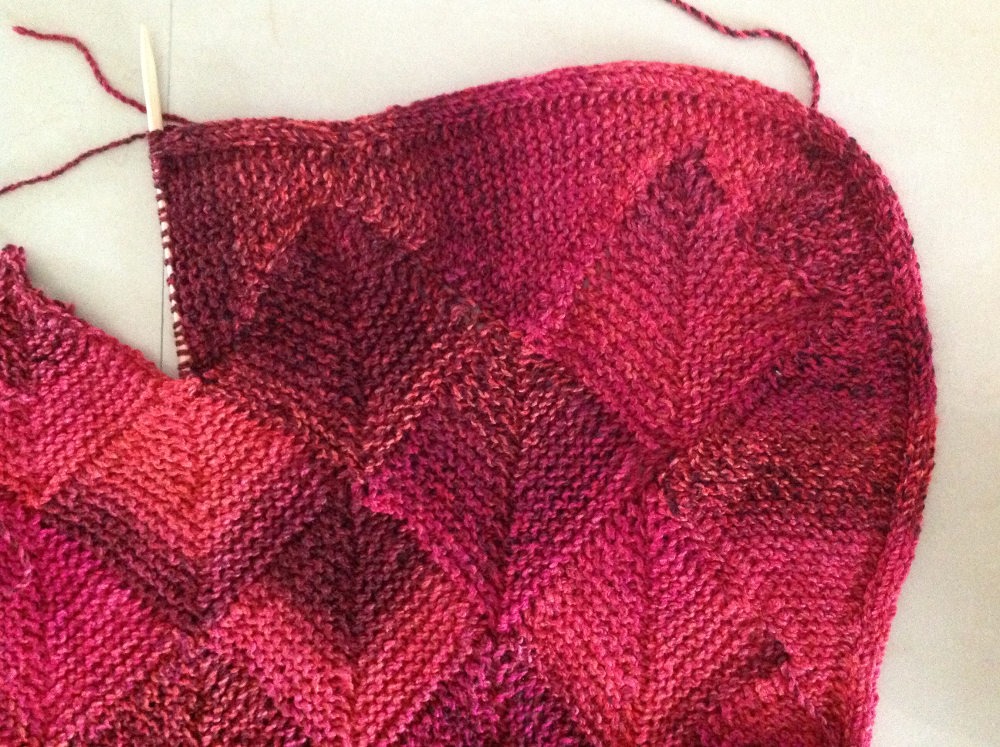
It’s particularly useful to create a “Chanel-look” professional detail on the fronts of cardigans. Buttonholes can be introduced between the edge and the main body, too. Or it can be used to create a casing for a drawstring or elastic, on the tops of bags or skirts. It can also be used on both sides of a narrow strip to create a firm strap, either to use as-is, or after fulling. (I posted about this almost 10 years ago).
How to work this edging? Very simple. Decide how many stitches wide you want it to be. Three or four is optimal, but up to six can be managed. Add that number to your total project width count. Let’s use four here for demonstration purposes:
Four-Stitch I-Cord Style Rolled Casing
- Row 1 (wrong side row): Work your project as usual until you get to the last four stitches. Bring the yarn to the front of the work. Leaving the yarn alone, slip the next four stitches as if to purl, transferring them one at a time from the left to the right needle.
- Row 2 (right side row): Just like when working I-cord, knit the first four stitches, making sure to pull the yarn very tightly to create the rolled edge effect. Then work the rest of the row as usual.
Now, what’s this about not quite working the edging on this project?
I had started it by adding five extra stitches of width on top of eking out my edge triangles, supplemented by a four-stitch rolled casing. That’s nine stitches per row extra. I got all the way around the corner, having worked that out, too, using short rows. Then I looked at how much yarn I have left – a little over 1.3 balls. It was highly probable that I’d run out before getting all the way around the blanket. With no way of getting more Marble here in India, I had to rethink.
I ripped out the whole completed edge section (two nights’ work), and began again. This time I’m using only one stitch of extra width, and I’ve cut back the casing from four to three stitches, for a total per row add of only four instead of nine:
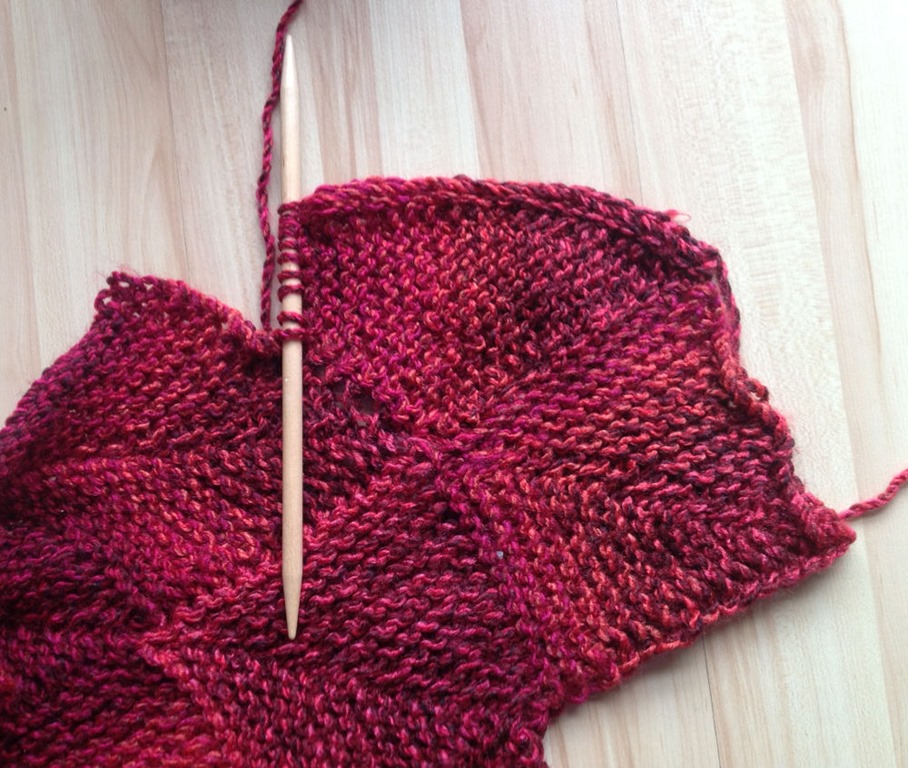
We’ll see how far I get. To be fair, I prefer the proportion of the last attempt, but it is no longer a valid option. So it goes…
If I still don’t have enough yarn, the next possibility is to rip back some of the center diamonds and make the total piece smaller. But because that’s worked on the diagonal, doing so will be a major pain.
Here’s hoping my quick fix is enough.
FRAMED
More progress on Motley. I am almost three quarters of the way done with the framing element. In this case, a Regia sock yarn in a deep charcoal grey.

I’m still on the first 50g ball of Regia, and you can just make out what has not yet been knit in the upper right of the photo (click on it to enlarge).
After this comes the multicolor edging, probably a plain saw-tooth, about as deep as the strips are wide. I’ll have to play around and see what looks best.
I’m flying by the seat of my pants here, and explaining exactly how I’m working the corners and filling in the edge triangles will be a challenge. When I post the final write-up of this project it will be more of a method description than a finished full pattern with explicit directions, quantities and the like.
Questions from the Mailbag
Nili asked a couple of thought provoking questions on my post about the difference blocking made in my Lattice Wingspan project. First she asked:
I bought some inexpensive acrylic yarn to play around with and am knitting a good sized sample of feather and fan stitch. If I keep going it could be a scarf. My question is, is there any value to blocking synthetic yarn? Will it respond to the blocking?
I attempt to answer.
There are as many answers to the question of blocking acrylic as there are types of acrylic yarns, multiplied by the uses to which it is put, and squared by the number of knitters, worldwide.
First, on fiber types:
Wools and high-wool-content blends have the memory/bounce-back property. The fibers have a natural elasticity and respond to changes in tensile stress and to a lesser extent, humidity. They return to their cozy, unstretched state upon washing (more or less). This is also what keeps the elasticity longer in ribbings knit from high content wool. Other protein fibers also display the stretch and bounce back property, although many are not as elastic as wool. Silk is the exception in that it doesn’t stretch very well.
Most acrylics on the other hand, do not have the same stretch and bounce back properties as wool and high-wool content blends. They can be stretched, but once set that way under heat and tension (aka “killed”), they will never return to their original shape. There are exceptions. High tech man made fibers are invented every day, and many acrylics contain a modicum of something elastic to keep ribbings true and offer a more “wool-like” experience.
Cottons, linens, ramie and other plant-derived fibers behave differently, with different shrinkage properties and performance characteristics under blocking.
Next, on blocking methods:
There are a zillion ways to block. Wet, dry, under tension vs. gentle pat out, with and without steam, and so on. Different methods are better suited for different fibers, or different uses. For example, the wet-block high tension set up used for lace to spread it out is not appropriate for a dense, cable knit sweater. A pat to measurements and non-contact steaming to relax it might be perfect for that Aran knit in wool.
What blocking does:
It evens out stitches, reduces (but does not totally eliminate) curl. It makes edges lay flatter and seaming easier. It coaxes the piece into the shape desired, although it cannot correct major size or proportion problems.
If a wash/wet block method is used, it removes hand grime any residual spinning oils from the yarn, and casual dirt from the piece. In general, it yields a more professional final appearance, and removes some of that “loving hands at home” look.
To answer in specific – blocking a lace scarf knit from acrylic:
How I’d proceed would depend on the acrylic I was using. You’re lucky because a lace scarf doesn’t need to end up being the exact dimensions that a garment body might require.
The best advice is to knit a small swatch that uses both the cast-on and cast off of your final project, and test out your method. You may find that damp block with blocking wires and pins, using non-contact steaming (an iron set to low heat) spreads out the lace and fixes it in that shape. Or you may find that doing so stretches the lace body a tremendous amount relative to the cast-on and cast-off edges, which end up looking cupped and puckered.
I’d probably attempt some sort of blocking on the thing, knowing that even if the ends puckered oddly, there are fall back positions. The most aggressive (and for knitters, controversial) way to fix that problem would be to toss the thing on a sewing machine and run three or four lines of machine stitching across the end, just before the cast-on or cast-off row. Then (horror of horrors) cut off the puckered end. The raw edge will be secured by the stitching, and can be made neater with a row of encapsulating crochet, or used as a base for fringe, or a knit-on edging.
Also what type of cast on creates a soft, loose base? I’ve found stretchy ones suitable for ribbing but I’m looking for one suitable for lace. I tried long tail with a larger needle as well as spacing the stitches out wider on the needle. It’s still pretty firm. What can I use instead?
I attempt to answer Nila’s second question without resorting to another indeterminate diatribe.
Lace cast-ons can be problematic. As you note many are too tight or are not stretchy enough for the wide spread of lace, or for the aggressive blocking that makes it look best. There are many simple and exotic cast-ons that can be used for knit from end to end lace. There’s another bunch that are great for center-out motif lace, but that’s for another post.
In general, for lace garments, the stretchy cast-ons are usually enough, especially when they are worked with a needle two or three sizes larger than the needle size that will be used for the bulk of the lace. But for things like shawls and scarves which are blocked until they scream, even a stretchy start is often not enough.
Simple lace cast-ons:
I won’t get into the really exotic methods, because most of the time the simple ones outlined here work well enough for me and my projects.
I usually work some sort of provisional cast-on because most of my scarf and shawl pieces are finished with an applied edging, which is quite easy to knit onto the loops that result when the initial edge is released from its provisional mooring. My favorite provisional start is crocheting on, which is easy to zip out for remounting the stitches on a new needle.
On the rare occasion when I want the edge to stand alone, and I need extra stretch, I will work the same crochet-on cast-cast on, but using a hook closer in size to my working knitting needle, AND working a crochet chain stitch BETWEEN each stitch mounted onto my knitting needle.
Another method I use is a variant of the cable cast-on. For this one I also use a knitting needle two sizes larger than my lace needle. Put a slip knot on the left hand needle. Insert the right hand needle into that stitch and draw a loop through it. Slide the new loop onto the end of the needle and before you snick the yarn up tight, insert the right hand needle into the new loop. Repeat drawing a new loop through the new stitch until you have enough stitches on the needle. If you were to insert the needle tip in between the old stitch and the new stitch, you’d be doing the classic cable cast-on – aka “knitting on”, but by making the new stitch in the loop of the previous one, you make a more airy and more stretchy edge.
Finally, on occasion the most convenient method for starting narrow lace pieces is the simplest one of all – the half hitch cast-on (aka “Looping On” or “Backward Loop Cast-On”). It’s the stretchiest of all, and can be made even more so by using a larger needle. It does however produce a very flimsy edge. I use it when I cast on stitches for a lace edging, when I intend on working the edging completely around something (scarf, baby blanket, etc.), and plan on joining my final row to my first row via grafting. Yes, I could use a provisional cast-on for this and end up grafting onto live stitches, but there are usually very few stitches at the start point of a narrow band of edging, and doing so wouldn’t be worth the effort. One caution on this – the stitches in the next row coming back HAVE to be regular knits or if they are purls, they need to be worked through the back of the loop. Otherwise the half hitches will collapse.
To sum up:
Lace cast-ons are largely a matter of personal preference. There is no one perfect method for every piece in every yarn. Knitters being passionate people, will each advocate their own favorite, and armed as they are with pointy objects – can be formidable in their discourse. The answer here is the same as every other answer in knitting. Give it a try, make a swatch and abuse it. See how you like the method for the piece at hand, with your chosen material. Preferences are as situational as they are personal, and there is no single correct answer.
 String-Or-Nothing