ROGUE – GOT IT!
As predicted, in those half-sentient moments between putting down the book, taking off the glasses, turning off the light and finally falling asleep all became crystal clear. I am not really sure what my problem was with the first few rows of the hood surround, but it’s fixed now. I’m busily bumbling along, about two inches into the chart. Perhaps was brain dearth brought about by lingering flu. Perhaps it was too much stress-itis. Or perhaps it was a touch of seasonal stupidity. Whatever it was, all is humming now, although I might rip back one last time because I’m not too happy with the look of some of the earliest increases. But that’s another story of another disorder.
While I await enough Rogue progress to make an interesting photograph, I present an odd little chance acquisition. I’ve written about Balich’s before. It’s an artifact from another time – an old fashioned general merchandise store several blocks from my house. They stock piles of inexpensive things you didn’t know you could live without, all tumbled together with minimal regard for organization. They happen to have a stock of Boye knitting needles and crochet hooks, plus Red Heart yarn, some crochet thread and vintage 1960s pattern leaflets. (Want a truly authentic ’60s era crocheted poncho? This is the place to find the original instructions.)
I went in to get some keys made, and while I was there I leafed through the pile of dusty patterns. There in the middle of the stack I found one and only one of these:
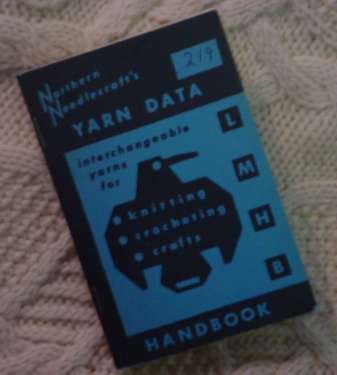
What is this?
It’s a 78-page yarn yardage/gauge comparison chart in purse-size format, put out by Northern Needlecraft, copyright 1980. It’s divided by yarn weight, and presents info for about 1,000+ or so yarns current in (and discontinued by) 1980. While some of the more widely distributed products by still extant or recently deceased/merged/otherwise gone yarn makers are also present in Valuable Yarn Guide, many of the yarns and makers in this little booklet aren’t. Even more interesting, for some yarns it offers up multiple gauges. Already it has come in handy, helping me decipher a vintage pattern calling for Columbia Minerva Calibar. Which turns out to be a 100% wool bulky, knitting at 16 st = 4 inches on US #10s, 2 oz., 75 yards.
A fantastic find! Especially for the princely sum of $1.25.
ROGUE – MORE PROGRESS
I continue to plug away at Rogue. I haven’t had much free time to knit lately, so I’m not zipping along as others might. The latest modification I’ve made has had to do with the smaller gauge of my chosen yarn, plus the texture pattern I’m using.
After getting to Direction #5 (split for back), it was obvious that I had more stitches than the pattern calls for. No surprise there. I cast on more than required (that gauge thing again). So I adjusted the number to be decreased. I’ve got more stitches than are called for even for the largest size, but my back armhole decreases are proportional to the original. I’m now in the work even for 38 or so rows. I’m upping that to 40 because it takes me to the beginning of my next repeat.
I can see that the step after this is going to be especially problematic. Rogue forms its shoulder decreases using short rows. A very clever technique. I’m not quite sure how or even if I will be able to integrate the short row shaping with my texture pattern. I may have to un-engineer that particular bit of cleverness, graphing out the shape of the decreases and moving them back to the ends of the rows. More on this after another two or so inches of work.

You are looking at the back of the piece, folded along the nifty side cables. You can see somewhat of the shaping made by the cables; the bound off underarm; the decreases that form the bottom of the armscye; and part of the work flat bit just before the shoulder shaping. Things look a bit curly because I’m a lousy photographer, and didn’t pin this piece out before attempting the shot.
Several people have written to ask me to go back to Webs with them. While it might be fun, I’m afraid I’m rather short of time, plus my yarn budget and available storage space are now stretched to the max. Please note I wasn’t theinstigator of this trip. I was pulled along not-so-reluctantly by the other members of an informal (and anonymous)Tuesday knitting group. They were kind enough to adopt me earlier this year, and I’ve had great fun watching their projects grow.
WEBS REPORT
As I mentioned yesterday, today I was part of a Grand Road Trip to Webs, the yarn mega-store in Northampton, Massachusetts. It’s pretty much at the other end of the state from where I live, but this being one of the small Eastern states (as opposed to large rectangular Western states) that translates to only a two-hour car trip each way.
I will say that the entire group had fun and spent some money, but not as much as we feared we might. Webs is quite large, with both a front room laid out in yarn shop fashion, and a warren of warehouse aisles and side rooms full of industrial shelving and shipping boxes full of extra stock. It’s easy to browse for hours, and especially if you’re looking for deep discount bargains in the warehouse, it’s easy to become overwhelmed by the volume of choices.
There are some hints I’d suggest to anyone planning a trip of this type either to Webs or another discount yarn venue. They all fall along the line of "be prepared."
- Bring the tools you may need to make your purchases. Depending on the individual, these can include a calculator, pencil and paper, a PDA, and a yardage consumption card or chart. In Webs case, a small flashlight is also a good idea because in places the warehouse area is very dark. If you’re a card-carrying knitting guild member, bring your card or other proof of affiliation. Some stores (including Webs) offer special discounts to guilds, but don’t be obnoxious about it if the shop doesn’t have a standing policy about extending such discounts.
- Look through your patterns and decide if there’s something special you wish to shop for. If so, bring either the pattern or some notation of gauge, fiber and yardage required.
- Look through your stashed yarns. You may want to buy something to coordinate with, eke out, complement or knit along with a yarn you have on hand at home. If so – bring a snippet for color matching, plus notation on the quantity you have stashed away.
- Familiarize yourself with the various numbering systems used to describe yarn weights. Webs (and other stores of its type) cater to both knitters and weavers. Many yarns can be used for both crafts, and cones are not always marked with yardage or suggested gauge. For example, if you’re looking at a wool or mostly wool blend, something marked 2/10 is likely to be DK to worsted in weight, knitting at 5.5 to 5 stitches per inch.
- Educate yourself about fibers. You’ll see yarns marked as "Shetland," "Merino," or other fiber types. If you’ve done your reading you’ll realize that Merino wool is softer in general than many other wools, but in certain spins and finishes can pill more than other types of wool.
- Be flexible. You will probably not be able to find the **exact** yarn your pattern calls for (although there is considerable stock of current labels) – but you can probably find a workable substitute. Look for matches in fiber type, yarn finish, and of course – gauge. If you can’t find a marked gauge but the fiber composition is close to that specified in your pattern, do the math to check the yards per pound (or ounce, or gram). If that’s close you’ll probably be o.k., especially if you buy 10-15% extra yardage as "insurance."
- Many yarns in places like Webs are significantly thinner than most hand knitters usually use. But remember, they can be doubled or tripled to bring them up to fingering, sport or heavier weights. Two strands of lace weight (2 ply in the UK ply system of yarn weight descriptors) = one strand of fingering weight (4 ply). Two strands of fingering weight (4 ply, usually 7 spi) = DK (8 ply) 5.5 spi. Two strands of gansey weight (5 ply, hard to find in the US, around 6.5-6.25 spi) = 10 ply or worsted weight (5 spi). Two strands of sport weight (6 ply, usually 6 spi) = 12-ply or Aran weight (4.5 spi). Two strands of DK (8 ply, 5.5 spi) = 16 ply or Bulky weight (3.75 spi).
- You will have questions. The staff is used to dealing with them, but try to make the staff’s life easier. Cluster your questions to make most efficient use of their time. Try to remember where you found something, and make every effort to find tags or other descriptors and gather as much info as possible before grabbing a shop clerk. You’ll find a question like "This yarn is labeled at 1500 yards per pound, could please you tell me how much it weighs?" followed by some quick calculations on your part, and the follow up question "Would 1900 yards be enough for a long-sleeve cardigan in size 36," will give you a more useful answer than handing the clerk a cone of something with the question "Can I make a sweater out of this?"
- Be considerate of other shoppers, many of whom have trekked as far as you to get to the target destination. Don’t push; put things back where you found them if you decide not to make the purchase; avoid rooting through displays and leaving them sadly pawed; have patience at the check out (especially if you’re behind a large purchase of unmarked coned yarn); try not to block access to the shelves or aisles; and in general – shrieks of discovery are not a good idea.
- Leave ample time to make decisions. Arriving before lunch, making some choices, parking the selections and heading out to eat, then returning for a final cull and/or addition is a good plan. (If you do go to Webs, I recommend Sylvester’s for lunch. It’s a short stroll from the shop, the fresh air does wonders for the brain cells after the dusty, dark yarn warehouse room, the food was quite good and very reasonably priced.)
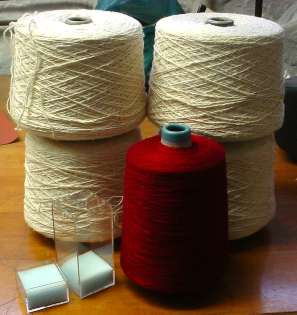
What did I buy? Just a couple of things. First, I finally got myself a McMorran Yarn Balance. That will come in handy to calculate yardage for the various yarns I have on hand. I bought a queen-size bed’s quantity sport weight cotton flake, destined for my re-do of my North Truro Counterpane. It was amazingly inexpensive, especially for the vast amount I need. And on a whim, I bought a cone of shrieking cranberry color lace-weight silk-look rayon which will (eventually) become a Hazel Carter Alcazar shawl, or maybe something else equally as dramatic.
BACK ON TRACK – ROGUE
Things are finally back to almost-normal around here. That includes getting back on track with my own knitting. I’m almost done with Chart A. In two more rows I’ll reach the point where I am supposed to divide for the back and front:
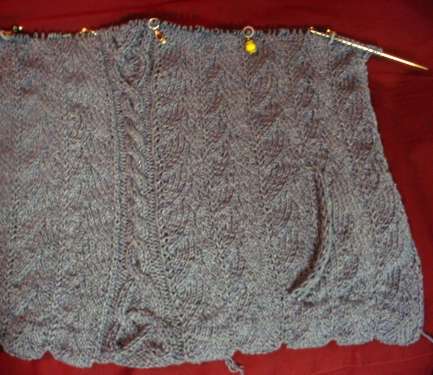
So far I’m quite pleased. The little dragon skin texture is working out well; the side cable has been lots of fun to knit. The next challenge will be to play with the texture pattern and any shaping decreases that will be happening around the armhole. I’m not worried though. I worked out the logic of trimming this particular repeat on the pocket. Shaping around the armhole should be more of the same.
The piece is weighty, and the yarn is a killer splitter but that’s to be expected working in a multistrand cotton of this type. Target Child is also quite pleased that I’m back working on the thing.
In other news, ten days of above 40oF plus savage rain has revealed the muddy glory that is Massachusetts in the spring. That means that sometime in the next three weekends our next major sweat-equity house project will commence – the removal of The Ugly White Picket Fence. I leave you with an archive photo from last year, so you can see Ugly Fence in action (plus the giant pine tree that used to lean on the house):
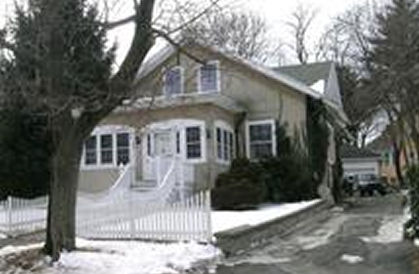
Why do I think my fence is worthy of destruction?
- It has nothing to do with the architecture or style of the house
- It’s the wrong size/proportion for the lot
- It’s not on the lot line, and shrinks the visual footprint of the house
- It’s discontinuous, and serves no purpose of containment or security
- Walking down the chute path to the front door makes me feel like a sheep about to be dipped
- It’s a pain to rake around, shovel over, and mow around. The snow dunes it formed this past winter completely covered it and required major excavation to move.
- For some reason, the previous owners included a massive sign post as part of the fence, as if they were going to be hanging out a doctor’s shingle or a permanent "for sale" sign (you can see it near the front door). I hate it.
- It needs a severe scraping, sanding, and repainting. A problem since it’s probably covered in lead paint.
- We know someone who wants it (lead paint and all), and who will help us take it down for the privilege of hauling it away and re-using it.
CAST ON ROUND-UP – II
Following up on last Wednesday’s post on looped cast-ons, today I’ll blunder through the family of knitted-on cast ons. Reference books not detailed below are listed in the original post.
There are dozens and dozens of cast ons. I know I haven’t gotten you your particular favorite yet. Eventually I hope to cover as many as I can find. Why bother?? Because it’s always nice to have options, to find new ways to do things and in doing so – to find out that some might just be a tad better than others in a specific use case. To someone who only owns a hammer, everything looks like a nail. To someone with a whole toolbox at their disposal, the hammer might not always be exactly what’s needed.
I’ll keep posting these. For the ones that are well illustrated or easy to describe, I’ll forgo illustrations, presenting instead these reference links. When I get to some of the less widely seen (or harder to describe) styles, I’ll begin adding my own illustrations. But we’re still well within the Known World here, so please forgive the lack of pix.
Simple Knit-On Cast On
This is a very popular cast on, although it’s more often taught outside the US. It’s often taught to children learning in large class situations. I know several knitters who learned to knit as small children in schools as far flung as Hong Kong, Brasilia, and Bangalore, all of whom report this as the first cast on they were taught.
Knitting on produces a neat, even edge that’s less elastic and more robust than that produced by the half-hitch cast-on. It can be worked either as the foundation for an entire piece, or as a method of adding stitches at the end or in the middle of a row. It’s not uncommon for example to find a scrap of knitting on (or a sister technique) forming the top edge of a buttonhole.
Advantages:? No need to measure out long tail lengths. Easy to teach absolute beginners. Miller in Heirloom Knitting mentions the utility of this simple cast on for lace (she uses half-hitch and invisible cast ons, too), citing the edge construction as being suitable for going back later and picking up or attaching additional stitches.
Disadvantages:? Not as stretchy as some cast-ons, but stretchy enough for most uses, even lace. The front and back have a different appearance. Some people don’t like the look of one or the other, and add a row to their pattern to make sure that the preferred side is visible when the garment is finished.
On line references:
http://www.knittinghelp.com/knitting/basic_techniques/index.php
http://www.wonderful-things.com/newknit1.htm
http://www.mycraftbook.com/Cast_On_Stitch.asp (a little hard to follow)
http://www.learntoknit.com/instructions_kn.php3
http://www.knitting.co.nz/pages/knitting/caston.php
Book references:
DMC Encyclopedia, Fig. 419
Vogue p. 26
Bantam, p. 17
Miller, Heirloom Knitting, p. 33
Cable Cast On
The cable cast on is very closely related to plain old knitting on. The difference is in the formation of the new loops. In knitting on, the needle is inserted in a stitch in the normal fashion, and the new loop is pulled through the old stitch and placed on the end of the left hand needle. In cabling on, the new loop is formed in the space between the last stitch cast on and the one before it. (The first stitch in a cable cast-on is always a plain on knit on stitch because at the outset there aren’t two loops on the needle in between which one can pick up that new stitch).
Advantages:? No need to calculate tail lengths. Very firm stitch with a pronounced decorative edge. One of the least stretchy cast-ons. Excellent for cuffs, hems, but less useful for necklines, sock tops and other high-stretch scenarios. Very good choice for cottons or other less-elastic yarns that have a tendency to stretch out (and stay stretched) with wear. Makes excellent, long-wearing buttonholes.
Disadvantages:? Stretch (see above). Like knitting on, this has two very different sides visually. Some people add or subtract a row from their pattern to make sure that the preferred side ends up on the front of the work.
On-line sources:
http://www.knittinghelp.com/knitting/basic_techniques/index.php
http://www.wonderful-things.com/newknit1.htm
http://www.knittingatknoon.com/cable.html
http://www.worldknit.com/howto/howtoknit/beginningtechniques/castingon.html
Book references:
Stanfield, p. 16
Vogue, p. 26
Bantam, p. 17
Alternate Cable Cast On
I’ve only seen this one detailed in Vogue. It’s a variant of the standard cable cast-on, made even firmer by working the cast-on row’s stitches through the back, rather than through the front of the piece. I haven’t tried it myself, so I can only report the book’s assertion that this method creates a firm edge. Also, from the accompanying illustration, it has a much less defined "edge spine" running across the bottom edge. People wishing to avoid that visual edge at the bottom of ribbing may want to experiment with this method.
Book reference:
Vogue, p. 26.
NOT SO OOP BOOK REVIEW – FOR THE LOVE OF KNITTING
Thank you for all the get-well wishes. I’m still flu-laden, and now joined with two sick kiddies at home, I am at least clear headed enough to sit vertical, type and knit. I don’t know where this particular bug came from, but it appears to take 10 days to run its course. An eternity of delight…
For the Love of Knitting
Despite some huge budget problems, my local library is still getting a trickle of new books. Patrolling the new book shelves, I found For the Love of Knitting: A celebration of the Knitter’s Art, edited by Kari Cornell (Stillwater,Minnesota: Voyageur Press, 2004).

This one is a knitting coffee table book. Big format, copious, colorful illustrations, lots of "name appeal," but little content. It’s a collection of essays by the likes of Zimmerman, , Falick, Swansen, Klass, and other knitting writers. About a third (including the Zimmerman, and Klass pieces) have appeared before in magazines, newspapers, and even in other knitting inspiration books like Knitting Lessons, Knitting Sutra, and KnitLit. I was surprised to see so much material mined from recent sources and reprinted in a book of this type.
While this book is certainly pretty, and the essays are interesting, no one is going to learn anything new from this book. There are no projects. There are no descriptions of techniques. The majority of the pictures are of knitting booklets from before 1960, shots of yarn baskets, archive photos of knitting and knitters, and pictures of knitting in art. Only a couple of the essays have pictures of immediate relevance in them. In terms of garment inspiration, there are a couple of close-ups of some of Solveig Hisdal’s stranded work (taken out of context because the whole garment isn’t shown); plus several shots of "art knitting" – a couple of wearables, plus various soft and hard installations incorporating knitted fabrics. Very little for a book so large and so copiously illustrated.
I also found the editorial tone of the thing got increasingly irritating. An example the caption on a Russian postcard, found on page 50. "Knitting Companion: In this quaint Russian postcard, a young woman keeps one eye on her knitting and another on her cat, who looks about ready to pounce on the next free stand of yarn." I can see the picture. there’s no reason to describe it in the caption. I want to know more about the postcard. Were such things common? When was it made? The style in the picture makes me think it might be from the 1920s. A Russian postcard from the 1920s? There has to be a story there, but there is no further attribution or sourcing for the postcard. Nothing whatsoever beyond showing the picture and then describing it overly cutely.
So if a sample course of essays describing knitting (as opposed to knitting technique), illustrated with patronizingly described eye candy appeals to you, you’ll probably enjoy this rather formulaic book. If nothing else, you may find a first taste of someone’s writing here that would lead you on to her or his other works.
Final verdict: Save yourself the $30.00 cover price. Borrow this one from the library.
PERSEVERE!
My older daughter is new to knitting. She just began at the Boston Knit Out this past fall. So far she’s done several foofy garter scarves for herself and her friends (first lesson in casting on and the knit stitch); a 42-stitch hat (using DPNs to knit in the round, decreases); and a felted bag (more reinforcement of knitting in the round, plus making a larger project, and I-cord, and picking up along an edge).
You’ll notice that all of her finished items were all-knit/big yarn projects. She wanted to “graduate” from all-knit and learn purling. She also wanted to use smaller needles. So we talked it over, and she suggested doing a pair of ribbed fingerless mitts. In fingering weight yarn. On US #0s. Without a pattern.
Now, did I tell her that many adults break out in prickly heat at the thought of using DPNs, let alone size #0s? Or that a 56-stitch around wristlet can contain as many stitches as an entire big-needle sweater? Or that I’ve seen grown women cry when someone suggests they knit (gasp) without a pattern?
Naah. What she didn’t know couldn’t daunt her.
So she cast on and began knitting. And knitting. And knitting. She plugged away at her mitts every evening after homework, while we (as a family) played video games. At first, being new to purling, her stitches were loose and wobbly, with ladders in the corners between the DPNs. But practice soon took care of that:
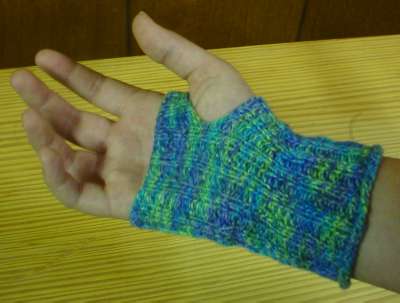
For everyone who has ever said to me, “I tried DPNs but I couldn’t manage them,” or “It takes too long to learn something new,” I present her learning progression. She worked the bottom one first, then the top one, both using the same yaran, stitch count and needles. You can see how her gauge, stitch accuracy and general neatness improved steadily throughout the project.

Sure, one’s bigger than the other, but both are wearable, and she does wear them proudly.
Knitting takes time to learn – there’s no getting out of that fact. Some people DO learn faster than others, but everyone who wants to learn IS capable of doing so. The key is practice. Unfortunately practice is a dirty word in today’s instant-dissolve, short attention span world.
Not satisfied with how something is turning out? Keep at it. Do something small and inconsequential that uses the same skills. Work out the kinks and bugs on the practice piece rather than the luxe yarn you chose for your “real” project. But keep going. You CAN do it. As the Target Child says “No stinking piece of string was going to defeat me!”
Here’s her pattern. (She?thinks her fingerless mitts look like the disc-shooting zapper gauntlets worn by a character in one of her favorite PS2 games).
Zapper Gauntlets
About 150 yards or so of a smooth non-itchy fingering weight sock yarn. This pair was knit in some remnants of On Line Linie 6 Supersocke 100 Cotton, but any sock yarn will do.
5 DPNs, Size US #0 (2mm)
Gauge: Approximately 9 stitches = 1 inch (2.5cm), measured over K2, P2 ribbing.
Cast on 56 stitches (14 stitches per needle). Join to continue working in the round. Knit six rows. Change to K2, P2 rib and work until piece measures approximately 4 inches long (10cm).
At the beginning of the next round, bind off 10 stitches. Continue working around wristlet. You should have one needle with 4 stitches on it, then three needles each with 14 stitches. When you get to the hole created by the bind-off, flip the work over and head back in the other direction. Work five more rows of K2, P2 rib this way – flat, ending at the right side of the growing thumb hole.
On the next row we return to knitting in the round. Start Needle #1 by casting on 10 stitches (all needles should have 14 stitches again). Continue in established K2, P2 ribbing pattern, working in the round until piece measures approximately 1 inch (2.5cm) measured from cast-on row above thumb opening. Bind off loosely in pattern, and darn in all ends.
That’s it!
(More in the cast-on series next week, I promise. Looking up all those links is more work than I have time for right now mid-deadline.)
CAST ON ROUND-UP – I
Monday I posted about teaching my sock class, and as part of it – teaching the backwards loop (half-hitch) cast-on for sock tops. I wrote that I thought the half-hitch cast-on was the stretchiest one I knew. I use it often both for sock tops, the bottom edge of lace pattern pieces, and the edge of watch caps – in fact, most things I want to stretch to their maximum potential. Sockbug wrote in to say there were other, stretchier choices.
I’ve heard people express skepticism on the durability of a simple half-hitch sock top edge, but not its potential for stretch. (For the record, out of around 30 pairs of socks in my own drawer, and easily another 75 knit for other people, I’ve never experienced nor had feedback that a half-hitch cast on edge has failed). Still, I’m always open to learning new things (there’s a nifty one below I’ll be trying out soon.)
Just to make sure we’re talking about the same thing, here’s the half-hitch cast-on:

Now I can’t say I’ve used every other cast-on out there (there are dozens and dozens). I’m always looking for more. Here’s a round-up of what I can find on the Web, and in some standard reference books. Today’s group is the family of half-hitch/backwards loop cast-ons, including a couple of rarely seen variants.
Reference book key:
Vogue Knitting. I have the old edition, (c) 1989. Page refs are good for that one.
DMC Encyclopedia is also known as Therese de Dillmont’s Complete Encyclopedia of Needlework. It exists in dozens of editions. Mine is the Running Press one put out in 1974. Page numbers can vary, but the fig numbers accompanying the text are uniform in all editions. Where possible, I’ve given the fig numbers as they appear in the knitting section.
Bantam Needlework. The Bantam Step by Step Book of Needlework I’ve reviewed this one before. It also exists in several editions. Mine is the 1979 issue. To my knowledge, page numbers are constant across editions.
Dictionary of Needlework. The Dictionary of Needlework by S. Caulfield, and B. Saward. This is a big wandering needlework omnibus, first put out in 1882. I have the 1972 Arno Press reproduction.
Stanfield. Encyclopedia of Knitting. This is a newer book, (c) 2000 – and is one of the easiest to grasp, yet unpatronizing or project dependent of the current crop of books for beginning knitters.
Apologies for not citing Mary Thomas. That book is Somewhere. Somewhere being defined as "within the house, but AWOL."
Half Hitch (Backward Loop; Single) Cast-On
This one is the simplest of all – just a series of loops mounted on the needle. I’ve seen people work the half-hitches in either the right or left orientation. I like to follow up this particular cast-on with a single row of plain knit before I launch into a ribbing. This seems to firm it up a bit, and avoids the untwisting purl problem that some people experience when working in the round.
Advantages: No need to measure out a long length, then hope you have enough set aside to accomplish all the required stitches. Very stretchy. Easy to teach to absolute beginners. A standard choice for adding stitches at the end of rows, or replacing stitches mid row (as in some buttonholes).
Disadvantages: Purls can untwist the simple loops of the cast-on row. Not the sturdiest, most stable edge. Some people think makes a sloppy, loose looking edge compared to other methods.
On line references:
http://www.dnt-inc.com/barhtmls/knit/sco.html
http://www.socknitters.com/toe-up/tulessonone.htm
http://www.knitnet.com/common/support/caston.htm
http://www.knittinghelp.com/knitting/basic_techniques/index.php
http://www.wonderful-things.com/newknit1a.htm
Book references:
DMC Encyclopedia, Fig 420
Vogue, p. 25
Bantam, p. 16
Stanfield, p. 17
Double Loop Variant of Half-Hitch Cast-On
I haven’t tried this one myself, and just ran across it researching this note. The source cites it as being very suitable for lace edges in which multiple increases occur rapidly on the succeeding row. That leads me to believe it’s also quite stretchy. It also looks a bit more open than the plain half-hitch cast on.
The best way I can describe it is to form a standard half-hitch loop, but before pulling it snug up against the previously formed stitches, to take it and give it a half twist, then place the loop formed by the half twist on the end of the needle – in effect making two stitches from every half-hitch loop.
Book reference:
DMC Encyclopedia of Needlework: Figure 421
Double Cast-On or Thumb Cast On
I learned this one only recently. It’s a useful addition to my bag of ticks, but I haven’t settled on a best use case scenario for it yet, although I could probably substitute it for other places in which I’d do a standard long tail cast-on.
I’m grouping this one with the half-hitch family because the ultimate row formed at the bottom of the work is secured by half-hitches, although it could be argued that it more properly belongs in the long-tail family. It’s a simpler version of the long tail method, and starts by leaving an ample tail (about 3x the width of the thing to be cast-on); and making a slip knot. The knitter forms a half-hitch using the long tail, but holds it open with the thumb. Into this loop around the thumb he or she then knits a stitch using the working strand of yarn (NOT the long tail).
Advantages: Firmer than half-hitch. Slightly easier to teach than some other long-tail methods.
Disadvantages: Has a tendency to become too tight. I correct this by casting on over two needles held together. Needs a guesstimate on how long the tail needs to be to accommodate the required number of stitches (I sometimes cheat by knotting together two strands for the first row, cutting one at the end of the cast-on and accepting the fact that I’ll have an extra end to darn in later). Because the bottom end is half-hitch, it isn’t as firm as some other cast-ons. Some think it may be as prone to wear as the half-hitch.
On-Line references:
http://www.wonderful-things.com/newknit1a.htm
http://www.knittinghelp.com/knitting/basic_techniques/index.php (last link under long tail)
http://www.mycraftbook.com/Cast_On_Stitch.asp
and an interesting variant – doing this in pattern for ribbing to create an edge with no visual ridge along it. I’d not seen this one before today either. I’m going to have to try this one out myself!
http://morcatknits.typepad.com/cast_on_workshop/
Book reference:
Bantam, p. 16
Vogue, p. 25 (long tail thumb method)
Dictionary of Needlework, p. 281
Stanfield, p. 17
DUTCH HEEL
A couple of people have asked me why I thought a Dutch heel was easier than other forms of heel-flap sock heels; and how they fit.
First, there are lots of other treatises on Dutch heels elsewhere on the Web. Judy Gibson has a nice write-up on this heel variant. It’s part of the Socknitters Cybersocks on-line sock tutorial. Regina Williams has done a work-up on the math needed to construct Dutch style heels on toe-ups.
In terms of history Dutch heels date back to at least the 1880s. I found one mention of them on the Web in a transcription of an 1883 edition of The Girl’s Own Paper, a typical young women’s interest magazine of the time. They may in fact be older, but sources on sock heels before 1883 at my fingertips as I type this aren’t very copious.
In terms of fit, Dutch heels have the ample instep (upper foot/ankle) of other shaped heels. That means they’re deeper in the ankle than are short-rowed sock heels. They are also a bit more snug side to side than other forms of round or square heels. People with average to narrow width feet and especially people with narrow heels will find them quite comfortable. While my own feet are in the walrus flipper range of size, my heels are narrower than one would expect given my paddle-like toes. I am still experimenting with Dutch heels, knit both cuff down and toe up. I’ll report back on comfort and fit as compared to short-rowed heels once I get a few more pairs into my wash/wear cycle.
I think the Dutch heel I’ve learned is easier than a standard round heel because the heel cup area maintains the same stitch shaping repeat throughout. the short-row segment that forms the heel has parallel sides. You don’t need to keep as close track of where you are in the shaping’s progression as you complete that stage of the work.
Here’s an example of a hypothetical Dutch heel, worked on 7.5 stitches per inch/10.5 rows per inch (the standard label gauge of Schoeller/Stahl Fortissima/Socka – a textbook classic sock yarn). I’ve calculated this for a average sized cuff-down sock, one that would probably fit someone wearing a US Women’s 7-8 medium shoe size. This works out to a very average sock of 60 stitches around. To simplify things, I’ll suppose a plain stockinette heel flap.
I’d work the ankle as desired. When it was completed, I’d work my heel on 30 stitches (half the available circumference). Because I normally use a set of 5 DPNs, that means I’d be doing my heel across two of them. People using two circs would work this across one of their needles. Magic Loop folks would work this across the stitches on one side of their needle’s loop.

I’d knit the heel flap in plain stockinette, slipping the first stitch of each row to make nice easy to pick up in chain selvedges. I’d probably make it about 30 rows deep, ending after completing a wrong-side row.
To turn the heel, starting on a knit side row, I’d knit 18, work a ssk, then turn my work over. Heading back in the other direction, I’d slip the first stitch, then purl 6. Then I’d do a purl two together, and flip my work over again. Back on the knit side row, I’d slip the first stitch (that’s the one I purled two together on during the previous row), then knit 6 and work another ssk. I’d repeat the slip 1, purl 6, p2tog, turn row; followed by the slip one knit 6, ssk, turn row until I had consumed ALL the stitches available on my heel needles, and my total on-needle(s) stitch count was 8, after the completion of a purl side row.
To make the gusset, I’d knit across the top of the heel to put myself in position to start the gusset pick-ups. Looking down the left side of the heel flap, I’d pick up 15 stitches in the chain stitch selvedge loops. At the bottom of the heel flap I’d do the anti-hole cheat by picking up an additional stitch at the base of the flap, for a total of 16 new stitches. Then I’d pick up my dormant instep needle and work across the top-of-foot stitches. If I were using the circ methods, I’d switch back to my heel-bearing circ or circ segment after the foot-top stitches were done. Now At the base of the heel flap on the other side of the foot-top stitches, I’d first pick up that anti-hole cheat stitch, then 15 in the chain stitch selvedge loops heading back up the right side of the heel flap.
I now have all the stitches I need to create my gusset. I’d knit across the heel flap and down the left hand edge until only three stitches remained, then I’d do a K2tog, and knit the last stitch on the needle. Changing to my top of foot needle(s) I’d work those stitches, then switch back to my heel needle(s), working a K1, ssk, and then knitting back up the side of the gusset and across the top of my heel. I’d knit the next round plain (no K2tog or ssk decrease at the corners of the gusset). After the plain row, I’d do another decrease row, alternating decrease rows and plain rows until I was back to having 60 stitches total again, the same number I had before the heel began.
so we see that the only real difference between a Dutch heel and the other standard heel flap and gusset heels is in the formation of the heel turn (heel cup). In the Dutch heel there are only two rows to remember – s1, knit (x), ssk; and s1, purl (x), p2tog. That to me at least makes it easier to calculate and to teach. Also to work in fits and starts, as my briefcase sock per force should be a project in which the need to keep track of where I am is minimal.
BRIEFCASE SOCKS
Not much knitting progress to report on Rogue. Other priorities intrude this week. I have however gotten a fair bit done on my "briefcase sock."? That’s the pair of socks in progress that live in my work backpack. I like to keep one going that’s done while waiting for appointments, in line at the post office, and in those other bits of time that would otherwise be frittered away.
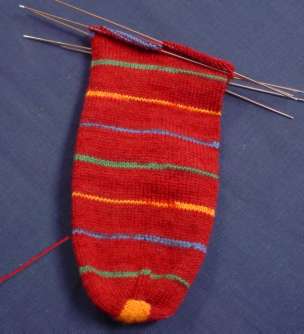
Briefcase socks are usually not of the most elaborate styling or construction. They have to be able to be picked up and put down without losing one’s place in a pattern, and mindless enough to do with only minimal attention. As such, self-patterning yarns are ideal. This pair is in Reynolds Swizzle. It’s marked at 7.5 stitches on a US #1 or #2. I’m using 1.25mm needles (US #0000), and getting 10.5 spi. This particular sock is 80 stitches around. As you can see, even at the much smaller gauge, I’m getting accent stripes that are perfectly satisfactory. They’re mostly one row wide, with a two row overlap of about 25-29 stitches. This pair is being done in the standard toe-up/short-row heel style that has become my automatic default. I began the sock at the very beginning of a yellow stripe. I’ve just started the short-row heel section at the blue stripe now just off the needles. I’ll probably begin the second sock at the start of either the blue or green accent stripe, just to be playful and have a pair of fraternal rather than identical twins.
Why do I knit my socks at such annoyingly tiny gauges?? I like them better. I find densely knit socks to be more comfortable, with none of that walking on pebbles feeling others report as a reason for not liking hand-knit socks. I have found that densely knit socks wear better and last longer, especially ones that are a bit tight on the foot. Socks that are large enough around to permit shifting can bunch up inside the shoe and either wear themselves thinner over time, or create blisters.
I find that most 4-ply fingering weight sock yarns work just fine for knitting at gauges significantly finer than they are marked. Three ply weight fingering is even thinner. It’s tough to find it now that the old Kroy 3-ply is history, but I can get up to 12 stitches per inch out of a good 3-ply. That’s fine enough to knit many pre-1900 era sock patterns verbatim. Cast on 96 stitches?? No problem with a 3-ply.
Finally how am I liking the Swizzle compared to other sock yarns?? It’s o.k. Not great. I find it a tad harsher than the Regia line and the Fortissima/Socka line. It’s also thinner looking un-knit, but denser (less airy) than the other two. The narrow, widely spaced skinny stripe is different, but boring. I may try to liven up the sock ankle a bit by either purling the accent rows, or by playing with a slip stitch or mosaic pattern on them.
Aside:? Welcome to my Japanese visitors!? I have no idea what the referring page says, but you are more than welcome to wander around and rummage through my past entries. Google translation tells me this
???????!
means "Happy knitting!"?? Although automatic translations are usually too literal (and usually produce silly output) I hope it’s not too far off.
 String-Or-Nothing