WORKING SUMMARY – FILET OF DRAGON
Filet of Dragon
Thank you for all the complements!? Filet crochet isn’t difficult if you’re comfortable following a chart. It flollows the same logic as knitting a colorwork pattern in the flat from a chart – back and forth row by row. The hardest part is making the correct number of chain stitches to form the foundation on which the first row is worked. I did the math, then used safety pins to mark off every 25 stitches as a counting aid. I did end up being one short, so I cheated, and added a mesh at the end. If you look VERY closely to the first mesh at the cast-on tail, you’ll see it’s a bit heavier on one side where I slip stitched back up after making my cheat mesh?in preparation for the next row.
Once the count of the first couple of rows was established, the thing became a simple mantra of counting. Begin, A, B, 1, A, B, 2, A, B, 3 and so on, with “Begin” standing in for “make initial double crochet of the mesh,” “A, B” being either work two chains for open meshes, or two more DCs for filled ones; and the number being the count of the open or filled meshes for that particular run.(UK crocheters read trebles for the doubles cited here.)
I used the improvised magnet board system I wrote about earlier. Since each row was “proofed” by the row that followed, my mistakes became almost immediately apparent. The two I did most often (and each only a couple of times) was skip over a mesh when making a long run of open meshes, reducing the count on the new row by one;?or substituing an open box for a filled one – in effect forgetting that the design on the new row was shifting up or down by one box to make a visual diagonal. Since I was both confirming the raw count of each segment as I worked it as well as doing the “work even/one more” system, I never had to rip back more than one row.
So to sum up, filet crochet is much easier than the complexity of the finished piece would lead one to believe. The style I used employs only chain stitches and double crochets, and once one is used to making even stitches,?is an excercise in chart-following more than anything else.
Some people asked me to repeat the photo of my book (The New Carolingian Modelbook), showing the dragon pattern page, so they could do a quick compare for the distortion effect. Here it is:

FILET OF DRAGON
The camera has surfaced!? The ‘net connection (briefly knocked out by overzealous electricians) is now up again!? I can finally post my progress on the Filet of Dragon curtain panel:
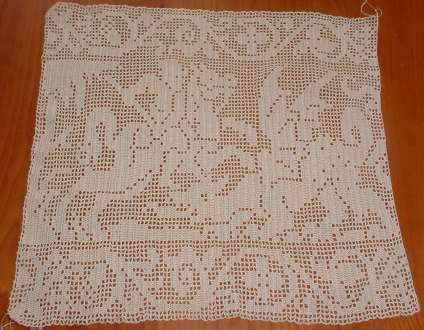
You can see the foreshortening effect I mentiond yesterday. I’ll be adding additional panels of the scrollwork at the top and bottom to either end, then another framing of some sort around the entire thing.
Rushing off to check up on yet another contractor…
IN ABSENTIA – FILET OF DRAGON; CROCHET
Another in-absentia post. This one reports progress as of 1 July. Again sorry to be not here.
Crochet in General
Crochet is not a dirty word. I know there’s an ongoing friendly rivalry between knitters and crocheters, but I think the two crafts aren’t mutually exclusive. In fact, I teach a one-day workshop entitled "Crochet for Knitters" offered sporadically at my LYS and to local guilds (when scheduling allows). It covers basic crochet techniques, then veers off to cover techniques of special use:
- Crocheted chain cast-on, both free and done onto a knitting needle
- Crocheted buttons and button loops
- Simple crocheted edge treatments, including the dreaded Shrimp Stitch (reverse single crochet)
Crochet and knitting do produce fabrics with very different properties. Knitting by nature makes the thinnest, most flexible non-woven textile possible from a strand of yarn – loops are single-thickness, and lie as flat as possible. Given yarn and needles of equivalent size, crochet produces a much thicker, heavier, denser fabric – multiple loops drawn through each other form the basic stitch unit. Knitting has an elasticity and drape that no crochet can equal (again given equivalent weight yarn and needles).
On the other hand, crochet has its own set of advantages. For the most part, it lies flat compared to knitting – especially to stockinette knitting. It produces a very durable, stable fabric. It’s also less constrained to "typewriter" row-based production (back and forth or round and round on a single plain of work). This makes things like relief work (think Irish Crocheted Lace), and 3-D freeform production possible. The learning curve for basic technique is also less steep. Crochet has only one basic movement – hooking a loop and pulling through another loop. Knitting has several?- forming knits, forming purls, and their several variants.
I learned to crochet long, long?before I learned how to knit. Like knitting, I taught myself from a book.I was around 7 when I?began making odd little squares with no particular use in mind, ?but I was a strange kid who read early and liked sitting quietly and making things.Knitting by contrast I didn’t pick up seriously until after college graduation. ?One of the reasons I found Continental style knitting easy and natural was that I was already well schooled in holding and tensioning thread or?yarn with my left hand, an artifact of this previous experience. In fact, I believe that people having problems learning Continental style might benefit from a brief side-trip to crochet because doing so would acustom them to this skill.
Crochet has many forms. The ones I favor are the finer styles of cotton crochet, done with threads of various thicknesses. Although I did quite a bit of it before learning how to knit, I no longer do much large-gauge crochet with yarn heavier than fingering weight. I find the resulting fabric too thick and stiff for most uses. Afghans, hats and bags are the exception, although I much prefer the airy drape of knitted blankets to the heft of crocheted ones. Hats and bags however can benefit from the additional?weight and structure. Note that I do not recommend fulling or felting crochet. I’ve never had a good result doing so, probably because I’ve never hit upon the right ratio of working looseness that would give the yarn enough room to shrink evenly.
A final note on crochet – I get lots of questions at wiseNeedle on how to go about converting a knitted pattern to a crocheted one. Although books have been written on the subject, my answer is usually "with difficulty, and probably not successfully with the original yarn specified in the pattern."? This goes back to basic stitch structure. For a piece of crochet to have anything like the same drape as a piece of knitting, it has to be made from a much thinner yarn. A knitting pattern written for worsted weight yarn cannot be crocheted in worsted weight yarn with the same result. I’d use a fingering weight yarn, light sport at the absolute heaviest. Then I’d draft out a pattern schematic from the original design, do a crocheted swatch, and re-draft all of the required pieces based on the gauge of that swatch. There are no short-cuts or magic formulae, just plain old trial and error and calculation.
Filet of Dragon
For all of crochet’s free-form possibilities, filet crochet is the most row-oriented form of the craft. Filet takes a graphed design, and interprets it in open mesh and worked mesh squares – sort of like net with some of the holes filled in. As I think I mentioned before, this is an aesthetic that dates back a long time, with several different crafts called into service to do it over the years. There are forms of darned netting and grounds, withdrawn thread work, and freeform needle lace that all produce roughly similar filled/unfilled box-based patterns. Crochet is the most recent, and (having tried most of the others), I can say?the fastest method developed so far.
Filet crochet production marches across a graph row by row. Reading charts for filet production is very much like reading a chart for stranded knitting done in the flat. You begin at the lower right hand corner, work across the first row right to left, then on the next row, return by reading across in the opposite direction. Filet crochet though exacting is a very easy technique. There are several excellent on-line tutorials. This one is my favorite. There are also quite a few filet pattens on line, but any design that can be graphed up on a grid using two values (open and filled squares) can be used.
All this being said, here’s the progress on my filet curtain panel:

The 4.3 rows shown represent about three hours of work. I’m a much slower crocheter than I am a knitter, as unlike knitting, I have to actually watch my fingers to ensure the stitches are formed correctly and are in the right spot. The piece is about 17 inches across. The dragon panel will happen in the center, with mirrored strips of a vine-like edging at top and bottom. The safety pins mark the transition point between the dragon panel and the framing vines.
I’m getting?a bit more than 5?meshes per inch using a 1.15mm Bates hook and Size 30 thread (thicker than sewing thread, but not as thick as perle cotton or bakery string). Each open mesh is formed by a double crochet followed by two chains (the next mesh forms the other leg of the box); each filled mesh is formed by three double crochets (again the first DC of the next mesh completes the box). For UK visitors, read treble instead of double crochet here, as for some reason terminology differs on the two sides of the pond.
My intent during this blogging hiatus is to keep plugging away on this thing. My curtain panel is about 30 inches wide x 17 inches tall. I’m working across the shorter dimension to save sanity. Once the panel is done, I need to go back and add another couple of rows top and bottom with larger holes through which the curtain rods will be inserted. I want to block out the piece before I do so, as the width between my curtain rods is fixed. Adding on these strips after the main motifs are completed will allow me to do any late course corrections to ensure a snug and proper final fit.
A final word – as I was starting out on this project I received some very valuable advice on filet crochet from a good friend and needlework buddy?of long acquaintence. Kathryn Goodwyn may or may not be reading this blog, but if she is – ten thousand thanks!? My dragon would not be crawling out from under his rock without you. (Kathryn is an exacting?researcher and needlework/historical clothing?re-creator. Her?favorite sig line "Too many centuries, too little time," which says?quite a bit?about the breadth of her interests and expertise.)
IN ABSENTIA – FILET OF DRAGON
I’m here but I’m not. Cut off from Real Communications, I’ve stored a couple of advance-dated posts. If you see this it’s because I’m running on autopilot, and have not had time to revisit these pages and do a proper write-up. In the mean time, here’s entertainment.
Filet of Dragon
This one is munching along, too. I’ve done some gauge squares with Size 30 cotton, and crochet hooks of various sizes that I could obtain locally and quickly. The two smallest are:
- Marked "Susan Bates US #10/1.15mm
- Marked "Boye US #11/1.10mm
Now the Bates needle, though marked as being larger has a shaft and hook that is noticeably smaller than the Boye. I’m using that one, and with #30 cotton am now getting about 10 meshes across the row = 2.25", 10 rows = 2.1". The stuff still looks leggy to me, but I doubt I’ll be able to find a smaller hook before I head out on vacation (did I mention that mid-move complication?)
Here’s my swatch, taken over no particular pattern of voided and filled meshes. I was practicing technique, deciding how I want to work into the stitches of the rows below, and whether or not I liked the look of crocheting into the open mesh instead of into the chain for filled meshes that appear on top of voided ones.
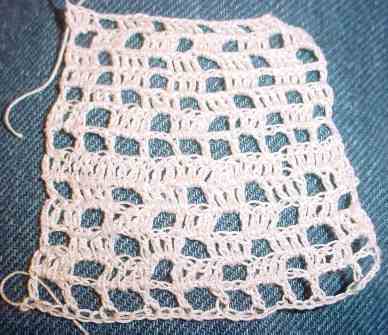
The lower, leggier, looser?part was worked on the Boye faux #11; the upper?tighter part?on the Bates #10. My working method was the same, I made no effort to work more or less loosely, and the difference is VERY evident. Go figure…
IN ABSENTIA – CRAZY RAGLAN WORKING REPORT
I’m here but I’m not. Cut off from Real Communications, I’ve stored a couple of advance-dated posts. If you see this it’s because I’m running on autopilot, and have not had time to revisit these pages and do a proper write-up. In the mean time, here’s entertainment.
Crazy Raglan
That’s proceeding apace, too. I’ve now done about eleven inches of both the front and back. It’s hard to see because of the stockinette curl, but each is about 15 inches wide, making a total garment circumference of 30 inches, give or take. I like the wide stripes and the sort of strange seam down the front. Not for me, mind you, but for a six-year old it’s playful and fun:

Now, here’s something to which I wasn’t paying attention. When I do my Intarsia twist where the two yarn strands meet at the center front, I must be twisting in opposite directions on the knit and purl side. Instead of a little "barber pole" twist down the center, I’ve produced what looks like a column of purls, seen sideways:
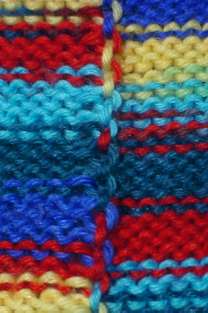
My "seam" looks good from the front, and isn’t spreading or distending oddly when stretched, but it is definately different. Not less satisfactory or wrong – just different. Anyone have any feedback/experience with this?non-standard Intarsia join??
FO – FULLED PILLOW
As I noted before, life around here is about to get REALLY interesting. I can’t guarantee that I’ll be able to post much over the next two weeks. Complications have arisen in the house rehab/move cycle and in our family schedule. We have to take down our main machines tonight or tomorrow, so I’ll be relying on an unreliable laptop for the near future. Plus once we head over to the new house it’s not entirely clear that we’ll have electricity and/or connectivity right away; and once we do there’s the minor problem of getting everything hooked back up again. Although things seem to be taking forever, progress is being made on many fronts. I hope…
In the mean time, I’ll report on some TANGIBLE knitting progress:
Fulled Pillow
It’s done!? All shrunken, stuffed, and sewn. I had put it on temporary hold until I could retrieve the pillow form I knew was lurking in the storage cubby (it’s the one that used to stuff The Smallest One’s crib pillow, the target child for this effort). Form retrieved, pillow done. I’m even pleased with the from-memory color match to her comforter and sheets.
Taaa daah:
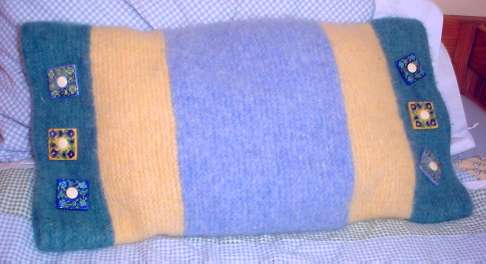
It’s not much, but there’s not much time to work on anything, so please bear with me.
Where are the reports on the other projects?? I decided to use the deadman switch option. I’ve broken them up into a couple of separate entries, and posted them with future dates. That way something will appear in this space over the next week or so. If I get lucky and can regain control of the helm here at String Central ahead of the date I anticipate I’ll?intercept and rewrite?those forward-stored posts. In the mean time at least this space won’t become a total dead zone until mid-July.
FUN WITH ODONATA
UPDATE: THIS DESIGN IS NOW AVAILABLE AS AN EASY TO PRINT PDF DOWNLOAD UNDER THE EMBROIDERY PATTERNS LINK, ABOVE.
A short post today on a time-stressed weekend day.
Buzzing in on the hopping heels of last week’s bunny, here’s another small graph from my embroidery book. This super-simple one is original. One dragonfly can be spot-placed, or they can be done in series using stranding. A strip of dragonflies can bealigned either katywumpus as I show here, or all facing the in same direction. In knitting, I think that these would be particularly fun to accent with shiny beads or duplicate stitching on the body or wings. They’d also be a killer trim if done in bead knitting.
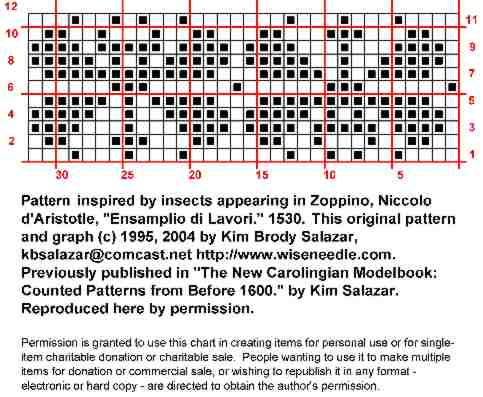
Other uses for simple graphs include filet crochet (Mary Thomas’ Knitting Book describes filet knitting, too); all types of cross stitching; needlepoint; and lacis or pattern darning. I’ve even heard from people using TNCM patterns for wood marquetry and tile mosaics!
CHEST OF KNITTING HORRORSTM – TATANIA
I mentioned my experience with this project before. Tatania is a pattern by Berroco, written for now discontinued SensuWool. Berroco probably won’t like to hear this, but I used a different yarn – the confusingly named King Australian Merinos/Rosina Stampata. That was the yarn with the ambiguous label I wrote about in March.
Tatania has had two visits in the Chest of Knitting HorrorsTM. The first happened while I was knitting. The Berroco pattern has a glaring error in it. The piece has a neckline of unusual shape, although it’s hard to see here:
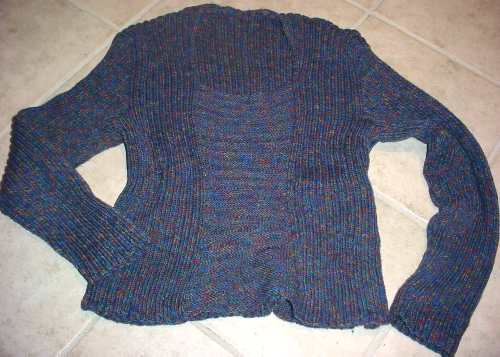
It’s sort of a squared off reverse Vee. It’s a neckline found in late Renaissance gowns, and one that looks quite good on me, so I bit and made the thing. But if you read through the pattern, you’ll discover that the directions say to DECREASE during neckline shaping. That leaves too few stitches on the needles to make the shoulder join, and inverts the shaping of the neckline. Here’san excerpt fromletter I wrote about it to Berroco:
Dear Berroco,
Thank you for making your website so complete, informative, entertaining
and easy to use. I especially like the way you have associated your
patterns and yarns.I am in the middle of working up your Tatania pattern. I am
enjoying it immensely and am looking forward to wearing the final product.
I did however find what I believe to be a rather serious typo in the
version available at this URL:http://www.berroco.com/188/188_tatania.html
The problem is in the front, at the point just after the bodice stitches
are bound off across the front of the squared neckline, as you are
beginning to work the sides of the neck opening.Here is the problem statement:
DEC ROW (RS): Work in ribbing to 2 sts before marker (dec 1, k2,
p3). Working in ribbing as established, dec 1 st before marker every 4th
row 4 times, then every other row 8 times…I did this, and ended up with far too few stitches to mate the front and
back shoulders properly. Plus, the piece I ended up with reversed the
angles of shaping for the neckline – with the two shoulder parts sloping
outwards instead of inwards.When I did the computation of stitch count by gauge it became obvious that
I should have INCREASED instead of DECREASING each time "dec" is specified
in the pattern.I am now proceeding to finish my Tatania, using increases in place of the
decreases in the pattern.I thought you might like to know about this problem so you can correct your
on-line pattern. The design is striking and it shows off the yarn to good
effect. It would be a shame for knitters to get so far into the thing only
to face frustration. I am sure you would not want that frustration to attach
itself to your sterling reputation.
I’m afraid I never heard back from Berroco, and the pattern is still uncorrected on their website. (I’ve since learned that the hard copy edition in Book #188 – Holiday also sports the same error.)
As you can see, I did muddle on through and produce the final piece. As expected, the welted center panel does draw up a bit in the center. That’s probably why the model was posed with her hands covering that spot. Even so, it’s a striking, form-fitting and very flattering piece.
O.K. So why did it go back to the Chest of Knitting HorrorsTM?
The yarnI used isjunk.The color is beautiful – a combo of deep blue with a ragg-type strand of brights twisted in. It’s wear-against-the skin soft and luxurious. But since knitting it has begun disintegrating. Without provocation (no moths, no mold, no laundry stress, no rough handling, no careless storage, and after only two wearings), spots here and there have broken. I’ve got a half-dozen safety pins in the piece right now, holding stitches to prevent them from laddering down. I need to find my leftovers and do some aggressive duplicate-stitch style darning, in effect Kitchener grafting the broken bits together. I’m especially annoyed because I had no clue this would happen as I was knitting. Grrrr.
More on Yarn Names
In response to yesterday’s rant about yarn names I got one note that pointed out something I didn’t know. It was from someone who works for a yarn manufacturer. That person pointed out that there are very few ways for a committee thinking up yarn names to check to be sure that the name they pick hasn’t been used recently. One way is to look in the index of Valuable Knitting Information, a twice-yearly spiral bound volume listing yarns going back abouta decade or so (the recent 40th edition goes back all 20 years). VKI although large does not list all yarn manufacturers, and does not associate yarns with any sort of date, so it’s tough to see how old an entry might be unless one checks through back issues to spot when it appears.
Another way they’ve been using lately is to look up the name on wiseNeedle. Although our list is smaller and dates aren’t precise, they do exist and can give a clue as to whether or not the name under investigation might still be on the shelves. Interesting! This is a use for wiseNeedle I didn’t consider. The note went on to say that the maker the author works for does check the yarn reviews for their products and greatly appreciates both positiveAND negative comments.
MUSEUM OF BAD IDEAS – YARN/COLOR NAMES
Aldmort’s comment on my calling a color “run-in-the-rain-racoon” got me thinking about a favorite silly topic: the names picked by marketing for yarns or colors.
Now I’ll happily put up with all sorts of nonsense, but it seems that ever so often those involved in the naming lose touch with reality. My favorite Bad Idea of 2004 so far is the Lana Grossa yarn, Brillo. It’s actually a rather soft and shiny fiber blend – but you’d never know that from the name. (Non-North Americans might not know that “Brillo” is a trade name for one of the most widespread brands of steel wool/soap pads.) Alamo is another bad yarn name. Am I supposed to associate that with a desperate and bloody battle, or the car rental outfit?
I realize that yarn names are at best, the product of intense focus on behalf of a marketing group, or at worst – the brainstormed bastard child of a bunch of people sitting around donuts and coffee after midnight. The most effective names evoke a mood or tickle the mind about a property of the yarn. They don’t have to be literal. After all, if everyone sold yarn called “Fuzzy Wool Worsted,” we’d also go nuts.
I like names that communicate something about the yarn. I think that Waterspun is a good name for a partially felted yarn. Elastico tells me the stuff stretches. Techno Fur says fuzzy synthetic and Lazer FX says shiny light and mirrors.
Neutral names abound. Most of the place names and a few of the person-names applied to yarns fall into this group. Some do evoke an image. I wouldn’t expect a yarn called “Florida” to be a polar-weight wool (the three Floridas in the yarn review collection are all cotton or cotton blends). I wouldn’t expect a yarn called “Alaska” to be something worn in the summer (also three, all wool or bulky winter-type yarns).
I detest names like Anna (two in the yarn review collection).A yarn named “Anna” might be anything. Isadora would be a better “people name” for a yarn. It makes me think of the famous (and famously reckless) ballerina Isadora Duncan. I think unconventionality,luxury, silk, sheerness,and fluttery – all associations with her dance style, the classical costumes she affected and the veil or scarf that killed her. Of course you might be turned off by the same associations. That’s what the marketing people are supposed to figure out. Names like “Mousse” are also problematic. There are four in the [now defunct WiseNeedle] yarn review collection, ranging from K1C2’s Aran weight mohair blend, to Katia’s nylon worsted and Artfiber’s novelty yarn. All very different and none exhibiting what I’d think of as mousse-like qualities.
Color names are even worse.
I can deal with things like “moorit.” That’s a traditional designation for one of several undyed colors right off the sheep’s back. But what the heck are these?
- Lichen
- Hero
- Bramble
- Swarm
- Hansel
And if you think I’m picking on Rowan exclusively, what about these?
- Depths
- Tingle
- Firefly
- Gelato
- Thursday
- Honesty
Don’t get me wrong – I like color names. A yarn with a color name is easier to remember than a yarn with a number. But I want the names to tell me something. Carnation, Blush, Powder, Azalea and Antique Rose are all perfectly good names for pinks – each giving me a rough idea of what hue is meant. Even Ballerina dredges up a color association and image. “Honesty” may be a good policy for labeling, but as a color name it tells me nothing.
Avant le dluge
I’ve been to keep the trivia of life from occluding my flow of knit-related entries, or from letting daily happenings stomp all over my posts. That’s about to get somewhat more difficult.
Please don’t be surprised if I miss the odd day (or week) between now and August. For example, in the next six weeks we close on a new house,I ammarshalling an army of contractors to rewire, repair the plumbing, and do the floors and (possibly) roof. I personally have toremove all of the old fiberglass insulation improperly installed in the attic, rip down several massive ivy vines invading the stucco and pack all our stuff, supervise the move to the new place, clean the old place,and unpack. During this period the kids end school, the little one begins day camp, the big one gets hauled to horse camp. Also during this period we take our annual week out in North Truro on Cape Cod.
Why a vacation in the midst of the chaos? It’s paid for (we have to reserve it in January); and it’s at a place that gives ‘dibs’ on next year’s rooms to this year’s occupants. I first stayed there when I was a teen, and have been going back ever since we relocated to this area. It’s ona quiet, (mostly) unchanged part of the Outer Cape just south of Provincetown, right on a bay side beach. About all that’s different in this particular place since the ’70s is that the curtainsof the efficiencywere replaced sometime between ’74 and ’95.No phones, no computers. Just books, sandy children, knitting, and paella cooked on the grill.We may come back early, or I may ziphome a couple of times if my presence is needed, but we AREgoing.
Which place is it? I won’t tell you. I want it to remain undiscovered, but if you know that area if I say we’re about a quarter mile from Day’s Cottages in a hotel that straddles Rt. 6A, you’ll have a very good idea of where I’ll be.

(We are NOT staying in Day’s Cottages.)
KNITTING PROGRESS – LACY SCARF, PILLOW, ENTRE DEUX LACS TEE, CRAZY RAGLAN
Good news on the Lacy Scarf! Aftera minor failure of the on-line ordering system (graciously rectified by the ownerafter aphone call)I finally got the skein of the Greenwood Hill Farm 2-ply laceweight I need to finish the scarf. I spent last night ripping back about a quarter of the finished edging and the last diamond panel of the center. My plan is to extend the center section by about six inches, reknit the diamond panel, then finish the edging all the way around. This should take a couple nights of work. I am not sure whether or not the thing will require blocking. We’ll see.
The fulled pillow is stalled. I just haven’t had a moment either to make a pillow insert to the exact dimension needed, or to run to the crafts store to see if I can improvise a solution with off-the-shelf stuff. It sits here on my desk, buttons in a baggie, just waiting.
Entre Deux Lacs Tee is moving along. I’ve finished two of the ten strips needed, and am about a third of the way through the next one. The bowling ball sized lump of yarn seems barely diminished, which is a good thing.
I haven’t mentioned the Crazy Raglan yet. I did end up going back to the clearance sale at Wild & Woolly in Lexington after the weekend. I came home with a bag of Regia 6-ply Crazy Color. It’s a DK-weight machine washable wool, in a somewhat self-striping combo of red, blue, yellow, white and turquoise. I’ll use it to make a top-down raglan style pullover for the small one, probably worked at sport gauge because I like this yarn better knit slightly tighter. The pattern is something I whipped up using Sweater Wizard, customized a bit after the original output. I’ll be casting on for this one prior to heading off on vacation. A plain stockinette small piece in washable yarn sounds like relaxing vacation knitting to me,as I’m not at all sure I’d like to get my entrelac project’s boucle hand-dyed wool full of sunblock and sand.
A NAME GENERATOR MORE TO MY LIKING
I see tons ofpeople posting name games, quizzes and other web toys on their blogs. Some are cute. This one isn’t. (I miss Brunching Shuttlecocks.)
 String-Or-Nothing