CHARTING SOFTWARE – ARAN PAINT
A couple of weeks ago when I wrote about charting knitted texture patterns, a couple of people were curious about Aran Paint, one of the lesser-known programs I mentioned. Here’s an example of what it does.
I’m starting with a twisted stitch texture pattern in Baulerches Stricken 1 by Lisa Fanderl. This is the first volume in a set of three German language knitting books that present traditional knitting patterns gathered from various regions of the country. This series is certainly interesting, but as with many stitch treasuries, presents the patterns using its own rather ideosyncratic notation and symbol set. In this case, the pattern is shown using plain old typeset characters, some linked with bars to indicate the direction of the twisted or cabled stitches. I’ve played with some of thetextured and lacy patternsfrom this series, but to work with a minimum of fuss, I usually had to re-graph them first.
This particular pattern is shown on p. 129 It’s a simple 10-stitch wide panel, and features some twisted knit stitch ribbing manipulated to look like a series of bells connected by chain links. I’m afraid I don’t have my swatch or a knitted sample, but this did look quite nice run as panels up the front of a baby sweater, close together in the upper bodice area, and set progressively further apart by an increasing number of stockinette stitches towards the lower edge.
Here are the results of graphing with Aran Paint:
|
|
 Final Graph |

The program also produced this set of prose instructions as a text file (it also outputs the same material in HTML):
AranPaint-BS1-129a.ara (10 Stitches x 26 Rows)
Repeat these 26 rows for the length required.
Row 1: K1, T2F, P1, K2, P1, T2B, K1.
Row 2: P1, K1, P1, K1, P2, K1, P1, K1, P1.
Row 3: K1, P1, T2F, K2, T2B, P1, K1.
Row 4: P1, K2, P4, K2, P1.
Row 5: K1, P2, K4, P2, K1.
Row 6: P1, K2, P4, K2, P1.
Row 7: K1, P2, K4, P2, K1.
Row 8: P1, K2, P4, K2, P1.
Row 9: K1, P2, K4, P2, K1.
Row 10: P1, K2, P4, K2, P1.
Row 11: K1, P2, K4, P2, K1.
Row 12: P1, K2, P4, K2, P1.
Row 13: K1, P2, T2F, T2B, P2, K1.
Row 14: P1, K3, P2, K3, P1.
Row 15: K1, P3, C2F, P3, K1.
Row 16: P1, K3, P2, K3, P1.
Row 17: K1, P2, T2B, T2F, P2, K1.
Row 18: P1, K2, P1, K2, P1, K2, P1.
Row 19: K1, P2, K1, P2, K1, P2, K1.
Row 20: P1, K2, P1, K2, P1, K2, P1.
Row 21: K1, P2, K1, P2, K1, P2, K1.
Row 22: P1, K2, P1, K2, P1, K2, P1.
Row 23: K1, P2, T2F, T2B, P2, K1.
Row 24: P1, K3, P2, K3, P1.
Row 25: K1, P3, C2F, P3, K1.
You can see that the thing is certainly useful, but that it has its limitations.
-
The program doesn’t include twisted stitches (like knit one through back of the loop). All of the original pattern’s knits are twisted, but I couldn’t show that on my version. YOs and eccentric cable crossings also aren’t included.
-
AranPaint includes its own “artificial intelligence” that prevents one from graphing only every other row, or from placing a cable unit such that it commences on an even numbered row. For example, if you’re working in the round and want to move one stitch over on two succeeding rounds without a plain round between them, you can’t graph it in AranPaint.
-
Symbol keys or glossaries don’t print at the same time as the pattern. While that’s not a big deal, and you can retrieve the keys from the publisher’s website, doing so is a pain and means an extra trip through cut-and-paste land.
-
You can’t easily get output for the mock-up I show at left above. To do this, I had to open AranPaint, take a screen capture, edit the capture down for size in Visio, save it as a *.jpg, then use Macromedia Fireworks to trim the resulting *.jpg down to something that is web-manageable.
-
There’s no undo function beyond “remove last stitch.”
-
Moving elements can be a pain, as there is no drag and drop.
All of these limitations being said, the program is still quite handy. Although I usually use my Visio template system for most “hard core” graphing, I do enjoy doodling with AranPaint, then having the resulting piece turned into an editable texture pattern. Here’s one of my doodles:
 |
 |
and the prose version:
AranPaint-doodle.ara (9 Stitches x 36 Rows)
Repeat these 36 rows for the length required.
Row 1: P2, C5R, P2.
Row 2: K2, P5, K2.
Row 3: P2, K1, C3B, K1, P2.
Row 4: K2, P5, K2.
Row 5: P2, K1, C3B, K1, P2.
Row 6: K2, P5, K2.
Row 7: P2, C5R, P2.
Row 8: K2, P5, K2.
Row 9: P1, T2B, K3, T2F, P1.
Row 10: K1, P1, K1, P3, K1, P1, K1.
Row 11: T2B, P1, C3R, P1, T2F.
Row 12: P1, K2, P3, K2, P1.
Row 13: T2F, T2B, K1, T2F, T2B.
Row 14: K1, P2, K1, P1, K1, P2, K1.
Row 15: P1, C2B, P1, K1, P1, C2F, P1.
Row 16: K1, P2, K1, P1, K1, P2, K1.
Row 17: P1, T3F, K1, T3B, P1.
Row 18: K2, P5, K2.
Row 19: P2, C5R, P2.
Row 20: K2, P5, K2.
Row 21: P2, K1, C3B, K1, P2.
Row 22: K2, P5, K2.
Row 23: P2, K1, C3B, K1, P2.
Row 24: K2, P5, K2.
Row 25: P2, C5R, P2.
Row 26: K2, P5, K2.
Row 27: P1, T2B, K3, T2F, P1.
Row 28: K1, P1, K1, P3, K1, P1, K1.
Row 29: T2B, P1, C3R, P1, T2F.
Row 30: P1, K2, P3, K2, P1.
Row 31: T2F, T2B, K1, T2F, T2B.
Row 32: K1, P2, K1, P1, K1, P2, K1.
Row 33: P1, C2B, P1, K1, P1, C2F, P1.
Row 34: K1, P2, K1, P1, K1, P2, K1.
Row 35: P1, T3F, K1, T3B, P1.
Row 36: K2, P5, K2.
Before you write and ask, remember – symbols and abbreviation setsused in AranPaint write-ups and graphs can be found here.
PROJECT – MANOS COAT
I was doing some more pre-move packing, and I came upon my Manos del Uruguay coat:
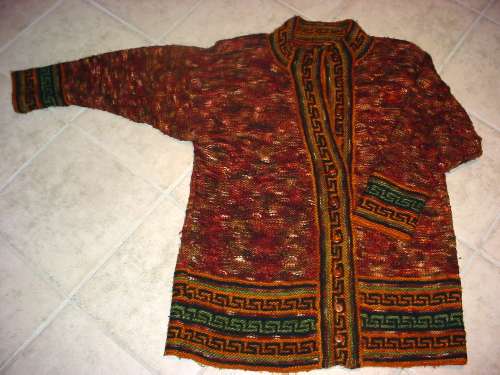
I made it in ’96, as a reward for landing a goodjob after moving from Maryland to Boston. But the project started ten years earlier when I bought some rosewood buttons at a crafts fair in Virginia. It took a long time before I found the right yarn/project to sit behind them.
I started with a pattern in the Manos Book #10, but made quite a few changes along the way:
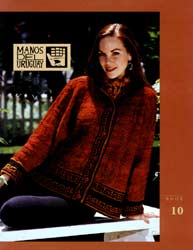
Aside from the trivial change of color (brick/topaz/black/cherryto canyon/topaz/olive/black), I did some redrafting. As you can see from this thumbnail, the original was a cropped jacket, reaching to the bottom of the beltline. Being tall andcurved rather than linear, I wanted something longer.
To add length though posed two problems. The first was that the body of the piece isn’t done in plain old stockinette. It’s worked in a very large non-repeating design of freeform swirls and elongated paisley spots, done in knit/purl texture. The second was that the proportions of the sleeves and edgings would look out of place on a larger piece.
My solution was to draw up an extension of the pattern’s swirly texture. I did that on graph paper, replicating the last ten or so rows of the chart in the leaflet, then going on to add another 75 or so rows. I also redrafted the sleeves and armholes, adding a bit more depth. Finally I extended the slip-stitch motif bands at the button band, lower hem and cuff by adding a few more plain rows of garter stitch between the Greek key design panels, also to help keep the piece in proportion.
I learned a few lessons along the way, the least of which is that wool in quantity is heavy. The original cropped jacket isn’t anywhere near as massive as my coat. In spite of my broad shoulders, I needed to add shoulder pads to make my coat hang properly. The second was about sleeve shape, and it didn’t become evident until a few years had passed. The deep sleeves were more current at the time the piece was knit, and as time goes on are making the fit of the thing look more and more dated. Had I done narrower sleeves I might have avoided this.
I also learned about hand-dyed yarns and skein-to-skein variation. Manos is beautiful stuff. Each skein is one of a kind. This is especially true of the multicolors, like the canyon color I used for the bulk of this piece. The canyon available at that point ranged from paprika through cocoa, with side trips to ecru and run-in-the-rain raccoon. Some skeins were heavy on the lighter colors, some on the darker ones. Before I began knitting, I laid out all my skeins and placed them where I thought the colors would balance. That means I paid the most attention to the right and left cardigan fronts, choosing skeins for eachthat had roughly equivalent amounts of each color. Then I picked complementing sleeve skeins. The remainder became the back.
Knitting purists will note that the swirly pattern I mentioned above isn’t visible in the photo because the yarn I chose for those areas is so variegated. I argue that while it isn’t immediately discernable, it is visible, as the patterning of the purl and knit stitches presents an interesting way to maximize the variations in the yarn. Yes, it’s not immediately evident that what I have there are swirls, but up close and personal, you can see that the piece is textured and the texture accentuates the colors.
While I’m pleased in general with this piece, I’m not 100% satisfied with it.Manos was not the best choice for a long coat. In addition to the weight/warmth issue, it does pill.I planned this cardigan as something to wear indoors at work, but I neglected to think about the abrasion a heavy jacket takes from the rough upholstery of most office chairs. The back of my coat is a mass of pills. (You can even see pills on the front and sleeves on the photo). Very disappointing, but entirely my fault.
I’ve still got someManos left over from my jacket. I’m thinking of using to to make a fulled bag. But that project will have to wait until we’re settled in the new house and I’ve reclaimed my stash.
YOUR FRIENDLY KNITTED-UP SPIDERMAN
Somewhere out in the dark of nightlurks Mark Newport; a fiber artist with time, imagination, and a fullattic of vintage comic books.
Mr. Newportknits head-to-toe superhero suits. You canpurchase his one-of-a-kindSpiderman; Mid ’60s Batman; Daredevil (with nifty ribbed hood) or Mr. Fantasticoutfits. If he selected a nice, springy wool,he’s probably figured out what I never could as a kid – howReed Richards wasable to stretch his arm to ten feet long butneverburst out of his suit. (Later when I got older I thought of the implications of being his wife Sue Storm, but that’s another speculation left over from a more innocent time.) My embroiderer and comic-collector selves also really appreciate the oddity ofMr. Newport’s embroidery on papercomic book samplers, too.
Mr. Newport’s work is being gathered into an upcoming exhibit at the Greg Kucera Gallery in Seattle, Washington. Be warned however – he overembroiders or embellishes many types of printed matter in addition to comic pages, including what in a more genteel era would have been called "French Postcards." The gallery’s site does explore those materials as well.
Yarn Reviews at wiseNeedle
Thank you, thank you, thank you!
Since yesterday 24 new reviews have been logged in. That’sthe most reviews received in one day since early ’95, when the collection was just starting out! Knitters everywhere will be extremely grateful as they find your comments on all those yarns. I’m particularly impressed with the blog community, and the way that it’s rallied behind this project. I feel like I’m back in ’94,part ofa happy band of knitting zealotsspreading their shared banner throughthe electronic ether. Thanks also to the folk from the KnitList who slogged on over to the site to add their experiences to the pile. I also really appreciate all the people who took time to say they’d miss the yarn review collection if it disappeared.
I’ve still not decided what to do to make the collection self-supporting, but I did get a couple of good ideas to chase down, both left as comments on yesterday’s page and mailed to me directly. I notice that other people don’t have the ethical/editorial independence problem I see with accepting ads from yarn makers or retailers. One person wrote to suggest that I offer a "buy me" sidebar, with a list of vendors appearing whenever a review is pulled up. The logistics on that might not be feasible, especially considering that many individual yarns have the half-life of a mayfly, and the indexing would have to be done by manufacturer’s line rather than individual offering. Plus, I’m afraid that if I become dependent on money from industry sources, the collection will become less impartial as people become hesitant to criticize the same stuff they see advertised. Also I might be swayed (even unconsciously) to favor advertisers over non-advertisers. Perhaps I’m too much a stickler here. More thought is needed.
Another intriguingidea was to see if sellers of knitting inventory software might be interested in licensing the database. Another was to sell bags or tee-shirts with knitting-related stuff on them. If anyone has had experience with Cafe Press or similar collateral services, could I beg a little guidance? (You can send me an eMail off-blog at using the "contact" link at the right.)I also got a suggestionto add a line of for-pay patterns to the free ones already there. I’m not convinced though that anyone would pay for these as the more complex ones are working descriptions rather than stitch-exact direction sets; and the less complex ones are so intuitive that I can’t believe people would plunk down a fee for them. Then again, there are people selling other simple patterns on the web and on eBay at surprisingly large prices…
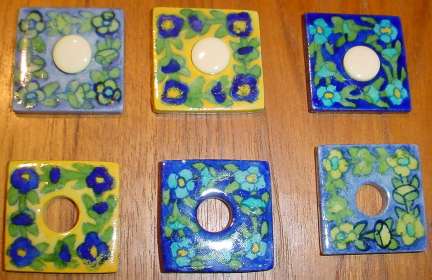
Buttons?
Some people asked for a closer view of the ceramicbuttons I’ll be using on the fulled pillow. Here they are, both with and without the little yellowplastic onesI’ll be using to hold them on.
REQUEST FOR SUPPORT
As most of you know,I’m the person responsible for wiseNeedleand its on-line yarn review collection. That collection is now nine years old. It began in 1995 as a round-robin text file I collected then circulated among members of the old KnitList mailing list (back in its pre-Yahoo days).The databasehas grown to fully searchable index of basic info on more than 4,800 different yarns, and contains around 2,000 reviews detailing more than 1,300 products (many yarns have more than one review).

I provide the forum, knitters world-wide write in to report their experiences on real knitting projects. No yarn maker or distributer subsidizes the site in any way, nor is it backed by any magazine, publisher or yarn retailer. It’s a 100% volunteer consumer-to-consumer info sharing effort in the best tradition of the early Internet.
It’s been fun, but now I am wondering if this all-volunteer effort has outlived its usefulness. There are now other commercial forums that provide yarn reviews. While foot traffic through the site has remained more or less on the same level, the number of reviews being submitted is way, way down. Plus the majority of the visitors are now coming for free patterns rather than to the yarn review collection. People just don’t seem to be interested in providing info, although there still seems to be limited interest in obtaining it.
So, I’m in a quandry. Do I continue to shell out to support the tenth year of an effort that isn’t earning hearts and minds in the greater community? Do I pull the plug? Do I muddlethrough for another year or sohoping that the idea will someday catch on?
Or do mutatewiseNeedle in some way so that it becomes self-supporting? If the last option is pursued, what can be done? Charging for membership? Accepting paid advertising from the yarn industry? Selling patterns or collateral material? Flogging the whole site to an interested buyer, providing some entity could be found?
Ideas and suggestions are greatly appreciated.
DIPPED IN CHOCOLATE
Monday the kids asked me what I wanted for my birthday. Igave the standard Mom reply: "Good children."
Then the little one piped up "…dipped in chocolate."
Sothis eveningthe big one gave me my present:

Too cute.
WORKING REPORT – FULLED PILLOW II
After two weeks of intensive laundry treatment, it appears that the fulled pillow has reached its maximum shrinkage potential. It’s not as small or as tight as I’d hoped (you can still see the ridges), but it’s much softer and about as small as it’s going to get:
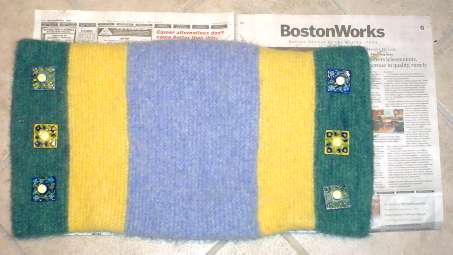
The pillow is unstuffed here. I haven’t sewn on the buttons yet – they’re just placed where I intend them to go. Each button unit is made up of a flat ceramic piece with a large center hole, plus a pale yellow plastic button to hold the ceramic in place. The Boston Globe page underneath the pillow is cut about the same size as the pre-washed size of the pillow (actually the pillow was about an inch longer, but I was too lazy to tape a one-inch strip on the end of the newspaper).
One interesting thing to note – the different colors of this yarn did not full evenly. As you can see, the yellow shrank more in both length and width than did the green or blue. I’ve test-stuffed the pillow with an old lumpy form I had in the closet, and the unevenness of the width isn’t as evident as it is when it’s laid out flat and unstuffed as pictured.
WORKING REPORT – ENTRE DEUX LACS TEE
A retrograde forwards-and-back type progress continues to be made on my tee. I’ve decided that I want to use a series of vertical strips, joined with something other than entrelac (more experimentation needed). I’ll bury increases and decreases in the join areas to give the garment a bit more shape. Here’s how I envision placement of the strips. Don’t worry. I’ll fill in the missing parts, like the bulk of the arms and add some kind of neck and bottom edge treatment. Possibly I-cord, possibly ribbing, depending on how I feel.

And here’s the first completed strip:

To answer the people who have written to ask why I’m not doing a knit-along or other shared project, I’d have to say I’ve always been a lone wolf knitter. Sometimes I do things inspired by others, but very rarely do I jump in when everyone else is doing them. There was a good five year lag time between the time I read the first Dale Lillehammer feeding frenzy on line, and the time I decided to knit one. I can’t say why this is. Perhaps there are always more things I want to try than I have time to try them so new ideas need to get in queue before they’re addressed.
Today is my birthday. Or rather it’s the day on which I celebrate the anniversary of my 21st birthday. I have no plans in particular, other than taking advantage of the day off to get as much as possible done in preparation for our upcoming move. We’re also suffering birthday cake exhaustion in the house, as both of my kids had birthdays last week. But if you’re itching to pony up good wishes, I would ask you to share that good will with the rest of the on-lineknitting world instead of with me.Consider adding a yarn reviewto the yarn review collection at wiseNeedle. The easiest way to do this is to look up your yarn by name on the search page, then click on the "review this yarn" link.
And for the few of you who may not have heard about this yet (and in honor of the US holiday of Memorial Day), I point out that the Red Cross is currently selling commemorative WWII knitting kits. This offering is paired with an on-line museum exhibit, and a historical article. Their assistance toservice people. and for civilians caught in both man-made and natural disasters deservesrecognition and support.
FUN WITH LAGOMORPHS
UPDATE: THIS DESIGN IS AVAILABLE ON THE EMBROIDERY PATTERNS LINK ABOVE, IN EASY-TO-PRINT PDF FORMAT.
SECOND UPDATE:
The source for this is under re-evaluation. I’ve found it in Bernhard Jobin’s New kuenstlichs Modelbuch von allerhand artlichen und gerechten Moedeln auff der Laden zuwircken oder mit der Zopffnot Creutz und Judenstich und anderer gewonlicher weisz zumachen, published in 1596. I believe that when I first transcribed this from microfiche in the early ’70s there was a mixup in the labeling of the fiches I consulted. If TNCM gets reissued, I will insert the correction.
I was re-graphing this rabbit from my book of embroidery patterns, and I thought angora-fanciers might like to work it into a headband or sweater front.
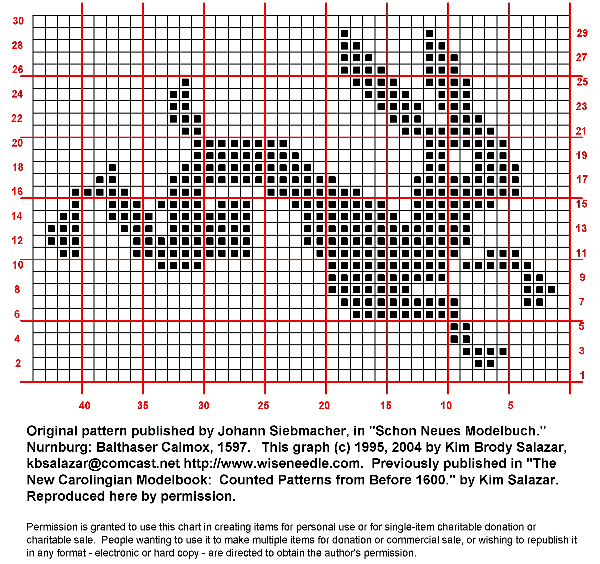
The original plate from 1597 showed a large group of animal motifs clustered together to save space. It included this one, two coursing dogs (possibly greyhounds) a squirrel, an owl, a stag, a unicorn,a parrot, a yale, and the lion I previously shared for Gryffindor pullovers.
I-CORD TRIX
I was playing around with I-cord last night, in part because I’ve decided to re-think the Entrelac piece (I’m going to do the vertical strips thing, as an entire front of unbroken entrelac in my size boded to make me look like thebacksideof an enormouspoison arrow frog).
I’m sure I’m not the first one to do this, but given recent explorations on knitting edgings onto things, and to attaching I-cord to terminal stitch edges (like in the poncho); I wanted to see if I could do I-cord attached to a vertical edge. I fooled around a bit and came up with this sample:

I apologize for the blurry pix. I had better luck knitting the sample than I did in photgraphing it.
This piece is ten stitches wide. It has I-cord at both the left and right edges, knit at the same time as the two-stitches of garter in the center. Here’s what I did:
Cast on 10
Row 1: K6, bring the yarn to the front without making a loop on the needle; slip 4 stitches purlwise
Repeat Row 1, making sure topull thefirst stitch especially tightly to create the I-cord effect
I could have done something similar to create a double I-cord strip for the poncho, had I started with 8 stitches, and done K4, slip 4.
As is at 10 stitches wide, this sort of strip might be useful for someone making belts or bag handles. It would work well fulled to make a wider bag handle than standard I-cord. I need to experiment more, but I think that if I started out with 12 stitches (4 for each edge, plus 4 for the center), I might be able to do some order swapping to make a braided cable.
But there’s no reason to stop there. I happen to detest the loose, flabby edges on most simple scarves and blankets. The next time I knit a scarf or blanket, I’m going to figure in four stitches on each side. I’ll begin each row with four knits, and slip the last four stitches purlwise. I’ll need to experiment more to see if this sort of thing tames Dreaded Stockinette Curl (I rather doubt it), but I think it would be a nifty edge treatment none the less.
WORKING REPORT – ENTRE DEUX LACS
Yes, I know I’m stuck in a rut reporting on this, but between schooling my unruly fingers into a new way of knitting and tackling a design (on the fly) in a technique that’s new to me, I’ve got a high fascination quotient here. I lead off with some advice I’ve received.
Mary-Helen wrote to share some experiences she’s had designing and knitting entrelac projects, and gave me permission to share her hints here. She advises that being produced on the bias,entrelac piecesdo hang quite differently from items knit in vertical orientation. For starters, entrelac can be loose-fitting and blousy. (I found this out the hard way when I over-calculated my starting width). She suggests that since I said I wanted a closer but not tight fit, that I plan on not being overly generous in adding garment ease. She says that she’s achieved a pleasing fit in some entrelac pieces by working the back of the garment in stockinette. Doing both would help avoid the maternity-smock/boxy-baggy effect. She says that with careful planning, I might not need to do any waist shaping, as the piece will fit well enough on its own.
Mary-Helen alsonoted that I’ve not mentioned any ribbing. She suggests addingeither ribbing or a garter stitch bandlater to help tame the bottom edge. (She observed that many entrelac piecesdo blouse out over the ribbing, in the puffy-body look popular in the 1980s.)
She went on to discuss square-formation. She said that adding cable details to eachsquare helps hers draw in a bit, avoiding the puffy mushroom-field look that some entrelacs have. Finally, she mentioned that the February archives of Witty Knitter contain some detailed musings on entrelac design.
Thank you, M-H! I hope I haven’t misinterpreted your notes too badly.
As you can see, I’m just about to begin the second course of teeny rectangles. You also get to see some of my collection of fancy stitch markers:
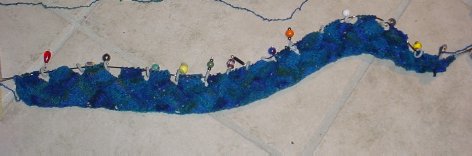
It looks like it will take about an hour to do one course of the rectangles, as I completed this one while watching Enterprise last night. I’ll keep going plain for a couple more courses. Then if necessary, I’ll think about nipping in a bit at the waist by doing a few rectangles per row on five stitches instead of six. I’ll probably work those decreases on rectangles at the edge and at the points at which the waist nips happen in princess-style seaming.
Right now I’ve got little or no ease. If I don’t like the effect in about six more inches, I think I’ll retool and begin again – taking all this good advice close to heart. Perhaps I’ll begin again on a different stitch count.Perhaps I’ll investigaterunning vertical panels of entrelac, withsmall columns of stockinette in between (I could bury the shaping in the stockinette columns.)
Good thing I don’t mind ripping back on a think-piece.
 String-Or-Nothing