WORKING REPORT – SUEDE T AND THE HUSH OF WAITING
It’s spooky quiet here, waiting for the phone to ring to announce another round of house-viewers. Even our pets (such as they are) feel the stress of the moment.
The kids have two hermit crabs. They’ve named the crabs Punchy and Crunchy, (or Akebono and Fujitake, depending on whom you ask.) We’ve had one crab for almost three years now, and the other for almost two. Both have decided tomolt their old carapacesin the past ten days. Not just change into newshells, which they do withamusing frequency, but to shed their own hard parts. This leaves a little "ghost crab" of discarded claws and legsbeneath them, like a naked toddler standing on a pile of shed pajamas. Perhaps it was all the strangers schlepping through the house, perhaps it was just the season for it, either way the timing seems **suspicious**.We’ve posted a noteon the cage thatreads, "Vicious Attack Crabs. Do Not Tap Habitat."
Aside fromproving oursedentary crustaceans are a bit more interesting than house plants, about the only good thing I can say about being in the deep hush of waiting is that I’ve finally had a bit more time to knit. The front and back of my Suede T are finished, and as you can see, I’m almost done with the sleeves. I knit both at the same time so that no matter what, atthe very least they always match – but I only photographed one for the sake of clarity:

So far the pattern has been spot on. I did have a gasp-and-remeasure moment when I thought the back had ended up severely under length, but then I remembered the short rows in the bust. I have to admit I’ve got more topography to cover than some, so I added another iteration of the short row sequence above and beyond what was recommended for size D.As a result, when measured down the center, the front is quite a bit longer than the back. But when side seams are matched, they are exactly the same length, as are the armscye halves, front and back. My T should sew together with no problems.
Now I’ve got a bit of worry looking at the depth of the underarm bind-off areas, just before the sleeve cap begins. You can see those plateau-like areas above. They seem rather deep,althoughit’s been a long time since I didSerious Sewing or assembled a knitted full-tailored set-in sleeve. But short sleeves are just that – short. I’ll keep at it as written, then do a pin-fit or baste the thing together. If the sleeves seem to fit in oddly, I’ll rip them back, reshape the sleeve capand try again.It’s probably my own unsettlement and nervousness speaking so I am really notanticipatingdoing anything that drastic. I promise to report back as my T takes further shape.
Oops. The phone is ringing. Got to gather up knitting, today’s newspaper and my tea and hightail it out to the back yard to get out of the way of the tour du jour.
EYE OF THE CLEANING STORM
Well, the easy part is over. The house is now scrubbed to within an inch of its life.With so many familiar things stowed itlooks oddly sterile, almost hotel-like.
Amusingly enough the Real Estate Gal asked me if – being a knitter – I might put together a basket of yarn in suitable colors, and pose it invitingly next to the sofa. She said it was the visual equivalent of boiling a vanilla bean or baking bread before an open house. So it was off on a trek to the storage cubby to retrieve some yarn in order to tart up the family room. Today I expect a herd of real estate people to amble through, in preparation for this weekend’s official viewing. Now for the hard part – hurry up and wait for what we hope will be multiple offers.
In knitting, I’m still mid-sleeves on the Suede T- knitting time being at a premium through all of this. So instead of posting a boring snap of too many stitches of olivenylon squished on a too-small needle, here’s an oldie. I knit this for my older daughter back in ’92 or so, and I wish I were a better photographer. It’s in a DK weight cotton from Lane Borgosesia whose label drifted off into infinite space before the advent of the Yarn Review Collection. It features hearts and OXO cables, both from Walker’s treasuries; embellished with clusters of embroidered bullion knots.The knots weredonein scraps of a matte-finish sport weight cotton.
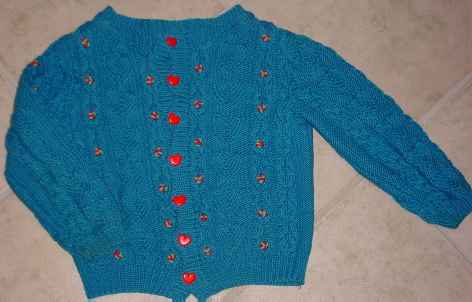
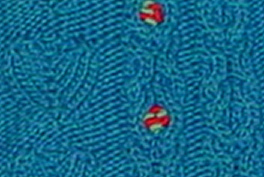
I was quite amused when two years later Knitters published a similar OXO/heart cardigan on the cover of its Aran issue. Mine however is unique – if for no other reason than for my inexperiencedbumbling around witth the button band when I was noodling it up.
- Note the odd number of heart-shaped buttons. There are seven because my spacing was off, and I was too lazy to go back and redo the button band for six.
- Note the fact that the button band is on the non-traditional side for a girl’s garment. When I was at this point I looked down at what I was wearing and did the same thing, never stopping to think that I was wearing a man’s chambray work shirt at the time.
- Note the less-than-effectively centeredhorizontal buttonholes. I didn’t know back then that during wear buttons "migrate" to the outside edge of the buttonhole slit. If I were to do this today, I’d not center my buttonholes in the band. Instead I’d skew them a bit to the inside edge, so that when buttoned, the buttons appear better aligned down the midpoint ofthe band.
Still for all these defects, this is a much-loved piece. Daughters #1 and #2 both wore it and enjoyed it. It lasted well, enduring grass stains, dripped ice cream, and a rather messy day of strawberry picking all followed by rather aggressive laundering. Now it’s at the cusp of being outgrown and is one of the things I intend on packing away rather than handing down to another wearer.
More Horror and Hands of Velcro
My hands are now officially made of Velcro. Or perhaps they just feel that way. The Better Living Through Chemistry people have managed to devise a set of cleaning products SO efficient that they have scoured me of integument. The only way I could work on the Suede T (made of a super-grabby nylon yarn) was to lather up in enough hand cream to fuel a brothel for a fortnight. Which might have been fun but all that lubrication was wasted on knitting. [grin]
In all the packing, another resident of the Chest of Knitting HorrorsTM has surfaced. I can’t quite figure out why this one has sat unattended for so long. It was started about two or three years ago, shortly after Lorna’s Laces introduced Shepherd Sock in the custom color Socknitters’ Rainbow – a hand dyed yarn in a riot of colors. I loved the colors, but it seemed to me that two skeins of it for a pair of socksmadea heady investment. I wanted to do something that showcased the brilliant Rainbow yarn, yet that leavened the total per-pair cost by introducing another yarn. My intent was to publish the result as a pattern on wiseNeedle. Perhaps stripes? Hmmm….
I played around with some stashed yarn for gauge. The yarn that best matched the Socknitters’ Rainbow was Dale Baby Ull – one of my all-time favorite yarns. This machine washable Merino is soft, very easy and forgiving to knit, and perfect for stranding, so I decided to do a simple stranded pattern instead of plain old stripes. One thing I did remember – I favor toe-up/short-row heel socks. They’re a bit narrower through the instep than traditional square or Dutch heel cuff-down socks, so I’d have to keep the stranding pattern loose and simple that it did not constrain the sock’s stretch. (I found this out the hard way after knitting a pair of socks with peerie patterns, that ended up being SO tight I couldn’t get them on). I did want to carry the stranding up through the short-rowed heel. Here’s the result:
 |
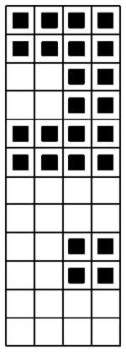 Pattern chart |
I like the way the happy chaos of the multicolor yarn is tamed by the solid charcoal black. I also like the movement of the little square checks as the focal points shift from stripe to stripe. (For those of you who are wondering – the little coiled wire thingy is a Strickfingerhut. I use them for all my stranded colorwork.)
I appear to have finished one sock, but pooped out shortly after the toe of the second. Why did I stop?I didn’t even remember beginning this project.My only clue is the bag in which I found the hibernating pair. It looks like I was working on them at about the same time as I lost a job, when Start-up #1 augered in after its funding fell through. That was around January ’01, and is still a painful memory (at the time. I drank the Koolaid, and truly believed that we’d pull off the venture). ’01 was not a good year. Iwent on to another start-up company, that one tooteetered on the edge ofthe Big Death before fall of that same year and canned 75% of the staff. Ever since I’ve been a freelance proposal drone. But that’s neither here nor there and largely irrelevant to knitting.
Apparently this pair of socksmust befraught with Painful Associations because until I found it I didn’t even remember that I had been working on it. My choices are now finish off the things, or dispel any lingering curse by ripping them back and making something else again. Sometimes being lazy is a good thing, as it reinforces the fact that I don’t believe in curses. I’ll put the bag aside instead of packing it off to the cubby, and finish this pair of cursed socks after I’ve tucked in the Suede T.
PACKING AND NOT KNITTING
Well, almost. I did manage to sneak in about an inch of the back of my Suede T last night, but that little progress isn’t worth the photodocumentation effort. [Side note: And even if I did the PicServer service appears to be intermittently fablunget. If you don’t see pix, try again later. I’ll port the whole show elsewhere as soon as I have the time to sit down and do the heavy lifting. Apologies!]
What I HAVE been doing is packing away stuff to make this house look more spacious. Half the books off the shelves, my aforementioned stash, most of the kids’ toys, furniture that makes the rooms look smaller – you get the idea. Among the things I have packed are some room-accessory type things.
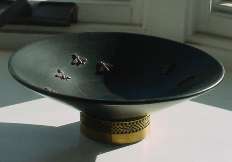
Here’s one. I don’t have many Treasured Posessions. Things are just things, after all. But this thing does count. I know very little of it beyond that it was my grandmother’s, and that she may have received it as a wedding gift. She hated it, and kept it upstairs where no one would mistake it for a candy dish (someone she dreaded must have given it to her for her to keep it all those years). Plus most people findthe flieshorribly ugly, which to me only increasesthe piece’scharm:
 |
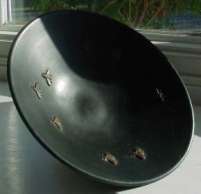 |
My fly dish is terra cotta or earthenware under that matte black glaze. It’s got the little brass filigree footing, plus a swarm of little brass colored flies applied to the inside. On the back is a hand-painted number and maker’s signature – "95/307 ITAM," which probably means that this was the 95th of 307 identical art pottery dishes. Who/what ITAM was is beyond my ken. I’ll never sell this piece (so please don’t ask). I suspect it post-dates the 1912 house by quite a bit, as my grandmother married in the early 1930s, but she didn’t necessarily get it new. Times were tough, and many people then gave presents from things they had on hand.
Right now it’s being packed away securely against the day when we are in the new space. Knitting relevance? Very little beyond my discovering that stash yarn makes soft, cushiony packing material for things that are both important and fragile.
SEPARATION ANXIETY
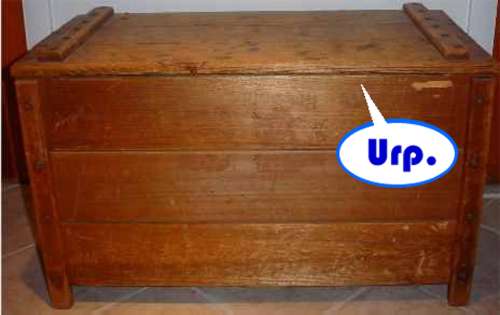
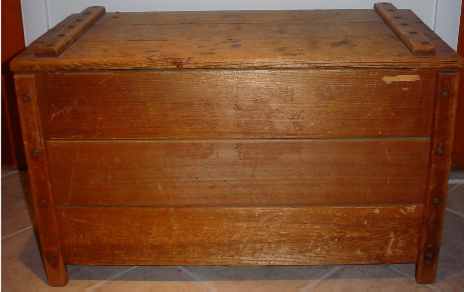
The Chest of Knitting HorrorsTM is now safely packed away into a public warehouse storage cubby, along with my entire yarn stash, (except for the Suede T still in progress) and I’m feeling at odds with myself over not having had time to knit in the past couple of days.
Will I survive putting this place up for sale? Will I manage to get everything clean and uncluttered by 4/12? Will finding termites, disconnected plumbing,andbare wire/knob style wiringin the new place crush our desire toshell out for it? Will I spiral downwards into terminal knitting-withdrawal before I can reclaim my goodies from storage? Will the Suede T ever be finished?
Who can say?HoweverI don’t believe I will everstop smelling Pine Sol…
WORKING REPORT – SUEDE T
O.K. Enough blather. Back to actual knitting…
Progress continues to be made on my Berroco Suede Shapely T. I’m now up to the armhole decreases on the back (this shot shows the front folded in half, and the back still on the needles. The entire front is here):

It’s been slow going however – and not because of the pattern (which is great), or the yarn (which is annoying but I’ve gotten used to it.) I’m afraid life has intruded into my knitting time. We’ve made an offer on a new house, and I’m now in the middle of a cleaning and de-cluttering frenzy, getting ready to put our current place up for sale. Here’s a snap of the new place:

Knitting relevance? This 1912 bungalow has a striking well-preserved Craftsman-style interior and a large dining room. While I don’t have a dining room table yet, I will finally have somewhere to display my now estivating Kinzel Tudor Rose tablecloth. So I better retrieve it from the Chest of Knitting HorrorsTM and finally finish it off. Plus, although you can’t see thehouse’s interior,I think there’s scope here for some knitted lace curtains as well.
So laugh if you will, I’m off to pack up my closet-dwelling stash, and The Chest of Knitting HorrorsTM
YARN LABELS 101
A couple of people have written to me saying they also have problems with yarn labels. Here in the US, they’re not very standardized – especially compared to labels made for the European market. Here are some examples.
First, here’s a label for Harlekin, a yarn imported from Germany:
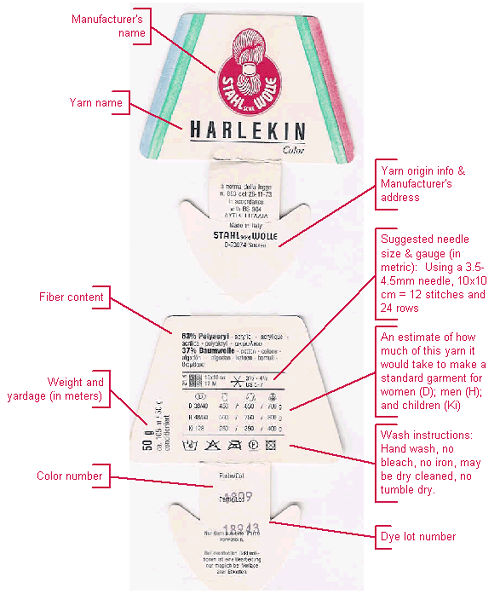
You can see not only a recommended needle size, but also a rough consumption guide for how much yarn it might take to make several different garments for average size men, women and children. Note the littlesquare shape with numbers above, below andaside it – that’s the gauge square, andshows how many stitches and rowsthe maker recommends for this yarn. It also has complete care instructions. This is pretty much the Cadillac standard of yarn labels in terms of the amount of information on it.
By contrast, here’s a label for a US yarn, made by a small producer (to be fair, it’s an old label, and current ones from the same maker might have more info on them):
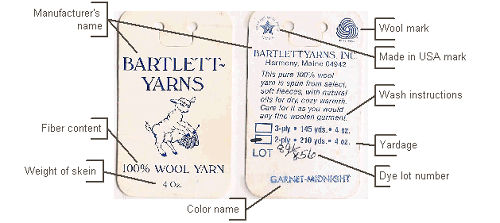
You’ll see that this label has yardage, but no gauge info; and wash directions are rudimentary at best.
Most yarns fall somwhere between these two. Here’s one that’s typical:
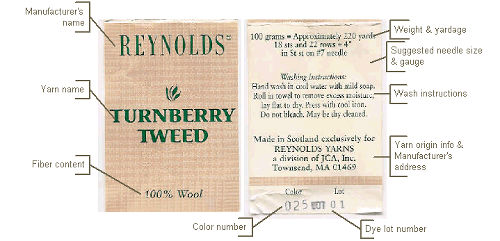
No little gauge square, but the info is there in prose. Good care information. Yardage and skein weight are also there.
There is a move afoot led by the Craft Yarn Council (mostly made up of mass-market yarn distributors and makers, plus some magazine publishers) to standardize on a new set of yarn descriptors for weight, and for those descriptors to appear on future yarn labels.
You might see markings like these:

While there is considerable weight behind implementaton of these symbols, frankly I think they are not worth the paper they’re printed on. The effort is a laudable one – to simplify the system of yarn designations, removing confusion from terms like worsted, DK, sport and the rest. But what they do is substitute a set of imprecise descriptors for the admittedly arcane but specific existing terms.
Here’s the chart of what each symbol means:
|
Gr. 1 |
Gr. 2 |
Gr. 3 |
Gr. 4 |
Gr. 5 |
Gr. 6 |
|
| Type of Yarns in Category |
Sock,
Fingering, Baby |
Sport,
Baby |
DK,
Light Worsted |
Worsted,
Afghan, Aran |
Chunky,
Craft, Rug |
Bulky,
Roving |
| Knit Gauge Range* in Stockinette Stitch to 4 inches |
27?32
sts |
23?26
sts |
21?24
st |
16?20
sts |
12?15
sts |
6?11
sts |
| Recommended Needle in Metric Size Range |
2.25?
3.25 mm |
3.25?
3.75 mm |
3.75?
4.5 mm |
4.5?
5.5 mm |
5.5?
8 mm |
8 mm
and larger |
| Recommended Needle U.S. Size Range |
1 to 3
|
3 to 5
|
5 to 7
|
7 to 9
|
9 to 11
|
11
and larger |
| Crochet Gauge Ranges in Single Crochet to 4 inch |
21?32
sts |
16?20
sts |
12?17
sts |
11?14
sts |
8?11
sts |
5?9
sts |
| Recommended Hook in Metric Size Range |
2.25?
3.5 mm |
3.5?
4.5 mm |
4.5?
5.5 mm |
5.5?
6.5 mm |
6.5?
9 mm |
9
mm and larger |
| Recommended Hook U.S. Size Range |
B?1
to E?4 |
E?4
to 7 |
7
to I?9 |
I?9
to K?10 1⁄2 |
K?10 1⁄2 to
M?13 |
M?13
and larger |
(source: Craft Yarn Council’s http://www.yarnstandards.com/weight.html)
For example, you’ll note that the old standard of DK – a pretty precise designation meaning 5.5 stitches per inch is now lumped into a broaderguideline that covers everything from 21-24 spi. That’s a TREMENDOUS difference, as true sport weight yarns cannot be successfully substituted for the heavier DKs. But magazines are printing patterns as being made from a Group 3 yarn. The way this symbol is so prominently featured leads beginners to believe that ANY Group 3 yarn can be used.
"Oh" you say, "they can’t be that naiive." Well they are. I’m not a yarn shop owner, but just in my visits to my LYS I’ve seen a good half dozen projects ruined by exactly this error. My heart really goes out to the folks who buy yarns sight-unseen on line, or people who shop in crafts stores for their knitting supplies. Neither venue offers hands-on help or the sanity check of dealing with another knitter face to face. Who knows how many people are abandoning projects (and knitting) in disgust because they picked out yarn with only the symbols for guidance andhave been disappointed.
My advice? If you’re a designer or yarn maker, tryresist the pressure to use this ill-conceived system. If you’re a knitter – ignore it. Look at the gauge listed (provided there is a gauge listed) NOT the yarn group. If you’re doing substitutions, plan on swatching. Lots. Start with the maker’s recommended gauge. Some yarns may perform well over a range of gauges, but not every yarn is guaranteed to achieve the full range of gauges listed in its newly assigned group.
MINOR TRAGEDY – TATANIA UNBOUND
This may well belong under a Chest of Knitting HorrorsTM entry, but I’m sorely disappointed with something I made for myself last year.
I knit up Berroco’s Tatania pattern. I didn’t use the recommended Berroco Sensuwool, instead I used an oddly labeled but beautiful wool that knit to the same gauge. After long and hard study (and after finally seeing other yarns by the same maker), I’ve decided that this stuff was Filtes King Australian Merinos Collection Irrestringible – a 100% Merino wool of about sport gauge. It was hard to tell exactly who made this yarn because the label also lists "Rosina Filati" and "Filtes Genoa", and placement of the name was confusing. I’ve listed it in the yarn review collection as Rosina King Australian Merinos, but I plan on correcting that the next time I do a database edit.

Knitting up this pullover was mostly pleasant. The wool is soft and forgiving to use, although it is a splitter. The pattern however has a serious error in it. The unusual neckline shaping should be formed by increases rather than decreases as written. Once I subbed "inc" for every "dec" on the neck part, everything came out o.k.
The (minor) tragedy of this piece has happened since. The yarn is a soft cabled multi-ply multi-color. I’ve been told it looks like Missoni Stampato, with two plies of deep blue, and two plies of variegated jewel color loosely twisted together. Sadly even though those plies are nicely twisted, and I found no imperfections or knots in the balls themselves the yarn has chosen to break in several spots. I now have a nifty sweater sitting in my darning basket waiting for me to Kitchener up at least three holes.
What caused this? I don’t know. I’ve got no moths, and didn’t notice any fiber weakness while knitting. I only wore it twice before I noticed the breaks, and spray blocked it instead of dunking it; so it hasn’t even undergone washing yet.
What am I doing about it? For now, letting it sit in the "to be mended" pile until my enthusiasm grows and/or I can figure out how to prevent more holes. I guess it really should be included with the rest of the HorrorsTM.
CHEST OF KNITTING HORRORS – NORTH TRURO COUNTERPANE
I promised I’d post pix of some of my HorrorsTM. Here’s the first: North Truro – my bulletproof cotton counterpane.
I’m fascinated by the way pieced quilting is composed. In it, thegeometric shapesbuild increasingly more visually complex units by the way they interact either in color, texture or line. Knitted counterpanes by contrast rarely offer that sort of interplay. Usually they’re made up of all one shape. Sometimes two, but rarely more. I wanted to build something that used several units, and in which the design built upon itself unit by unit. In this case, I’ve combined a hex, a patterned square, a patterned triangle, and a plain triangle to make a larger repeat. All of these units are my own design (I’ve highlighted the units so you can spot them):

I reallylike the way the squares and triangles extend the hex, making larger compass roses. I like the way the lines of eyelets draw the eye from rose to rose. Interestingly enough, this layout isn’t the only one possible. The swirl hexes can be used alone, and the compass rose unit can be arranged in one of several ways (the last one is layout shown above):

The name? North Truro, Cape Cod, Massachusettsis where we vacation each summer, and is one of my all-time favorite places. This piece was composed and knit on the beach. Also the compass rose design resonates with that town’sseafaring heritage.
Sadly this project languishes only because of Bad Yarn Choice. The DK-weight yarn I used is too heavy. The central swirl-star hex measures 9 inches across. The compass rose unit measures about 16 inches across. When I do this again I’ll do it up in sport or lighter (on smaller needles of course). Eventually I’llinvent a companion half-hex and border. I do however have all the units pictured above graphed up already, and do have enough done to illustrate the concept. If people are interested, I’ll consider posting what I’ve got so far to the free patterns page at wiseNeedle. Unless of course some well-heeledpattern publisher wishes to offer me oodles of cash to finish it up. Since the chance of that happening is slightly less than zero, you can count of seeing it on wiseNeedle sometime soon.
WHERE HAVE ALL THE ENTRIES GONE?
Beats me…
They were just here, but seem to have hidden themselves. They’re not gone though. I can see them all on my admin page. To help people find info, I’ve added sidebar links to most of them.
With luck blog-city will get itself into gear, or someone will be able to tell me what I might have done to cause this mess. In the mean time, help yourself to the (side)bar.
 String-Or-Nothing