BOUGHS, HOOPS AND STRIPS
More progress on the big sampler:
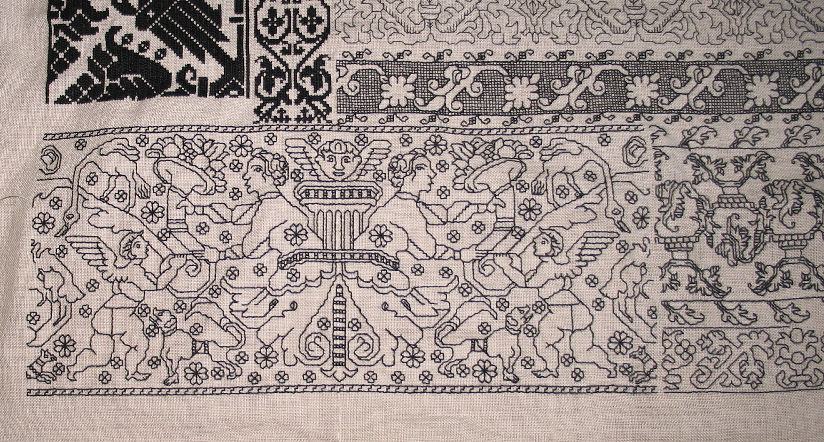

I’ve finished out the excerpt from the big Lipperheide repeat and started another. This pattern appears on the same plate as the one I just finished. Like it, this one was originally worked voided. It turns out to have the exact north-south stitch count I need to eke out the horizontal row, getting ready for a darker, wider strip at the project’s bottom edge. It’s also an extremely quick one to stitch up. The bit above only took about an hour or so.
Anna asked me what kind of hoop I’m using, and whether or not I’ve padded it. I reply:
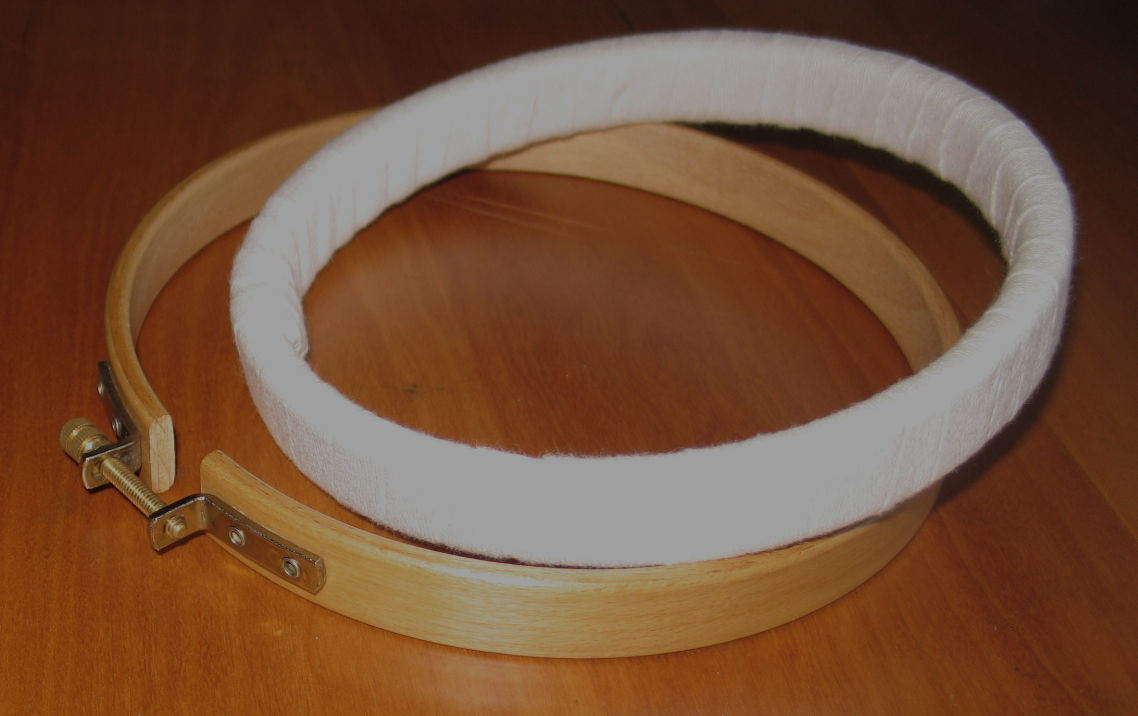
It’s a 7-inch Hardwicke Manor hoop I bought from Hedgehog Handworks, about 10 years ago, but didn’t use until recently. In part because I’d been on an extended vacation from stitching, and in part because I didn’t like the way it tensioned the fabric. At 5/8″ wide it grabbed nicely, but never maintained the tightness I prefer for double running stitch. So finally tiring of my ancient dime store bamboo hoop last month, I got some standard fabric store issue half-inch white twill tape and carefully wrapped the bottom of my Hardwicke frame. It’s hard to see, but the tape is angled at 45-degrees, and overlaps by roughly half a width on each wrapping. The end is tucked underneath and stitched to the bottom hoop’s inside (left on the image, where the lump is), to keep the outside perimeter bump-free. The hoop’s screw closure is long enough to handle the extra diameter of the wrapping. About six turns of the screw’s threading are visible, and I had just popped the thing off the work for the photo.
I now love this hoop. The twill tape cushions the work and minimizes crush and holds the ground cloth drum tight. However wrapping the bottom hoop does reduce the effective stitching area by decreasing the inside diameter. Even with cushioning I would not recommend using a hoop for anything other than flat surface stitching using cottons. When I stitch with silk, metallics, or use any sort of raised or heavily textured stitch I pull out a flat frame.
Where is the crowdsourced pattern of the week? I’ve got a very nifty motif queued ready to go, but it’s only one panel. I’m hoping for at least one more before I post the next update.(Hint, hint…)
Aside: Hoping all on the East coast were spared overly much grief with Irene. Only minor damage here in the leafy close-in suburbs outside of Boston:

Half a tree down, blocking our street, and another big limb in our back yard. Thankfully both fell with surgical precision, missing every structure, vehicle, power line and comms wire. I bow to the courtesy of my neighborhood vegetable friends. Also to the amazingly diligent Arlington, MA DPW crew, that had this cut up and hauled away within 45 minutes of the tree’s fall!
Finally, for folk who landed here looking for Ensamplario Atlantio. (Word is still spreading about it.) It’s here.
STREAKING ACROSS SKIES- CROWDSOURCE #5
Although it is in the periodic nature of comets to come and go, I owe apologies to The Person Who Wishes to Remain Anonymous for inadvertently omitting her tribute to the Bayeux Tapestry from the crowdsource project updates. The inbox management blunder that made that mistake has been taken out and shot.
This week brought five additions to the project, including the belated comet:
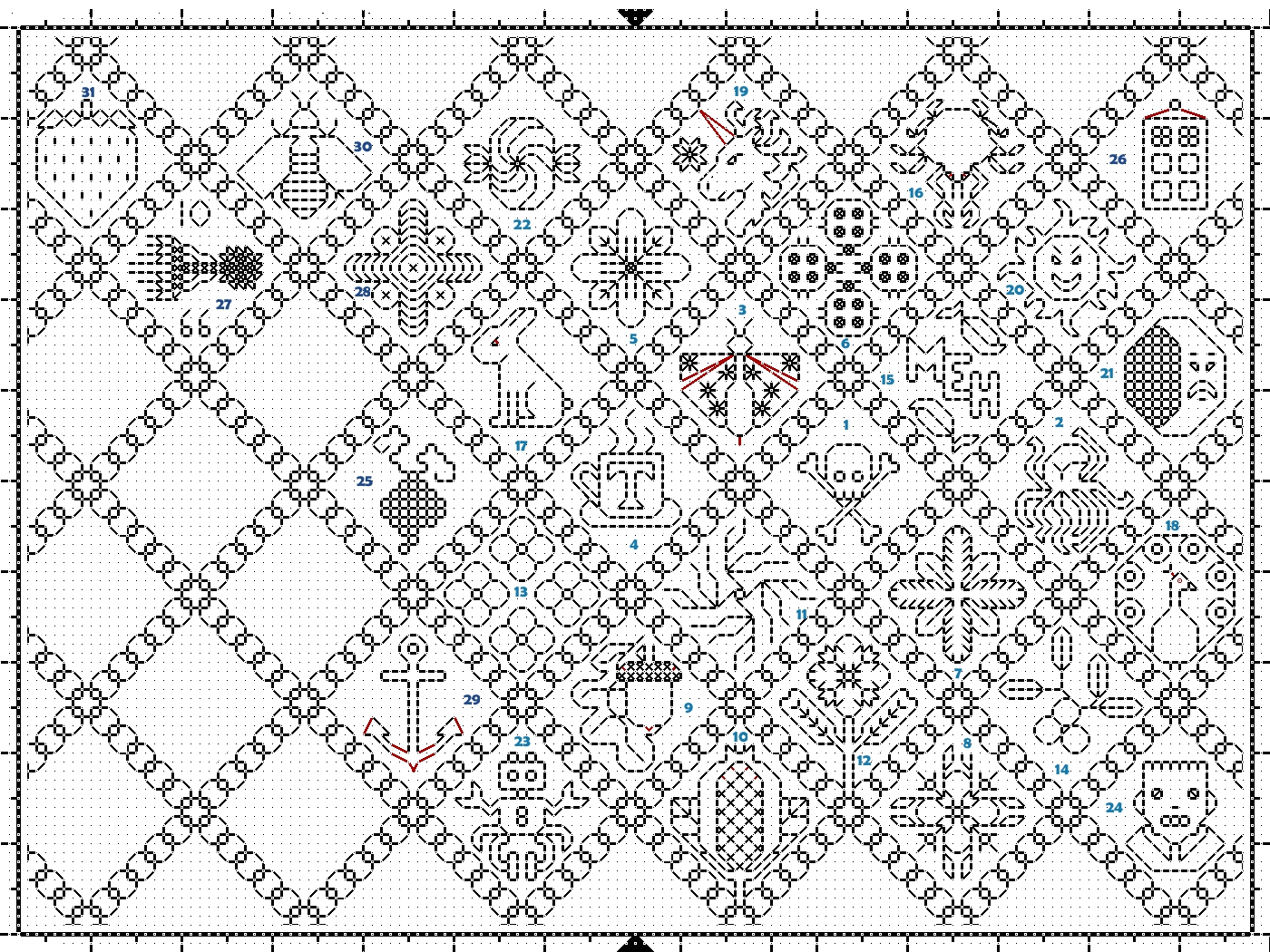
- 27. Comet – a tribute to Halley’s Comet as it appeared in the Bayeux Tapestry – Karen Isaacson.
- 28. Mesmer-Flower – A mind bending cross-style flower from from Alexandra Rule
- 29. Anchor – A continuation of our maritime sub-theme also from Alexandra Rule
- 30. Bumblebee – We need more insects if we want to pay homage to the spirit of historical era stitching. This one is from Laura Kathleen Brashear.
- 31. Strawberry – Another for the traditional motif sub-theme, again from Laura Kathleen Brashear.
I’m having way too much fun with these. You can see that we’ve still got room for eight more full-diamond designs, and for about five more that are symmetrical and that can be represented in the half-diamond boxes at top and bottom.
With some overlap among categories, our sub-themes so far seem to be piratical/nautical (1, 16, 20, 21, 3, 29), science fiction (26, 23, 24, 11), sweetness-and-light (31, 22, 6, 10, 18, 13, 4), traditional (31, 30, 26, 5, 6, 3, 25, 13, 7, 16, 9, 12, 14, 10, 12), astronomic (27, 20, 31, 11), beasties-and-bugs (30, 19, 16, 6, 17, 3, 2, 16), and floral-fruits (26, 5, 25, 13, 7, 9, 12, 14, 10, 8). This leaves poor ennui (15) sitting in the corner and sulking, unless you think that by virtue of “Meh” being a popular Think-Geek t-shirt, he belongs in with SF.
If anyone has started stitching something using these, I’d love to hear about it.
BIGGER INSIDE THAN OUT? – CROWDSOURCE #4
First, thanks this week to our crowdsource design contributors – the patient Jane Wyant, and (as always) Long Time Needlework Pal Kathryn Goodwyn:

- #25 – Grapes – Kathryn’s own needlework sigil, offered up to our collection. (Kathryn’s deep love of grape motifs is legendary).
- #26 – TARDIS – From Jane Wyant, a Whovian tiny inter-dimensional call box should we wish to stitch in two places at the same time.
We’ve still got a few open diamonds. With some repositioning I think I can fit in seven more motifs. Feel free to send yours along.
On my own blackwork sampler, progress is being made. My Lipperheide panel is proceeding apace.
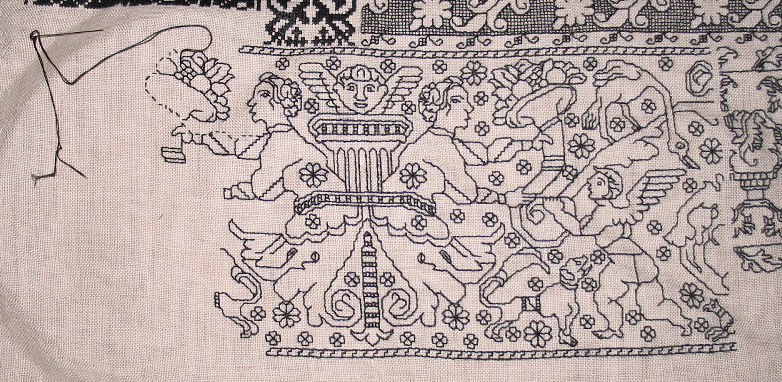
I am not going to have room for the entire repeat. There’s a head of one of the four winds (possibly Boreas), and a horn tooting satyr that will have to wait their turn on a future piece. Unless Kathryn gets there first. 🙂

After I finish out this strip to the left hand edge of the stitched area I will fill in a narrower band below the sprigged chimney pots. Then I’ll edge across the entire bottom with something nice and dark – probably worked voided style. I haven’t picked out the designs for either of those strips yet, but as folk following here know, I enjoy bungee jump style stitching. Once the dark area is done that will leave only the top. Believe it or not, the part you see stitched here is only about 65% of my total piece. I’m not sure what I’ll do up there, but that’s still down the road.
SUNSETS AND SPANIELS
A break from the crowdsource project this week. No new designs came in, so unless I cheat and post more myself, there’s no update. Feeling shy about submitting a design – please don’t be! We’re delighted to see your efforts, whether it’s your first venture into drawing a pattern, or if you’re an old pro.
Instead I share progress on my own sampler. As you can see, I finished the last band, described as “sprouting chimney pots” by Long Time Needlework Pal Kathryn:

And Kathryn is also to blame for the new band. She was gracious enough to lend me Kathleen Epstein’s Old Italian Patterns for Linen Embroidery – a redaction of one of the legendary Lipperheide volumes. This is the only design on the sampler that will not be offered in my upcoming sequel to TNCM because it’s in that book. If you’re familiar with the original you’ll see that I have adapted slightly:
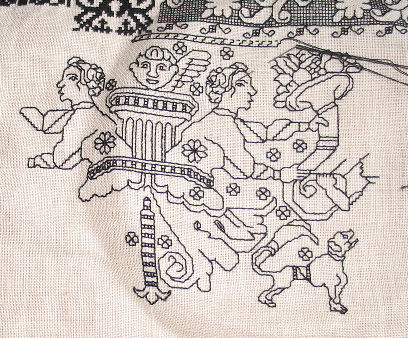
My variation differs in the way that the background’s handled. I won’t be working this one voided like the original. I also tinkered a bit with some of the interior elements, the banding for example right under the central cherub. In the original the darker little vertical elements are filled in with cross stitches. Mine uses plain ladder like elements, which I repeat elsewhere in the piece. Thanks, Kathryn! You remain my chief enabler, even after all these years. 🙂
Now where do spaniels and sunsets come in? For spaniels, that’s easy to see: the odd little critter in the lower right hand corner. He’s got a spaniel-like fluffy tail, foot feathers, and floppy ears. Even the stylized dark area on his middle is reminiscent of the classic saddle-area markings on a Cavalier King Charles Spaniel (a breed that was fashionable at in the 1500s-1600s.) As I worked him I could almost hear him barking at the cherub that will stand to his right (you can see the cherub’s hand and lower face at the edge of the stitched area). And if you’re eagle-eyed you’ll see the two mini-mistakes at the left hand edge of the completed work. Hint: I’ll be picking out the left hand lady’s upper arm and the hairline of the central angel-face.
Sunsets? That’s implied. This week’s vast amount of progress is brought to you by an impromptu mini-vacation the Resident Male and I took for part of last week – sans children, the youngest being in summer camp and the oldest being trusty enough to leave on her own. Three blissful days of embroidering while watching the tide roll in and out, basking in Outer Cape sunsets, wiggling toes in hot sand, snarfing up some fine food, and enjoying a production of A Winter’s Tale. I am now armed against the inexorable slide back to fall, school, heavy deadlines, December, and snow.
Finally, for folk who landed here looking for Ensamplario Atlantio. (Word is still spreading about it.) It’s here.
PLANET OF THE CROWDSOURCE
A few more submissions this week. It’s not too late if you want to play along!
All of these are from anonymous donors.
#20 – A very aggressive sun.
#21 – A mustachioed moon.
#22 – A spiral mint candy.
#23 – Tiny robot!
#24 – Frankenstein’s Monster/
The sun, moon, robot and monster are from someone who doodled these up on the floor of a recent science fiction/comics convention that shall also remain nameless. The candy comes from someone who was charmed by the ladybugs, unicorn and the bunny, and was inspired to continue the counter theme of sweetness and light. (As opposed to poison, pirates, and ennui).
I welcome more input – traditional flowers, non-specific geometrics, animal, vegetable, domestic, wild, fantasy or reality.
CROWDSOURCE PROJECT SO FAR
Thank you all! As you can see, our crowdsourced blackwork pattern page is starting to fill up:

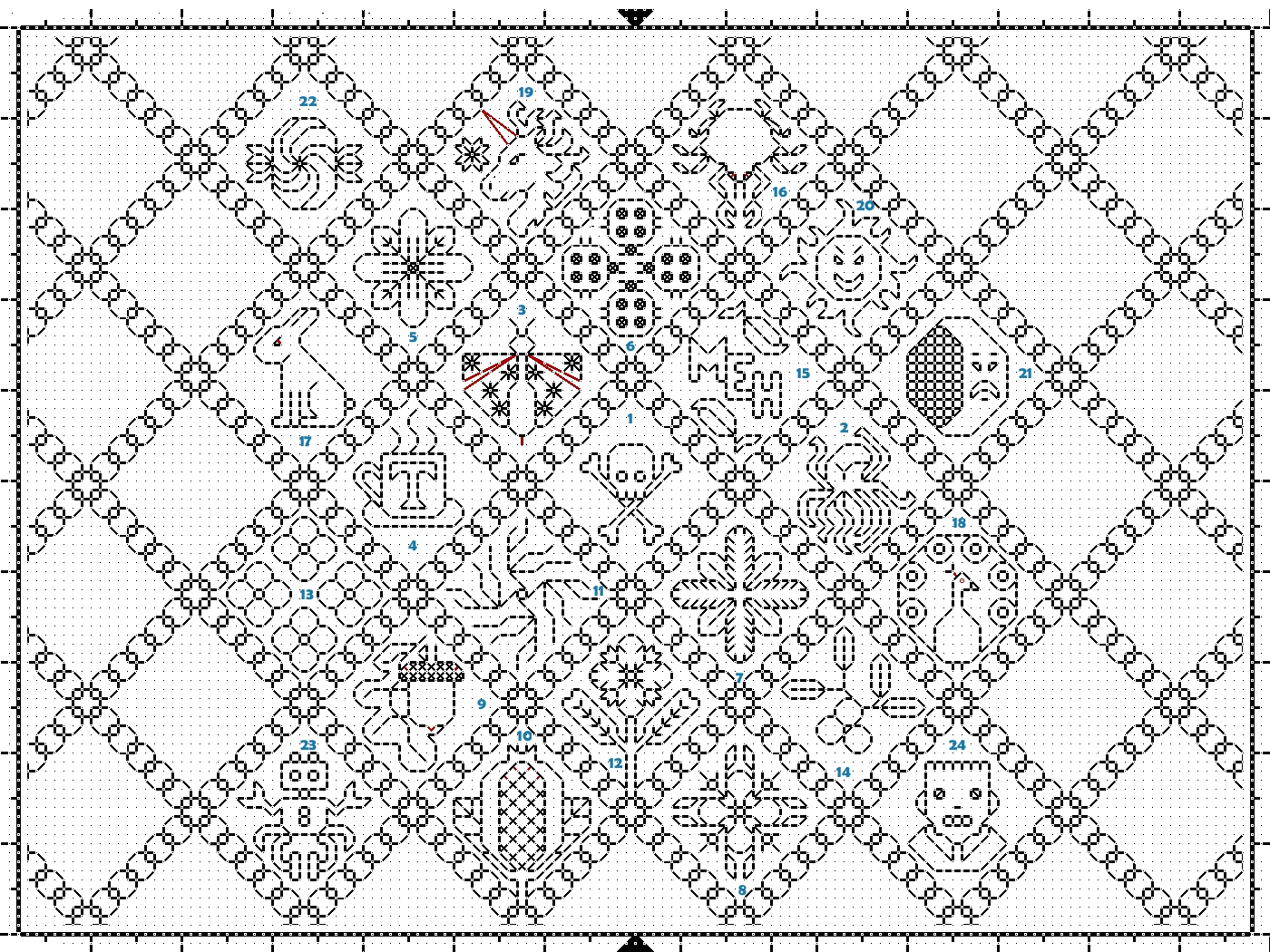
I’ve made no attempt to balance these or place them in any particular way. Numbering starts in the center, and works (more or less) in order of receipt. Half stitches, and stitches off the grid are shown in red. I’ve also taken the liberty of naming these, and including comments if provided by the donors. So we have:
- Death’s head – mine, fromDancing Pirate Octopodes
- Octopus – also mine, from Dancing Pirate Octopodes
- StarBee – sent in by the fabulous Twerp, our first submisison!
- A Cup of Tea – from Sandy
- Crosshatched Flower – from Anonymous
- Ladybugs – from #5 Anonymous’ 10-year old daughter
- Shaded Flower- from the prolific Jeannette de Beauvoir
- Geometric – “It starated life as a flower, I don’t know what it is now…” – from Jeannette de Beauvoir
- Acorn Sprig – “The acorn looks a bit big but a smaller one was too small.” – Jeannette de Beauvoir (I think the size is just fine).
- Pomegranate – Jeannette de Beauvoir is on a roll!
- Zap! – :”Kind of reminds me of a circuit diagram.” – another from Jeannette de Beauvoir
- Flower Sprig – Jeannette de Beauvoir again.
- Four Flowers – Jeannette de Beauvoir
- Mistletoe – “I think this could stand to be moved down a space or two in the frame” – Jeannette de Beauvoir
- Meh. – This one came in earlier but fell to #15 due to lack of enthusiasm 🙂 – Another (totally different) anonymous donor
- Blue Crab – “To continue your ocean theme.” – from Maryland Stitcher, who managed to fit in the requisite number of legs!
I’ll release the whole page as a well-behaved PDF as soon as it’s full. It’s not too late to add your patterns to our pile. I’m more than happy to finish out this page, and to start more pages if needed. The instructions are here.
And if you landed on this page looking for Ensamplario Atlantio my free book of blackwork fillings – do not despair. You can find it here.
CROWDSOURCE #2 – TEA, FLOWERS, LADYBUGS AND A YAWN
Patterns for the Crowdsource Blackwork Pattern project continue to trickle in.
Sandy (no link) sends a cup of morning tea.

And a family wishing to remain anonymous sends a flower (from the mom) and ladybugs (from the 10-year old daughter):


This anonymous donor was inspired enough to register his or her lack of enthusiasm:

Got an idea – simple, elaborate, silly, or serious? Here’s the blank frame again:

Copy it local and edit it in any graphics program, or do like these folk did – print it out, draw on it, and send me a scan or a photo ( kbsalazar (at) gmail (dot) com). I’ll graph up the final. When we have a pile, I’ll compose them all together into a page or two of patterns and post them back here.
CROWDSOURCE #1 AND SOCK DISAPPEARANCE
Back from vacation! A week of Cape Cod sun, sand, salt water and doing as little as possible except enjoying those things.


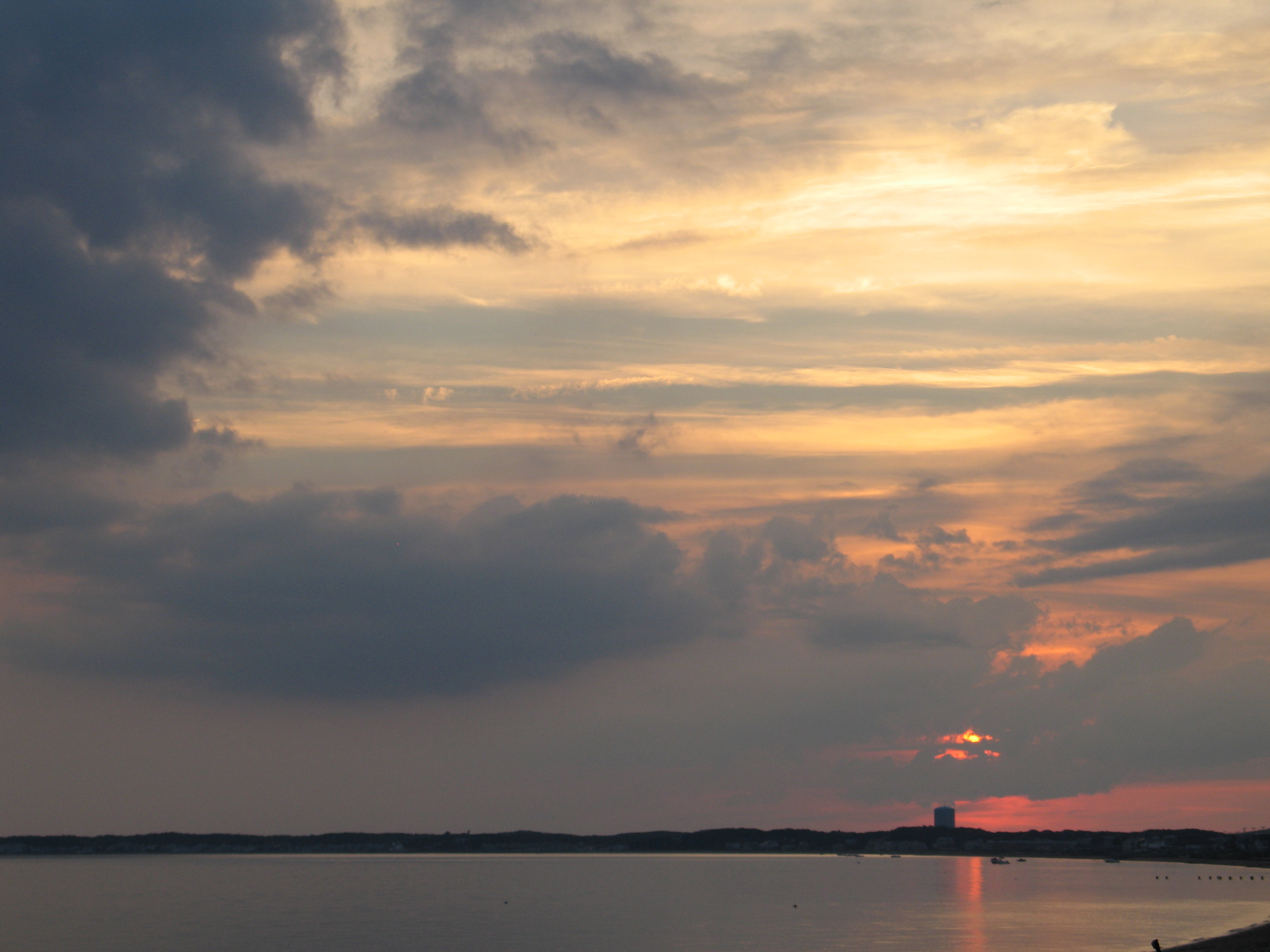
This year my mom came with us and we had a great time. We spent most of our time on the sands right at our hotel, sitting, swimming, kayaking, even watching Provincetown fireworks from our room’s deck. We did our now traditional beach paella, salmon teriyaki on the grill, and flank steak kabobs. I am rested but could be easily persuaded to do a wash-rinse-repeat of the whole week’s experience. Seven days is not enough.
Arriving back home, I checked gMail to see if anyone had volunteered a graphed pattern for the crowdsource project. Lo and behold! There was one:

I present Design #1 – Twerp’s StarBee. The first design in the series. Red lines indicate straight lines “off the grid” or not at 180/90/45-degree angles. I like this cheeky little fellow. A nice one, Twerp!
If you want to draw up one of your own to be posted here, please feel free to download the JPG at the project’s kickoff page, then draw on it by hand or using any graphics program. You can email the resulting file, a photo or a scan of your design to me at kbsalazar (at) gmail (dot) com. Let me know whether or not you want your name or a link posted with your offering. I do reserve the right to do light editorial selection (this is a family-rated website).
Now, what progress have I made on my own stitching?
Some, mostly prior to our departure. I concentrated on two pairs of socks while we were on the beach.

I knit a pair of guy socks, with a simple broken rib ankle and k1p1 ribbing to finish. There is only one in this picture. The other is now at parts unknown. At best guess, I dropped it at dusk on the beach and didn’t notice that it was gone. Either seagulls or the sea made off with it. Somewhere there is either a lobster or a tern sporting a new brown habitat. And I need to get another ball of the same yarn and knit a third to make a pair. (Grrrr.) The other pair has a lacy pattern in the ankle. More on that another day.
And here’s the latest strip on my sampler:

To which I will return once the socks are done.
One last note – to date (using the click-through count of the fourth part) – over 1,000 people have downloaded the complete Ensamplario Atlantio since I posted it two weeks ago. If you are looking for it, it’s here. It’s a PDF file – you need a recent version Acrobat Reader to open it. You can get Reader for free, for both Mac and Windows. Although I’ve gotten some thank-you posts and a couple of questions from people unfamiliar with Acrobat, I’ve had very little other feedback, and only one bug report – of fonts not displaying properly on an iPad II running the latest version of Safari. I’m looking into that problem and may repost the files later this week.
BUTTERY PARTLET AND CROWDSOURCING
Thanks to everyone for their kind words about Ensamplario Atlantio (EnsAtl)!
I’m delighted that folk find it useful. I was going to leave it up as the blog’s front page for a while, but two stellar things came in that I had to share. Before them however, please note that I will be leaving the book available on String for a while longer yet.
The two things?
First, I’ve mentioned before that my main joy in designing is seeing what folk do with the patterns. I have to show this one off (click to enlarge the thumbnail):

This partlet was stitched by Kimiko Small (in the SCA, the talented Lady Joan Silvertoppe of Caid). She used the Buttery pattern in TNCM Plate 59:1. It’s one of my originals, but it’s based on period conventions, motifs and aesthetics. The partlet design, stitching, and most obviously the picture above are all hers. The photo is reproduced with her permission.
Kimiko, I’m thrilled! Well done! I’m quite excited to see this particular pattern picked up and worked so well. The partlet is an excellent showcase for your stitching. It’s prime! You can read more about Kimiko’s award-winning project and read her arts competition documentation on her blog.
Now, this ties into the Second Thing.
The Buttery is an omnibus pattern – a frame filled by a large number of different design motifs. In this case, flowers, herbs and fruits. I’ve augmented my original set of patterns, and stitched up even more Buttery fillings on a recent project of my own.
Now the new book is generating some buzz about my patterns. Hannah was kind enough to spread word about EnsAtl on her blog, enbrouderie. In the comments that accompany her post Rachel of VirtuoSew commented on my Dancing Pirate Octopodes pattern. Rachel wondered about working up alternates for DPO. Initial silly filings aside, that pattern has excellent potential to evolve into another omnibus design along the lines of Buttery, and I think Rachel’s idea is a splendid one.
So I announce the first (to my knowledge) Crowdsource Design Blackwork Filling Project.
What’s Crowdsourcing? In a nutshell, it’s putting a project in front of a large number of otherwise unrelated/unassociated people, and asking them to apply their individual creativity to it, spreading the word and bringing all that creativity back together using ‘net based communications. It’s all the rage right now. Even the Defense Department’s research arm (DARPA) has launched a crowdsourced projects to jump start the design process or solve sticky problems.
So. Reaching both behind to the past and into the future – why not one for double running stitch?
Here is a square with just the frame from Dancing Pirate Octopodes:
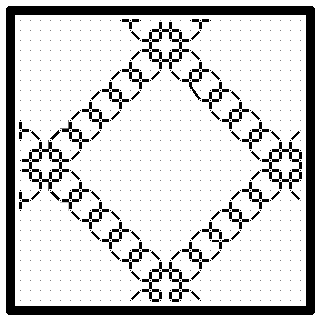
It’s a simple JPG – shown above at full size. Right click on it and save the image. Then attack it with any graphics program, or print it out and doodle on the hard copy. Work up your own filling(s)! Be creative! Run amok! Just one request – this is not an adult-rated site. Please keep your designs family-friendly. (I reserve the right to do light editorial selection, if need be.)
When you’re done, eMail the file, or transcription of the thing, or a scan or photo of your design to me by 10 July at the gmail address listed in this post . I’ll assemble all submissions in one big layout, and share the results back here as quickly as I can. (If you’d like me to withhold your name rather than be credited on String, I’ll be happy to do so.)
This isn’t a contest – I’ve got no prizes to give away. But I think it will be lots of fun to see what everyone comes up with. So fire up your drawing program or sharpen your pencil. Let’s see what our stitching crowd can devise!
Again, thanks to Hannah, the gang at Total Insanity, others at various Yahoo needlework discussion groups, and all other posters and email respondents for their welcome and acceptance of EnsAtl. Special thanks to Kimiko for making my day with her project. Thanks to Rachel for the idea of making more fills for DPO. And thanks in advance to everyone who will take a moment to share their own creativity for the joy of participating, and glory of their needle.
ENSAMPLARIO ATLANTIO – BLACKWORK FILLING COLLECTION PDFS FOR DOWNLOAD
UPDATE: 13 JUNE 2023. The old four-block system for downloading the original Ensamplario Atlantio, an artifact of bandwidth limitations common in 2011 is no longer needed. I’ve taken a moment, stitched the four pieces together into one book, made a couple of minor corrections AND added four pages of additional filling patterns. Please enjoy this new edition.
——————-
At long last, and as promised. Ensamplario Atlantio: Being a Collection of Filling Patterns Suitable for Blackwork Embroidery is here in PDF format!
I have to admit that my ambition ran away with me. The entire thing is 40 pages long, with 35 plates of designs – over 220 or so individual all-over or filling patterns for double running stitch embroidery. Some are very large repeats and would be better suited for free-use, others are smaller in scale and would work well as fillings in traditional outline/infilled blackwork (like on the pix of the cover, below):
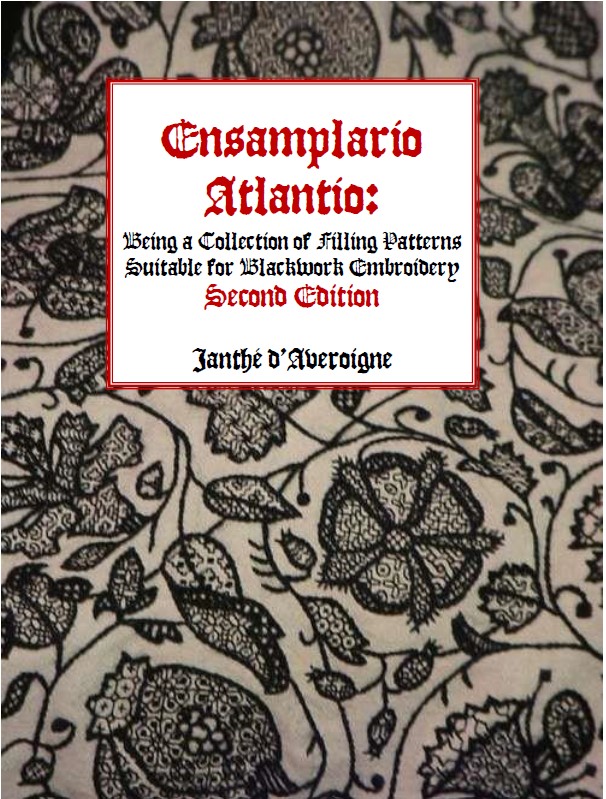
Formerly issued in four parts, the new, expanded edition of EnsAtl is now available as a single downloadable PDF file:
I would dearly love to see any projects that use fillings from the collection. Since I’m making this available as a free download, seeing what my pattern “children” are up to in the real world is my biggest reward.
And also a reminder – just because this is being made available freely doesn’t mean that I have relinquished my author’s rights. This book may not be re-issued, re-posted, or sold by others without my specific permission. I ask that needlework instructors wishing to use the thing get in touch with me so I can keep a log of by whom/when the book has been circulated.
UPDATE:
Longing for more? There’s a sequel. 200 more plates of designs – more fills, plus borders and even some neckline yokes. Also a free download. Pop over to this link to download.
 String-Or-Nothing