DOUBLE RUNNING STITCH LOGIC 102 – WORKING FROM THE BASELINE
Well, with luck this mini-series will be useful to someone out there. There is someone out there, right?
Continuing from the last post, now that we’ve figured out that our design can be worked double sided, and we’ve identified the baseline, how do we go about the stitching? What logic can we follow to ensure that no areas of the pattern are orphaned, and that all lines are covered?
The method most often followed is the baseline method. The other I’ll call “accreted section” and deal with it in a later post.
BASELINE
I find baseline to be pretty easy – nearly foolproof, provided the stitcher can remember the nested logic of detours-within-detours encountered along the way. Some stitchers keep a paper copy of the design, and overtrace it to keep track of where they’ve been. Some use a paper copy to try out their logic before committing needle and thread. I have to admit I do neither. I just go for it.
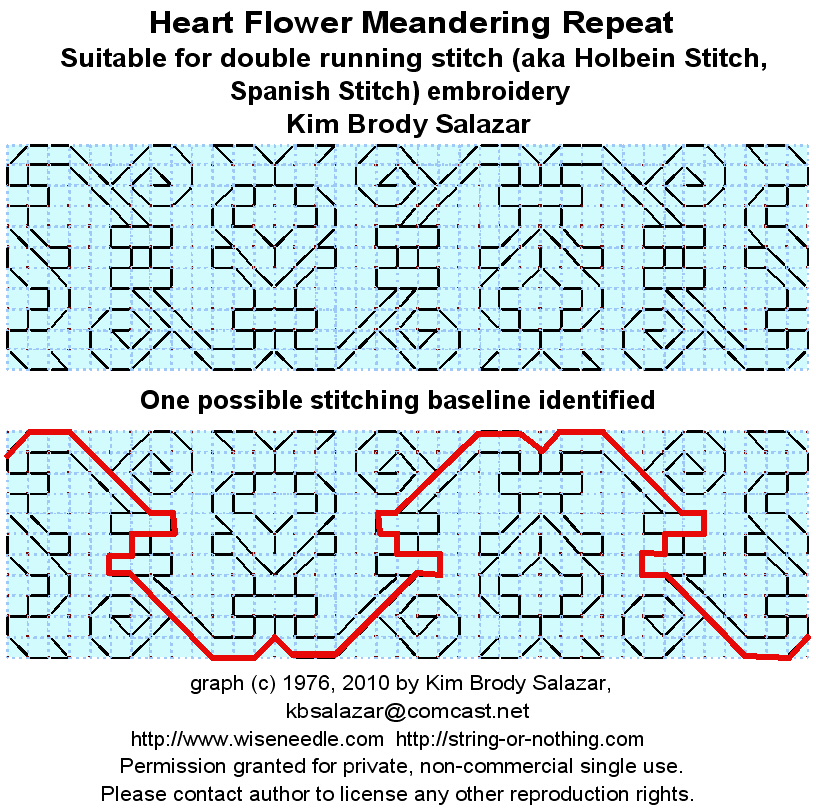
Let’s look at this pattern. It’s from my very first booklet on Blackwork, a hand-drawn photocopied piece done in my teens and distributed entirely within the SCA. I know I got this particular design from a historical source, but my original annotation wasn’t complete enough for me to include in later books or in fact to find the source again, so this design has sat on the shelf ever since. I’d consider this one to be a pattern of intermediate complexity, but well within the reach of most beginners (click on pix below for enlargements).
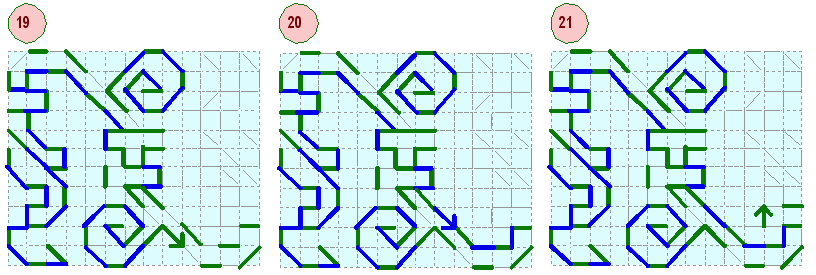
To parse out the stitching logic, let’s look at a half repeat. I’ll illustrate the entire stitching path for one half repeat. The logic to complete a whole repeat is very much the same. In the pix below, green indicates my first pass of double running, and blue marks a return path, in which I retrace my steps. The first stitch and its direction in any pass or return is marked by an arrow. Click on any of the drawings to enlarge. And please keep in mind that the method below is just one of a huge number of possible paths through this particular pattern. Path planning and trying out different strategies is what keeps this style of stitching fresh to me. Which is to say there’s no guarantee at all that I work every repeat in exactly the same manner. YMMV.
To work this design double sided, I’d start along the baseline leaving at least three inches of thread extra on the back (no knots). I find it helpful to wind the excess around a pin placed in an inconspicuous spot. I travel along the baseline (1) in double running stitch until I encounter a branch. My preferred logic is to then follow the branch to its end, then turn back and fill in the “every other” running stitch, to eventually return to the baseline (2). Then I continue on to the next branch decision and follow that detour (3).

In this case I’ve gotten to the first of the double bracelets on the main stem. Unless a branch is a turn left only branch, given a choice, I tend to turn right. Gamers, the mathematical and those who study behavioral sciences or robots/autonomous navigation will recognize this – it’s a classic. Any maze can be successfully navigated by putting one’s hand on the right hand (or left hand) wall, and following it, without taking one’s hand from the wall. The path traced may not be the most efficient, but sooner or later, the wall-hugging, maze-wandering mouse, robot, or high school topology student will emerge from the exit.
So here I am at the top of the brackets. I could continue down and wander around the bracelets, or I can turn right again and follow the main stem back to the half-heart motif on the left edge of the swatch area. I take a right hand turn from my line of travel, and stitch back up to the main motif (3). When I get there, I notice one little tiny detour – the single stitch between my current line and my starting point. (4) makes quick work of that. Then I continue around the necklace at the base of the heart motif. Again I turn right (5), then double back on my path and continue down and around the wing at the base of the heart (6).

After completing the first pass at the base of the heart and ending up at my “bounce line” – the centermost point of the strip repeat – I do a mini-step back to the heart’s outline (7), then I continue around the heart’s perimeter, eventually reaching the detour point to complete the small inset detail in the heart’s center (8). Again I stitch to the bounce point, and then return to the heart’s perimeter (8).

Once I’m back at the edge of the heart, I can do the antenna that sticks up from its top (9). Heading back from there turns out to be a long run all the way back to my baseline, filling in all of the “missing” stitches to complete the first half of the left hand heart motif (10). Now for a minorly tricky bit – one that folk unfamiliar with double running stitch logic occasionally miss – the little detours that fill in the bracelets around the stem. It’s easy to miss stitches in these, and very easy to get lost, not remembering which way to turn next. We’ll step through.
The first bit is to progress along our baseline. The initial stitch is marked with the arrow. I work it, then the two stitches along the bottom of the upper bracelet, followed by the stitch that completes the three that define the top of the bracelet (12).

Time to head back to the baseline, but it’s not very far away. One stitch brings us back to it (13). On the next step because it’s extra confusing, I’ve marked two stitches with arrows. First I head south from the upper bracelet, then work around the lower one (14). There’s now one stitch left to finish defining the box between the two bracelets. I take that one stitch (15).

Now I’m ready to return to the baseline again. A couple of quick stitches takes me there (16). If you look at the work now, you’ll see only one “unfilled” path through the two bracelets area. That’s the path of our baseline. All of the other stitches have been completed, and none are orphaned, unworked. Now to progress along the baseline again. I detour for the little side curl, worked there and back again style just like I did before (17, 18) landing me back on the baseline again.

The logic should be a bit more obvious by this point. I progress along the baseline, making a detour back up to complete the outline of the stem unit (19). And back again to the intersection just below the necklace at the base of the next heart flower (20), and up around it (21).
Now I move on to the wing section that defines the lower edge of the flower (22). As before, having hit the center point, I head back to the outer edge of the heart (23), then continue around the heart’s perimeter, and down into its center detail (24).

Almost done now, there’s just heading back out to the edge of the heart (25), and doing the first half of the antenna (26). Our grand finale is here! Starting at the antenna, we work all the way back around the heart’s edge, and then all the way back to the beginning of our pattern, following the established baseline. At this point there’s no more counting, just following the snail trail laid down before (27):

It’s done! The entire half repeat – worked 100% two sided in double running stitch, with no little orphaned areas left unstitched. We worked through the baseline concept on a pattern of moderate complexity, stitching along detours as they present themselves, always returning to the baseline before moving on, and leaving one long final unifying run along that baseline to finish off the pattern. Yaay!
O.k., some of you ask. “Smarty pants, that all works great for the half-repeat shown above, but what about the full repeat?” I answer – the logic is the same. With the exception of the antenna which needs to have both “ears” worked one after another the first time they’re encountered, the stitcher can follow the “to the center” logic above, verbatim, or can work each heart flower as an entire unit when it is first encountered, following around its entire perimeter up to the point of return to the baseline before doubling back around the heart to arrive at the original spot of departure from the baseline.
If you’ve got questions about this logic, please post them. I’ve already gone on long enough for one post. The next post will be on the accreted section method and when to use it or the baseline approach. The series will end with how to finish off ends invisibly for double sided work. Hope this is helpful!
DOUBLE RUNNING STITCH LOGIC 101 – TWO SIDED WORK AND BASELINE IDENTIFICATION
Surfacing…
There’s been a discussion of late on the Yahoo Blackwork embroidery discussion group about stitch order, direction and stitching logic in double running stitch – especially reversible (two sided) double running stitch. I contributed to the discussion with these thoughts, but the answer below is a bit of an elaboration on my original discussion group post.
Double Sided Double Running Stitch – Is it possible for your chosen pattern?
The first thing to do is to determine whether or not your contemplated design can be done 100% reversible. Those that can have every design element connected. There are no floating little diamonds or sub-motifs off on the side un-connected to the main design. This simple design is easy to do two sided:

This one, although vastly more complex, only presents a couple of challenges. The center diamond in the nodule at the base of the plume flower is one. Every other element is connected, but that one diamond stands alone. If I were to work this design double sided, I’d add a stitch to the top and bottom points of the diamond to connect it to the rest of the design. The visual impact of that modification would be minuscule. The other challenge is the presence of some detached stitches in the “bark” area of the branches – the little floating verticals unattached to the main body of the work. If I were to do this one double sided, I’d either omit them, or lengthen them to intersect with a segment of the branch’s outline. A pain, but not totally fatal, and both changes wouldn’t be very evident.

By contrast the column and wreath design below, though simpler, presents a greater challenge for two-sided stitching. Each of the small circlets in the centers of the wreath units stands alone. Attaching them to the rest of the work would diminish the impact of the design. Although the rest of the design can be worked entirely two sided, the circlets are problematic because they’re free floating and rather small. If they were worked independently, with their own lengths of thread, there isn’t enough real estate in each one to cleanly hide the thread ends.

Much of this mermaid panel can be worked double sided, but by now you can spot the facial features, fruit dimples, flower centers (and prominent nipples) as presenting problems that can’t be solved by modifying the design. BUT the small dolphins, although separate from the main pattern aren’t a problem. They’re big enough to stitch with their own threads

O.k. Now we’ve determined which designs can be done double sided without modification – the ones that have no isolated design elements. On to stitching logic.
Stitching Logic – Baseline
I use two methods for completing a double running stitch pattern – baseline and accreted section. I’ll tackle baseline first
Baseline Identification
In the baseline method, the stitcher identifies a line that travels the entire length of the pattern. That’s the baseline. It can be obvious, like a stem from which all of the pattern’s flowers grow, or part of an outline; or it can be less obvious. In this oak leaves and acorns border, one baseline is blindingly obvious:
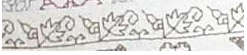
It’s the ground line from which the little motifs sprout.
In this pattern it’s slightly less clear. Any one of several options can be used as an effective baseline:
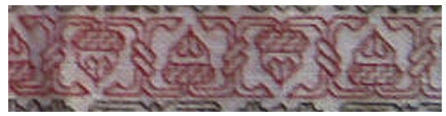
Here’s one possible baseline:
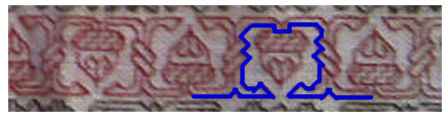
Every other element of the design can be worked as a detour off this main highway. You’ll note that the baseline needn’t march around the perimeter of the acorn. In fact the entire acorn is one nested set of detours. And this isn’t the only possible baseline. Here’s a more efficient though less intuitive one:
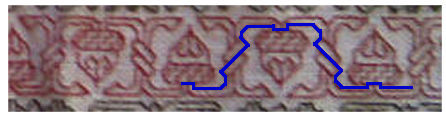
Both are perfectly logical. I might use the one at the top if I wanted to quickly establish the height of my piece. It’s just one unit shy of total pattern height. But the only reason to chose one or the other is personal preference. Please note that the logic of these to baselines applies equally well to the horribly complex plume flower:
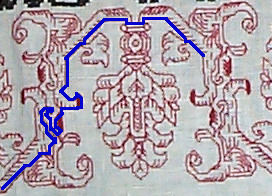
I’d suggest folk new to double sided work start with patterns with easily identified baselines, and work up to some of the more daunting patterns.
Next post – stitching logic. Traveling along the baseline and its detours.
YOU GUESSED IT, MORE SLOW PROGRESS
Well, my day job continues to eat my life, leaving precious little time left over to do much else. I do keep plugging away on the Clarke’s Law sampler. I finished out the small panel of narrow bands on the right, and am working on the border defining the bottom edge of the similar space on the left. I have to admit that I’m very bored with this narrow strip. It’s LOTS of repetitions of the SAME unit, with LOTS of long armed cross stitch background to fill in. I am sincerely looking forward to when this band is over and done with, so I can move on to the next bit of fun.

For Eleanor, who wanted to see the source material for the current band, it’s here. Fourth strip up from the bottom. I wish I could read the V&A accession number on the label in the photo.
The set of narrow bands in the blank space immediately above the bit I’m working now will be different from the ones on the right of the center motif. There will be four and they’ll alternate between black and red, but they will be of different widths than their counterparts, with the narrowest on the bottom rather than on the top.
Apologies to the few remaining readers here. This project has bored everyone but me to tears. Thank you for putting up with it.
NARROW BANDS
Amazingly, in the middle of the constant stream of work-related chaos, I did manage a half day over the weekend to unwind. Here’s the result:

I’ve finished the panel of narrower bands to the right of the central motif. Now, with my right hand edge better established, I can finish out the voided, red band immediately below. Then it’s on to th set of four narrow bands on the other side of the center. They’ll be different (and different widths) but they will also alternate red and black. For the record, all four of these narrow bands can be found in TNCM, the pomegranate and foliate bands being two of my special favorites.
Here’s a partial shot showing more of the piece. I still have to fill in “-A.C. Clarke” immediately to the right of the word “magic,” but I haven’t identified the smaller but complementing alphabet to use. I’ll fill any left-over space above and/or below the author’s name with another narrow black double running stitch band.

And on the bottom? Yes – there’s one more wide band to go after all of this is done. I’m not sure. Something spectacular, with liberal use of both red and black. I’m not sure what that will be either, although I do know that whatever it is it will need to be between 50 and 60 units tall. (point of reference – the grapes at the very top of the photo above are 65 units tall.
YES THERE IS PROGRESS
Where have I been? First swamped with work, then on my annual week at Cape Cod, then swamped with work again. Through it all I’ve kept stitching, although admittedly the vast majority of new stuff below was done on the beach in North Truro:
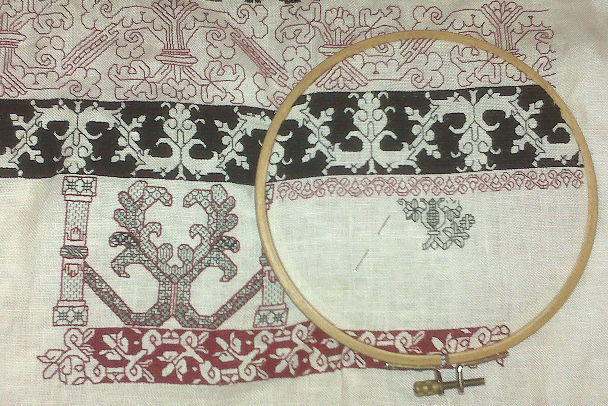
I finished the inhabited bit in the center, but decided not to stretch that strip left and right. Instead I did one repeat, put a new voided strip below (as yet unfinished), with the goal of stacking narrower simple double running stitch bands left and right of the center motif. The narrow band of red acorns is from my very first pamphlet on blackwork, which I produced in the SCA circa 1975 or so. The pomegranate under it is from TNCM, which was published in the mid-’90s.
I also knit on socks when the evening’s light grew to dim to stitch. My beach report and photos will follow. But as usual, I’m totally under the gun with work obligations here and have to run. Consider this a “drive-by blogging.”
BACK TO BANDS AT LAST
Finally! Time to finish off the last band on my Clarke’s Law sampler. I really like the way it turned out. Yes, it’s dark. But it’s the narrowest strip on the work so far, and it separates the text bearing area above from what will be a more chaotic bit below. (The jury is still out if I’m going to continue full width strips down here, or do a more random placement of motifs:

But on to the the next a bit, unusual in the original sampler:
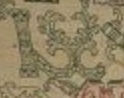
It features prominent outlines, plus some speckled, scattered straight stitch fillings and what looks like some patterned fillings too (the base of the pillars). While the source has several voided patterns and ones with lots of internal detail, this is one of the few that could be classified as falling into the “inhabited” style. I’m going to play with this a bit – working the outlines in two strands of red, and then doing some fillings in a single strand of black. Possibly patterned darning, possibly standard blackwork geometric fillings.
“Ah,” but you say. “These patterns were done in monochrome, with the same color used for both outlines and fillings.” I answer by pointing out some sources, including the ultra-famous Jane Bostocke sampler, and several others illustrated in The Victoria & Albert Museum’s Textile Collection: Embroidery in Britain from 1200 to 1750, V&A accession numbers 516-1877, T.32-1936(particularly nice contrast color specking on this one). and an Italian strip (late 16th/early 17th century) appearing in Johnstone’s Three Hundred Years of Embroidery, 1600-1900. You can even see polychrome work in the sampler that’s been the inspiration for most of the bands in this piece, and from which the above snippet was taken.
Plus since I’ve got no historical precedent for the way I am using these patterns (even though each can be sourced), who’s going to stop me? The Stitching Police? I raise my needle in defiance!
BABY HAT TO MATCH ANN KRECKEL’S BABY BOOTIES
UPDATE: THIS PATTERN IS NOW AVAILABLE IN AN EASY-TO-PRINT PDF FORMAT, AT THE KNITTING PATTERNS LINK, ABOVE.
Yes, it’s been dark here longer than usual at String. My life has not been my own, with raging work-related deadlines consuming every inch of me. But in spite of those, I had a special commission from The Resident Male. He asked me to do some baby knitting for a workpal of his, whose wife is expecting. So I whipped out my needles and made up a pair of standard booties, from the Ann Kreckel pattern I favor, and improvised a matching hat. I’ve posted about the booties many times before, including an illustrated tutorial.
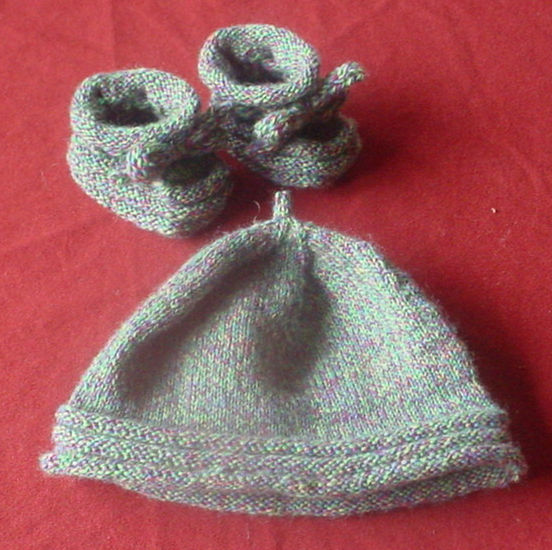
My matching hat is a simple beanie shape knit in the round, with three welts around the bottom edge to match the three welts that run around the sides of the stay-on bootie. I know that many other people enjoy making these booties, so I share the matching hat pattern here.
Baby Beanie to Match Jane’s Stay-On Booties
Materials:
50g fingering weight or sock yarn
1.5 mm (US #000) double pointed knitting needles (can be worked on 1 or two circs if preferred)
4 or 5 stitch markers
Tapestry needle for darning in ends
Gauge
9 stitches = 1 inch on 1.5mm needles
Finished dimensions
Measured across the opening, unstretched = approx. 7 inches
Notes
For the record, my hat is on the small side and should fit a petite newborn. I haven’t tried it yet, but using a 1.75mm (US #00) or a 2mm (US #0) at a slightly less extreme gauge should produce a hat for a larger newborn and 3 month size, respectively. If you want to work this at a standard gauge of 7 stitches per inch but end up with the same size hat as I made, cast on 100 stitches, and place your markers every 20 stitches. Follow the instructions as written EXCEPT that instead of following the (K23, K2tog), (K22, K2tog) or (K21,K2tog) directions instead ALWAYS knit until two stitches remain before your marker, then knit those two stitches together. I had plenty of yarn left over from my hat and booties from my one 50 gram skein of sock yarn, you shouldn’t run out even if you knit a larger hat or a hat at a less extreme gauge.
Directions
Using a very stretchy cast on (I used half-hitch) cast on 120 stitches and divide among your needles. If you are using one or more circs, mark the beginning of the row with a stitch marker for convenience.
Knit 12 rounds. Purl 4 rounds. Knit 4 rounds. Purl 4 rounds. At the end of this, counting the self-rolling bit of stockinette around the hat’s edge, you should have the appearance of three welts at the hat’s bottom edge.
Continue knitting until the hat measures 2.5 inches from the bottom. (Measure this with the curling edge curled. Don’t flatten it out.) On the next row knit 24 stitches, place a marker, then repeat. If you’re using DPNs, you’ll have 4 markers in your work, with the division point for the last one being the break between needles that aligns with the dangly cast-on end. If you’re using circs, you’ll have five markers in your work.
On the next round, (knit 23, K2tog). Do this five times total to complete out the round. Each decrease will occur JUST BEFORE a marker. Knit 4 rounds.
On the next round (knit 22, K2tog). Do this five times total to complete out the round. Knit 3 rounds.
On the next round (knit 21, K2tog). Do this five times total to complete out the round. Again each decrease will occur just before a marker. Knit 2 rounds.
On the next round knit to two stitches before the marker, then knit 2 tog. Do this five times total to complete out the round. Knit 1 round.
From here on in every round is the same – Knit until two stitches before a marker, knit those two stitches together. Repeat to complete out the round. Keep doing this until only five stitches remain on your needles. When only five stitches remain, work them I-Cord style for five rounds, then end off. Darn in both ends.
TARTS AND BERRY BIMBOS
Another descent into deadline hell for me so posts here have been/will be sparse again.
I did manage to squeeze in a strawberry tart. Made entirely from our own home-grown strawberries.

Three years ago I got one plant from a neighbor, and put it along with some lirope in the sunny side garden near our giant grass. I know that strawberries spread by runners, and between the two low, green, spreading plants, I hoping for a nice ground cover in between the roses, heather and blueberry bushes, sort of a green mulch.
The first year the strawberry plant established itself. The second year it conducted a savage land war with the lirope, which is now pushed to the edges of the area. There were a couple of berries, but the squirrels got them long before we did.
This year there are strawberries everywhere. My ground cover hopes have come true. The plants are thick enough to suppress all but the most insistent weeds. In addition we’ve got berries! LOTS of berries! So far we’ve picked about four pints. Not much by commercial standards, but enough for a nice fat tart and several breakfasts. And they’re GOOD. My girl-next-door berries are a far cry from the centerfold-bimbo ones trucked into the local market. True, mine are no where near as huge nor as pretty, but they’re intense and firm with a flavor the watery supermarket berries can’t match.
Slow going too on the Clarke’s Law sampler. I’m still working on the current voided strip. Again, filling in the background with long armed cross stitch takes longer than just working double running outlines. That and time compression are slowing me down:
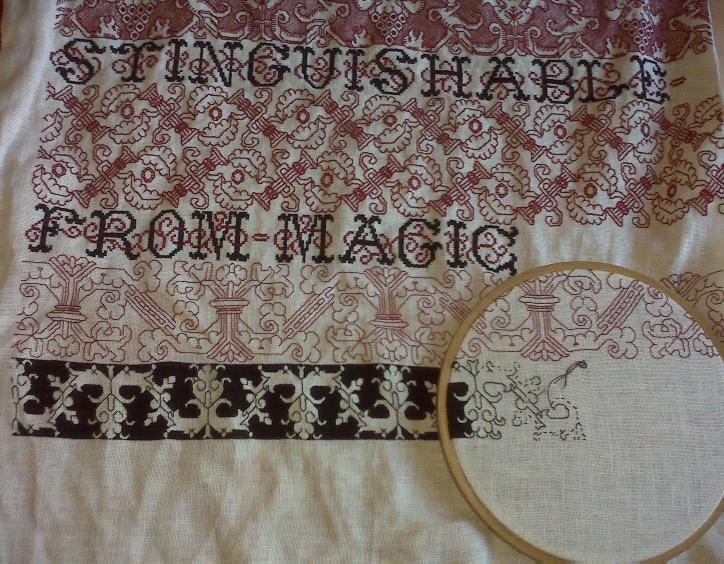
And for Karen in California, who wanted to see the whole thing so far:

This is roughly 7 months of stitching, for between 30 and 90 minutes per day (my first post in this series was back on 7 December of last year).
Next will be a very wide strip, probably worked two tone using both the red and the black together. Slightly less dark than the narrow strip I’m working now, but denser than the motto bearing areas above it, to help anchor the bottom. I’ve got a couple of candidates but haven’t decided exactly which one to do. After that it’s probably between one and three strips to finish out the cloth, depending on width of the patterns chosen, filling in the area east of “Magic” with an author attribution in a smaller font (probably balanced with a narrow strip to take up any remaining space); and doing some end of line doodles to square out the ragged right in the other text strips. Then finishing and framing. Taa daah!
PS: Thanks to adnohr. Both the Ursa and XStitch Studio programs are on my list to review, once I return from the shadow of deadline doom.
BIRTHDAY PRESENT
My sampler continues to grow. Here’s the progress on my latest strip. Filling in the background with long armed cross stitch does take quite a bit more time than does just working the outlines in double running:
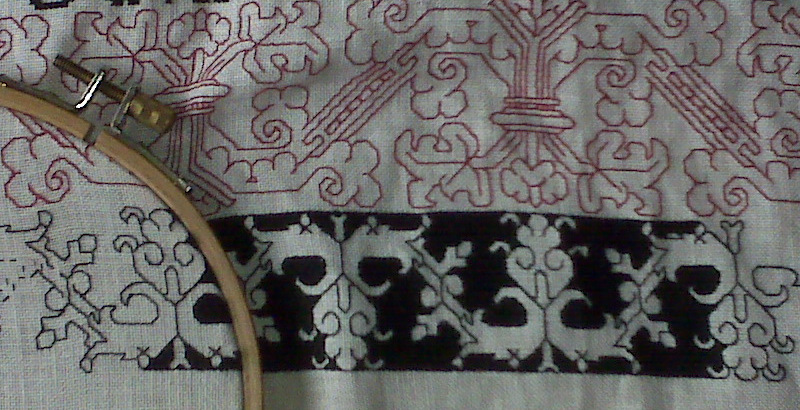
In other news, I celebrated yet another anniversary of my 21st birthday over the long weekend. The Resident Male helped me snag a copy of Lotz on eBay as my present (special thanks to Long Time Needlework Pal Kathryn, who pointed me to it).
What’s Lotz, you ask? One of the leading sources on historical pattern books. In 1933 he began the systematic categorization of all extant historical pattern books printed prior to around 1700 or so. His Bibliographie der Modelbucher is a compendium of his research and is considered to be the seminal work in the field. It’s in German, with over 100 plates of page reproductions at the back. I had used some of the Lotz pages when I graphed up patterns for TNCM, but now I have my own copy of the 1963 edition. Although I don’t read German, I’m looking forward to puzzling out the text with the help of OCR software and translation utilities, and learning more.
In the mean time, those of you who wish to see some 16th and 17th century modelbooks, I recommend Pal of Pal Mathilde’s on line linked bibliography as an excellent place to start. To be able to find some of the sources readily available on the ‘net is a wonderful thing, although doing in-person research in libraries does have the collateral benefit of seeing the book two over on the shelf from the one you were seeking. Mathilde has gathered together a selection of reproductions that are readily available (one may require retrieval of a dead link via Internet Archive).
I’m still investigating possible platforms for charting double running stitch. So far none of the commercial needlework specific packages have presented an overwhelming advantage. I’ll detail more of those trials at a later date (you can read reviews of several candidates in my posts from February 2010). I’m now looking at commercial general purpose graphics programs, including Visio, Open Office Draw, GIMP, ArtRage, ArtWeaver, Real-Draw, and others. Criteria for selection include:
-
Ability to graph VERY LARGE projects legibly on 8.5″ x 11″ paper
-
Visual breaks between consecutive individual stitches (as opposed to showing a series of many stitches as a solid unbroken line)
-
Ability to represent the background as dots rather than graph squares (to complement the visual break stitch illustration method)
-
Standard freeform capture/copy, rotate, mirror and flip tools
-
Ability to represent both line and solid unit patterns
-
Ability to vary the width of straight stitch units (to represent various thread thicknesses)
Most needlework packages handle #4 and #5. Several also do #6. The do however fall down on #1 because tend to present patterns at large scale for legibility and in deference to most modern stitchers gauge preference. It would be difficult to use those packages to graph out high stitch count repeats without the patterns overflowing onto multiple pages.
I’ve only found one package that does #2, but to achieve it I run afoul of #1, because the real estate required to represent the stitches as units is prohibitive. #3 is alien to everyone. I appear to have invented that method of presenting counted thread stitching when I doodled up TNCM. It worked, and I’d like to use it again (with edge notation on count), but it appears that the only way I’ll find it is to figure out how to do it again on my own.
PUBLISHING AGAIN?
The latest strip:

I’ve been alternating red patterned panels and lines of black lettering. I’ve run out of lettering, but I’m keeping the red-black-red alternation. This one is also from the V&A 14.931 sampler. I’m working the foreground double running stitch using a single thread of DMC 310 black, and the background in long armed cross stitch using two strands.
I’m having way too much fun with these patterns to stop. I’ve been talking about a sequel to TNCM for years, but now I’m engaged in doing it. I’ll be resuming my search for a decent charting program (or general purpose graphics program) specific to the needs of legible presentation for double running stitch. And given my horrible experience with the publisher of The New Carolingian Modelbook, I’m looking into other options, in specific – the feasibility of self-publishing, but I know very little about the various web-based micropublishing alternatives, but I’m open to all concepts. I do know that for this type of book paper copies are still valued by most. I don’t believe that there’s a critical mass of stitchers out there yet who would make use of an ebook stitch reference when hard copy sits so quietly in one’s workbasket without consuming batteries.
I’m also considering different formats. The last book was a 200+ page compendium of patterns, with lots of appendices of various sorts. I don’t think that’s necessary this time out. Other options exist. Shorter booklets or broadside sheets for example lend themselves more easily to web-based publishing both for the issuer and the downloader. Pricing is also problematic. The income stream this would represent is quite small, and the burden of record keeping as a small business for taxes is immense by comparison to any possible profit (discounting entirely the major effort involved in creating the work itself).
So I put these question to the few folk who visit this place and who I presume might be interested in such a thing:
1. Would you be interested in a sequel to TNCM?
2. Would you find ebook format (meaning to be read on a book reader or iPad) useful?
3. Would you be open to receiving a print-your-own PDF rather than bound paper?
4. What length book would you consider worthwhile – a leaflet of 20 pages or fewer? A booklet of 21-50 pages? A small book of 50-100 pages? 100+? (Bearing in mind that content for a 100+ page book would take a while to compile).
5. Any suggestions for publishing options aside from self-created PDF download via wiseNeedle, or commercial services like Lulu, iUniverse, or Etsy? Any cautions on the commercial service route?
6. Would you object to a higher proportion of original and adapted patterns mixed in with exact stitch recreations, so long as all patterns were documented as to origin and modifications (if any)?
7. Anything else you want to see in a book of patterns of this type?
 String-Or-Nothing
