ADVENTURES IN LACE – CORRECTING HISTORICAL LACY KNITTING PATTERNS
First, let me reassure everyone that it’s not my intent to supplant the need for the books I’ve been using lately. I strongly recommend that people interested in lacy knitting buy them, and have as much fun learning to knit from them as I am having. But I also realize that it’s very daunting for many people to think of picking up a book in a language they don’t read, that uses an unfamiliar symbol set, and that can be full of unexpected differences from modern knitting logic (to the point that would be thought errors in modern books.) Mining these older works for usable ideas is a form of Extreme Knitting* – one that I want to encourage more people to try. I hope these posts help bridge some folk over to beginning their own explorations.
For example, here’s another lace redaction problem that turned into a paddle in the lace design pool.
I intended to finish out my black lace doodle scarf with an edging appearing in the same book as the insertion strip I modified for that scarf’s body. But the graph of the original isn’t quite logical, especially when compared to the engraving of the finished item. The edging I originally intended to use is on page 12 of Knitted Lace (Kunst Stricken) by M. Niedner anf G. von Reden (edited by the Kliots).

If I flat transcribe each of their chart symbols into modern notation, I get the chart in the diagram below (click on it to make it bigger).

Although the chart looks good, it’s not knittable. Not if you want to make an edging that looks like the one in the engraving. Why? Look at each graphed row. If you count up the increases (the YOs) and the decreases (ssks) you quickly find that there is an equal number of both in each row. That’s perfect if you’re doing a straight insertion with parallel sides, but this is supposed to be a dagged edge that grows and shrinks to make triangular points. In order to achieve the ragged left edge indicated the stitch count should increase or decrease each row. But you say – it does! The little points are being formed. MY point is that there is no indicated origin for those extra stitches. For Row #3 to have one more stitch on it than Row #1 as shown, there should have been an increase without an accompanying decrease on Row #1. Otherwise that stitch just appears **poof** without a logical point of origin.
Now, if we want to knit this edging, we need to add that missing stitch. In fact, if you look at each and every line of the pattern you’ll see that there’s either a missing increase or decrease on each illustrated row. We need to put them in.
There are several ways to make those corrections. The simplest is to leave out one strategically placed decrease somewhere on the “growing” rows (working the two stitches involved as plain knits); and to introduce one somewhere on the “shrinking” rows (working two stitches shown as being knit as a decrease). Another fix would be to make up the differences on the interstitial even numbered rows. A third method would be the most noticeable – incorporating the corrections as visible additions to the pattern, in effect, editing the pattern to introduce new eyelets or decreases to form a new design element.
Now. Where to put them? Again looking at the original graph, you’ll see that the only area that changes is the part I marked in blue on the original chart (the original didn’t differentiate these stitches in any way). Other than growth/shrinkage in that triangle area, the pattern is stable, alternating between two design rows – the unshaded area shown on Row #1 (repeated on 5, 9, 13, 17, 21, 25, and 29) and the unshaded area shown on Row #2 (repeated on 7, 11, 15, 19, 23, 27, and 31). Obviously all of our edits will have to take place within the blue shaded area. Even with those edits, the heavy reliance on only two pattern rows means this will be an easy pattern to memorize once we’ve noodled out the missing bits.

I began experimenting, although I fizzled out along the way, having lost enthusiasm for using this particular trim. But I did produce a workable solution. It relied heavily on the original chart, modifying some of the decreases on the growing rows and adding some on the shrinking rows:

As you can see, while my yarn choice for this swatch isn’t optimal (something lighter would conform better and shape itself more fluidly up and over the triangle’s point, it did work. It also looks pretty close to the original. But not spot on (more on that below).
I tried mightily to make the mods on the off-side rows piece work. In theory it sounded feasible. It would have worked, had there not been the flower-like quad eyelet structure in the point of the base triangle. Adding/subtracting stitches at the right edge (the straight edge) perturbed the placement of the eyelets and lost the symmetry of the feature. Putting those additions/decreases elsewhere by adding/subtracting stitches along the pointed edge of the base triangle produced a clunkier, more clumsy finished product than did working them in on the right-side row.
I have to admit, I didn’t bother with the increases as a decorative element step. To do that I’d have had to widen the pattern as a whole, and introduce a YO after the slipped stitch on each odd numbered row. On rows 19-31 I’d have had to follow that YO with a double decrease (removing one stitch to compensate for adding the YO, plus the one stitch needed to shrink the base triangle . Contemplating the result of the second scenario above made me think that this arrangement would also run afoul of that quad eyelet flower. Between that and realizing that this pattern wouldn’t be a good compliment for the design of my scarf’s body – I ran out of enthusiasm to keep fiddling with it.
Oh. The final straw? Examining the pattern chart, the engraving of the pattern and my knit sample, and realizing that the chart as shown (and that I knit – more or less) wasn’t the same as the engraving. That clearly shows four courses of eyelets, not three, plus two rows of crocheted picots. The picots I can forgive, especially since I can noodle out just enough of the blackletter-style German text to determine that instructions for it were included in the prose. Here’s the chart for my successful result, plus a posited modification to produce the four-course pattern shown in the book’s original engraving. I haven’t actually knit up the lower chart yet, but it should work.

I’ve run into these problems several times in these older pattern collections – both the lack of correspondence between chart and illustration of the final product; and basic charting that doesn’t produce the desired result. I’ve found it’s always a good idea to proof the rows in a pattern – especially one from a historical source – before sitting down to knit, and if knitting from an unproven vintage source, to always swatch up a repeat or two before committing oneself to a full project in any given stitch pattern.
Oh. What did I end up using on my doodle scarf? More on that another day.
*Extreme Knitting – A mythical book I long for instead of what’s on the shelves now. A compendium of highly challenging patterns in lace, colorwork, garment shaping and tailoring, tiny gauges, historical recreation/redaction – whatever, so long as each project is as magnificent and as timeless to wear as it was an inspiration and learning experience to knit. I hereby reserve this title, but will surrender it to any author who can prove his/her work meets these conditions.
RAVELED?
We’ve done science this week, why not science fiction, too?
How about sock puppets in space? With luck this opus sheds light on one of life’s eternal mysteries – where that second sock really ends up.
KNOTTY PROBLEMS
Science once again catches up to knitting. This article from Live Science details some recent advances in knot theory – a discipline that examines the rules, topologies and probabilities of physical tangles. It’s actually a useful area of study. There are lots of areas ranging from biochemistry to materials sciences that would benefit from a better understanding of what happens when filaments, proteins, or fibers touch. Still, it’s hard not to say “No kidding!” when faced with some of the observations listed in the write-up:
- It is virtually impossible to distinguish different knots just by looking at them
- “Surprisingly little disturbance or motion is even needed [to generate knots]”
- “A highly flexible string placed in a very large container will have a
higher probability of becoming knotted than a stiff one that’s confined
in a smaller container.”
I can now officially classify my knitting bag as an Official Basic Science Research Laboratory. Perhaps I can apply for grants to fund further exploration of the phenomenon.
WOVEN DIAMONDS – RUFFLES ON A POT ROAST?
Shawl. Unpinned, spread out and patted flat. My final size prediction was spot-on.
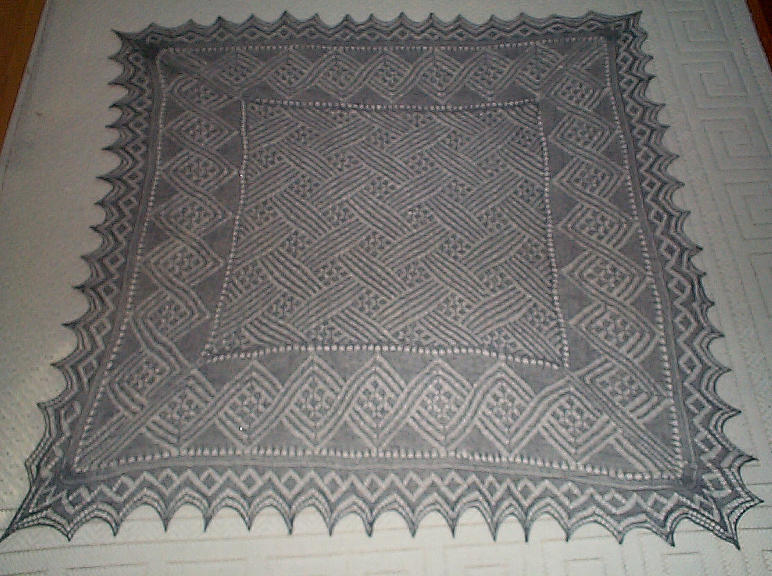

As you can see from the before picture – blocking lace is A Good Thing.
Now only one challenge remains. Where the heck would I wear such a thing? I’m not a shawl-wearing type person. They tend not to go with work boots, jeans, and polo shirts (my standard uniform). Which is the origin of today’s title. Name for the shawl itself? “Woven Diamonds” has been suggested.
It has also been suggested that I publish a real pattern for Woven Diamonds. I’ve got working notes and I’ve already charted the stitch designs, but writing up a full pattern would be a challenge. For example, describing how to fudge the ease around the corners on the edging, or how to do the final graft – neither would be easy. Given that I wouldn’t recommend this as a first lace project, I’m unsure how much previous lace experience I would have to assume any knitter would have.
Would you make such a thing? What level of detail would you need in a pattern?
SHAWL BLOCKING
I stole a bit of time today to get my brown/gray shawl pinned out and blocking. Lace is INCREDIBLY stretchy – or at least if knit from a good wool, alpaca, or other animal fiber – it should be. Here it is in an optically challenging presentation thanks to the rally check sheets I use as an alignment aid:
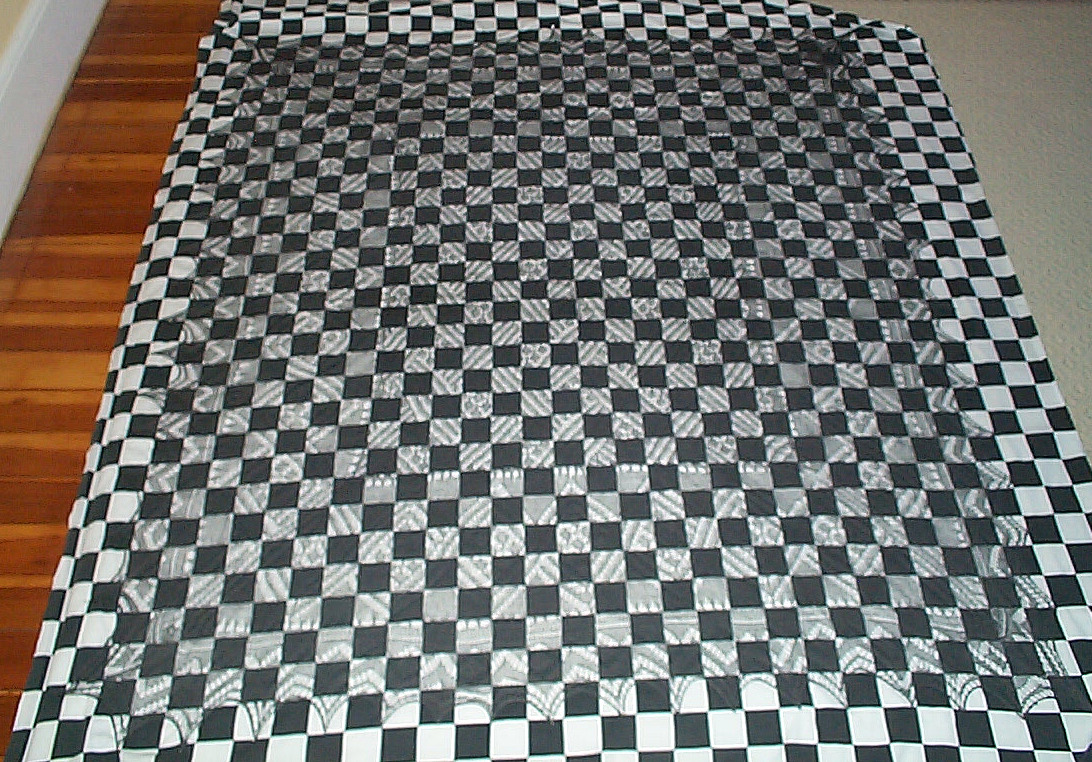

The checks make it very hard to see, but you can make out a bit more of the pattern now in the detail shot. I promise more pix tomorrow, and I’ll take those on a plain white background.
Now how stretchy is lace? My unblocked piece was approximately 39 inches across. See those checks? They’re 2 inch squares. My shawl is pinned out to be a square of approximately 60 inches on a side. My guess is that it will spring back somewhat after it’s dry. I’ll probably end up with something closer to 54 inches on a side (about 4.5 feet across).
We also made significant progress on the final stage of our bathroom renovation this weekend. Here you see The Resident Male exercising his inner artist. Before you write to me with safety tips, please note that we’ve got about 2 inches of closed cell camping mattress pad topped with another layer of bath towel underneath the no-slip tarp in the tub. The ladder is stable, and won’t mar the surface beneath its feet. Plus the ceiling is so low that no one has to climb above the second step to reach it.

As to the color – I don’t know if you can make out the difference given the variability among monitors, but the ceiling is bright white, and the walls are barely green. Not mint, not pistachio. Think three gallons of milk with one drop of food coloring. It’s my hope that they will contrast nicely with the white tile underparts and fixtures, echo (just barely) the green tile accent stripe, green stone sink top, greenish tint of the glass shower door, and make the green (rather than the yellow) in the stained glass window pop out more.
Even though it’s shrouded in protective plastic, you can see that the refinishing of the window and its replacement in the wall have both accomplished. A special merit badge for chemical management (with scrapers rampant) to he who did that work. Goodbye ugly mustard yellow enamel paint! And good riddance.
Comments Problems
We’re having intermittent problems with the comments feature that screens out automatic postings. Sometimes if you go to enter your comments the little “type what you see here” box isn’t displaying. If you want to leave a comment please scroll down and make sure that you can see that box before you begin typing. If it’s not there, try reloading the screen. We’re not quite sure what’s happening, although we’re working on it. When he’s not elbow deep in brushes and rollers, The Resident Male (website plumber par excellence) is busy applying his biggest software wrenches to wiseNeedle’s pipes. Apologies for any/all inconvenience.
WHAT BIRD?
This little fellow is fluttering in distress on my back porch. He doesn’t appear to be injured, but his behavior is that of a bird that’s been hurt – tolerating people walking close by, and flat out panting in fear.
He’s small – smaller than a house sparrow, and distinctly greenish above. The eye stripe and the crown are sharply defined gray with a faint black line around it. The eye is brown, and the bill is something like a sparrow or tiny vireo. And the feet are sort of blueish.
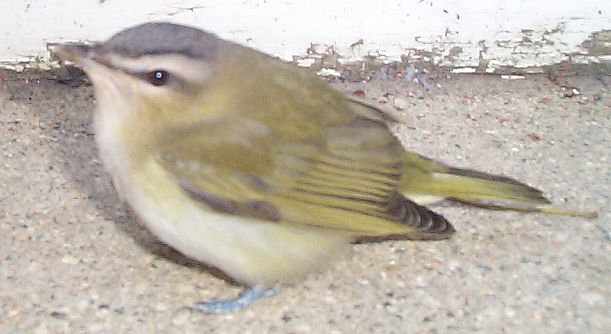
We’ve got no place to bring him, nor do we wish to cause further harm, so we’re leaving him alone for now. But I’ve not seen a bird like this around here before. For the record, we’re in the Metro Boston area, a close-in suburb to the northwest; inside Route 128.
Leafing through bird books and on-line references, but I don’t see anything that has the gray hat and mask, brown eye, olive upper part and cream breast. But this might be an immature bird not yet displaying its final colors. Any birders have an idea on what our little refugee might be?
UPDATE
Special thanks to Sally, who identified our little flutterer as a Philadelphia Vireo. We kept watch against cats (from a distance), but otherwise didn’t bother him or go near him. About an hour and a half after he was first spotted on the ground he shook out his wings and zipped up into the trees. Given the range reported on the bird ID link page Sally provided, he’s just passing through on his way down to the tropics somewhere. I hope he makes it.
CASHMERE LACE SHAWL – FINISHED!
Lead a Horse to Water Department
Reminder – every NYT file I posted a link to earlier this week is free-for-view to people registered at the New York Times website. I didn’t pay a cent to look at any of them. If you are getting a paid access message it means you are not logged in. Go to the main NYT page and register. It’s free. I’ve been a member since the site went live and not once in all that time have I received spam traceable to that source.
Cashmere Lace Shawl
It’s done! Here it is in the not-so-harsh light of a cloudy morning, unblocked but patted flat on a white rug:
It measures approximately 100cm (39 inches) square in this state. I’m sure blocking will add another couple of inches as it stretches. Some detail shots, too!


The patterns were adapted from charts appearing in The Knitted Lace Patterns of Christine Duchrow, volumes I and III. I’m pleased with the way my corners worked out. They’ll display better under blocking, but the designs meet up at the corners without truncation. The edging is a bit narrow to be in proportion, but I think that blocked it will also display better.
KNITS OF THE TIMES
Several small developments on this end. First, I’m up to the final corner on my gray/brown shawl. One more night’s knitting should put it to bed. Then it gets added to the ever growing to-be-blocked pile. Second, I’ve decided I should take personal steps to decrease the “overweight, middle-aged women who knit” demographic. Since I can’t do much about the passage of time nor do I have any intention of abandoning my hobbies, I have embarked on an exercise program. I won’t speak about it again until it produces some sort of result. Third, the bathroom renovation is now in its final step – painting. I’ve spackled, sanded, and washed down the walls. I’ve cut in the corners with primer, and am about to roll the walls and ceilings with that base coat. After that comes white ceiling paint, plus a white tinged with green for the upper parts of the walls above the railroad tile. Pix when I’m done.
For the meat of this entry, last week the New York Times announced that it was throwing part of its archive open for free access. People who have registered with the site (a painless, no cost, and non-spam-generating process) can view most articles prior to 1928 or so, plus a subset of articles after that point without paying. Needless to say, I took advantage of the opportunity to see what early knitting-related material might be there.
The New York Times was never noted for frivolity and never ran a crafts or continuing women’s interest column that published needlework interest items, therefore it’s not surprising that I found mostly business- and war-related knitting articles. I found quite a bit of interest to textile historians – accounts of mills opening, burning, and closing down (all very common); reports on inventors or new processes; documentation of poor working conditions and worker exploitation. I did find some fashion commentary for both home and personal wear; but more on war knitting, describing materials distribution, yarn and needle shortages, yarn rationing (and the resulting protests), and famous people knitting for the cause. Amid all of this were some scattered patterns and knitting trivia.
Here are some of the most notable. Remember though that these are all written in the vernacular of their times. Few are ready-to-knit in the modern sense, but experienced knitters with a bit of perseverance should be able to make sense of most of them – especially the how to knit socks for soldiers piece from 1914. All are in PDF – remember you need to sign up with the NYT website to view these:
A human interest piece from 1908– warning of the dangers of knitting on trains and buses. Amusingly enough, I’ve seen this very same story repeated as a gentle caution against knitting on planes. Perhaps this is the ur-source of an Urban Legend.
Patterns from 1883 – includes knit over gloves intended to be worn over kid leather gloves for extra warmth that uses #16 needles (in between a modern US #00-#000 or 1.75 and 1.5mm); a simple lacy shawl knit on #14 (modern US #0, metric 2mm); and baby booties (also on #16s); and a sock using fine wool that looks like it starts mid-pattern – this last one may in fact be directions only for the heel. I’d need to experiment to confirm.
Fancy ornamented knitting accessories are nothing new. Silver plated and brass straights with fancy charms or jeweled button ends were offered for sale in 1917.
For Civil War period re-enactors and historical needlework buffs – a pattern for Soldiers’ Mittens with a separate forefinger from 1861 (aka shooters’ mittens). From the number of stitches cast on I suspect these can be worked from sport weight yarn today.
Again everything old is new again – carpal tunnel syndrome as a result of writing, sewing and knitting –described in 1882.
How to Knit Socks for Soldiers, 1914. Mrs. De Lancey Nicoll presents comprehensive prose instructions on sock knitting in excellent detail because “The trouble with American Women is that so few of them how know to knit socks. Practically only the foreign-born women know how.” Surprising because today we think that everyone in the past knew these skills. Excellent beginners instruction in sock knitting (and in period terminology), these socks are standard 5-needle top-down socks with a drawstring toe, calf shaping, and a gusseted heel, worked on size #14 needles (US #0 or 2mm). They start at 80 stitches above the calf, but narrow down to 60 at the ankle, making them dead on for modern fingering weight yarn and a fit close to contemporary socks. Plan on at least 200g of sock yarn to make a pair of these. Probably a bit more.
War work, this time from 1917. The illustrious Mrs. Leeds offers up patterns for knitted sleeping socks (#12 needles, around modern #2 or 3mm, but the 84 stitches around make me want to work this pair on #000s or 1.5mm). Also two crocheted scarves – note that worsted is not a yarn weight descriptor for these, instead it specifies a twisted multi-plied long fiber staple yarn of high quality. I’d use a light fingering weight or 3-ply baby yarn. Directions also for an abdominal band, and two knitted helmets.
Official Red Cross patterns for war knitting, also from 1917. Again Mrs. Leeds – the knitting and crochet instructor for the Atlantic City Red Cross – is mentioned. This collection includes wristlets, a trench cap, knee caps, a sleeveless jacket (pullover vest); a helmet, muffler, and jacket. There’s also a bath mitt, eye bandage, and crocheted hospital stockings.
1917 war knitting again – a plea for knitting to comfort sailors. This includes cursory directions for sleeveless jackets (vests), wristlets and mufflers. These three garments were considered a set. The article points out that each battleship requires 500 sets of these garments and each submarine, 20. This article, also from 1917 also mentions the Navy sets, and offers Red Cross directions for an abdominal band.
From 1915, the most curious piece of war knitting I’ve ever seen. Invented by a French doctor, the “Multipurpose Garment” that appears to be a loosely knitted body-wide strip with a head hole. The idea is that it can be used or worn in several ways: flat as a comforter; or with the sides laced up in various manners, making the thing into the equivalent of a sleeveless vest, an upper body cropped sweater, or swathed around as an odd looking combo abdominal band/balaclava. This may be worth knitting up just to see what it looks like.
Embedded in this 1910 women’s column is a cursory description of a crocheted afghan – long strips of plain crochet, joined with openwork.
From 1911 – cursory directions for a striped knit afghan, in a women’s interest column that also warns about the dangers of diet pills.
And finally a cast-on hint from 1907 – use bigger needles when you cast-on.
I hope someone finds these bits entertaining and useful. If you attempt to knit from any of them, I’d love to hear about the result.
SHAWL PROGRESS AND FUTURE LACE CHALLENGES
Progress on my shawl!

I’m finishing up the edging along Side #3, in preparation for Corner #3. Then it’s the mad dash along the final side. It’s taking a little over week per side, so I expect to be done by the end of next week. Then the sorry thing gets added to my blocking pile, which has itself become an embarrassment.
Now is the part of any project that I find the hardest. No new challenges, just more of the same, with the siren call of other things beckoning me away. For example, there’s the Resident Male’s Galaga hat. I need to finish that before cold weather sets in. And the quickie strip scarf out of black Merino Lace. That was begun as an interim project until I could finish the big shawl. There are other half-finished things from The Chest of Knitting Horrors(tm) that I really need to finish, too. Like my dragon-skin Rogue. Older Daughter is looking pained about it.
But (and I’m sure my fellow flitterwing knitters will understand) there’s something that’s calling to me. In the back of the Duchrow #3:
there are six hand-drawn charts included as an appendix. They’re not well documented, and use slightly different symbols than the more formal repros in the rest of the book. The key and few accompanying notes are not only in German, they are a medium-quality photocopy of the pattern author’s hand-written script. That makes them very difficult to decipher, especially considering that I don’t read German. Marginalia names the author of the appendix charts as Gertrud Weywod, a “contemporary of Christine Duchrow.” I’ve done some cursory searching for more info on her, to find out if anyone else has worked these patterns up; and to see if any of her work was ever published professionally in her own day. So far, I haven’t turned up anything, but again – I can’t read German and don’t have access to much in the way of German-language libraries. If you’ve heard of this pattern author, please let me know. I’m itching to find out more.
As you can tell, these patterns fascinate me. Several are floral rather than geometric, and most of them are very complex. One of the simpler ones reminds me strongly of some double running stitch and counted band patterns from patternbooks published in Germany in the 1520s.
I think I’ve deduced what most of Weywod’s graph symbols mean. Using those assumptions I’ve translated one of the graphs to modern notation. I’m proofing it now – doing the calculations to see if given each row’s stitch counts, increases, and decreases, whether or not my assumptions are knit-able. I’ve also got some lovely sage green laceweight – another gift from Friend Dena. So it’s pretty much a given that by the middle of the fall, I will have fallen to a new challenge, and will be hopelessly fuddled working out the Weywod patterns.
But first I have to finish my shawl, and that hat, and all that blocking…
CASHMERE LACE SHAWL – EDGING
First some administrivia. This site has been under massive attack by comment and trackback spammers. As a result, we’ve totally disabled the trackback feature, and limited comments to the most current three months of entries. We have also instituted a protected comment system to prevent automated spammers. But since the crowd that visits here doesn’t appear to be particularly chatty, that shouldn’t be a problem. We’ve also updated the software that runs the infrastructure of the blog. Whenever a set of changes of this magnitude is undertaken, it’s going to take a few days before the bugs are ironed out. Apologies if you tried to consult these pages and received error messages. We’re working on the remaining nits as fast as we can. Special thanks to The Resident Male – website plumber extraordinaire for the hours he’s put in wrestling with these issues.
In the mean time, knitting here continues. Friend Dena was amazingly generous, giving me more of the gray/brown laceweight (also lots of other goodies destined for some more over the top lace projects). Ten thousand thanks! Armed with more yarn, I’ve been able to work more on the big shawl. I’m rounding the second corner and on the back stretch. No pix today though. It looks much as it did last week – a frothy gray/brown object too unblocked to see well.
It turns out that this blog serves a major purpose that I didn’t really appreciate. I am not good at cataloging what exactly I do as I fudge my way through a project. I was careful to note the pattern and mechanism I was using for the framing area of my shawl, but I hit on the edge pattern during the time I was stretched thin and didn’t have time to write up entries. Therefore I didn’t make a written note of where that edging pattern came from and what I did to adapt it for this piece. Since I also set the shawl aside when I ran out of yarn, I had lost my thread of continuity on it. It took me a couple of days before I located the edging that I was using and figured out what I had been up to. It’s from the first volume of Duchrow reprints compiled by J. and K. Kliot:
I now present it here as much to keep track of what the heck I’m up to for myself, as for others to play with. The pattern I’m using appears on Page 35. The original stumped me a bit because I couldn’t make the last three stitches work out correctly. According to the book, every row should end with a SSK, K2 – but I find that working the “uphill” side of my triangular dags, I have room for a plain K3, and on the “downhill” side as the dag narrows back, I have room for a K2tog, K3 – but need to cheat, working the first stitch on the wrong side return row as a P2tog to preserve the visual line of the narrow strip at the outer edge of my border.

The pattern page (click on image above to get a readable version) presents both the original from the book, translated into modern notation; and my adaptation.
 String-Or-Nothing