MORE LACE LOOMING IN MY FUTURE?
Small progress on several fronts. First, I’ve finished the knitting on my red doily. I have done the ceremonial breaking off of the yarn, and am up to the grafting part. I will begin that tonight, possibly even documenting it with photos, if I can find a willing volunteer photographer in the house. I will also try to get to the blocking of both doilies this weekend, although pre-holiday preparations and work may intrude.
On the website front, our resident technical wizard is fine-tuning some aspects of the site and boldly slaying bugs. Comments should now be working properly. I have put some pointers on the old String site’s most popular pages, redirecting folk over here, so with luck some of the people who link to those pages will notice and make corrections before those pages go dead. I’ve also started to answer the backlog of questions on the advice board, add more of this season’s yarns to the database, and to learn Wiki syntax. I’m plotting out the KnitWiki structure right now, diagramming hierarchies and interrelationships on paper. Suggestions for areas not to miss, or for how content would be most usefully organized are most welcome.
In addition to all this stuff going on (plus heavy deadline pressure at work) I still haven’t worked the lace bug out of my system. I’m not quite sure what will be next up. I’ve got a ball of lace-weight linen in a natural ecru. It’s two-ply construction, with a small bit of thick/thin and linen slubbing going on. I got it at the one Maryland Sheep & Wool festival that I went to, circa 1996. For solid sections, it looks best on 1.75 or 2mm needles, so I suspect for a bit lighter, lacier look I’ll move up a size or two. Not quite sure of my yardage, but whatever it is, that’s all there is. I’m thinking of messing around and making something up, combining lacy stitches from Hither and Yon (two of my favorite sources), adding an edging, and ending up with something wearable. Perhaps a medium-sized rectangular or square scarf, able to be worn as a dress accessory (there’s not enough there for a huge shawl). One minor complication that should work itself out – I have misplaced my copy of Heirloom Knitting. I used it last when I was selecting the edging for the second red doily. The one I used came from its pages.
Or I might do Eunny Jang’s Print o’ the Wave Stole. She’s already worked out a simple layout using a traditional Shetland pattern and companion edging. The Print o’ the Wave design itself is visually complex, but very easy to work, with a logical 12-row repeat. Eunny has also done an excellent tutorial on lace shawl construction. The series goes on from the one on shawl construction (links are on the right hand side of her page) and includes a highly useful round-up of lace-knitting cast on techniques.
DPN AIRLIFT
I sheepishly admit I whined in public and was so pitiful that someone took pity on me.
I’ve mentioned here many times that I am probably the last person on earth who enjoys using DPNs, and adores the extra-long DPNs more commonly found overseas than here in the US. The whining was that extra-long DPNs are hard to find here. Judith from the UK had a stash of them, collected over many years of happy knitting. She recently moved over to circs, and her collection of long DPNs languished. So she packed them up and sent them to me!

Here you see her collection, ranging from 4 to 6.5mm (US#6 to #10.5), displayed on the converted-from-jeans denim skirt I’m sewing with and for my daughter. Since no good deed should go unpunished, a suitably splendid gift in return is being boxed up for shipment back to Judith. Ten thousand thanks to her again. I’ll have lots of fun with my new needle library!
On the skirt, who knew they’d come back into style? I wore them in the mid-1970s, and made dozens for my friends. I even have a bit of blurry, faded photographic proof from that era (let’s just say my lack of camera skills runs in my family):

Now I find my skills are in demand again as converted skirts seem to be the rage with my daughter and her set. Even though it’s not knitting, if anyone is interested, I’ll diagram out how to go about doing it. With the top, and jean jacket I described before, the ensemble reaches counterculture nostalgia critical mass, just in time for cold weather.
HALLOWEEN APPROACHES
Quick aside: I don’t know about you, but a small window onto a whole new universe of costume options just opened up for me and mine today. Too funny!
CAUGHT UP
Finally.
I’ve caught up on the by-hand port of last month’s entries from the Blog City incarnation of String or Nothing. I’ve copied over comments, too. It was much easier to do this for the months prior to June. In June BC changed their blog back-up methods, and stopped offering XML exports. Earlier stuff we were able to (mostly) automate, although there will probably be some links here and there that need to be replaced. My premium Blog City account will expire at the end of November. At that time all of the photos there will disappear. Shortly after that BC will probably pull the plug on the account proper, as I will no longer be posting anything new over there. If you have links that point to entries there, please take a moment and use the search page here to hunt up the comparable entry in this location. Otherwise your links will go dead. I’m afraid I can’t contact each of you individually (Google says there are thousands of links to String pages out there), so apologies on this blast notification.
I’ve also caught up on entering the backlog of yarn reviews and advice board questions on wiseNeedle proper, although there are lots and lots of advice board answers that remain to be written. Feel free to pitch in and answer fellow knitters in distress. Even though in some cases the questions themselves are no longer “shelf fresh” future knitters with similar queries will benefit from our assembled knowledge on file.
Aside from getting back to a semi-regular schedule of semi-regular postings here and updating the yarns database with as many new season products as I can find in catalogs and on-line listings, the biggest rock remaining to roll is our KnitWiki. I’ll be dividing my time between blogging and structuring that resource. Lots of reference material that I have posted on String will end up over there Plus there are books and books worth of other articles to create. But first I have to do the basic tree structure type index that ties the whole thing together. Everyone needs a hobby…
Doily progress? Here it is (click on pix below to enlarge):
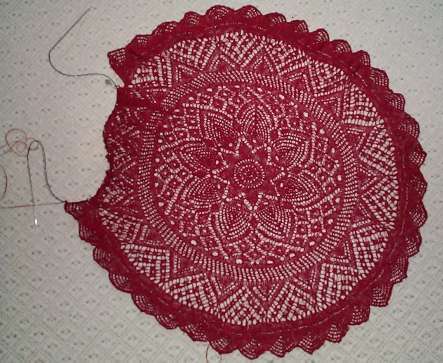
As you can see I’m pretty close to finishing my edging. I estimate that by mid-week I’ll have completed it and grafted the seam.
Other than that, a hearty welcome to the ten people who have followed me here from Blog City. With luck and time (plus getting the word about our relocation out), the rest of String’s regular audience will find this spot, too.
KNIT-ON EDGING FOR DOILY ON STEROIDS
[Repost of material appearing on 1 September 2006]
I’ve been too busy to blog in the morning, but not too busy to knit at night. I had mentioned before that I wasn’t all that pleased with the crochet edging of my smaller red knit doily. The reason harks back to the original difference between knitting and crochet – the thickness of the stitches formed.
In needle lace, the stringy bits that connect more opaque sections are called “brides.” In knitted lace those bridging units are very slender, often only one or two thread thickness equivalents. By contrast, brides formed by crochet chains are by crochet’s own nature a minimum of the equivalent of three thicknesses of the base thread. While most people aren’t phased by this, I prefer not to mix crochet and knitting unless I’ve ironed out the thickness difference between them. One way I do that is to knit with two strands, but do any accompanying crochet with one. More on this another time, when I’ve got a solid combo project to play with. Back to my doily.
It’s grown. It’s now the size of a small tablecloth or large centerpiece. I estimate that it’s about three feet across, including the edging. Give or take for blocking. Yes, I did say edging. I decided to use a knit-on edging in place of the simple crochet finish. So I am in the middle of doing just that:

As you can see, I’ve chosen a pretty simple traditional Shetland-style edging, and I’m knitting it right onto the live stitches of the piece’s body. I picked something that echoed the alternate YO/decrease texture used elsewhere, plus something that was relatively visually dense compared to the previous patterned band (that one had lots of double YOs, so it looks quite airy compared to the rest of the piece.) So far things are going pretty well, but rather slowly. The airy band had 17 full repeats of 33 stitches around the circumference – a total of 561 stitches. MATH UPDATE: My lace edging is 28 rows per point, and “eats” 15 live stitches in the attachment process. 37 repeats of my edging is about 555 stitches. That leaves 6 other stitches to be randomly consumed, evenly spaced around the piece. I’ve completed about five of the edging’s gazillion repeats so far. (That’s what I get for writing about this stuff when the actual knitting isn’t to hand. My every-other-row attachment scheme eats half as many edge stitches as there are rows in the repeat.)
Now what do I mean by “eaten?” Simple. To start this edging knit perpendicular to the doily’s body, I used a half-hitch cast-on to add stitches to the end of my left hand needle – the same circ that I just finished using to complete the doily’s body. I worked a wrong-side edging row back, purling together the innermost of my newly cast on stitches along with one of the live stitches from the doily’s body. One eaten. Then I did a right side row, proceeding out from the edge of the doily’s body to the outermost edge of the lace strip I’m adding (the edge that forms the outermost zig-zags). On the next wrong side round I worked across my newly added strip, purling the last new stitch along with the next stitch of the doily’s body.
I continue in this manner, attaching the live body stitches to the growing strip of edging. Every now and again (most notably on the shortest row of the edging’s repeat) I “eat” an extra stitch by purling that last wrong-side row stitch along with TWO body stitches.
Clear as mud?
SNOOD STAGE
[Repost of material originally appearing on 28 August 2006]
As you can see, I’m up to giant snood stage, where the piece is larger in circumference than the circular I am using to knit it. Since I am loathe to spread it out onto two needles just for a photo opp, you’ll have to bear with me:
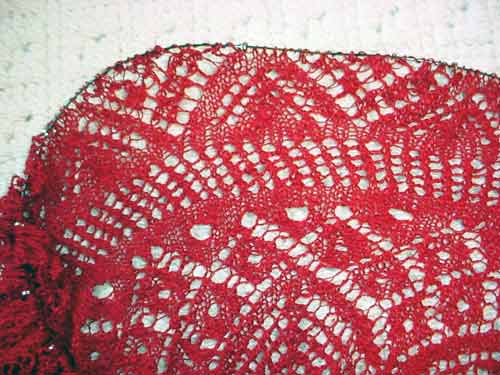
As you can see, I’m past the area that contains the center star, and past the (very boring) stripe of plain old diagonals formed by an infinitude of SSKs and YOs. I’m up to the outer ring of patterning, about three rounds from the end. Plus or minus. While I finished the last piece off with crochet, I didn’t like the look. This piece, at roughly 20 inches across right now pre-block, is just big enough to be a mini-tablecloth for a tiny tabletop. Big enough to show off an edging. So I’ll probably end off with some sort of knit-on edging. Exactly what, I’m not sure. But I’ll figure that out when I get up to it.
In the mean time, I can report perfect accuracy on this pattern, and the probability that I’ll knit more from the same booklet. Perhaps a lace collar. I’ve got a boughten black top with a jewel neckline that would be killer with an antique-look white lace collar. Either that or I’ll figure out something lacy to do with some spectacular blue fingering weight I bought from June…
This lace stuff. It’s addicting!
INSPIRATION FROM ANOTHER TIME
[Repost of material originally appearing on 25 August 2006]
Like socks? Ever hear of the socks shown at the Great Exhibition of 1851? No? You’re in luck. The Victoria and Albert Museum never forgets. Their collections are now searchable on-line. A bit of poking around brings up this set of images, socks from that very exhibition, when all things Scots and the latest advances in machine knitting were the rage.
Now don’t poo-poo machine knitting. Sock machines of that time required quite a bit of hand manipulation. How about these socks – stockinette, with some openwork, finished off with hand embroidery, from the early 1840s?
Socks too mundane? Contemplate Sara Ann Cunliffe’s exquisite cotton lace baby gown, knit sometime in the late 1800s.
White cotton lace knitting too late for you? How about a brilliant 17th century silk and silver brocade jacket, with a thumbnail opinion that it was probably knit on needles and not a frame. What do you think. Cut and steeked? I think so. Even at 17 stitches per inch, I’d love to make one…
Looking for wool? How about an early 1800s baby ensemble that looks like it inspired Debbie Bliss.
There’s 19th century bead knitting, too. And (amazing to me) 18th century beaded knitting! Not to mention hand-knitted lace doilies from the Azores (1875-1900); 16th century liturgical gloves, a Shetland shawl to die for (19th century), and lots of other stuff from every era since knitting impinged on Western consciousness.
Of course, if you prefer stitching over knitting, especially Blackwork or monochrome embroidery, there’s some well-known examples of that there, too. Also samplers showing motifs straight from early modelbooks. Even an Egyptian piece from the 14th-16th century I’ve never seen before. I’m in heaven.
RED AND GROWING
[Repost of material appearing on 23 August 2006]
Still fiddling with lacy knitting and doilies here. I’m making progress. Although the notation used in the Schnelling pattern is squirrelly, once the unfamiliarity factor is removed, it’s not difficult to follow. I’m now up to round 58 or so. I plan on working this pattern out to round 125 or so, so you can see I’m a little way over a third through with this project. (Remember, as the rounds progress, they get larger, so while I may be almost half-way through the round count, my later rounds will be much larger than the initial ones, so there are lots more stitches to go).
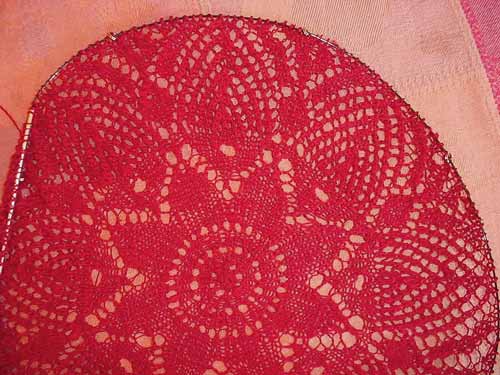
What’s next in terms of lace knitting? I’m not sure. I’ve got the Princess Shawl pattern safely stored away, waiting for the inspiration to work up. I’m sorely tempted to buy the Wedding Ring pattern, too. But those are both very large life-consuming projects. I am sure I’ll enjoy them, but I’m not in the mood to give over to yet another monster project right now. So Princess will sit a while. In the back of my mind lurks the thought that someday my two rugrats will be female adults, and that it would be nice to provide them each with an heirloom. But they’re both still in the anime, Popsicles, and homework phase of life, so I’ve got lots of time.
To answer yet another question – the tiny stitch markers. What are they?
They’re inexpensive silver color 4mm split rings, bought at a crafts store. 4mm is big enough to sit comfortably on needle sizes up to 3.5mm, perfect for lace. I think a little bag of 50 set me back a princely $1.75. They’re thicker than single jump rings, and so stay put instead of wandering off under YOs. I save the wildly fancy dinglebob-graced silver marker for end-of-round use, and flick these little cheapies in to mark each repeat. At that price and quantity, if some end up under the sofa or in the wash, I don’t mind.
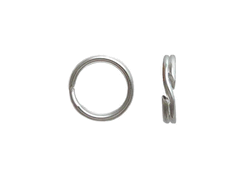
Why mark each repeat? Because doing so is way of proofing the lace as I knit. I don’t use a lifeline (lifeline video from KnittingHelp) and rarely have to rip back a full row. I avoid that by using lots of markers and making sure that each repeat is correct before I move on past the upcoming marker to the next section.
YET ANOTHER RED DOILY
[Repost of material originally appearing 21 August 2006]
After dithering about finishing off the red doily with a sawtooth or similar style edging, I decided to end it as the pattern recommends – with two rounds of simple chain loops. Here’s the result. I haven’t blocked it yet. That has to wait until Elder Daughter returns from camp. Why? Because the checked sheet I prefer to use for precision blocking is part of her sleep-away camp accouterments, and I have to wait for it (and her) to return.
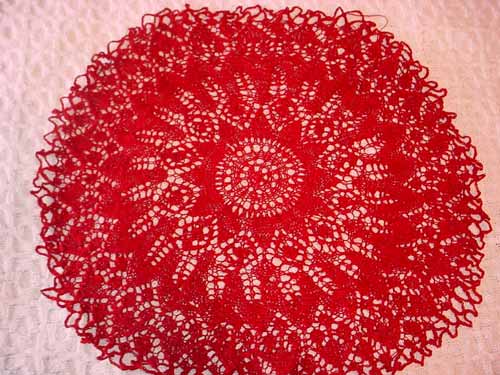
I’m happy with the result. It’s about 15 inches across, pre-block. I ‘d like something larger, but I do have a perfect spot for this one. It’s serving its doily-emergency mission right now, but will soon be sidelined to another use. So that means that having found out that doilies are the potato chips of lacy knitting, I get to do another. (Now I understand those houses that are covered in the things.) You can see that I’ve begun:

This one is from The Complete Works of Rachel Schnelling, a leaflet compiled by Gloria Penning of that designer’s patterns (On her website, Penning writes that Schelling probably translated patterns by Christine Duchrow). I bought this leaflet direct from Gloria about seven years ago and am just now getting around to playing with its patterns.
My new doily is built on an octagonal rather than hexagonal logic. The pattern itself might be a bit daunting for some, although it’s really not difficult once you get the hang of the thing. Unlike the one I made last week that was written up in prose directions, this one is graphed. But with an idiosyncratic notation system all the author’s own. Stitches are shown as boxes, with SSKs represented by a boxed letter D, K2togs as a boxed letter T, and YOs by a boxed letter I, etc. Unlike my preferred graphed notation, no effort whatsoever is taken to relate the visual presented by the pattern to the actual appearance of the knitting. Margins of the repeat wander right and left in synch with the knitter’s repeat rather than the way the finished item looks. Edge notations indicate rows on which the graphing shifts over a stitch or two. Heavier outlines are supposed to unite visual elements, but (to me at least) do little to introduce clarity.
This is not to say that the patterns are inferior – they’re not. They’ve e got the nice, crisp lines I like, and (once you’re used to the notation) are very easy to work – just knits, K2tog, SSK, YOs and double YOs, with all patterning restricted to the even numbered rounds. So far the thing has been error-free and both quick and enjoyable to knit. Plus the round motifs come in several graduated sized sets. For example, in the piece above, the outer pineapple-like areas grow out to become petals, making an eight-petaled flower. The smallest finished object stops there. Then there’s a second tier of design, after which the second largest finished object stops. And so on until the final full tablecloth sized expression. I’ll stop somewhere after the piece grows sufficiently large.
MORE DOILY MODS
[Repost of material originally appearing on 18 August 2006]
Yesterday’s mod was clearly indicated by comparing the directions to the photo. But today’s are a result of NOT wanting to make something that looks like the original.
Around the outer edge of my doily are 24 arrowhead or heart-like shapes, with the pointy tip facing the thing’s edge. In the original photo and directions, these are oddly placed. While they could have easily fit in between the points of the larger leaf/tulip motifs in the previous ring of design, they are skewed off the repeat, almost as if they were tossed on as afterthought. I like the minor asymmetry of the base of the leaf/tulips. It made sense there both visually and in knitting logic. This outer ring’s perturbation however is just …odd.
So not being able to leave well enough alone, I played with the thing, centering the arrowhead shapes in the areas between the leaf/tulip points. I haven’t changed the motifs – just shifted them to the left by a couple of stitches so they align between the ribs formed by the center stitch of the leaf/tulips. I think it’s an improvement:
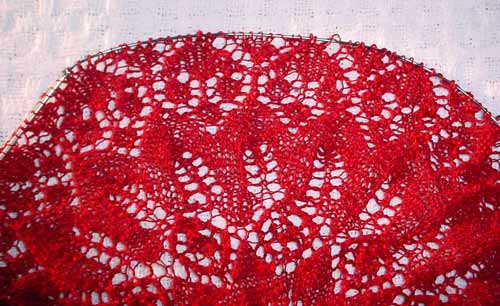
If anyone else is interested in doing this pattern, here’s the whole modification – rows 63-71.
I’m using the pattern’s own notation system present in the rest of Nurhanne’s translation. Note that while it’s written for sl1-k1-psso type decreases, when working, I substituted SSKs throughout.
Alternate final motif area for FANDUGEN
Row 63. *K7, k2tog, yo, K1, yo, sl1-k1-psso*
Row 65. ->1stitch *K5, k2tog, yo, k3, yo, sl1-k1-psso*
Row 67. -> 1 stitch *K3, k2tog, yo, k5, yo, sl1-k1-psso*
Row 69. -> 1 stitch *(K1, K2tog, yo, k1, yo, sl1-k1-psso)2x*
Row 71. ->2 stitches (sl1-k2tog-psso, yo, k3, yo)2x*
 String-Or-Nothing