BAKE SALE AND WAVING ON
It was cookie time here again at String Central. School Bake Sale season is upon us. I know there are some readers here from outside the US and Canada who may not have run into this custom before, so in the interest of sharing the joy, I share the joy. (I do hear that the UK shares this particular custom, too although it’s more centered around church groups doing good works than it is civic groups and schools.)
On election day most polling places in the US are in public buildings – very often county, town, or city-run schools. School parent committees see all that foot traffic as opportunity, so on most election days they mobilize as many parents as possible to make edible goodies to sell as fund raisers – always with some lofty goal or another. Send the band to the regional competition; refurbish worn-out playground equipment; send supplies to a sister school in a disadvantaged area; buy books for the library, a van to transport special needs children, robes for the choir, violins for the orchestra, or uniforms for the sports teams- the list is endless and every cause is deserving.
Most often it’s hapless non-baker moms who are dragooned, and interminable plates of cake mix brownies and slice-to-bake chocolate chip cookies are prepared by those with generous hearts and more volunteer spirit than time or baking knowledge to spare. Zucchini (vegetable marrow) season is especially feared because of the flood of zucchini breads and muffins that overflow the sale tables. I don’t think there’s a parent of a school age child in the US who has not heard “Oh, and we need to bring something to school today for the bake sale” ten minutes before the bell rings. You can find those parents buying cupcakes at supermarket bakeries on most bake sale mornings.
Needless to say, it’s local/state election day tomorrow and the clarion call for cookies has been made. This time around I made icebox cookies: half and halfs – chocolate and cinnamon. Seven dozen. On a work night. Thankfully I had advance warning and mixed the dough and refrigerated it on Saturday. Which explains in part why time was at a premium this weekend past. Even so, I’m cookied out.
Knitting? Yes I did some of that, too. As you can see, my Wave scarf grows:

Working with this linen of forgotten provenance is interesting. It’s relatively soft – no sharp bits of cuticle like some linens I’ve used. There are some fluffy slub like areas, and some places where the stuff is sewing thread fine. I am not having any problems working the lace pattern in it, and the result is surprisingly soft for something as slash-your-fingers-before-breaking durable as the the yarn actually is. I’ve got a ton of it. My foot or so of lace has made no discernible dent in the ball.
PRINT O’ THE WAVE SCARF
Well, it’s obvious that talking about wiseNeedle is a sure-fire way to keep people away from this blog, so I’ll give the topic a rest. Back to knitting.
I’m swamped again at work so discretionary knit time is at a premium, but I did manage to cast on for a Print o’ The Wave scarf. The body pattern is relatively simple – a 12 row 16 stitch repeat, with half-drop symmetry. That means there’s only three substantive rows to memorize, plus the fact that after three rows they’re repeated with an 8 stitch offset. I’m not sure whether or not I’ll bother with the author’s specifications for grafting two pieces together in the middle thing to make the two ends symmetrical. Perhaps instead I’ll just pick up stitches and work out in the other direction. Or maybe I’ll just keep going. It depends on how mindless everything end up being and how bored I get without other sections or pattern changes to look forward to.

The yarn is a nameless lace-weight linen I bought aeons ago at a Maryland Sheep and Wool Festival. You can see some of the texturing it has if you click on the thumbnail above to pull up the larger image. No stretch in the stuff of course, which will make blocking interesting, but it’s butter soft. I’d estimate that it’s about 15 inches across with minimal on-needle smoothing out.
I have to admit that one of the reasons I like complex lace knitting is that there’s always something interesting and new happening. It’s fun to watch the pattern build row by row, accumulating each new texture and design. This scarf by contrast is a long strip of a single stitch pattern. We’ll see how I as a knitter with the attention span of a mayfly handle this challenge to perseverance.
On the domestic front, my Heirloom Knitting book is still AWOL and I’m at sixes and sevens over it. I wish I could blame Franklin’s Delores, but she was no where near Boston during the week it disappeared. Besides, she’s not my hallucination. I’ll have to get both more creative and entertaining before I come up with an excuse half as amusingly incorrigible.
ADVICE BOARD POSTS
Another reason we moved String over here to wiseNeedle was to help me stay focused on wiseNeedle maintenance. I’ve spent my discretionary blogging time this morning answering wiseNeedle advice board queries, so I feel minorly useful so far today. Again apologies to those who have been waiting for answers – questions were stuck in a morass of spam that was jamming our to-be-processed box. We’ve winkled them out and all have been posted. But not are all visible.
One advice board feature people may not know about is that readers can rate answers (anonymously, of course). Questions remain on the open list until the aggregate score of all accumulated answers is high enough that we are reasonably satisfied that the question has been answered. So even if you aren’t intending on providing answers yourself, feel free to go over and review what has been posted. More unanswered queries lurk below the ones that have been addressed, but won’t be visible until items above them in the Open Questions queue are judged adequate.
Oh. And if you want to answer queries, please know that your assistance is greatly valued, not only by the original posters of questions but by everyone in the future who may search the collection looking for similar advice. Plus we remain open for new questions. Feel free to send them in, too.
On the knitting front, I didn’t get to do the grafting on the big red doily last night. My assistant photographer in residence had too much homework to help out, and barring growth of two more hands I can’t manage a camera and grafting at the same time all by myself. I did do some swatching for the Print o’ Wave scarf,. I am narrowing in on my chosen needle size for full implementation, but have no actual product to show off yet.
MORE LACE LOOMING IN MY FUTURE?
Small progress on several fronts. First, I’ve finished the knitting on my red doily. I have done the ceremonial breaking off of the yarn, and am up to the grafting part. I will begin that tonight, possibly even documenting it with photos, if I can find a willing volunteer photographer in the house. I will also try to get to the blocking of both doilies this weekend, although pre-holiday preparations and work may intrude.
On the website front, our resident technical wizard is fine-tuning some aspects of the site and boldly slaying bugs. Comments should now be working properly. I have put some pointers on the old String site’s most popular pages, redirecting folk over here, so with luck some of the people who link to those pages will notice and make corrections before those pages go dead. I’ve also started to answer the backlog of questions on the advice board, add more of this season’s yarns to the database, and to learn Wiki syntax. I’m plotting out the KnitWiki structure right now, diagramming hierarchies and interrelationships on paper. Suggestions for areas not to miss, or for how content would be most usefully organized are most welcome.
In addition to all this stuff going on (plus heavy deadline pressure at work) I still haven’t worked the lace bug out of my system. I’m not quite sure what will be next up. I’ve got a ball of lace-weight linen in a natural ecru. It’s two-ply construction, with a small bit of thick/thin and linen slubbing going on. I got it at the one Maryland Sheep & Wool festival that I went to, circa 1996. For solid sections, it looks best on 1.75 or 2mm needles, so I suspect for a bit lighter, lacier look I’ll move up a size or two. Not quite sure of my yardage, but whatever it is, that’s all there is. I’m thinking of messing around and making something up, combining lacy stitches from Hither and Yon (two of my favorite sources), adding an edging, and ending up with something wearable. Perhaps a medium-sized rectangular or square scarf, able to be worn as a dress accessory (there’s not enough there for a huge shawl). One minor complication that should work itself out – I have misplaced my copy of Heirloom Knitting. I used it last when I was selecting the edging for the second red doily. The one I used came from its pages.
Or I might do Eunny Jang’s Print o’ the Wave Stole. She’s already worked out a simple layout using a traditional Shetland pattern and companion edging. The Print o’ the Wave design itself is visually complex, but very easy to work, with a logical 12-row repeat. Eunny has also done an excellent tutorial on lace shawl construction. The series goes on from the one on shawl construction (links are on the right hand side of her page) and includes a highly useful round-up of lace-knitting cast on techniques.
DPN AIRLIFT
I sheepishly admit I whined in public and was so pitiful that someone took pity on me.
I’ve mentioned here many times that I am probably the last person on earth who enjoys using DPNs, and adores the extra-long DPNs more commonly found overseas than here in the US. The whining was that extra-long DPNs are hard to find here. Judith from the UK had a stash of them, collected over many years of happy knitting. She recently moved over to circs, and her collection of long DPNs languished. So she packed them up and sent them to me!

Here you see her collection, ranging from 4 to 6.5mm (US#6 to #10.5), displayed on the converted-from-jeans denim skirt I’m sewing with and for my daughter. Since no good deed should go unpunished, a suitably splendid gift in return is being boxed up for shipment back to Judith. Ten thousand thanks to her again. I’ll have lots of fun with my new needle library!
On the skirt, who knew they’d come back into style? I wore them in the mid-1970s, and made dozens for my friends. I even have a bit of blurry, faded photographic proof from that era (let’s just say my lack of camera skills runs in my family):

Now I find my skills are in demand again as converted skirts seem to be the rage with my daughter and her set. Even though it’s not knitting, if anyone is interested, I’ll diagram out how to go about doing it. With the top, and jean jacket I described before, the ensemble reaches counterculture nostalgia critical mass, just in time for cold weather.
HALLOWEEN APPROACHES
Quick aside: I don’t know about you, but a small window onto a whole new universe of costume options just opened up for me and mine today. Too funny!
CAUGHT UP
Finally.
I’ve caught up on the by-hand port of last month’s entries from the Blog City incarnation of String or Nothing. I’ve copied over comments, too. It was much easier to do this for the months prior to June. In June BC changed their blog back-up methods, and stopped offering XML exports. Earlier stuff we were able to (mostly) automate, although there will probably be some links here and there that need to be replaced. My premium Blog City account will expire at the end of November. At that time all of the photos there will disappear. Shortly after that BC will probably pull the plug on the account proper, as I will no longer be posting anything new over there. If you have links that point to entries there, please take a moment and use the search page here to hunt up the comparable entry in this location. Otherwise your links will go dead. I’m afraid I can’t contact each of you individually (Google says there are thousands of links to String pages out there), so apologies on this blast notification.
I’ve also caught up on entering the backlog of yarn reviews and advice board questions on wiseNeedle proper, although there are lots and lots of advice board answers that remain to be written. Feel free to pitch in and answer fellow knitters in distress. Even though in some cases the questions themselves are no longer “shelf fresh” future knitters with similar queries will benefit from our assembled knowledge on file.
Aside from getting back to a semi-regular schedule of semi-regular postings here and updating the yarns database with as many new season products as I can find in catalogs and on-line listings, the biggest rock remaining to roll is our KnitWiki. I’ll be dividing my time between blogging and structuring that resource. Lots of reference material that I have posted on String will end up over there Plus there are books and books worth of other articles to create. But first I have to do the basic tree structure type index that ties the whole thing together. Everyone needs a hobby…
Doily progress? Here it is (click on pix below to enlarge):
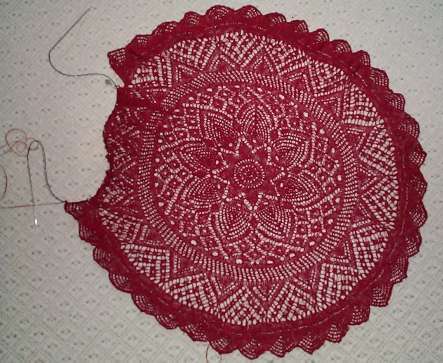
As you can see I’m pretty close to finishing my edging. I estimate that by mid-week I’ll have completed it and grafted the seam.
Other than that, a hearty welcome to the ten people who have followed me here from Blog City. With luck and time (plus getting the word about our relocation out), the rest of String’s regular audience will find this spot, too.
KNIT-ON EDGING FOR DOILY ON STEROIDS
[Repost of material appearing on 1 September 2006]
I’ve been too busy to blog in the morning, but not too busy to knit at night. I had mentioned before that I wasn’t all that pleased with the crochet edging of my smaller red knit doily. The reason harks back to the original difference between knitting and crochet – the thickness of the stitches formed.
In needle lace, the stringy bits that connect more opaque sections are called “brides.” In knitted lace those bridging units are very slender, often only one or two thread thickness equivalents. By contrast, brides formed by crochet chains are by crochet’s own nature a minimum of the equivalent of three thicknesses of the base thread. While most people aren’t phased by this, I prefer not to mix crochet and knitting unless I’ve ironed out the thickness difference between them. One way I do that is to knit with two strands, but do any accompanying crochet with one. More on this another time, when I’ve got a solid combo project to play with. Back to my doily.
It’s grown. It’s now the size of a small tablecloth or large centerpiece. I estimate that it’s about three feet across, including the edging. Give or take for blocking. Yes, I did say edging. I decided to use a knit-on edging in place of the simple crochet finish. So I am in the middle of doing just that:

As you can see, I’ve chosen a pretty simple traditional Shetland-style edging, and I’m knitting it right onto the live stitches of the piece’s body. I picked something that echoed the alternate YO/decrease texture used elsewhere, plus something that was relatively visually dense compared to the previous patterned band (that one had lots of double YOs, so it looks quite airy compared to the rest of the piece.) So far things are going pretty well, but rather slowly. The airy band had 17 full repeats of 33 stitches around the circumference – a total of 561 stitches. MATH UPDATE: My lace edging is 28 rows per point, and “eats” 15 live stitches in the attachment process. 37 repeats of my edging is about 555 stitches. That leaves 6 other stitches to be randomly consumed, evenly spaced around the piece. I’ve completed about five of the edging’s gazillion repeats so far. (That’s what I get for writing about this stuff when the actual knitting isn’t to hand. My every-other-row attachment scheme eats half as many edge stitches as there are rows in the repeat.)
Now what do I mean by “eaten?” Simple. To start this edging knit perpendicular to the doily’s body, I used a half-hitch cast-on to add stitches to the end of my left hand needle – the same circ that I just finished using to complete the doily’s body. I worked a wrong-side edging row back, purling together the innermost of my newly cast on stitches along with one of the live stitches from the doily’s body. One eaten. Then I did a right side row, proceeding out from the edge of the doily’s body to the outermost edge of the lace strip I’m adding (the edge that forms the outermost zig-zags). On the next wrong side round I worked across my newly added strip, purling the last new stitch along with the next stitch of the doily’s body.
I continue in this manner, attaching the live body stitches to the growing strip of edging. Every now and again (most notably on the shortest row of the edging’s repeat) I “eat” an extra stitch by purling that last wrong-side row stitch along with TWO body stitches.
Clear as mud?
SNOOD STAGE
[Repost of material originally appearing on 28 August 2006]
As you can see, I’m up to giant snood stage, where the piece is larger in circumference than the circular I am using to knit it. Since I am loathe to spread it out onto two needles just for a photo opp, you’ll have to bear with me:
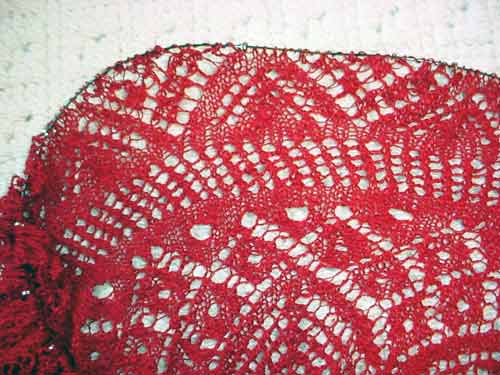
As you can see, I’m past the area that contains the center star, and past the (very boring) stripe of plain old diagonals formed by an infinitude of SSKs and YOs. I’m up to the outer ring of patterning, about three rounds from the end. Plus or minus. While I finished the last piece off with crochet, I didn’t like the look. This piece, at roughly 20 inches across right now pre-block, is just big enough to be a mini-tablecloth for a tiny tabletop. Big enough to show off an edging. So I’ll probably end off with some sort of knit-on edging. Exactly what, I’m not sure. But I’ll figure that out when I get up to it.
In the mean time, I can report perfect accuracy on this pattern, and the probability that I’ll knit more from the same booklet. Perhaps a lace collar. I’ve got a boughten black top with a jewel neckline that would be killer with an antique-look white lace collar. Either that or I’ll figure out something lacy to do with some spectacular blue fingering weight I bought from June…
This lace stuff. It’s addicting!
INSPIRATION FROM ANOTHER TIME
[Repost of material originally appearing on 25 August 2006]
Like socks? Ever hear of the socks shown at the Great Exhibition of 1851? No? You’re in luck. The Victoria and Albert Museum never forgets. Their collections are now searchable on-line. A bit of poking around brings up this set of images, socks from that very exhibition, when all things Scots and the latest advances in machine knitting were the rage.
Now don’t poo-poo machine knitting. Sock machines of that time required quite a bit of hand manipulation. How about these socks – stockinette, with some openwork, finished off with hand embroidery, from the early 1840s?
Socks too mundane? Contemplate Sara Ann Cunliffe’s exquisite cotton lace baby gown, knit sometime in the late 1800s.
White cotton lace knitting too late for you? How about a brilliant 17th century silk and silver brocade jacket, with a thumbnail opinion that it was probably knit on needles and not a frame. What do you think. Cut and steeked? I think so. Even at 17 stitches per inch, I’d love to make one…
Looking for wool? How about an early 1800s baby ensemble that looks like it inspired Debbie Bliss.
There’s 19th century bead knitting, too. And (amazing to me) 18th century beaded knitting! Not to mention hand-knitted lace doilies from the Azores (1875-1900); 16th century liturgical gloves, a Shetland shawl to die for (19th century), and lots of other stuff from every era since knitting impinged on Western consciousness.
Of course, if you prefer stitching over knitting, especially Blackwork or monochrome embroidery, there’s some well-known examples of that there, too. Also samplers showing motifs straight from early modelbooks. Even an Egyptian piece from the 14th-16th century I’ve never seen before. I’m in heaven.

