YARDS PER MILE?
[Repost of material originally posted on 16 June 2006]
No, not a knitting-related math question (for a change), but an idle query. Check out this – a UK art student has knit hersef a car. I hope she gets a good grade on the project!
TRANSLATING BETWEEN KNITTING IN THE ROUND AND KNITTING FLAT – Part IV
[Repost of material originally appearing on 14 June 2006]
If you are translating between knitting in the round and knitting flat you may run into a direction to perform something on the right side of the work that you now need to do on a wrong side row (or vice versa).
The absolute best source for this info are the symbol key charts at the start of B. Walker’s Charted Knitting Designs, and A Fourth Treasury of Knitting Patterns (and possibly several of her other smaller books, though not Walker I or II). It’s the most complete, listing a huge number of stitch manipulations and giving directions – sometimes more than one set of directions – for ways in which that same manipulation can be achieved on both right side and wrong side rows. Other books of charted patterns including L. Stanfield’s New Knitting Stitch Library give right side and wrong side equivalents, but I find the Walker set the most complete and the easiest to use as a ready reference.
The info below is abstracted from a small portion of her charts, but without her specific how-to write-ups. Items with asterisks are ones for which Walker gives multiple variants that should be subject to experiment before the optimal one is chosen. Her write-ups are excellent and should fuel countess hours of yarn-y tinkering.
| Right Side Row | Wrong Side Row |
| K – Knit | P – Purl |
| P – Purl | K – Knit |
| (K1-b, K1) – Center double increase into one stitch | (P1b, p1) – Center double increase into one stitch |
| K2tog – Knit 2 together | P2 tog – Purl 2 together |
| SSK – Slip, slip knit | P2 tog b – Purl 2 together through the back of the stitch |
| P2 tog – Purl 2 together | K 2 tog – Knit 2 together |
| (S1, K2tog, PSSO) – Left slanting double decrease | (S1 WYIF, P2tog-b, PSSO) – Right slanting double decrease* |
| K3tog – Knit 3 together, a right slanting double decrease | P3 tog – Purl 3 together, a left slanting double decrease* |
| K3 tog b – Knit 3 together back, a left slanting double decrease* | P3 tog b – Purl 3 together, a right slanting double decrease* |
| (S2, K1, P2SSO) – Slip 2, knit one, pass 2 slipped stitches over, a center double decrease | (S2, P1, P2SSO) – Slip 2, knit one, pass 2 slipped stitches over (Specific method of slipping desribed*) |
WISENEEDLE PROGRESS
Thank you to the two people who wrote in to report errors on wiseNeedle and String-or-Nothing associated with our port and update. We’re fixing them as fast as we can. If you find bugs or strange behaviors, please send them in. I have also processed in the backlog of yarn reviews and queries that were stuck among junk entries in a gigantic queue of spam posts. My sincere apologies if you have been waiting to see a query or yarn review appear. After noting that we received over 100 ads for questionable products on just one single night you can bet that we’re working on the spam prevention problem, too.
Next steps include catching up with reposting the last few String notes from July and August on Blog-City to the new String over here; beginning to answer the huge pile of backlogged questions on the Advice Board; putting basic structure into the Wiki; and getting as many of this season’s yarns’ basic data into wiseNeedle as I can. In my copious free time of course.
Oh. And knitting. I’m happy to report that the latest Red Doily progresses apace. My edging now marches three quarters of the way around the piece. There’s no point in taking an additional picture yet. It looks pretty much the same as it has. I promise pix when the thing is done. As ever, your patience is greatly appreciated.
TRANSLATING BETWEEN KNITTING IN THE ROUND AND KNITTING FLAT – Part III
[Repost of materail originally appearing on 12 June 2006]
We’ve looked at taking a pattern that’s been written for circular knitting and parsing it out for knitting in the flat. That’s pretty easy, as most items knit in the round are not drafted with much complex shaping. Texture designs and colorwork do impose limitations, as does some shaping. In most cases it’s a matter of identifying seamlines, then doing the math to apportion the existing stitches into pieces defined by those seams.
Going the other way is harder, mostly because of the range of complexity of shape that can be accommodated by knitting in the flat. In general, the simpler the shape, the easier a piece is to translate. Drop shoulder sweaters with backs and fronts that are nearly identical are a cinch. Stuff with waist shaping, darts, “>princess style seaming, or other tailoring presents special challenges. But in spite of shaping most things can be knit either whole or in part using circular technique.
Starting with something simple, the Spring ’06 edition of Knitty contains Jamesey, a pattern by Mary Neal Meador. It’s a nicely patterned simple men’s pullover, worked flat in knit/purl combos. There’s minimal shaping, and the texture pattern with no row count abberations or increases and decreases is easy to translate for in the round knitting. There’s one tiny bit in her Sideways Stitch description that bears paying special attention.
To work Jamesey in the round, I’d add the total stitches front and back. I would NOT modify the pattern to substitue a full pattern repeat for theextra non-pattern-repeat stitches at the leftmost and rightmost sides of the front and back unless I were very ambitious. Doing so is a refinement to be sure, but one that’s totally optional. Unless the piece was intended to be very fitted or the gauge was large, I wouldn’t eliminate any stitches on the sides that in a sewn piece would be eaten up by seam allowance. BUT if I felt that four extra stitches of width at my gauge WOULD make a noticeable difference in fit, I’d take the time to refigure the stitch counts without them (remember that this would have to be done all the way around the piece, on the body and sleeves both).
In general, first I’d begin reading the pattern and noodling out how to deal with it’s tougher parts. This sounds like a dumb thing to say, but I know lots of people who knit with the “headfirst off the pier” approach. They grab needles and yarn and start in without taking the time to work through the piece mentally and to make sure they understand it. While this step can be less intensive if you’re knitting something verbatim as written, if you’re translating between flat and circular knitting not taking the time to really understand the original can be fatal to your project. I’d also point out that if you are knitter who rarely reads ahead, you are far more trusting than I. I’ve found lots of patterns that were poorly written or confusing. At the very least, knowing ahead of time that rocks are in the stream makes the the rapids less of a surprise.
In this case I’d begin by casting on the stitches for the front, placing a marker, casting on the stitches for the back and working the pattern as written up to the tricky Sideways Stitch rows. I’d work the front to the marker, then the back to the second marker. Every row will be a right-side row, so the texture pattern – conveniently graphed out – would be very simple to follow. The piece would grow as a single tube until the Sideways Stitch rows.
Those rows are written up for back and forth knitting, and need a bit of examination to translate them. Round 1 is pretty easy – it amounts to working the pattern as described, but laying the stitches so that their front legs are in the back of the needle. This twists them. (If you’re unfamiliar with stitch mounting, you can pop over here.) The second row requires the knitter to work backwards the way he or she has come. In the case of knitting in the round, it would be simplest to turn the tube inside out and accomplish the directions as written, knitting counterclockwise around the piece until the starting marker was reached. BUT just before I’d do so, I’d wrap what would have been the next stitch if I were to have continued around normally. Wrapping this stitch, then when it is encountered later, working it along with its wrap will help prevent a little hole from forming. Once I’d done the second round of the sideways stitch, I’d flip my tube back out so that the public side was on the outside of the thing, then continue with the third row of the Sideways Stitch pattern.
Having accomplished the tricky bit, I’d return to plain old knitting in the round until I had gotten to the point where the sleeve would eventually be set. That point isn’t marked on the schematics, but it’s pretty simple to figure out in a drop shoulder piece. I’d take the measurement across the top of th the pattern’s flat-knit sleeve and divide it in half. Then I’d subtract that from the height of the body. When I’d reached the point where the bottom of the sleeve was to be sewn on, I’d have a choice. The easiest way to finish off would be to split the piece front and back, and finish each piece knit flat on the circ, using a separate ball of yarn for each one. However this is a return to knitting in the flat. For some people it might smack of defeat. Others have very different gauges when they knit in the flat – enough to make a visible horizon across the sweater.
The alternative is to steek. Remember the markers indicating the “seam lines” dividing the front and back stitches? I’d work up to one, cast on three or four stitches, then continue around to the other and repeat the procedure. This will add a couple of stitches left and right to the sleeve area. The body will be just a bit wider at this point, with the extra width being clear to spot. I’d work the extra in plain stockinette. I’d continue to finish out the body, perhaps following the simple neckline shaping directions verbatim (with the introduction of that second ball again); or perhaps knitting straight across that area in anticipation of forming the shape by machine stitching and cutting later. (We’ll get back to steeking in a bit).
Sleeves are easy in this piece. There’s simple shaping – increases at the left and right of the pieces at regular intervals, making them into simple elongated trapezoids. Again I’d cast on and join in the round – probably starting out on DPNs. I’d introduce a stitch marker to indicate the beginning of the round, and assort my stitches so that it wasn’t apt to fall off the end of a DPN. Then I’d work in the round, introducing my increases as paired increases on either side of the marker.
Once I had the sleeves and body done, if I had chosen to steek, I’d stabilize the extra stitches I introduced to the body tube. Some people do this with a line of slip stitch crochet or hand-embroidered chain stitch. I prefer to whip out my ancient Elna and run a couple lines of machine stretch stitch on either side of my intended cut line. I’d then cut carefully between the machine stitched lines to make my opening. If I were doing the stitch and cut method of making the neckline, I’d draft out the curve I wanted onto a paper template, pin it to my piece and machine stitch along its edge.
Although this sounds hard, mostly it’s figuring out how wide and how deep the neck area should be, then taking a piece of paper and folding it in half – marking the width and depth on it and cutting a symmetrical curve by hand to match. Paper is cheap so if it takes several tries it’s o.k. The alternative of course is to whip out the French curve or drafting program and produce a proper drafted piece. Either part of the paper can be used, although I do find using the smaller inner curve piece to be easier to pin out flat onto my knitting.

At this point finishing whether you’ve worked flat for the upper body or in the round for the whole thing is pretty much the same – sewing the shoulder seams and setting in the sleeves.
Now. What about pieces with complex shaping – waist nips or princess line seams?
Those features work more or less like the sleeves. I introduce a marker at the point where the seam line should be, then work the increases or decreases as directed, on either side of the marker in accordance with pattern directions. Areas where you are told to cast off can be harder. For example in the princess style schematic, at the head of the front body side panel in there’s a “blind end” where the body side panels terminate short of the sleeve. I suspect I’d have to noodle on that one quite a while, and the solution would require short row shaping. Not easy. But for the determined willing to experiment and rip back – not totally impossible, either.
I can’t cover every eventuality of shaping and its implications for translation from flat to round knitting, but I hope I’ve given you an idea of the general process.
Yesterday’s Post
I wasn’t claiming that the Knitters pattern was ripped off from mine. First of all, it’s not my pattern. All I did was slap a couple of ornamental stitches onto a well known published piece. I own nothing here. Plus traffic on this site is so low that it’s highly unlikely that anyone who saw something on String two years ago consciously repeated it. My post was instead more of a “neeener neener neener” piece, accompanied by gloating rather than accusational finger pointing.
SEPARATED AT BIRTH
[ported repost of material appearing on 12 June 2006]
My version of Joan McGowan-Michael’s White Lies Shapely Tee – a semi fitted tee shape with a shaped waste and bust darts, used with the optional set-in sleeves (excellent pattern, and most graciously on Joan’s part – available free). Completed April 24th, 2004 and blogged about extensively here. Berroco Suede ribbon yarn, featuring two rounds of B. Walker’s Indian Cross Stitch around the gently contoured bottom hem, one turn of it around the scoop neck collar, and one at the bottom edge of the short sleeves:
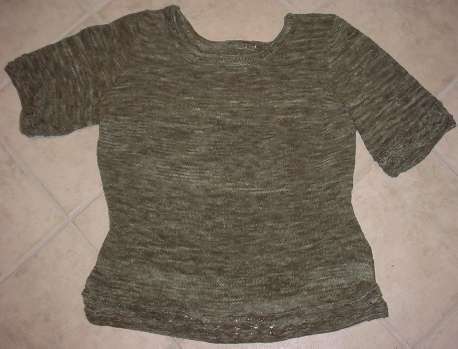
Compare this from the latest issue of Knitters. Tee shape, ribbon yarn, two rounds of B. Walker’s Indian Stitch around the hem, one around the crew neck, and one around the sleeve hems. Plus a texture stitch in the body that’s almost invisible in the photos.
Mine fits better.
YARDS PER MILE
[Repost of materail appearing on 16 July 2006]
No, not a knitting-related math question (for a change), but an idle query. Check out this – a UK art student has knit hersef a car. I hope she gets a good grade on the project!
ALL OUR EGGS IN ONE BASKET
Surprised to see this here? Don’t be!
We’re taking the wraps off our newest set of projects: porting over my whole String or Nothing blog over here; making various deep infrastructure changes to improve wiseNeedle’s base performance; spiffing up wiseNeedle’s overall look and feel; starting a knitting and embroidery Wiki; and even adding a new lace scarf knitting pattern for all to enjoy.
We’re not quite done. We’ve got some buffing up to do – some odd formatting to fix (most notably in the new scarf pattern); some recent String posts to copy over by hand; some links that need repair; and (a big undertaking) putting the flesh-and-bones on the wiki.
In the mean time, take a stroll through and see what’s here. After all, we don’t do a major overhaul very often. Only about every four years, whether we need it or not.
NORTH TRURO COUNTERPANE LAYOUT
[Repost of material originally appearing on 3 August 2006]
First, here’s a picture showing one finished meta-unit, plus one that’s mid-assembly. You can see the swirl hex in the center, plus where the square and triangle units fit.
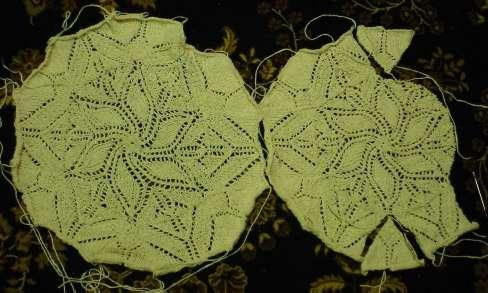
In the layout I’m using, these meta-units fit together with plain triangles inserted at the point where three meta-units meet.

I suppose I could have made just one big triangle for those spots instead of four smaller ones. That design variant will have to wait for a future blanket. In the next photo you can see how the concept above actually works:

Finally, here are some other arrangements for the same basic units. The swift will note that the one in the upper right is in fact the layout I am using:

In addition to these, the squares and triangles can also be used by themselves, or in combo. LATE UPDATE: The two layouts on the right are in fact different. While both employ entire meta-units, with plain triangles where they meet, the top one butts the meta-units up against each other by uniting the edges of the squares, the other unites the edges of the triangles. The differences are subtle, but the lines of the piece do look different if the lower right hand arrangement is made.
In terms of technique used and hints for seaming – the squares fit stitch for stitch along the edge of the hex. Due to decrease ratios, the triangles are in fact just a bit wide at the base. To eat up that extra width, I play with ease, plus I sew them in using mattress stitch. I take a slightly bigger “bite” out of the triangles’ sides than I do out of the edges of the squares to which I am sewing them. So far it has worked out well enough. Other spots where cast-on/bind-off edges meet are sewn together with whip stitch, picking up the innermost edges of the chains formed by the cast-on or bind off (or if no chain was formed, the equivalent edgemost stitch).
I do note that I’ve gone back and forth several times between working the hex, then sewing on the squares, or working the hex, then working the squares directly onto it’s live stitches. I had forgotten I had done this as I began this summer’s production, but looking at my finished blanket, I’m hard pressed to identfy the abberant sewn-on squares. I’ll go back to the knit-on method on the next meta-unit. In the mean time, I’ll just sit here in the heat and think about knitting, because at over 100-deg F indoors, it’s too hot to actually do anything more than sit in one spot and pant like a dog.
Now. Has anyone else tried the hex yet?
PATTERN – NORTH TRURO COUNTERPANE, PART 3
[Repost of material originally appearing on 2 August 2006]
As promised, here is the third unit needed to build my North Truro Counterpane. I won’t say the last, because I still intend on squaring out the sides and adding coordinated strip-knit coordinated trim. That will require some half-hexes, half-squares and the trim itself. But I’m not there yet.
Like the square, the triangle is knit flat and is quite straightforward. In addition to the patterned piece graphed below, I also make some plain triangles to fit in between the larger meta-motifs. In essence they are the triangle graph below, but without any patterning. To make them I cast on 31, then work entirely in stockinette, employing only the shaping directions shown at the ends of the right-side rows.
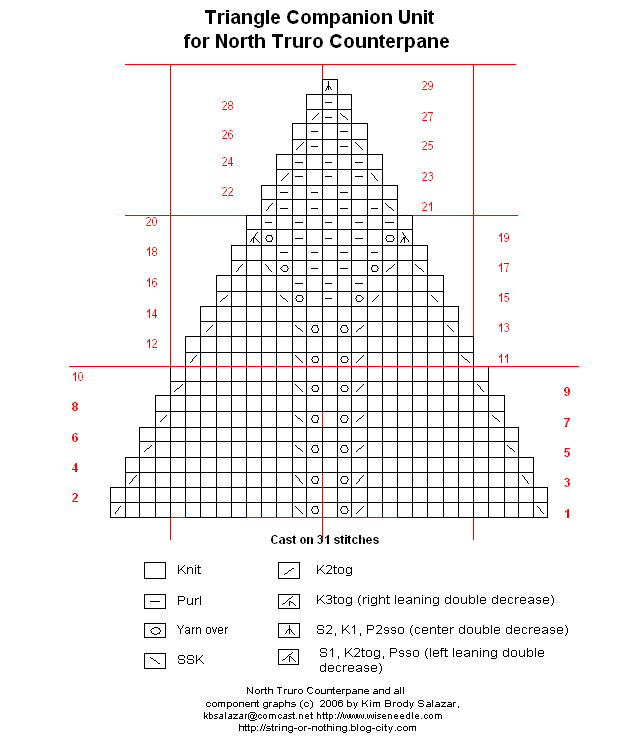
[Click on pix above for larger rendition]
I think that I might have done the patterned triangle a bit differently if I were to assay it again now. I might have eliminated the YOs and companion decreases down the center on rows 1-11. Or maybe not. I’d have to play with it to see if I liked the meta-unit (and how multiple metas fit together) after assembly without those radial spikes.
Tomorrow I’ll discuss again how these go together, and present some alternate arrangements.
PATTERN – NORTH TRURO COUNTERPANE, PART 2
[Repost of material originally appearing on 1 August 2006]
As promised, here is the square I use to build my North Truro Counterpane – the first of the companion units needed to build the thing along with yesterday’s hexes.
I could see someone making a blanket of only the squares, or only the triangles (tomorrow’s post), but I did design them to fit visually with the swirl counterpane to make up the larger star meta-motif. I like the contrast between the patterned, almost embossed central swirls and plain stockinette. The lines of the square extend and frame the swirl’s motion, spreading the design out beyond the borders of the hex itself.
The square is knit flat, back and forth on straights. I use two of my longer DPNs for all the smaller units. Since these are quick and almost never languish on the needles, don’t bother finding a pair of traditional straights with end buttons.

[Click on pix above for larger rendition]
Now, why did I go to all this trouble? For the classic reason. Why not?
I’m not a big fan of pieced quilting. I think it can be visually quite lovely, and value it as a medium for artistic expression, but I don’t enjoy manipulating all those little patches of cloth myself. I am however fascinated by simple geometry. Things like tessellations tickle my fancy. I can’t pass by a bit of interesting mosaic or brickwork without pausing to appreciate regular polyhedral tiling. Traditional Islamic non-figural ornamentation is a source of wonder to me. When I stumbled across Phillips Knitting Counterpanes I skidded to a halt and hung on every page.
Since then I’ve kept my eye open for more pieced counterpane style patterns of all levels of complexity. But I notice that very few are built on layouts beyond all squares, triangles, or hexes; or (at the most) on octagons plus small squares. I wanted to play with some of the more unusual layouts – to see if I could bend knitting around them. There are lots of ways to tile an area with simple regular polygons, and simple regular polygons are easy to knit. Why not mix squares and triangles? Or hexes, squares and triangles? Or (be still, my heart), dodecagons, hexes, and squares? North Truro is my first attempt.
I wonder what trouble i could get into if I departed the single plane, and ventured into the 3D world of polyhedra? Hmmm….
 String-Or-Nothing
