KOMBU SCARF PATTERN IN GERMAN
Apparently there are lots of German-speaking knitters out there who would love to have my Kombu scarf pattern in German. Or so the very gracious Kerstin Michler tells me. So many in fact that she translated the thing, and asked my permission to post it. I said I’d put it up on wiseNeedle, but some major overhauls on that site have made the appearance of Kerstin’s hard work woefully late.
I apologize, and for the time being, post the thing here
HOUSEKEEPING AND STARTING BEGINNERS
Some questions recently posed:
What happened to the list of recent referrers that used to be on the right?
It’s gone. I had been using a free service to report the places that people had been coming from. That service is no longer available. What’s there now is the native referral reporting feature offered by Blog City. Not very informative.
Of minor interest and on sort of a tangent to the where folk come from data point, the single largest thing people visit String to see is the pattern/report/working method for my Waterspun poncho. That page is the most viewed on the whole site, by an overwhelmingly huge margin. After that comes Stupid Stitch Marker Tricks. Lots of other posts from the general reference and pattern headers follow. All are understandable, as they contain how-tos or other info that I thought people would find useful. The only anomaly is the post I did about the name frequency web toy. For some reason, that post was picked up far and wide, and is in the top ten visited list.
Am I going to change the referrer reporting tool? Probably not. We’re plotting big things here for both String and wiseNeedle, so there are not a lot of spare moments to spend on redecorating what’s in each spot right now. I will continue to post here though – sporadic as it has become.
So? How were the fingerless mitts received?
Tickled! The recipient was absolutely tickled. It’s always fun to give a gift that’s appreciated.
What’s the next gift?
I’m now working on one of those standard issue fancy yarn garter stitch scarves. While I’m not fond of making them, this new deserving recipient saw one worn by another person and went googly over it. I was lurking nearby and took notice.
I’m using US #13s and plain old Eros and ColorLash – an oft-mixed pair to be sure. While the result is striking looking and no doubt tempting for beginners to knit, I despair at the number of people who have probalby given up knitting because of this stuff. Others have noted how unruly both yarns are, how they slither off the needle and off the ball; how easy it is to drop or inadvertently increase a stitch; and how annoying it can be when a needle tip snags in the interstices of the railroad ribbon. I know in my hanging out at the LYS days, I must have rescued a half-dozen of these scarves for distraught beginners, reseating the stitches on the needles after their inevitable escape. Which brings me to a discussion thread that doesn’t have an externally posed question to cue it. So I supply one just for fun:
What’s makes a good beginners’ project?
I’m of two minds on this one. First, the best thing for a beginner to knit is something that a beginner wants to knit. Telling someone that something is beyond them is a "one size fits all" defeatist strategy. Some people learn better when faced with a challenge. Others get discouraged if they’re told something is hard before they even try it.
At the same time, not every knitter can leap in and make a complex bit of lace, a fitted Fair Isle or an elaborate Aran sweater as their first-ever piece. There’s a balance here to strike among well-behaved materials in comfortable sizes, project scale that provides the best mix of achievablity and challenge, and skill requirements that stretch the knitter without frustration. If I have to recommend something as a first project, I tend to look for these factors:
- Smooth, classic finish yarn rather than texture
- Worsted or Aran weight (20 or 19 stitches = 10 cm or 4 inches)
- Size US #6 to #8 needles (depending on yarn weight used)
- Light color to make stitch identification easier
What size project and whether it’s knit flat or in the round depends on the knitter. I’ve started people out on everything from small swatch sized mug rug squares, to scarves, hats, even socks. Full sweaters (unless they are ultra simple dropped sleeve ones in little kid sizes) I tend to recommend for a second or subsequent project. But again, desire to knit is the strongest motivator of all. If someone REALLY wants to use an unruly yarn for a first project, or begin with an adult size cardigan, hot desire can trump cooler considerations.
My own first project was a Dr. Who length scarf that started out in garter stitch and quickly took off on a tangent as I tried out all the stitch texture patterns in my book on it. My second was a Penny Straker trinity stitch baseball jacket.
Are you someone who started out on the classic track, or are you someone who did the knitting equivalent of jumping off the end of a pier to learn how to swim? Would you encourage a beginner to embark on what you know will be a challenge, hoping that perseverence will see the newbie through the difficulties ahead? Or would you try to gently redirect that person to something that’s easier, more in line with the classic progression from first swatch through scarf, flat knit drop shoulder pullover, and so on? Inquiring knitters want to know…
TOPS UP AND DOWN
My convertible mittens are done. I have to admit, the joy of ending off ten fingers wasn’t a pleasure of the ages – but they’re finished.
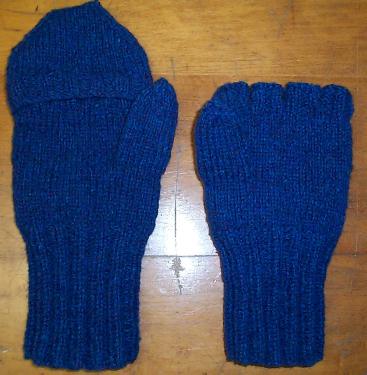
The rustic wool I used for these isn’t as soft and non-itchy as I would have preferred, but in this case the intended use trumps that problem. It’s my understanding that the recipient would be wearing ultrathin silk gloves inside these. Liners do away with itch.
If I were to make another pair of these mittens, I’d probably use a shaped thumb gusset instead of the afterthought thumb. While these do fit nicely, I find a shaped thumb area to be more comfortable. Award to recipient is this afternoon. I’m sure he’ll be pleased.
Next up in the gift parade is problematic. I had a Very Strong Hint shared with me yesterday. I don’t have the special materials on hand, so compliance will entail a lunch-time raid on my LYS. Now not everyone around me can get goodies just by idle hint. Hints must be 1) shared innocently, with little expectation that they will lead to the desired object; and 2) must be given by the deserving, and I get to decide who’s deserving. If I didn’t impose limits, I’d be chest deep in special requests.
Other items on parade include another pair of socks (probably not going to happen), and some ear warmers and hats. Plus some additional crocheted snowflakes for the tree. We’ll see what further stash excavation expeditions unearth.
Cookie report:
Rum balls this year turned into Scotch balls, as a last minute dearth of rum foiled my original plans. I’ve used bourbon before, but found the result too strong, so we’ll see how this year’s crop mellows. Peanut butter cookies are also finished. I’m happy to say that the spice cookies turned out exceptionally well. Thin, light, and gently spiced. A delicate cookie compared to many heavier riffs on the spice cookie theme.
KNITTING TOOLS IN UNLIKELY PLACES
I have to lead off with a disclaimer – I haven’t tried this yet. It’s from TechTrax – a very useful third party support source for Microsoft applications. Between them and WOPR, I have never failed to find a needed answer to a question about MS Word, Excel, Visio, Project and other MS-official torture devices I use in the course of writing proposals. Most of the time in fact my answers are sitting ready to be found in the various discussion forums and articles on those sites. (Instant expert help is always appreciated).
I know there are lots of people who use Excel or Word to set up knitting charts. Some of them wish knitting fonts were more widely available or (more importantly) more intuitive, or more like symbol sets with which they’re familiar. Others have looked into building their own knitting symbol fonts. That’s a big task, and there are all sorts of tools to help. It turns out that there is a hidden, free tool avaialble to MS Windows users – resident in operating system itself. This tutorial takes you through using this character map editor to build custom symbols.
The same site also recently published an article on creating custom graph paper in MS Word.
Other useful tools:
- Factor generator – useful for quickly figuring out possible repeats
- From the same site as the Factor Generator, a quick metric/imperial unit conversion utility
- And a grams/ounces coverter, too.
And so we see that knitting tools aren’t always found in knitting-specific places. If you’ve come across something useful in an unlikely location please feel free to add a comment here. I can assure you that someone, somewhere will be very, very grateful.
FLIP TOP MITTS
Holiday shopping is now complete. My cookie list is done and supplies have been purchased. I turn again to knitting (in between the batches).
My hunter’s mittens (or shooting mittens, or flip top mittens, or convertible mittens) are more than three quarters done. I’ve finished the first one, and am up to the fingerettes of the second. I read through the list of patterns that I posted last week, and absorbed some general principles. In specific, I adopted the afterthought thumb and line of purls along the knuckles to make flap attachment easier from this one but mostly I just went along on instinct.
I’m using a rustic-type worsted weight wool. This particular bit is left over from a sweater I knit for myself from yarn I bought at a Gore Place Sheepshearing Festival, held annually in Waltham, Massachusetts. I’ve written about my No Math Pullover before. My normal gauge for this stuff is about 5 stitches per inch over stockinette on US #7s. For this project I wanted something tighter and more wind-proof, so I ratcheted down to a mix of 2s for the ribbing and #4s.
 |
 |
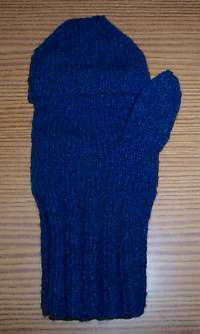
I worked about five inches of wrist ribbing in K2, P2, switched to stockinette, knit to the thumb point and introduced some waste yarn for the thumb opening. Then I knit to the knuckle ridge and purled the stitches on the back of the hand. After about four rows of spacer after the knuckle ridge, I worked some evenly spaced mini-fingers. Once they were complete, I picked up stitches along the knuckle ridge, cast on extras to go across the palm (I used cable cast-on for that to make a firm edge). Once I had my stitches for the mitten end established, I did several more rows of ribbing across the palm side to keep the edge from curling and stretching, then finished off the mitten end with a standard sock toe, ending it off with Kitchener grafting. Then I went back and worked a standard thumb.
The palm side is shown on the left. You can see the thumb and ribbed edge of the mitten end flap. The back of the hand is shown on the right, with the mitten flap end folded back to expose the fingers. I’m pretty happy with the result.
Now, some people have asked how I figure out the sizes for gift knits. I try to do it by nefarious means most of the time, but for this gift I admit I showed a partially done (and woefully oversized) mitten to the recipient. I knew I was so far off that the result would be laughable, so I spoiled my own surprise.
Nefarious means: For socks, I eyeball the target feet. I’ve been known to measure footprints in the snow, sneak looks at spare shoes when visiting, or note where the toe and heel line up when their owner is standing on a patterned rug,then return later and measure the interval. Hats are harder, but since knitting stretches, planning on a 21-inch head circumference to start with, then doing a plus or minus based on whether I think the person has a larger or smaller head than usual has always worked for me. For mittens, I usually contrive some sort of conversation that leads to a hand to hand comparison between the target and me. For example, I’ll ask about how comfortable the target finds his/her particular model of keyboard, note that my experiences vary, and posit a hand-size difference. That usually leads to a palm-to-palm comparison, which gives me a rough idea of size. I’m sure others have similar sneaky ways to evoke the needed data. I’d love to hear about them, too.
Side trip – I’ve had a request for the recipe for Oysters. I posted it last year around this time. Enjoy!
HALF-BAKED HOLIDAYS
Between work, holiday preparations and other commitments, my updates to String have gotten very spotty. For that I apologize.
Right now I’m consumed by deadlines of various flavors. Not the least of which is our annual cookie fest. I’ve mentioned before that holidays are not allowed to happen here until we’ve got at least ten kinds of cookies baked and ready. Ten batches of cookies makes far too many for a family of four to consume, so I always share the bounty, giving cookies to neighbors, friends and co-workers. (If family lived closer, they’d get some, too.)
This year’s list includes both things I can’t NOT make, some repeats of special favorites, plus a couple of experiments:
- Chocolate chip cookies – the classic, but made with mini chips and pecans instead of walnuts, slightly smaller than their non-holiday brothers
- Mexican wedding cakes – a very rich, pecan-dense shortbread cookie, rolled in powdered sugar
- Peanut butter cookies – my kids would shudder in horror if I left these off the list. Done with crunchy peanut butter
- Buffalo Rum Balls – a version of the classic crushed cookie bourbon ball, done with rum and cocoa, rolled in cocoa. Our variation comes from a recipe published in the Buffalo NY evening newspaper some time in the 1960s
- Sugar cut-outs – the iconic holiday cookie. This year we get to use the Hannukah cookie cutters. Also I put lemon zest in the batter, and mix the icing with lemon juice instead of milk or water
- Oysters – a family invention. A hazelnut spritz sandwich cookie, filled with dark chocolate ganache
- Earthquakes – another classic, renamed by the kids. This one’s a chocolate crinkle cookie, rolled in powdered sugar before baking. We use additional bitter cocoa in the place of the coffee in the recipe. The expansion of the cookie creates chocolate rupture fault lines in the white exterior
- Cinnamon maple rings – a rolled, layered refrigerator cookie. Very thin and delicate.
- Elephant Tongues – Like last year’s ears, this one is a quickie that uses store-bought puff pastry for more effect than effort. I’ll be posting the how-to here.
- Cocoa amaretti – Barely cocoa, very almondy and very biscotti-crunchy. New this year from a cookbook
- Spice cookies – Also new this year, but from a recipe on the King Arthur website.
- Panforte – Chocolate/nut/fruit heaven on earth new last year. A must-repeat from last year. This is so good we may NOT share it.
In the midst of all of the holiday knitting continues. Again apologies if you visit looking for more yarn goodies. Other goodies right now are taking precedence.
STRANGE PICKS
Sometimes having lots of dribs and drabs in one’s stash can lead to some strange picks as projects and available yarns are aligned. This week’s projects are case in point proof.
Knitterguy asks why on earth one would want to knit an acrylic/cotton blend scarf. I agree with him. Those fibers are far from warm and cozy, and there are lots of better choices for a warm neck wrap. In this case i plead a confluence of several factors:
- The screaming yellow color. The crossing guard in question will appreciate it.
- Having the yarn on hand
- The target recipient’s frequently repeated statements that she can’t wear wool
Now I don’t want to start the whole, "but of course she can" or the old warhorse perceived allergies vs. real allergies debates. I take her words at face value. She doesn’t want anything made of wool. She gets a nice, bright scarf in a color she favors and fiber type she believes is best for her, and I find an appreciative home for yarn I’ve held on to for upwards of ten years. But if I were knitting this for me, I’d be looking into a supersoft merino, or cashmere/merino blend for sure.
Next up appears to be a pair of flip-top mittens. I’d like to make something for a friend who has a predeliction for outdoor activities in the winter that occasionally require the use of bare fingers. A pair of these should be perfect. I note the presence of lots of free patterns on the web (convertible mittens, work mittens, two-way mittens, urban coping mechanism mittens I and urban coping mechanism II) plus several well regarded for-pay patterns (Pop-Up Paws, and Patons.) But in true String-or-Nothing tradition, I plan to leap off the cliff and improvise something on my own. I’ll probably start by looking over what’s out there, then messing about with the concept. Not sure if I’ll do a fingerless glove surmounted by removable finger end cap, or if I’ll do a fingerless mitten. I suspect the former will stay in place better, while the latter will be quicker to make.
As to what yarn to use – I’m not sure yet. This particular target recipient has an interest in historical things, so I may look at some of the more rustic looking 100% wools I have. For example, I’ve got some leftovers of Cestari light fingering weight 100% wool singles in both white and heathered barn red. I could combine the two into a Ragg-style looking DK equivalent. Hmm….
EVEN MORE HOLIDAY KNITTING
My stash diving and holiday knitting continue. Unfortunately, my camera and camera skills are far from the best (plus I’m still having some platform issues left over from my system upgrade), so you’ll have to use some imagination on this one.

Believe it or not, there are three strange and blurry objects above. At the top is a long scarf knit in the loopy mohair previously described. It’s in plain old garter stitch, but the resulting fabric looks a lot like the curly lamb stoles my great aunts wore four decades ago. It’s plush and lush. It also left precious little left over, but I contrived a simple beanie cap from the leftovers. That’s the shapeless black lump at the bottom of the photo.
In between is a simple knit/purl patterned scarf in screaming yellow. In this case, yellow is appropriate because the thing is a gift for a crossing guard. The pattern is a basketweave variant from B. Walker’s Fourth Treasury. The yarn is a well-aged stash resident – Brunswick Bermuda II. Bermuda is a cotton/acrylic blend, with a maker’s gauge of 5 stitches per inch on US #6 needles. I am not quite sure where I came by the five skeins of screaming taxicab yellow, but I suspect that this is a leftover from a project my mother made years ago. I can say that I am not fond of working with the stuff. It combines many of the worst features of both cottons and acrylics.
To start, Bermuda has a loosely twisted multi-strand construction, with about eight constuent plies. Eight point-trapping nuisances that make this yarn a nominee for "Worst Splitting Yarn I’ve Ever Used." The stuff is unstretchy as one would expect, but so much so that knitting evenly with it is a huge challenge. To keep my stitches uniform, I’m having to knit as tightly as possible, especially on the transitions between knits and purls. Even so, a knit/purl combo pattern is better than all stockinette for this yarn, as the texture doesn’t betray those "I’m knititng with an uncooperative cotton" occasional leggy bits. But I can go on… The texture of this stuff is string-like and hard in the fingers, very uncomfortable to use especially given the tightness I’m trying to achieve. I’ve knit up three skeins of Bermuda so far. One more should make the scarf a useable length, and any leftovers will become fringes. Ending this one off can’t come soon enough for me.
I’m not quite sure what stash diving I’ll do next, or what the next bit of knitting will be, but I suspect that there will be at least one more pair of socks between now and the holiday, plus some more snowflakes for the tree.
MORE HOLIDAY KNITTING
The socks are done, and I’m looking over all the possibilities for gift knitting that can actually be accomplished between now and when needed. So far I’ve stockpiled two pairs of socks, two scarves, and a pair of halfie mittens. This is an excellent opportunity to go through my small quantity stash box and identify things that can be pressed into service. So far I’ve found:
- A large ball of heavy loop mohair/wool blend in black, probably bought at a Maryland Sheep and Wool Festival from Tess Yarns. If I recall correctly the year I went Saturday night and Sunday morning were quite rainy. The Tess booth had the misfortune of experiencing tarp failure, and the stock got quite wet. Those of us who chanced by when the inventory was being packed up at the end of the day were treated to sizable discounts on sopping skeins. When knit up in garter stitch this stuff is a dead ringer for curly lamb or mouton. Perhaps a scarf and (if there’s enough) trim on a matching hat. Or perhaps if I feel adventurous (and there’s enough), a shaped shoulder shrug in imitation of a curly lamb stole of the 1950s. One drawback – mohair and I don’t get along very well. I’ll probably have to knit this wearing gloves, or put up with itchy, red hands for the duration. (I didn’t realize how poorly we got along until long after I had bought the stuff.)
- Some leftovers of cotton blend and cotton velor yarns – the dribs and drabs of kid sweaters long since completed and outgrown. Since I often buy yarn in bag quantity I almost always have extra. This stuff would be good for small seaman style inside the coat type scarves.
- Some sport weight Shetland two-ply yarn in cranberry, olive and muted blue, left over from a linen stitch sweater-suit my mother knit sometime in the mid 1960s and shamelessly stolen from her stash. The colors look quite good together and are not as out of favor as they have been in the past. Hats? Ear warmers? More halfie mitts, but with stranded patterns? No decisions yet, but the stuff is still in excellent condition and should be used
- Some fingering weight cotton blend sock yarn. I am not a fan of cotton socks, I find them cold, clammy and hard textured compared to wool or wool blend socks. But I have some sock weight cottons. These should make nice wrist warmers or ear bands. Or perhaps cell phone or iPod socks for the gadget-blessed who have requested such things. (Someone please tell me why anyone would want an cozy for a device upon which engineers have lavished man-years of effort to mitigate the problem of heat dissipation inherent in small scale electronics.)
And that’s just in the top layer of the box. Stay tuned!
TOE UP SOCK, PAST THE HEEL
First, an aside. I finally darned in the ends of my Alcazar shawl. I only end off ends when the final disposition of a piece has been decided. In this case it means I’ve decided that as much as I love my Alcazar, there’s someone who deserves it more. My shawl has now found its way to its new (and very appreciative) owner, and I beam with my own pleasure at joy with which it was received..
My socks continue. I’ve finished the first and am only a single evening away from finishing the second. I’ve placed the motif on the ankle. Because I chose to work it as a knit image on a purl ground, and the motif is made up of solid blocks and strips, unstretched the sock looks rather strange. The motif draws in like ribbing and the purl background puffs out compared to the rest of the stockinette sock. But when worn, it looks fine. The purl ground recedes, the proportions of the knit motif correct, and the draw-in so evident in the unstretched item goes away.
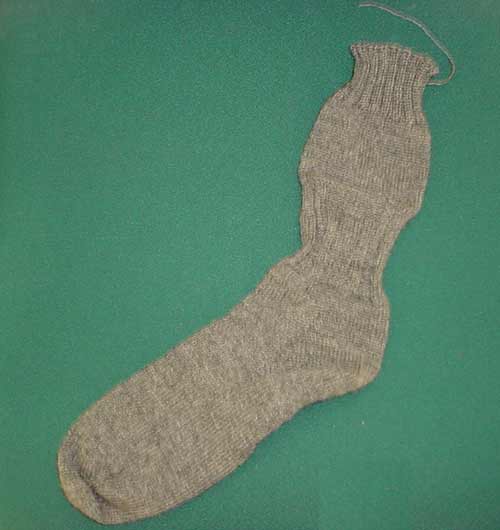
The motif on the ankle isn’t very visible in this photo, so here is the graph:
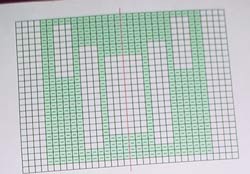
Yes, it has a specific meaning. A work-related meaning that a very small minority of the viewers here will recognize. And no – I didn’t stick to the graph in the absolute. My final version has the same height to width ratios as this visual, but because there is very little variation row to row, I repeated the center area rows and the upper end rows more times than they are shown here. I did that because my graph was done on square units, but my knit stitches are not 1:1 ratio. I needed extra rows to achieve these proportions.
In terms of placement, I centered the unit on the ankle bone, and repeated it on both sides of the sock. The red line marks the centermost point and the whole graph represents half the sock’s stitches. Because I work with four DPNs in the work and one in hand with an equal number of stitches on each of the four DPNs, finding that center point was very easy. I do admit that once I began the pattern panels I rearranged the stitches so that I held the motif and field stitches (the green ones) on a single DPN, eight stockinette stitches on a second, the other side’s motif on a third, and the final eight stitches on the fourth DPN. I did the reassortment to avoid the possiblity of a loose stitch marring the center of the motif. While I don’t have ladder-itis between DPNs in stockinette, I am less sure of myself in reverse stockinette, so I avoided the issue entirely. I planned my vertical placement so that the motif would occupy the center third of the sock measured from the bottom of the foot to the bottom of the ribbing. That means I worked a few rows after completing the heel and before starting the motif, and working my post-motif stockinette to the same depth as the patterned part.
Finally, I finished the sock off with plain old 2×2 ribbing, whick I did until I ran out of yarn in my standard issue Regia 4-ply 50g/210 meter ball. I’d say the resulting sock should fit from man’s shoe size 9.5 wide through 11 (possibly 12) medium width or so. With luck the target recipient has feet in that size range. If not, I’ve got an alternative recipient planned, and I’ll knit another smaller pair for target #1.
 String-Or-Nothing