FOR SOMEONE DOING NOTHING, I SURE AM BUSY
It’s a fair question – “Where have you been?”
The answer is “Busy.”
I’ve been out fabric shopping with friends; trying to establish a regularly meeting needlework circle at a local mall on Fridays; battling the Sacred Dust of India as it tries to repossess the flat; writing a presentation and workshop on the style intersection between Kasuthi embroidery and Renaissance counted work; dealing with assorted technology annoyances; working on TNCM2; trying to parse out more interesting blog entries from my London pix; and playing with various stitching and knitting projects.
First off, I’ve taken up Big Green again. It’s tough to do here. I need very strong light, and even with a small task spot in the living room, the only place bright enough is next to a window in the middle of the day. I long for my comfy chair and spotlight at home.

It’s hard to spot the progress on this strip because it advances at such a slow rate, but it’s there.
Then there’s a new stitching project, as leggy and coarse as Big Green is fine. I bought a pack of ultra-cheap dishtowels at the supermarket, because I always seem to have run out of non-terry ones when I am looking for something to toss over rising bread. One quick wash later, and as expected for bargain basement Indian cotton – they’d faded and shrunk. But wait! That dark indigo one is now a pleasant, mottled chambray. And it’s almost even weave:

So into the stash for some ecru DMC linen floss (which I’ve now learned has been discontinued. It figures…) Because I’m stitching over 3×3 threads to even out inconsistencies in the weave, and because the linen thread is fuzzy with its own rustic character, I decided to play on that folksy appearance rather than going for crisp, tiny detail. The pattern is yet another one that will be featured in in TNCM2. This, when finished out, will be a strip decorating a pocket edge of a zippered stitching caddy. The entire outside of the case will also be worked in one of the larger all-over patterns in TNCM2. Without cutting up the dishtowel, I intend to origami it into a series of graduated pleats, then stitch perpendicular to the folds to make pockets opening “up” and “down”.
The final step will be to fold the entire thing in half, then take an over-long large-tooth jacket zipper (toddler size), and run it around three sides. This should make an organizer pouch that when zippered, lies totally flat. I may sew one of the smaller interior pockets shut, stuffing it with some sort of padding to make pin cushion (perhaps with a finer gauge fabric as liner, so I can put emery into it). And I may also stitch in a couple of pieces of sturdy felt, so it has an integrated needle-book on the inside. The details of this finishing are still idle speculation at this point. Right now, it’s just a quick doodle.
I’ve been busy with knitting, too.


I’ve finished the body of the beaded red lace scarf. I’m drafting up the companion edging, with more beads and mitered corners. I also have to “kill” the acrylic yarn so that it lies flatter. Not quite sure how I’ll achieve this, since the beads make ironing problematic. But I’ll figure it out, even if I have to do up a couple of sacrificial beaded test swatches.
Also in the photo above is the latest pair of socks. That’s pair #5 in the past two months. I work on them while we wait for the school bus in the morning, or any other time I’m waiting on a line, for a car, or find myself idle outside the apartment. After this pair I’ll have to get creative in combining the leftovers on hand. I’ve gone through most of the sock yarn I brought with me. I have a couple of balls of Noro sock yarn left, but I’d prefer to use that for some other accessory. The yarn is beautiful but I prefer wearing (and washing) other sock yarns, for comfort and durability reasons.
ELIZABETHAN BLACKWORK SMOCK
O.k. I know a few of you want me to do a blow by blow travelogue of our London trip. But that’s not my forté. I’ll wander over and cover some of that material several posts, but mostly want to write about specific things we saw, this being one of the first times I’ve been able to get relatively up close and personal with historical artifacts. Besides, The Resident Male is a much better travel writer than I am.
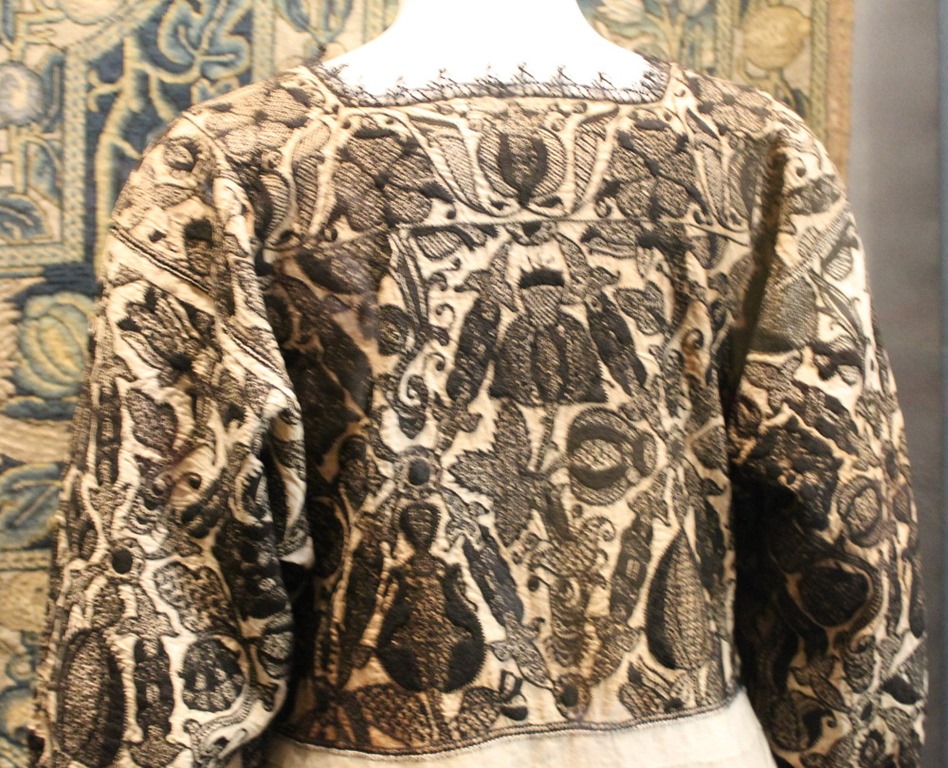
First off, to satisfy my stitching readers, is this blackwork smock, currently on exhibit at the Victoria and Albert Museum:

The full citation cites it as being of British make, and stitched some time during 1575 to 1585. They posit home manufacture rather than a professional house. If you read through the full description, you’ll find out that the top part (the stitched bodice) was done on fine linen, and the unseen and unstitched lower part was also linen, but of a much coarser fabric. The plain lower skirt and the needle lace around the neckline and cuffs are modern reproductions. The accession number is T.113 to 118-1997.
I tried to take pix of this artifact to show the details. It’s basically three large rectangles, with underarm gussets (each sporting a flower, and unseen here). One rectangle for each sleeve, plus a larger one with head hole for the front, back and shoulders. I wanted to see if that center strip was seamed from smaller parts, but I wasn’t able to do so based on my examination.
One thing that delighted me was the use of various techniques for the fills. Some were done on the count. It looks like the grid may be 4×4 threads. I can’t estimate the stitch per inch count, but it’s roughly comparable in look to between 20 and 25 stitches per inch. The thread does look finger spun from floss silk, with some areas more tightly twisted than others, and some variation in thickness.
Some filling placements were eyeballed, and done freehand (note the trailing vines and spot motifs that follow the flower forms rather than marching rigidly in diagonals). The solid bits look to have been done in satin stitch or a stitch in the Romanian couching family. The dark borders around the shapes look to be either outline or stem stitch in some places, and in other places possibly whipped or threaded back stitch. There may be knot stitches in there, too, (especially the knotted line stitches that sport little side stitch “legs”) but my eyes couldn’t pick them out for absolute identification.
Effort was made to use the same filling in matching areas of symmetrical designs, but some variations do occur. In fact, the occasional lapses in attention to detail on the fills, and that some are presented in a couple of variations (see below) are charming, and makes me think that my guess that the fillings were thought up on the fly, rather than being copied from canonical works may be true. (Filling inventors, take heart.)
I tried to get very close to the turned back cuffs to determine whether or not they were exactly double sided, with both front and back identical. Well, they’re close but not absolute. My pictures aren’t good enough to show it, but there are (barely) detectable knots on the inside of the cuff. The double running stitch fills and solid areas (satin stitch in this case) are certainly worked very neatly, especially compared to the relative chaos of the back sides of other contemporary work, but they are not spot on exactly the same front and back, although they are presentable and nicely done, for sure.
Here are some more pix of the thing. These shots were taken by Elder Daughter, with her superior camera skills and equipment:


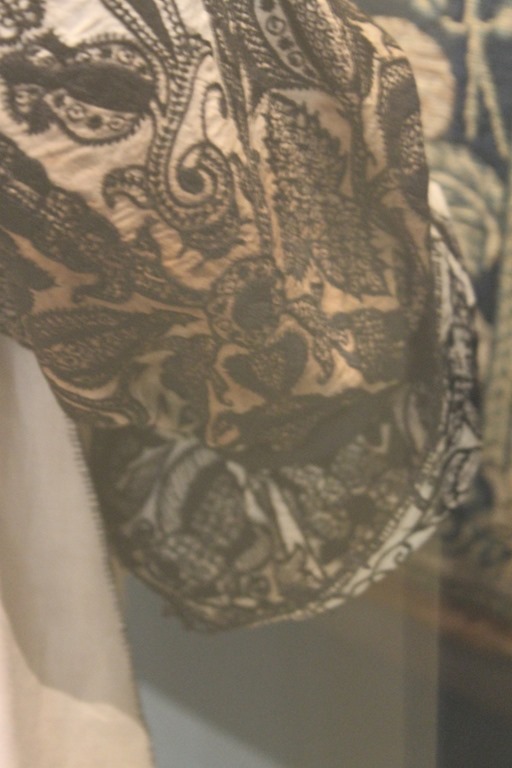
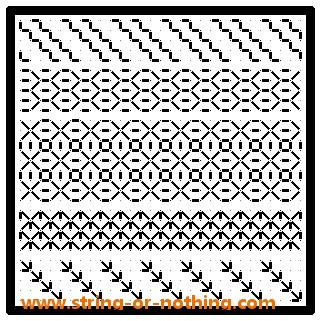
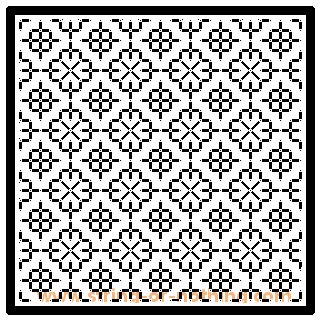
And finally, to satisfy the people who pointed out that I did not include exact citations for every fill in my free-to-download Ensamplario Atlantio collection, here is a set of 10 plates with fills sourced specifically to this artifact.


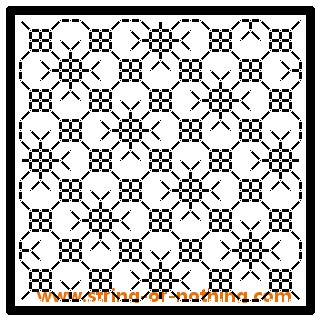
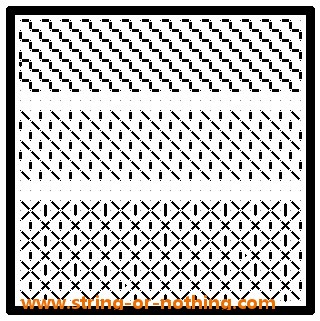


So much for facts. I have to say there were several items on display that caused me to hyperventilate like a Twilight fangirl. Blackwork geek that I am, this was one. It’s in excellent condition, with the stitching, dense, the threads shiny, and minimal wear or damage. The overall effect was one of understated opulence, but not splendor. For one, there is an aspect of “loving hands at home” to this piece, especially in the composition and heaviness of the fills.
But what struck me the most was that the standard of excellence in this piece is entirely achievable today. Yes, it’s exacting, and acquiring the materials would be difficult, but it’s not miles beyond the capability and reach of modern amateur needleworkers. It’s time we stop bowing to “the ancients” and banish our temporal craftsmanship insecurities The best of us are darned good (no pun intended), and many of the contemporary projects I see on the web are just as well executed as this prime piece from the 16th century.
IN WHICH WE BUY EMBROIDERIES–PART II
Here’s the second group of purchases.
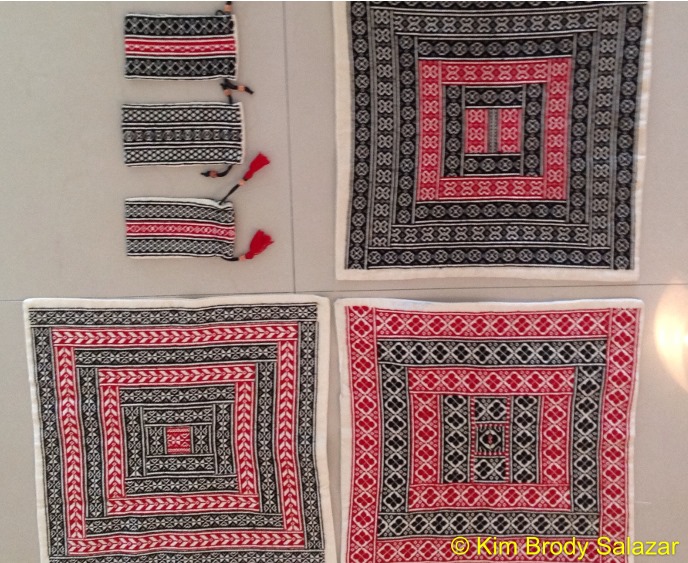
These are three cushion covers and three small glasses-case-sized pouches, all done in pattern darning. We also got these in Dilli Haat, in Delhi; from a Government-registered ethnic arts stall. In this case, the pieces were done by a Toda cooperative. The Toda people are from South India in the Niligiri Hills and surrounding areas. Their traditional culture is pastoralist, centering on dairy herds.
Their stitching, seen on a Toda’ woman’s outfit below, has been adapted for retail sale. The Dilli Haat vendor was selling the square cushions and small bags I bought, plus tote bags, larger throws, and bolster cushion covers (think cylinders, with the stitching going around the circumference).

Image credit for the lady above: 6 Assago via the Fair Trade Forum – India, which also works with Toda cooperatives to market their crafts.
Anyone who is familiar with my love of black, red and white geometrical stitching will know I was especially delighted to find these pieces. It will be difficult for me to part with any of them, even though I bought them as gifts.
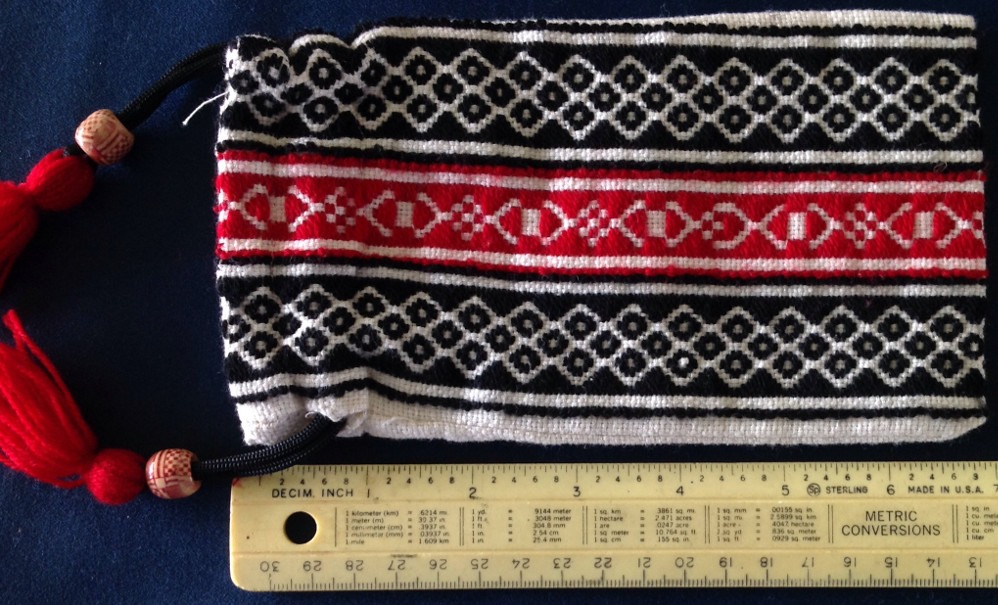
In terms of technical specs, the white ground cloth is a bit like Aida cloth, even weave with a well defined “stitch here” hole structure; at roughly 20 doubled threads per inch. The thread used looks to be an acrylic lace-weight plied yarn. It’s a bit friable, so gentle care is in order to minimize surface fuzzing. The pouches and cushion covers are lined, so seeing the reverse is problematic.
Now, there are several embroidery styles in India that use pattern darning. For example, Kasuthi also employs Negi (weaving) stitch for individual stand-alone motifs or for borders in which the stitches form the foreground. But the Toda style is a bit different. It’s characterized by strips of uniform patterning, with the stitching making up a solid background against which the unworked ground cloth peeps through in geometric designs.
And I love it.
 String-Or-Nothing