THE LEAFY FAMILY
I hope I’m not boring my readers (especially my knitting pals), but with just a little bit of encouragement, I’m off and running on more historical embroidery pattern families.
This one I’ve nicknamed “Oak Leaves.” It’s relatively well represented – not the design with the most extant examples, but I’ve managed to collect seven photos of artifacts displaying it, in various styles. No modelbook source (yet), and I particularly like when designs are interpreted in different ways.
As in many of these smaller fragments, museum provenances and dates are not necessarily precise. Some of these artifacts have not been revisited since they were originally donated to the hosting institutions. Putting these on a specific which-came-first timeline is problematic, especially doing so based on photos alone. However, there is a possibility here again of “separated at birth” pieces, where an original artifact was cut apart by a dealer and sold to multiple collectors.
I start with a piece given to the Cooper Hewitt by my idol, Marian Hague. She was an embroidery research expert and curator, who worked with several museums in the first half of the 20th century. Her work pairing extant pieces with modebook sources is legendary.
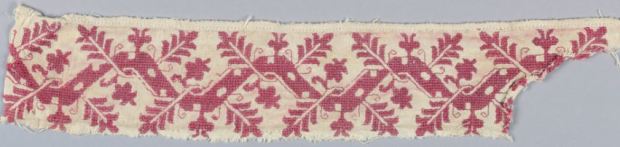
The Cooper-Hewitt citation for this piece dates it as 17th century, and of Italian origin. The museum’s accession number is 1971-50-97 and was acquired as a bequest from Ms. Hague. It displays the signature elements that make up the group – the center meander, with two heavily indented “oak” leaves sprouting left and right, overlapping the meander. A central smaller floral element in the center of each of the meander’s hump, and a secondary leafy sprout filling in the hollow of the design between the leaves. This particular piece also has voided spots along the length of the center meander.
Compare this piece from The Art Institute of Chicago:
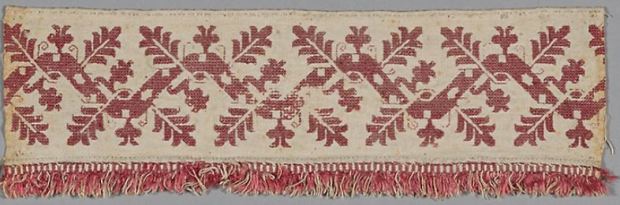
They also attribute it as 17th century, Italian. The AIC accession number is 1907.742, acquired in 1907. Although the C-H example lacks the fringed edge, the executed design of both pieces is extremely close. C-H on left, AIC on right:


Ignore minor wear and tear. The count of the leaves, voiding of the stems, method of placing and working the spots, and placement of the tendrils is the same, although some of the tendrils on the AIC sample have fallen victim to time. Therefore I opine that these two pieces may have come from the same original. That Ms. Hague’s bit is a bit more savaged is not unusual. There are other instances where she had fragments of pieces in museum collections, but usually kept the more damaged bits for her own research.
Moving on here’s a fragment from the Metropolitan Museum of Art:

The Met places it as 16th-17th century, also Italian. Its accession number there is 09.50.3806, collected in 1909. This may or may not be part of the same original as the previous two, even though it is fringed like the AIC sample. For one – it’s mirror image. That in an of itself isn’t a big difference. Photos get reversed. Designs themselves are sometimes mirror-imaged if they appear on opposite sides of a larger artifact. Tendrils are missing, but this piece appears to have undergone more wear than the other two. There are enough partial remains of the double running (or back stitch) bits to posit their existence. But while the delicate linear stitching is more prone to damage the heavier interior stitching is more durable.
Look at the little interlace where the leaf-twig emerges from beneath the meander and crosses over it (AIC on left, Met on right):


The little “eye” of filling, which done in the solid filling stitch and should remain – is missing.
Might this be part of the same original, possibly a suite of hangings, covers/cloths or bed furnishings, but of a segment done by a less attentive stitcher? Possibly. But also possibly not, especially in light of the next example.
Here’s another one with an empty “eye.” This example was found by my Stealth Apprentice, and is in the Textiles Collection of the University for the Creative Arts in Farnam.
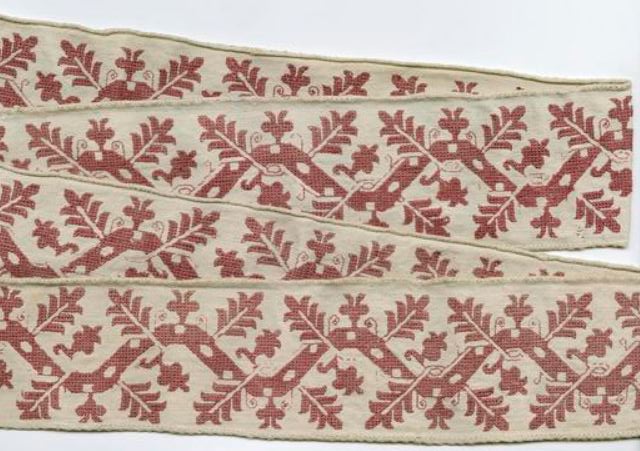
Unfortunately, the UCA gives no date or provenance for the work. Note how long this strip is, and that it’s folded – we see both sides. This might be double running and one of the double sided Italian cross stitch variants because regular long-armed cross stitch doesn’t look the same front and back. Tendrils? Check. Center meander with holes? Check. Oak leaves and supporting sprouts? Check. BUT those “eyes” – they are not worked, just as in the Met example.
OK, now we go on to other design adaptations. This voided piece from the Boston Museum of Fine Arts is undoubtedly an interpretation of the same design, but with a bit more elaboration on the stems – using twining instead of spots, and on the sprouts and leaves. It’s also doubled north/south – a very common method of taking a strip design and making it more dramatic by making it wider.

The MFA calls this piece out as being Italian, 16th-17th century, and names the technique used as “Punto di Milano.” (The MFA uses several stitch style names not commonly seen elsewhere, this is one.) The accession number is 83.236.
I am particularly intrigued by the unworked area at the upper right. The tightly overstitched pulled mesh technique used for the background is almost impossible to pick out, and even worn, leaves a very clear perturbation of the ground weave. I know this from sad experience. Even over the centuries, I have to say that the missing bit was just never worked. Which gives us an insight into working method – defining an area, then going back and filling it in.
Did this piece, in this style predate the more simplified depictions above? Again we can’t say for sure, but I tend to lean that way because the spots on the wide, plain meander to me look like the simplified descendants of the voids formed by twining stems in the MFA’s example. One person’s opinion – feel free to disagree.
Voiding. That was always done in long-armed cross stitch or the meshy stitch, right? Nope. Here’s another example of the same pattern, with an even more finely defined main twining meander, but done with a squared filling stitch. This one is also from the Metropolitan Museum of Art:

The Met lists this one as being Italian or Greek, from the 16th-17th century. It was acquired in 1909, and its accession number is 09.50.58.
This piece is my favorite of the set, both for the delicacy of the interlace and the squared ground. Obviously the tendrils are gone, as in the other voided interpretation, but it’s the same oak leaf design for sure. And did you catch the mistake? Upper right, where the meander is cut off from joining the previous repeat. That’s not wear and tear – that’s a place where stitching happened where it doesn’t appear in subsequent repeats.
And last, but not least, a pattern cousin. This one was also found by the Stealth Apprentice.

This is an Italian towel or napkin, claimed as 16th century, in the Marcus Jehn private collection. The only link I have for it is to the collector’s Pinterest board.
This is a curious piece. It’s clearly derived from the same pattern family, interpreted in a linear stitch. But the interlaces of the meander are rather heavy compared to the delicacy of the Met square-voided sample, above. The slightly fudged corner is also of interest. If I had to guess, I’d suspect that this piece was a see-me-and-copy, derived from something that looked more like the two voided examples.
So, what have we seen here? Mostly that there are design clusters that are clearly related. That there is no one canonical way in which to use these patterns – interpretations, some only a bit different, and others quite divergent, vary from artifact to artifact, even among those done in the same technique. And based on museum citations alone there’s no clear way to arrange them in parent-child relationships other than idle musing.
Most of all, I like that there is no one “right” way to stitch these designs, and that when I do my own variant, I’m adding to family that stretches back for hundreds of years.
UPDATE:
And another one of the same family surfaces! This one is the largest departure to date in terms of style, but it is clearly descended from the same pattern lineage.
Meet the Metropolitan Museum of Art’s holding #09.50.65 – entitled “Fragment,” dated to the 16th or 17th century, from Italy or Greece; added to the museum’s collection in 1909.

UPDATE UPDATE:
And another…
This one is from the Victoria and Albert Museum. It’s one piece of a composed group of borrders, displayed together. The entire group is attributed to 17th century Italy, and is cataloged together as museum number T.114-1930.

This one is sort of half-way between the versions with the heavy, abstract main trunk at the top of the page and the Met example with the squared ground. In this “missing link” you can see where the lozenge spots on the most abstract versions come from, while it still retains the coiled smaller branches of the most detailed example.
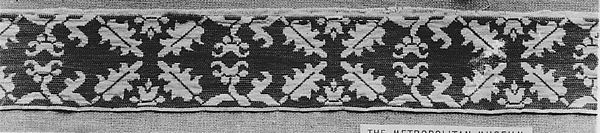
To complicate matters further, there is the fragment below, from the Met, accession 79.1.294, also sourced to 17th century Italy – Sicily in specific. Although the museum calls it a border, I don’t think it started out as one. The bottom edge is nice and neat, with a defined stitched edge, but the top piece is ragged – cut from a larger design. Now look at the V&A piece above and image it doubled, with two strips stacked one on top of another. (Doubling pattern strips this way was a very common method of achieving a deeper design.) In your thought experiment, now “cut” a section where the leaves are facing each other.
Hmmm….
Not only is this totally plausible as a strip cut off of a wider design based on our leafy friend, but the similarities to the Met’s strip are unmistakable. Again, we can prove nothing without artifact forensics on the ground and stitching thread, but I would not be surprised to find that these came from different stitched sections of the same original piece – possibly from a side strip and a wider decorated end of a towel or other cover.
ONE DESIGN’S MIGRATION
Early stitching modelbooks. They so often look the same, page after page. Where did I see that design before? Why is it oh, so familiar?
And so we launch again into a post that only a stitching geek would love.
Early European modelbooks produced by sixteenth century printers in Italy, Germany and France often include similar patterns. Often the same patterns. Sometimes patterns SO much alike that one would think they were printed from the same blocks. In some cases, especially if one printer did successive editions of work, that’s entirely likely. In other cases, where the same block appears in works from different shops – that’s not entirely clear. Especially if the workshops of the various printers were separated by geography and/or time. However it happened – trade in blocks, plagiarism from printed copy, whatever – it is clear that considerable cross-pollination did occur.
Here is just one example.
This is from Niccolo d’Aristotile’s (called Zoppino) Venice-published Ensamplairo di Lavoiri, 1530/1531, as redacted as Volume I of Kathryn Goodwyn’s Flowers of the Needle collection (left). At right I show the same page from an original (unredacted) copy of the same book in the Gallica BNF20 collection, to remove doubt about any assertions I made below being artifacts of cleaning up for reprint. Watch those two center designs:
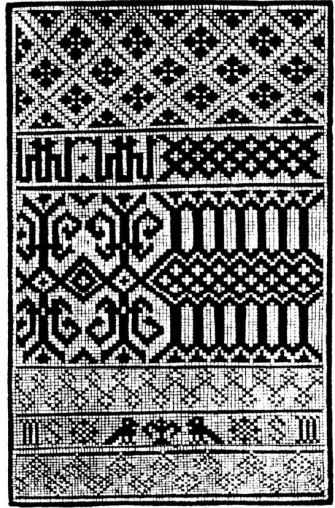

1530/31, Italy is pretty early, right?
Well, there’s this. Johann Schonsperger the Younger, from 1529, published in Augsberg, Germany This is from Ein new getruckt model Buchli auf außnehen, vnnd bortten wircken..., in the collection of the Staatliche Museen zu Berlin, #0S-1473-kl, as presented via Bildindex.

Not surprisingly, Johann Schonsperger’s earlier work, Ein new Modelbuch auff auaußnehen vnd bortern wircken.. from 1526 (also from Augsberg) has the exact same page. Also from Staatliche Museen zu Berlin, #0S-1472, as presented via Bildindex.

So we’ve traced this panel back to a 1526 edition, published in Germany. But were all of these printed from the same blocks?
I’d say that the two Schonsperger pages were certainly produced from the same blocks. They have the same curious features and mistakes.
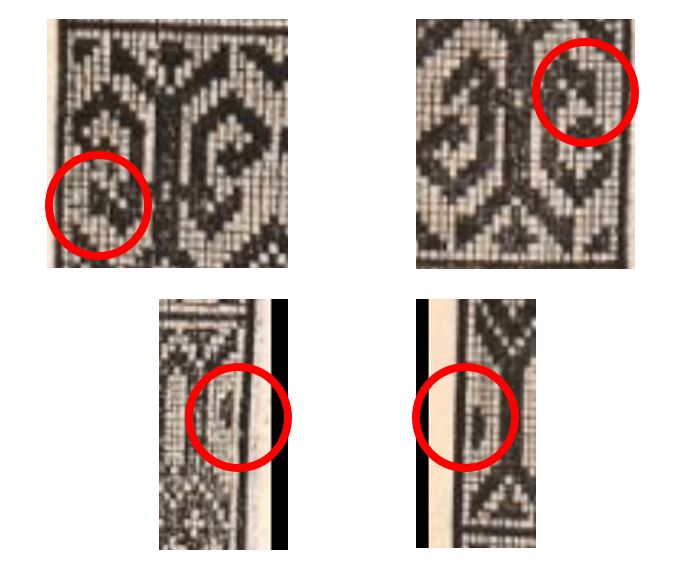
By contrast, here are the same sections from the Zoppino work, with the same areas highlighted:

Yup. The little crescent is missing, and the lower arm of the fleur-de-lis type detail with the clumsy header is gone entirely – the design is truncated, leaving it on the cutting room floor. There are other differences – mistakes made in one version of the design but not in the other, that you would only notice if you were trying to redraft or stitch from each pattern.
So in this one case, I’d posit that a copy of a printed page from Schonsperger in Augsberg – either as part of a book, or as a broadside – made its way to Venice, where it was seized upon and re-rendered for inclusion in Zoppino’s collections. Which is pretty much counter to the intuitive argument that I’ve seen many make – that these counted patterns all originated in Italy and then spread north. Of course there may be another printed copy even earlier than Schonsperger…
Oh, and this design in particular? I’ve always been fascinated by the narrow border with its strong directionality. I posited in The New Carolingian Modelbook, that based on similarities to examples of Tiraz band calligraphy done on the count, as appearing in Richard Rutt’s book A History of Hand Knitting, 1989, that this motif may have been copied (possibly without knowing what it represented) from an extant piece of stitching, rug, or other textile from an Islamic workshop. If that’s true, it would make the design’s peregrinations even more impressive. Somewhere in the Islamic world, to Germany, then to Italy. And on from there…
UPDATE
And the Schonsperger plate makes another appearance! This time in Anton Woensam’s Ein new kunstlich Modelbůch, published in 1536, in Köln.

UPDATE UPDATE
You guessed it! Another appearance of our block friend – this one in Peter Quentell’s 1541 Ein New kuntslich Modelbook, published in Cologne. It also has the same idiosyncrasies as the Schonsperger, above.
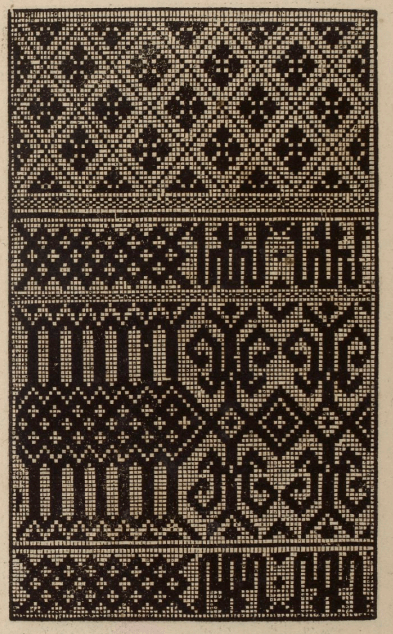
UPDATE UPDATE UPDATE
Yet another representation has crossed my notice. And it’s a particularly curious one. This is from Schon neues Modelbuch, printed in Frankfurt in 1608, from the shop of Mayn Durch Sigismundum Latomum (Latomus).

Although it mostly aligns with the Schonsperger-Woensam 1536/Quentell 1541 version, it’s lacking a couple of very minor copyist errors, although it faithfully duplicates other peculiarities of that printing. Also it extends further to the left – instead of seven column/diamond repeats in the geometric on the left hand side, there’s a mirror point/bounce repeat. BUT at the center of that repeat there’s an artifact – the “elbow” of the curlicue pattern on the right. In other blocks it may serve to cue the stitcher that the geometric and the curlicue can be alternated, but here it’s encapsulated inside a rather clumsy centering, with a badly botched top and bottom border, plus on the same bounce line, another improvised mirrored center (with an extra wide column of boxes) in the simple separate border beneath. Almost like someone wanted to take an older block and eke out the page, so a new bit was carved to match. Hmmm…..
UPDATE x 4
I thought I had stopped finding more of these today, but apparently not. I’m including this because it fills in more of the early representation/movement of this design.
From Livre nouveau et subtil touchant l’art et science tant de brouderie fronssures tapisseries comme aultres mestiers qu’on fait à l’esguille soit au petit mestier aulte lisse sur toile clere tres utile et necessaire a toutes gens usant des metiers et arts dessinés ou semblables, published in 1527 by Pierre Quinty, probably in Cologne. It appears to be the Schonsperger plate, verbatim. Complete with odd little carving errors.

Our timeline now looks like this:
- 1526 – Augsberg (Schonsperger block)
- 1527 – Cologne (Schonsperger block)
- 1529 – Augsberg (Schonsperger block)
- 1531 – Venice (Zoppino block)
- 1536 – Köln (Schonsperger block)
- 1541 – Cologne (Schonsperger block)
- 1608 – Frankfurt (Schonsperger block, partial – augmented with additional carving)

