MODULAR EXPERIMENT
A quick bit of knitting to keep the fingers occupied.
Using some of the yarn I got during the Wild & Woolly’s close-out sale, I started an improvised modular blanket. I’ve seen lots of these on line, knit in small units with a double decrease providing the shaping. Some are worked in modular style as the piece grows so there is no seaming later, others are produced one unit at a time and then stitched into the final form. Because of the directionality and relatively small width of the individual squares, they can be used to show off a gradient, long repeat, or self striping yarn.
I’m not using a pattern, I’m just noodling this out as I go, knowing that others have done so before me. This isn’t invention, it’s reverse engineering on the fly.

I chose the simplest of shapes – the square. It’s fifteen stitches on a side, worked in garter stitch, with a center double decrease providing the fish-scale or tree-leaf spine. I also chose to use the modular knit-on style.
I started by making two single unit squares (the rightmost two on the bottom row). Then I made the dark top square just underneath the needle, starting it by picking up stitches along the top edges of the two established squares. Having established a diagonal direction of working, I then picked up half of the stitches to make the middle square on the right edge, casting on the remaining half. When I finished that one I broke the yarn and started another diagonal row of squares to the left of the finished ones. You can see that I’m mid-way through yet another diagonal run right now.
I’m using JC Brett Marble Chunky, a very soft all-acrylic that comes in large 200g/341 yard (312m) puffballs. It’s slightly reminiscent of Lion Homespun (also made in Turkey), but in nicer colors, and without the annoying thread binder that tortures Homespun into its crinkly shape. Marble is machine wash in cool water. I’d dry it flat to keep its texture.
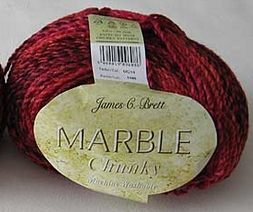
I’m working on US #11 (8mm) needles in order to get a nice drape on the finished item. It’s a quick knit – about 15 minutes per square, so this should move along at a good clip. The yarn is interesting, with the shading of the two constituent plies meandering from rose to deep maroon, with side trips that introduce a little bit of orange and purple. I like the loft and texture of the finished garter stitch on the #11s. I had tried this on smaller needles (the label recommends 6mm – US #10, but the fabric was too stiff for a blanket, although adequate for a sweater). However, I am not fond of the yarn’s tendency to shred and split. It’s relatively softly spun, and needle tips – even massive #11 needle tips – catch on stray bits as I work. This makes ripping back difficult, especially on the center double decrease (slip 2 tog knitwise, k1, pass slipped stitches over). Still, the annoyance is mostly passed, now that I’ve decided on what to do with the stuff, and what size needles to use.
As usual, I’m bungee-jumping here. The particulars are being decided upon as I go. I’m not sure how big the final piece will be, or whether I’ll stick with the established pattern of squares throughout, or even how big this center area (if it ends up being just a center area) might be in relation to any framing or edging elements. I may add edge triangles to norm the zig-zag sides, then do something else for an edging. There are several possibilities once the thing is a nice, even rectangle:
- A couple of rounds of concentric I-cord, or perhaps double I-cord
- Another round of some type of modular units
- Narrow strips knit perpendicular to the blanket’s body, so that the yarn’s gradients show well, probably with mitered corners, just for fun.
- Some kind of edging that uses garter texture and diagonals, to echo what will be happening in the center area.
Why a blanket now, and not continued work on the lace-in-process? Well first, new yarn burns a hole in one’s pocket with an urge to cast on SOMETHING. Of the yarns I’ve gotten at the sale, this is the only project that would be quick enough to complete before my return to India, and all of the yarns I’ve gotten are too massy to fit into my luggage. Also, aside from three warm days, it’s been rather cool here for spring in Massachusetts. A nice, cozy throw just appealed to me.
Finally, the last point of pondering… ANOTHER blanket? Who’s going to get this one? Younger Daughter has piped up, so it may end up being hers.
RIGHT ON TRACK
A semi-quiet weekend here at String.
First, progress on my Dragon Stole, which I’ve modded to include the central undine from its pattern’s ultimate ancestor:
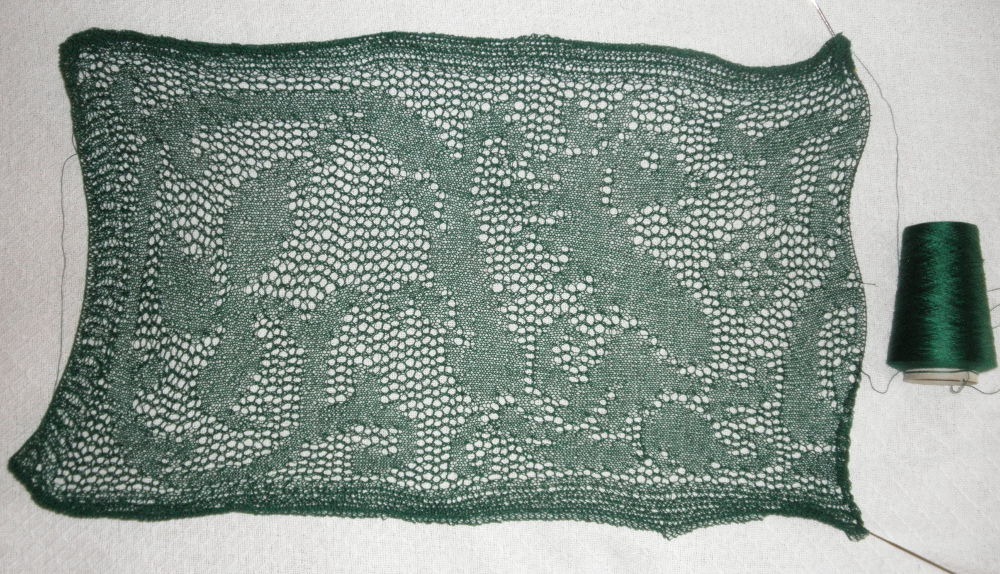
Mods include the star above the beastie’s eye, the large flower in front of it, and beginning of the mermaid at the right.
You can see that my spool of Valley Yarns Tencel 8/2 has been barely diminished by all this knitting. The tencel is quite easy to work with, a bit slippery compared to cotton (which for me is a good thing), but less slippery than rayon. It doesn’t roll back on itself to kink, even coming off the cone. Being about half done at this point, I estimate that my cone, claimed by Webs to have 3360 yards on it, will be ample for 8-10 shawls of this size. At around $25 for the cone, I’d rate it as a very good buy. Aside – if you’re budget challenged or packing for an extended stay somewhere, consider taking up lace knitting. Lace offers the most knitting satisfaction per dollar invested on materials, and per square inch of suitcase space.
Then, coincident with the Indian nation’s Republic Day, Younger Daughter’s school had their annual field day – a morning of track and field events pitting the Indus International School’s various houses against each other. Phoenix, Orion, Hercules, and Pegasus have vied all year for points in academics, debating, deportment, and sporting events, just like at Hogwarts. Field day is the culmination of the annual competition.
Assignment to the houses appears to be pretty arbitrary, no sorting hat here. Younger Daughter was shuffled off to Hercules on the whim of the admitting administrator. Hercules took first place in the day’s marching. Here they are, behind their blue flag:

Perhaps the most fun of the day was the kids vs. faculty tug of war, where (no surprise) the myrmidons of the massed houses triumphed over their long-suffering teachers. Younger Daughter’s sense of triumph is palpable:

Phoenix house won the 2012 house trophy. I hear the kids are already plotting new domination strategies for 2013.
WHELK AND STOLEN DRAGON
The long flight overseas was not wasted. I managed to knit a hat during the trip. This is Le Bulot (The Whelk) by Kokolat de la Kokolatiere. I worked it up with some remnants, roughly less than half a skein each of charcoal color Regia Extra Twist Merino, and On-Line Supersocke 100 Harlekin Color for the multi.

I’m pleased with the result, but I can say that the pattern isn’t entirely straightforward. It took some deciphering, plus referring back and forth between the French original, the English translation, and the very informative pix of the finished item, but I got it all together in the end.
One thing that sped up production and minimized the number of things that could go sliding underneath my airplane seat – instead of using the slip one stitch to a cable needle and knit in front, I used a left twist stitch. When I got up to the part of the pattern that included decreases made at selected twists, I worked them by inserting the tip of my right hand needle into the backs of the second and third stitch from the end, knitting them together but leaving them on the right hand needle, then shimmying the right hand needle into position to knit the twisted stitch, and finally slipping the entire unit off the left hand needle. Oh, and while doing that I kept track of which color would follow in the logic of the row, and made sure that the decrease was worked with that one. Not particularly difficult, but not exactly mindless, either.
On the yarns, I’ve used the Supersocke many times before. It’s a standard issue self striping sock yarn, with an interesting mix of bright colors in a rather conservative small repeat. On socks, about four full repeats of the entire color sequence will occur in the foot part. I was less pleased with the Regia Extra Twist Merino. It’s nice and soft, and looks good when knit up, but for a sock weight yarn it splits like crazy. No word yet on durability, but I’ve knit a hat, admittedly not the most torturous use for the stuff.
I’ve finally unpacked my knitting and stitching stash. Working on my big green sampler right now will be problematic, though. I don’t have a good light for evening stitching, although I can haul a kitchen chair to the big windows and work on it during the day. I may ease my stitching withdrawal symptoms by working on a smaller in-hoop project. I brought some supplies and a kit with me, so I’m armed.
In the mean time, I’ve embarked on the MMario Knits Dragon Stole, an extended exercise in filet knitting.

I’d played with filet knitting before, but was not satisfied with the methods I had tried. MMario uses three worked rows per graphed chart line, and while not as teeny, nor as precisely geometric as filet crochet, works quite nicely. I’m hoping that I’ll be able to apply his method to my huge warehouse of Italian Renaissance graphed patterns and have some cross-pollination fun.
STILL AMBITIOUS
Motley continues to grow. I’m just about done with the center area now:
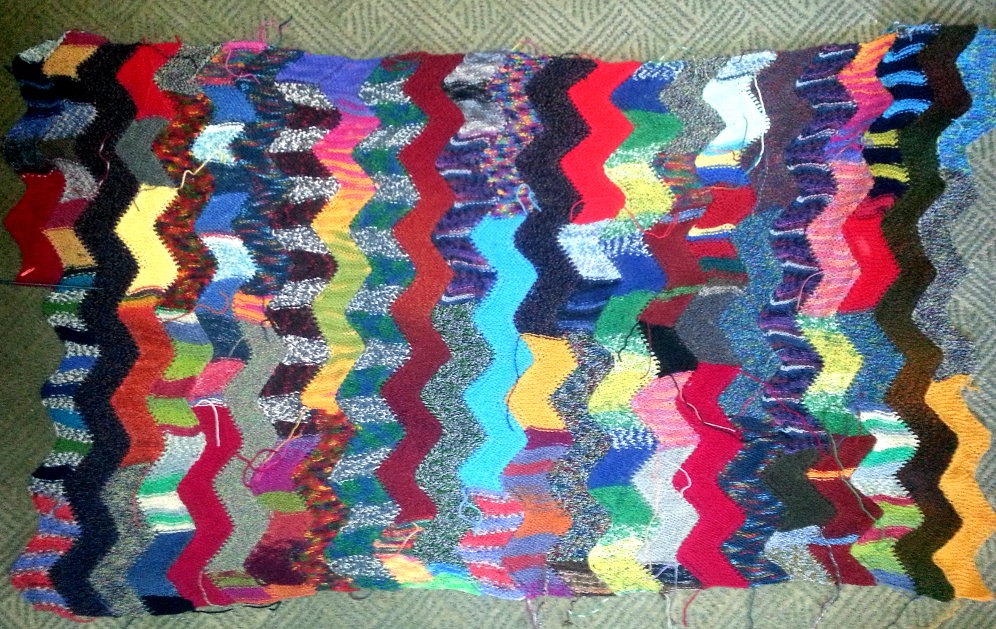
Some people have expressed incredulity that I’d consider working fingering weight on US #8s (5mm). However it’s working out just fine for this purpose. This is a blanket, not a sock that benefits from tight knitting, nor is it a garment on which a looser fabric would present show-through problems. Instead, even with the large needle size, thanks in part to garter stitch, I’m getting a nice, cozy and cushy thermal weave texture.
However the main reason I chose such a large needle size relative to the yarn is because I’m using up dribs and drabs of yarns in a variety of weights, from light 3-ply fingering like ancient Kroy 3-Ply and Wildfoote, to standard sock yarns (Regia, Opal, Fortissima) all the way through some of the heavier sock yarns that are almost sport weight (Marathon, Koigu). I even have a couple of small ends of lofty DKs that knit down to sport gauge. That means that the “native gauges” of the yarns in this piece range from about 32 to 24 stitches in 4 inches (10cm). Breaking the rules and working them all on what normally would be grossly large needles evens out differences in gauge and lets me use them all together. Yes, some of the stripes are denser (or more airy) than others. But they all present as uniform in width, and as a whole – work together.
I’ve got to finish out the current stripe (at far left) and add another at far right. Then I’ll be up to the next step – filling in the edge triangles left and right to achieve a nice, even rectangle.
There are two methods I could use to do this – either pick up one stitch and knit an isosceles triangle, joining the two shorter sides to the existing blanket, using the same method I employed to knit each strip onto the growing whole; or I could pick up stitches along the edge of each “zig” and knit out, using a center double decrease to achieve the triangle shape. I’ll probably experiment with both, although I am leaning to the first method for visual congruence with the rest of the piece.
Once I’ve filled in the edge triangles, I’ll probably work a narrow solid color strip all the way around the outside, using mitered corners, to unite the piece. After that all bets are off. I might stop there, or I might add some sort of zig-zag or dagged edging, also worked in multicolors. There’s only one problem though. I started with a bag of leftovers that was about the same size as half a standard pillowcase. I’ve used most of them, and don’t have a nice range of colors left. If I do a multicolor edging, I’ll have to BUY yarn to complete my stash-consuming Motley!
Whichever methods of framing and finishing off this piece I choose, I will be writing this up as a method description, complete with approximate square yardage per weight estimates (for fingering) so that those of us who happen to have a bag of leftovers the size of a 25-pound turkey can put them to good use on their own stash-busting scrap blanket.
GAUNTLET IS CAST
Two pairs, actually. Now winging their way cross country to the recipients:

Both are from patterns available on Ravelry. Left are Susie Roger’s Reading Mitts, and at right are Swirling Gauntlets by Susanna IC. Both are knit from Red Heart Shimmer, one skein of which (plus four evenings) was more than enough for both mini-projects.


I mailed these on Monday, but I’m posting this ahead so that the package has time to arrive without totally spoiling the surprise! Shh!
MORE MOTLEY, MUFFATTEES, MODIFICATION AND MUTT
Back from visiting Florida, my mom and sister (plus her family). We had a great time, feted like royalty on progress. Special thanks to all, especially my mom, and to Chef Terry who pulled out all the stops for the holiday meal.
Motley
Sitting and chatting with mom did allow Motley to grow. In order to keep color distribution even, I have been adding to both ends:

I’ve got some snippets of hers now in there, too. I’m about two thirds of the way through the center rectangle, and am very pleased at how it’s turning out.
Muffattees (Fingerless Mittens)
Also, while we were there my two nieces expressed a desire for fingerless mittens. I’m not quite sure why they’d need such a thing in Florida, but teenage fashion whims (when reasonable) can be indulged. Especially when they are a quick knit.
For the first pair, I’m using the Reading Mitts pattern from Susie Rogers, available on Ravelry:
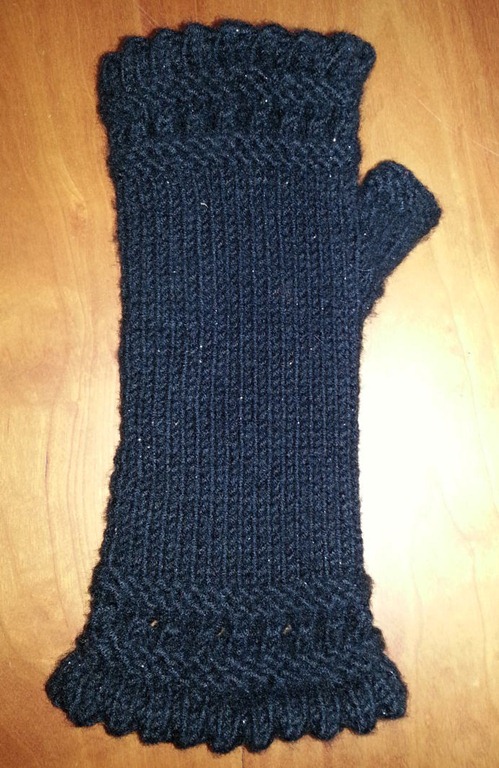
I’m about a third of the way through the other mitt of this pair. I’m still looking for a slightly different but equally interesting design for pair #2. Although I love luxe yarns, I’m no materials snob. The yarn for this one quite humble. It’s a very soft Red Heart acrylic worsted with a subtle shiny mylar thread running through it. Called Shimmer, it does, just a tiny bit, and has a very pleasing almost cashmere-like softness, which will feel nice on the hands. I chose a washable yarn because even in black, mitts get dirty quickly. The yarn is a bit splitty, but I’m happy with the result.
For the pattern, I knit the smallest size. With this yarn on US #5s, it’s plenty big enough (the medium was too big for me and I’ve got gorilla paws). The only modification I did to the pattern was to use a provisional cast-on, then knit the cast on stitches along with the live stitches to fuse the picot hem, just before the decrease row that sets count for the cuff pattern. That ended up adding one row of width to the edging before the first purl row of the cuff. Not noticeable. Also users should note that the lace pattern is set up for an even number of stitches, but two of the three sizes as presented yield an odd number in circumference after the decrease row. Just ignore the extra stitch and work it plain – on this item no one will ever notice. Finally, the method for picking up the thumb benefits from casting on two rather than one stitch on the side facing the mitt’s body. Even so, I advise leaving a nice long tail when you join the yarn to make the thumb. The excess will come in handy to close up the rather large gap at the “thumb crotch”.
This pattern is a sweet little project for a last-minute gift. Mitt #1 took two evenings. Mitt #2 bodes to take less, in part because I don’t need to start, then rip back the medium size.
Modifications – Vintage Yarn Chart Rehab
I know that lots of folks who visit here are looking for my chart of vintage needle sizes, historical yarns as plotted against gauge and modern needle sizes (with a few modern yarn recommendations). That chart was ported over in the Great Blog Migration, but arrived in less than readable condition. I’ve ironed it out now. To minimize confusion, I’ve modded the original post from 2005, rather than reproduce it here. But I’m opening it up again for additions. If you run across a pre 1930s pattern that calls for a specific yarn and vintage needle size, and you have made a successful modern substitution, toss a comment onto that page listing the original needle size and yarn specified, plus your modern substitutions. I’ll add them to that chart.
Mutt
Apologies for calling my mom’s companion, Honeybun, a mutt. Mom would classify her as a “designer dog” – a mix of Maltese and Yorkshire Terrier, sometimes referred to as a Mookie. But I needed the alliteration, and as long as I toss the toy or scratch behind the ears, I don’t think Honeybun would mind:

She’s a cute little bundle of fluff, and a very good apartment pal.
MOTLEY!
Things being rather unsettled here right now, but still in need of stress abatement, I looked around to see what evening needlework distraction I could find. I don’t want to start a forever project with only a limited amount of time before The Big Displacement. I’ve sent the embroidery floor stand on ahead to India, so working on Big Green is problematic. I’ve been doodling up knit scarves and socks – giving most of it away. Additional inspiration for this one came from the Resident Male, who always bemused by my yarn hoarding habit, forwarded this.
I’ve got a big bag of little bits of fingering weight – mostly left over from sock projects. I’ve dipped into it every now and again to make booties or to supply a stripe or toe for later socks, but for the most part, the bag has grown steadily larger in the 18+ years I’ve been knitting socks.
So. Given the need for totally mindless knitting, very few needles in the house (also mostly sent on ahead), and the guilt-induced constraint to use my stash yarn remnants, what could I come up with?
Motley!

This is ultra simple – 12 stitches across (10 plus 2 slipped edge stitches), knit in garter stitch; 10 ridges with each right side row beginning with an increase and ending with a decrease; followed by 10 ridges with the wrong side rows beginning with an increase and ending with a decrease. After the first ripple is done, subsequent ones are joined to the established chain selvedge edge with a simple pick up/pass last stitch over move, followed by purling that stitch on the next row. The basic zig-zag concept is Frankie Brown’s Ten Stitch Zigzag, which I’ve played with a bit.
Using relatively giant US #7 needles (giant for sock yarn, that is) I’m reaching into the big bag of leftovers, pulling out whatever I find, and adding it on. Eventually I’ll add little triangles to square out the piece to make a center golden ratio rectangle. Then I’ll figure out some sort of similarly chroma-chaotic edging, so that I end up with a little lap throw.
It’s a quick knit, and totally without thought. What you see above is the the consumption of nine mini-balls of leftovers over the course of three evenings.
GALAXY OF WINGSPANS, MORE KOMBU
Where have I been? Busy, mostly.
I’ve been getting our India-bound household goods shipment organized – buying what’s needful, and sorting the rest out from our domestic inventory. There are tons of details that have to be settled before we go, and not enough time to do them, of course.
But that doesn’t mean that stress abatement isn’t happening. I’ve taken to watching Dr. Who with Younger Daughter, after dinner is picked up and homework is complete. I’ve worked a bit on stitching, but mostly knitting. Holidays are coming up after all, and there are gifts to be stockpiled. Plus in all of the rushing around there’s a fair amount of “hurry up and wait.” I don’t do that well, so I always go armed with some sort of handwork. My big frame isn’t portable at all, so small knitting projects have been accompanying me on my rounds.
So far the tally for September/October is two pairs of socks, four Wingspan scarves (three were my variant on the basic pattern), and two pairs of booties. The socks below – finished yesterday – are my standard 72 stitch circumference short-row heel/figure-8 cast on toe-ups, with an improvised Old Shale/Feather and Fan variant on the cuff. The other pair of socks is making its way cross country to Elder Daughter (chasing the first Wingspan, sent several weeks ago), and the booties have been distributed. The two remaining Wingspans will be blocked this weekend.


Last night and this morning in the splendor of the Sears auto repair shop waiting room I worked on an old friend – my Kombu Scarf.
I’ve knit a few of these since first posting the pattern in 2004. The initial one was in Schaefer Little Lola, a space dyed mix of greens and browns, that combined with the undulating shape of the center, gave the scarf it’s kelp name. Since then I’ve done it up in other yarns, ranging from sport to worsted weight.
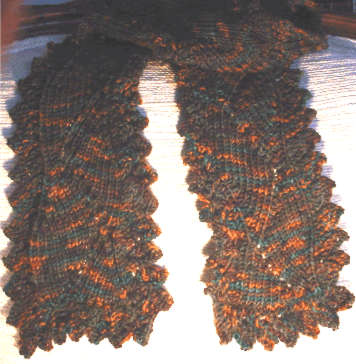
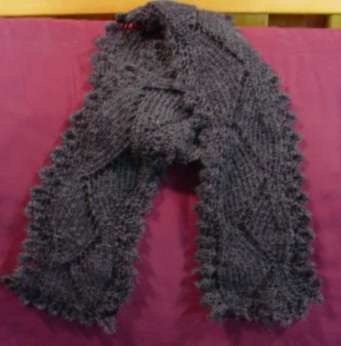

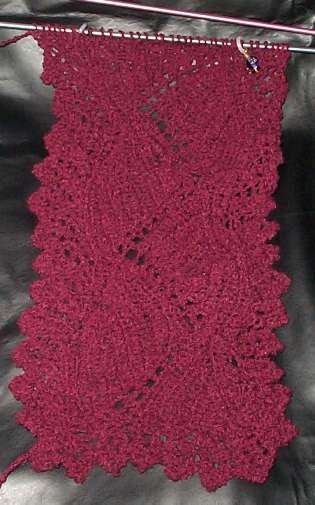

Kombu is a graceful, narrow scarf that can be made from as little as around 280 yards of yarn. The design is both bold and a bit fluttery. The pattern knits up well in every fiber I’ve tried (cotton, wool, acrylic, alpaca, cashmere blend). It’s reversible, attractive on both front and back. There’s no seaming – the bottom edging is knit as a narrow strip, then the scarf body is picked up and knit north from there, with the side borders worked at the same time as the scarf center. At the end, the final bit of edging at the top is worked across as a finish on the remaining live stitches, right from the needle. There’s no need to sew on or pick up and knit an edging, and if done from a large ball of yarn – there are only two ends to darn in when it’s done.
Here’s the latest. It’s in Marks & Kattens Indigo Jeansgarn – leftovers from one of my all time favorite projects.
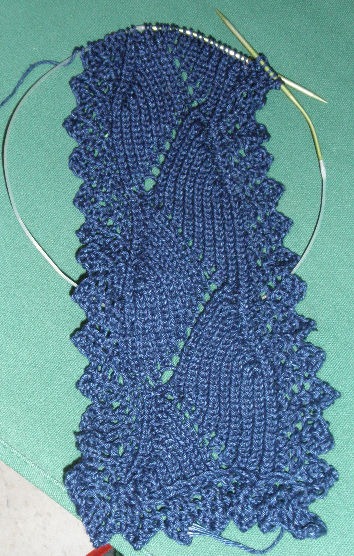
I started this one in part because I needed something on the needles, and I wanted to add to my pile of presents-to-be. But also I got a shout out from a Ravelry reader who was wrestling with her own Kombu project and needed help. It’s been a while since I knit one of these, I had to cast on in order to lend a hand. Happy to say, she appears to be over her problem, and is now knitting away again.
If you’re interested in the Kombu pattern, it’s available as a free PDF download, at the “Knitting Patterns” link at the top of the page. There’s a German language version there, too.
STEP FORWARD, STEP BACK
As you can probably tell by the off-the-end-of-the pier style of my knitting and stitching projects here, not everything is fully swatched, graphed out, or perfectly planned before it’s realized. This may horrify some readers, but it’s the way I think. I prefer to learn on the fly, and don’t mind ripping back or starting again. For me, exploration is more fun than final product.
Case in point – the latest Wingspan. Let’s critique this thing to shreds:

Things I like:
- The basic Wingspan pattern
- The larger needle size/gauge for this particular yarn
- Using dice to determine hole size and placement
Things I don’t like:
- The color progression of this particular yarn
- This yarn in garter stitch
- The overall (near) finished look
- The combo of color, stitch and technique is too busy
One thing that made the last two Wingspans so dramatic was the long and gradual shading of the Zauberball Crazy. This was achieved by Zauberball’s dual strand ragg plies each cycling independently through their color ranges. In this full strand as opposed to ply-dyed yarn, color change is abrupt and the colors themselves are high-contrast. Speckles of the next color dot each block. (Now I remember starting socks with this ball, and not liking them either). The holes look less like airy bubbles, and more like the savaging of a demented moth army. And the eyelets, which work nicely in stockinette, look sloppy in garter stitch.
In total, I was Not Pleased. So this has been totally ripped back. I may play a bit with other stitches and this yarn, but in spite of it being a looonnnnngggg repeat, I am not confident that it’s right for a garter stitch Wingspan. However, the technique of placing eyelets in a fabric using a randomizing device to determine placement is still gnawing at me, as is thinking about other possible Wingspan variants. As a single project, this is a failure, but as a learning experience, it was valuable.
In other news, I’ve added to our house arsenal:

It’s a Korean-made sickle, sharp and sturdy. Similar ones have been used in Japan for centuries. They often figure in Anime, Samurai (and gangster) movies, both in their agricultural context and as weapons. We are close-in suburban here at String Central, and not out in the land of gentrified sprawl, so why do we need such a thing?
Giant grass:

I cut the patches on the side and front of the house each fall, just after they bloom but before they scatter seed. I don’t want to be responsible for colonizing the neighborhood with the stuff, and I don’t want it to sit looking forlorn and frowzy through the winter. To date I’ve been clipping each stalk with a pruner, but that’s painful and time consuming. I am hoping that this tool will allow a swifter handful by handful harvest.
For those concerned with possible waste – I strip the leaves off the stems and re-use the stalks to build my bean trellis each spring. The leaves go to town composting. I also post about availability of (free) plant stakes each year on the local mailing list, and put them out on the curb for other gardeners to take.
LIKE WATCHING PAINT DRY
Mid-blocking. Waiting for her new Wingspan scarf to dry:
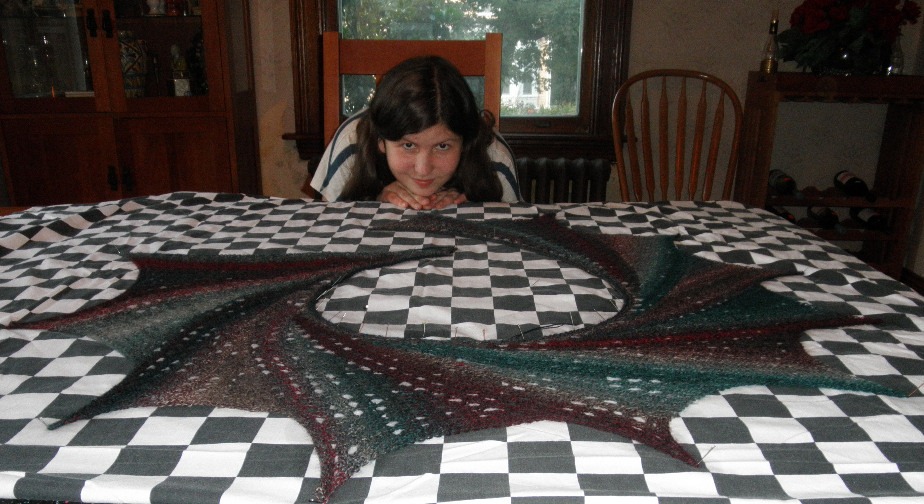
Before blocking, and the op-art horror of pinning out on a checked ground:
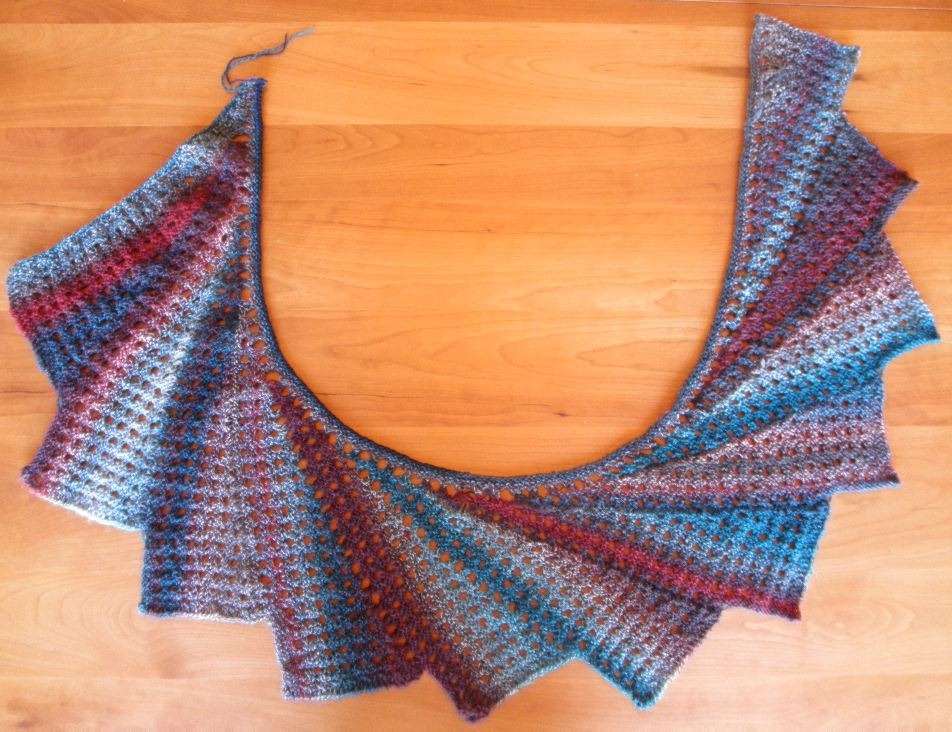

The actual color of this Zauberball Crazy is more like the two pinned out than it is in the dawn-light picture on the wood background.
What fancy blocking set-up am I using? Four rubber jigsaw-edged floor cushion tiles, with a rally check sheet laid out on top of them – all on the dining room table. I’ve got two twin size flat sheets like this, bought for pennies at a local salvage store. The regular 2-inch square checkerboard pattern may make eye-blasting photographs, but it’s fantastic for blocking to dimensions. Large checks come around every so often, most often in kids’ bedding, intended for proto-race car drivers. Oversize gingham and Tattersall plaids are ultra-trendy right now. They would also work well as blocking backgrounds.
Talk Nerdy To Me
I haven’t worked this Wingspan pattern out of my system yet. I’ve got one more ball of long-repeat hand-dyed sock weight yarn. My new yarn is mixed neons – very circus balloon like. This one has lost its tag, but I’m certain I found it at Wild & Woolly about a year or so ago. I like the lattice work double eyelet texture I used for this second scarf, but I want to try something more… unexpected.
I want to play with eyelets and this design, using a multicolor. But I don’t want to do the same regular lattice that I just finished.

I want to make something more like Swiss cheese, with eyelets of random size and spacing, to pick up on the airy, light-hearted colors. You can just make out a couple large and small eyelets in the purple stripe.
How to achieve random size/placement? Remember these?

Stand proud, you knitting dungeon crawlers of the past! That same set of dice so often used for exploring graph paper on dorm room floors, armed only with friends, a bag of Doritos and a bottle of Diet Coke, can also be harnessed as a knitters’ tool.*
I’m using a d20 and a d4 to determine hole spacing and size. I roll the 20-sided die, and the number rolled determines how many stitches I knit before I make an eyelet. The d4 by landing on an odd or even number, determines whether I make a large or a small eyelet. (Yes I could use die of any even number of sides for this, but why not employ that lonely, underutilized d4 for something for a change.)
The small eyelet is defined as a K2tog-YO2-SSK unit, with the YOs worked KP on the next row (a two-row double eyelet). Large ones are a bit more complex. They take three rows to complete – K3tog-YO3-SSSK as the base eyelet unit. On the next row I do another YO3 when I get to the hole. On the third row I work KPKP into the bottom YO3, encasing the horizontal strands left behind working both YO rows, and restoring stitch count to the original number. Yes, that’s a YO3, not a YO4, even though I’m working four stitches into the open space. I found by trial and error that YO3 made a less floppy, neater looking hole.
I haven’t seen this particular three-row mega-eyelet documented anywhere else, but as with all knitting – I refuse to believe that I’m the first to think it up. I’m sure there’s a reference book citation for it somewhere.
And using dice to introduce randomness isn’t an original idea either. There’s a whole school of aleatoric and indeterminate music that in addition to encouraging performers to take a major role in deciding how a piece is played, often employs mechanisms of chance (including dice) to add immediacy and uncertainty to its base compositions. Other knitters have used dice to determine stripe width or repeat, motif placement, or color choice.
So there you have it. Second Wingspan finished. Third, if luck holds out and this method produces something attractive, will be a bubbly, swirly Swiss-cheese of candy colored neon. If it does I’ll have to find a recipient whose idiom encompasses bubbly neon color scarves. And if it doesn’t I’ll rely on one of knitting’s prime virtues: The ability to reduce worked materials to their pre-project state, ready to begin something else.
* Another knitting-related use for polyhedral dice is as row counters. Put one next to you and advance it one number for each row (or stitch) that needs tracking.
 String-Or-Nothing