THAT MYSTERY SAYING…
More progress on the sampler tribute to the Resident Male’s book Fractured Symmetry. I’ve teased the photo of the motto on Facebook, and promised to explain it here. I’m now further along, and can do so.

The phrase comes from a discussion describing a settlement of Raylics – furred, pack-dwelling aliens, close allies of Terrans. While their society as a whole is a technologically advanced one, space-flight capable and modern in every aspect, they retain a closer bond to their past than do many other species of similar achievement. One way this manifests is the presence of artisanal/subsistence communes, preserving the skills, values, and lifestyles of prior generations. In this discussion, the Raylic founder of such a commune refutes a scoffer, who doesn’t believe that their efforts would be viable.
“In my youth I traveled space, and on other worlds there are still those who appreciate what is built with ferthan, fuur and fustovv” – Raylic for mind, fist and blood – and we will sell to them if our own folks have so much forgot what it means to truly live.”
Fractured Symmetry, page 224 of the print edition
So in a way, not unlike Roycroft and other similar movements grouped together under the Arts and Crafts banner, this statement echoes the tenets of concentrated, dedicated, personal manufacture; of valuing traditional hand skills for the vision, effort, expression (and any possible personal sacrifice of choice) that they contain. A weighty thought, and one not too often found in gadget-oriented/low-touch science fiction in general. And quite appropriate for a hand-embroidered piece.
As far as what’s what in the stitching, some but not all of the strips have allusions to the various stories that make up the book. The latest band with its fish-like creature is one of the ones that does. All of the band patterns (but not the alphabets) are in my books. A couple are in my free download Ensamplario Atlantio Volume II. Several are from the third volume of that series, on which I am currently working. One is in my for-pay work The Second Carolingian Modelbook.
The fancy initial F is based on yet another of the listings on the Patternmaker Charts blog – adapted from a linear alphabet in Sajou number 182. Although it’s shown in two colors, I opted to do the letter in just one. It was also a bit tricky because it contains a lot of half stitches, which are not well documented in the original chart. Obviously I also modded the letter a bit, making it taller by inserting a bit of my own interlacing, eliminating the solid cross stitch (or satin stitched) units, and smoothing out some pointy ends. The rest of the letters I made up on the fly, as needed. So if you go looking for a full A-Z of them you won’t find it.
One thing I’m still thinking about is adding more to the background field surrounding the motto. A lot will depend on how dense the stitching is beneath it. I don’t intend to do full voiding, not even in a sparse pattern, but there might be some need to add a bit more around the letters. Possibly a couple more spot motifs in blue. We will see…
How far am I along? There’s a little bit of basting remaining, left of the working end of the fish strip. That marks the north/south center point. The fishies straddle it. So there’s still a lot more to go. But that’s good progress considering I only started stitching this one only 14 days ago.
PAST PROJECTS AND LESSONS LEARNED – PART 1
This post is to answer Susan and Michelle, who asked how long I’ve been doing counted stitching and blackwork, and who wanted to see some of my other pieces.
At the risk of tooting my own horn, here’s the story. More or less. Over the years, I’ve cobbled together a few publications (some still unfinished); given away many pieces; started more projects than I’ve completed; and wandered away to and back from knitting and crochet. Please indulge me as I reminisce. I promise to put in lessons-learned as I go along to make it bearable.
All of these are original compositions of found and/or original motifs. I haven’t done a counted work kit or pattern designed by someone else since I was 12. It looks like I don’t often finish, which while it has some truth to it, I’ve given away many of the completed pieces, so what I have in my stash to show off are the unfinished bits.
The first counted project I did that’s not plain old cross stitch and is in the greater continuum that includes blackwork (that I still have) is a sorry, unfinished sampler I began in high school, circa 1973/74, continuing on and off up to January 1975. There are double running bits in it – among the very first I ever did. Most of the designs I cribbed from photos of band samplers and traditional pieces – taking magnifying glasses to the teeny and blurry photos of historical or ethnographic pieces in general survey embroidery books and books on samplers. It’s probably on 28 count even weave, using Coats & Clarks floss. Colors were haphazard at best – I used what I had at the time, and din’t plan much in advance.

Lesson Learned: A glimmer of the sad truth that while I am a starter, it’s much harder to be a finisher. I suppose I could go back and add in the tree and animals I originally intended. But there are so many other things I want to finish off first.
By the spring of my freshman semester, I found the SCA – an organization that advocates the hands-on exploration of the arts, sciences, and entertainments of pre-1600 cultures. That put the nail in this piece (being a mishmash of post 1600 band sampler patterns), but I found an inspiration. I had need to make a favor for a certain individual with a Spanish persona. So I zigged sideways and back in time a bit to blackwork, stitched over the summer of 1975. It’s the project that killed the sampler, above.

The only information I had on blackwork during the summer I stitched this was a tiny thumbnail photo of the Faulklands Cushion in Mary Thomas’ Book of Embroidery. I drew the leaf shapes and my device, and did diapered fillings freehand, on muslin. There’s also a bit of needle lace around the edge, with points at the corners – everything now dirtied and tattered by use. (The silver horse is couched and surface stitched – it’s a pouch, also a present for the same person.)
Lessons Learned: In retrospect – research. Learn and do, not the other way around. There is a lot about this piece that’s flat out wrong, but my heart was in the right place (and also properly given). Also far more people were interested in learning how to do blackwork than the couching, or in a bit of needle lace I was also working at the same time.
The next bit of blackwork I did was after I did a bit more investigation into the style, both for my own edification, and because I wanted to encourage others to do historical stitching, and to do that, I needed to know more about it first. This piece started out as a cushion cover or possibly a tablecloth but within three days of the start, turned into an underskirt for my coronation dress (started just before the crown tourney, October 1976, worn in April 1977). Major thanks for the inspiration to do this piece go to Mistress Kathryn Goodwyn, who gave me Bath’s Embroidery Masterworks book, which in turn furnished the rough outline of the coiling fruits, flowers, and leaves.

The original dress is long gone, but I still have this Melton wool monstrosity with the entire panel – still a squared off (I never cut off the side bits). There are some small stitched areas you can’t see here, hidden inside the skirt, but the piece was never completed as a full rectangle. It’s worked on a sale faux linen coarse weave tablecloth my mother found on a department store sale table. Probably at something like 30 threads per inch (about 15 stitches per inch). This one is more accurate – diapered fills on the count, heavy twisted chain stitch outlines, satin stitched berries.
A bonus – I wrote a paper on the style and also submitted the piece for credit in my Sophomore year art history course, so not only did I have an SCA coronation dress, I got two As for it in mundane life.
Lessons learned: Stitching to deadline does suck some of the fun out of the project. My double-deadline (our coronation and the associated schoolwork) come to mind every time I look at it. It’s also an excellent reference piece, because I can look at each leaf and know exactly which class and lecture I was sitting through while I was stitching it.
The next thing I attempted was a coif, circa 1979 or so. For some unknown reason I wanted to use muslin as a ground. It’s about 70 or so threads per inch, done with super fine handsewing thread – roughly 35 stitches per inch. I never finished (obviously). This little bit was donated to the East Kingdom Doll Project to better equip my tiny effigy.

Lessons Learned: It’s good to be ambitious, but to be overly so isn’t worth the effort. The teeny-tiny stitching here is largely wasted. At this scale it’s so small that one has to be six inches away to make out any detail.
After this came a series of small pieces, given as gifts, plus works in other embroidery styles. I also issued two booklets of designs for blackwork, hand drawn and photocopied. And I learned to knit. The next piece I still have is this sampler, made circa 1983, in part to remember my father and his favorite saying. It’s DMC floss on a plain linen table runner found in a church rummage sale discard bin.

Many of the designs on this one were in my hand-drawn booklets. But shortly after this I became increasingly rigorous in my documentation. My early notes were lost in an apartment move, and I had to begin again from scratch. This collection bridges that period and moves from my rather more scattered previous inquiries to more of what I am doing now. Note that the sunflowers and hearts on my ’74 piece are here again, just above my signature. There are also four designs on this that I sketched from a missionary’s collection of Chinese designs, collected in the 1890s. I ran across those notes while working as an intern at the Harvard Peabody Museum, circa 1977-1978. A few of the better documented bits made the cut and ended up in The New Carolingian Modelbook (TNCM).
Lessons Learned: Large and done on the fly (added design by design, with little advance planning) I discovered I liked the adventure of “bungie-jump stitching.” Looking back now I am not entirely pleased with the balance of the composition. But it includes a few well-loved motifs and still hangs proudly on my wall.
Next up were a few play test pieces of the designs that were in my earlier hand-drawn booklets that later became the core of TNCM. These were done in the 1980s and 1990s.
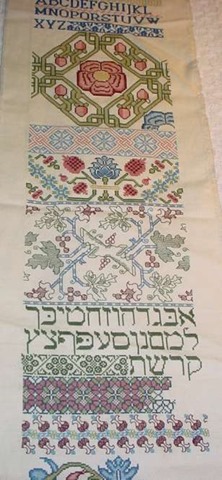
The piece above is a bit from a sampler intended as a wedding present for a friend whose engagement sadly ended before the sampler was finished (circa 1985). It’s done in DMC cotton on 32 count linen. I still have it and it’s still not complete, due to some vague association with the unfortunate end of the inspiring romance, and not wanting to tempt fate.
Lesson learned: Don’t pour effort into something that depends entirely on circumstances out of your control. Also, picking a limited color set and sticking with it provides a lot of unity in what might otherwise be a very scattershot work.
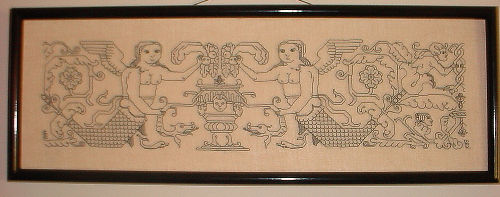
These shameless mermaids that got an honorable mention award at Woodlawn Plantation. I stitched them in 1988, Au Ver a Soie Silk on 36 count linen. I like that I didn’t center the motif on this one.
Lesson learned: It’s surprising what will offend people. The prize committee pinned the ribbon over the bust of one of the mermaids, and put a post-it note over the other. And then hung the thing alllll the way up near the ceiling of the main room, where no one could peek under.
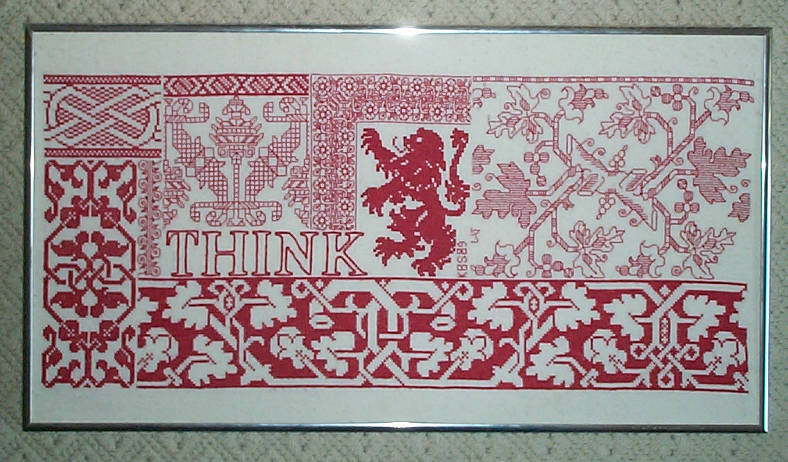
“Think.” Done for the husband in 1989. DMC on 32 count linen around 1989. The leafy log panel (in TNCM) looks familiar? Scroll up – it’s also on the wedding sampler, but there in multicolor.
Lesson Learned: Visual density of small designs can be overwhelming. I always loved my original briar rose tangle – the corner design surrounding the lion, but only on paper. I’ve never been happy with it stitched up. The detail is entirely lost.
Circa 1990 or so I began work on my Forever Coif. Silk and silver, on 50 count. It’s still on the frame. It was intended to go with a reworked dress that featured the underskirt panel shown up at the top of this tirade. But it was not to be.


The fruits and flowers in the standard strawberry frame are original. I’ve lost the notebook where I had additional motifs doodled up. To finish I will have to think up new ones.
Lesson Learned: I’m still lousy at finishing. Eventually I will. But not as a coif – probably just as a rectangle, and wall-mount. Also, don’t design in a medium that doesn’t allow easy back-up. After this project I switched to drafting on the computer, exclusively.

“Do not Meddle in the Affairs of Wizards, for they are Subtle and Quick to Anger.” For the husband, in 1995. DMC on 36 count linen One of my faves, with several TNCM designs. This is also the first piece I did that used long-armed cross stitch (LACS) both for foreground in the daSera knot in the center, and background on the bottom motif that looks like an S designed by a Renaissance era Dr. Seuss. More reuse of bits on this one, too, including a scalloped edging (below “wizard”) that’s also on the very first piece on this page.
Lesson Learned: People are easily mystified when you break your words up in a non-standard manner. Also, LACS is lots more fun than plain old cross stitch.
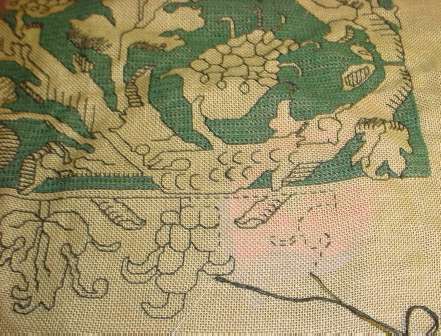
Partially finished shot of a large leafy repeat that’s shown in TNCM. I did finish this but have no pix of the final object. Given to a dear friend after completion circa 1996. Danish Flower Thread on 38 count linen, and more LACS.
Lesson Learned; Take more photos.


Two “try out” pieces, just playing with no intent to finish either one. Upper one in linen thread, lower one in Danish Flower Thread on 38 count linen. The grounds on the voided strips are all long-armed cross stitch.
Lessons Learned: A lot. Neither of these grounds are true even weave. I was playing with how skew weaves distort designs. The one on the bottom is counted over 3×2 threads to make up for it.
This just takes me up to 1998 or so and I’ve skipped lots of pieces for which I have no photos, but this post is getting long. I guess the main lesson learned is that practice and perseverance help in any pursuit, even the most trivial. If people are interested, I’ll keep going.
 String-Or-Nothing