AAALLLMOST THERE
The hounds and pelican strip is finished!

I know of two mistakes on it, which I may or may not go back and pick out. I’m also thinking of adding another heart-bud immediately underneath the hounds’s forepaws. It’s not in the original, but that area looks a bit barren to me.
Now to go on to the next strip. Here’s the whole piece laid out, so you can see the (problematic) real estate that remains:

I was originally planning for two more strips, one medium dark, and one quite dark to add balance to the piece as a whole. But there’s this…
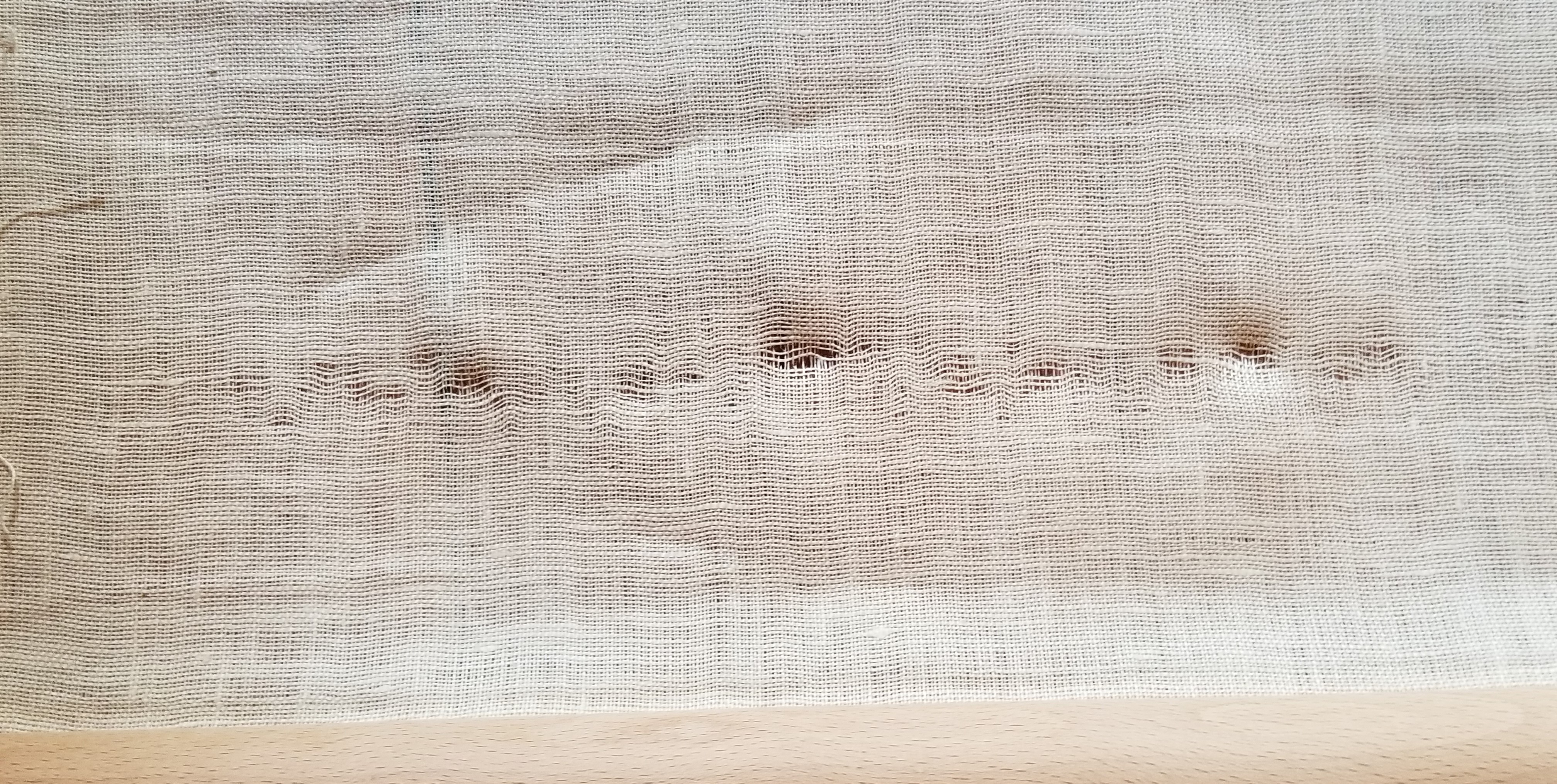
Damage! And not just distorted weave that can be gently stroked back into place – actual breakage of multiple warp threads, and too many to compensate. There’s no going around this. I have to end my sampler out about three or four inches short of my intended length.
How did it happen? Many reasons:
- Very gauzy, fragile linen ground to begin with.
- Abuse during two shipments back and forth to India. While it was unmounted from the verticals, I left it on the horizontals of my frame, scrolled up so that the unworked portion was on the outside. The resulting bundle was then wrapped in a thick cloth, and put into the shipping crate that held my hobbies. Where it probably abraded somewhat against the surrounding objects.
- Abuse since returning. I’ve been schlepping the thing around with me to show off at gatherings where embroiderers might be present.
- Not sufficiently padding the unworked portion. I put a couple layers of scrap muslin in between the stitched portion of the piece as I advance the scroll while working. But I did not pad the unworked portion. That was a mistake, leading to extra tension when I remounted my Long Green for work last month
- It has been what… nine years since I started this?
The aggregate result was that the area that had been rubbed and abused over time, and that had been fragile to begin with, under tension of my re-mount, began to give way. Note to self – no matter how tempting, avoid gossamer grounds and stick with more beefy linens…
So now instead of two or three strips to finish, I’m looking at one or two, in order to leave at least three inches between the breakage area and the bottom of the stitching. I may also reinforce the bottom bit by actually basting on some muslin to help take the strain of remounting for stitching – an extra precaution that I would remove before mounting for display.
OK. What to finish with. I’m not sure. First I have to measure out my area to figure out the maximum height of what can be stitched there. Then depending on how tall that workable area is, there are several classic designs I’m considering. But a couple of them I have not yet drafted up (T3CM fodder?), so I may take a quick side journey into another simple piece while I’m thinking it over.
Stay tuned!
TINY SOCK SILLINESS
Long time readers here know that I knit and crochet as well as embroider. These things tend to happen in phases, and I rotate among my hobbies, going from one to the other to keep fresh.
As I was going through the endless piles of cruft in my basement I found this.

It’s a tiny sock, full figured, worked with the same figure-8 cast on and short row heel that I use on my normal size socks, but knit on blunted hat pins using the reinforcement yarn that comes with some brands of sock yarn. I’ve done a couple of other teeny socks over the years, but this is one, from 1996 or so was one of the first. And it has a story behind it.
At the time I was working for Bay Networks. It made the high capacity routers and other networking equipment that large companies and even service providers needed to connect to the Internet. I was a proposal specialist, and worked side by side with engineers and sales teams to respond to opportunities. Bay decided that in order to write about the equipment I had to take the same training classes as the sales engineers, although I was not expected to sit for the qualifying exam to get the exiting service certification. So I sat in several training classes, auditing them and absorbing what I could. They were multi day sessions, and I have to admit my mind would wander as the class did exercises in provisioning or “speeds and feeds” – info with which I needed to be vaguely familiar, but I would never be called upon to calculate.
Outside the classrooms was a lobby. I could see it through the glass door. On the wall opposite me was an enormous mounted swordfish. One of Bay’s founders had a serious fishing mania, and many of the common areas were decorated with his trophies. An Evil Idea came to mind.
I went home and that night knit up the tiny sock. I rolled up a bit of one of my business cards and stuck it into the ankle, so the sock looked like it was on the leg of a tiny person. Then I snuck into the lobby early the next morning, and put the sock into the fish’s open mouth, posed to look like the fish had just swallowed a victim. And I told no one about it.
The next few days of class were enlivened by watching the fish and the people who passed by. Several noticed and fell out laughing. A couple dragged their buddies over to see the thing. After the class was over I left the sock there, and so it remained.
Flash forward five years. I am leaving Bay quite unceremoniously after it was acquired by Nortel. I swung by the fish lobby to retrieve the sock. Other employees saw me reaching for it and told me not to touch it because it was a fixture of anonymous company folklore and affection. I told them to look at the scrap of paper inside. It being my card and my name, they had to admit that I had the right of first possession.
The sock and I left Bay forever. Given Nortel’s steep subsequent plunge into obscurity and acquisition, they might have been right about its talismanic virtue.
BUNNY-HOUNDS AND PELICANS
Last week’s columns and plume flowers strip was a quick one. Not the least because it was in plain old cross stitch. I am pleased with the darker-but-not-overwhelming density. And as you can see, I’m on to the next one, featuring the hounds and pelicans, yet another design that will be in the ever-forthcoming T2CM:
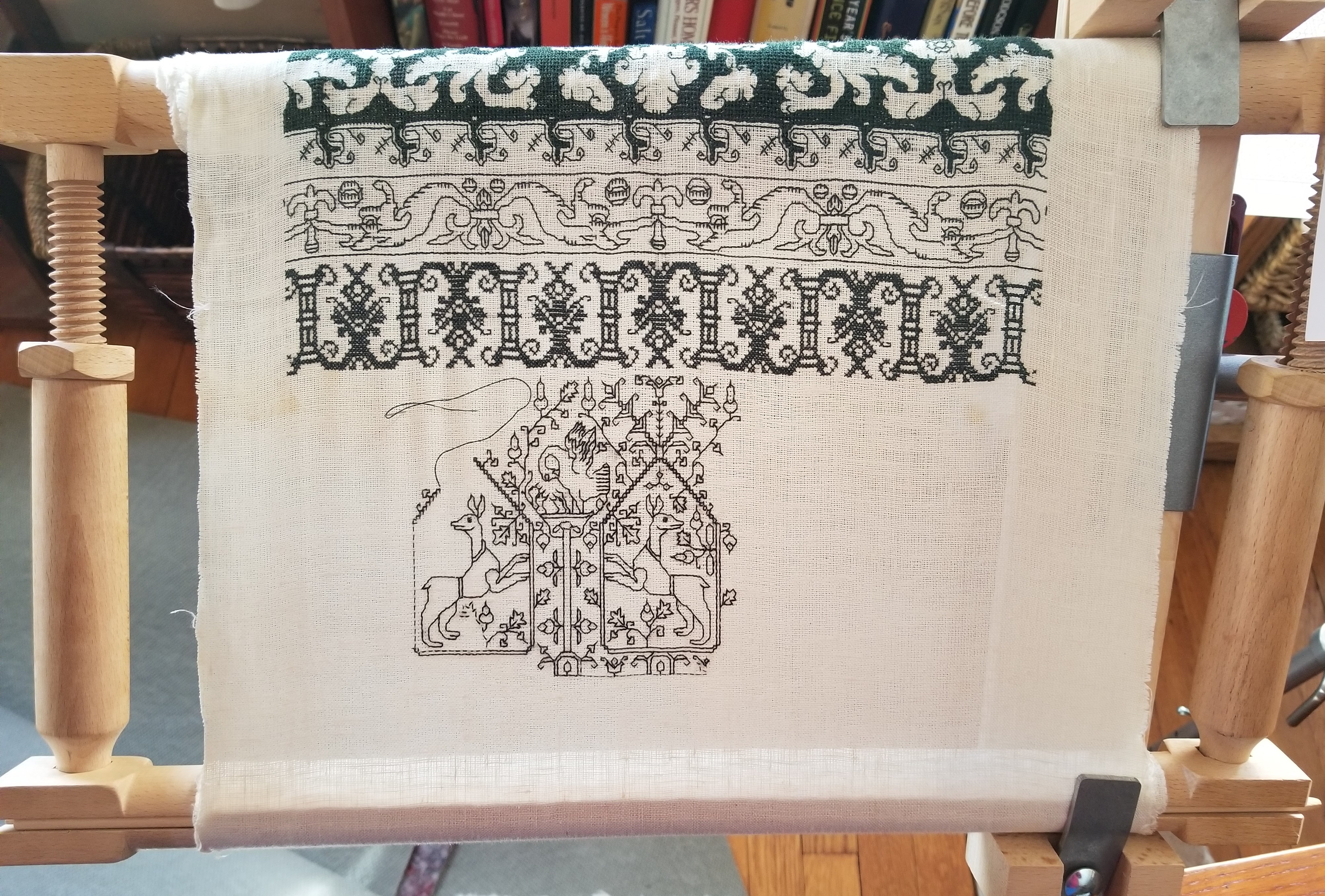
I am looking forward to unrolling this piece when this new strip is done, to see how much more real estate I have to cover, and to make plans for how dark or light those strips will need to be. Then I get to go hunting for what to stitch next.
This week’s strip is an interesting one on a couple of fronts. First, in terms of history, it has a specific point of origin – in 16th century Sweden; not Germany or Italy or any of the other countries better known for linear embroidery at that time. It’s in the Swedish History Museum, Inventory number 19600.
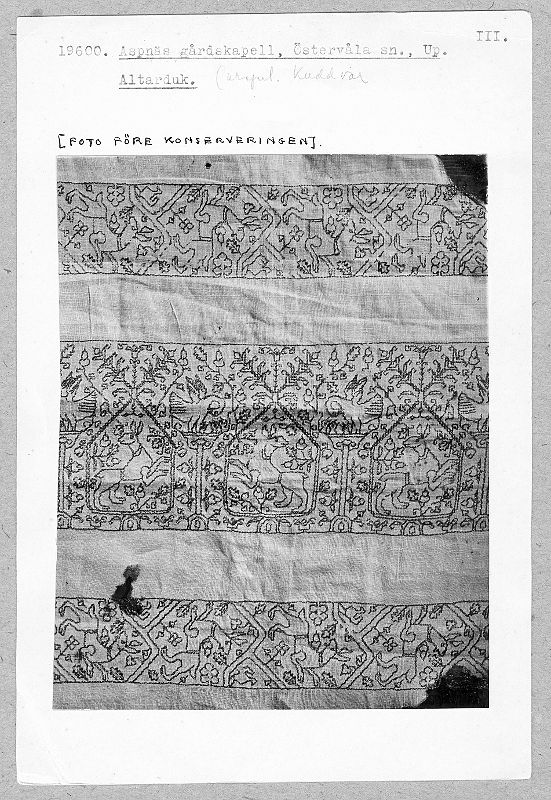
The museum citation says that the piece is from a chapel in Uppland, Östervåla; stitched in red silk on white linen. It also includes the matching vertical border which I haven’t graphed yet, plus a sweet row of heart-shaped cartouches bearing heraldry, the frames of which are also on my futures list. I haven’t stumbled across another piece of linear stitching in this style from this region/time, so it’s a bit of a mystery. How prevalent was it? Was this type of work limited to church linen? Did it appear also on clothing? Obviously more research is needed. If you know of any other pieces in this family, please let me know.
Now on to iconography. While this piece has non-secular origins and was part of a chapel’s furnishings, its religious symbolism is not as direct as most church hangings. No martyrs. No pascal lambs, sacred hearts, or other standard symbols. Just pelicans and hounds. Even slightly misshapen, the quadrupeds are identifiable as coursing/sight hounds of some type. They are collared and belted, slim waisted and long legged, with floppy ears and pointy muzzles. Dogs, especially hunting hounds would have been seen as symbols of fidelity, determination, and loyalty. Pelicans are a bit more esoteric. Here they are shown “vulning” – piercing their breasts with their beaks, in order to feed their young with drops of blood. This was a standard bit of common folk legend at the time – along with the belief that worms spontaneously generated from the soil, and hedgehogs carried berries home to snack on later, impaled on their quills. Obviously the imagery was associated with self-sacrifice, devotion, and parental care.
Therefore, we have a cloth covered with symbols of devotion, loyalty, and self-sacrifice – something that would have special meaning in the religious setting. The background for this may be Sweden’s departure from the Catholic church in the late 1520s. Perhaps this rather humble, non-demonstrative bit of stitching (no gold, no gems, no saints) with its generic paean to virtues fits into the schism between Catholicism and Sweden’s developing Lutheran-based faith.
I admit I knew the pelican story courtesy of the Society for Creative Anachronism (SCA). It’s no secret that I’ve been involved with it deeply in the past, and continue to have many friends active in the organization today. The highest SCA award for service is the Pelican, and its badge is a pelican vulning. This highly respected honor recognizes those vital individuals whose labor, largely voluntary, is the fuel that keeps the organization running. If you ever attend an event and see someone with a brooch or pendant with a pelican, know that the person you have met is Very Important, and widely respected by their peers. My sampler will have pelicans on it, but I am not a member of that order, nor do I intend to display it in an SCA context. I could wear a badge with a laurel wreath, but that’s another story for another time.
Finally, I announce that we have embarked onto another Great Home Improvement Journey. This time it’s the basement. I will post before/during/after pix, but right now I am still packing up and stowing my needlework library, office area, and craft room. The chaos is palpable. Here are a few of my stitching and knitting books. I’ve already had reason to refer to them, but have had to sit on my hands and just contemplate my wall of boxes. Work on the basement proper should begin by April. Until then, it’s lift, sort, box, and stack for me.

ANOTHER WEEK. ANOTHER MOTIF
Moving on from the dolphins, we leap to the next motif. I wanted something both darker and less dense than the massive meshy panel, and hit on this column/flower meander. It’s another one from my ever-forthcoming The Second Carolingian Modelbook (T2CM – it includes both linear patterns and block unit designs).
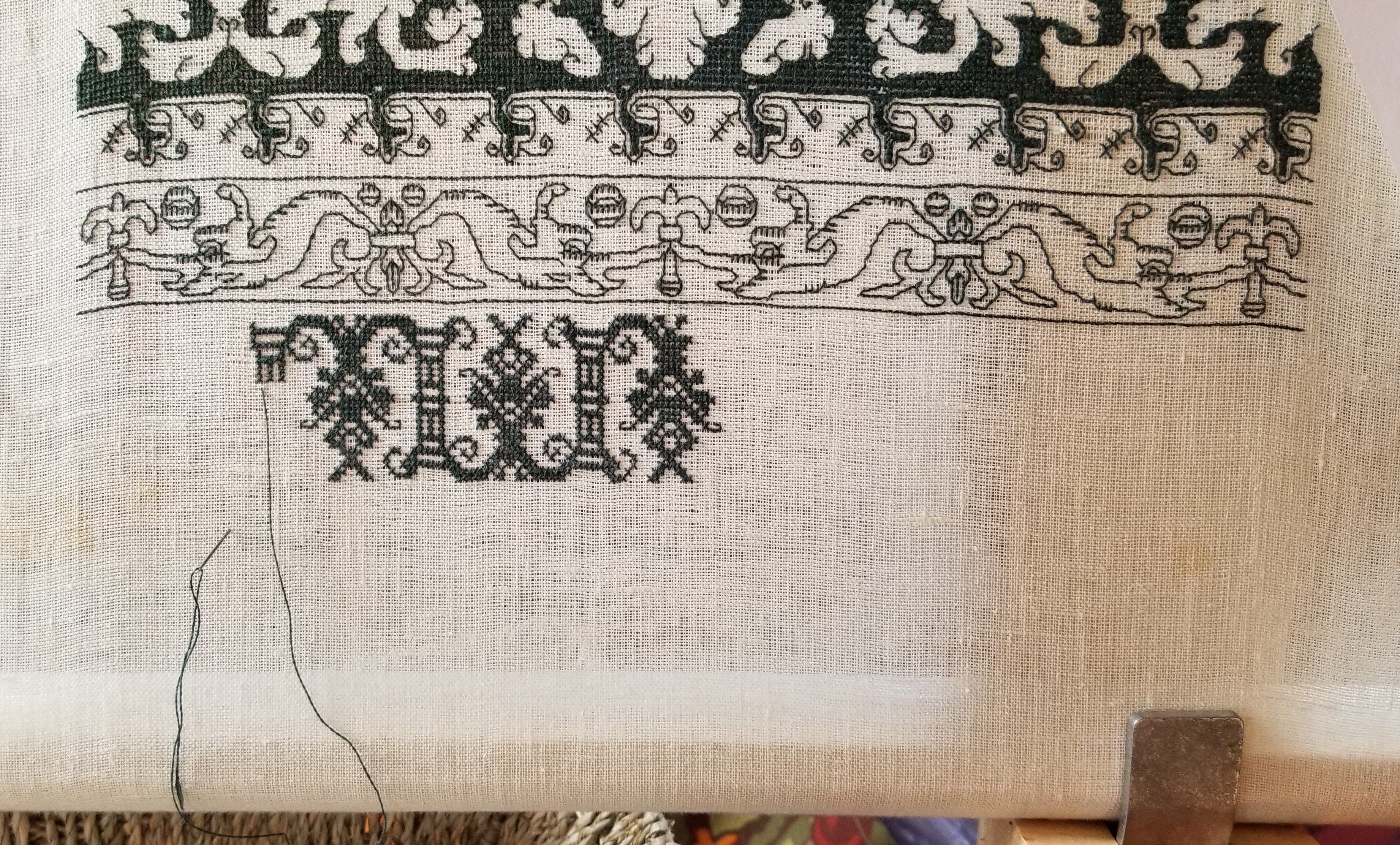
The columns design appears on Plate 70 of my book, but it’s source is a 16th century Italian openwork piece in the Metropolitan Museum of Art, Accession 20.186.27

The museum description is rather cryptic. It says “Bobbin lace, buratto, punto a rammendo.” To me it looks like buratto – darning on a woven gauzy ground, and not bobbin lace or a withdrawn thread technique (punto a rammendo). Buratto and lacis are very close, with lacis being worked over a hand-knotted net mesh, and buratto being worked on a purpose-woven gauzy linen fabric. It’s structure is not unlike Penelope canvas, but made from much finer threads with much wider gaps between them. It’s effect is entirely that of an open mesh – no where near as dense as the Penelope. Admittedly this piece might be lacis. I am not seeing knots at the junctures of the meshes, but sharper photos might reveal their presence.
While my treatment of it in plain old cross stitch isn’t necessarily something that can be defended as a common historical usage, the use of these designs for both openwork (lacis or buratto, or even withdrawn thread designs) and surface embroidery on the count is well documented. Since I am not doing a historical piece I chose POCS because it on this ground with only one strand of silk, presented an airy and lighter contrast to the mesh technique, and the long-armed cross stitch and Montenegrin stitch that I’ve used in elsewhere on this piece.
Oh. And the source for the dolphins? Plate 29 of T2CM. But it is my rendition of an illustration in Lady Marian Alford’s Needlework as Art (Plate 42), originally published in 1886. There it is cited as 16th century Italian. I tracked it down. That piece from Lady Alford’s collection and shown in her book is now in custody of Belton House, Lincolnshire UK, and registered with that country’s National Trust (#426944). I know of no no on-line photos of it. If you do, please share the citation in the comments.
As mentioned before, the original shown that I drew up for T2CM features the dolphins and connectors (but not the rondels) and the background of the original is voided – filled in, but with a grid of tiny one-unit squares.
When will T2CM be out? I know it’s been a very long wait, for which I apologize. However I do know that if all goes well, my schedule will emerge from some significant time constraints in late spring, and I will be able to devote myself to publication. I am loathe to promise after so long, but 2021 has every indication of being The Year.
MESHY DONE, PLUS KITTING OUT THE FRAME
Yaay! A bit of self discipline imposed, and the forever voiding on the meshy lettuce pattern panel is complete. I have to admit that while I adore the look, I am not wildly fond of the hard-pulling needed to achieve it. I might try it again if I ever find a linen that’s the right combo of threads-per-inch plus nice soft and lofty constituent threads, instead of skinny hard-spun ones.

How does this strip fit into the growing project? After all – it has been about 8 years since we’ve seen the whole thing laid out. For the record, I’ve filled about 45% of the available real estate – there’s a lot more to go.

Now for the next. I don’t think I’ve play-tested these dolphins before (another design in the ever-forthcoming T2CM). The original showed them with a squared fill background in voided style, but I wanted something lighter to follow the dark band I just finished. I left off the voiding, but then decided that the bit looked rather spare. My dolphins needed something to play with, so I added the round elements, and am now pleased. A quickie, this bit took just Saturday and Sunday evenings:
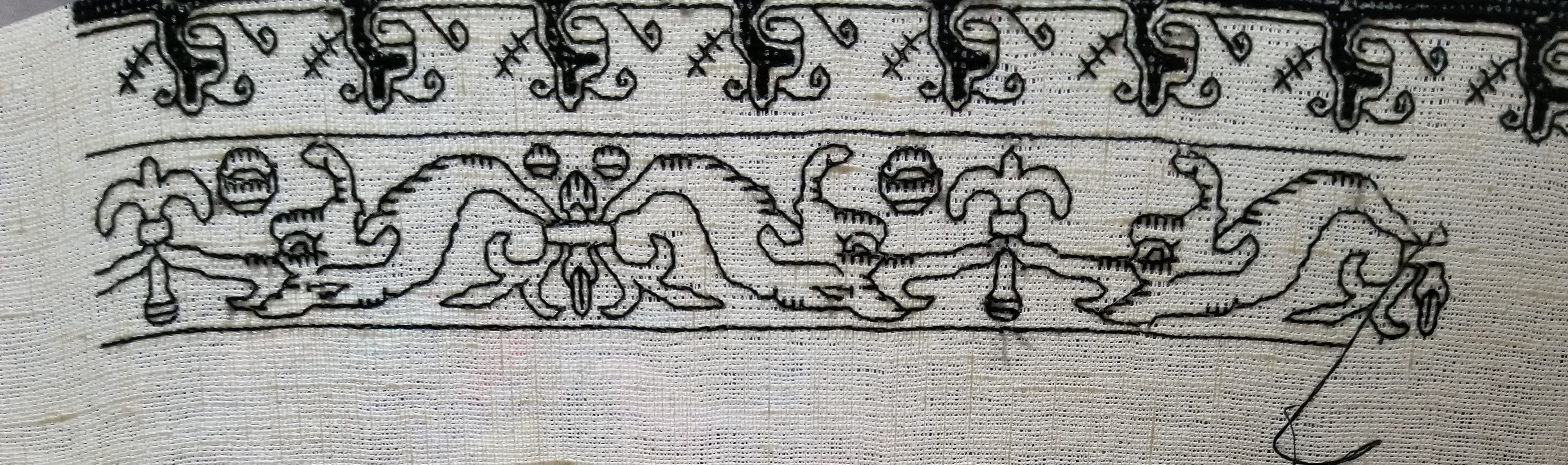
I will add the roundels to the dolphin at right of center, but I left it off so you can see the rather unfinished look it had without something there.
After this one? Probably another narrow strip, possibly a bit wider than this one, and possibly darker for contrast. Then after that I have a double running stunner queued, but it’s rather wide and needs a bit more spacer ground between it and the giant meshy lettuce panel.
In the mean time, as I get up close and personal with the frame I am making little improvements to my set-up. For example, the jaw of the Lowery is steel, and well loved by magnets. But it’s not exactly accessible with the large frame extender unit. BUT when I flip the thing over to terminate a thread, it is. Add a strong classic U-shaped magnet, and I’ve got a handy place to park my snips (the red magnet is just behind the red snipper).

My needle minder works quite well, and sometimes I use it to park my threader. It often does double-duty as a holder for my pattern page. But that can get in the way of the stitching area. So I glued a magnet to the flat side of one of my Millennium frame scroll bars – on the flat side (yes, I tested it to make sure the correct side was up – that’s the one that attracts rather than repels the other magnetic goodies I wanted to use):

I can use this as a rather plain needle minder all by itself, or I can park my fancy one there instead of in the hidden spot where you see it now. Or I can use another magnet with it to hold my pattern page. But best of all, I can use it in conjunction with this page holder I picked up years ago (it used to stick on my fridge door, to hold tickets, recipes, coupons, or whatever).

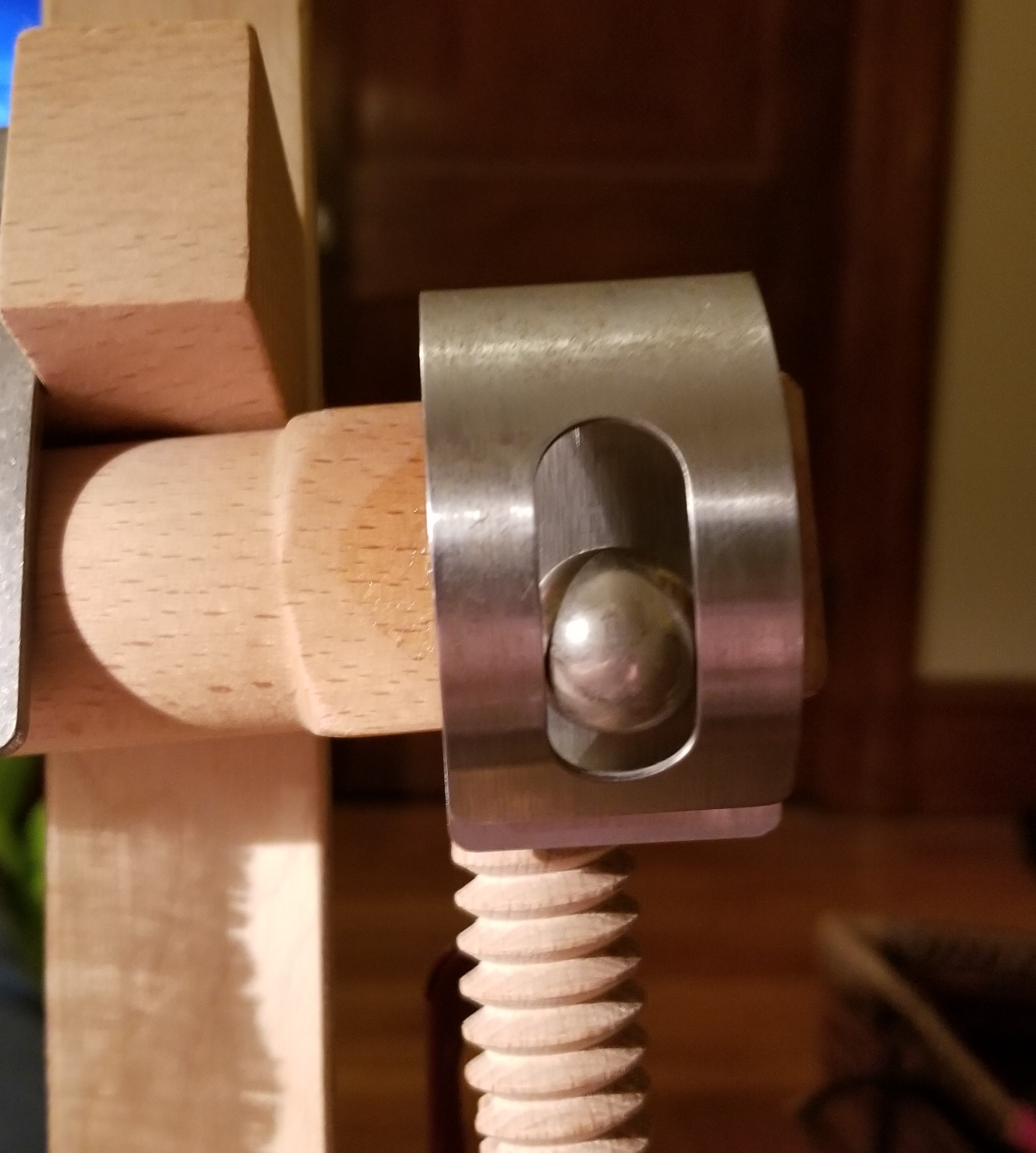
By just gluing on a magnet, I’ve left the door open for all sorts of other magnet-enabled organizers. There are other styles of clips. Hooks and loops with magnetic bases could accommodate scissors, for example. Finally, I’m still looking for it to test out, but because the rare-earth magnet I used is so strong, I’m betting it can hold my smaller flat metal magnet board. That would allow me to use placeholder magnets on my pattern page while the page is displayed right on my work area.
And where to find inexpensive strong-hold magnets? I recommend the geeky source, American Science & Surplus. They are a clearing house for engineering tidbits, science gear, weird surplus items, kids’ educational toys, and other miscellanea. They are especially good for containers, magnifiers, bags, precision scales and measurers, cutting implements, office supplies, and magnets. Like any surplus store, their inventory turns over quickly, so if you don’t see what you want there today, visit again next week.
 String-Or-Nothing