Yet another post only a stitching nerd will love.
Remember a while back, I pulled together some observations on the Azemmour Cluster? That’s a group of embroideries, usually known as fragments rather than whole cushions or other items. Those fragments were among the bits largely collected during the era of the Grand Tour (roughly 1870s up through World War I and on to the 1920s) when monied folk would do a season in Europe, collecting artworks and other items of interest. Needlework and lace collection were among those passions, along with other more traditional forms of art. Those gleaningss eventually landed in museums.
Since needlework fragments are not among the items most highly prized in museum collections, many remained in storage cabinets, with the donor’s provenance notes unchallenged. Or they did until museums began photographing these holdings both for their own use, and to post on line. At that time many of the attributions came under scrutiny, and did not hold up. In the past thirty-plus years I’ve been nosing these up, comparing them and making notes I’ve seen dozens of museum tags specifying stitches, dates, and places of origin change.
Among these collected and sometimes reclassified pieces were items in what some call the Azemmour Cluster. They were scraps sold to unwitting tourist-collectors as genuine late Medieval through Renaissance artifacts. But in actuality it does look like a lot of them, and a lot of the most represented designs in those museum back room cabinets, were produced in Morocco, with many dating to the late 1700s at the earliest, but most were likely made in the 1800s.
To be fair, the designs DO look like they express Renaissance roots. In the post above I even point out a piece that looks like it may be a predecessor. The Moroccan connection was known for some of these. Frieda Lipperheide in Old Italian Patterns for Linen Embroidery does point out that origin for some strips, noting their similarity to Italian designs.
Well, thanks to discussions in the Zoom meetings that are part of the Unstitched Coif project, a significant arguments strengthening the joint Moroccan sojurn of these designs has come to my attention.
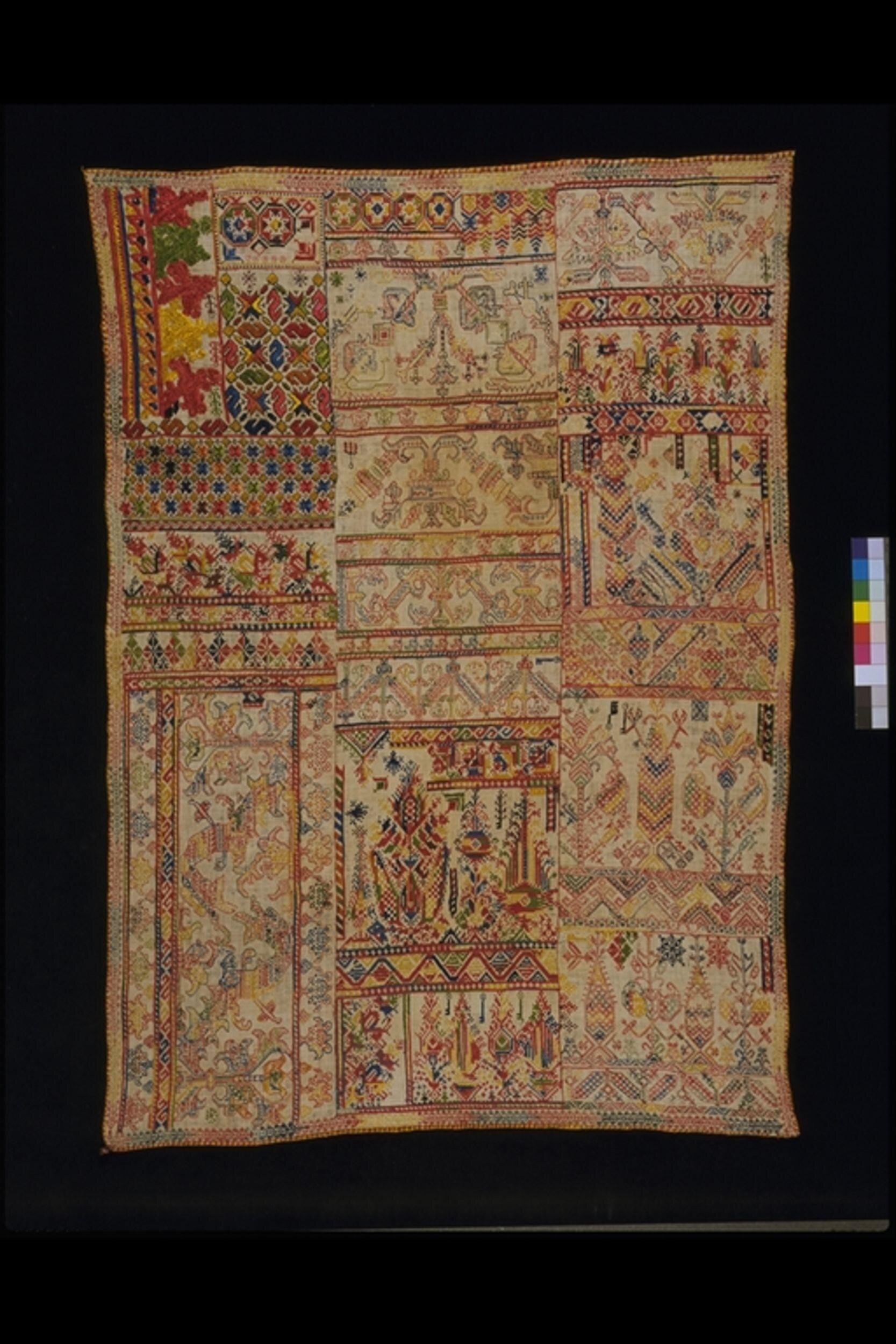
Here are two samplers from the Victoria and Albert Museum’s collection. The images are theirs used here under fair use/academic auspices. The multicolor one is Accession T.35-1933, a 19th century piece from Morocco, stitched in silk on linen. Yes, most of the individual fragments of these designs are in monotone, usually red, but occasionally deep indigo, these two samplers with their collections of many designs are happy riots of color.
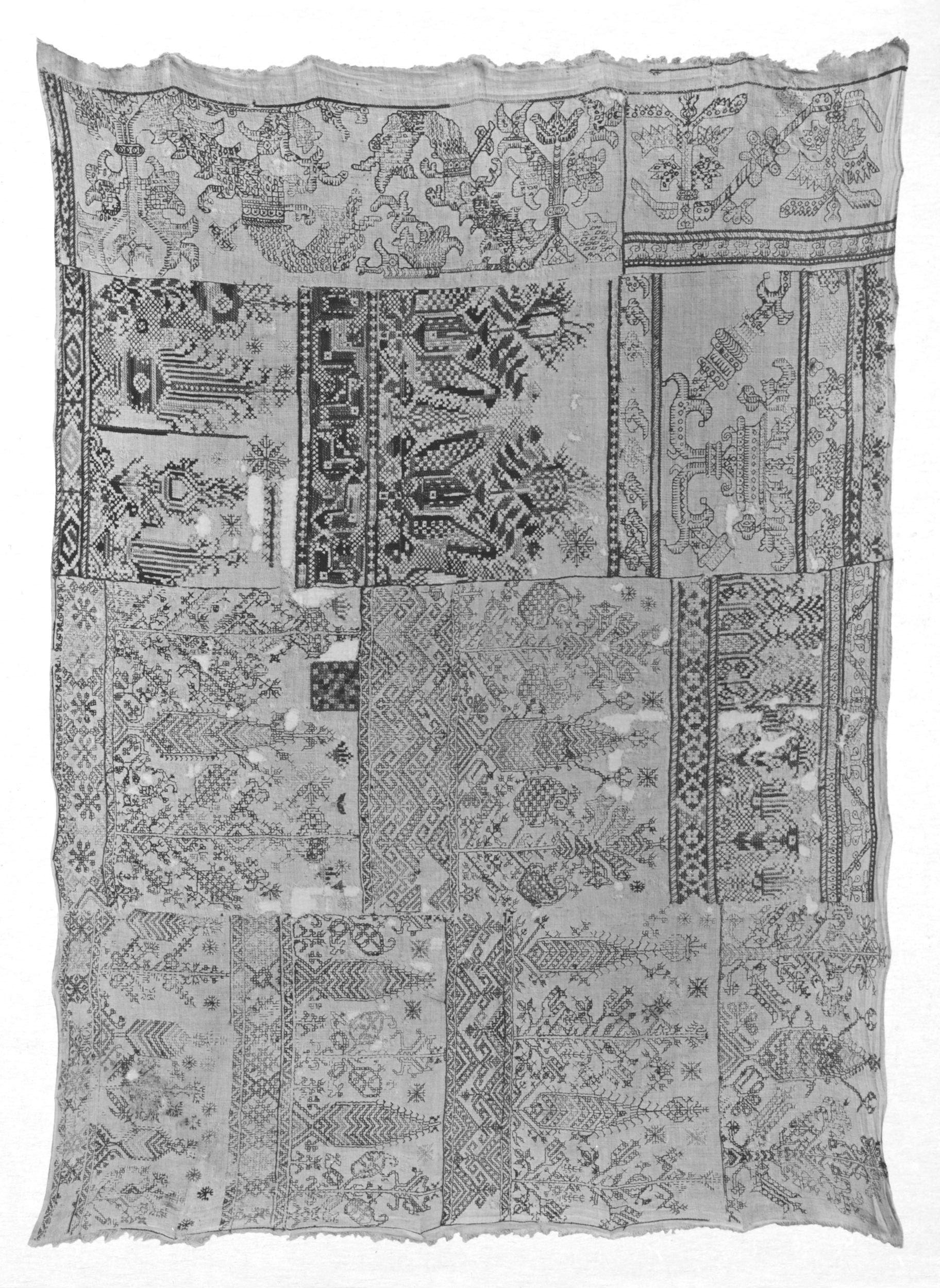
This black and white photo is also of a multicolor piece (Accession 372-1905), dated from the 1800s, and is also listed as of Moroccan origin.
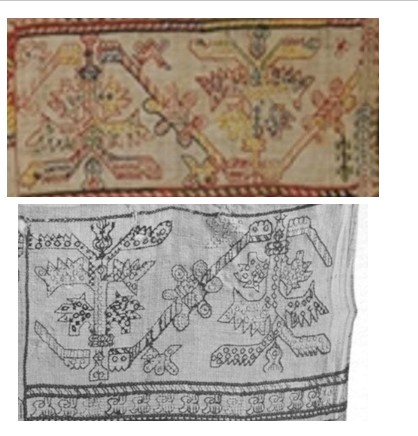
Both of these pieces contain two of the most common motifs in the cluster. This one is what I call the Spider Flower, for its spindly center blossom.
Here’s the second. I call it Wide Meander. This is found both with the wide strip looking rather sea-monster like with a gaping mouth, and in a tamer form, where the monsters have fused to become a super-wide belt like meander join. Discussions of both Wide Meander and Spider Flower are in my previous Azemmour post. Earlier musings on the Spider flower are here.

But these are not the only ones. The multicolor photo also has these two designs on it that I’ve discussed before.

The one on top is a variant of a pattern that is of Italian provenance. I mention it in this piece, and again in my discussion of voided grounds (under the boxed fill).
The one underneath I call the Pomegranate Meander. It’s clearly related to the Spider Flower, although in this case the ornaments on the joining diagonals are emphasized, rather than the center flower shape. It’s also mentioned in the Azemmour discussion cited earlier.
Plus it’s also worth noting that both of these V&A samplers show lots of variants of the customary accompanying borders so often seen with these main strip designs.
But for me the eye opener was the addition of another design to the group. Both samplers show the wide urn design.

This one I should have tweaked to based on the style of detail in the foreground. But I did graph it up for The Second Carolingian Modelbook based on this example from the Hermitage Museum, and accepted their identification as Italian, 16th to 17th century. Accession T-2714, entitled “Border Embroidered with Bowl and Stylized Plant Motifs” if the link breaks).

Here is my own rendition of this design, as I stitched it on my long green sampler.

Now we have a conundrum. We have many items whose dates and places have been corrected in museum collections. We have a continuing tradition of design replication and pattern re-use in a specific place. We have some predecessor designs and traditions that might have fed the Moroccan styles. And we even have some evidence of the post-Inquisition diaspora spreading these stitching styles TO settlements in Morocco. The Jewish link is cited by The Textile Museum of Canada. The Jewish Virtual Library notes the migration and community. The Jewish link is also mentioned here. The Textile Research Centre writes that production of Azemmour pieces died out in the mid 1900s, although recent revivals have been undertaken.
So where do we draw the line? Are these related items ALL to be reassigned to the Azemmour Cluster, with production dates in the 1700s through 1800s, sold to the unsuspecting as older artifacts? Are some possibly earlier, transitional pieces? Can we rely on just the wealth of ornament in the foreground of these strips to differentiate them from earlier forbearer pieces? Without detailed textile forensics, we may never know. But wherever and whenever their points of origin, it’s nice to see the family reunited again.
 String-Or-Nothing
As you say, lovely to see the family together again. Would the colours used be a good indicator for the forerunners as opposed to the ones sold to the unsuspecting
We have no way of knowing without additional samples that have firm, scientifically verified or documented provenance. There are lots of pieces and fragments from the 1500s through the 1600s that are done in madder red, quite a few in a deep blue or green, and some in black. There are also a few Italian pieces done in multicolor. And portraiture and other illustration that include depictions of them. There are even a couple of verified “precursor” patterns similar to the spider flower and pomegranate meander.
But what we won’t have are samples of Azemmour works with unambiguous verified dates prior to the 1800s. Some that are murky AND a very conservative tradition of pattern persistence, but nothing that can state with certainty that these EXACT designs stretch back further in time, or in what colors they might have been stitched.
That is we don’t know YET. Research on these continues to delve deeper, by qualified professionals with textile forensics and detailed visual and chemical analyses. And additional data in the form of more pieces are being unearthed in back room storage and private collections. So we may yet someday have an answer to your question. But we don’t have one yet.
There is a multi-coloured Moroccan sampler in the collection of the Textile Museum in Switzerland which also contains the Spider Flower, Wide Meander, Pomegranate Meander and the Wide Urn border. Accession Number 24157. I have photographs of it but failed to take one of the whole sampler, only sections of it.
Regards, Susan
Thanks! I’ll see if I can ferret it out and add it to the discussion.
Hello Kim, I am fascinated whilst reading your research on different types of motifs discovered from early 1600 to 18 th century. I am curious, if you found any alien type of motifs? I am not crazy! Honest, I am intrigued & curious to see if any anomalies were found by scholars? I love reading your emails. I am genuinely intrigued by your research.
Thank you so much! With gratitude, Sandra M.
I am afraid I don’t know what you mean by alien. There are certainly motifs cribbed from cross cultural sources. In TNCM I point out a motif in an early German modelbook that was most probably copied from a Kufic script/Tiraz band or carpet woven in the Islamic world, for the aesthetics and not the underlying religious motivation. There are also lots of styles that migrate, or present in derived forms over time. Mexican samplers of the late 1800s sometimes carry identifiable legacy echoes of strip bands from the 1500s, some from early samplers, and some from fragments theorized to have originally adorned household linens. As to scholarly debate on these things, it’s an area that has not attracted a lot of study. Being a self-taught dilettante, I am not well connected to the academic world, but I have seen very few papers in open circulation that trace movements of patterns over time and place. There may be lots, but I don’t have the connections or resources to reach around or through paywalls.
Hi Kim I was poking around the Royal Needlework school site and on their Chevron stitch page they stated “Chevron stitch is used in Morocco, in both Old Rabat embroidery, a silk floss technique which dates from the late 17th to the mid 19th century, and Azemmour embroidery, a counted thread technique which uses negative space designs.” Needless to say this sent me down a rabbit hole poking around museum sites etc. I also encountered this article on your site. I was wondering have you encountered Chevron stitch in any of these works? Unfortunately many of the photos I have seen are not good enough to see the stitches
Hi Sharon! I’m sorry that your note to me got lodged in the spam filter, and I just stumbled on it. I can’t say for certain I’ve seen chevron because I’ve only dealt with these works via museum photos on line. But photo resolution is improving and new images are being posted all the time. I will flag this as a look-for-me and get back to you if I find a specific and identifiable example. Again apologies for the delay. I blame WordPress.
No worries about the delay in answering I know what blog software and spam filters can be like – Thanks for keeping an eye out. I asked mainly because this info came from the royal needlework school. The question is one of those curiosities that stitch nerds like myself collect in the back or our brain. If you ever spot anything of interest I would be grateful to hear from you. I hope life is treating you kindly
I would recommend to any of you to go down to embroidery schools in Azemmour Morocco, where they are reviving these techniques. There’s a nice hotel nearby called Mazagan golf resort
[…] Even More on Azemmour. Additional observations on a cluster of embroideries from Morocco, common in museum and private holdings. Some of which were sold to early collectors as Renaissance fragments. […]
[…] I wrote about some of them in my Second Carolingian Modelbook, and in this 2018 blog post. And then I revisited the cluster in 2023, when a group of eye-popping multicolor pieces documenting concurrent usage of many of the […]