STILL WORKING ON IT
Apologies that time seems to run ahead between these posts. I have only so many hours of comfortable productive sitting time each day, and I tend to spend them actually stitching, drafting/redacting new designs, and working on my books. Blogging often gets ignored.
But that doesn’t mean I’ve been idle. Far from it. I finished those two strips at the bottom of the Anything Could Happen sampler (the one honoring The Hungry Judges book by my Resident Male, itself still being written, too.).
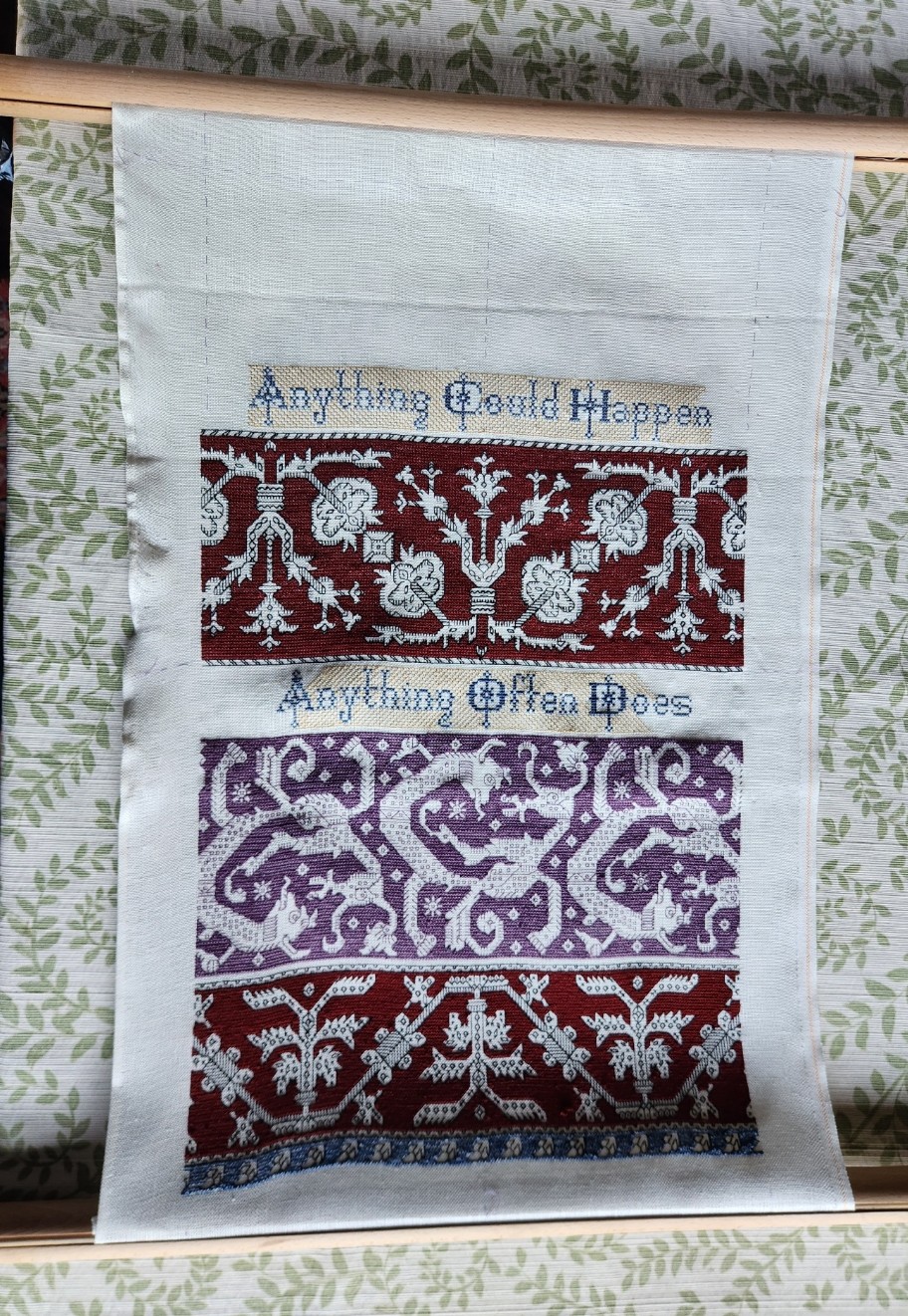
Laying the roller bars out flat in the early morning light accounts for the shadows and non-parallel edges. In any case, two things remain – two panels at the top, one of which will be a duplicate of the blue one at the very bottom; and devising the little motifs that go at either end of the motto lines. Once I’ve identified those, drawn them up, and stitched them I can work the yellow step-voiding around them. I can say that one of those spaces will hold my initials and the year of completion.
Which brings us to the top panel. What to put there?
I wanted to continue with my theme of panels from the Azemmour Cluster. Paired birds are very common. I wrote about them a while back in this post. In the larger examples they usually face each other from either side of an urn that sports three plants or flowers. There’s also often a house-like structure with small resident creatures as the unit in between the pairs of birds. But those things aren’t set in stone. Sometimes trees appear, or other birds of various sizes. But one thing all of the bird panels big enough to bear it have, and that’s lots of “chaff” filling the main motifs. Smaller ones often have a token bit of filling, too, but sometimes they are just the bird outlines, with a tree or flower in between them, not quite as rounded and with fewer diagonal stitches than the paired bird panels of early modelbooks, but slightly echoic of them none the less.
Sadly they also tend to be of two sizes – either way too small north-south to fill my available space, or about a third to twice again as tall as the area I have to put them in. So since I wanted birds, I had to draft up my own.
I took inspiration from several of the bird strips in the prior post and tried to incorporate as much as I could of their iconography and general look-and-feel. So armed with my interpretation of the birds, I begin the top with that central urn. This strip will be voided in non-traditional purple to balance out the purple of the monsters strip. A departure, but true to the spirit of the design family, and (I hope) seen as a respectful tribute to the long standing tradition of Azemmour embroidery.

CATCHING UP AGAIN
It has been a while since the last post. But I keep going. After all, I have a reputation for stubborn persistence to uphold.
First, here’s a shot of the whole Anything Could Happen sampler, unrolled, as it was just before I began the current strip.
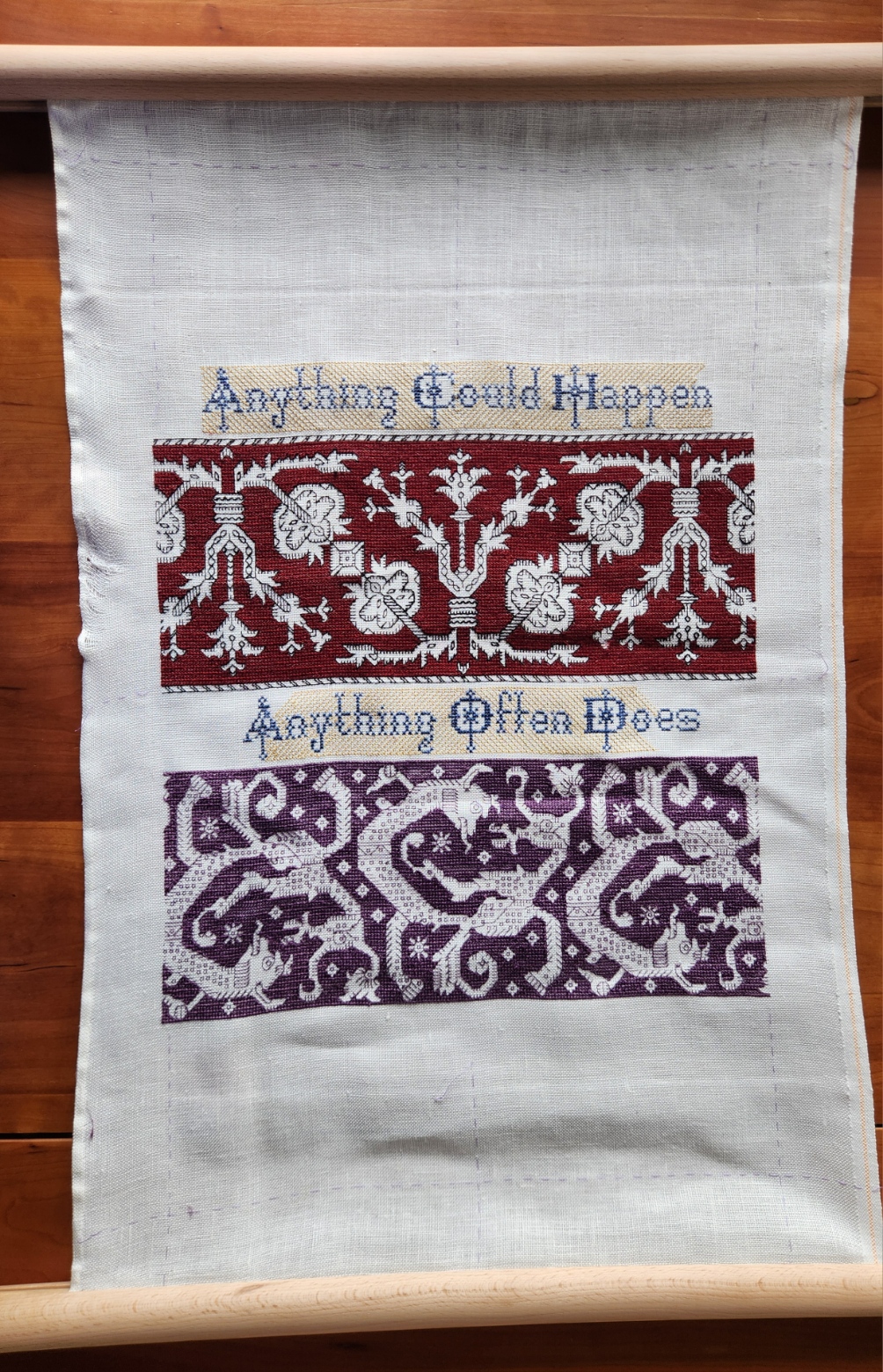
A few things to note. First, there is much less room remaining at top and bottom that needs to be filled. In fact, I have shorted myself. I should have chosen narrower strips than the pomegranate meander and the strange monsters band. I still intend to work a full width strip above and below what’s there, plus a narrower matching border as the final top and bottom framing mechanism – probably in blue. That means I will go over my basted edge lines. I may even have to finish with a hand hoop because I will run out of real estate for the flat frame by the time I get to those final edgings.
Second, the yellow step voiding behind the lettering still doesn’t reach all the way to the side edges. Right now that’s on purpose. The piece is a tribute to the science fiction book currently being written by my Resident Male. Those areas on either side of the motto lines are small, but they are big enough to contain a custom motif or two directly relating to book content. And I might use one or two of them as signature or date blocks. In either case, I will be drawing up new content, and won’t fill in the background yellow until the foreground material has been completed.
Third, that rippled left edge. That’s an artifact of Doing Something Wrong. I had this happen once before, but not for many years. I hand-hem my edges. Occasionally I get lazy and leave the selvedge edge unhemmed. A big mistake. That means that the left and right edges of the piece have different stretch potential (hemming limiting stretch more than the native woven bolt edge). When that happens, distortion, stretching, and fraying can occur. When I frame the piece with fabric as a hanging scroll, I will take pains to do it in a manner that covers up those flaws. Nothing else I can do about it until then.
And now we get to the part that you want to see. The latest strip. This one is a play on the Spider Flower I’ve discussed here before. There are many iterations of this Azemmour Cluster design. I included a chart normed from multiple repeats of one of them in my Second Carolingian Modelbook, as Plate 33:4.
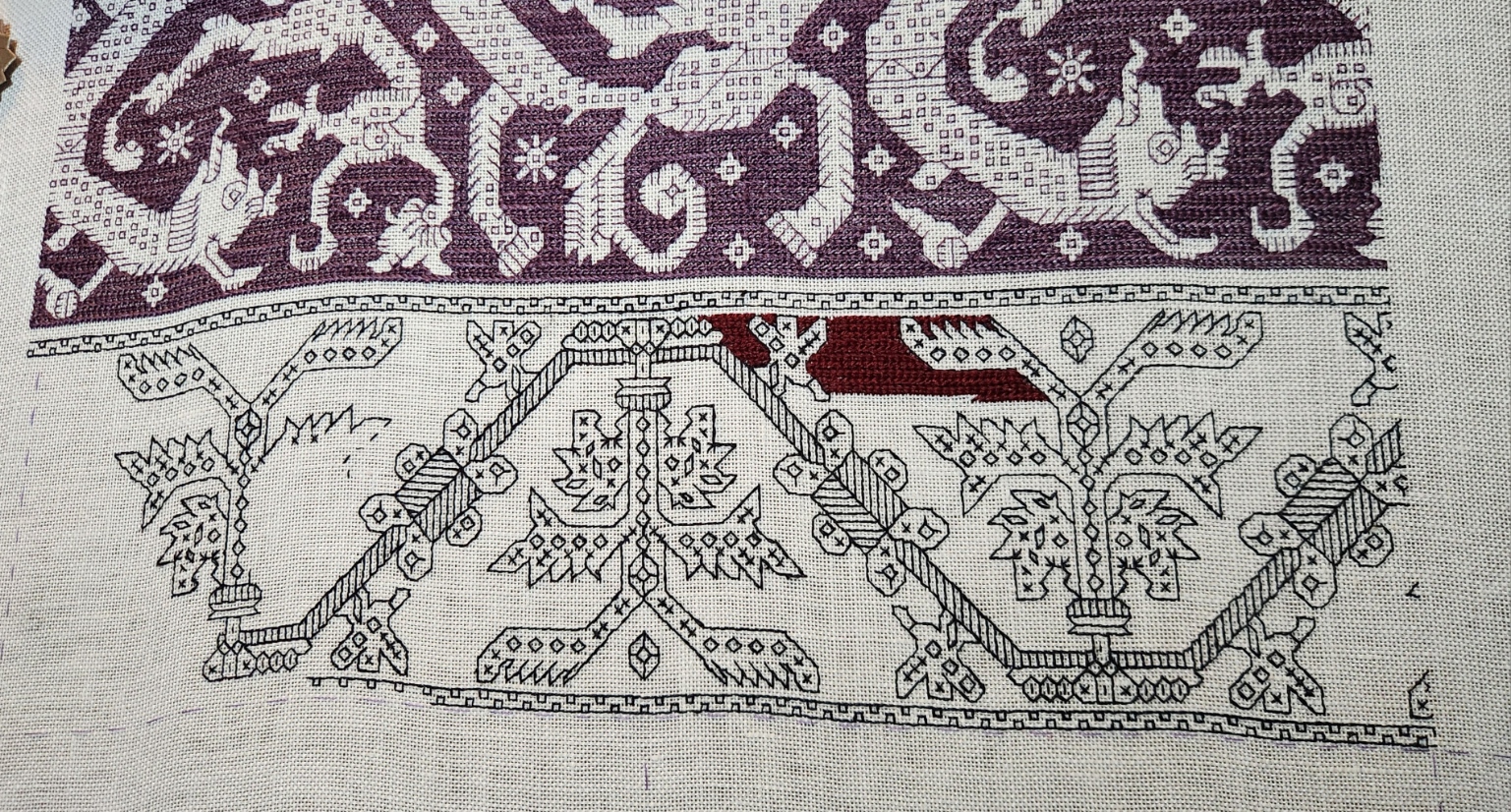
This one is being done in black and cranberry, but a bit differently from the obviously related Pomegranate Meander I used earlier (Second Carolingian Modelbook, Plate 34:1). For one, I am now sure that I will have enough thread to do a properly cushy rendition of long armed cross stitch. Using two plies of the Au Ver a Soie Soie d’Alger gives the proper well filled plaited look to the ground. I have also gotten a bit better at splitting and re-spinning the Tied to History Allori reeled silk, so the black lines are more uniform in appearance. Always fun to pick up a new skill.
These designs are both fast and slow to work up. Slower than many double running stitch strips because of all of those little disassociated filling bits that make up the decorative “chaff” inhabiting the foreground, but faster than many others due to the simple nature of the outlines themselves. I admit that chaff is a pain in the neck to do, impossible to terminate individually due to their small size and scattered placement, and annoying to path plan while minimizing skips. But again, I’m stubborn beyond words. One reason I had put off playing with this pattern family for so long was dealing with the chaff. No longer.
Health Update
Obviously I have weathered the latest round of surgery. The last procedure to shave down my cranial chordoma manifestation was quite lengthy – over 21 hours. But it was as effective as it could have been given the delicate location and nature of the beast. Getting most of it means there are leftovers that will be addressed via an aggressive program of proton and photon radiation. So next week it’s back to daily visits to rad therapy for the better part of a month and a half.
I can say that I continue to improve on a daily basis. Right after surgery I was particularly discreditable – a massive black eye that looked like a boxing souvenir, for starters. Lots of other swelling and seam-like scars just inside my hairline. Double vision at distance when I could peek at the world with two eyes; and with the swollen right side of my face, the eye being squeezed tightly I couldn’t open it, little to no useful vision on the right.
Now I look mostly normal.

Stitches are all out, the bruising and most of the swelling is gone. Zero cognitive effects, no headaches, no balance or hearing issues. I’ve kicked the double vision, and the right eye’s useful productivity has returned to my nearsighted normal. Which explains why I was able to finish the monsters and start on the new strip.
My continuing physical improvement challenge is to rebuild strength and mobility. I can get around the house but slowly, but am not quite in the shape to do all the simple chores like gardening I was able to accomplish just a month ago. Again stubbornness works in my favor. I refuse to be defined by what I can no longer do, so every day I work towards making that list just a bit shorter.
EVEN MORE ON AZEMMOUR
Yet another post only a stitching nerd will love.
Remember a while back, I pulled together some observations on the Azemmour Cluster? That’s a group of embroideries, usually known as fragments rather than whole cushions or other items. Those fragments were among the bits largely collected during the era of the Grand Tour (roughly 1870s up through World War I and on to the 1920s) when monied folk would do a season in Europe, collecting artworks and other items of interest. Needlework and lace collection were among those passions, along with other more traditional forms of art. Those gleaningss eventually landed in museums.
Since needlework fragments are not among the items most highly prized in museum collections, many remained in storage cabinets, with the donor’s provenance notes unchallenged. Or they did until museums began photographing these holdings both for their own use, and to post on line. At that time many of the attributions came under scrutiny, and did not hold up. In the past thirty-plus years I’ve been nosing these up, comparing them and making notes I’ve seen dozens of museum tags specifying stitches, dates, and places of origin change.
Among these collected and sometimes reclassified pieces were items in what some call the Azemmour Cluster. They were scraps sold to unwitting tourist-collectors as genuine late Medieval through Renaissance artifacts. But in actuality it does look like a lot of them, and a lot of the most represented designs in those museum back room cabinets, were produced in Morocco, with many dating to the late 1700s at the earliest, but most were likely made in the 1800s.
To be fair, the designs DO look like they express Renaissance roots. In the post above I even point out a piece that looks like it may be a predecessor. The Moroccan connection was known for some of these. Frieda Lipperheide in Old Italian Patterns for Linen Embroidery does point out that origin for some strips, noting their similarity to Italian designs.
Well, thanks to discussions in the Zoom meetings that are part of the Unstitched Coif project, a significant arguments strengthening the joint Moroccan sojurn of these designs has come to my attention.
Here are two samplers from the Victoria and Albert Museum’s collection. The images are theirs used here under fair use/academic auspices. The multicolor one is Accession T.35-1933, a 19th century piece from Morocco, stitched in silk on linen. Yes, most of the individual fragments of these designs are in monotone, usually red, but occasionally deep indigo, these two samplers with their collections of many designs are happy riots of color.
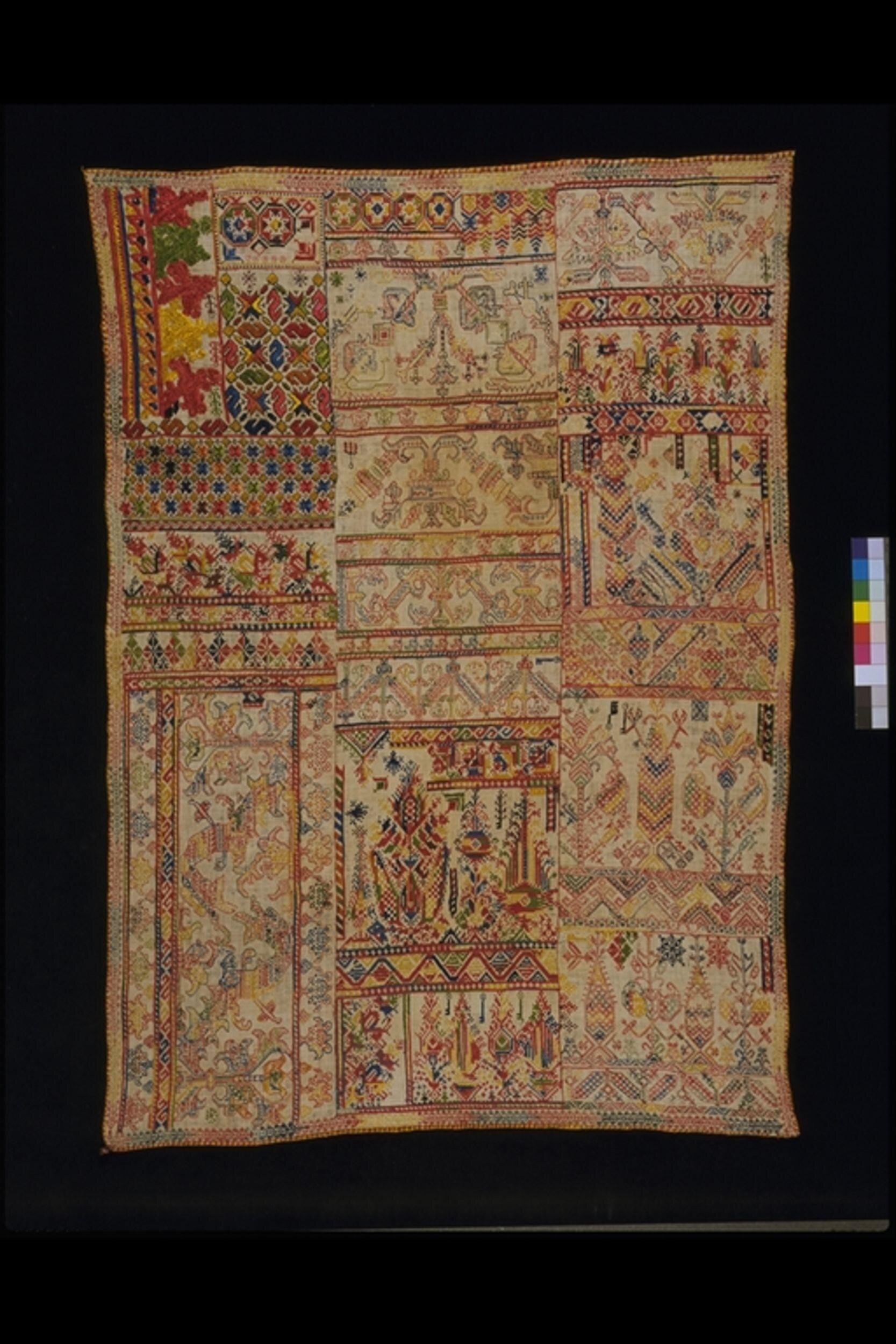
This black and white photo is also of a multicolor piece (Accession 372-1905), dated from the 1800s, and is also listed as of Moroccan origin.
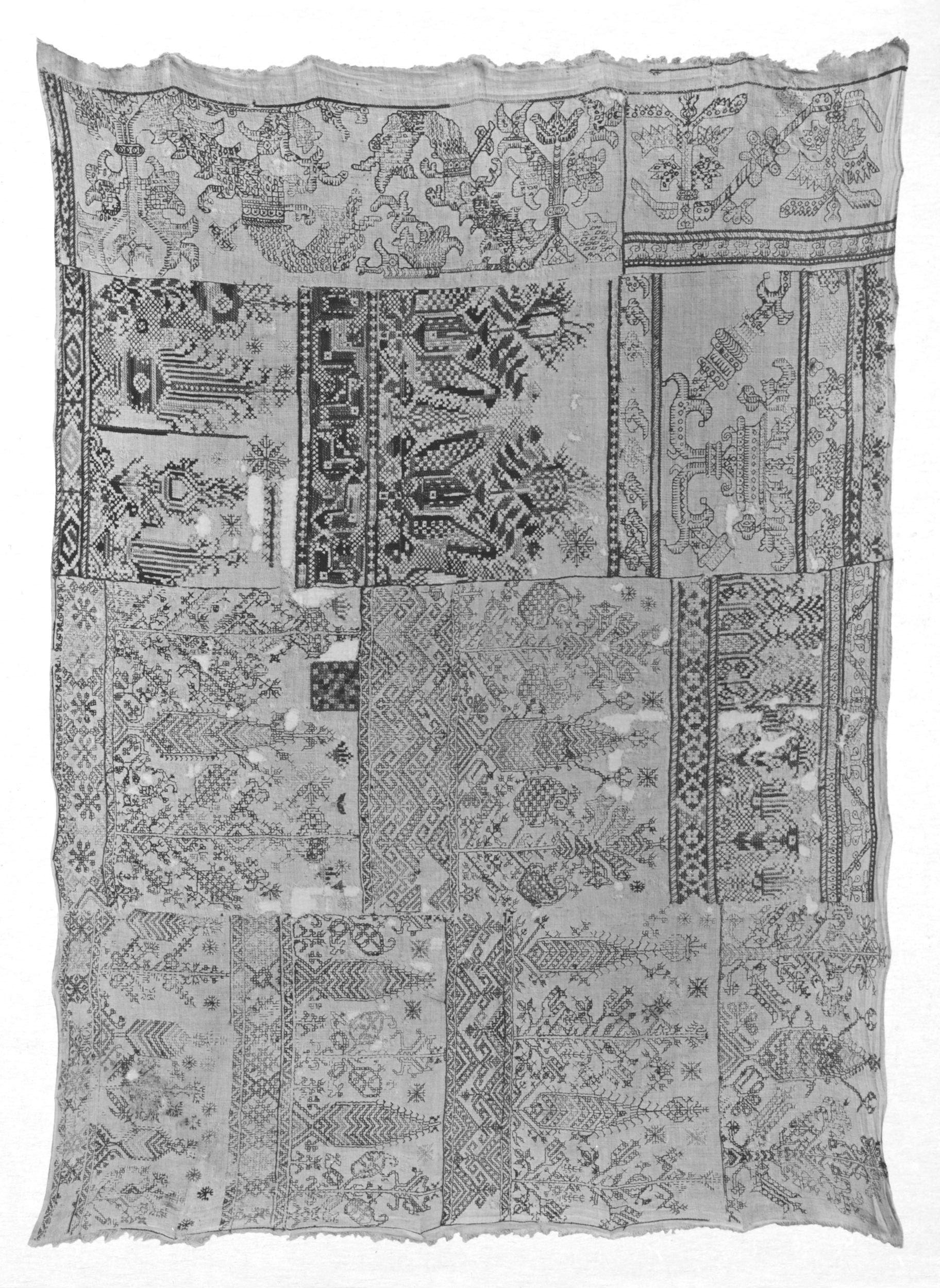
Both of these pieces contain two of the most common motifs in the cluster. This one is what I call the Spider Flower, for its spindly center blossom.
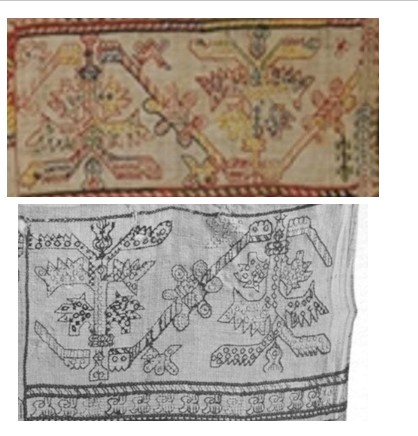
Here’s the second. I call it Wide Meander. This is found both with the wide strip looking rather sea-monster like with a gaping mouth, and in a tamer form, where the monsters have fused to become a super-wide belt like meander join. Discussions of both Wide Meander and Spider Flower are in my previous Azemmour post. Earlier musings on the Spider flower are here.

But these are not the only ones. The multicolor photo also has these two designs on it that I’ve discussed before.

The one on top is a variant of a pattern that is of Italian provenance. I mention it in this piece, and again in my discussion of voided grounds (under the boxed fill).
The one underneath I call the Pomegranate Meander. It’s clearly related to the Spider Flower, although in this case the ornaments on the joining diagonals are emphasized, rather than the center flower shape. It’s also mentioned in the Azemmour discussion cited earlier.
Plus it’s also worth noting that both of these V&A samplers show lots of variants of the customary accompanying borders so often seen with these main strip designs.
But for me the eye opener was the addition of another design to the group. Both samplers show the wide urn design.

This one I should have tweaked to based on the style of detail in the foreground. But I did graph it up for The Second Carolingian Modelbook based on this example from the Hermitage Museum, and accepted their identification as Italian, 16th to 17th century. Accession T-2714, entitled “Border Embroidered with Bowl and Stylized Plant Motifs” if the link breaks).

Here is my own rendition of this design, as I stitched it on my long green sampler.

Now we have a conundrum. We have many items whose dates and places have been corrected in museum collections. We have a continuing tradition of design replication and pattern re-use in a specific place. We have some predecessor designs and traditions that might have fed the Moroccan styles. And we even have some evidence of the post-Inquisition diaspora spreading these stitching styles TO settlements in Morocco. The Jewish link is cited by The Textile Museum of Canada. The Jewish Virtual Library notes the migration and community. The Jewish link is also mentioned here. The Textile Research Centre writes that production of Azemmour pieces died out in the mid 1900s, although recent revivals have been undertaken.
So where do we draw the line? Are these related items ALL to be reassigned to the Azemmour Cluster, with production dates in the 1700s through 1800s, sold to the unsuspecting as older artifacts? Are some possibly earlier, transitional pieces? Can we rely on just the wealth of ornament in the foreground of these strips to differentiate them from earlier forbearer pieces? Without detailed textile forensics, we may never know. But wherever and whenever their points of origin, it’s nice to see the family reunited again.

