WORKING IT
And the latest piece continues to grow.
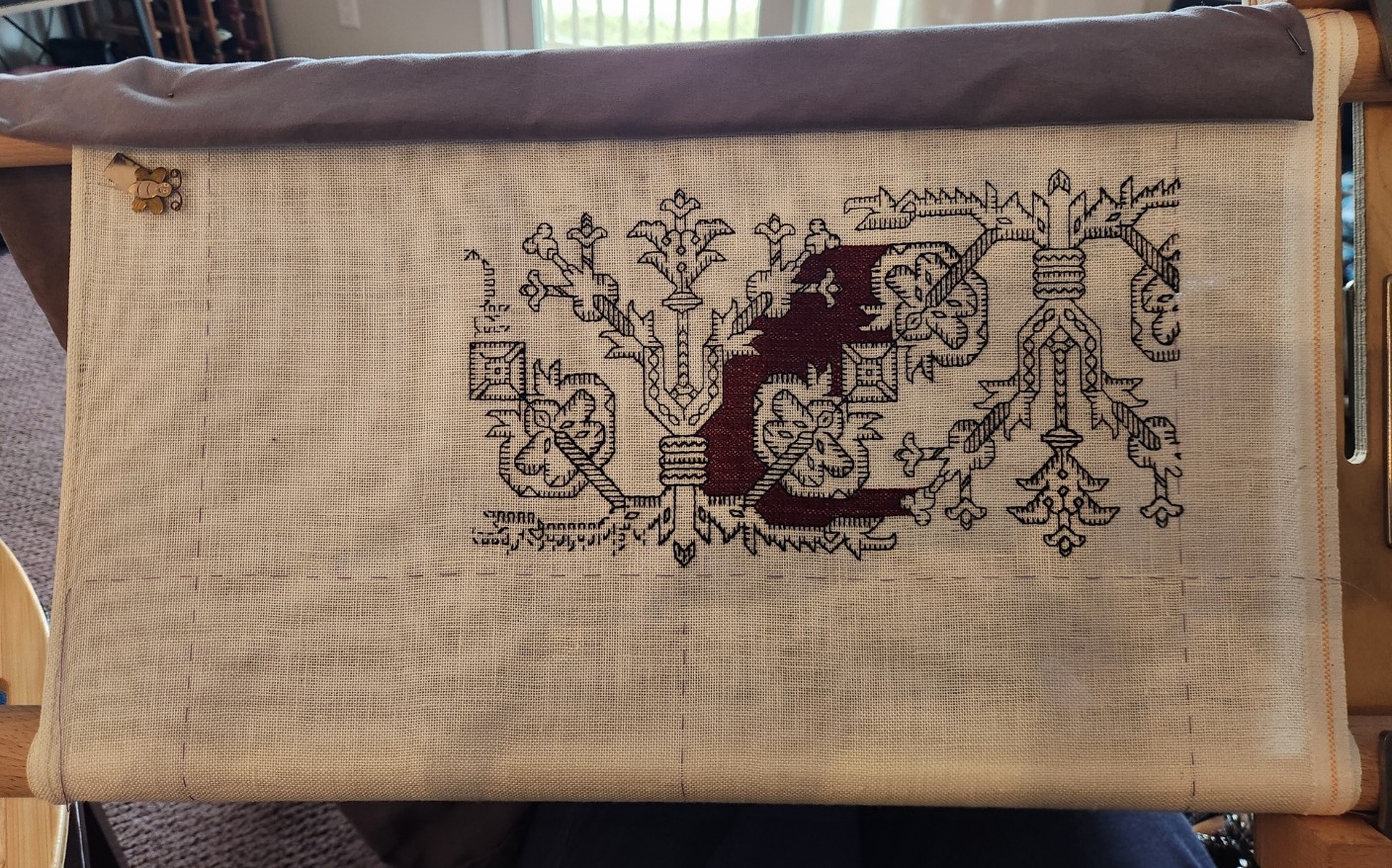
At this massive gauge – 28 threads per inch compared to my normal 40+, it’s mile a minute. All in all I am pleased. While the voiding is sparse (one strand of spun Au Ver a Soie’s Soie D’Alger – a thread economy measure), it is solid enough to be effective.
Another thread economy issue is in the black. The reeled long fiber Alori silk is divisible into four strands. Each of those strands is made up of three plies, not all of uniform thickness, although the thickness of each of the four officially divisible strands is very close. I am dividing each strand into a two ply, and a one ply, using the one ply doubled. No, this is not an advisable practice, and I would not suggest anyone else pursue it. But I am working from stash and want to eke out every inch possible.
As a result of my frugality there is a noticeable variation in the density of the black double running stitch lines. Some are heavier than others. To be fair, this is actually a look pretty common among museum artifacts, but in their it case was caused by the stitcher’s having to finger-spin each length of thread used from a clout of dyed, combed but unspun silk fiber. It’s especially evident on samplers worked by newer/younger stitches, where there is a marked difference in weights and even colors, since intermediate shades were achieved by marling together their parent hues. As with everything, practice helps. Some stitchers were more uniform in their thread thickness or color blending efforts than others. So I am doing my best, trying to mate or meld areas of similar weight so thick/thin dashes don’t occur in the same line of double-running.
In the helpful hacks department, note the old grey pillowcase pinned to the top edge of the work, and hanging down in back. That’s a light shade. I find that minimizing the ambient light shining through the work from windows, low lamps, and the television eases counting. In this case the pillowcase does double duty. This piece on my longest Millennium frame bars is too wide for the travel carrying case I made for on-frame projects. I suppose I could make another, but time does not stand still. I pop this one into that king size bed pillow slip, pin the top end closed, and it’s good to go.
Go we did. I packed up my upstairs Lowery stand (I keep a hex key in my stitching box for this very purpose), disassembling the thing into a heavy canvas tote bag, and bringing the frame, large frame extender, tool chatelaine, and pirate lunchbox of threads and other support materials/tools with us out to our place on Cape Cod. A welcome respite and restorative bayside sojourn. Nothing heals better than watching the tides march in and out.
As to health issues, I have bounced back from the dual biopsies in March – stamina and strength are back to where they were back in February. Findings are not universally great but neither are they dismal. My Danger Lentil might have been any number of tumor types that are far more dire than what was revealed. I do have a secondary chordoma site, at a location not previously documented for that very rare manifestation. But chordoma doesn’t eat brain. It eats bone and connective tissue, and responds well to radiation therapy. I meet with a rad oncology team soon to plan and embark on another round of proton treatments.
In the mean time I am in good spirits, optimistic and full of fight, along with the strength and stubbornness to win. And armed as I am with this easy to see project, plus working on Ensamplario Atlantio Volume 4, and a few pairs of socks to knit – equipped with ample amusements to keep that determination in high gear.
COMFORT FOOD FOR THE FINGERS
As folk following along here know, I like to keep busy. I need the comfort of fiddle-food for my fingers. Waiting is particularly annoying without it. Just before heading off for my second diagnostic procedure, I had started an experiment in Buratto, on a chance find bit of cloth that mimics the weave of that Renaissance era open mesh ground.
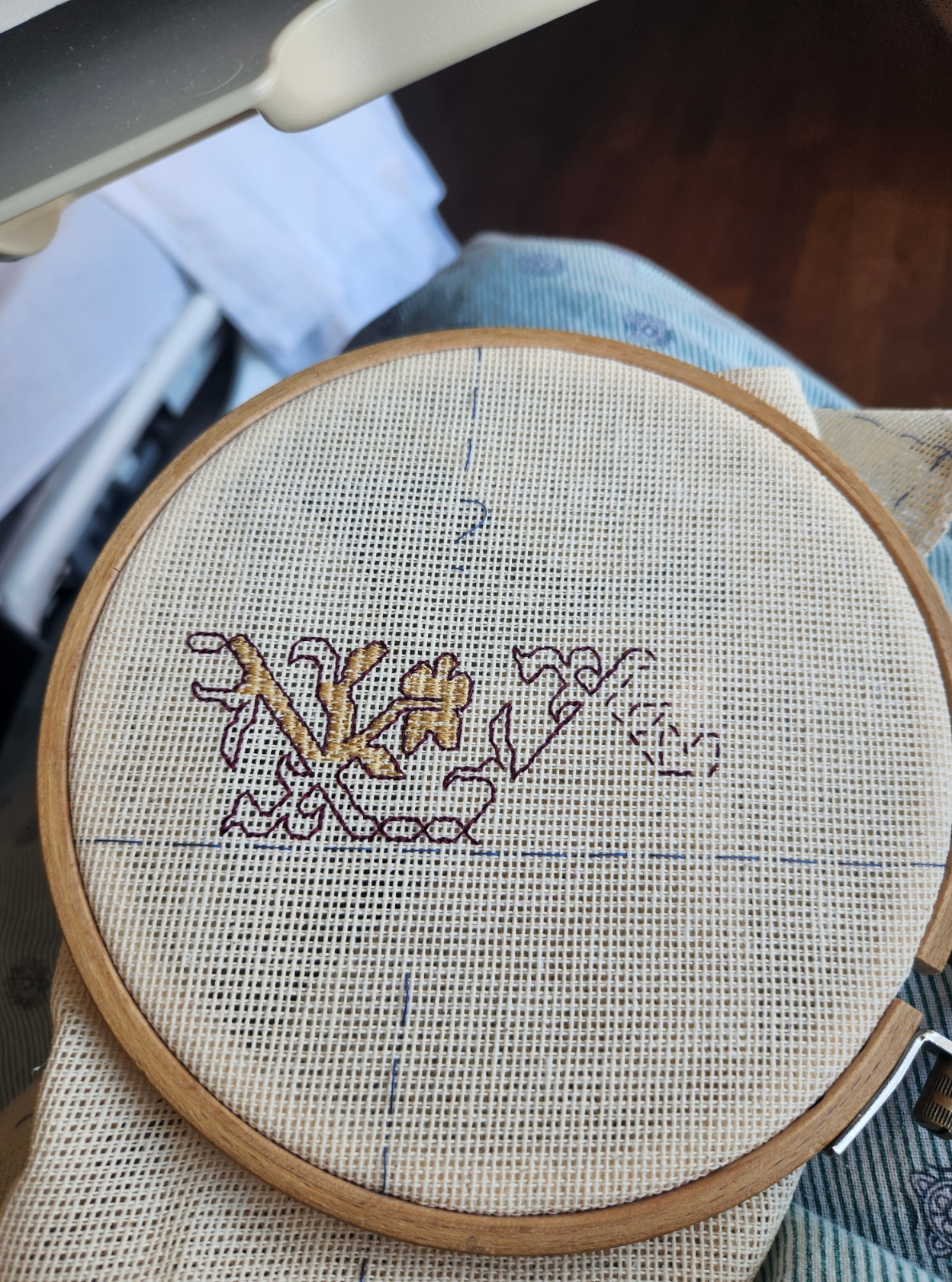
I am not pleased with it. I’m using some of the leftover Ciafonda faux silk I got in India. Nice enough thread, but not lofty enough for this. Even stacked, the double running stitch fill is too sparse. I supposed I could pick it all out and begin again, but right now I don’t have the patience to do that. I’m going to set this small wash-cloth size bit aside and get back to it later.
As you can tell from the bit of hospital tray shown, I had been working on this during my stay there. But I also brought knitting with me, and bargained with the various specialists installing the needed lines and monitors to leave my “bendy parts” clear, including inner elbows, wrists, backs of hands, and index finger tips. They were kind enough to work around all that. As a result, here’s last week’s finish. Yet another pair of socks cast on in pre-op, and finished during the ensuing week and a half of recuperation.
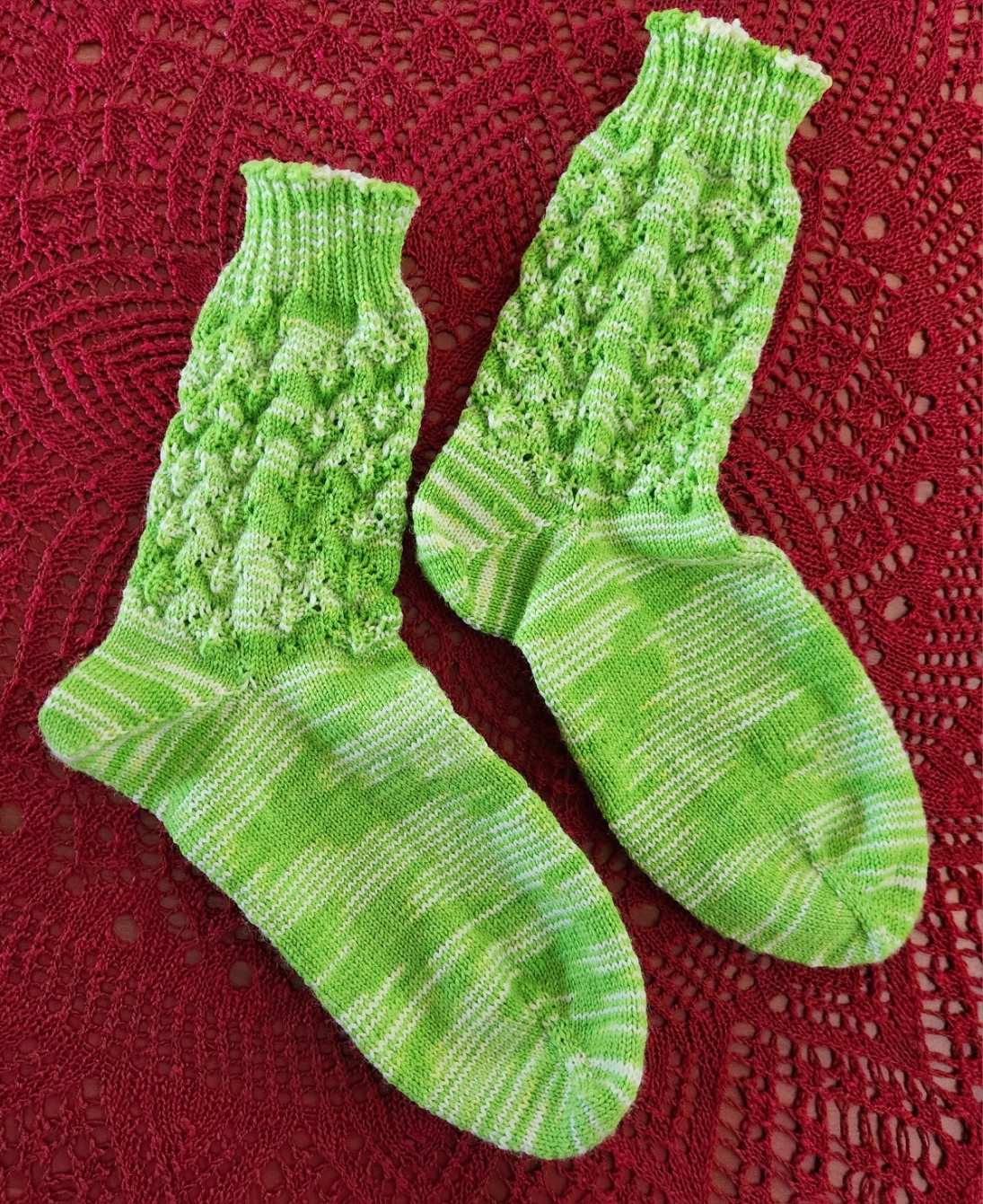
Since these are pretty much done on autopilot – toe up (Figure-8 toe), double wrap German short row heel, and something improvised on the ankle, such socks are “procrasti-knitting,” a fill-in project done while I contemplate other more involved efforts.
And I have arrived on the next one. It will eventually be fine-tuned to honor my Resident Male’s latest book-in-progress, but he’s at an early part of that journey. Themes and significant bits to be illustrated are still in the developmental phase. So I will do something of broader appeal, and add the book-specific bits as they become evident.
But what to do? And how to “future-proof” the project in case therapies affect short term acuity of vision? While such a thing is far from a probability, being a proposal manager has trained me to think in terms of identifying and managing possibilities, no matter how remote. Always.
Thank goodness for a deep stash. I vastly prefer stitching on finer count linens, and consider 40 to 70 threads per inch to be my sweet spot. But that doesn’t mean I don’t have linen of other counts squirreled away. I have unearthed a lovely piece of 28 count. Big as houses. Very easy to see. So I grabbed it, cut a healthy piece, hemmed the edges, basted my edge and center guidelines, and mounted it on my largest width Millennium scrolling frame.
And for thread – how about REAL silk? I adore the stuff. I have two large hanks of Au Ver a Soie’s Soie d’Alger in a lovely cranberry red just sitting there staring at me. And some Tied to History Alori Silk divisible in a couple of colors, also in a parking orbit. If I am going to indulge myself, why not?
The overall style of this one? I will take inspiration from the casual research I’ve done into the Azemmour Cluster. This is a well represented group of embroidered fragments that made their way into museums via wealthy donors who collected bits and bobs of what was sold to them as “Authentic Renaissance Embroidery” in the era of the European Grand Tour, roughly from the 1870s and ending around the time of Word War I. There are lots of snippets formerly labeled as being Greek, Italian, or Spanish that are now being reclassified to their true point and time of origin – Morocco in the late 1700s through 1900. I wrote about some of them in my Second Carolingian Modelbook, and in this 2018 blog post. And then I revisited the cluster in 2023, when a group of eye-popping multicolor pieces documenting concurrent usage of many of the style’s key design tropes was pointed out to me during the Zoom-based group meetings for participants in the Unstitched Coif Project. We had a lively discussion on the obvious Renaissance roots of some of those tropes, and why the museum attributions of so many of them are only now being updated.
I’ve stitched up a couple of the Azemmour group on previous pieces but I’ve never done a deep dive. Not sure which of them I will work with voided grounds, what colors or combos I will use, or what the rest of the piece will look like. But here’s the start. As I said – big as logs.
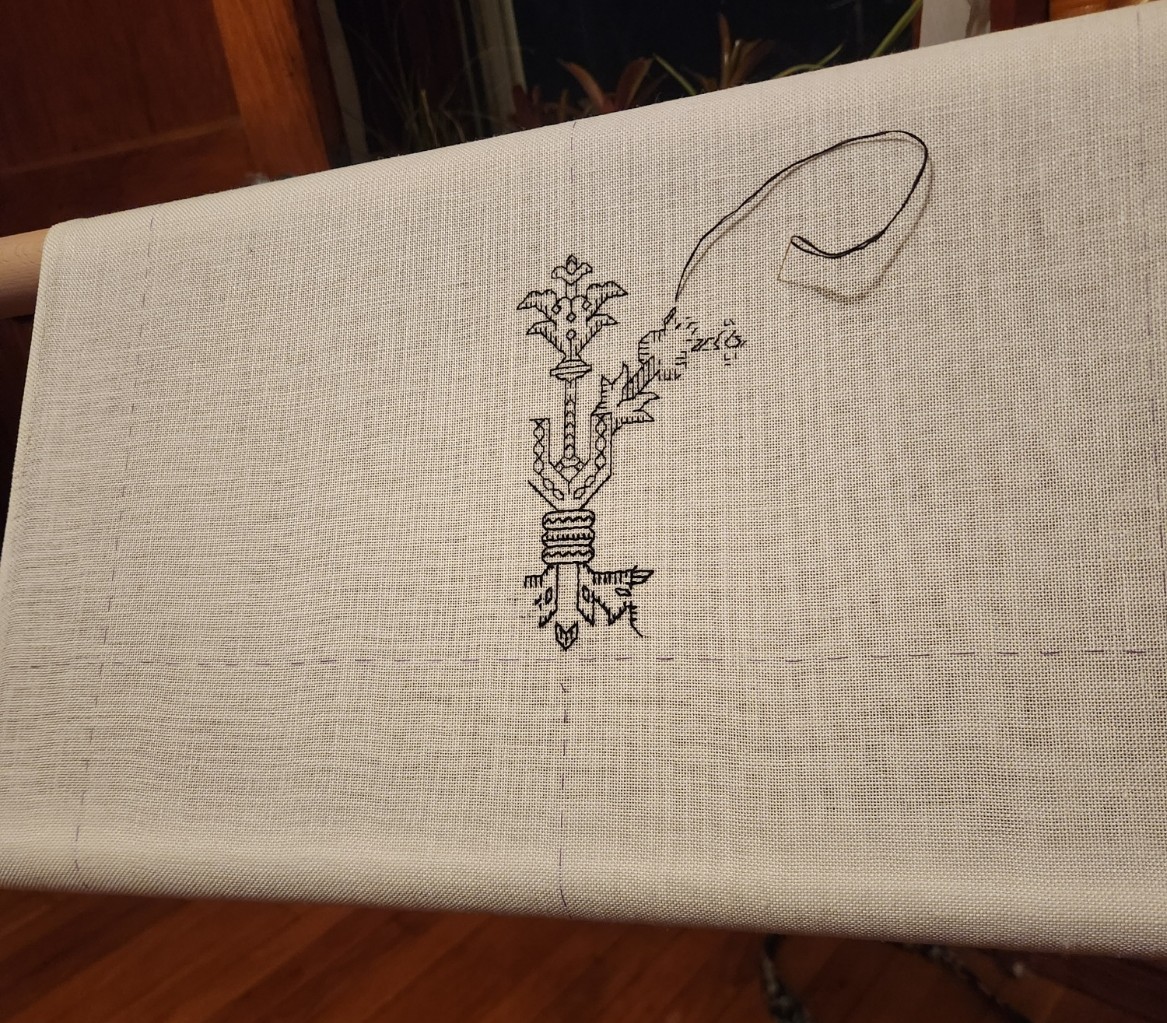
This armed against boredom and the as-yet-unknown, I march ahead.
 String-Or-Nothing