FESTIVALS PAST
There’s always something a bit bittersweet about the end of a holiday or festival. All that preparation before, then the exuberance of celebration, followed by an ending. And then all that’s left is clean-up, thinking on the past, planning for the future, and looking over the pictures.
Yesterday was the end of the 10-day annual celebration in honor of Lord Ganesh. We didn’t get to see the very heart of the festival in Pune – that was accessible only by wading on foot through blocks and blocks of dense crowds in the old parts of the city at night, something inadvisable for Western women on their own. But thanks to the resourcefulness of Driver Rupesh, we did get to catch some of the sights and excitement around the edges.
First, there are over a thousand sanctioned celebratory platforms (pandals) raised by various affinity groups – civic associations, merchant groups, political parties, charitable organizations, religious affiliates and so on. And there are easily as many “unofficial” pandals, not registered, erected by still other smaller groups; in addition to an uncountable number of displays and altars in private homes.
Rupesh drove us around the edges of the area cordoned off for pedestrian traffic only. We saw only a very small portion of the pandals, but even so, we lost count at around 50. The only thing these displays have in common is that there is a revered image of Lord Ganesh at the center, as the focal point for devotion and offerings. The housings differ in size, elaborateness, decoration, and other activities. Some include stages for live performances, and in between devotions show live action tableaux, plays, musical performances, puppet shows, or other in-person entertainments. Others include audio-animatronic spectacles, illustrating scenes from sacred texts, classical literature, or history. Some are total light shows, with throbbing music and choreographed displays of thousands of LEDs blinking in time to the beat. Still others include video loops or public speakers espousing various noble causes – respect for women, clean water, universal education, and the like.
Some, belonging to smaller, less affluent organizations, pass up the expensive lights and fireworks. Those are decorated with flowers and plaited banana leaves, paper ornaments, or modest household textiles. The most poignant were totally bare, with signs that said that the money the group would otherwise have used for decoration this year has been donated to flood relief in Uttarakhand, the province in which thousands of pilgrims and hundreds of villages were swept away during the June monsoon rains.
Here are a few photos of what we saw. Apologies on the image quality. Taking photos at night from a moving car in the rain requires a better camera and a steadier hand than we possess.
The architectural fantasy on the left had a large stage with dance performances. The LED creation on the right twirled and throbbed like a Las Vegas sign.


Here’s a GIF made up of images we took, that conveys a (silent) impression of the frenetic dancing lights at yet another pandal. But you’re missing out on the disco-beat drums of the accompanying sound track.
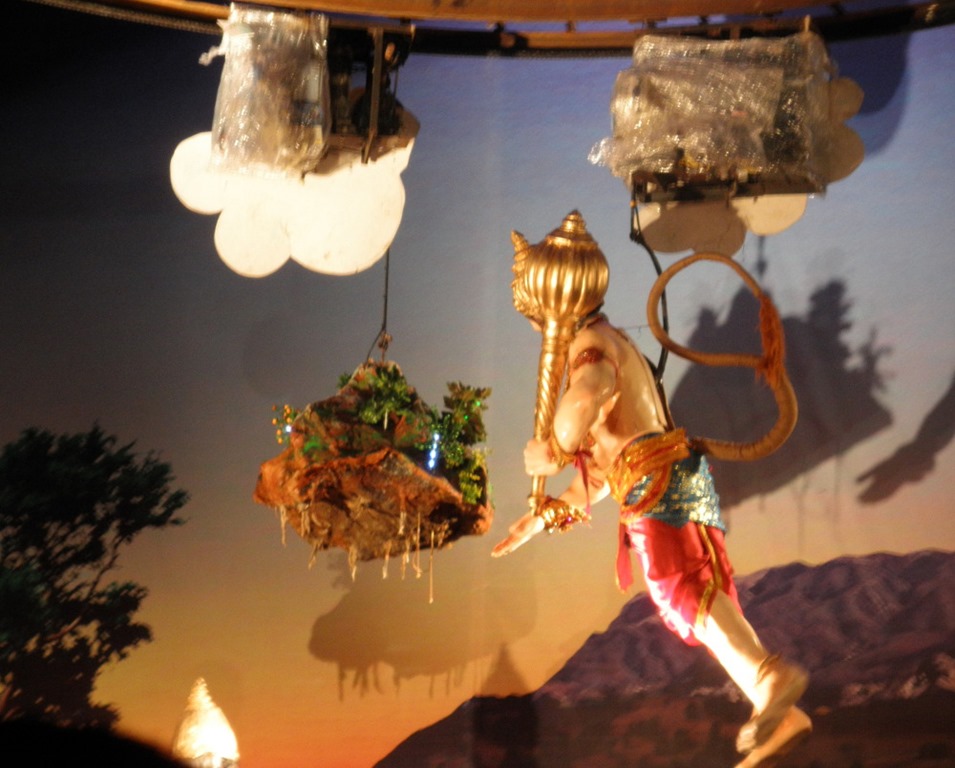

The animatronic display at the site above is of a pivotal scene from the Ramayana. In this story, Lakshmana, the son of Lord Rama has been gravely wounded during the wars against Ravana, king of demons. The only thing that can heal him is a herb that grows on a certain mountain in the Himalayas. Lord Hanuman, comrade of Lakshmana undertakes the quest. Prevailing against a hindering Ravana, the hero Hanuman arrives at the mountain, but even after stretching time for his search by delaying the sunrise, he cannot identify exactly which of its plants the healing herb might be. He solves the dilemma by fetching back the entire mountain (image at left). Lakshmana is saved (image at right), and Hanuman is extoled as a sworn brother of Lord Rama.
Pandals are the centers of celebration for ten days and nights, with most of the activity occurring after dark. On the last day, the images and devotional offerings are honorably retired by immersion, preferably in a flowing body of water. This is accomplished via procession, with as much music, dancing, singing, and general merriment as possible. Here you see a small family image being escorted down our street (seen from our balcony, above). What you can’t hear is the singing, chanting and cymbals that marked this progress:

The celebrants are stained with red because they launch red powder at the image as they make their way to the river, three blocks away from our flat.
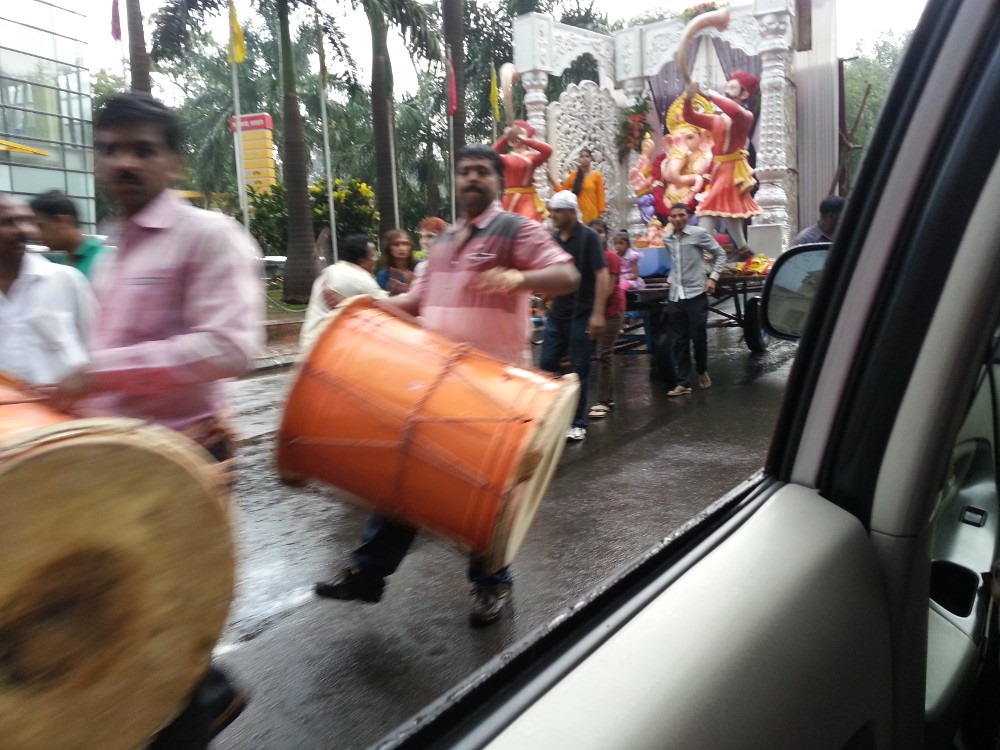
It seems that on the last day, half of the city is in motion, conveying Ganpati to designated immersion spots. Big ones travel in luxury, in massive lorries and carts decorated as elaborately as the pandals (below). Smaller ones are pushed on hand carts (also decorated); or as above – carried by hand. In all cases, the images are accompanied with chanting, drums or marching bands, singing, and dancing.
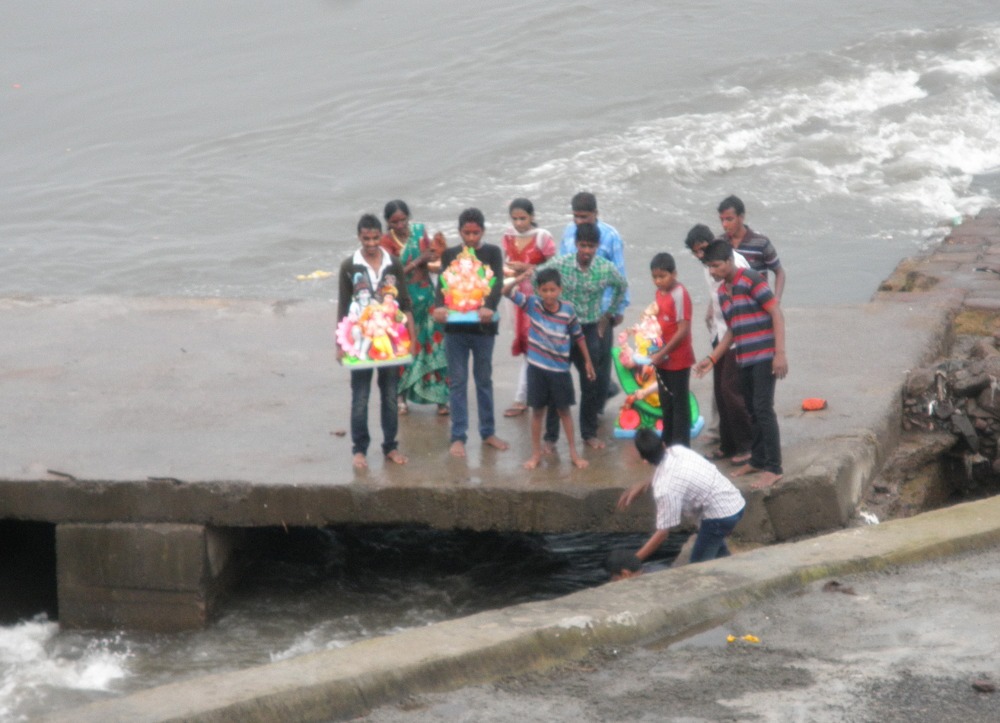
Most processions converge on one of the official staging areas, where the images are handed to special groups hired to perform the final ritual to sink them into the river, either from boats or (if size is a limiting factor) being carried by teams of bearers and swimmers (left). Some families opt for non-official immersion spots, and even risking the rapids themselves (right).

Now today, the day after, the city seems empty. Pandals are still standing, but their sacred inhabitants are gone. The structures are being slowly disassembled. They have a slightly forlorn and empty air, as if all of the past ten days of celebration can still be heard echoing across the empty platforms, playing out before their absent Lord.
HEMMING AND HAWING
Well, not “hawing.” Just hemming.
In answer to the question, “What do you mean by ‘Italian hemming’ since there are so many things that go by that name?” I trot out this picture of my Lord Ganesh cloth’s corner:


The person who asked the question is spot on. There are many types of hemming with confusing, occasionally overlapping names. Some are single pass rolled or folded hems like mine, others are double rows of stitching. I don’t remember where I learned this, but “Italian hemming” was the name attached.
Basically, the stitch I learned is similar to a hemming technique employed in withdrawn thread work, but in this case is done without removing any threads, as a pulled thread stitch. This style of hemming is worked on the reverse, and folds up/fixes the hem/makes the decorative pulled thread “dots” all in one pass. The stitches that make the vertical legs (as opposed to the stitches that do the horizontal bundling), are worked solely through the hem fold, and do not pierce the front or display side of the piece. All of the folding up is done with finger-pressing, neatly crimping the edges tight between thumb and forefinger, just ahead of the actual stitching. The same for the mitered corners – no ironing here, just careful folding along the threads of the weave, going slowly and working under a strong light.
I’m not the neatest at it, being long out of practice, but I’m finished, and not entirely displeased with the final product.
LORD GANESH–ENDINGS AND BEGINNINGS
The stitching part of my Lord Ganesh is complete:

All that’s left now is a little bit of finishing around the edges of the cloth. I may try out some Italian hemming, just for the fun of it.
Although I didn’t create this stitching specifically in honor of the festival, it is fortuitous that the project’s completion will coincide with Ganeshotsav or Ganesh Chaturthi.
Ganesh Chaturthi is celebrated throughout India, although it holds special significance in western areas of the country, including Maharashtra, the state in which we live. Lord Ganesh is venerated at the time of his rebirth. He is beloved as the patron of arts and sciences, who watches over the good beginnings of any venture. As I mentioned before, Ganeshji is a daily presence in life here. His images protect almost every vehicle on the road, and guard the front door of most homes. His shrines are everywhere.
In spite of this ubiquity, the festival itself is not all that ancient, becoming popular as a protest movement in the 1890s. It was revived as a unifying, mass assembly of people for a very public celebration, in opposition to anti-gathering laws in place during the British rule of India.
Modern celebrations include the erection of decorated avenues and temporary platforms, on which images are displayed. These festival areas are also the center of both scheduled and street performances – everything from music and theatrics to impromptu dancing. During the festival, offerings and devotions are also performed at the platforms (pandals).
You can see signs of the upcoming festival now all over Pune, with street constructions sprouting in neighborhoods, near temples and shrines, and along commercial streets, as civic, religious or community affinity groups try to put on the most beautiful and elaborate display. Some of the modern displays and performances are dedicated to additional causes, especially those of social justice. Families make (or buy) special delicacies for the celebration and reunite to enjoy the time together. Devotions culminate at the end of the holy week with huge processions, in which the images are escorted to bodies of running water, where they are immersed and destroyed, in a ritual that echoes the impermanence of the universe – be it of gods or men.
This ritual immersion presents a number of logistical and environmental problems. Many of the images are crafted from plaster of Paris, and are decorated with paints containing heavy metals. The sheer number of these can produce major pollution events, and can leave toxic residues in the bodies of water used. There is growing awareness of this problem, even among the most traditional of the devout. Clay, as opposed to plaster of Paris statues are more widely sold, albeit at greater cost. Some people are making their own rather than buying them. There are even calls for volunteers to recover immersed floral offerings, similarly retired to the waters after the festival, in order to reduce the effects of a large biomass of decomposing vegetation.
Logistical challenges include crowd safety, personal security, and fire awareness for unbelievably large throngs of people, all of whom are intent on getting the best view, having a good time, and enjoying the day and night time displays (complete with light shows and fireworks). There are also civic infrastructure challenges – in the cities, pandal construction damages the streets when holes for the supporting poles are drilled. Electricity for lights and loudspeakers is leeched off street poles, with improvised connections. And construction of the platforms and drapery-lined avenues can also be problematic, with enthusiasm often outstripping engineering for the anticipated loads or required clearances.
Still, for all of the challenges, the city is poised for what looks like it will be a major celebration. I’m hoping we can experience some of the edges of the festival, and come back with memories and pictures to post here.
CROSS-CULTURAL STITCHING
Lord Ganesh is a beloved and hard-working Deity here in India. His image is omnipresent. Aside from gracing his many temples, Lord Ganesh rides on dashboards all over the nation, protecting almost every car, truck, and bus. He wards the door of most homes; and blesses many shops, schools and public buildings. His image has been rendered in just about every medium, from exquisite woodcarving to molded pink plastic. He has been sculpted, printed, woven, painted, and stitched. Hmm. Stitched.
So of course, I had to work my own.
I tried to draw up my own freehand design, but decided in the long run that it would be easier to use an established image. That way I couldn’t get the iconography wrong. I found a kids’ coloring book page via Google. Its simple shapes were particularly suited to inhabited blackwork – the traditional form with heavy outlines enclosing counted thread fillings. I sized the design for some cloth I had on hand, and printed it out. Here you see the cloth and the design taped to a window – a free version of a light table – for pattern tracing:

And here’s progress to date – about four days’ worth:

He’s red because red is a happy color. I’m about two-thirds done, with one ear, some “filler” and some of the lotus frame left to go. I’m very pleased with the way he’s turning out.
For the record, I’m using plain old DMC six strand cotton floss, color #498; two strands for the fillings, three four the chain stitch outlines. I’m working on a coarse cotton/acrylic “linen” that’s not quite even weave (you can see the distortion in the floral pattern in the face, with the north-south axis looking slightly squished compared to east-west). I’m doing this at (for me) a huge gauge of 16 stitches per inch, and the entire piece measures across from lotus-point to lotus point is approximately 8 inches across. All of the fillings above are from my free Ensamplario Atlantio collection.
I have a special purpose for my Lord Ganesh, which will be revealed in time.
WOOLWORKS AND ANN KRECKEL’S “JANE’S BABY BOOTIES”
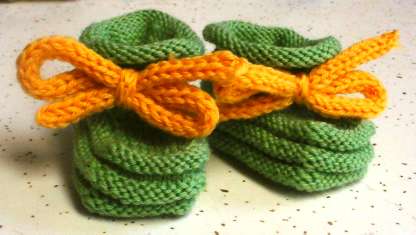
As folks here know, I adore this little pattern. It’s not mine, but I’ve knit at least sixty pairs for friends and family. Ann Kreckel posted it to the Ancient KnitList mailing list in 1995 (in its pre-Yahoo academic server days). It is Ann’s redaction of an older pattern passed down to her from her mother. There’s also a similar pattern that appeared a couple of years later in Threads Magazine (before they abandoned handwork), sent in from a lady then in her 90s, who said she learned it as a girl. I’m still looking for the ultimate source of both her and Ann’s mother’s pattern, probably in a women’s magazine or knitting booklet published before 1920.
In any case, for the longest time, this pattern has been available in the archives of the KnitList, and later on the now apparently defunct Woolworks.org website. Most of Woolworks’ content can be found here on the Internet Archive, via the Wayback Machine, a nifty tool for exhuming dead websites.
Ann’s pattern for Jane’s Baby Booties is here at this link, in full.
Here is my mini tutorial on knitting her pattern.
Here is my hat pattern to match her booties (PDF).
Woolworks disappearance is a shame, especially in that it appears to have happened without comment. Woolworks, compiled and maintained by EmilyWay, was one of the first comprehensive knitting sites on the ‘Net, and Emily should be one of the Internet knitting community’s patron saints.
In any case, having tried but failed to find Ann herself, I’ve shared the link above, but am loathe to repost her pattern verbatim. It’s hers, and I respect her copyright. If you know Ann, please match-make the two of us together, because I’d like to host the full text of her excellent design here.
PACKING ADVICE FOR EXPATS-TO-BE
OK, I’ve gotten a request from someone who doesn’t wish her name or tag posted. She is looking at an extended family stay in India in support of her expat husband and wanted recommendations on what to pack. I’ll attempt to answer, but with the caveat that each person’s experience, expectations, housing situation, and comfort level is different; and what I see here in Pune may not be typical of the rest of the country.
As to our housing, we are three people: two adults and a teenager. We opted for a sparsely furnished high-end apartment and what we brought is specific to that situation. Others who rent unfurnished apartments or stand-alone villas, or who have small kids, will have different needs.
Our apartment complex has a 24-hour guarded gate, a secure parking area, a building generator that bridges electrical outages and brown-outs (albeit with a minute or two gap before it kicks in); filtered water; piped in gas for our four-burner cooktop (instead of having to buy and lug our own propane cylinders) and an elevator. Our apartment has hot water heaters in the bathrooms and kitchens (push a button and in 20 min there’s hot water); a dishwasher, washing machine, small microwave, and a refrigerator. There is no conventional oven, although we could buy a small convection one if we really want to (we don’t). Our furnishings are minimal but functional – dining table and chairs, sofa and coffee table, TV stand, beds and built-in closets/drawers in the bedrooms, curtains, student desks in the kid bedrooms, and a big desk in the bedroom set aside as my husband’s office. It’s common for upscale apartments to have one bathroom for each bedroom. We also have a maid’s room, but with no maid, it’s dedicated to laundry.
Note that India’s electricity is 240V, and the plug configuration is different than in the US, so most US appliances and electronics won’t work here unless they are clearly marked for 240v. Most computer and high tech gear is multi-voltage (100-240V) though.
I’ll break this down by categories.
Kitchen and Food
We are cooking a lot of Indian style food because maintaining a familiar Western menu is prohibitively expensive and difficult to source.
Recommend to bring – any cooking implements that are vital to you. We brought a set of good knives, pots, pans, a heavy iron skillet, my hand-grater, a chopping bowl and chopping knife, stainless tableware, metal cooking tongs, vegetable parer, a couple of funnels, and some silicon spatulas. We brought some disposable plastic storage containers (I should have brought more of these), measuring cups and spoons, and plastic wrap. We also brought a heavy plastic cutting board for meat and good refillable water bottles that are easy to clean.
Recommended to buy here – Strainers or colanders, glassware, inexpensive unbreakable Corian type dishes, plastic or steel mixing bowls, steel cooking spoons and flippers. Plastic storage containers, canisters, and bins for spices, flour, lentils, coffee, etc. Gas service is low pressure/low flow, so the following have been indispensible: rice cooker, electric kettle, inexpensive low-tech pressure cooker. Coffee maker, toaster. Wooden cutting board for vegetables, small wooden rolling pin for making Indian flatbreads. Blender/grinder if you plan on doing a lot of Indian cooking. Cheap cotton dishtowels. Thermos bottle for coffee or tea. All of the small electrics can be resold when you leave.
Recommended to leave home – Baking dishes and pans, unless you plan on buying a convection oven. Anything that would be a pain to wash or care for because even with a dishwasher, you’ll end up doing a lot more hand washing than you are used to. Or if you are engaging household help, avoid bringing anything that you’d cringe to see broken in their well meaning but occasionally ungentle care.
Cleaning and Maintenance
It’s quite grimy here from the prevalence of diesel exhaust, plus for most of the year there are no rains, and the dust flies. You will be dry-mopping floors and dusting almost every day.
Recommended to bring – A dry Swiffer holder (the least expensive one disassembles neatly for easy packing). Don’t bother bringing the disposable pads. Go to a fabric store and buy one yard of the cheapest microfleece flannel they have in stock. Take a Swiffer pad and measure it out on the fleece, then cut the yard of fleece into rectangles of that size. You’ll get about 16. No need to hem, just use them in place of the disposable, then shake them out and when you’ve got a pile of dirty ones, toss them in the washing machine. Bring a small vacuum if you have or plan to have rugs. I brought my Roomba, for which a 240v adapter is available on the iRobot website. A small tool kit (hammer, wrenches, screwdrivers, pliers, etc.) is very useful. Bring cheap brown packing tape and duct tape. We had windows that didn’t close completely, and needed to tape plastic bags over the gaps in order to exclude mosquitoes.
Recommended to buy – Mops, buckets, brooms. You’ll need them all. If you have a balcony, get a broom just for outside, because it will quickly get too filthy to use indoors. An iron and ironing board, unless you plan on sending everything out for laundering and pressing. (If you do, be warned, it’s hard to find a place that does this gently, and we haven’t yet found a satisfactory dry cleaner.) Clothes drying racks – dryers can be had here, but electricity is very expensive. You’ll want to dry things on a rack or line, either indoors (cleaner, if you have the space), or outdoors (quicker, but only if you have a secure place to do it, and don’t mind dust-dingy clothing). Laundry detergents, all fabric bleach, and other cleaning consumables are all available.
Recommended to leave home – Unfortunately, you can’t ship most cleaning products because they are caustic, this includes scouring powder (like Comet or Ajax). This is a shame because on the whole, the stuff available in the US is more effective than what’s on the shelf here. But what’s here is good enough if you apply extra elbow grease and determination.
Tech and Entertainment
Recommended to bring – Dual voltage flat screen TV that has a hook-up to use with a laptop computer in order to watch pre-recorded material. A small hard drive loaded with the same (we have a DVR at home, and on it we brought five years worth of laagered favorite movies and shows with us). Laptops for each person (schoolkids need their own to bring with them, the working spouse will need one, and the accompanying spouse will need one to maintain sanity, too). You’ll appreciate Skype to keep in touch with the folks at home. Tablets, iPads, or other readers – books and games are bulky; readers allow you to subscribe to the home newspapers or magazines on line, plus read all you want, wherever you want, without accumulating a weighty and expensive pile to ship back home, plus they can hold your music, too. iPod/iPad or music player speaker/amplifier/stand/recharger. “Jailbroken” phones or phones that can accept an international SIM chip. You can get phones here, but they are 2-3x more expensive than similar models in the US. Hand held game units for the kids, with lots of games. Hobby supplies. If you knit, stitch, paint, or do any sort of craft as an outlet, bring your supplies. Stuff can be had here, but availability and selection are extremely limited, and there is a lot of down time and isolation, especially for an accompanying spouse. Allow yourself a generous bit of space for such things, if that’s what’s needed to keep you happy.
Recommended to buy – an uninterrupted power supply (UPS). We bought one locally (they’re prohibitively heavy to ship) and have our router attached to it. When the power goes down and up as it does up to six or seven times a day, the UPS bridges the minute or two between the municipal power disappearing and the building’s generator power kicking in, which otherwise is long enough to reset the house router and lose connectivity. The router or switch itself (usually obtained through your ISP as part of their package). Omni-plug accepting power strips, which are widely available here. These provide a modicum of surge protection, plus they accept US-format wall plugs. Provided the item connected is dual voltage (like a computer or phone charger), they eliminate the need for individual adapter plugs. Note that replacement earphones and other accessories for the leading makes of phones, iPods, and MP3 players are widely available.
Recommended to leave at home – Bicycles, Razor scooters, and the like. Indian traffic has its own internal chaotic rule set. I wouldn’t suggest any but the most intrepid adults to ride in the streets. And that goes quadruple for kids. There are no places for them to ride at all, even in this gated community tooling around the parking lot will get old, very quickly. Sports equipment – again the “place to play” problem, plus most stuff – swim goggles, soccer balls, and the like are available here.
Personal Care
Recommended to bring – Personal care and cosmetic brands you can’t live without. That being said, Olay, Gilette, Garnier and Colgate brands have significant presence here, although most Americans would not be thrilled by cumin-flavored toothpaste instead of mint. If you like unscented products, bring them from home, because unscented isn’t popular here either. Q-tips, hair gel. If you need acne ointment with salicylic acid in it, bring that too. Definitely bring mosquito repellent containing DEET, preferably pump spray for economy, even if you are usually opposed to better living through chemistry. Mosquito-borne illnesses are a huge problem, and dengue is far worse than temporary exposure to the repellent. Bring high SPF sun block. They have sunblock here but it’s often mixed with harsh “whitening agents” because the local aesthetic values fairness to an extent that will make most North Americans of any race cringe at the personal care product commercials. I can’t speak to hair dye yet, although in another couple of months I may. Razors, again if electric – dual voltage. If manual, you may want to stock up rather than buy local. Bring any prescription medicines, in original containers, plus any non-prescription stuff you need, including non-Aspirin pain relievers, plus maintenance medicines like enteric Aspirin or vitamins. I’d strongly suggest going to a travel medicine clinic to get needed vaccinations and prescriptions for “just in case” medications, then filling them before you leave home. Bring a fever thermometer, band-aids, anti-itch crème, and antibacterial ointment. All can be found here, but only after much searching, which you may not have time for if need for them presents itself.
Recommended to buy – Hair dryer, the ones bought here tend to be more forgiving of the iffy voltage than even the US-purchased “international” dual voltage models. Mosquito killer wall sprays – in the US you can buy little plug in units that dispense air fresheners or fragrances. Here the same technology is used for insecticides. Again, remember that the illnesses are worse than short term chemical exposure, and use them.
Recommended to Leave at Home – Think of streamlining your daily routine and kit. Personal care items are bulky. Although brand availability is limited, adequate shampoo and conditioner can be found. Moisturizers are available. Soaps, especially hand-made soaps are excellent. Bring the absolute minimum.
Household Items
Recommended to bring – Towels and sheets. Make sure you know the size of the beds before hand. Most in high-end buildings are king size, but don’t make any assumptions. For kids, those bed-sitting pillows with arms on them. They will be spending lots of time in their rooms, and a dorm-style sitting pillow makes their bed a comfy place to read, listen to music, or study.
Recommended to buy – Bed Pillows. They’re bulky. Unless you have specific sleeping needs, you’ll find what’s here adequate. Furnished apartment furniture is very generic – you’ll probably want to liven the place up a bit with purchased rugs and pillows. Textile choices here for decorative items are better than choices for standard domestics. Small supplemental floor or table lamps. Wastebaskets and garbage cans, laundry baskets and hampers.
Recommended to Leave at Home – Heavy bedding, including quilts and comforters. A lightweight cotton blanket (or maybe even just a top sheet) is all that’s needed, even with air conditioning.
Clothing
Pune’s climate (for India) is mild, with only a month or two of intense heat. Daytime for the rest of the year is in the 80s-90s, and nightimes are in the 60s-70s. During monsoon (June-September) it can be very humid, and rains at least a little bit four days out of five, some of those days quite intensively. During the other months, it’s extremely sunny and parchingly dry. Even here, you are not going to need jackets, sweaters, or warm pants.
Clothing here is sized small by US standards. My daughter is about 5’6 1/2” and depending on length wears a US 11, somewhere between a size medium and large. Here if she’s lucky to fit into anything off the rack it’s a women’s extra large, or a men’s large. Shoe stores seem to stock up to US women’s size 9 (Euro 40). I’ve been told you can get things larger, but it’s all special order.
Remember, male or female, you are going to be stared at. If you’re female and of any age you are going to be stared at twice as much. And if you are young and attractive, you are going to be openly leered at, catcalled, and if unescorted, even jostled. Be aware of this as you are planning clothing choices.
Recommended to Bring – underwear, sneakers (trainers), walking shoes, sandals. Jeans and light weight pants. Short sleeve cotton shirts or tunic style tops. Nothing sleeveless unless it’s intended for layering under stuff with sleeves (which is highly recommended). Shorts should not be shorter than your fingertips when you stand with arms at your sides, over the knee cropped pants are better. “Breathable” but modest exercise clothing if you plan on going to a gym (by modest for women I mean short sleeve rather baggy t-shirts, Capri length or over the knee exercise pants, nothing midriff bearing and no exercise bras worn as shirts). Bring one outfit that’s appropriate for attending an afternoon church wedding (modest dress or skirt/suit set). If you’ll be here for monsoon, bring a folding Totes type umbrella – a rain jacket is too hot during the day. If you’re going to be out in the sun, bring a sun hat.
Recommended to Buy – Accessories, scarves, bags, etc. Both costume and real jewelry especially if you like ornamentation. No one does bling quite as well as here in India. I am not brave enough to try wearing a sari yet, but others have more grace than I do enjoy them immensely. I will be buying kameeze or kurti style tops in the near future.
Leave at Home – This is not the place to seek attention, flaunt or prance. Think “clothing suitable for visiting an elderly maiden aunt,” not clothing that shouts “I’m hot!” to the world. Think clean and neat, and a bit on the preppy side. Avoid Statement Clothing, unless you are prepared to endure the attention. Also, remember maintainability. Leave stuff that needs to be dry cleaned at home.
Office and School Supplies
Recommended to Bring – Schools differ in what they require, but I’d suggest a couple of large spiral bound notebooks. The only ones I’ve seen here are very small and saddle stapled, like exam books. Student calculator, if you’ve got a kid in middle school or higher. They have them here but they are quite expensive. Same thing for combination locks for school lockers. Sharpies and paper scissors come to mind. Spare power cords or USB cables for your devices. You can find USB thumb drives here quite cheaply though. Batteries if you have a lot of battery powered items, and if you’ve got a household shipment allowance because they are expensive here, too. A good student backpack (we each have one and use it for work/school or day trips). Scotch tape, school glue, and crazy glue for small repairs. A LED flashlight or two. Crayons or colored pencils for the kids (if any). Photo printing paper. Small stapler and staples. Envelopes. Stationary for writing thank you notes.
Recommended to Buy – Cheap printer/scanner. You’d be amazed how many documents need to be copied, and how many duplicates of passport type photos you will need. Being able to manufacture these at home is a lifesaver.
Recommended to Leave at Home – Printer paper. Everything here is A4, not US Letter or Legal size.
I’ve gone on long enough. Please feel free to leave additions or suggestions, or ask questions in the comments. Hope this helps someone.
LAST LEGS (OR IN THIS CASE, ARMS)
What is this wadded, folded red object?

The red top-down pullover, of course. I’ve finished both sleeve caps. They were worked onto the body rather than seamed on later, and were done both using the short-row method described in the pattern. More or less. There was some fudging and work-arounds to maintain the lacy rib pattern, and I ended up having to do an extra row after pick-up because try as I might, I could not pick up as few stitches as were specified without leaving unsightly gaps and puckering. So, I picked up an appropriate number (mid way between my chosen size and the next one up), then worked an additional row of strategically placed decreases to slim the count down to the pattern’s number. That means my lacy rib starts one row after the seam instead of butted up against it, but unless I point that out, it’s not noticeable. (Oops. I just did.)
Why is it all folded up? Because now that I’m in the post sleeve cap arm section, I am knitting both sleeves at the same time, using the two-circ method. This will guarantee that they are both the same length and configuration.
I often do the same thing for socks, mittens, or other things that come in identical or mirrored pairs. I even knit cardigan fronts side by side when working flat, for the same reason. You can barely see a pink stitch marker attaching the two sleeves together in the center, just above the working needles. This is a small trick I stumbled on that has eliminated hours of grief for both two-circ and flat production of side by side pieces. Securing the two pieces together in a fixed orientation helps me keep on track, knitting both items in the same direction and minimizing the “Drat! I just loaded everything onto the same needle” mistake.
RIGHT ON TRACK
The red top-down pullover is growing at a good pace. I’m finding the Cascade Yarns UltraPima to be a very easy cotton to knit – easy to keep tension, non-splitty, and fast to work. I’m averaging about 3 inches per evening.
The true color is rather more tomato than fuchsia, but you get the idea:
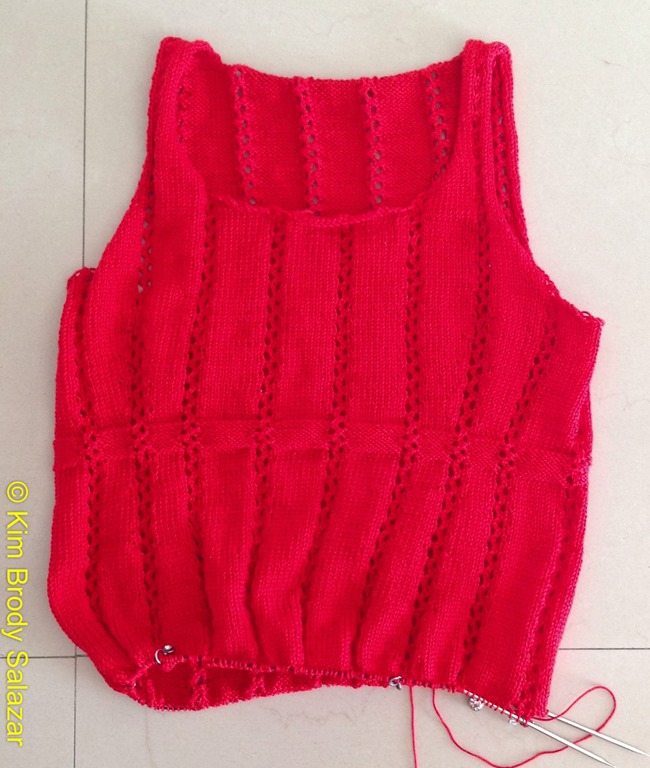
The pattern is of the type I haven’t seen for quite a while. It’s not written for new knitters. As I warned before, if you are intimidated by things like “repeat as for left, reversing shaping,” or if you have problems calculating back to add panels of an established pattern to newly cast-on stitches, you will want to sit down with this one first, making plenty of notes and figuring out what is meant before you plunge on ahead.
One extra hint – the increases and decreases in this piece happen at long intervals, for the size I’m working in one case every seven rows, in another, every 14. Keeping track of that can be a pain, but I use one of my Stupid Stitch Marker Tricks to do it. I have a marker indicating the first stitch of the round. I take a contrasting color marker, and advance it one stitch away from the first-stitch marker on each round. When seven stitches have accumulated between my first-stitch marker and my counting marker, I am ready to do my decrease. I find this method more immediate and less difficult to forget than using tally marks on paper, counting stones, or a stitch counter gizmo.
But I’m past the tricky bits now. I’m into the section below the empire waist, where the “skirt” area is slowly increased to make a baby-doll A-line silhouette. Easy. The next tricky bit will be the sleeves, which I intend on making shorter than the original.
On yarn consumption, I’ve just wound and tapped into Skein #3. I figure one more after this one on the body, then possibly 1.75 to 2 per sleeve. I’ve got plenty and should not have to dip into the odd-lot extra skein in my mixed dye lot bag.
I’ll post more on expat life this week, once I’ve retrieved the pictures from family cameras.
NEW PROJECT, MORE MONSOON
A mixed post today. First on knitting, I’ve embarked on a quickie project – a pullover for Younger Daughter. I’m starting with this commercial pattern, the Empire Waist Top Down Pullover, from Vermont Fiber Designs (#172):

But I’m making two changes. The first is that I’m knitting it in Cascade Yarns UltraPima cotton DK. The original is written for a wool or wool blend DK. That means that the piece will be more massy and less elastic than the original designer’s intent. The other is that I’m shortening the sleeves. I’m moving the garter stitch band up somewhat, so that it aligns better with the band at the waist, and proceeding with the belled sleeves from there, so that the whole sleeve is closer to 3/4 length than back-of-knuckles length.
And here’s my initial progress on the back:

On the yarn – I like it. It’s relatively painless for a multistrand cotton DK. It isn’t splitty, and it’s a bit more forgiving in stitch irregularity appearance than is Cotton Classic, my go-to all-cotton DK. It’s also shinier than the Cotton Classic.
On the pattern – I note that the range of sizes it includes is superior, from extra small all the way up to 6X. This does make for a confusing pattern presentation though. I made a photocopy and have highlighted all of my chosen size notations. Those who struggle with tiny type will probably want to photo-enlarge this one, too. (To reassure copyright protection advocates, under Fair Use provisions I can do this provided I own the original, and either keep the resulting copy with my original, or destroy it after I’m finished. I cannot give away, sell or otherwise share the copy).
So far the pattern has presented no problems, although I would not call this a pattern for those who have not worked from an classic style one before. For example, you’ll need to know that a hypothetical direction that states something like “increase 0(2,4) stitches 0(3,1) times” means that for the smallest size, you’d increase nothing no times (in effect, skip this direction); for the middle size increase 2 stitches 3 times; for largest third size you need to increase 4 stitches 1 time. The “increase 0” direction can cause distress.
I’ll keep posting progress here as I wade deeper into the project.
On the India Travelogue side of the house, I present more monsoon scenes and contrasts. First, It’s been pretty uniformly cloudy here over the past month, with only one morning showing a breakthrough sun. But there have been many afternoons of spectacular cloudscapes. This is a view over my shoulder:

And here’s the promised view of the hills near Younger Daughter’s school, near Manas Lake in the Bhukum area on Pune’s outskirts:


Contrast this lush verdure with a dusty shot of the same area taken this past January. And January isn’t even the depths of the dry season. The driest time is May and the beginning of June, just before the rains arrive in mid-June.
MARBLE ROLLED, EDGE TREATMENTS EXPLAINED
Yaay! The lap blanket knit from Marble is finished. Well, mostly. I do have to finish off the ends and block the thing. But all of the knitting is complete, and I grafted the edging’s last four stitches to its beginning, so that the seam is unnoticeable.

Aileen in Springfield asked me how I was filling in the half-motifs, because she’s working on a modular square piece, and prefers the look of the units tipped to present as diamonds. I’ll attempt to explain, but I won’t be publishing this as a full up pattern because of general lack of interest.
My treatment includes a nifty self I-Cord edging, worked as the piece progresses. It’s a nice, robust “hem” that stands up to wear and tear nicely. Here’s how.
I started on the REVERSE of the piece, so that any ridges formed by knitting the edging on would happen on the front, the same side as the native diagonal and vertical lines of the modular squares. I needn’t have bothered with this refinement, because as you can see in the photo above, the join lines are quite indistinct. Also note the slight ruffling of the edge triangles. That should steam-block out (mostly).
Starting at Point A – the rightmost corner point of the motif at the bottom right of the blanket.
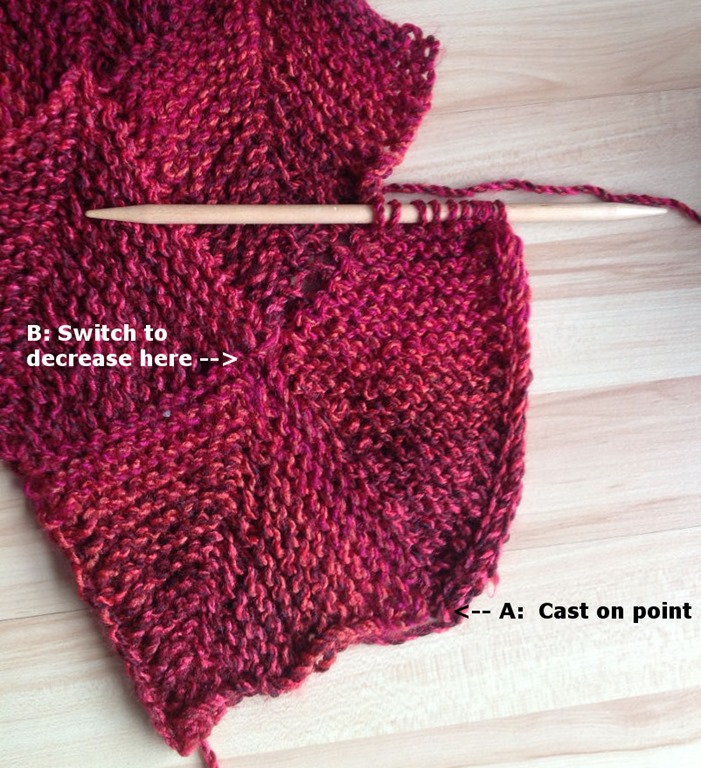
Increase progression:
Row 1: Cast on three stitches, then pick up one in the rightmost corner of the first motif.
Row 2: Slide all stitches to the right end of the needle, I-Cord style. Knit 4, and pick up one stitch in the next available selvedge stitch of the diamond motif. There should be 5 stitches on the needle.
Row 3: Flip the work over so you are working away from the main blanket. Slip the first stitch purlwise. Knit the second stitch. Slip the final three stitches one at a time, all purlwise.
Row 4: Flip the work over so you are working in from the edge, toward the main blanket. Knit the first three stitches VERY FIRMLY, pulling the yarn tight in classic I-Cord style. Knit the remaining stitches on the needle. Then pick up another stitch in the next available selvedge stitch of the diamond motif. There should be 6 stitches on the needle.
Row 5: Flip the work over again so you are working away from the main blanket. Slip the first stitch purlwise. Knit the second and third stitch. Slip the final three stitches one at a time, all purlwise.
Continue working rows 4 and 5, adding one stitch on every even row, until you have “used up” all of the available attachment points along the edge of your motif. The actual number of stitches will depend on the size of your motif. Mine was a 15×15 stitch square, so I had 14 attachment points along each diamond’s edge. After working your last Row 5 equivalent you will be ready to decrease
Decrease progression:
Row 1: Starting at the edge, working towards the main blanket. Knit the first three stitches very firmly, I-Cord style. Continue knitting across the row until only three stitches remain. Knit those three stitches together. Pick up one stitch in the first available selvedge stitch on the next motif.
Row 2: Working from the main body of the blanket back out to the edge. Slip the first stitch purlwise, knit until three stitches remain. Slip these three stitches one at a time, all purlwise.
Continue working Rows 1 and 2 of the decrease progression until you are back at the tip of Motif #2. At that point you should be down to four stitches. In the event that you have five when you reach the motif tip (which happened to me a couple of times, and I didn’t take the time to figure out why), on the last iteration of Row 2, just knit the first two stitches together instead of slipping. Fudging this way is invisible – the goal is to make sure that by the time you start down the increase section of the next motif, you begin at the point with only four stitches on the needle.
Now. How to use this same edge I-Cord idea on a straight edge? You can do it one of two ways, depending on whether you are working this at the same time as the main body, or adding it as a supplemental feature on a finished edge.
First, if you’re working a flat piece in garter stitch or stockinette and you want to add this at the same time as you are working the main body, just set aside the first three or four stitches at either end for the I-Cord curl. Or if you like, add some stitches for the treatment to your total count, but be aware that this will use more yarn and if you are working from a set pattern with a set amount, adding even six total to each row (3 left and 3 right) you will risk running out of yarn.
Once you have figured out how many to set aside or add, work each row as you usually do, BUT at the end of every row, slip your I-Cord designated stitches, and at the beginning of each row, KNIT them. You’ll notice that this edging is the same front and back, so if you are trimming both sides of your scarf or blanket, the left and right edges of your piece will look the same. This is pretty much the same thing I described as being useful for making straps for bags back in 2004, but with a whole blanket in between the I-Cord edges rather than just a couple of stitches.
If you want to add this I-Cord edge to a finished piece, it will be easier if you have worked a slip-stitch selvedge, so that the edge loops are crisply defined. But with fiddling this will also work on non-slip-stitch edges, and on cast on or bind off rows. Cast your desired number of stitches onto your needle, pick up one stitch in the body of the work to be trimmed. Flip the work over and heading back out from the body, knit the first two stitches together, then slip the rest purlwise, one at a time. Now working back from the edge towards the main body, knit the designated I-Cord stitches firmly, knit the attachment stitch, and then pick up another stitch in the main body. Continue in this manner, adding one stitch every “inwards” row, and knitting it together with the attachment stitch on the “outwards” rows. This is slightly different than the method I’ve described before for adding I-Cord to an edge, because it moves the attachment point one stitch away from the I-Cord itself, and makes a neater presentation with both sides looking more like each other.
 String-Or-Nothing