LATEST INTERLACE AND BUTTERY PATTERN
Here’s what that little red scrap at the center top of the last post’s picture has grown to:

To be fair, this all hasn’t happened since the last post. I took that picture a couple of days before I wrote the blog entry.
This is another panel from TNCM, Plate 32:1. It’s a long repeat with two reflection points. This scrap is the center of one of them. As you can see the pattern will mirror image left and right along the centermost line of the stem interlace. There’s another totally different bounce line that will just make it onto this cloth, but the repeat on the other side of it won’t be full cycle. I really like these extra long repeats, but they’re hard to use for most modern work unless one is doing a whole length of bed linen, or wishes to stitch at gauges much smaller than most modern embroiderers attempt. The longitudinal repeat for this pattern for example is 257 units. On 14 count Aida for example, 257 stitches works out to a strip that’s 18 inches long, and that’s just for one repeat. I’m not much better here, stitching as I am on quite coarse 36 count linen. My repeat will be about 14 inches across, just a little bit narrower than the width of my stitched area. For the record though, this isn’t the longest repeat I’ve got in TNCM. That one is 308 units, and is the one I want to use on my notional library curtains. Someday.
In other embroidery related news, I had forgotten that I had given my pals at the Buttery permission to post my original line unit pattern named after their house. Please respect my copyright though and don’t repost the page.

Also the pattern in TNCM and available at the Buttery link above shows only a bit more than half of the fillings I worked in the swatch above. The new ones I doodled up specifically for the Do Right sampler.
ADDING ON
At the risk of further boring what few readers remain here, I present more progress on my Clarke’s Law sampler:

I’ve finished off the two bands of lettering north and south of my first voided strip, and have started on the foreground stitched panel that will be the one at the top of the finished piece. I’m using yet another pattern from TNCM. This one is on Plate 31:1, and reproduces a pattern by my favorite modelbook publisher – Domenico da Sera, from a work of his dating to 1546. The original is shown in a manner that implies working the background, which I replicated in my book, but for this piece I’m stitching the foreground instead. I’m also using long armed cross stitch for this panel, not plain old cross stitch. I’m doing it the easy way though. Instead of bending the path of the stitching up to follow the course of the diagonal stems, I’m just marching across in horizontal bands, worked back and forth with each row alternating direction. This emphasizes the plaited texture more than does working all of the rows of stitching in the same direction, a detail that I like but some others don’t. Some folk prefer a smoother top-leg-uniform result, and use a different stitching logic altogether. Also nice, but I prefer the complexity of the herringbone family long-arm cross stitch more.
The current band should take me about two or three weeks to finish – work deadlines willing. Then I’ll begin the band below the *LY ADVANCED TE* segment. That one will be another line unit pattern rather than a solid block unit pattern, quite probably one of the ones I’ve been storing up post-TNCM against my mythical second book.
LETTER BY LETTER
It must be exquisitely boring especially for knitters to tune in here and see slug like incremental progress on a non-knitting project. Even so, I ooze along:
I also note that this style of embroidery on the count doesn’t seem to be very popular right now, at least not among web-connected stitchers. I’ve been web-walking for a couple of days now, looking for inspiration to share, but found very little contemporary work, although I did find the historical artifact photos cited in my last post. I guess I’m just programmed to be doing something different – knitting before it became a fad, crocheting when everyone else was doing needlepoint, and am now off stitching obscure styles.
There are a few folk connected with the SCA with work or research that piques my interest and who readers here may find inspiring, too:
- Extreme Costuming’s gallery of impressive stitched pieces. Lovely, with lots of infillings or background voiding, but not exactly what I was looking for.
- ElizabethanGeek’s blackworked smock is also quite charming.
- Here’s a historical example (rather than a contemporary work) from an SCA affiliated researcher – a pair of impressive Italian woman’s breeches (an undergarment, really) from the mid to late 1600s, accompanied by a chart for the stitching pattern used. (Other items at the Realm of Venus website are very interesting, too – especially the embroidered shifts).
If you know of any pix of long-repeat works on the count, either voided (background filled) or stitched foreground, in monochrome or mixed colors – based on historical patterns or original – please feel free to post the links to them here in the comments so we can all oooh and aaaahhh.
Finally, if there’s enough interest, I’ll share some graphs of future pattern panels here, that aren’t available in TNCM.
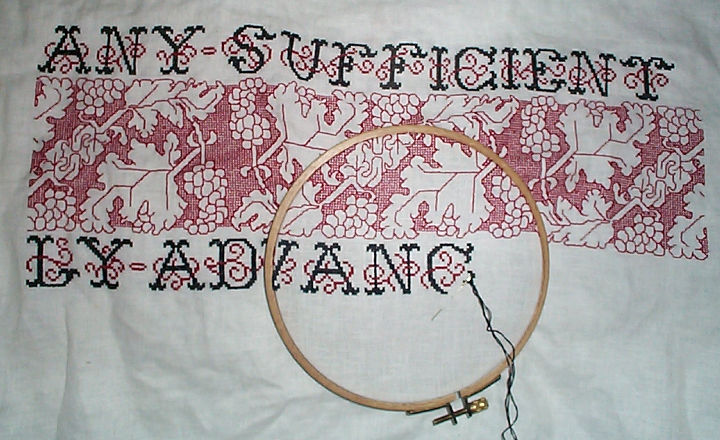
NOT QUITE SUFFICIENT
More progress on my latest sampler. As you can see, “sufficiently” doesn’t fit on one row. No problem. the “ly” will begin the row of lettering below the grape pattern. I intend on marking word breaks with the little red oval anyway. I’ll probably go back and fill in the small slice of space after the final T on the first row with an all black bit of patterning after all of the words are done.


For those who are keeping track, the quotation is “Any sufficiently advanced technology is indistinguishable from magic.”
I’m planning my next non-letter strips – a rather dark one immediately above the existing top line of lettering, and something rather more narrow but probably not as dark below the just-begun row of lettering. I’m looking at both line unit and solid unit patterns, plus voided work and other forms of counted thread stitching. The more complex, the better of course, just to underscore the irony of using “old tech” to depict this particular thought. Among the sources I’m using are my own book, plus notes for my theoretical next one, and some on-line photos of voided work on display at the Victoria & Albert Museum. (The cited photo set was provided by the unknown keeper of the Drakt.org website. Thank you, unknown keeper!)
PROGRESS!
As you can see, my voided grape strip is complete, and I’ve begun some of the lettering.

I’m using an embellished alphabet from Sajou #55, by way of Ramzi’s Patternmaker Charts website. Just to make life interesting, I’m working the tendrils that twine around the base letter forms in my crimson, and the letters themselves in black.
My plans are to march the letters across the piece, truncating words willy-nilly at the rightmost edge if they don’t fit, then continuing them on the next strip of lettering. For example, I will probably run out of room for the rest of “Sufficiently” before I get to my right hand margin, but I will finish out the word on the next line immediately below the grape panel. Words will be divided by little red ovals, as seen above between “Any” and the start of “Sufficiently.” I also intend to alternate patterned panels with letter bearing strips.
I like the way this is maturing. Now just to keep at it, both planning and execution, until all is done.
VINING ALONG
Yes, with all the cookie baking some embroidery did get done:

Here you see the first strip pattern, further along than the last stitching-related post. But not too far. Time is after all a finite commodity.
I’m a bit over half done with this particular strip. The grape unit to the right in this picture is the center one, and will be complete. There will be another partial unit of the same size as the truncated right hand unit on the left.
I’m thinking of working the words in black, perhaps using more than one of the various vintage alphabets from Ramzi’s Patternmakercharts website. I’m thinking about several presentations for them, including doing each word in a different face, so that the final presentation looks a bit like a ransom note; or working each initial letter in one of the more demonstrative faces, but the rest of the letters in another simpler or lower case face; or working each line in a single face, but no two lines the same. I’m not sure yet what I’ll be doing, but there’s lots more grape leaf panel to stitch as I contemplate the problem.
COOKIE PARADE
As promised, proof that there are ten kinds (plus fudge) for 2009:

1: Linzer Cookies – recipe from the King Arthur Flour website, this year with almond meal and using cherry preserves instead of raspberry. We used the smallest snowflake shape to make the center hole. The dough is very delicate and is best rolled out between waxed paper, with the center holes being cut after the cookie has been placed on a baking parchment covered cookie sheet. These really are best the day of making because the cookies tend to absorb moisture from the filling. They’re still very good, but they are softer and more cake-like if kept.
2. Light Spice Rolled Cookies –another from King Arthur (their cookie recipes are uniformly excellent). The only substitution I made was to use 1/4 tsp Chinese Five Spice Powder in place of ground cloves. (I don’t like a strong clove flavor). I used the cookie roller described in the last post. Aside from the advice posted there, I strongly suggest very lightly dusting the top of the dough with flour before trying to use the embossed roller, and using the roller without the handle. Cookies are light and crisp, not too sweet. Overall, this is an excellent ginger/spice tea biscuit, worth doing again. (This dough can also be rolled thin and cut out with conventional cutters if you don’t have the roller.)
3. Classic Peanut Butter Cookies – this one is from our circa 1970s copy of Joy of Cooking. We usually use crunchy peanut butter instead of smooth because it makes a better texture, but this year Younger Daughter has braces on her teeth and crunchy is banned for the duration. For decoration instead of the standard fork-tine checkerboard on top we use a cookie stamp, just because we have it. Peanut butter cookies tend to be moist and oily and keep a long time. They’re usually the second cookie we make in our march towards our requisite 10 types.
4. Buffalo Bourbon Balls – This is a standard no-bake cookie recipe that starts with ground store bought vanilla wafers, cocoa, and ground pecans. Ours comes from a version published in one of the Buffalo NY newspapers some time in the early 1960s. I’ve posted it before, but the recipe appears to have gone the way of all things so it’s repeated at the end of this post. We switched to using rum a few years ago, and prefer the results. Rum or bourbon, cookies also benefit from being made at least two weeks in advance so that the spirits mellow out. They’re always the first cookie we make each year because they keep so well.
5. Sugar Cookie Cutouts – this year in snowflake and holly leaf shapes only. Another classic cookie. This one is “Rich Rolled Cookies” also from our old Joy of Cooking. Our variant is to add a couple of drops of lemon extract to the batter, and to make the icing by using just enough lemon juice to make confectioner’s sugar spreadable, then dividing it into several smaller quantities, each tinted with food coloring. This icing hardens up nicely and if the cookies are left spread out after painting until they’re firm to the touch, will not cake up in the tin.
6. Chocolate Chip – our version of the official Toll House cookie recipe, although I do admit we splurge and use Ghirardelli semisweet chips and lots of broken pecans for an over the top touch.
7. Chocolate Crinkles – In this house they’re called Earthquakes because of all the fault lines. I alternate between the King Arthur Flour version, and a very similar cookie recipe from a clipping sent to me by long time pal Kathryn (Hi, Kathyn!). The King Arthur version is smack-you-in-the-face-with-chocolate, but the other one has a better texture and is less candy-sweet.
8. Pecan Sandies – Another recipe with Buffalo heritage, this one is an heirloom from my husband’s extended family. My variant is to sort through the bag of pecans and set aside the unbroken halves, then grind the bits to add to the batter. The pretty halves get dunked in water and pressed on the cookie tops just before baking. As you can see I’ve gotten a little better at shaping them over the years.
9. Easy Fudge – the condensed milk version. Super easy to make and a great way to use up leftover nuts from the other cookies. This year’s was bittersweet chocolate and walnuts. I repeated using the silicon oval baking forms to shape the pieces. Much neater and more uniform than the pat it into a pan and slice method.
10. Tatte Date Nut Rolls – recipe from the Boston Globe. This one was new this year. Preparation was very easy with a klutz-avoid rating of only 2 out of 10. The dough was well behaved, rich tasting dough and yummy date/walnut filling. Although it doesn’t look like there’s a ton of filling while the cookies are being made, the proportion of filling:cookie at the end is perfect. This is a keeper, but it’s not my ideal Christmas cookie. They taste fantastic, and would be the star of any holiday buffet, but they’re too delicate for plonking into cookie-share boxes, and like most fine pastry they do not keep especially long. (I’m thinking of all sorts of other fillings and will make this again for a dinner party, for sure.)
11. Oysters. My own invention. A hazelnut spritz sandwich cookie with a rich chocolate filling. It turns out that Younger Daughter is a dead-eye ace with the cookie press. She formed all of these this year. One caution – use one of the simple cookie press dies. The fancy shapes with small or narrow openings will not work. The ground hazelnuts will clog them and you’ll get the haphazard odd shapes that prompted this cookie’s name.
Buffalo Bourbon Balls
Adapted from the women’s pages of a Buffalo newspaper from the 1960s. Best if made at least two weeks in advance and allowed to mellow in a cookie tin.
Ingredients for cookies
|
1 12-oz. box |
Store bought vanilla wafer cookies |
|
2 cups |
Confectioner’s sugar |
|
1 cup |
Finely chopped pecans |
|
cup |
Cocoa |
|
cup |
Rum |
|
cup |
Light corn syrup |
Special equipment
|
Food processor |
Directions:
1. Using food processor, grind cookies to powder. Remove from processor.
2. Using food processor, grind nuts finely. Add to cookie crumbs.
3. Sift sugar and cocoa together into crumb/nut mix.
4. Stir in rum and corn syrup. (Clean-up hint – measure the half cup rum into glass measuring cup, add light corn syrup to same cup until total volume equals 3/4 cup. Mix the two together in the measuring cup, then pour mix into dry ingredients. Much easier than trying to measure sticky syrup by itself). Keep stirring wet into dry ingredients until everything is combined (this may take a while).
5. Form into inch balls. Roll in confectioners sugar or a mix of cocoa and confectioners sugar to coat.
6. Store in a tightly covered container. Makes about 40-50 cookies, depending on size.
Variants: Use rum instead of bourbon. Walnut/Bourbon is a good combo. Use almonds and Amaretto; hazelnuts and Frangelica; or almonds and Chambord, Kirsch or other cherry or berry liqueur.
COOKIE CODEX
Yes, it’s the end of December here at String, and that means cookies (and latkes). In spite of work younger daughter and I have managed to finish baking nine of our ten planned varieties. For 11, she’s stellar and can mix a batter on her own from the recipe without leaving the kitchen a disaster. She’s also dead eye accurate on the cookie gun, and can turn out uniform spritz cookies on her own. As a result we’ve managed tag team production, with me swooping in to do stuff that she prefers not to do, or juggling the sheets in and out of the oven.
This year’s production included a new item – a light gingerbread style cookie rolled out with a European style cookie roller:

The recipe I used is from King Arthur Flour’s website – Light Spice Cookies. I had tried another from Fine Cooking, but was sadly disappointed. That dough has been relegated to pat-in-pie crust status.
The King Arthur cookies I had made before, using standard cut-out cookie cutters. They turn out quite nicely, sort of like gingery animal crackers, and are especially good when rolled out very thinly. For the record, I use Chinese 5 spice powder in place of ground cloves, just to be different and to tame the clove undertaste a bit (I don’t particularly like cloves).
Here you see the dough roller results. I think the roller’s impressions look a bit like a Mayan Codex.
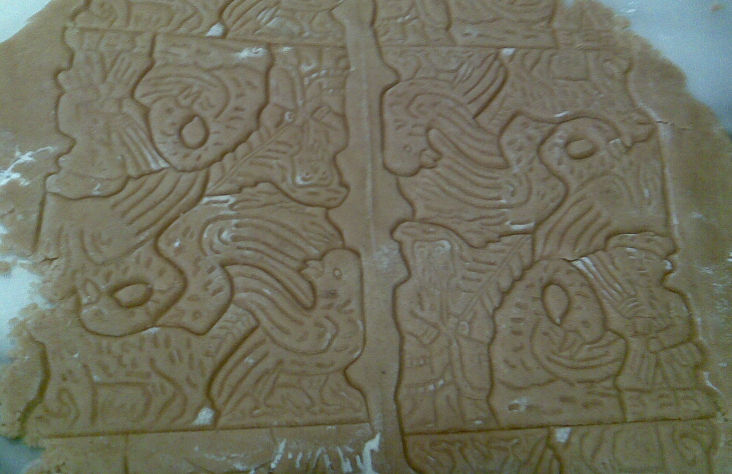
To get this result, I rolled out my dough very thin, less than 1/8 of an inch. Although it was tender and easy to manipulate, the handle of the cookie roller and not the cookie dough turned out to be the weak part of the system. Applying any pressure at all snapped the removable patterned cylinder out of its mooring. So I set the handle aside and used the heel of my hand to apply slow, even pressure as I rolled out the impressions. The raised bits on the roller are high enough to cut the cookies almost completely out. A small bit of encouragement with the tip of a very sharp knife was needed to release a couple of the tricker bits, like the cat’s tail, and the protruding feather of the upside down bird immediately above the cat (or is it a fox or wolf – it’s hard to tell).
In any case the cookies did separate nicely and the dough preserved the textured detail even after baking:

Nice crisp (almost hard) grown-up ginger spice cookies. Not too soft, not too sweet. A perfect accompaniment to hot tea.
A full visual catalog of all ten kinds later this week. I promise.
MORE GRAPES
“Go back to knitting!” Sorry. I’ve got the stitching bug now and I go where my fingers lead me.
Minor progress on the latest sampler – another panel from TNCM. This one I decided to do voided style (the original had no background). Instead of using cross stitch or long-armed cross stitch for the fill, I’ve opted to do a grid like mesh, worked in one strand of the same DMC floss that I’m using for the two-strand outlines. I’m not sure how I’ll handle the top and bottom. I’m thinking of being non-traditional, and instead of extending the fill a couple of units past the design’s base area, terminating it a unit or two inside the design, so that the grapes “overflow” their background.
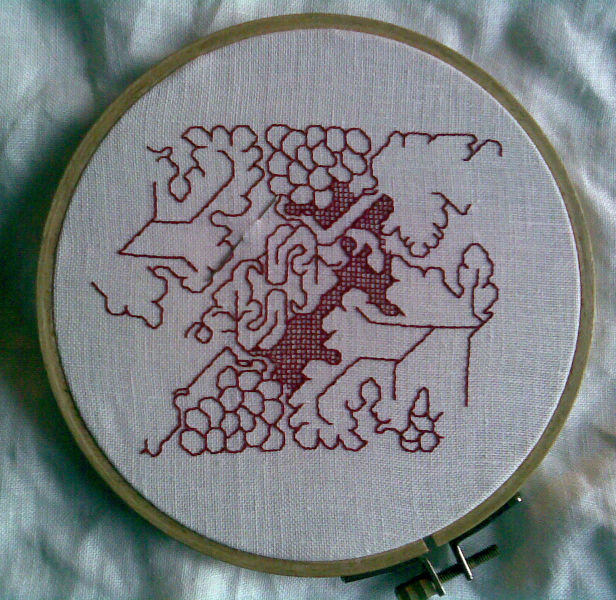
The next decision is whether or not to continue this entirely across the cloth, or apportion my space differently. The piece of linen I’m using is rather large and long. I may decide to just go horizon to horizon, with no outer framing edging, and insert the lines of my quotation in between a series of strip patterns of various types. If so – do I use the same typeface for all of the words, or do I use different ones for each line. Decisions, decisions…
FULL THROATED PANIC
All the stitching on Don’t Panic is done! It now goes into the “finish me later” pile. This one will be framed, with a mitered fabric border all the way around. Not sure what color for the edging yet, but I’ll go for complementing rather than matching the deep green thread:
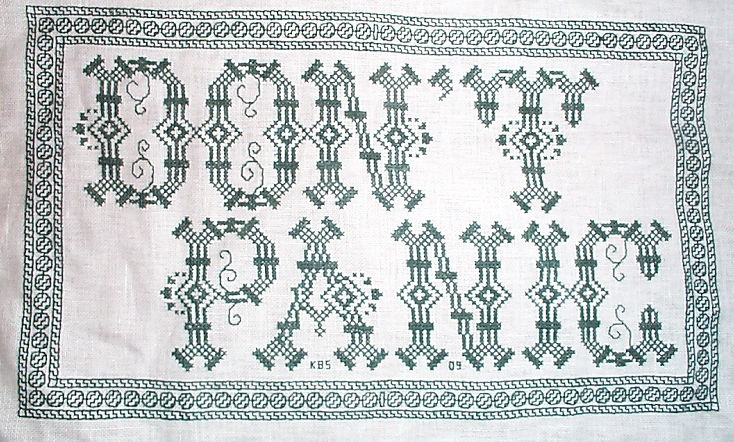
To answer a question, it’s about 8 inches across from border to border.
But I’m still not stitched out. The next one is the Clarke’s Third Law sampler. This one will be a large filled cloth, covered with various patterns in my usual haphazard style, probably a bit less symmetrical than the Do Right piece. I’m thinking that the saying will meander among the patterns rather than being rigidly confined to horizontal rows. It’s on a finer count linen than Panic, stitched with two strands of standard DMC floss. I present the very larval beginning:

It’s yet another strip pattern from TNCM, this one of grapes (Hi, Katheryn!). No, beyond folding the cloth in half to determine a rough center, I have not established a size, alignment lines, border areas, or done any other planning whatsoever. (Purists who baste in their center grids and edges are shuddering in horror right now.) I haven’t even decided whether the final piece will be displayed in portrait or landscape orientation. It will be an adventure.
In other news, in spite of another spate of horror deadlines looming from now to mid January, splatting directly on what was to have been a week off from work, I have started holiday cookie prep. Long time readers here know I aim for 10 types each December, to satisfy the family’s desire for lots of variety and to have plenty to give to family, friends, and co-workers.
This year’s line-up includes the traditional faves, plus a couple of new items. The standards making their annual appearance are chocolate chips, pecan sandies, peanut butter, Buffalo rum balls (so called because my ancient recipe copy is noted as being from the Buffalo Evening News, sometime in the 1960s), earthquakes (very similar to these chocolate crinkles), sugar cookie cut-outs (standard Joy of Cooking recipe, this year with new snowflake cutters), and oysters. Linzer cookies are making an encore appearance, too. The new ones are rolled gingersnaps (using an odd European cookie roller) and date nut rolls (from Tatte Bakery in Brookline, as published in the Boston Globe). Also back by popular demand is the panforte I’ve made before. Oh. And fudge to use up leftover chocolate and nuts. I can hear Elder Daughter hyperventilating over this, all the way from her dorm…
This weekend we baked the two items that improve with age – the rum balls that need to cure to lose that raw rum edge, and the panforte because we’re soaking it in Calvados this year. The others will follow, with the longer keepers like peanut butter being done first, and the tender ones that go stale quickly last (Linzers and the date nut roll). I try to have all baked by the weekend before the holiday. Deadlines willing.
And not to forget this week’s holiday:

Happy Latkes to everyone!
 String-Or-Nothing

