UPDATING THE PENNY METHOD
A while back I posted about using a penny, a cell phone, and a bit of math to determine the thread count of linens, both evenweave and skew. And now the US penny is quickly charging to extinction, abandoned by the US Mint, and soon to disappear entirely from circulation. Which means that I need to issue an update.
Voila!
The Dime Method.
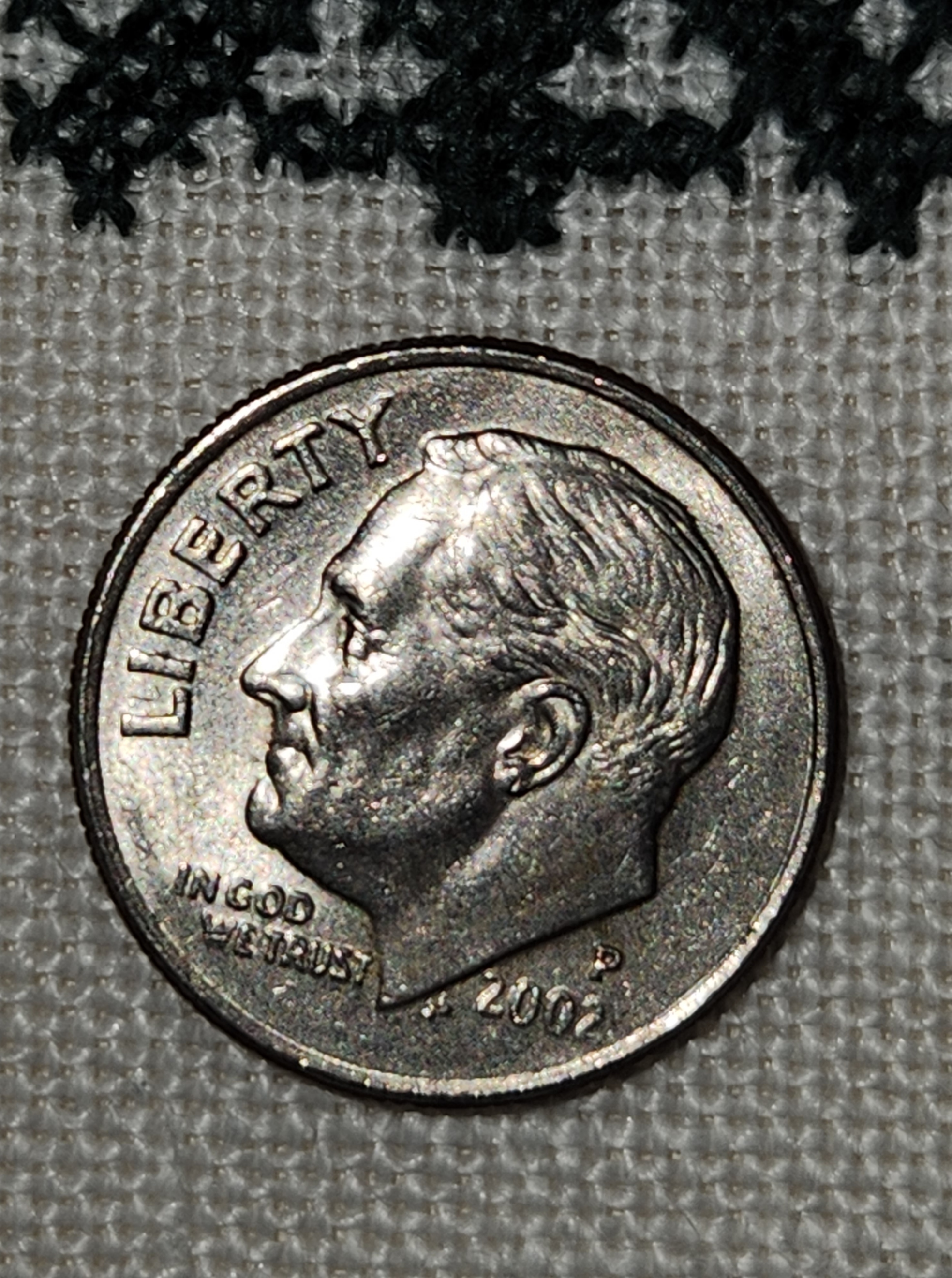
I picked the dime because it’s smaller than the nickel or quarter, and easier to count around the outside edge without losing your place. Counting the threads totally covered by the dime, heading north to south, we get a total of 26. And by counting the number of totally covered threads east to west, we also get 26. The first conclusion is a happy one. We have an evenweave.
Now for the math.
The official diameter of a US dime, as stated by the US mint, is 0.705 inch (17.91mm). I will continue the math here with threads per inch rather than metric to avoid confusing US folk, but the same method works perfectly well with metric measurements. And if you know the measurements of any other coin used anywhere else in the world, you can adapt this for local convenience, worldwide.
So what we have is 26 threads over 0.705 inches. We divide 26 by 0.705 and we get 36.88 (roughly). We can round that up to 37. My fabric in this sample is 37×37 threads per inch.
Let’s confirm that.

Yes, 37.
And you are right that’s a decimal inch ruler. I am proud to be an Engineer’s Daughter, and have many of my dad’s old drafting aides. I deliberately did NOT add any assisting lines to the ruler photo as proof of my assertion that it is FAR easier to count the threads obscured by the coin, going around the edge of the coin, than it is to do a straight line count across a ruler’s edge. It’s also FAR more likely that I would have a dime handy than a ruler in my pocket when I am out and about in the wild.
Try again. This time finer.

I get 31 in the north-south direction and 28 in the east west direction. This piece of linen is a skew count, with more threads in the vertical than the horizontal. Doing the math:
- Vertical (north-south) 31/0.705 = 43.97, rounded up to 44 per inch
- Horizontal (east-west) 28/0.705 = 39.71, rounded up to 40 threads per inch
Now, does a skew count mean that effective countwork can’t be done? Absolutely not. Here is the piece that I used for the second example:

The slightly skew count means that over the same length there are more stitches in the vertical direction than there are in the horizontal. My mermaids are then a bit squished in height compared to their width because the vertical stitches are a tiny bit shorter than the same number of stitches over the horizontal. But the only place that this is evident are the large, symmetrical flowers just above their tails. You can just make out the height elongation in them because (logically) they are supposed to fill a square volume, not a rectangular one. Here is an old post that discusses this challenge further, and shows what happens when you wrap a design around a corner on a skew count fabric, and confesses that flipping your measurements is an easy mistake that even I make..
For the record, I stitched this piece in 1994, from a chart I redacted myself. The photo source that I worked from was in Schuette and Mueller-Christensen’s Pictorial History of Embroidery. I presented this chart along with my own original accompanying border on Plate 75 in my own The New Carolingian Modelbook, published in 1995.
As for the piece I used for the first example? The full Don’t Panic chart is a free download on my embroidery patterns tab, right here on String-or-Nothing.
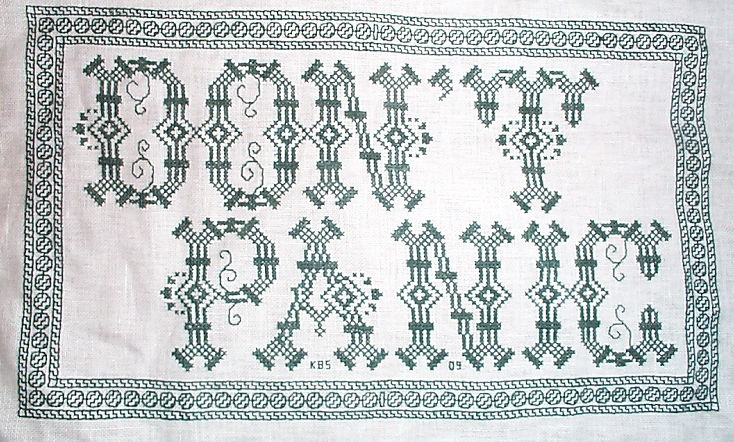
Don’t Panic is in fact the best advice I can give to the math anxious among us.
PROGRESS ON A WEALTH OF FRONTS
It’s been half a month since the last post, and all sorts of things have happened.
First, I’ve finished the wildly intricate interlace panel on my current sampler.

Second, as I was doing so I found an error in my chart for it as it appeared in the original edition of The New Carolingian Modelbook. The error was a minor one, a copyists/flip and mirror problem with two side by side crossings. It’s my guess that no one has attempted this particular design before, otherwise they would have either contacted me about it, or trumpeted my incompetence on social media. So of course I had to correct the problem. For a legible copy of the correction, including the original TNCM source attribution, and two chart versions – one for the border as shown, and one for a wider border or all-over design, please click here download a PDF file.

I have also been able to draft out a couple of tribute specific bands for this sampler, referencing the in-process novel Forlorn Toys in specific. They will be coming up after I finish the latest leafy strip. So stay tuned!
In other news, at long last, the Victoria and Albert Museum has updated all of the pages for the individual contributors under the Unstitched Coif Project. Again thanks to Fearless Leader Toni Buckby! My page can be found here, and has both the essay I did to accompany my work, plus ultra high resolution ZOOMABLE photographs of the back and front of the piece. For some reason the museum chose to lead with the photo of the backs of all of the pieces.

And for those of you who have asked about my personal health odyssey – I am improving. I’m in the middle of graduating from walker to cane. I can get around well with the cane, but I am still shaky with it over uneven terrain, so I mostly stick to it indoors, and continue to rack up practice distance. I have also been able to sit longer, as my stitching and blogging progress demonstrate.
There are still some hurdles to go, including a stint of proactive/preventive radiation to minimize any chance of chordoma recurrence, but I will take that in stride like all the rest. In the mean time, I’m feeling further along to being my old self than I have in months. No doubt due to the incessant care, coaching, and excellent cooking of my Resident Male.
OFF AND RUNNING!
On the ground, it’s more like walking slowly getting used to the transition from walker to cane, but in stitching, we’re galloping. Here is progress since the last post.

Several strips so far, a combo of reach-backs to my older books, and to the more recent Ensamplario Atlantio Volume III. I am still drafting up the custom bands that are specific references to the content of Forlorn Toys, the book that The Resident Male is writing right now. When you see them you will realize what’s taking so long (other than limits on how long I can stand at the computer in a day).
I do have to report an oops. One that dates back to the publication of The New Carolingian Modelbook in 1995. I hadn’t stitched the current strip before, mostly for reasons of size. It’s quite tall. But this being a very long piece of cloth, I thought it would work well on this piece. Lo and behold. There is a small crossings error in the original. It’s small enough to be an easy fix, but I will put redoing that page in queue and eventually publish it in here, and on the errata section on the “My Books” tab elsewhere on this site.
In the mean time I’m at the point in this complex interlace that I can go off-book. I’m just copying what I’ve stitched to date now, flipping/mirroring/inverting the crosses as required. Yes, it’s an eye-bender, but each subsection is logical, and if I keep the precision up so that all of the subsections meet up nicely, no where near as difficult as it looks.
GALLERY OF APPRECIATION
UPDATE: 6 FEBRUARY 2024 – I’ve added a permanent page for the Gallery of Appreciation. Click here, or find it in the tabs listing, above.
——-
I adore it when I see projects folk have worked up from my designs. I’ve shown off a smattering of them here on String under the tag “Gallery” on the categories list, but I have fallen behind of late. I will try to be more timely posting these fabulous finishes (and works in progress), as tribute and thanks to the creative people who have returned joy to me.
Right now I have several such submissions lurking in my email inbox. Apologies if you have sent photos to me that haven’t appeared yet. It’s a big inbox, and I am combing back, looking for the flags. Names and photos appear here with the permission of those who sent them. I also have some requests out to folk who have sent me photos, but from whom I do not yet have express consent to post. And if you’d like your work to appear here in a subsequent gallery post, please drop me a line. My Gmail address is kbsalazar (in the usual email format).
So in no particular order other than my stumbling around in the dark, I present the first of what I hope will be a renewed series of proud pieces.
The Second Carolingian Modelbook
Sent in by Alex Logsdon, a genuine original composition featuring many motifs from T2CM, selected, snipped, and arranged in true “bungee jump stitcher” mode – picked on the fly and fitted to the space available. There haven’t been many finished objects from my latest book, and this one made my heart sing.

The New Carolingian Modelbook
Elaine Cochrane is working on a big purple band sampler, and has included in it some strips from TNCM. Elaine is also choosing designs on the fly in bungee-jump mode. I love seeing her piece evolve with the addition of each new bit.

Ensamplario Atlantio, Volumes I and II
It’s hard for me to separate out the fills in the two volumes in the EnsAtl series. With only a few exceptions, even I can’t remember which ones are in which book. V Louise Behrman is working on a couple of projects using the patterned fills from the books. One is a lovely bit of inhabited blackwork – panels for a casket (a small fabric covered keepsake/display box), the other is destined to be made up into an adorable needle book (a small fabric folder to keep needles safe, dry, and at hand). Both images below are (c) V Louise Behrman, 2022, and appear here with permission.


Epic Fandom Stitchalong – Adaptations
Long time friend and occasional SCA mentor Robert Himmelsbach was a stealth beta tester for some of the bands appearing as part of Epic Fandom. He used the dinosaur strips to make collar and cuff ornamentation for an otherwise historically accurate Renaissance era shirt, proudly proclaiming his ancient lineage and participation in that group’s pre-history (provided you look closely enough at his outfit). He is intending the pirate strip for a second shirt.
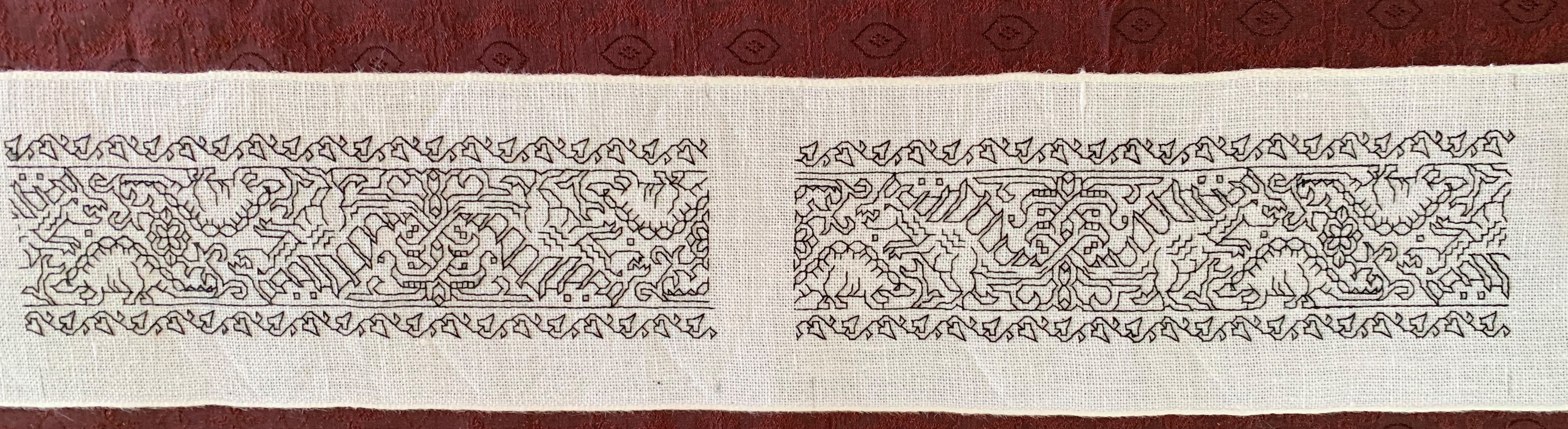
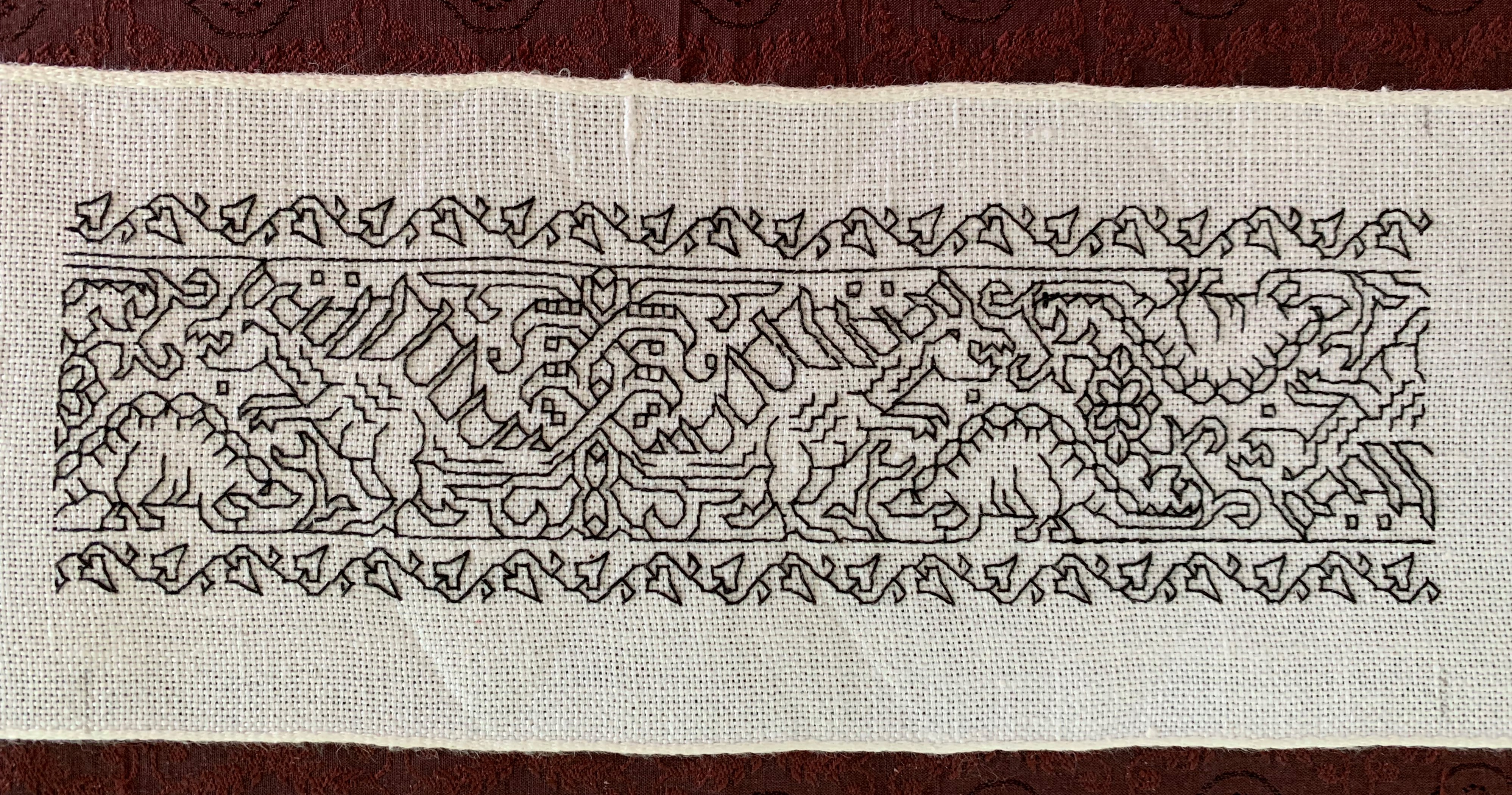
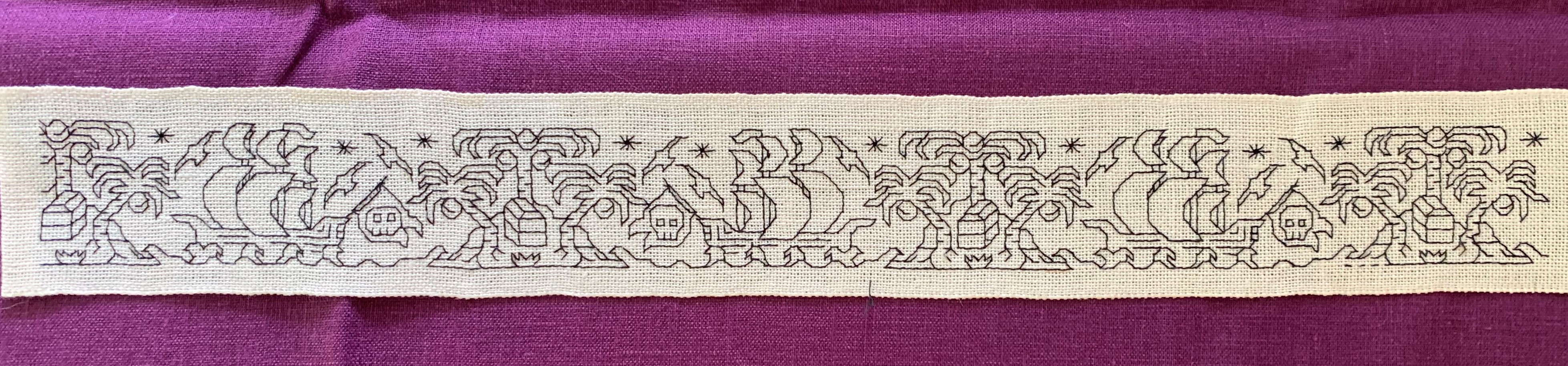
Links and/or info about the books mentioned are at the “My Books” tab above. The Stitchalong also has its own tab, above.
EARLY MARKETING? OR NOT….
Another in my occasional series of posts only a stitching nerd will love.
This base design I present here is among the patterns that have long fascinated me. It comes from a time of political and religious conflict, and exists in two versions – one with a devotional inscription, and one plain – with the motto removed.
It’s pretty widespread as pattern books go, appearing in several. There is also at least one actual stitched artifact of it in one of its variants
First, to look at the pattern as (and where) it was published.
All three modelbook pages of this first group are quoted from Mistress Kathryn Goodwyn’s most excellent Flowers of the Needle collection of modelbook redactions. It’s pretty obvious that the 1537 Zoppino (Venice) and 1567 Ostaeus (Rome) versions were both printed from the same block – the same pattern errors exist on both impressions.

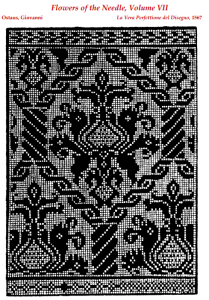
Now for the third – this one was published in 1546, in a book attributed to Domenico daSera, who worked in Lyons, France.
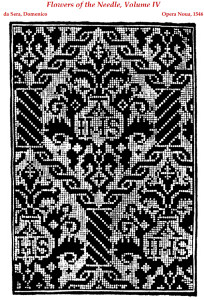
It’s clearly the same design, but carved anew into a different block. The framing mechanism of the twisted columns and chains remains, as does the frondy onion-shaped center motif and the majority of its details. More or less. Obviously the religious motif is new, as is the inclusion of more prominent crosses. But the design is still recognizable.
Going back and forth in time, here’s that same Zoppino block, from his Convivo delle Belle Donne, from August 1532, courtesy of the Metropolitan Museum of Art (Accession 22.66.6) This is the earliest hard-dated rendition of this design that I know of.

It’s also interesting to note that the same block was collected into Hippolyte Cocheris’ 1872 collection Patrons de Broderie et de lingerie du XVIe Siecle which is itself a reprint of several 16th century works. I suspect that a different block may have been involved, because although the copy is almost perfect there are minute mistakes on the Zoppino original that are not replicated in this iteration.
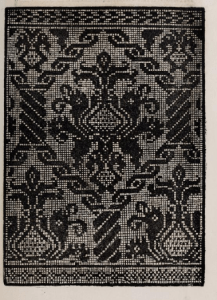
And on to artifacts.
First, here is a clear rendition of the da Sera devotional version. The picture below is shamelessly lifted from the Harvard Art Museum’s holdings page, of their object accession number 1916.379, cited as Italian, but not dated.

Note that the inscriptions switch direction, and not necessarily in a logical manner. I strongly suspect that the stitching is truly double-sided, and the intent was to produce something that could be read from both sides. Either that or the embroiderer was quite forgetful, and neglected to keep track of the front and back. Once the error was established, he or she just kept going.
As an aside, the edging is from Jean Troveon’s 1533 work, Patrons de diverse manieres. It’s also in his other work, La fleur des patrons de lingerie (dated 1533 at the latest) , which we will see again in a moment.
Headed a bit further afield is this example is a first cousin of the design above. The sample below is from the Boston Museum of Fine Arts. It’s got many of the same design elements, but they’ve been simplified and abstracted. We’ve lost the twisty columns, but kept the chain dividers, and the center foliage/flower has been much simplified. This piece is dated to the 16th century, as Italian. MFA Accession 90.50. It’s one of the pieces labeled with the mystery technique “Punto di Milano” which in this case looks like tightly overstitched Italian four-sided stitch, pulled to achieve a meshy look. Oh, with cross stitch accents.

But did someone take the twisty columns design and adapt it? Nope.
Troveon, in La fleur des patrons de lingerie has this one, with the minor exception of using initials in the shields instead of the anonymous sunbursts.

And what else shall we find in Troveon’s soft-dated work? Our old friend, (which based on a close look at block mistakes, I can’t for certain cite as the Hippolyte source.)
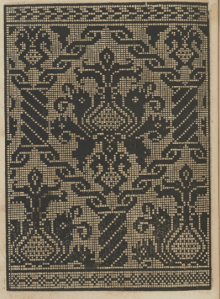
Now. We have a few questions.
- How did the border design that appears only a few pages away from the secular version of this design, in the Troveon book get paired with the devotional main motif from daSera?
- Which plate came first? Troveon’s not-dated-in-stone version (1533 latest), or the Zoppino from 1532? Are they printed from the same block or not?
- Why did the design exist and circulate in the two forms?
The places where the secular version appears (Rome, and Venice) were not break-away hotbeds of Protestantism. I would have thought given the tenor of the times (which included the destruction of vast amounts of religious embroidery) the secular version would have been found in the religiously rebellious areas. When I started looking into this my suspicion was that having two versions of this design was an early example of targeted marketing – selling what would appeal to a local demographic. But I can’t substantiate that theory based on place of publication.
The relative order of publication? Again, I can’t hazard a guess. Unless the Bibliothèque Nationale de France refines its listing (or another hard-dated copy of the work surfaces) we are stuck with the uncertainty.
So your guesses are as good as mine. Yet more topics I offer up to anyone doing gradate research in historical embroidery.
Oh. One final aside. Both the secular version of this design and the border from Troveon are graphed up in my first collection The New Carolingian Modelbook.
UPDATE – 2 FEBRUARY 2022

I stumbled across another example of the Da Sera version, worked as lacis (darned net). This one is in the collection of the Metropolitan Museum of Art, accession 06.578. They attribute it as 16th century, Italian or French.
Undoubtedly the same field pattern. Amusingly rendered double-sided by the inversion of some of the inscriptions. It’s also fascinating to see it in combo with this border, which I haven’t seen in a modelbook yet.
ONE DESIGN’S MIGRATION
Early stitching modelbooks. They so often look the same, page after page. Where did I see that design before? Why is it oh, so familiar?
And so we launch again into a post that only a stitching geek would love.
Early European modelbooks produced by sixteenth century printers in Italy, Germany and France often include similar patterns. Often the same patterns. Sometimes patterns SO much alike that one would think they were printed from the same blocks. In some cases, especially if one printer did successive editions of work, that’s entirely likely. In other cases, where the same block appears in works from different shops – that’s not entirely clear. Especially if the workshops of the various printers were separated by geography and/or time. However it happened – trade in blocks, plagiarism from printed copy, whatever – it is clear that considerable cross-pollination did occur.
Here is just one example.
This is from Niccolo d’Aristotile’s (called Zoppino) Venice-published Ensamplairo di Lavoiri, 1530/1531, as redacted as Volume I of Kathryn Goodwyn’s Flowers of the Needle collection (left). At right I show the same page from an original (unredacted) copy of the same book in the Gallica BNF20 collection, to remove doubt about any assertions I made below being artifacts of cleaning up for reprint. Watch those two center designs:
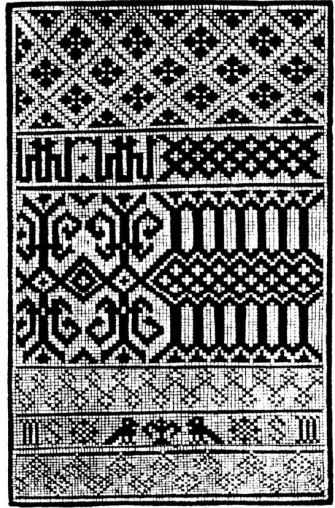

1530/31, Italy is pretty early, right?
Well, there’s this. Johann Schonsperger the Younger, from 1529, published in Augsberg, Germany This is from Ein new getruckt model Buchli auf außnehen, vnnd bortten wircken..., in the collection of the Staatliche Museen zu Berlin, #0S-1473-kl, as presented via Bildindex.

Not surprisingly, Johann Schonsperger’s earlier work, Ein new Modelbuch auff auaußnehen vnd bortern wircken.. from 1526 (also from Augsberg) has the exact same page. Also from Staatliche Museen zu Berlin, #0S-1472, as presented via Bildindex.

So we’ve traced this panel back to a 1526 edition, published in Germany. But were all of these printed from the same blocks?
I’d say that the two Schonsperger pages were certainly produced from the same blocks. They have the same curious features and mistakes.
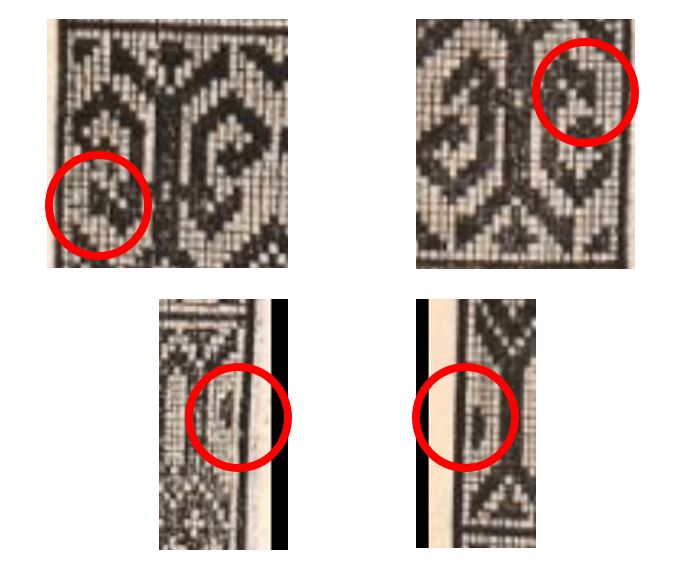
By contrast, here are the same sections from the Zoppino work, with the same areas highlighted:

Yup. The little crescent is missing, and the lower arm of the fleur-de-lis type detail with the clumsy header is gone entirely – the design is truncated, leaving it on the cutting room floor. There are other differences – mistakes made in one version of the design but not in the other, that you would only notice if you were trying to redraft or stitch from each pattern.
So in this one case, I’d posit that a copy of a printed page from Schonsperger in Augsberg – either as part of a book, or as a broadside – made its way to Venice, where it was seized upon and re-rendered for inclusion in Zoppino’s collections. Which is pretty much counter to the intuitive argument that I’ve seen many make – that these counted patterns all originated in Italy and then spread north. Of course there may be another printed copy even earlier than Schonsperger…
Oh, and this design in particular? I’ve always been fascinated by the narrow border with its strong directionality. I posited in The New Carolingian Modelbook, that based on similarities to examples of Tiraz band calligraphy done on the count, as appearing in Richard Rutt’s book A History of Hand Knitting, 1989, that this motif may have been copied (possibly without knowing what it represented) from an extant piece of stitching, rug, or other textile from an Islamic workshop. If that’s true, it would make the design’s peregrinations even more impressive. Somewhere in the Islamic world, to Germany, then to Italy. And on from there…
UPDATE
And the Schonsperger plate makes another appearance! This time in Anton Woensam’s Ein new kunstlich Modelbůch, published in 1536, in Köln.

UPDATE UPDATE
You guessed it! Another appearance of our block friend – this one in Peter Quentell’s 1541 Ein New kuntslich Modelbook, published in Cologne. It also has the same idiosyncrasies as the Schonsperger, above.
UPDATE UPDATE UPDATE
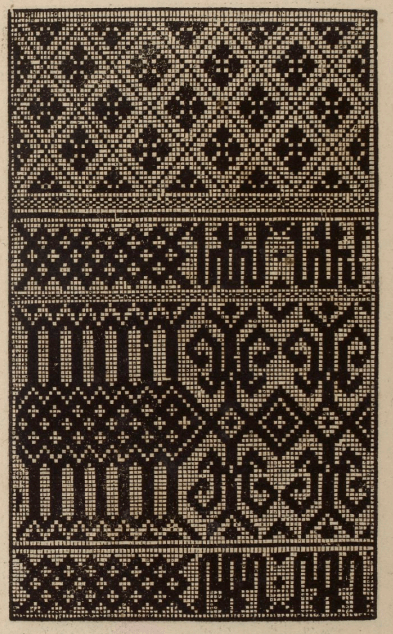
Yet another representation has crossed my notice. And it’s a particularly curious one. This is from Schon neues Modelbuch, printed in Frankfurt in 1608, from the shop of Mayn Durch Sigismundum Latomum (Latomus).

Although it mostly aligns with the Schonsperger-Woensam 1536/Quentell 1541 version, it’s lacking a couple of very minor copyist errors, although it faithfully duplicates other peculiarities of that printing. Also it extends further to the left – instead of seven column/diamond repeats in the geometric on the left hand side, there’s a mirror point/bounce repeat. BUT at the center of that repeat there’s an artifact – the “elbow” of the curlicue pattern on the right. In other blocks it may serve to cue the stitcher that the geometric and the curlicue can be alternated, but here it’s encapsulated inside a rather clumsy centering, with a badly botched top and bottom border, plus on the same bounce line, another improvised mirrored center (with an extra wide column of boxes) in the simple separate border beneath. Almost like someone wanted to take an older block and eke out the page, so a new bit was carved to match. Hmmm…..
UPDATE x 4
I thought I had stopped finding more of these today, but apparently not. I’m including this because it fills in more of the early representation/movement of this design.
From Livre nouveau et subtil touchant l’art et science tant de brouderie fronssures tapisseries comme aultres mestiers qu’on fait à l’esguille soit au petit mestier aulte lisse sur toile clere tres utile et necessaire a toutes gens usant des metiers et arts dessinés ou semblables, published in 1527 by Pierre Quinty, probably in Cologne. It appears to be the Schonsperger plate, verbatim. Complete with odd little carving errors.

Our timeline now looks like this:
- 1526 – Augsberg (Schonsperger block)
- 1527 – Cologne (Schonsperger block)
- 1529 – Augsberg (Schonsperger block)
- 1531 – Venice (Zoppino block)
- 1536 – Köln (Schonsperger block)
- 1541 – Cologne (Schonsperger block)
- 1608 – Frankfurt (Schonsperger block, partial – augmented with additional carving)
THOSE SNAILS
Another question from the inbox: “So, what’s up with those snails?”
No mystery – just a bit of silly that’s been codified into semi-tradition.
The original strip of snails was one of the first patterns I doodled up – inspired by the non-counted snails in Scholehouse for the Needle (1624). That was way long back ago, when I was still in college. They’ve wandered in and out of my notes over the years, first appearing as a spot motif, and eventually ending up in my first and second hand drawn pattern collections (published in ‘76 and in the early ‘80s) and eventually my own New Carolingian Modelbook. I dedicated that form of the pattern to Mistress Peridot of the Quaking Hand – a local resident of the SCA Barony of Carolingia (Eastern Massachusetts/greater Boston area), famed for her calligraphy and her unselfish sharing of the same. The artist behind so many excellent awards scrolls. Peridot’s own device features a sleepy snail.
Maybe it’s a subliminal comment on slow, steady perseverance inherent in needlework, but for whatever reason, I have used that snail on the majority of my samplers. Not all, but most. Here are charts for some of the ways my little creeping friends have shown up. The original row is at the top left. The all-over of snails circling little gardens with ominous intent is from the Trifles sampler. The ribbon strip at the lower left is the bit I’m currently stitching in blue and red.

BLACKWORK SAMPLER – YEAR 2
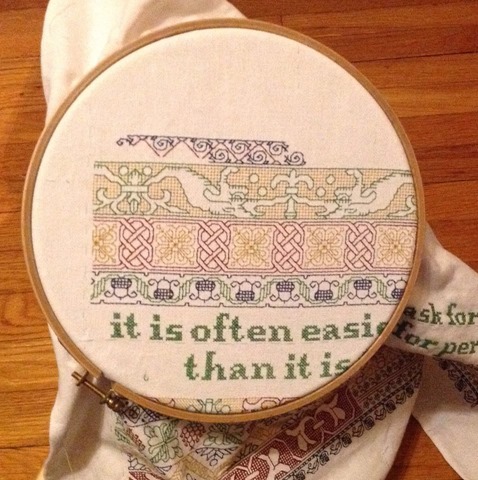
This is new for me. I’ve had projects that spanned years (decades, even), but never before have I had one embroidery project that I worked on without stopping, that has taken more than a year. Even my blackwork underskirt was done in 10 months. But as of mid December, I have now spent an entire year working on my big blackwork sampler. I’m not quite done. Almost, but not quite:

You can see that I’m filling in the area to the left of the dragon. I’ve finished the first dark band, and am now on a lighter one just above it. Two more to go, balancing the progression of shade values on the dragon’s right. Then it’s a sliver of the voided leaf panel at the top of the work, to finish that off even with the edge of the strips below. And finally – I will sign the piece in the strip beneath the dark panel on the leftmost edge. And it will be done. Maybe two more weeks? More if work deadlines intrude.
Here’s a close-up of the latest two strips:

The sharp-eyed will note that the voided one on the bottom is included in TNCM, on Plate 28:4. It’s from Jean Troveon’s Patrons de diuerse manieres…, published in Lyon in 1533. Those of long memory may remember that I’ve used it before. It’s doubled, and appears on the left and right-most edges of my filet crochet dragon window curtain.
The Troveon’s original is shown single width, but the halved fleur-de-lys motifs seemed to beg use as an all-over pattern. Also, the graph of the original is shown in reverse of mine color placement, with the foreground emphasized rather than the background, more like the treatment in the crocheted piece. (Come to think of it, that knot strip along the top of the curtain might be a candidate for the dark strip at the top of my current sampler section. Hmmm….)

The lighter strip I’m currently working on will be in TNCM2. It’s adapted from a non-graphed (but oh-so-obviously-intended-to-be) design in Ostaus’ La Vera Perfezione del Disegno…, Venice, 1561 and 1567. I’ve chosen to augment it here with the frilly edge treatment.
In any case, the holidays have departed here at String. The tree is undecorated, the cookies, panforte, goose, cassoulet, and other goodies have been consumed or distributed. And the long slog through the year commences.
GRAPHING CHALLENGE
I’m still trying to work up my favorite mode of double running graphing. I’ve pretty much dismissed all of the dedicated charting programs. They don’t allow the dot/stitch metaphor that I find far easier to stitch from than heavy lines superimposed on a background lighter grid.
Again, here’s that jester snippet from TNCM. I find this clear enough to stitch direct from the thumbnail, even at its tiny size/poor resolution.
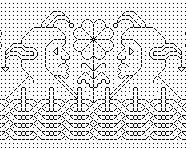
It’s small, but it’s clear. The lines are stitches, the dots represent the “holes” in the cloth being stitched. In something like Aida, Hardanger or Fiddlers Cloth, each dot is an actual hole in the weave. If one is using plain weave linen, each dot corresponds to the interstices between each two (or three, or more) threads over which the stitches are taken.
Here’s the same pattern, graphed out in one of the stitching programs (click on this, to see it better than it is shown in the thumbnail):
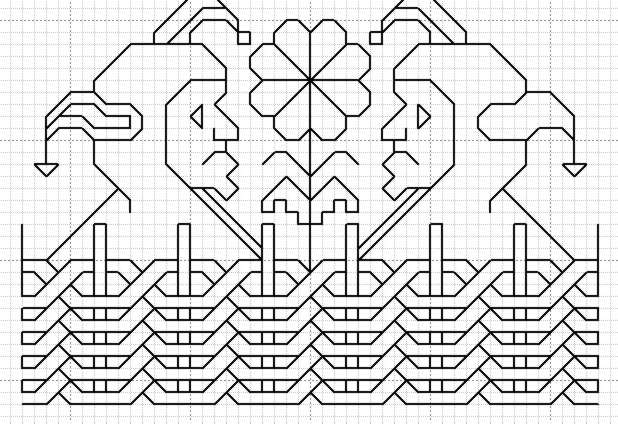
Yes, there are some aids built into the stitching program, like decimal bars on the graphs (every 10th bar indicated), and stitch counts along the margins, but those can be added to my style of illustration.
My main beef with ALL of the stitch graphing programs is that they treat back stitch, double running or other straight stitches as an afterthought. Sometimes the back/double running notation can’t be easily mirrored or manipulated (as in KG-Chart LE, which I used for the bit above). In others it always appears as an undifferentiated or symbol-represented line, with no indication of individual stitches. And in all of these programs, scale is limited. They’ve been invented for folk who stitch at larger gauges than I favor. My 18 stitches per inch (36 count linen) is a bit smaller than the 7, 10 or 12 stitches per inch many modern stitchers favor. Patterns plot out waaay too large for easy display or reproduction on book size pages. So far I’ve taken the demos of quite a few of the dedicated stitching programs for a test drive. To date I’ve tried and discarded PCStitch 9; WinStitch, SitchR-XP, DigiStitch, KG-Chart, Easy Cross, Easy Grapher Pro, STOIK Stitch Creator, and Cross Stitch Professional. I will say though that most of them do a fine job at turning photos or drawings into cross stitch. (I am a bit frustrated with programs that allow very limited trial periods. I work. Lots. My hobby investigations take place over months, not days. I would have liked to have gone back and re-tried some of the earlier programs I encountered later on, but was unable to do so because my 3-day trial had expired. Their loss, not mine).
Now I’ve turned to general purpose graphics programs. I need one that lets the user manipulate grid density and representation, that allows mirroring and rotation, and grid-constrained line drawing. Ideally I want one that allows either patterned lines, or that allows some sort of logic-based display controls (black pixel overlaid with white pixel = white pixel as displayed; black pixel overlaid with black pixel = black pixel as displayed; white pixel overlaid with black pixel = black pixel – you get the idea).
I’m not quite at the optimal yet. But I’m getting close. I did the bit below using GIMP – a general purpose open source graphics manipulation tool. Elder daughter (the one jumping up and down, waving madly over there in her dorm room) gave some vital assistance with layer manipulation and masking. Here’s the result (click on this one too):

I’m not quite happy with the dots/voids. I find my original method from TNCM much easier to parse out visually than I do the new version, with dots in the center of each void. But that may be just me.
I’m going to soldier on, looking for something – anything – that can get close to my original. For the record, that was done on my long gone Mac IIcx using Aldus Superpaint. A program that has no direct cognate today.
All advice/leads on possibles are gratefully accepted. In fact, if someone manages to put me onto an effective solution to produce the look in the first snippet above using Windows software, and I end up using their method for my next book, I will reward them with a highly suitable stitching related gift.
CLARKE’S LAW SAMPLER – FINAL SOURCES ROUND-UP (LONG)
UPDATE ON 24 APRIL 2022 – For some unknown reason, the majority of this page disappeared. I’ve gone back to find and restore the missing info. Apologies if the links are still broken. This is a work in progress.
———–ORIGINAL POST – RESTORED MATERIAL FIRST PUBLISHED ON 24 OCTOBER 2010 ———–
I seem to have picked up some new readers here this week. I answer questions and comments from Kabira, Annanna, H. from Japan, and others. Recognizing that upon completion this heads to my pile of “finish me for display”, is unlikely to emerge before the holidays are over (and may not be seen again before spring) I post my wrap-up now on the almost-completed piece. Apologies for the length of this post.
First, thanks for your kind words. I’ve had a lot of fun stitching this piece. My sampler is more of an exercise in perseverance than anything else. The wide pattern strips, though complex, are not appreciably more difficult to stitch than are the narrow ones. All follow the same basic logic, and once a stitcher is used to following that logic the only thing that can go wrong is miscounting threads. (Bright, indirect light helps with that).
My sampler is worked on 36 count even weave linen, using one or two strands of standard DMC embroidery floss, colors #310 (black) and #498 (deep crimson). Worked over 2×2 threads, it’s done at 18 stitches per inch (about 7 per cm). The entire embroidered area measures out to roughly 16 x 32 inches (40.6 x 81.3 cm). I did not work it double sided, but the double sided logic does prevail.
The Clarke’s Law sampler, like all embroideries on this site, is an original composition. However the individual strips are adapted from or inspired by historical sources. I comb period modelbooks (mostly pattern books printed before 1650) and photos of museum artifacts, looking for goodies. Then I graph them out and stitch them up. I’ve been playing with patterns this way since the early 1970s, and over the years I’ve amassed a collection of designs. I put out a couple of leaflets within the Society for Creative Anachronism, the first one being issued in 1977/1978, and reprinted a couple of times thereafter. I released a second, better documented leaflet in 1983.
Then in in the ’90s some friends convinced me that others would find my notebooks useful (the leaflets containing only a small bit of what I’d been collecting) and introduced me to a publisher. The result was The New Carolingian Modelbook: Counted Embroidery Patterns from Before 1600 (TNCM). Sadly, the publisher turned out to be either exploitative or incompetent, or both, and to this day I’ve seen almost no return for the effort. But the book is out there, and continues to sell on the used book market for absurd prices. New copies continue to trickle in via eBay and a used book seller in New Mexico, so somewhere out there beyond my reach, there is still a source.
Be that as it may, I continue to collect and “play test” patterns on samplers like this one. Here’s an index to the sources for the 22 patterns used on the Clarke’s Law sampler:

1. TNCM Plate 32:1 “Twined Blossom and Interlace Meandering Repeat”. Known affectionately as “The Brooklyn Pattern.” Ultimate source – Domenico daSera. Opera Noua composta per Domenico da Sera detto il Francoisino. Venice, 1546 – one of my all time favorite modelbooks.
2. The alphabet for the main quote is from Sajou #55, posted by pattern archivist Ramzi at his Free Easy Cross, Pattern Maker, PC Stitch Charts and Free Historic Old Pattern Books blog site. Thanks, Ramzi! I played with it a bit, working the curlicues in red and weaving them over/under the letter forms.
3. TNCM Plate 69:1 “Grape Motif or Border Repeat”. I graphed it up originally from a photo in Drysdale’s Art of Blackwork Embroidery that showed the Victoria & Albert Museum’s artifact T.14-1931. The picture available on line is MUCH better than Drysdale’s black and white photo. Many of the other patterns on this piece come from this same source. Drysdale cites it as being Spanish, from the late 16th/early 17th Century. The V&A’s attribution is Italian, 16th Century. I’d go with the museum’s judgment on this one, and if given the chance to republish, would amend TNCM’s listing accordingly.
4. Plume Flowers. Victoria & Albert Museum’s artifact T.14-1931. I’ve charted this out on paper but other than stitching it here, I haven’t published it yet.
5. Hops. Victoria & Albert Museum’s artifact T.14-1931. I’ve charted this out on paper but other than stitching it here, I haven’t published it yet.
6. Column and Wreathe Repeat. Victoria & Albert Museum’s artifact T.14-1931. I’ve charted this out on paper but other than stitching it here, I haven’t published it yet.
7. TNCM 68:2 “Seam Decoration or Border Repeat”. Graphed from photo in Pascoe’s Blackwork Embroidery: Design and Technique. Pascoe cites this as being from 1545. The original was worked along the shoulder seam join line of a butted sleeve man’s shirt, stitched in all black.
8. Another alphabet from Ramzi’s Sajou collection. This one is from #172. It’s interesting to note that several of the late 1800s/early 1900s booklets he’s got quote some early modelbook patterns closely enough to recognize the direct line of heritage.
9. Meander Repeat. Victoria & Albert Museum’s artifact T.14-1931, BUT this one appears on at least one other source, also on display at the V&A. The keeper of the www.drakt.org website shows a display case with what’s clearly a close kin to the T.14-1931 pattern, but worked voided style. [2022 Edit note – I have since tracked down the particular strip that was included in the massed display artifact shown on the defunct drakt.org website – it’s Victoria & Albert Museum’s Border, dated 1600s, accession 503-1877. The massed display in which it is mounted is also pictured on the V&A’s page.]
10. Yet Another Meander Repeat (I’m running out of descriptive names). This one is also from Victoria & Albert Museum’s artifact T.14-1931. I’ve charted this out on paper but other than stitching it here, I haven’t published it yet. I worked it voided, although the original is in double running only.
11 a-d (top to bottom)
a. TNCM 55:1. “Snail Border Repeat”. My original, inspired by period designs.
b. TNCM 51:1 “Brier Rose Twining Border Repeat” My original, inspired by period sources. Also in my second booklet, Counted Thread Patterns from Before 1600, published informally in the SCA circa 1983.
c. My first booket, Blackwork published in 1978. Pattern #j, which I cited as being Italian counted thread work from the 1500s. No citation though, which is why it didn’t make the cut for later booklets.
d. TNCM 52:2. “Flower and Bud Meandering Border Repeat”. My original, inspired by period designs.
12 a-d (top to bottom)
a. My first booket, Blackwork published in 1978. Pattern #gg, which I cited as being English, very early 1500s. No exact source though, and I didn’t include it in TNCM for that reason.
b. TNCM 54:3 “Pomegranate Meandering Repeat” and #53 Counted Thread Patterns from Before 1600. Another one of my own, inspired by period sources.
c. TNCM 49:2 “Acorn Meandering Border Repeat” One of the early set I graphed from the photo in Drysdale’s Art of Blackwork Embroidery that showed the Victoria & Albert Museum’s artifact T.14-1931.
d. TNCM 44:2 “Acanthus Meandering Border Repeat” also #55 from Counted Thread Patterns from Before 1600. Yet another from the Drysdale photo of Victoria & Albert Museum’s artifact T.14-1931. (I do adore that source!)
13. Wreath and Columns Repeat. Victoria & Albert Museum’s artifact T.14-1931. I’ve charted this out by hand but other than stitching it here, I haven’t published it yet.
14. Columbines(?) and Twists Voided Repeat. This one also appears on the same Drakt website photo taken at the V&A as one of the sources for #9, above. I can’t make out the artifact’s accession number though. And yes – I graphed it direct from the on line photo, as seen on the screen.
15. TNCM 58:1 “Strawberries and Violets Meandering Border Repeat.” Also #61 in Counted Thread Patterns from Before 1600. This is the pattern adapted from the very famous Jane Bostocke sampler, also resident in the V&A. But my source materials were photos in Gostelow’s International Book of Embroidery and King and Levy’s The Victoria and Albert Museum’s Textile Collection: Embroidery in Britain from 1200 to 1750. If you’re familiar with those sources you’ll understand why my squinting at them came up with the odd raspberries in between the flowers, instead of what can now be plainly seen as simple twists on the V&A’s own photo page. I’d amend the description to “After Bostocke..” were I to republish TNCM now.
16. Black strip pattern. From page 57 of Louisa Pesel’s Historical Designs for Embroidery, but I worked it outlined and voided instead of foreground stitched.
The patterns I tested on this piece will probably make their way into a sequel to TNCM – once I find a graphing program capable of handling double running stitch with ease, and that can chart out giant repeats at a small, but useful gauge. I want to be able to present largest of these patterns on a single page, and to do it using a background dots and voided line style of presentation which I came up with for use in TNCM, and which I find much easier to follow than regular dark line on background graph paper charts:
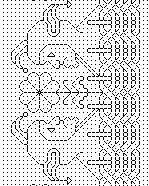 (Snippet of Jesters pattern, TNCM 69:2)
What’s next? I’m not sure. I’m certainly not stitched out. I’d like to do another big sampler to try out more patterns, but I haven’t decided on its size or form yet. There’s also the possibility of a set of matched but not matched napkins – six all using the same colors, but all different. There’s also a pile of holiday knitting to achieve between now and the end of the year. Rest assured – I won’t be idle.
 String-Or-Nothing
