VINES AND TWISTS
My own progress on the Clarke’s Law sampler? A bit:

I’ve got the full segment from one bounce point (the column down the center of the trefoil interlace) to the other bounce point (the column down the center of the heavy stem interlace at the left). To be fair, this pattern’s bounce points aren’t exact. The interlaces themselves don’t mirror perfectly left and right, but they’re close if one makes allowances for the minor perturbations caused by the stem elements twisting and weaving over and under each other.
The rest of this strip is a (more or less) mirror image of what I’ve already stitched. As you can see, a full cycle of this repeat is very long, making it difficult to use for clothing, but ideal for household linens, curtains and the like.
I happen to like long repeats though. They’re far more interesting to stitch than shorter ones. But I’m ready for the next panel. Got to finish out this one first, then it’s back to the area below the lower band of the motto. I’m not sure what I’ll put there, but it won’t be long-armed cross stitch. Back to double running for the next panel. And it will probably be something from my design notebooks, rather than from TNCM. If so, I may consider posting it here. Stay tuned.
DOUBLE RUNING STITCH LOGIC
I really like double running stitch. The more complex the pattern, the better. Best of all are the amazingly detailed ones from the late 1500s/early to mid 1600s that are an explosion of vegetal forms. Some are inhabited by natural or mythical creatures. Here’s an example:
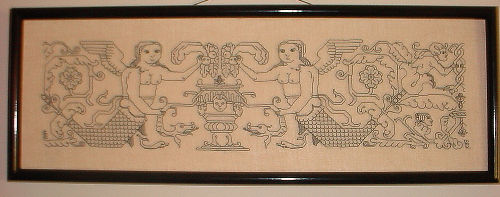
StitchPuppy, a stitcher new to double running stitch (aka Spanish Stitch, Holbein Stitch) asked me about the logic and method of working double running. She’s familiar with the working method – that the final effect of a solid line is achieved by two passes of the needle. On the first trip every other stitch unit is made, and on the return trip, the “in betweeners” are filled in:


(Pix above are from TNCM). She understands that with careful stitching, pieces in double running stitch can be made to look exactly the same on the back and the front – a plus for cuffs, collars, napkins and other applications where both sides of the work are likely to be seen. Where StitchPuppy has problems is on understanding how the method can be applied to complex patterns. She wants to know where I start when I tackle a complicated double running pattern, and whether or not I use a logic that helps keep me from running into dead ends, or that helps ensure that I do end up with a front/back reversible end product.
I’ll try to answer.
First – not everything that’s graphed out for double running can be done easily totally two-sided. Any design with an isolated bit of stitching that’s not connected to the main pattern presents a problem. The small dolphin just below the mermaid in the stitched panel above is not connected to the rest of the design. It’s a stand-alone element. To work this particular piece double sided, one would need to both begin and end off a separate strand of thread, just for that dolphin, or connect it on one or both sides to the main motif by one or more bridging stitches. Either way, the dolphin presents only a small problem. A larger one is posed by the mermaids’ facial features. The eyes, nose and mouth are isolated from the main stitching areas, and are too small to be worked double sided and have enough area to finish off the ends.
The rest of the mermaid pattern can be worked double sided. There are no other logical impediments to completion. But how to work a complex design? Not hard. Any design without a discontinuity (like the orphan dolphin) can be envisioned as a single baseline, with detours to fill out the details or as a series of areas. Let’s look at the phoenix I posted here a couple months ago:

(By the way – see that border? The octagonal interlaces are not connected to the little “Vs” filling out the border north and south. Lots of discontinuities there, and if you saw the back of that work you’d notice the bridging stitches I used to connect the design elements).
Back to the phoenix. It’s pretty easy to identify a baseline around the phoenix’s perimeter:

Sometimes I stitch this way – working a long every-other-stitch outline around the entire motif, then going back and doing the “detours” from that line. The advantage of working this way is that it’s quick to block in the major design elements and to make sure they’re properly aligned to each other before investing time and thread in filling in the rest of the design. The primary disadvantage is that it’s hard to keep count during long straight runs. This is the working logic described in most blackwork books. This piece shows another example of the conventional baseline-first attack method:

You can see that I’ve outlined the blossom’s main elements, and am now following along to work the individual petals.
However, I’m far more likely though to work my pattern in a more compartmentalized manner, either identifying the baseline but instead of following it and filling in detail later, starting on the baseline and taking every detour that presents itself. I’m using the baseline identified above, but instead of following around the bird, I immediately zip down to do that first little feather slice, returning to the baseline when that’s done.
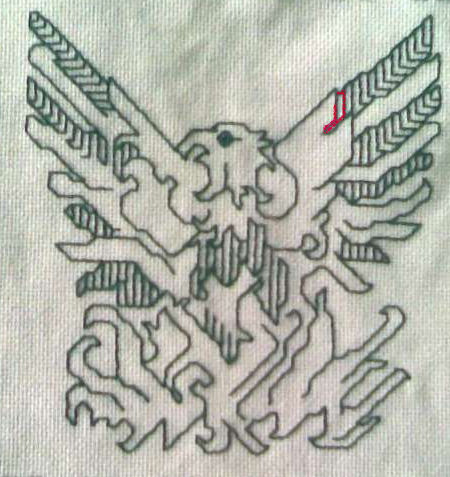
Worked this way, the design gets filled in early on, moving down the baseline and accomplishing the detours, and returning to the baseline after each one. All that’s filled in on the second pass is the every-other-stitch segment of the baseline. .I find this method much easier to use for complex charts. It’s quite easy to count little completed feather units in the bird’s wingtips as I finish them. The flower strip above also shows the second method. I used it for the acorn sprigs. I stitched along the baseline, but every time I got to a branch, I finished the branch before returning to the baseline. The second pass is a straight run along the baseline itself.
Where to start? It depends on your work, the style of frame you are using, and your own preferences. In general it’s better to minimize handling of the stitched area. Working from the center out is an accepted practice because it tends to keep sweaty hands away from finished stitching. But there are times when working that way isn’t logical. I began the phoenix with its head, having matched the center of the pattern with the center of my to-be-embroidered area. The phoenix was also at the rough center of my finished project and was one of the early elements I completed on it. The strip below though was done bottom up. And the patterns I’m working on my current piece were begun at the cloth’s center. It’s all situational.
Where is the baseline in an all-over pattern? Wherever it’s convenient. Here you can see that I’m using two baselines for the twisted frame element, and not worrying about completing the entire interlace in one gulp:

Is there any way to determine which method was used on historical pieces? Scholars may have made figured it out but I haven’t run across word of it in popular stitching literature. The most reliable way to figure out historical stitching logic would be to pick apart an artifact. NOT something anyone sane would do.
One word of caution to those who want to work something two-sided. Resist the temptation to use veeerrryyyy loooonnnnnggggg strands of thread to minimize the number of ends. They WILL tangle and abrade as they are stitched. You will curse the day you started the project. (Trust me on this.) I do have a trick to share, though. If I use a very long strand I start from the middle of it. I pull the thread half-way through my work, then in an inconspicuous spot, I wind the excess thread around a straight pin. I stitch away with the free end until it’s ready to be terminated. Then I go back and free the other end of the thread from the pin, and use that. Since I am stitching with a sane length each time I avoid tangles and thread wear, but I minimize total ends. Of course this presents its own logic problem – how do you know where to start the next mega-thread, but that’s a conundrum for another day.
I hope that this is helpful to StitchPuppy and with luck others, too. If anyone has questions about identifying baselines or stitching logic in double running, please feel free to post them here.
MORE LEAVES AND VINES
I’m just a bit tired this morning, but I’ve made enough progress to post. I do prefer working long armed cross stitch to regular even-armed cross stitch, but I like neither one as much as double running:

Even so, I’m plugging along. I’ve got the bounce repeat center of my strip done (the trefoil interlace at the right), plus about half of the infilling between there and the complementing bounce repeat that will be further left. This particular pattern is a bit unusual because the two bounce repeats are not symmetrical. They’re both different, which you will see as progress accrues. This is one of the things I like about Domenico da Sera, my favorite modelbook author. His repeats are more imaginative and less stiff than many others, with a vegetal formalism that I find most charming.
LATEST INTERLACE AND BUTTERY PATTERN
Here’s what that little red scrap at the center top of the last post’s picture has grown to:

To be fair, this all hasn’t happened since the last post. I took that picture a couple of days before I wrote the blog entry.
This is another panel from TNCM, Plate 32:1. It’s a long repeat with two reflection points. This scrap is the center of one of them. As you can see the pattern will mirror image left and right along the centermost line of the stem interlace. There’s another totally different bounce line that will just make it onto this cloth, but the repeat on the other side of it won’t be full cycle. I really like these extra long repeats, but they’re hard to use for most modern work unless one is doing a whole length of bed linen, or wishes to stitch at gauges much smaller than most modern embroiderers attempt. The longitudinal repeat for this pattern for example is 257 units. On 14 count Aida for example, 257 stitches works out to a strip that’s 18 inches long, and that’s just for one repeat. I’m not much better here, stitching as I am on quite coarse 36 count linen. My repeat will be about 14 inches across, just a little bit narrower than the width of my stitched area. For the record though, this isn’t the longest repeat I’ve got in TNCM. That one is 308 units, and is the one I want to use on my notional library curtains. Someday.
In other embroidery related news, I had forgotten that I had given my pals at the Buttery permission to post my original line unit pattern named after their house. Please respect my copyright though and don’t repost the page.
Also the pattern in TNCM and available at the Buttery link above shows only a bit more than half of the fillings I worked in the swatch above. The new ones I doodled up specifically for the Do Right sampler.
ADDING ON
At the risk of further boring what few readers remain here, I present more progress on my Clarke’s Law sampler:

I’ve finished off the two bands of lettering north and south of my first voided strip, and have started on the foreground stitched panel that will be the one at the top of the finished piece. I’m using yet another pattern from TNCM. This one is on Plate 31:1, and reproduces a pattern by my favorite modelbook publisher – Domenico da Sera, from a work of his dating to 1546. The original is shown in a manner that implies working the background, which I replicated in my book, but for this piece I’m stitching the foreground instead. I’m also using long armed cross stitch for this panel, not plain old cross stitch. I’m doing it the easy way though. Instead of bending the path of the stitching up to follow the course of the diagonal stems, I’m just marching across in horizontal bands, worked back and forth with each row alternating direction. This emphasizes the plaited texture more than does working all of the rows of stitching in the same direction, a detail that I like but some others don’t. Some folk prefer a smoother top-leg-uniform result, and use a different stitching logic altogether. Also nice, but I prefer the complexity of the herringbone family long-arm cross stitch more.
The current band should take me about two or three weeks to finish – work deadlines willing. Then I’ll begin the band below the *LY ADVANCED TE* segment. That one will be another line unit pattern rather than a solid block unit pattern, quite probably one of the ones I’ve been storing up post-TNCM against my mythical second book.
LETTER BY LETTER
It must be exquisitely boring especially for knitters to tune in here and see slug like incremental progress on a non-knitting project. Even so, I ooze along:
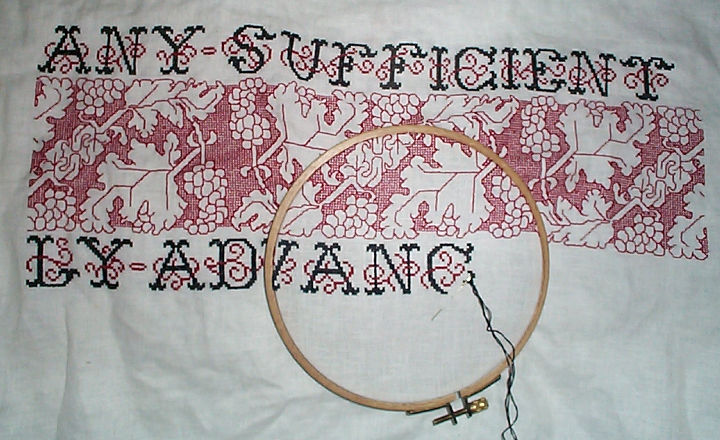
I also note that this style of embroidery on the count doesn’t seem to be very popular right now, at least not among web-connected stitchers. I’ve been web-walking for a couple of days now, looking for inspiration to share, but found very little contemporary work, although I did find the historical artifact photos cited in my last post. I guess I’m just programmed to be doing something different – knitting before it became a fad, crocheting when everyone else was doing needlepoint, and am now off stitching obscure styles.
There are a few folk connected with the SCA with work or research that piques my interest and who readers here may find inspiring, too:
- Extreme Costuming’s gallery of impressive stitched pieces. Lovely, with lots of infillings or background voiding, but not exactly what I was looking for.
- ElizabethanGeek’s blackworked smock is also quite charming.
- Here’s a historical example (rather than a contemporary work) from an SCA affiliated researcher – a pair of impressive Italian woman’s breeches (an undergarment, really) from the mid to late 1600s, accompanied by a chart for the stitching pattern used. (Other items at the Realm of Venus website are very interesting, too – especially the embroidered shifts).
If you know of any pix of long-repeat works on the count, either voided (background filled) or stitched foreground, in monochrome or mixed colors – based on historical patterns or original – please feel free to post the links to them here in the comments so we can all oooh and aaaahhh.
Finally, if there’s enough interest, I’ll share some graphs of future pattern panels here, that aren’t available in TNCM.
NOT QUITE SUFFICIENT
More progress on my latest sampler. As you can see, “sufficiently” doesn’t fit on one row. No problem. the “ly” will begin the row of lettering below the grape pattern. I intend on marking word breaks with the little red oval anyway. I’ll probably go back and fill in the small slice of space after the final T on the first row with an all black bit of patterning after all of the words are done.


For those who are keeping track, the quotation is “Any sufficiently advanced technology is indistinguishable from magic.”
I’m planning my next non-letter strips – a rather dark one immediately above the existing top line of lettering, and something rather more narrow but probably not as dark below the just-begun row of lettering. I’m looking at both line unit and solid unit patterns, plus voided work and other forms of counted thread stitching. The more complex, the better of course, just to underscore the irony of using “old tech” to depict this particular thought. Among the sources I’m using are my own book, plus notes for my theoretical next one, and some on-line photos of voided work on display at the Victoria & Albert Museum. (The cited photo set was provided by the unknown keeper of the Drakt.org website. Thank you, unknown keeper!)
PROGRESS!
As you can see, my voided grape strip is complete, and I’ve begun some of the lettering.

I’m using an embellished alphabet from Sajou #55, by way of Ramzi’s Patternmaker Charts website. Just to make life interesting, I’m working the tendrils that twine around the base letter forms in my crimson, and the letters themselves in black.
My plans are to march the letters across the piece, truncating words willy-nilly at the rightmost edge if they don’t fit, then continuing them on the next strip of lettering. For example, I will probably run out of room for the rest of “Sufficiently” before I get to my right hand margin, but I will finish out the word on the next line immediately below the grape panel. Words will be divided by little red ovals, as seen above between “Any” and the start of “Sufficiently.” I also intend to alternate patterned panels with letter bearing strips.
I like the way this is maturing. Now just to keep at it, both planning and execution, until all is done.
VINING ALONG
Yes, with all the cookie baking some embroidery did get done:

Here you see the first strip pattern, further along than the last stitching-related post. But not too far. Time is after all a finite commodity.
I’m a bit over half done with this particular strip. The grape unit to the right in this picture is the center one, and will be complete. There will be another partial unit of the same size as the truncated right hand unit on the left.
I’m thinking of working the words in black, perhaps using more than one of the various vintage alphabets from Ramzi’s Patternmakercharts website. I’m thinking about several presentations for them, including doing each word in a different face, so that the final presentation looks a bit like a ransom note; or working each initial letter in one of the more demonstrative faces, but the rest of the letters in another simpler or lower case face; or working each line in a single face, but no two lines the same. I’m not sure yet what I’ll be doing, but there’s lots more grape leaf panel to stitch as I contemplate the problem.
MORE GRAPES
“Go back to knitting!” Sorry. I’ve got the stitching bug now and I go where my fingers lead me.
Minor progress on the latest sampler – another panel from TNCM. This one I decided to do voided style (the original had no background). Instead of using cross stitch or long-armed cross stitch for the fill, I’ve opted to do a grid like mesh, worked in one strand of the same DMC floss that I’m using for the two-strand outlines. I’m not sure how I’ll handle the top and bottom. I’m thinking of being non-traditional, and instead of extending the fill a couple of units past the design’s base area, terminating it a unit or two inside the design, so that the grapes “overflow” their background.
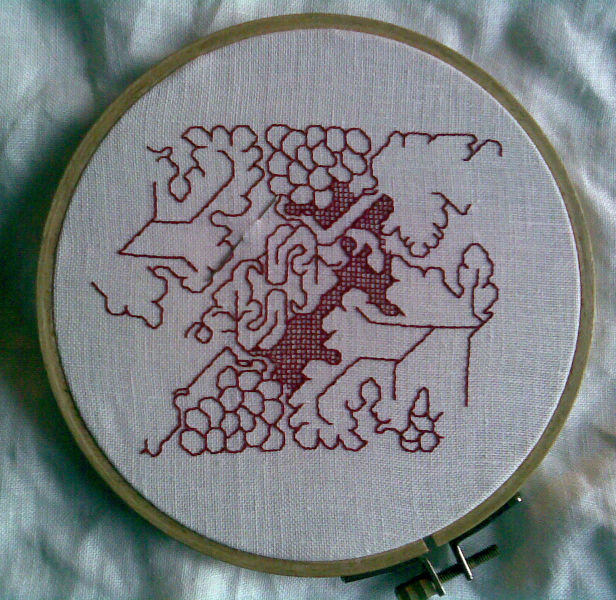
The next decision is whether or not to continue this entirely across the cloth, or apportion my space differently. The piece of linen I’m using is rather large and long. I may decide to just go horizon to horizon, with no outer framing edging, and insert the lines of my quotation in between a series of strip patterns of various types. If so – do I use the same typeface for all of the words, or do I use different ones for each line. Decisions, decisions…
 String-Or-Nothing
