CENTER OF IT ALL
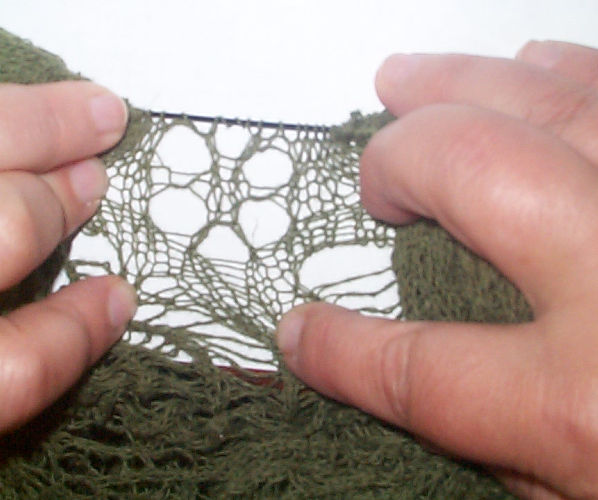
Work continues on the green tablecloth. I finally knuckled under and got a second long circ of the requisite size. I’m now working on the thing in two-circ mode, which means I can finally smooth out the center to show off the patterning:

It’s going to be nifty, to be sure!
EYELET DETAIL
UPDATE: THIS SPOT MOTIF CAN BE FOUND AS AN EASY TO PRINT PDF AT THE KNITTING PATTERNS LINK ABOVE.
Return to knitting!
Here’s a minor detail from the chart I’m working now. It’s a six petal daisy eyelet, but cleverly done in the original to make a nicely defined motif. The German language note accompanying the chart had a notation about dropping one of the three YOs in each triple YO set, but it’s hard to tell the difference between a numeral one and a lower case l in the reproduction volume, so a bit of confusion ensued.
I’ve redacted this to modern notation, and graphed it with the motif centered as a stand-alone. This motif can be spotted all over a surface, placed willy nilly in other framing units, or can be used as either vertical or horizontal panel repeats. The chart contains evil gray no-stitch boxes. Ignore them when you are working. They’re just there to maintain logical presentation, and serve no other purpose. Click on the chart for a full size copy, but it’s rather large and may challenge folk with slow connections.

In any case, as you can see, I’m still plodding away on Olive Tablecloth…
GRADUATIONS AND THE BLOB
There’s been precious little knitting shown here of late, an egregious oversight for a knitting blog. As usual, I plead too much work and too little time, with the added complication of kid graduations/celebrations – Elder Daughter from high school, and younger daughter from elementary school.
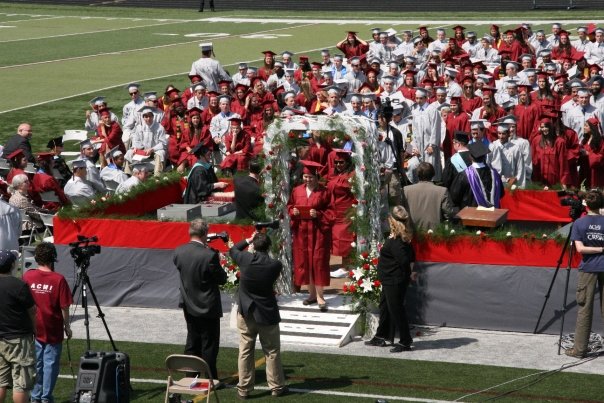

Fun events to be sure, complete with family/friends, but time consuming none the less.
What little time I’ve had to knit I’ve used to work on my olive tablecloth, which at this point is better named “The Blob”

Right now unstretched it’s about 24 inches from needles to center, with something upwards of a thousand stitches on the needles and I’m not done yet. You can see how densely the stitches are packed onto my too small needle:

That’s a 2mm, by the way. At this point I don’t dare let it free from the stitch keeper unless I’m actually working on it. The thought of dropping those thread-fine stitches makes me hyperventilate.
The good news is that I’m only 40 or so rows from completion. At the rate of 1.5-2 rows per week, I’ll be working on this for quite a while yet.
I do have an interim knitting decision to make. This is NOT a good piece to take with me on our midsummer vacation. It’s best worked on in one spot (you can see I didn’t move it far from my favorite knitting chair for the photo, above). But what to bring?
Perhaps I’ll bring along the Kyoto I still haven’t finished for Elder Daughter. I’m mid sleeve, in boring stockinette, with just the last 8 inches of sleeve to go plus finishing. And I’m also considering bringing my Truro Counterpane. At this point it’s a traditional summer knit for me, and with only nine mega-motifs done I still have miles to go before I can deploy it as a blanket. Or I may decide to do something else entirely. I’ve got a few sweater-sized lots of cotton stashed, any one of which would be an excellent quick-knit summer top for me. Decisions, decisions…
SAND
I’m being eaten alive by work deadlines as usual, limiting my time for knitting and blogging, but I did take off this afternoon to work on the Resident Male’s Fathers Day present. Elder and Younger Daughter helped, of course.
Back story: Akira Kurosawa’s Seven Samurai movie is one of this household’s all time favorites. On more than one occasion we’ve pointed out that the Resident Male is vastly outumbered here, surrounded as he is by a sea of females. And on more than one occasion I’ve threatened to make him a “odd man out” banner inspired by the one raised to rally faltering spirits in our favorite move:

Today we did it. We made a beach flag inspired by the movie. The movie banner says “Farm,” but in our case “Sand” is more appropriate, because we intend on flying this on our annual Cape Cod vacation. Calligraphy for “sand” is courtesy of Ted Goodman and family, local Aikido instructor and all around good guy. (Thanks again, Ted!)
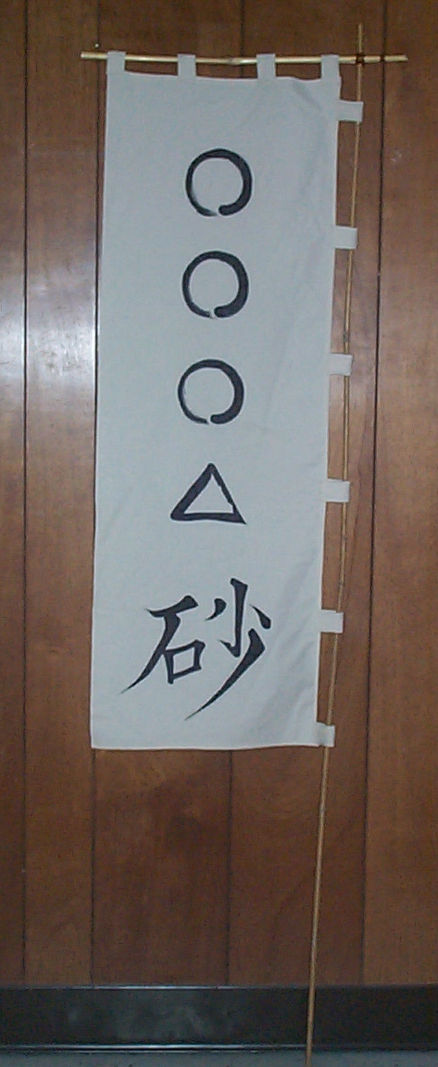
Younger Daughter helped with the sewing, learning to use a sewing machine in the process. Elder daughter helped create and ink the circles and triangles.
Resident Male was quite tickled by the gift, which we gave early – there being no effective place to hide a four foot tall banner in this house.
RETURN TO OLIVE
Not much knitting progress this week. I picked up the olive tablecloth after my sock urge was sated, continuing to produce a couple more inches of the spiderweb section. Then I moved to the set-up round for the final edging. Unfortunately, I made a mistake early on that I did not catch for four more rounds. At ten zillion stitches per round (most of them incorporated into double decreases separated by double yarn overs), the tinking back has been painfully slow. But I’m finally past it and moving forward again. In the left hand shot below, you see the spiderweb section. In the right hand shot, a bit of the center medallion’s outer band motif.


To recap, the center of this tablecloth is from The Knitted Lace Patterns of Christine Duchrow, Volume III, edited by Jules and Kaethe Kliot. The center is on page 72, charted on p76.

In any case, the math worked out, so I decided to merge the two patterns. Success however isn’t guaranteed. Although the spiderweb portion is very forgiving in that it will resist ruffling due to the ability of its brides (the horizontal twists of the double YOs) to compress, it may well ruffle when the peacock like terminals of the pattern are added. The trick is to make the spiderweb portion wide enough. It’s a clear gamble. Too wide, and the cloth won’t lay flat. Too shallow and the piece will ruffle at the edge. Add to that the fact that the pattern as written is for edging a smaller circumference; that I’m working in a fine linen thread – guaranteed not to be a cooperative, stretchy blocker; and that I’m working with all of the stitches jammed onto a way too small circ, making it hard to judge how flat everything is working out. It’s an Adventure in Knitting, to be sure.
Even with all of these disaster factors and putting the piece down for several months, I’m having fun with it. I find that I really enjoy noodling out lace. With the end in sight on this one, I’m not sure what I’ll do next. Probably something more scripted with a lower chaos factor. One possible candidate is Heirloom Lace’s Princess Shawl. I bought the pattern a while ago, before it was revised and expanded. I am considering doing it up in the black laceweight I just bought.
But there are so many other things to knit. I need to work more on my North Truro Counterpane. I would dearly like to finish it off and use it as a summer weight blanket. Someday. And if I don’t finish Elder Daughter’s Kyoto and dragon skin Rogue, she’ll have my head. And there’s the Sempre pullover from this past winter. And projects even older languishing in my Chest of Knitting Horrors(tm).
Finally, some folk have written to me to complain that I mis-characterized the gentleman spinner in the last post. Apparently he’s Dan of Gnomespun Yarn, and he’s got a huge following in the hand spinning/blogging community. I meant no disrespect. On the contrary, I was quite taken with his matter of a fact attitude and general uber cool confidence. So was my photo-taking friend. So all the best to you, Dan. Should our paths ever cross again, I’ll be sure to introduce myself and buy you a drink to make amends. Any other complaints about this blog or its contents can be sent to me either care of this website or at my wiseneedle inbox on Ravelry.
NEEDING A JUMP START
Another week of low inspiration here. I’m half way through the brown/tan/ecru entrelac socks. They’re working up nicely, but as I mentioned last week, the yarn has had lots of knots in it, one or two interrupting the color progression, but most clearly knotted before the stuff was dyed. I’m not pleased and will consider greatly before buying Berroco Sock again, even though I like its other properties that are so similar to more expensive European label sock yarns.
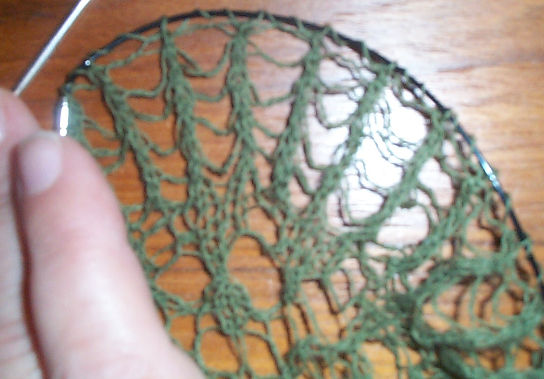
I’ve also picked up my olive tablecloth again. Rounds are still interminable, and nothing much interesting has happened since I put it aside last year. I’m still in the spiderweb section, with at least eight more rows of that two-row pattern before I have enough width to consider moving on to the final design element. I share my last olive picture again. The piece now looks the same, except the spiderweb around the outer edge is now about twice as deep.
And finally, in yet another traditional blurry String picture, I show off a partially completed embroidery. This one is a true sampler – a piece that exits only to try out random counted patterns. I had no particular goal in stitching it, it wasn’t intended to be displayed and remained a work in progress. The super long repeat in maroon shown separately is one of the design candidates for my curtain project mentioned here before. That work is still in the larval planning stages, mostly pending finding an affordable close to even weave linen or linen look alike.


Gauge on this sampler is approximately 15 stitches per inch on 30 count linen, in DMC Danish Flower Thread. Stitches used are cross stitch (green at top left), double running (grapes down center of piece and the two-tone framed flowers bit), and long-armed cross stitch (the extra long repeat). At this gauge the red repeat is just under 3.25 inches wide. To make my curtains less of an aeons project and to achieve the heft I want for my curtains, I’m looking for a plain weave even weave of about 12-15 threads per inch. That would make my stitched ribbon about six inches wide. Considering that I would need four panels to cover my windows, each 71 inches long x 35 inches wide, the six inch strip width would be in proportion to the rest of the project. But I haven’t found the linen yet, and certainly haven’t had the time to start, so my embroidered curtains remain a mental exercise for now.

Graphs for all of the patterns on this piece except for the small bans of field filling squaring out the area immediately to the left of the frame flowers can be found in The New Carolingian Modelbook. DMC DFT is now discontinued, which is one of the reasons why my play sampler ended up in my Chest of Knitting Horrors(tm).
GRAPE ESCAPE
Life took a silly twist here at String this week. Younger daughter and her fifth grade class participated in an Egg Drop. That’s the now classic assignment of designing and building some sort of a container that will protect a raw egg when container and egg are tossed from the roof of the school. The kids worked on their designs over the school break week last week. Yesterday was launch day. Acclaim was given for mission accomplishment (the passenger egg remained unbroken after a three-story fall), and originality of design.
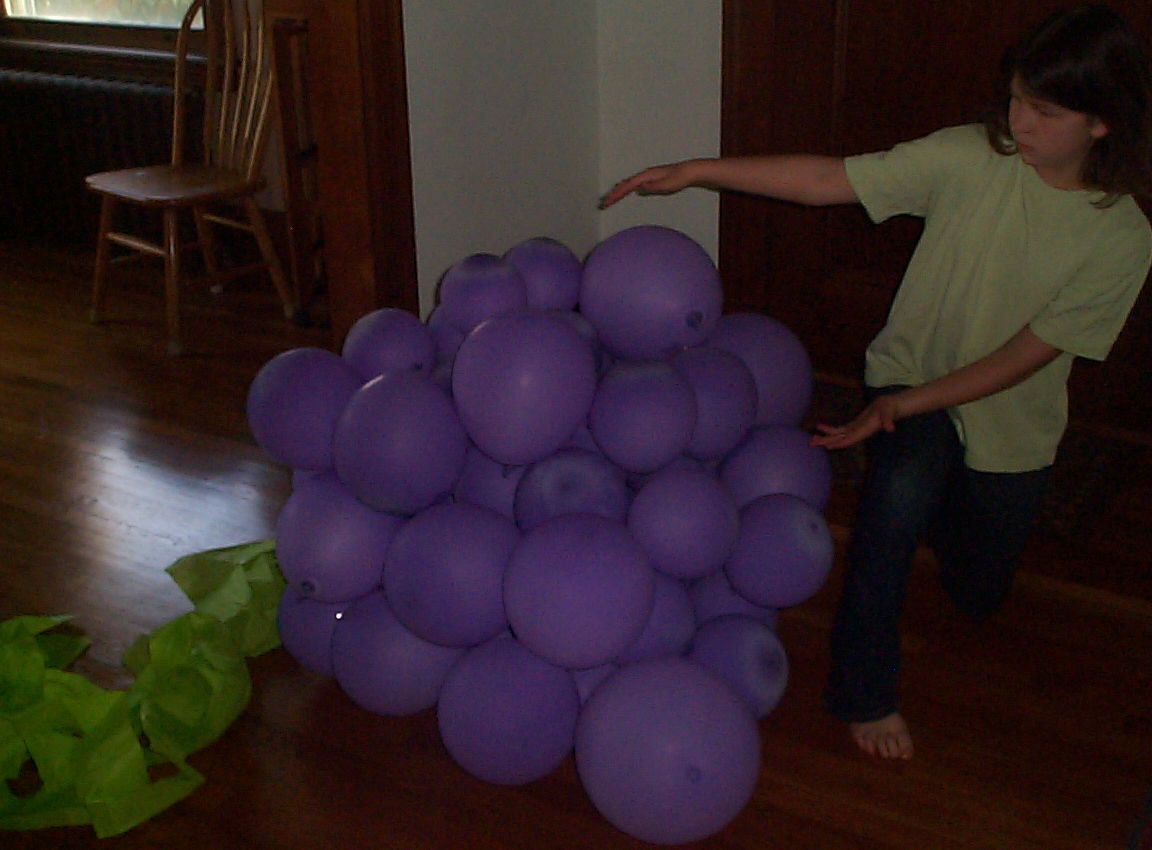
Younger daughter’s idea was to wrap her egg in a bit of bubble wrap for stability, then to embed the wrapped egg in a mass of balloons. When we went to the party store we found a bag of purple balloons on sale, a post-season discount along with other traditional Mardi Gras colors. She decided to make her balloon mass into a bunch of grapes. A very BIG bunch of grapes.
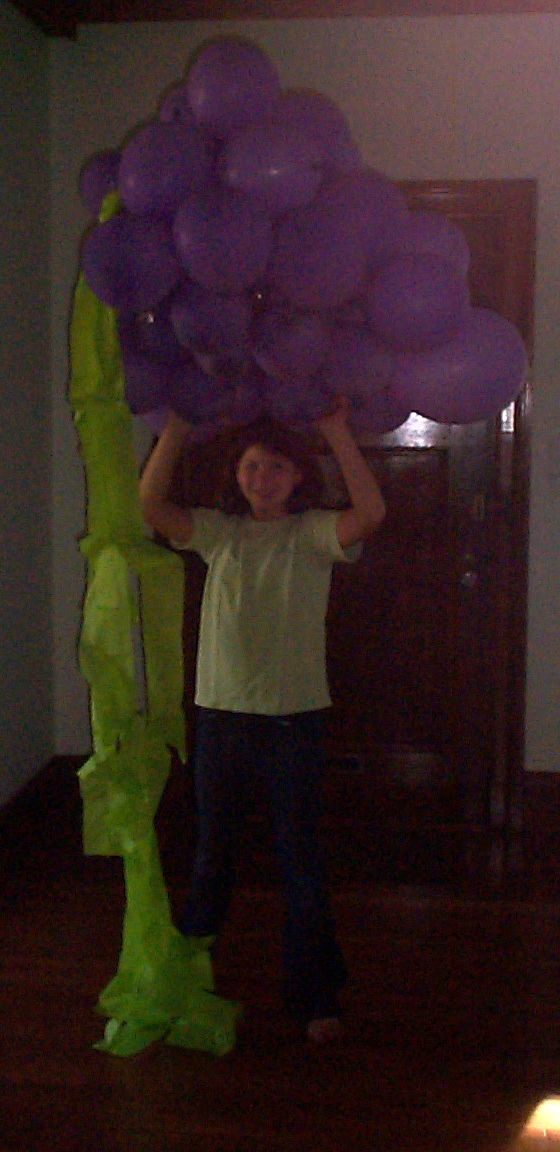
She made the streamers from tissue paper, three sheets each cut in a spiral for maximum length without the extra weight of additional tape.
Getting the thing to school on a windy morning was a challenge. It filled the back of the van. But as I hear the effort was worth it. “The Grape Escape” had a successful launch, and fell from the third floor rooftop with majestic slowness, bouncing a couple of times on landing but remaining intact. The egg passenger was unharmed. If the school posts a video of the trial I’ll share the link. Younger daughter is quite pleased both with her project’s success and with its amusement value.
In knitting news, I continue on the entrelac sock and am now about halfway up the ankle. Minor disappointment in the Berroco Sock yarn I used, though. I’ve found six knots so far in the skein of color 1487 (browns/tans) that I’m using – one or two are a statistical aberration I can live with, but that many knots is a clear indication of quality control problems. By contrast the skein of #1425 (mixed turquoise black, red, orange, purple) was clean.
SCRATCHING THE SOCK BUG
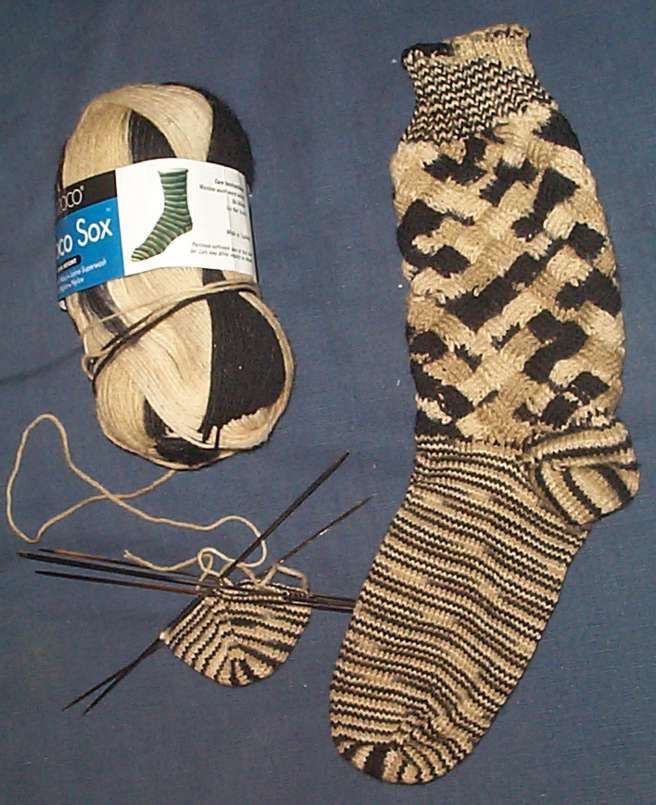
I clearly haven’t gotten the latest sock bug out of my system. After playing with the yarn-leftovers entrelac pair last week, I thought that the same technique might be useful for a problematic skein. I recently bought a couple of 100g balls of Berroco Socks. The first was a visual jumble in the ball (color #1425 John Moores). The colors were pleasing, but the appearance of the thing gave no clue as to how it would knit up. It ended up working pretty conventionally, with an interest-maintaining long repeat:

I kept patterning on this pair to a minimum, and introduced the eyelets only because I find miles of stockinette to be exceedingly boring.
The other ball looked nifty in the skein, but presented more of a problem. Those nice, solid sections you see in the photo (color # 1487, Gielgud) are actually quite short. The foot of my toe up sock shows the small tiger-stripy effect of the stuff just knitted up plain in stockinette:

But that’s even more boring if continued up the whole leg. That’s where the entrelac comes in. I’m using it on the ankle part. The color patches don’t align into checkerboard (a mathematical impossibility) but they are interesting in a skewbald sort of way. Note that if I had used a companion contrasting color along with this brown/tan/ecru yarn I could have made the visual weave effect clearer.
I don’t know why I’m not more enthused about picking up an in-process project, but until I am I’ll stick to working up more of my stashed sock yarn. One thing that whets my interest somewhat is Hanne Falkenberg’s Mermaid jacket kit. Unfortunately it’s way out of my price range and doesn’t come in an XL (the large looks to be a 12-14 US). There’s a vaguely similar pattern available from DROPS/Garnstudio that is in my size, but the lines aren’t anywhere near as elegant and to me at least, it doesn’t have the drape or color placement finesse of the Falkenberg. So I keep dreaming…
THE BEST OF ORC MANUFACTURE
We had an entertaining weekend here at String, spending most of it cleaning up the debris of a New England winter and waking up the garden for spring. Now I’m not a very good gardener. In fact I stick to plants that in more hospitable geographic areas are rated as borderline invasive, because they are about the only plants I can’t kill. I trust in my own lack of skill and the odd deep freeze winter to keep them in check.
This weekend’s chores included moving a trillium and a peony to make more room for an aggressive hosta‘s growing hegemony; shuffling some day lilies out of the way; rescuing some tulips and daffs so courteously relocated mid-lawn by squirrels; planting three ultra hardy five petal rugosa roses in some newly freed up spots; and pulling dead leaves out of the giant grass stubble (aka elephant grass, or maiden grass).
How giant is our giant grass? It gets tall enough for its early September plumes to overtop the roof of our front porch. We cut it down before the seed sets and ripens in order to keep it from colonizing the entire neighborhood. But what to do with canes ranging from 8 to 13 feet? The first year we bagged them with the rest of the yard trimmings, for the town to haul off for composting. This fall though I had an idea.
I also attempt to grow what started out as an antique variety of big scarlet speckled runner beans. While I don’t harvest enough of a crop to eat, the kids get a big kick out of our sequential years of Mendelian genetics. We plant our Magic Beans for three springs now – some are still true to their parent’s form, some now look more like French flagolets/ Then we watch to see what color flowers appear (originally all red, now a mix of 25% white/75% red), and what color/form of beans result. They grow very fast, and require strings or a trellis to climb. Last year all we could find at the garden shop were puny 4 foot tall bamboo stakes. Not near long enough. So I decided to dry my giant grass stalks and store them through the winter to furnish the scaffolding for this year’s bean trellis.
It’s not warm enough for bean planting yet (final frost date is the second week of May here), but we did build the trellis and set it up against the sunny southern face of the garage:

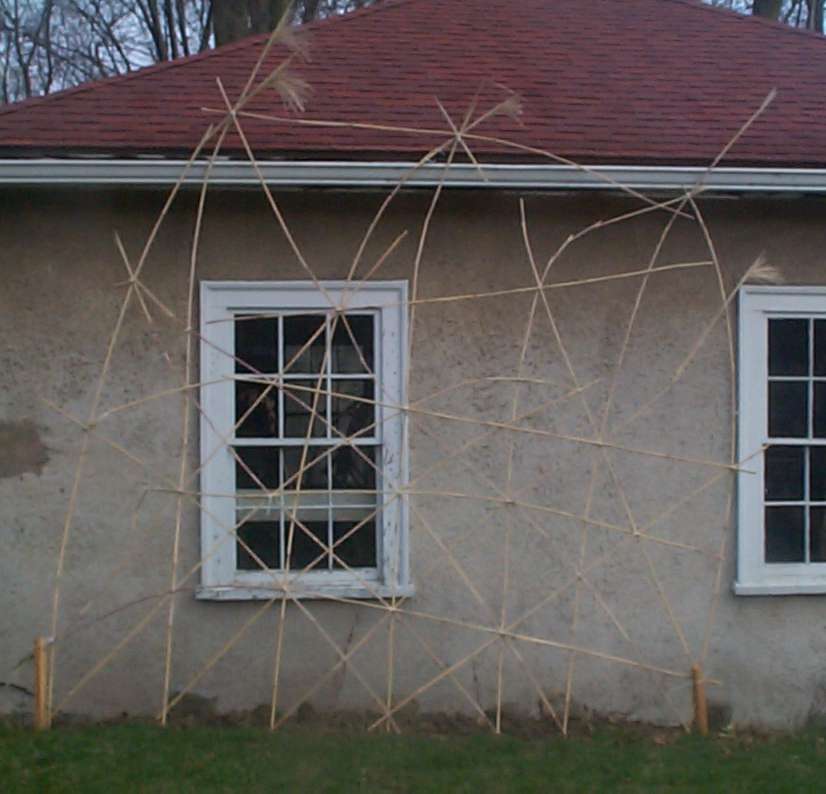
On the whole, given the random length, lack of flexibility and fragility of the stalks, I’m amazed we were able to come up with anything at all. Yes, those are cable ties fastening the thing together. We’re nerds and proud! The structure is sort of pitiful, as if it were built by drunken orcs in World of Warcraft. I’m pretty sure that if they produced something this sad their players would be dunned a dozen experience points for failing so miserably in the attempt. But I like it. Covered in green with little flowers it will look grand. Provided it survives. Which is why we built it early. Better for it to collapse before beans attack it rather than having to disentangle them after the fact.
On the knitting front, I’m just about done with the entrelac socks. They turned out better than I expected.
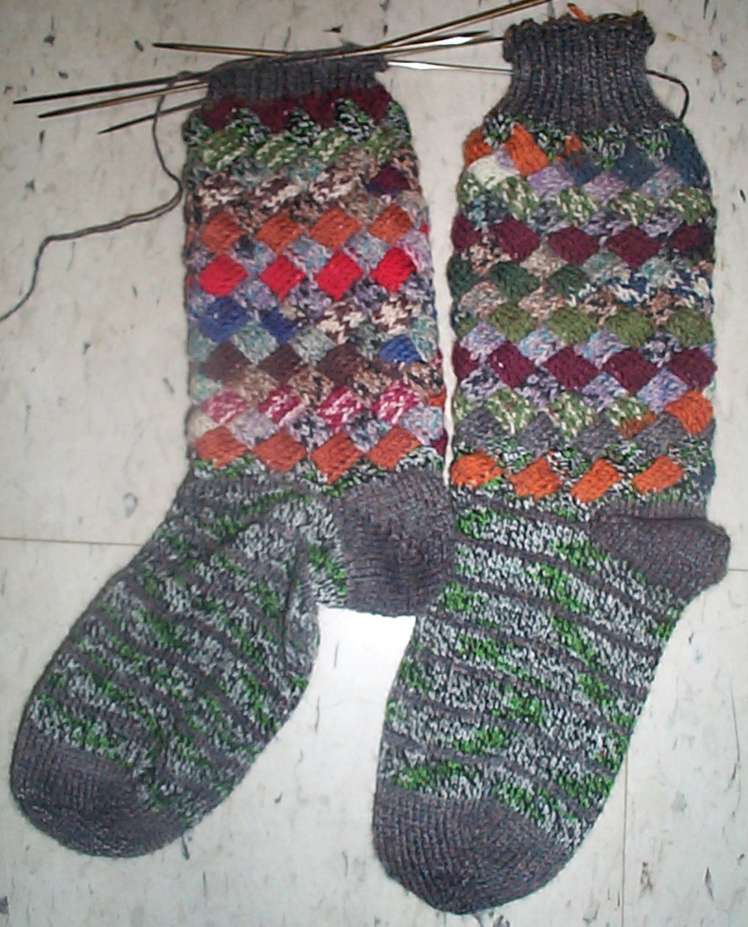
Still a bit motley, but the four colors of leftover self stripers ended up complementing each other, mostly because all of them had green and brown in their mix. In person what looks like bright tomato red in the on-needle sock is more muted. Also, I divided the lot of leftovers into two groups – one that was mostly speckled with few or no solid stripes, and one that had firm solid stripes and spotty bits. The finished sock clearly shows the solids in the entrelac bits worked from left to right, and the speckled yarn in the entrelac bits worked right to left. All in all quite a satisfying project for something starting with such an unpromising quantity of leftovers.
LEFTOVERS FOR LUNCH
I’m not quite sure why – maybe it’s spring doldrums, but I continue to be rather uninspired by knitting. Since I wrote last, I’ve finished two more pairs of socks and am half-way through the third. One of those pairs has already been given away, so no pix are possible but here’s the second rather boring pair:

About the only thing I can say about recent sock production is that I’m trying to use up leftovers and odd skeins. The turquoise in the pair above is old Kroy 4-ply (pre Kroy Sock). The multicolor is a Schachenmayer sock yarn, a ragg blend of spring pastels, mint, turquoise, yellow and pink leftover from a baby project. I had only one 50g skein of each.
The sock on needles below is a more ambitious adventure in leftover exploitation. I save every little bit of sock yarn. You never know when you’ll need as little as a row or two to work a contrasting color stripe. Along the way, larger bits get used up to make baby booties in my favorite pattern –Jane’s Booties by Ann Krekel. But I tend to use mostly the brighter colors and primary colors for the booties. This means that the tangled mass at the bottom of my sock yarn box is disproportionately a large number of tiny balls in browns, greens, and muddy mixes (the in-between parts of self stripers). Since there’s more than enough of those leftovers to do a couple of pairs of socks, and I wanted to reclaim my storage space, I decided to work them up.
Even though I need to use lots of little bits, I don’t like lots of darned ends in the foot part of my sock, so I decided to use some of the larger quantities for the feet. The ankle part however is fair game. The foot is rather humdrum, toe and heel in the same brown, and 6×2 stripes of green and brown. Rather than tons of skinny stripes I opted to do my ankles in entrelac:

I’ve got bits of my brown and speckled green in the ankle, plus odds and ends of three self stripers and a couple of raggs and other prints. Lord knows what yarn labels these were in specific, but likely suspects include Regia Ringel, Schoeller Stahl Fantasia and Opal, all chosen because somewhere in their repeats they included green and/or brown. The second sock will begin similarly with a very plain foot part. Then it will explode into a similar bit of entrelac, although I won’t be using the exact same mix of leftovers. I do have just enough of the first set (most notably the orange and brown) to unite the look of both socks so they end up being fraternal twins.
As for what pattern I’m using – I’m not. These are toe-up socks with Figure-8 toes, worked on 72 stitches around (rather large gauge for me, and quick to knit), with a short-rowed heel. I worked about three rows beyond the heel in the speckled green before blasting out into the entrelac. To keep the ankle a manageable width, I had to do some decreases. Each foundation triangle “eats” 8 stitches of my circumference (k2tog, k1, k2tog, k1, k2tog) to produce patches that are 5 stitches wide. That’s 9 five-stitch foundation triangles in total around the ankle. Then I continued in normal entrelac manner until the sock was long enough. On the last row of half-triangles, I reintroduced the stitches I trimmed out before to restore the piece to 72 stitches. I’m now working my standard 20 rows of plain old k2, p2 ribbing at the top.
One more note. To keep from going nuts, I worked the entrelac patches using “backwards knitting.” I used my usual yarn in left hand Continental method for what are normally the knit side rows, but instead of flipping the work over to purl back on each 5 stitch patch, still holding the yarn in my left hand I used a throwing variant to knit back from left to right. Much more efficient than flipping back and forth a zillion times.
So I guess the moral of the story is that frugality pays. If you save all those small bits you can look forward to some interesting adventures in sock knitting.
 String-Or-Nothing