BLOCKING
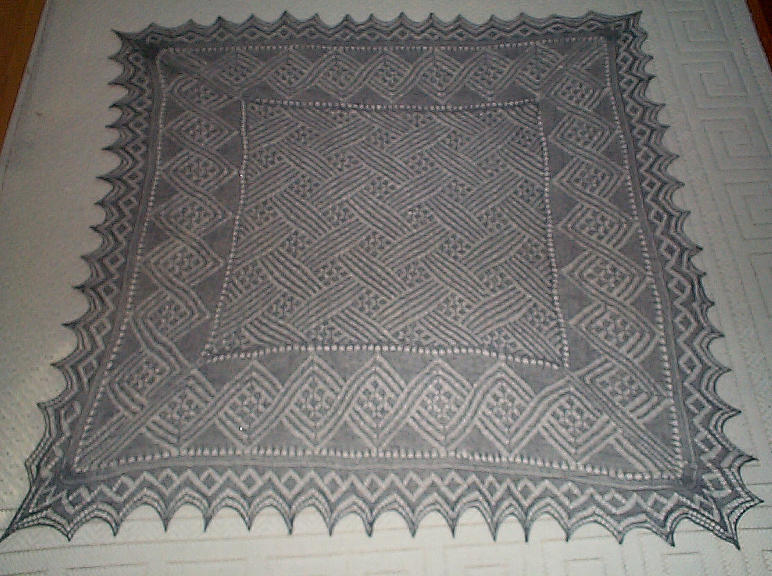
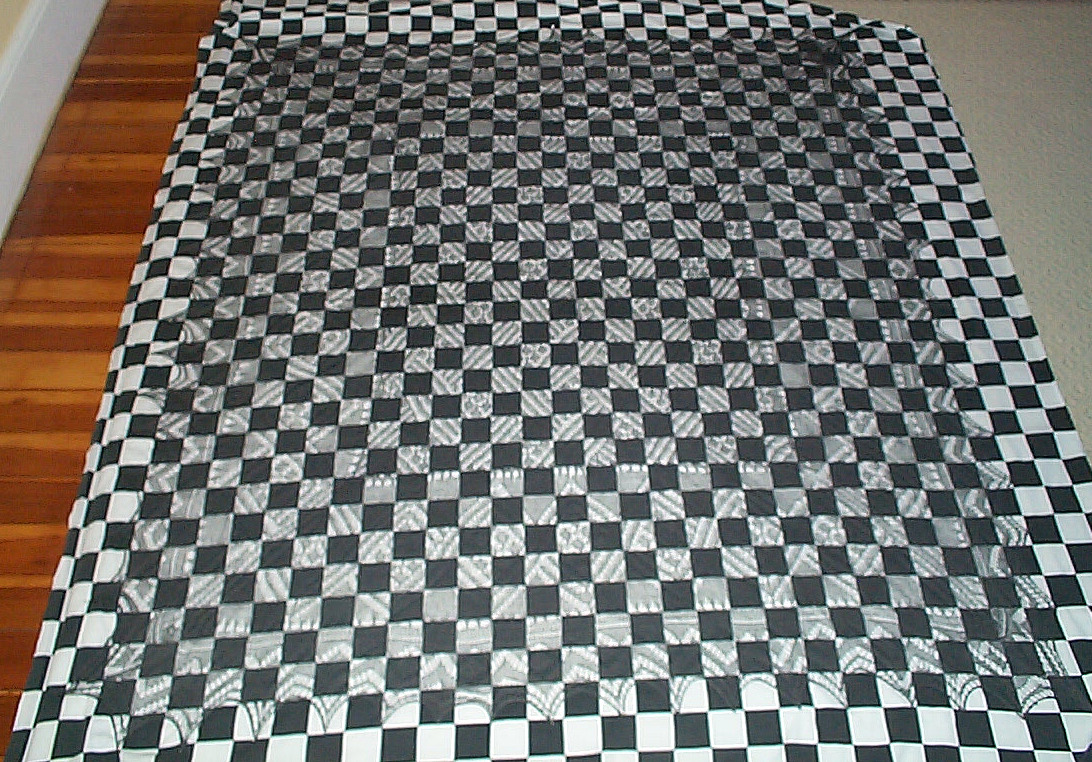
As you can see from the traditional String blurry pictures, the Zig-Zag Baby Blanket is done. Although it’s acrylic, I blocked it out to stretch the lace and flatten out the edging. And I spare you from squinting only at the Peter Max image of the thing mid-block on my checked sheets:


Now you can see what I was talking about in the last note – I took the single zig-zag insertion framed by diamonds as presented in the text, used one column of diamonds as a center “spine” and mirrored another zig-zag on the other side. I also improvised a matching edging adapted from the main design’s zig-zag and quad eyelet motifs. The thing is a square approximately 37 inches across from point tip to point tip – a useful size for a travel or basket blanket, although at tad small for a crib blanket. It’s knit in a DK weight yarn and sports a stockinette gauge of about 5.5 stitches per inch. Stitches used are knit, purl, K2tog, SSK, and YO. If you can manage them and read a chart, you can knit this thing. (While keeping place in the admittedly large chart can be a minor challenge, given sufficient sticky notes or magnetic bars, that problem is very manageable.) If anyone is interested in making one like this I’ll consider writing up and posting a pattern. One caveat – this piece is a gift and will be leaving the house within the next two weeks. Requests made after that time will have to rely entirely on my shaky memory.
Because I had the blocking sheet out and had some room, I grabbed another piece from my done-and-waiting pile and blocked it, too. Here’s Red Doily #3, knit last year, pinned out and presented done (but with some ending off still on the horizon)

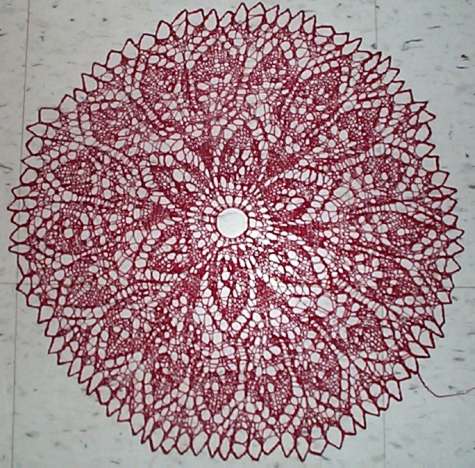
To embarrass myself, I went back through blog archives looking for when I knit this third red doily but didn’t find it. I think was knitting this piece back in the fall of 2006, and it has been sitting in the blocking pile ever since. That’s so long ago, I’m not sure where the pattern is from, but I think it might have been from Patterns for the Art of Lace Knitting: The Complete Works of Rachel Schnelling, compiled by Gloria Penning.
Only three more items in my to-block stack…
ZIG ZAG BABY BLANKET
Still not much time for knitting around here, but I did get to finish off my doodle lace scarf (pix when I get a chance to block it), and do up a quick baby blanket.The blanket is still in process, but I’ll be posting more details of the finished pattern here if people are interested. I’m also still chugging away on the Kyoto for Elder Daughter. I’m about a third of the way through the sleeves. All that remains is to finish off the sleeves, piece the thing together and knit the collar strip.
On the new blanket – I am still enthralled by my Duchrow trilogy, so I went trolling through the pages of those books looking for candidate strip and coordinated edging patterns to do up in a large gauge yarn. Large for me, that is. I found something interesting in Knitting Patterns of Christine Duchrow, Volume 1 on page 30 – a large zig zag. The zag is shown as one big Z shaped insertion, framed by two columns of diamond lozenges, pierced with eyelets. As printed, the one repeat edge to edge is 63 stitches. I decided to toy with it a bit, using one column of diamond lozenges as a centerpiece, framed by symmetrical repeats of the zig-zags. At my gauge of 5.5 spi the framed zig-zag made a nice size for a small basket/car seat type utility blanket. To finish off the piece, I scaled down the edging featured in Duchrow, eliminating the extra column of lozenges, opting for one fewer side to side zig-zag elements. For those of you who are still wary of charts, doing something like this with a knitting pattern written out in prose is a relatively difficult exercise. Editing down a charted edging is easy. Slap two sticky notes on the thing, one masking out unneeded vertical columns, and one to keep one’s place row by row, and (provided you’ve not cut off the inception spot where the entire thing is narrowed or increased – you’re good to go. (Let me know if you want more details on this.)

The picture shows the edging, plus one half of the blanket, from the edging to the line of lozenges that form the center. The big zig is mirrored on the other side of that center spine. It’s bundled up snood style because I’ve picked up stitches all the way around the perimeter, using two circs; and am now knitting the edging onto the body. I’d estimate this piece so far (center plus one side of the edging) has taken me about six actual hours of knitting time, spread over two weeks, which for a lacy blanket is pretty quick, even given my dismal work schedule.
As to what I’ve knit this piece from – I’m not entirely happy with it. I’m working at consuming some of the yarn that I have here in the house. A dear friend of the family recently gave me a huge bag of mixed acrylics that she had accumulated from yard sales and flea markets. It included a number of skeins of 1993-vintage Lion Jamie Pompadour. It’s marked at 20 stitches and 28 rows = 4 inches or 10cm. I’m getting DK standard gauge of 5.5 stitches per inch in stockinette on US #7 needles. While it does knit up quickly, I’m not that pleased with the feel. It’s a Sayelle acrylic with a shiny rayon binder strand. The feel is rather spongy and a bit plastic like as opposed to woolly. The drape is relatively stiff given the yarn’s density and weight. Still, yardage per skein is high, it’s not itchy, it is machine washable, the color is pleasant if you like baby pastels, and having been stored well over the years none of the yarn is discolored, snagged, stained or smelly. I’ll probably use all of my inherited skeins for baby blankets for people I know might not have the time or inclination to hand-wash. For the record, the center of the blanket took a few yards more than three full skeins of Jamie- I’d estimate it as having eaten about 525 yards. The edging along one long side has taken a little over 3/4 of another skein. Final consumption figures will be forthcoming when I’m closer to the end.
MORE DOODLING – DUCHROW HEART EDGING AND MITERING A CORNER
Yet another spate of horrific deadlines has washed past me. I survived (barely), but I haven’t had much time to knit.
I’m still working on that second lace doodle scarf – the one composed from patterns out of the Duchrow books. (Which I wholeheartedly recommend for lace fanatics.) I’ve finished the center panel, and have applied the edging down one long side, around the narrow end, and am now starting back up the second side:
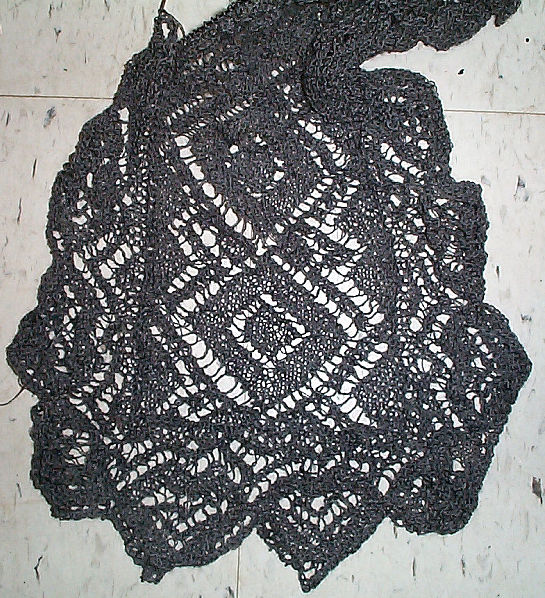
The edging in this case is a bit unusual. It’s predicated on motifs that are somewhat heart-shaped, and sports a very deep dag. I managed to fiddle around with the attachment rate so that I ended up at the corner of the body at the exact narrowest point of the edging repeat. That let me miter the corners using short rows. I wish I’d stopped and taken pictures of that process, but I’ll try to explain it sight-unseen.
To miter the corner on this symmetrical lace, I knit this edge onto my main body piece, either directly calculating the pick-up ratio, or (more likely) fudging the rate of attachment so that I ended with my narrowest row (the valley between two points) at the exact corner stitch of the corner I wish to go around. Sometimes this is easy – if I’m a stitch or two off, those can be made up in the last repeat just before the corner. If I’m more than just a couple of stitches off, I might need to rip back a repeat or two and space the required extra rows or skips (or k2togs) over a larger interval. Obviously, it’s easier to fit an edging with fewer pattern rows into any given arbitrary length than it is to fit a longer one, because there are fewer rows between the widest and narrowest points of the repeat.
Back to actual performance. Arriving at the narrowest point of my edging in concert with reaching the absolute corner of my piece, I’d knit the next right-side row of my edging as usual. BUT on the return journey instead of working all the way back to my attachment point, then purling the last stitch of the edging together with one from the body, I’d wrap that attachment stitch (Row 2, Column A). Then I’d turn the work over and head back on the next right side row, taking care to keep my place in the edging pattern. I’d continue like this, but on each successive wrong-side row, I’d work one fewer stitch, and wrap the next one prior to turning. All of this is complicated of course, by the increases and decreases that form the lace pattern itself. Liberal fudging is usually in order to maintain the pattern as established – or a close to it as is possible.
Eventually I’d reach the row that on a “normal” repeat, would be the longest row – the one that happens in the centerpoint of one of the protruding dags. My actual row worked is much shorter than usual because I’ve been wrapping stitches to form my miter. It’s at this point I go back and begin the second half of my short row sequence, working each row one stitch farther along, waking them up one by one by working them along with the wrap at their base. If I’ve done this correctly, by the time I have reawakened all of the stitches on my row, I’ll also have arrived at the narrowest row of my lace edging repeat, and all of my previously parked short row stitches will have been reincorporated. When that happens, my mitered corner is complete, and I can I begin resume working the edging along the side of my piece.
I’ve taken the liberty of translating the historical pattern from Duchrow into modern notation. She doesn’t present a mitered corner for this edging, but I’ve noted where the short row shaping should take place so you can see (more or less) what I am writing about. Click on the image below for a full size pattern. Apologies for the file size.

HOCKEN SHTEINER
You know your life is chaos when you look at a two-hour school opening delay due to snow and say “Great! I finally have a chance to update the blog!”
Life here has been subsumed to work, right through the Thanksgiving holiday. We managed to cook and serve a great meal, and enjoy the company of old friends, but after that it was back to what my grandmother would call “hocken shteiner” (Yiddish for breaking stones ). I’m weeks behind in holiday shopping. We haven’t a candle or a potato in the house for Hanukkah, and my annual cookie fest hasn’t even hit the planning stage yet.
But for all of that, little bits of knitting have happened. Not any of the gift socks I’ve promised this year though. I will most certainly be visited by Franklin’s Ghost of Christmas Knitting this year. But I can report some small progress.
First, on specific request, I’ve begun Knitty’s Kyoto for Elder Daughter. But I’m working it in a DK weight tweeded alpaca. I’m using Grignasco Top Print in color #29974 – a ragg type mix of soft antique pink, pale turquoise, lavender, apricot, pale brown, ecru, and sea green. The “distance read” on it is sort of fallen cherry blossom, somewhat pink/lavender with a touch of pale brown, with the natural streaks imparted by the ever changing tweed.
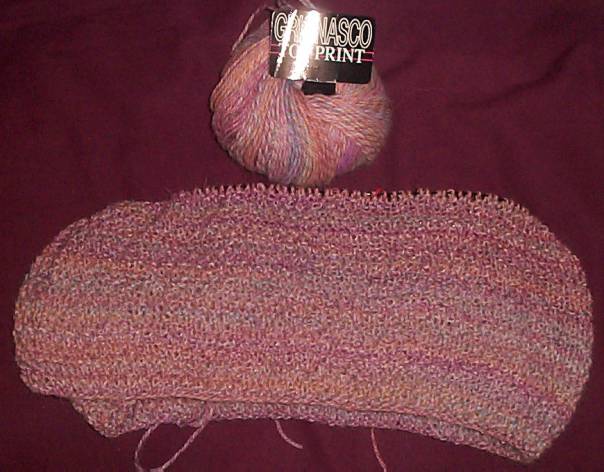
Gauge is hard to get with this stuff (I agree with the review posted in the yarn review collection, above). The label reads 30st x 38 rows = 4 inches/10cm on #3.5-4mm. I’m getting 19 x27 with #5. The pattern gauge is 20×27, so I’m making some small adjustments. Also, this is the most incestuous yarn I’ve ever used. It comes in evil mushroom puffball style 50g balls. The yarn is so soft and supple that it falls off that put-up at the slightest provocation, and so surface fuzzy that it twines around itself and sticks given any opportunity at all. With that level of fraternization in the bag, I’m surprised that reproduction hasn’t occurred and that I still have only 14 balls.
The other bit I’m working on is a second doodle scarf, using two more stitch patterns from the Duchrow series. That’s done in some of the leftover from my big woven diamonds shawl. It’s not exactly zipping along, given the complexity of the pattern and my limited knitting time, but it is progressing. I’ve finished the center strip, picked up all the way around the outside, and I’m on adding the edging.

A YEAR LATE, BUT NOT FORGOTTEN
You can always tell when Life overtakes Discretionary Time here. Blog entries dry up. Lack of time means less knitting. Less knitting means that I’ve got no interesting things to write about. The past couple of weeks have been dense-pack. The next few bode to be that, plus havoc. Apologies for the silence.
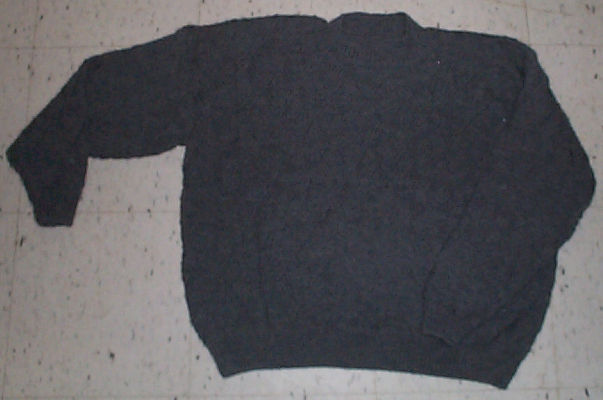
In the mean time, while I haven’t had time to be very productive, I have been able to dip into the stash of to-be-finished projects, polishing off a couple of pairs of socks, and blocking and seaming up my ribbed leaves sweater.
To recap since I started the project about a year ago, this one was done from a commercial pattern by Sarah James. I used Jaeger Matchmaker yarn, with excellent effect. The yarn was soft and lofty, especially for a machine washable wool. I suspect that given the structure and twist of the yarn it will resist pilling a bit better than other more softly spun Merino wools. Matchmaker was a perfect choice both for this project, and for any highly textured project requiring a DK or heavy sport yarn with good stitch definition. I’d use this stuff again in a heartbeat.
I found no flaws in the pattern at all, and my finished sweater ended up being 51 inches across – just a smidge wider I believe than the suggested final measurement, but close enough not to matter for fit. I elaborated on the pattern in a couple of very minor ways – adding both tubular cast-ons, and matching tubular cast offs. I enjoyed this one immensely, although I have to caution that if you’re not a fan of left and right twist (1×1 cables) you’ll hate this with a passion, because the entire texture design is formed by twists over the whole surface.
And proof positive that I’m done – the traditional String or Nothing blurry and indistinct photo, showing very little beyond a finished object in silhouette:
And a slightly better detail shot showing the stitch texture pattern:
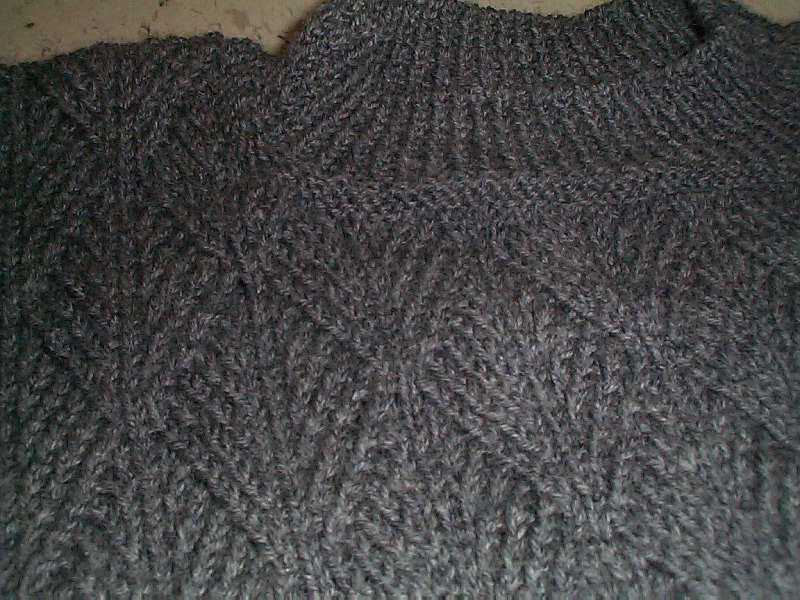
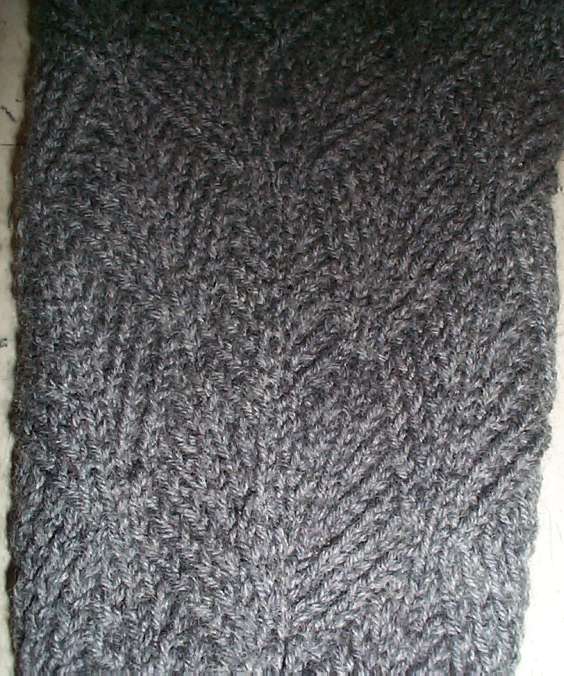
And one showing a nice mattress stitch seam in the texture pattern, done on the increase area of the arm, where the sleeve widens from cuff to shoulder:
If you want a full blow-by-blow recap of this one, it’s indexed at the right as “Project – Ribbed Leaf Pullover.”
WHISTLING DEMONS AND BLACK LACE GLOVES
For your holiday themed enjoyment (and because I’ve been stacked with precious little knitting time of late), I present our very own whistling demon. This candid of Younger Daughter is courtesy of a kids’ Halloween trick or treat party hosted by my employer, and the clever camera of Ms. L. Smith:

Elder Daughter however has more elaborate costuming in mind. She loves the black lace doodle scarf, but wants to complement it with black lace fingerless mitts. Never one to back down from a challenge, I’ve been playing with the concept – flying without a pattern, but as you can see – not without a black lace net.

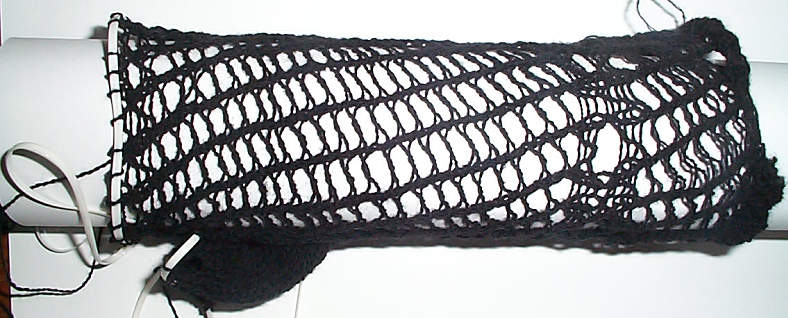
Left is the thing patted flat, right is the mitt stretched out a bit on a roll of paper. I began at the cuff with a provisional cast-on, then worked a fused picot hem (barely seen here). I continued in pattern, with a mega-eyelet band after I’d done a bit of cuff. I might end up threading a wide ribbon through those eyelets – or not, depending on the bespeaker’s preference. The thumb gusset is done entirely in stockinette, and both the thumb and the top are also finished off with a picot hem, although on the cast-off row, I’ll need to take a tapestry needle and stitch down the live stitches now stowed on the white cord, cast-off fusing being a bit too fussy for the inside of such small spaces. I don’t know if anyone is interested in a stitch by stitch pattern. If so, I’ll consider writing one up from my notes.
The white cord itself is a handy tip. It’s plastic lanyard string (aka gimp or boondoggle). I’ve found it to be quite handy for provisional cast-ons, and as a flexible stitch holder for exactly this purpose. It’s stiff enough to make threading the stitches onto it easy, can be cut to any length, and it’s very inexpensive, especially if you scoop up a spool in an unpopular color from the craft store’s discount bin.
DOODLE SCARF – FINISHED
My doodle scarf is done. Blocked and everything. It ended up being about 16 inches across and just under nine feet long. I ended up using a variant of the double YO “Dewdrops” edging (found in Sharon Miller’s fantastic Heirloom Knitting) instead of the item that prompted the last two posts:
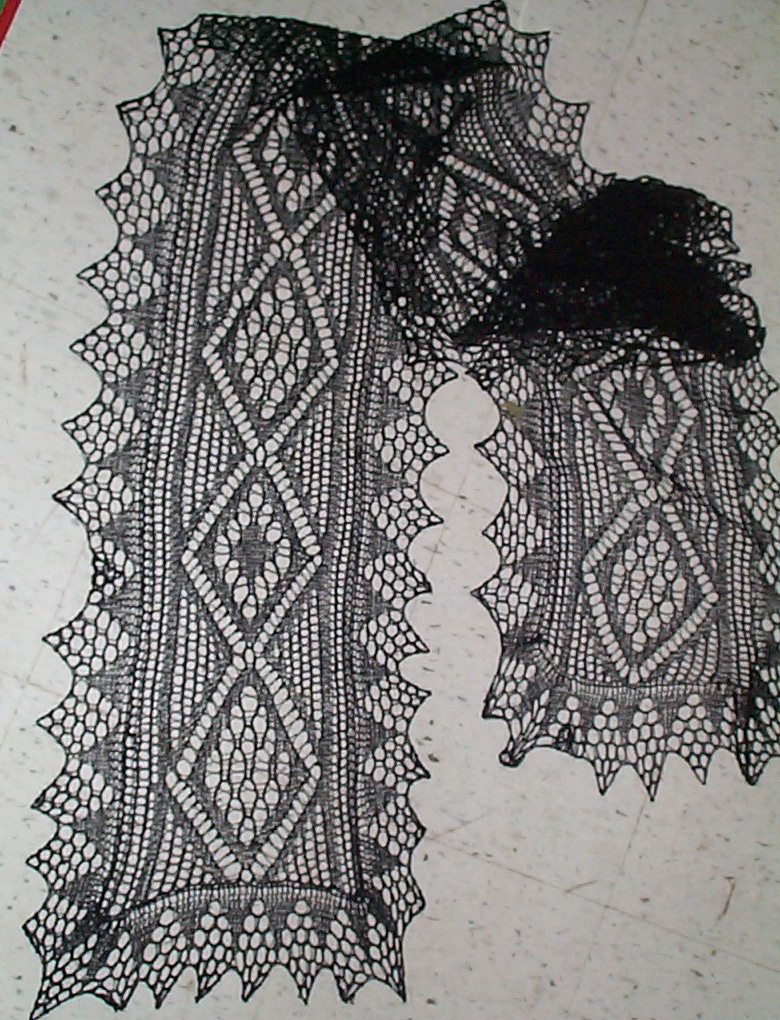
I also played with the main diamond motif – alternating ones with the full pierced centers with ones that filled in the center-most four diamonds. I chose the edging because the structure replicated the mesh in the pierced diamonds. I also took the lazy way out on the corners. Rather than calculate the miter, I just went around the edges, doubling up on my rate of attachment to make enough fullness to ease around the 90-degree angle. Elder Daughter has poached this one for her very own. But (to quote someone I ran into in the airport while I was working on this last week). “You’re a sneaky parent. How much of a Goth air can it provide when the wearer has to ‘fess up that “My mom knit it for me” whenever she’s asked?”
I’m thinking of doing matching fingerless mittens – something relatively long, perhaps between matinee and elbow length (that works out to mid-forearm, for those of you too young to remember formal gloves), with the pierced diamond motif on the back of the hand. I’m pretty sure that Elder Daughter would swoon for those. Especially if I can get them finished before Halloween.
In a somewhat related topic – yesterday’s post brought a comment from Lace Goddess Nurhanne, she of Yarn Over. She’s got the original book that the edging I’ve been posting about is from, AND she can read German. She says that I did miss something in the accompanying text. Her comment read “I don’t have the Lacis book, but an original 1921 copy in which the accompanying text instructs you to work even rows 2-16: yo, k to end with k1p1 in double yo. Even rows 18-32: k2tog, k to end with k1p1 in double yo.”
I had posited the “make it up on the wrong side” method back when I began experimenting. It looks like the original pattern took that approach. I need to experiment though to see if adding/subtracting those stitches at the leftmost edge (the beginning of the row for even numbered/wrong side rows) works. But I am a bit leery of that approach. I think that putting adds/deletes there will interfere with the patterned repeat, but I’m willing to try it out. I’m tickled to have another opportunity to learn something new. Especially if I’m sitting chela at the feet of someone who really knows this stuff.
ADVENTURES IN LACE – CORRECTING HISTORICAL LACY KNITTING PATTERNS
First, let me reassure everyone that it’s not my intent to supplant the need for the books I’ve been using lately. I strongly recommend that people interested in lacy knitting buy them, and have as much fun learning to knit from them as I am having. But I also realize that it’s very daunting for many people to think of picking up a book in a language they don’t read, that uses an unfamiliar symbol set, and that can be full of unexpected differences from modern knitting logic (to the point that would be thought errors in modern books.) Mining these older works for usable ideas is a form of Extreme Knitting* – one that I want to encourage more people to try. I hope these posts help bridge some folk over to beginning their own explorations.
For example, here’s another lace redaction problem that turned into a paddle in the lace design pool.
I intended to finish out my black lace doodle scarf with an edging appearing in the same book as the insertion strip I modified for that scarf’s body. But the graph of the original isn’t quite logical, especially when compared to the engraving of the finished item. The edging I originally intended to use is on page 12 of Knitted Lace (Kunst Stricken) by M. Niedner anf G. von Reden (edited by the Kliots).

If I flat transcribe each of their chart symbols into modern notation, I get the chart in the diagram below (click on it to make it bigger).

Although the chart looks good, it’s not knittable. Not if you want to make an edging that looks like the one in the engraving. Why? Look at each graphed row. If you count up the increases (the YOs) and the decreases (ssks) you quickly find that there is an equal number of both in each row. That’s perfect if you’re doing a straight insertion with parallel sides, but this is supposed to be a dagged edge that grows and shrinks to make triangular points. In order to achieve the ragged left edge indicated the stitch count should increase or decrease each row. But you say – it does! The little points are being formed. MY point is that there is no indicated origin for those extra stitches. For Row #3 to have one more stitch on it than Row #1 as shown, there should have been an increase without an accompanying decrease on Row #1. Otherwise that stitch just appears **poof** without a logical point of origin.
Now, if we want to knit this edging, we need to add that missing stitch. In fact, if you look at each and every line of the pattern you’ll see that there’s either a missing increase or decrease on each illustrated row. We need to put them in.
There are several ways to make those corrections. The simplest is to leave out one strategically placed decrease somewhere on the “growing” rows (working the two stitches involved as plain knits); and to introduce one somewhere on the “shrinking” rows (working two stitches shown as being knit as a decrease). Another fix would be to make up the differences on the interstitial even numbered rows. A third method would be the most noticeable – incorporating the corrections as visible additions to the pattern, in effect, editing the pattern to introduce new eyelets or decreases to form a new design element.
Now. Where to put them? Again looking at the original graph, you’ll see that the only area that changes is the part I marked in blue on the original chart (the original didn’t differentiate these stitches in any way). Other than growth/shrinkage in that triangle area, the pattern is stable, alternating between two design rows – the unshaded area shown on Row #1 (repeated on 5, 9, 13, 17, 21, 25, and 29) and the unshaded area shown on Row #2 (repeated on 7, 11, 15, 19, 23, 27, and 31). Obviously all of our edits will have to take place within the blue shaded area. Even with those edits, the heavy reliance on only two pattern rows means this will be an easy pattern to memorize once we’ve noodled out the missing bits.

I began experimenting, although I fizzled out along the way, having lost enthusiasm for using this particular trim. But I did produce a workable solution. It relied heavily on the original chart, modifying some of the decreases on the growing rows and adding some on the shrinking rows:

As you can see, while my yarn choice for this swatch isn’t optimal (something lighter would conform better and shape itself more fluidly up and over the triangle’s point, it did work. It also looks pretty close to the original. But not spot on (more on that below).
I tried mightily to make the mods on the off-side rows piece work. In theory it sounded feasible. It would have worked, had there not been the flower-like quad eyelet structure in the point of the base triangle. Adding/subtracting stitches at the right edge (the straight edge) perturbed the placement of the eyelets and lost the symmetry of the feature. Putting those additions/decreases elsewhere by adding/subtracting stitches along the pointed edge of the base triangle produced a clunkier, more clumsy finished product than did working them in on the right-side row.
I have to admit, I didn’t bother with the increases as a decorative element step. To do that I’d have had to widen the pattern as a whole, and introduce a YO after the slipped stitch on each odd numbered row. On rows 19-31 I’d have had to follow that YO with a double decrease (removing one stitch to compensate for adding the YO, plus the one stitch needed to shrink the base triangle . Contemplating the result of the second scenario above made me think that this arrangement would also run afoul of that quad eyelet flower. Between that and realizing that this pattern wouldn’t be a good compliment for the design of my scarf’s body – I ran out of enthusiasm to keep fiddling with it.
Oh. The final straw? Examining the pattern chart, the engraving of the pattern and my knit sample, and realizing that the chart as shown (and that I knit – more or less) wasn’t the same as the engraving. That clearly shows four courses of eyelets, not three, plus two rows of crocheted picots. The picots I can forgive, especially since I can noodle out just enough of the blackletter-style German text to determine that instructions for it were included in the prose. Here’s the chart for my successful result, plus a posited modification to produce the four-course pattern shown in the book’s original engraving. I haven’t actually knit up the lower chart yet, but it should work.

I’ve run into these problems several times in these older pattern collections – both the lack of correspondence between chart and illustration of the final product; and basic charting that doesn’t produce the desired result. I’ve found it’s always a good idea to proof the rows in a pattern – especially one from a historical source – before sitting down to knit, and if knitting from an unproven vintage source, to always swatch up a repeat or two before committing oneself to a full project in any given stitch pattern.
Oh. What did I end up using on my doodle scarf? More on that another day.
*Extreme Knitting – A mythical book I long for instead of what’s on the shelves now. A compendium of highly challenging patterns in lace, colorwork, garment shaping and tailoring, tiny gauges, historical recreation/redaction – whatever, so long as each project is as magnificent and as timeless to wear as it was an inspiration and learning experience to knit. I hereby reserve this title, but will surrender it to any author who can prove his/her work meets these conditions.
WOVEN DIAMONDS – RUFFLES ON A POT ROAST?
Shawl. Unpinned, spread out and patted flat. My final size prediction was spot-on.

As you can see from the before picture – blocking lace is A Good Thing.
Now only one challenge remains. Where the heck would I wear such a thing? I’m not a shawl-wearing type person. They tend not to go with work boots, jeans, and polo shirts (my standard uniform). Which is the origin of today’s title. Name for the shawl itself? “Woven Diamonds” has been suggested.
It has also been suggested that I publish a real pattern for Woven Diamonds. I’ve got working notes and I’ve already charted the stitch designs, but writing up a full pattern would be a challenge. For example, describing how to fudge the ease around the corners on the edging, or how to do the final graft – neither would be easy. Given that I wouldn’t recommend this as a first lace project, I’m unsure how much previous lace experience I would have to assume any knitter would have.
Would you make such a thing? What level of detail would you need in a pattern?
SHAWL BLOCKING
I stole a bit of time today to get my brown/gray shawl pinned out and blocking. Lace is INCREDIBLY stretchy – or at least if knit from a good wool, alpaca, or other animal fiber – it should be. Here it is in an optically challenging presentation thanks to the rally check sheets I use as an alignment aid:

The checks make it very hard to see, but you can make out a bit more of the pattern now in the detail shot. I promise more pix tomorrow, and I’ll take those on a plain white background.
Now how stretchy is lace? My unblocked piece was approximately 39 inches across. See those checks? They’re 2 inch squares. My shawl is pinned out to be a square of approximately 60 inches on a side. My guess is that it will spring back somewhat after it’s dry. I’ll probably end up with something closer to 54 inches on a side (about 4.5 feet across).
We also made significant progress on the final stage of our bathroom renovation this weekend. Here you see The Resident Male exercising his inner artist. Before you write to me with safety tips, please note that we’ve got about 2 inches of closed cell camping mattress pad topped with another layer of bath towel underneath the no-slip tarp in the tub. The ladder is stable, and won’t mar the surface beneath its feet. Plus the ceiling is so low that no one has to climb above the second step to reach it.

As to the color – I don’t know if you can make out the difference given the variability among monitors, but the ceiling is bright white, and the walls are barely green. Not mint, not pistachio. Think three gallons of milk with one drop of food coloring. It’s my hope that they will contrast nicely with the white tile underparts and fixtures, echo (just barely) the green tile accent stripe, green stone sink top, greenish tint of the glass shower door, and make the green (rather than the yellow) in the stained glass window pop out more.
Even though it’s shrouded in protective plastic, you can see that the refinishing of the window and its replacement in the wall have both accomplished. A special merit badge for chemical management (with scrapers rampant) to he who did that work. Goodbye ugly mustard yellow enamel paint! And good riddance.
Comments Problems
We’re having intermittent problems with the comments feature that screens out automatic postings. Sometimes if you go to enter your comments the little “type what you see here” box isn’t displaying. If you want to leave a comment please scroll down and make sure that you can see that box before you begin typing. If it’s not there, try reloading the screen. We’re not quite sure what’s happening, although we’re working on it. When he’s not elbow deep in brushes and rollers, The Resident Male (website plumber par excellence) is busy applying his biggest software wrenches to wiseNeedle’s pipes. Apologies for any/all inconvenience.
 String-Or-Nothing