JUSTICE (AND KNITTING) FOR ALL (ALSO WORKING REPORT-LACY SCARF)
Yesterday’s visit to the halls of jurisprudence was at the same time, quite dull and quite interesting. Although I was not among the impaneled and got to leave early, watching the process up-close-and-personal was enlightening. I metthree other knitters among those waiting in the jury pool, and got lots of edging done in the hours I sat there:

Two of the people I chatted with were quite nice. Both were women who had knit years ago and who were thinking of getting back into it after reading that the hobby has grown in popularity. Both mentioned "fancy scarf yarn," so I’m guessing that the scarf craze hasn’t exhausted the pool of late adopters yet.
The third was a pain, a pest, an annoyance, and I spent part of the morning trying to dodge her. The problem was that she insisted that what I was doing couldn’t be knitting. It was crochet because it was white, lacy looking, had holes, and wasn’t being worked on long needles with buttons at the ends (I was using two DPNs). After all, everyone knows there’s no such thing as knitted lace.
She wandered over and gushed a bit. I kept working, giving short but (mostly) patient answers. "Gorgeous crochet!"
"Thank you. It’s knitting, not crochet."
"It can’t be. It’s crochet. I can tell."
"Sorry. As you can see, I’m knitting."
"Thats not knitting. I know knitting and you aren’t doing that.
You’re making holes. You NEVER make holes in knitting.
It’s wrong. This is crochet. Don’t tell me what I know."
This went on and on, all in a voice that the entire room could hear. I excused myself, picked up and resettled in another waiting room. After a little while my tormenter followed, commencing whereshe left off. I moved again. She followed. I was ever so grateful when they announced the lunch break. I watched to make sure she left the building, then popped down to the cafeteria for a stale tuna sandwich and a half-hour of relative quiet.
On the edging, I’m about 85% sure that I won’t run out of yarn. I’m also not entirely pleased with the two corners. I did try to miter them, but wasn’t able to manage it in the face of constant interruption. They are more or less symmetrical in stitch count and pattern iteration, but they look clunky to me. I’m also not entirely sure that this project will be successful enough to make it to the write-me-up-for-wiseNeedle stage, or to deserve a name other than its current generic descriptor. So it goes.

If any lace mavens out there can offer up advice (or sympathy for ripping back), I’ll listen with eyes wide.
WORKING REPORT – LACY SCARF, FULLED PILLOW II
I continue to make progress on my two at-hand projects.
Lacy Scarf
I finished the center strip of the lacy scarf on Saturday night. The center strip took almost one entire skein of the hand-spun lace weight Merino. That rate of consumption put the last stake in the heart of my first choice of edging (with minimal modifications). I did’t think I would have had enough yarn to do one that wide.
So as I predicted, it was back to the drawing board. I spent my knitting time on Sunday and Mondaymessing around with stitch dictionaries bothhard-copy and on-line, usingthe little bit of yarn leftover from Skein #1, swatching out possibilities. Disappointment. Overall, I felt like a cable TV viewer – I’vehad hundreds of choices, but nothing to watch.
I started with several possiblities from books, then tinkered with them. I even drafted up a couple ideas from scratch.I wanted to use diagonals and/or diamonds to mirror the motifs on the scarf end. The thing should be rather demonstrative as the bulk of the body is so plain. I neededmy edgingto be no wider than 12-14 stitches at its widest point. Asawtooth or point detailwould make going round the corner easier.
After extensive fiddling with dozens of patterns (enough to actually wear out my short length of practice yarn from all the knitting up and ripping back), I cycled back to my original pick.It had the best combo of diagonals and I liked the balance of opage to openwork areas. All that effort wasn’t lost though. What practice did do was give me a better feel for how patterns can be changed around. My initial efforts at modifying the pattern book original were pretty tame – taking out a small insertion detail. This last time I chopped it right in the middle of a vertical pattern element, narrowing the thing down by half. As you can see, it’s working:
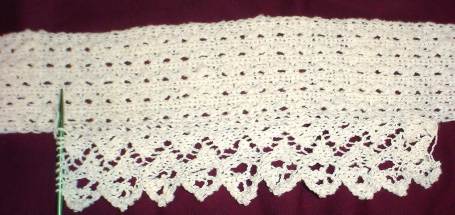
Stitch counts on the eding range from 10 to 15 (the body by contrast is 27 stitches wide, butbecause it’s a ribbing, it looks narrower than that).
To attach my edging, I’m using the same pull-a-loop method employed in the Forest Path Stole. It’s fussy, but it makes a very airy join, with no heavy column of attachment stitches. I will work from the point shown, rounding the first corner to the center of the end. Then I’ll weigh my remaining yarn. That should give me a handle on yarn consumption. If I’ve used more than a quarter, I’ll rip back and slash another three columns from the edging’s repeat, then begin again.
Fulled Pillow II
The fulled pillow went through five wash/tumble drycycles over the weekend, keeping company with the family’s regular laundry. I didn’t expect much in terms of total shrinkage. I’ve used this yarn before and it takes quite a few tries before it’s sufficiently de-lanolined to full.
It did start to fuzz up around Wash #3. I can still see garter stitch ridges, but the individual stitches are getting harder to spot. The pillow has also begun to get denser, and a small bit of shrinkage has occurred, but it’s not worth photographing yet.
Original dimensions were 26 x 14 inches (66 x 36 cm). Right now it’s roughly 23 x 13.5 inches (58.4 x 35 cm). I do note that the yellow stripes account for about half the shrinkage so far. The blue and green ones haven’t tightened up as much. I’ll keep washingthe pillowuntil I’m satisfied but as laundry is only done on weekends, you won’t be hearing about this piece again until next week.
WORKING REPORT – LACY SCARF
Thank you to everyone who wrote to say that they liked the level of detail in these posts. I blush a bit. I’m writing a blog that I’d find interesting to read. But my mom’s main point is taken – not every post need be essay length. I’ll try to make things a bit more readable, perhaps splitting longer thoughts over two or more days.
Lacy Scarf
I ran into a temporary snag on the lacy scarf pattern, but I think I’ve beaten the problem.
I chose a bunch of texture patterns thatI thought would lookgood together. Lots of play among them on diamonds and sharp diagonals. My idea was to knit a pattern panel at each end of the scarf, and use a simpler, coordinating pattern between them for the scarf body, with the entire piece trimmed with a killer edging.
I drafted up my patterns, and swatched each one. Here’s where the mistake came in. I’ve got**just enough**yarn with no chance of getting more, so I swatched each pattern in turn by itself, ripping back and re-using the yarn between swatches. Each looked great on its own, so I cast on and began the piece as a whole. End pattern #1 worked fine. The welted eyelet divider looked fine. But the simpler plain diamond pattern for the scarf body was wrong, wrong, wrong. The proportions of the diamonds just didn’t fit the proportions of the end pattern. They fought, and the piece looked way too busy.
So in a Wile E.Coyote moment, it was back to the drawing board. I decided to go with a contrasting pattern/texture. I had played with the rick-rack rib stitch in the Zen scarf pattern. It looked nice enough in a large gauge, but the texture didn’t really come out. I decided to play with it some more. I separated each column of the zig-zag by a column of p1, k1, p1. I like the look and I think that it’s enough different from the first panel to stand on its own:
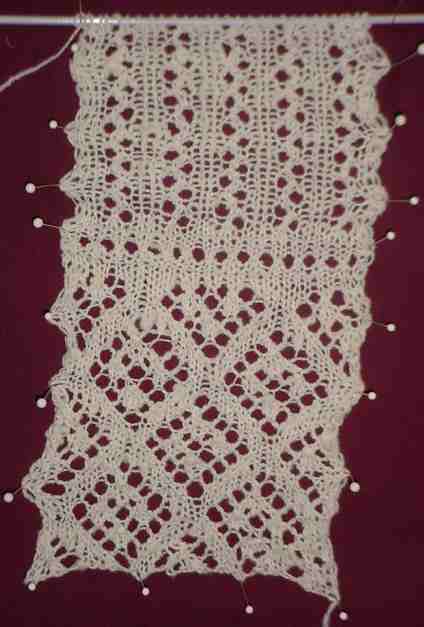
Thinking on the edging I’ve graphed out, I think am going to have the same problem. I’ll scout around today to see if I can find something narrower that has a coordinating presentation.
The yarn is wonderful. It’s a hand-spun super-soft Merino wool, labeled as laceweight, but actually closer to fingering. (I’ll add a yarn review after the project is finished and blocked). It’s fromGreenwood Hill Farm, asmall producer here in Massachusetts, and is my souvenier from this year’s Gore Place Sheepshearing Festival. It’s a rustic-looking two-ply yarn in that there are thick and thin/tightly spun and looser spun, fluffysections on each ply. This makes a very informal feeling bit of lacy knitting – snuggly rather than crisp. (You can see some o the slubby, puffy sections in the piece above – look at the top corner of the top leftmost diamond.) It knits up evenly, there’s none of the kinking back on itself I’ve found in some other small-production hand-spun yarns. One minor annoyance – there was quite a bit of tiny, sharp vegetable fragments in the first third of my skein – about one thorn or spriglet every two inches. I understand the logistical problems/economics ofwhy these shards remain.I don’t expect this type of sheep-to-knitterenterprise to produce pristine yarn; but it’s a minor pain to keep the tweezers on hand to pull out the stickers as one knits. In spite of the rustic look and occasional tiny thorn, thisyarn slides like butter and feels like a cloud. It’s the absolute poster-child for non-itchy natural Merino. I’ve got about 400 yards, enough for a very short overlap style inside-the-coat scarf (as opposed to a wrap-around-the-neck grand scarf). If it performs as I expect it will, I’ll be trying out their sport weight real soon.
Another departure from my original idea: At first, I was going to work this scarf like I didmy Kombu Scarf – starting with a strip of edging, picking up along its spine, then working the edgings at the same time as the scarf body. I decided to work it differently this time, just for the sake of the challenge.
I am going to knit the entire center strip, end to end. Then starting in the scarf’s center (the part usually at the back of the neck), I’ll knit on the edging. I willcalculate the length of each edgingrepeat, so I should be able to work in an even number to the corner. If the edging I end up using is narrow and flexibleenough, I might be able towrap the corner easily, working an extra iteration on the cornerto avoid cupping. If it ends up being too wide for that I think I’ll try mitering the corner with short-rowsto makea nice, finished end. Remember,both approaches are"in theory." I’m not quite sure how I’ll go aboutthe cornersyet. In the mean time, I’ll just keep knitting the center strip.
WORKING REPORT – FULLED PILLOW II
Today I’ll keep it short. My mom found this blog and has told me that I go on so long it’s too much like work to be enjoyable reading.
I’ve finished the garter stitch tube destined to be The Small One’s pillow. I intend to full it as-is, then add some sort of buton or trim to fasten the ends. Although one can never be certain, based on previous experience with this yarn I’m anticipating 40% shrinkage in length and about 10-15% in width. It’s 26 x 14 inches (66 x 36 cm), so I should end up with somethingin the neighborhood of 15.5 x 12 inches (40 x 30 cm). That would let me use a 12-inch square pillow form, in a style similar to the Manos pillow.
Of course, I have to winkle her out of the thing first. She’s taken a liking to it as some sort of kid-specific cocoon:

Which makes me think that knitting up a cuddly tube to use as a nap-sack wouldn’t be a bad idea at all. Hmm….
WORKING REPORT – LACY SCARF/FULLED PILLOW II
The past two days’ posts aside, I have been making progress on bothmy lacy scarf andmy fulled pillow. Knitting on the pillow is almost done. I’ve got maybe one more evening of garter stitch left. This weekend I intend on fulling it when I do laundry. I’m rushing a bit on it because I want to be sure to be able to full it completely before I have to leave this washing machine behind (it was a negotiated sacrifice in my house sale). I’m afraid the older hand-me-down machine at the new house might not be up to the challenge.
On the lacy scarf, I’ve finished re-graphing the patterns I intend on trying out. I’m working on modifying them a bit so that they play off each other better. I’m also narrowing the edging by either messing with or eliminating the double column of faggotting shown in the pattern original.
For those new to the term, faggotting is a true lace knitting stitch, in whichincreases and decreases occuron every row (as opposed to a lacy knitting stitch, in which rowscontaining increases and decreases alternate with plain knitted or purled rows). One common form of this effect when worked in the flat takes only two stitches and two rows for the entire repeat. Row 1 would be an endless repeat of the (YO, SSK) unit. The accompanying Row 2 would be an endless repeat of (YO P2tog).
So? Why is it called "faggotting" anyway? [Warning. This is a Kim-theory, so go chip yourself an enormous grain of salt before reading on.]
It’s not immediately evident why the name stuck to this particular knitting texture stitch.In historical usage, faggots are bundles of sticks – especially twiggy sticks used as kindling or cheap firewood. Nothing much looks bundledif you examine justknitted pieces. But if you look at those pieces in in the context of other needlework contemporary to the Great Whitework Cotton Knitting Craze of the mid to late 1800s the reasoning is pretty clear.
Withdrawn thread embroidery was one of those contemporaryneedlework styles. Commonly used for hemming or decorative insertions, it can range from the pretty simple to the amazingly complex. The sampler below shows several withdrawn thread patterns spanning several different substyles (the lacy white-on-white bits). Disclaimer and attribution: this sampler isn’t my own work, it’s a piece in the collection of the National Academy of Needle Artsthat I found doing a Google image search. I didn’t find a more exact attribution on their website for it. Great work though!

The topthree little bands on the sampler are the most widely known and used forms of the technique. The others, while nifty aren’t as often seen. The two most common names for this substyle that includes the top three are "Italian Hemstitching" and "Faggotting." The multicolor bands are double running stitch (aka Holbein Stitch or Spanish Stitch).
You can see in the openwork bandsthat the horizontal threads of the linen groundweresnipped at the left and right, then teased out. The cut ends were secured with stitches, usually before any cutting took place. The remaining vertical threads were bundled tightly with tiny hemming stitches that tie the fabric threads together like little bunches of sticks. In the more complex forms on this sampler, these bundleswere further embellished with threads woven in among them, orwere subdivided and/or twisted by additional stitching.
The second strip of the sampler with it’s running VVVVVs is the most interesting one for knitters. Compare the zig-zag pattern of one often-seen type ofknitted faggotting:
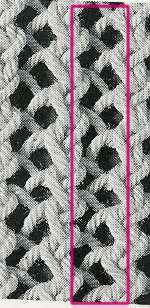
The zig-zags produced by faggotting in knitting mimic thegroups of verticalscreatedin withdrawn thread hemstitching. That’s where the bundle idea came in, andfrom where I believe the knitting stitchborrowed its name. This snippet is excerpted from Lewis’ Knitting Lace, p. 146 (Yow! I just saw the used bookprice. Ineed to update my insuranceto cover my library!)
WORKING REPORT – LACE SCARF; ANOTHER FULLED PILLOW
Having finished the poncho yesterday, I scuff around with what little yarn remains here in the house (my stash being stowed in the storage cubby pending our upcoming move.)
At theGore Place SheepshearingFestival last month I bought two skeins of hand-spunfine gaugeMerinofrom Greenwood Hill Farm. Each is around200 yards so I have about 400 yardstotal. In my opinion it’s more like a light fingering weight than a truelace weight. I bought them with a lacy scarf in mind. No pattern in particular. I thought I’d noodle out one on my own.
I’ve decided to make a piece with two fancy ends, a rather plain but coordinating lacy middle, andtrimmed all the way around with a killer edging.
I swatched on several size needles, and decided I liked the way that lacy stitches felt when knit on a US #6. (That’s an argument that this stuff is trulyfingering weight, because I like lace weight knit on #3s.) Gauge is hard to estimate because I haven’t decided on pattern stitches yet, but I’m not worried about making a scarf fit. The various lacypatterns I played with worked up at between 5.5 and 5 stitches per inch, so I know roughly how wide a pattern I should be looking for to make a scarf of around 5 inches in diameter.
To that end I started paging through some of my knitting books and stitch dictionaries today. I found several things that had elements I liked. First, I found a wide diamond band in Lewis’ Knitting Lace (pattern #42). Nice wide diamond frames, filled with a smaller diamond pattern in the center. It’s a 12-stitch repeat, with 2 stitches before and one stitch after the end repeats. That’s 15 total for one repeat. Narrow, but I’m planning on adding an edging.
To complement the diamond pattern, I’m looking at a couple of simple lace grounds. Right now the leading candidate is a mini leaf pattern from Walker 1 (p.215, #3 in the set), but I’m not sure it will work out. I’d like to use a divider to set this pattern off from the diamonds. I’ve always liked a plain row of YO, K2tog framed by garter stitch welts.
Finally we get to the killer edging. I’m looking at Heirloom Knitting by Miller, the Victorian Zigzag Edging on p. 125. That’s a WIDE piece as written – 20 stitches at cast-on, widening to 26. I might have to eliminate some of the openwork on the attachment side to slim it down some.
The next step is to swatch a bit with each of the given patterns. Before I do that however, I’m going to redraft them using a uniform symbol set and put all the patterns I intend to try out on one sheet of paper. It’s easy enough to adapt to each book’s ideosyncratic style of stitch representation, but it’s a pain to switch gears between systems and flop all those heavyvolumes around while I’m knitting.
I give no guarantee that this process will lead to an Actual Design. I begin two or three of these for every one that ends up as an on-the-needles project.
In the mean time just to have something mindless on the needles for last night’s and tonight’s weekend sofa movies, I took my other Sheepshearing Festival acquisition and cast on for another felted pillow similar to the one I did in Manos del Uruguaywool. This one is also done in the rustic Nick’s Meadow Farm yarn I’ve mentioned before. The pale blue, light moss green, and light butter yellow skeins together cost less than one skein of Manos.
The movies that accompany this excercise in autopilot garter stitch? Last night it was Master and Commander. Tonight it’s John Cleese in Shakespeare’s Taming of the Shrew. If you like either adventure stories or Jane Austin, you’ll enjoy the series of books from which the former was adapted. The movies skipped over the whole drawing-room/social manners side of O’Brian’s books, especially the rivalries in love that divide the two lead characters. As for the Shrew – it’s so non-PC it’s over the top, but it’s also one of my favorite plays. I’m really looking forward to seeing Cleese as Petruchio, and finding out how the actors cast as Katherine and Grumio stand up to him.
Back to knitting. Thumbing through my stitch books I lighted againupon Indian Cross Stitch (Walker I, p. 112), a variant on enlongated stitches. I used itinmy Suede T. It seems that in just the past three months, I’ve seen elongated stitches, including this oneand Seafoam (Walker II, p. 21 ) all over the place,including the latest Interweave Knits and Knitters, Berroco’s patterns, and Lana Grossa’s patterns. Given the long lead time of both magazine and yarn makers’ pattern development cycles, it’s always interesting to see the same idea hit multiple sources at the same time. Shadow knitting cropped up in parallel issues of IK and Knitters a while back. Lacy knitting featuring lily of the valley-inspired textures is another recurring theme (IK led the pack with Forest Path last summer).
About the only explanations for this parallelism I can come up withare that the designing knitting community is quite small; some things are natural fits (elongated stitches work well with ribbons, ribbons are hot right now); and many designers draw inspiration from the same fashion industry sources (deconstructed/slashed looks were big on the runways two seasons ago, and it takes a season or two for runway ideas to percolate into retailknitting patterns.)
So far most sources talk about doing the elongated stitches do them with the multiple wrap method. Can a revival of Condo Knittingbe far behind?
WORKING REPORT – WATERSPUN PONCHO
UPDATE: THIS WORKING DISCUSSION (INCLUDING HINTS FROM PRIOR PROJECT POSTS) IS NOW AVAILABLE AS AN EASY DOWNLOAD AT THE KNITTING PATTERNS LINK, ABOVE.
My Classic Elite Waterspun poncho isdone! Here it is mid-block:

I am really loving the improvised blocking wires I got to finish my Forest Path stole. I threaded them through the I-cord edges, two per side, then spread the poncho out on some towels to dry. The edges are straight, the corners are perfect, and dreaded curl-up has been eliminated. And I didn’t even need pins!
And here’s a shot of it on the happy recipient:
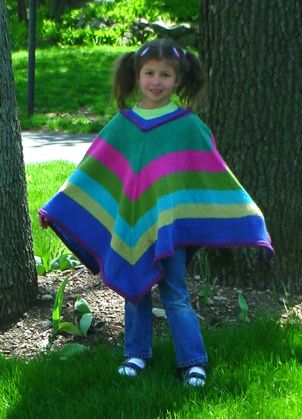
For those of you who wrote to ask for the pattern, here it is.
- Make swatches until you get a fabric that you like.
- Figure out your gauge.
- Measure how big a neckline you need to go over your head.
- Multiply that measurement by your gauge, and round it up to the next multiple of four.
- Cast on that number of stitches, placing 4 markers evenly spaced.
- Knit 6 rounds.
- On the 7th round, K1,make one, knit to one stitch before the next marker,make one, K1. Repeat this three times.
- On the 8th round – knit
- Repeat steps 7 and 8 until your poncho is as long/wide as you like it.
- Bind off, or work one or more rounds of attached I-cord to finish.
- If the neck is too wide, pick up purl bump stitches at the base of the rolled collar. You should have the same number as you cast on. Put 4 markers in your work evenly spaced. Then work one round starting with k2 tog, (k1, p1) until you have two stitches left before the next marker, ssk. Repeat between the other markers. Then work a K1, P1 round continuig ribbing as established. Continue this way, alternating decrease rounds and plain ribbed rounds for about 6-8 rows. Bind off VERY LOOSELY, making sure you can still get your head through the hole.
As to what yarns are suitable, what number to cast on given a particular gauge, what size needles to use, how much yarn you’ll need – this is all up to you. Experiment! Here are some thoughts to keep in mind:
What yarn is suitable? Look at it. Will it feel good when worn? Is it hand-wash only, otherwise hard to clean, or a light color? If so – are you prepared to care for it when it gets dirty? Is it loosely or tightly spun? Loosely spun yarns are more prone to pilling, catching and looking “used.” On the other hand, they’re often softer with a more luxurious drape and sheen. Is it heavy? A poncho is a big thing – larger than a lap blanket. Lift about 10 skeins worth. Can you envision yourself dragging around that much weight (or more)? Will the yarn stretch under its own weight when used in a large quantity? Cottons are heavy yard for yard and are infamous for this. Wool is less weighty per yard or meter. Wool/acrylic blends are lighter still. Is the color/texturenot only attractiveon its own, but will it look good on you? A puffy or furry yarn will add bulk andincrease the size of your sillouhette. A giant-gauge or shiny yarn willmake a garment look larger than it really is. Some colors and textureslook fantastic as accents, but applied over an entire garmentmay not be as appealing on every wearer.Decide what’s important to you and choose accordingly. Remember, you can always buy one skein to try out before you commit for the whole project. If that yarndoesn’t work out for a poncho,one skeinmight make a nifty hat or scarf.
What needle size to use? When swatching with a new yarn, start with the needle size recommended by the yarn maker. Do up a good size swatch in your chosen texture stitch or colorwork design. Do you like the feel and drape? If so, measure your gauge – you’re good to go. Swatch feel too stiff and tight? Try again on a size larger needle. Swatch too drapey and holey? Go down a needle size and try again. You’ll know when you’ve hit the best combo. If you’re combining several yarns of different weights or textures, be sure to swatch them as you will use them, using the stitch and needles you intend for the final project, even if that means making a VERY large swatch with multiple stripes. Once you do get the look/feel you like, make a note of your needle size and FINISH YOUR SWATCH. You’ll need it to do both gauge measurements and yarn consumption estimates. (I’m not good at keeping paper notes, so Imake knots in my dangling tail end to help me remember what needle size I used to makemyswatch. For example, four knots = US #4 needles.)
How many to cast on? Simple math. If your gauge is 4.5 stitches per inch, and you’ve decided that a 24 inch neckline is big enough, you start with 4.5 x 24 = 108 stitches. That lucks out because 108 is a multiple of 4, and you don’t need to round up.
How much yarn will you need? You can figure out roughly how much yarn your gauge square took for that number of square inches or centimeters. Draw out a diagram of your project (in this case – a big square), and estimate how big you want the thing to be when it’s done. Figure out its total area and divide that area by the area of your swatch. Got a 6-inch square swatch? Want to make a peice that’s 4 feet on a side? 4 feet x 4 feet = 48 inches x 48 inches = 2304 square inches. 6 inches x 6 inches = 36 square inches. 2304/36 = 64. It will take you about 64 times as much yarn to knit your 4-foot square piece than it took to knit your six inch square. Ravel back your swatch and measure, or weigh itto determine the amout of yarn you used. Now do the math.
Shortcut: If you like a slimmer poncho than this super-easy square one, there’s a poncho pattern generation utility available elsewhere on-line.
CHEST OF KNITTING HORRORSTM – MEXIKO PULLOVER
I’ve mentioned this resident of my Chest of Knitting HorrorsTM before. It’s my Fortissima Colori/Socka Color Mexiko pullover. This yarn has since been renamed Fortissima Colori/Socka Color Mexiko Disco, and the fiber content has changed. No review yet under that entry.
The pattern was issued by the manufacturer. It’s one-size-fits-most with the sizing limited by the width needed to express the yarn’s flash patterning, and I’m at the upper end of the fit range. I bought itkitted with five 100gballs of the stuff. Here’s what I’m supposed to end up with. Thankfully, braids, salt,and the forced toothy smile are not required accessories:

My copy is a bit worse for the wear, but you can see the happy striping. This effect is achieved by worked flat from one ball for front and back and from two balls for the sleeves (2 rows A, then 2 rowsB). Thrilled to have a fine-gauge pattern and to be using sock yarn for something larger than socks, I took the plunge. Here’s what I’ve got so far:
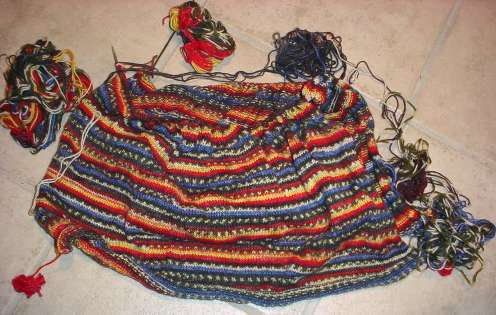
Just to be annoying, Idecided to knit the front and back side by side, althuogh each is knit flat from its own ball of yarn. I wanted the patterning to sort of match at the side seams. I’m not going for absolute fanaticism on this, a rough approximationis good enough. I found comparable spots in two skeins and started on in. It went o.k. for the first six inches or so. Then the problems started.
See all those balls hanging off the ends? Those are out-takes where the yarn’s color repeat went off-phase, got muddy enough for long enough to interrupt three or more full rows, or disappeared entirely. My intent was to loop out such annoyances, then later go back and use them on the sleeves. (I kept them attached to the work so that in theory – when I went back to re-use themI would have a better idea of where they fit in sequence.)
I’m still hoping to eke out a semblance of matching until I get to the point where sleeves are introduced. Since the front and back will no longer butt up against each other, mismatches will be easier to ignore. I long ago gave up any thought whatsoever of color or pattern-balancing the two sleeves.
As you can see, the problem is getting worse. What started out as a fun lark in fingering weight has turned into an agonizing slog on #3s, with all too many excised bits. I put it down when the fun leaked out. I do hope to take it up again because I still want to be able to wear this piece. Someday…
Moral of this sad tale? If you make life more difficult for yourself, things are not going to be easy.
WORKING REPORT – PONCHO WITH ATTACHED I-CORD
Messing around with the edging on the Waterspun poncho, I realized that I was using two different methods of attaching I-cord, and that "How do I work attached I-cord?" is a common question.
Recap: The first round of I-cord edging was applied to live stitches. Instead of binding off my last row of the poncho body, I left its stitches on the circs. Using a DPN and a half-hitch cast on, I cast on four stitches and knit one row of I-cord. On the second row, I knit three stitches, then did an SSK, working the last stitch of the I-cord together with one stitch of the poncho body. I worked this way, doing three rows of attached I-cord, followed by one round of "free" I-cord. This 3:4 ratio of attached rows:total rows kept the edging from being either gathered or ruffled. When I got all the way around my piece and had incorporated all of the body stitches, I grafted the live stitches at the end of my I-cord to its beginning.
On the second round of I-cord I was not working with live stitches. Instead, I was picking up stitches along the outer edge of an established row of 4-stitch I-cord. On the previous round of cord one stitch was "eaten" by the attachment row. That left three to form the rounded edge. I used the centermost of these three as my line of attachment. To do this round of edging, I again cast on four stitches using half-hitches, and knit one row of unattached I-cord. Then I began working it onto the established round of edging. On the next row I knit two stitches, then did a SSK and picked up a stitch under both legs of the designated spot on the previouslyfinished I-cord. In this shot you can see the knit two, the SSK (under my thumb), and the needle thrust under the stitch of the existing I-cord, ready to do the pick-up.
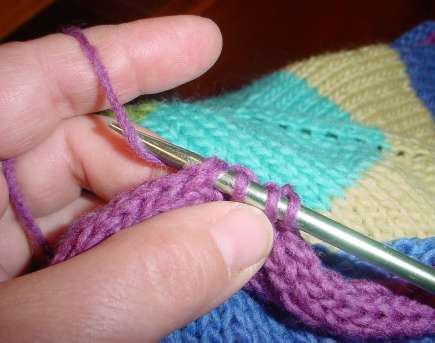
The reason why I didn’t use this method to attach the first round of I-cord is that theattachment rows of each method look different. Pre-block waviness aside, you can see that the first round of I-cord has a smooth chain-stitch like appearance to its bottom edge. The secondmethod produces an attachment row thatlooks rather like crochet, although you can’t see the non-crochet look rounded multi-stitch upper edge from this angle:
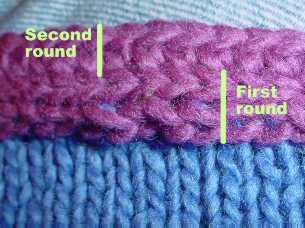
I prefer the speed of the second round’s style of attachment (less fumbling and shifting stitches between needles), but I like the look of the first round’s style of attachment. Note that the reverse of the second round’s style is a bit smoother and less leggy. Sometimes I work it around something clockwise instead of counterclockwise, so that the I-cord’s other side presents itself on the public side of my piece.
There’s another nifty use for this second method of attachment. You can use it along with I-cord or a lace edging to make a decorative seam, or you can use it for counterpanes or pieced blankets,multi-directional or domino-style knitting to joinmotifs or sectionstogether without sewing. More on using this for decorative seaming tomorrow.
PROJECT – SAMPLER SOFA PILLOWS
There are lots of stitch patterns that look tempting in the various stitch dictionaries on my shelves. Some I’ve been able to place on garments, but others just haven’t worked out – mostly because they were too wide or presented composition problems if used over the topography of a person’s body.
About 8 years ago, right after we moved into the house we’re on the cusp of leaving, I decided to take some of these difficult-to-place patterns and do up two sofa pillows. Anticipating severe pillow-abuse that only homes with small children face, I decided not to spend a lot making them. I got three large skeins of Lion Fisherman Wool from a discount crafts store; and pulled out a pair of US #8 needles and some of my stitch treasuries. I started right in, not worrying much about absolute size.
I chose a bunch of patterns from the treasuries, planning out my pillows around an average gauge of 4.5 spi and a target size of around 15 inches, square. If I was off a bit I didn’t worry, knowing my knit pillow tops would stretch to compensate. Just for kicks, I decided to use different patterns for each side:


If you’re a texture pattern junkie like me, in the top picture you’ll recognize Rocking Cable (Walker 3, p. 130) and Medallions with Cherries (Walker 2, p. 141) framed by Bulky Double Cable (Walker 1, p. 243). The simple lacy edging is adapted from #57 in Classic Knitted Cotton Edgings by Hewitt and Daly (p. 44), but I narrowed it a bit by eliminating the openwork along the top edge.
On the other side of these pillows I used Wheat Sheaves (Walker 2, p. 138); and a combo of Patchwork Cable II (Walker 3, p. 93) and Grand Swinging Cable (Walker 3, p. 91). Note that the Patchwork Cable and Grand Swinging Cable match up exactly in row count. I was able to tuck them in together side by side in a playful combo I intend on using someday for a kid’s pullover. That pillow is also framed with #89 from Stanfield’s New Knitting Stitch Library (p. 59).
Once I had my four sides knit and blocked, assembly was easy – even considering that Iput a zipper in each so I could remove the covers for washing. In fact, if you’ve never sewn a zipper into a piece of hand-knitting pillows are excellent practice pieces. To make life easier, I sewed in my zippers first:
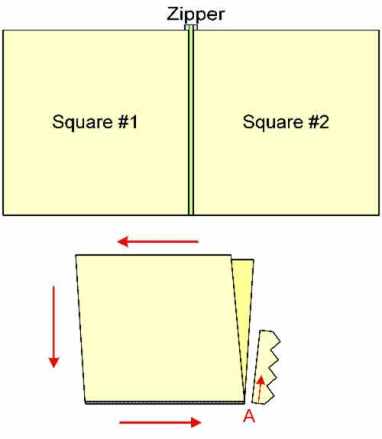
I laid the two squares side by side, and pinned the zipper between them. Then I hand-stitched the zipper to each square. Once the zipper was set, I folded the two squares along it, so that the wrong sides were sandwiched between. Then starting at the foot of the zipper, I worked either I-cord or an edging up along the outer edge of my two matched squares, effectively joining them together at the same time as the edging or I-cord was created and skipping the sew-up-the-pillow step. I went around the three open ends of the pillow, joining as I went. When I got to the zippered side, I worked the edging along only ONE of the squares taking care not to foul the path zipper pull with yarn. My (now camouflaged) zipper nestles along that side at the base of the edging. “Zip open, shove in store-bought pillow form, zip shut” were the final steps of assembly.
To fasten the pillow sides together I used the second of the two I-cord attachment methods I described yesterday. The I-cord edged pillow worked exactly the same way, but instead of picking up both legs of the stitches running down the length of the previous round of I-cord, I held the two sides together and picked up the innermost leg of the edge stitch from each one. This turned the outermost legs inside as a selvedge, and made a nice, neat join without gappy holes.
The pillow with the lacy edging was done in a similar manner. Unlike the I-cord however, I had wrong-side rows on the lace. I did my lace trim, using three plain knits on the straight side as my point of attachment. I ended every right-side row of the lace with SSK, pick up one stitch, just like the I-cord. Then I flipped my work over, slipped the first stitch purlwise, knit 1, and continued with rest of my wrong-side row.
Just like in joining the first round of I-cord to my poncho, for both the I-cord and lacy edgings I had to adjust the ratio of stitches picked up to rows or stitches on the piece’s body. I believe I used needles two or three sizes smaller for both the I-cord and lacy edgings. I also ended up working 4:3 on the sides of the piece and 2:3 along the top and bottom. Experimentation at the outset and a willingness to rip back a few rows and try again are both always required when you’re adding a knit-on edging.
I’m pleased with the way these turn out, and surprised at how well the inexpensive wool I used has held up. The pieces were a bit stiff and slightly real-wool itchy when first knit, but softened up quite nicely when washed and blocked. Sure, there’s some pilling, but these pillows have survived 8 years of slumber party pillow fights, general abuse and spills of all sorts. They’ve resisted stains, and freshen up quite well after a general pill-pluck and washing with Eucalan. My only cautions on the Lion Fisherman yarn are that even washed it isn’t Merino-soft; and that my gauge of 4.5 spi worked but is a bit loose for it in garments. I think it would look better knit a tad more firmly as a true worsted.

