PROJECT – DOUBLE KNIT HAT GRAPH
Again apologies to those on the updates mailing list. I did a bit more maintenance, adding categories to all the existing posts so it’s easier to page through this ever-growing mound.
A couple of people have asked for the graph I used to knit the interlace shown on my overly warm teal and black alpaca hat. Here it is.
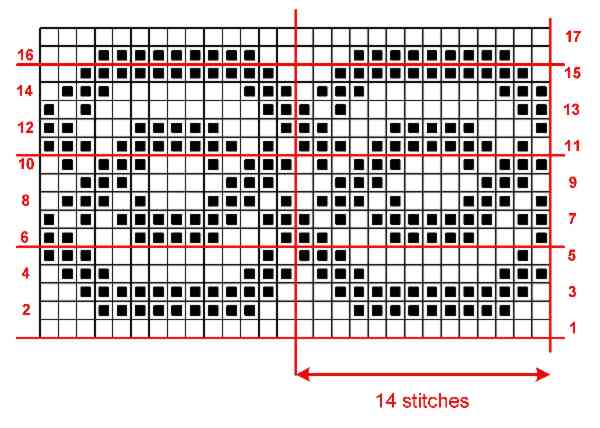
This one didn’t make the cut for my book because it’s one of the designs for which I lost my notes. A long time ago I had a miserable move between apartments. Several boxes were stolen off the back of my truck. Among the things that went missing was a notebook full of source notations for counted embroidery patterns. I had been researching them casually for more than ten years, and had hundreds compiled. The sketches for most of them had already been redone on my ancient Macintosh, but all associated notes remained solely on paper.
When I was composing The New Carolingian Modelbook I had to go back and confirm the exact origins for all the counted patterns I wanted to include. I managed to find the sources for about 200 of them, but a third as many more have eluded me. This particular interlace is from my collection of the lost. It is similar to designs by Matteo Pagano as published in his 1546 book Il Specio di Penfieri Dell Berlle et Virtuoise Donne, but I can’t swear that it came from that or one of his other works. Given the relatively clumsy, heavy spacing and short repeat it might even have been something I doodled up myself after a day of research.
Many of these early Modelbook designs got there by way of Islamic influences (especially patterns cribbed from woven carpets and embroidered textiles). Over the years the patterns drifted away from work worn by the elite to work worn by middle and then lower social classes, eventually ending up in folk embroidery where they never quite died out. Counted thread needlework styles were revived big-time among the fashionable in the mid 1800s. Researchers found and reproduced surviving older pattern books, and began collecting motifs from traditional regional costumes and house linen. Some of the later and folk uses of counted patterns include standard cross-stitch, Hedebo, Assisi-style voided ground stitching, and various types of pattern darning or straight stitch embroidery done on the count.
This pattern can be interpreted in many crafts. Historically accurate uses contemporary with first publication include cross stitch panels (the long-armed style of cross stitch is overwhelmingly represented in historical samples compared to the more familiar x-style cross stitch); weaving, or lacis and burato (types of darned needle lace).
Counted patterns are a natural for knitting. The first book of general purpose graphed designs that listed knitting as a specific use came out in 1676 in Nurnberg, Germany and was published by a woman: Rosina Helena Furst’s Model-Buchs Dritter Theil. (the title is actually much longer). There may be others that predate this book, but I haven’t seen mention of them, and I haven’t seen the Furst book in person. It’s in the Danske Kuntsindustrimuseum in Copenhagen, a tad far for a day trip from Boston, Massachusetts. The entire group of graphed designs displayed in the early Modelbooks shows a straight continuity with the geometric strip patterns found in modern northern European stranded knitting.
The short 14-stitch/17 row repeat of this graph does work well at knitting gauges. I’ve always meant to use this one again on socks -either as-is or stretching it a bit by repeating the centermost column so that it better fits my sock repeat, or doing eight full repeats at an absurdly tiny gauge. As is, you’d need a multiple of 14 stitches around. A standard 56-stitch sock could accommodate 4 full iterations of the design without adding any columns.
Some people have asked how to get a hold of my book. The answer is, aside from the used market where it is going for quite a premium, I haven’t a clue. Sadly all I can report is that the publishers absconded shortly after publication. I have no idea where they went, and have had no replies from them to any queries since 1996. I received only about a year of royalties on the first 100 or so copies, in spite of the fact that the book went through at least two printings with an estimated total run of 3,000. New copies continue to trickle onto the market even today (they’re sold as used but mint). The new-copy seller has rebuffed my attempts to find the ultimate source.
Moral of the story – don’t enter into publication contracts without a literary agent, and if the company has a name like “Outlaw Press” there’s probably a reason.
WORKING REPORT – WATERSPUN PONCHO
I’m still nibbling away at the The Small One’s Waterspun poncho. To recap – I had seven colors to start, but only about 80% of a skein of each. I decided I really had to have at least one more skein of yarn, so I went out looking throughthe myriad local yarn stores for Waterspun.
How many local yarn stores make up a myriad? An amazing number. I live in the Boston metro area – a yarn paradise compared to most of the rest of the USA. Here’s just a sampling of the shops within an hour’s drive of my home, and most of these are reachable within a half-hour. This list doesn’t include the "big box" hobby shops sellingmostly mass-market yarns:
| Places I’ve been: Wild & Woolly, Lexington (favorite & "home base" LYS) Woolcott, Cambridge Minds Eye Yarns, Cambridge Hub Mills/Classic Elite Outlet, Lowell Fabric Place, Woburn and Newton The Knitting Room, Arlington |
Places I’ve never been: |
Please don’t be jealous. The cost of living in this yarn heaven is very steep, and the economy ofeastern Massachusetts is still hit hard by the Great Tech Crash. Those things make up quite a bit for having so many knitting sources nearby.
In any case, I quickly found that even with a ton of local yarn shops, very fewstock Waterspun during the summer season. Even fewer had a range of colors on hand. I could place a special order formy yarnjust about anywhere, but doing so would mean taking a full single-color bag – much more than I needed. Since I know with absolute dead certaintythat Waterspun is NOT about to disappear, I decided on trekking the 45 minutes up to the Hub Mills/Classic Elite outlet. I had a lunch date aboutten minutes away from the place anyway, so I was able to piggyback my errand and save some gas.
Hub Mills is two small, dusty rooms in the same 19th century brick mill building that houses the Classic Elite manufacture/distribution facility and design offices. Think crumblingblock in an industrial New England mill town, complete with a silted-in canalacross the street. Aside from the usual suspects from the standard set of makers in their full-price inventory, they stock cone-ends and "out-takes" of Classic Elite’s various lines. Fantastic bargains can be had, but like every mill-end shop, it’s hit or miss.People who head for the yarn first and are able to figure out what to do with limited quantities or variant dye lots are the best suited tothis type of shopping. I head up there maybe once every 18 months or so,butI’ve found some interesting bits over the years including samples of a heavier version of Sand that never madeit into distribution, odd cones of Montera and Provence, and assorted Fox Fiber natural-color cottons in non-standard weights, all for bargain-basement per-pound prices. I’ve also made the trip but returned empty-handed because the discount shelves were empty.
This time I found my Waterspun, even though the outlet store didn’t have much either. I found one more skein of the plum, plus a remnant cone of the blue that weighed out to the equivalent of about a skein and three-quarters. The plum’s dyelot looks quite close to my yarn. The blue was off a bit. Here’s what I did with them:
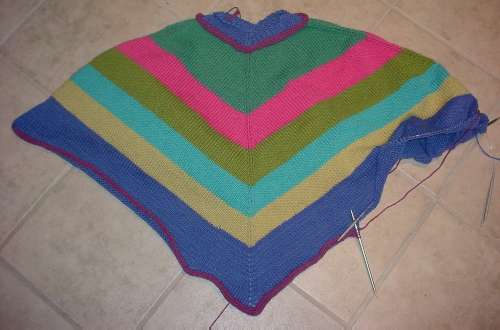
First using the method I described earlier. size US #6 (4mm) needles and my new blue yarn, I picked up 100 stitches around the inside of the neck edge. I placed a marker at the point corresponding toeach corner in theponcho body. I worked nine rows in K1, P1 ribbing. Every other row I started each between-marker section with a SSK, and ended with a K2tog. Because I was decreasing 8 stitches every other row I ended up binding off 68 stitches.
Then I went back to the bottom edge. I had already knit the final blue stripe, but I ripped it back because I wanted to alternate rounds between the new and old blue yarns in order to make the different dye lots less evident. (You can still see some minor striping thanks to the wonders of flash photography. In person the difference is less noticeable). I kept going, alternating yarns until I ran out of my old yarn. I finished up using every scrap of the new yarn.One interesting effect I got from using more or less the same quantity of each color (until the blue) was that with the increasing circumference of the piece, the width of the color stripes changed. I didn’t have more teal than pink, more pink than green and so on. That’s just the way the piece worked out. Had I used only the blue I had on hand, the final stripe would have been proportionally smaller. Adding the yarn I did is why it breaks the established progression of diminution. I’m pleased though. I ended up having a blue strip that’s about twice the width of the previous one. Although it is wider, the proporations aren’t all that bad.
The last step is adding an four-stitch I-cord edging in plum onto the live blue stitches. I’m using US #9(5.5mm) needles, the same size employed for the body. I’m attaching the edging by working the last stitch of the I-cord row as a SSK along with a live blue stitch. I’m doing this at a 3:4 ratio – three attached rows of I-cord, followed by one "free" unattached row. This is keeping the I-cord from bunching up the poncho into a gathered edge. (I could make a ruffled bottom by increasing the number of free I-cord rows.) I’m handling the points by working four unattached I-cord rows at the corner tips.
So far I’ve used less than a quarter of my remaining original ball of plum, and have completed more than a quarter of my I-cord. I should have enough to go around the entire piece once. But as you can see, I’ve got the classic stockinette edgeroll problem. I need more weight to stabilize the thing and tame the roll. Iplan toadd another round of the I-cord on top of the one that’s already there. I’ll document how I attach one row of I-cord to an existing row of I-cord in my next progress report.
PROJECT – DOUBLE KNIT FULLED HAT
Not every project turns out perfectly. Some start out well, but end up beinga bitshy of the goal.
Some years back my husband requested an ultra-warm hat. I took him at his word, and settled ona watch capin alpaca. Now, alpaca ismuch warmer than woolto begin with – but I didn’t know that at the time. To make sure thehatwas wind-proof I decided to knit it large, then full it to size. Finally to make sure it was nice and snuggly (and to have an excuse to try out the technique) I decided to do a double-knit hat. That’s not "double knit" as in the yarn weight designation – a yarn that knits up at 22 st=4 inches or 10cm. That’s "double-knit" as in a special technique that produces a fabric of two thicknesses, both of whichdisplay their knit-sides to the world (the purl sides are sandwiched back to back inside, between the layers).Those of us who remember the Leisure Suit ’70s, can think polyester double-knit, but done at hand-knitting scale.
Double knitting is a strange beast. It’s related to the famous sock-inside-a-sock trick described in the book War and Peace. In it the stitches of the two layers alternate on the needle. The knitter either works each layer from its own ball, or uses one ball of yarn to accomplish each round in two passes – first knitting the odd numbered stitches and slipping the even ones, then going back and slipping the odd numbered stitches and purling the even ones. The two-ball method if employed carefully can produce the two separate layers of fabric needed to pull off the War and Peace trick. Using one ball of yarn, or using two colors, swapped back and forth between the layers makes a two-sided fabric that does not separate.
Always being up for a challenge, I decided to use a two color stranded pattern, worked in the round. My intent was to employ only two strands of yarn, trading them back and forth to meld the two layers together into one unit. The result would bethe same design showing up on both sides of the work, but in a positive/negative value trade. On one side Color A would be the foreground and Color B the background, but on the other side Color B would be the foreground and Color A would be the background. You can sort of see the difference between the hat body and its reverse side, shown on the flipped up cuff-style brim:

The knotwork design isan out-take from my book of graphed counted embroidery from pre 1600 sources. I havethis onein the notes I drew upon to compose the book, but my documentation of the exact source wasn’t good enough to include in The New Carolingian Modelbook. I used Indiecita Alpaca Worsted 4-Ply, a worsted weight 100% alpaca yarn imported by Plymouth, and knita bittightly at 5.5 spi. Experienced fullers/felters are beginning to shudder here.
I won’t say I truly enjoyed the knitting. Having to remember that two-stitch groups (one inside and one outside) equalled on box unit while following a complex graphmade the project perhaps a bit overly ambitious. Eventually I muddled through, finished the cap, and with much difficulty – fulled it.
What made the result a disappointment?Several things.
Remember how warm I said alpaca is? Double knitting means that the fabric is two layers thick. This watch-style cap with a folded brim has FOUR layers of fulled worsted-weight fabric in the ear-band area. Although I live in an area of the US known for cold, wet winters I will say that in the eight years I’ve been here there has been only one winter with a solid month of below -10F (-23C) weather, cold enoughto wearthis portablelittlehead-oven in comfort.
Fulling alpaca isn’t as easy as fulling wool. Also, I knit this piece much too tightly for something that was to be fulled. There just wasn’t enough room in the already-densely packedpiece for the stitches to pull together properly. It did shrink, but not as much as Iexpected – especially in width. The hat ended up being a bit too wide for the target head. Plus the two colors didn’t shrink at the same rate. It took many, many trips through the washer/dryer, plus a conserable amount of hand-bashing to even out the fast-shriking teal with the slow-shrinking black. It looks good now, but during the process I think I swore at it enough to provide an entire national navy with suitable vocabularly.
Fulling/felting something, a pattern with fine colorwork detail can be wasted effort. Especially if you’re using a rather hairy and soft yarn to start with. It’s tough to make out the detail of the knotwork patterning in my finished hat. In fact, it’s tough tomake outthat the flipped-up brim is displaying the same pattern in negative.
The upshot of all of this is that I learned some valuable lessons: 1. Save fancy patterns for after I understand the basics of a new technique. 2. Knit loosely if you expect to full a piece to shrink it. 3. Alpaca is extremely warm andmore difficult than woolto full. 4. Colorwork patterning is muddied in fulling. 5. My husband really DIDN’T want an ultra-warm hat. I wear this piece now and he’s much happier with his lightweight Ch’ullu, even on a -10F day.
PROJECT – NO-MATH PULLOVER
A couple of failed start-ups ago, I was sitting in the cafeteria withthe company’sresident theoretical mathemetician. I was penciling out a new knitting project, and he was watching me shape the pieces and place repeats. I did a few simple calculations, ratios, slopes, division – nothing terribly complex, but he was impressed at the amount of math that was going into the design. So impressed in fact that he scoffed at the idea of pre-numerate people (meaning people who had no formal math education) coming up with complex patterns.
Now you and I both know that some prettyinvolved knitting went on for quite a while before modern math education took hold.Dr. Math and Igot into a discussion on the subject, and the outcome was I bet him that I could come up with a complex knitted pattern that was constructed using only simple counting. He took the bet. With a bottle of good single-malt Scotch on the line, I was off and running.
I decided to go further. I’d make a sweater that required no swatching, or gauge measurement to boot. I remembered an idea I had seen in a vintage Anna magazine, put out some time in the 1960s. I decided to give the method a try.
I fished some rustic Maine style wool out of my stash (Have Ewe Any Wool – I’d bought it at a Gore Place Sheep Festival the previous year). I knew from prior experience I’d be using a US #9 on this wool. I happened to have a set of 18-inch European 5.5mm DPNs, but I could have worked this on circs. Here’s the logic of my project.
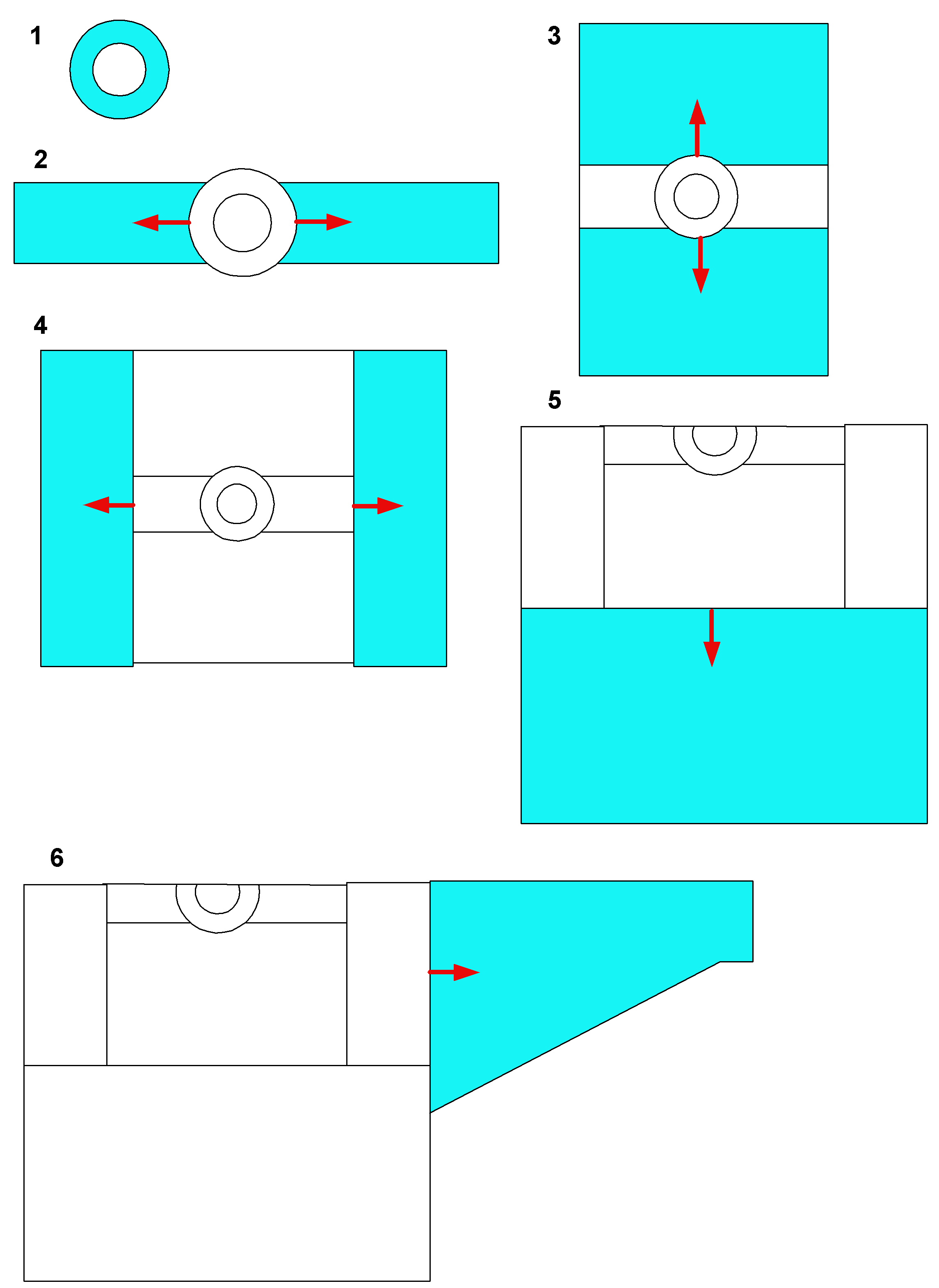
Apologies that some lines have been lost in the above diagram due to file re-sizing, but they aren’t dead-vital.
First in the round I cast on enough stitches to make the neck ribbing (Step 1). I worked them for about an inch and a half. Then counting from the point where I cast on as center front, I determined and marked the center back. Once that was marked, I counted out the center ofeach shoulder. I eyeballed the number of stitches I should use for the shoulder strip and knit out two epaulette-shaped pieces (Step 2), leaving the rest of the stitches on holders. I kept going,trying on the piece until I had a strip that was as wide as my shoulders. I now had something that looked like a bell-pull with a hole in the middle.
I put the live stitches at the ends of the epaulettes onto holders, and began the center front bib area. Starting around a hand-span’s worth of stitches in from the end of the epaulette, I picked up stitches along the sides of my strips until I got to the collar. There I knit across the stitches I had reserved, and picked up the same number of stitches on the other side of the collar. I knit down until I had a hanging piece that was about2 inches below my arm, placing the stitches on a holder instead of binding them off. I repeated the process for the back (Step 3).
Once the bib areas were done, I added width so that the upper body was wide enough to fit me shoulder to shoulder. I picked up the first “wing” along the side of the bib area, then worked across the live shoulder strip stitches, and picking up along the side of the second bib piece. I put these stitches on holders instead of binding off (Step 4).
After the upper body was done, I folded the piece along the shoulder line. I picked up stitches along the side of the first wing, worked across the live center bib panel stitches, then picked up along the side of the second wing. At this point I decided I needed to add more length, so I knit about another three inches in the flat before joining the front and back and switching over to working in the round. I continued to knit the body down in the round, working until it was the desired length, ending with a ribbing (Step 5).
I now had a sweater body with two holes for arms. I picked up along the edge of the arm opening along the little bit of body I just added before joining, then worked across the live wing stitches, finishing by picking up the remaining few stitches along the side of the other bit of late-added body. I worked the sleeve out to the cuff, doing double decreases at the bottom edge every other row until the sleeve looked narrow enough for comfort. I continued working it out as a tube until it was long enough (yes, I know the diagram shows decreases evenly to the cuff. Shoot me.). I ended off with some cuff ribbing. (Step 6)
Here’s the result:

I admit on beyond the method described above, I tarted the thing up a bit with some cables and texture stitches:

I used the Twin Leaf Panel from Walker’s Second Treasury (p. 235) for the centermost panel in the bib area. I framed it with an unusual eccentric chain link cable that featured an openwork detail. I thought I got that one from Stanfield’s New Knitting Stitch Library, but I can’t find it in there right now. I also used the same cable on the epaulette strip, continuing the design down the sleeve to the cuff. Plain 2×2 cables (mirrored left and right) frames the fancy-work areas on both the bib and sleeves. I did like the openwork detail of the eccentric cable, so I decided to introduce more openwork into the piece by using YO K2tog or SSK YO combos instead of the more traditional purl ground on which most cables float. That’s what makes the curious spines between the patterned panels. The rest of the piece is done in seed stitch.
So there you have it. I produced a visually complex piece using only simple counting. To determine centers, I counted in from the ends rather than divide. To place cables knowing their stitch count widths, I counted out from my center markers, and placed additional markers to indicate where they went. I did no other math of any sort, and did no swatching or gauge measurements either.
Did I win my bet? Of course. To be fair, it WAS a sucker’s bet.
The Scotch is now long gone and the sweater is now a bit stretched out, but the Bowmore canister lives on as a trophy, happily holding needles here on my desk at wiseNeedle Central.
WORKING REPORT – WATERSPUN PONCHO
The Tiny One’s poncho continues apace. I only have had about an hour or so to knit each evening, and as you can see, I’m almost done. Dark blue is the last body stripe. The remaining plum is reserved for edging and mistake-fixing.
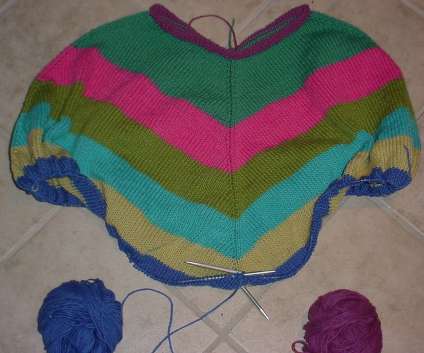
It does turn out that the neckline is way too wide. 100 stitches as cast-on would have worked for an adult, but for a tall Kindergartener (size 8), it’s too big. If I were to begin again, I’d probably go with 80 stitches, tops. Instead of ripping everything back and starting again, or unpicking the top and knitting in the opposite direction, I’m going to fudge it and in doing so produce a detail that (I hope) will look planned.
My goal is to preservethe currentrolledcollar as a welt detail,but fillin the loose-fitting neckline with a contrasting texture. Using plum, I’m going to pick up stitches in the purl bumps of the last row of thecurrent rolled collar, just before I switched from plum to the teal and began the body increases:
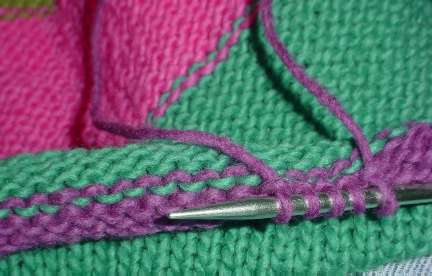
Using these stitches, I’ll work at least six rows of K1, P1 ribbing. Where the "corners" of the piece happen, I’ll use a double decrease, keeping the centermost stitch of the decrease on top: slip two together as if to knit, return both slipped stitches to left hand needle, k3 tog.
With luck, I’ll have just enough of the plum left over to do an I-cord edging. If not, I’ll rip back any completed I-cord and buy another skein. Even if the dye lots don’t match (which they probably won’t as I got the plum months ago), between the striping and the large visual distance between bits of the same color at neck and hem any differences will not be noticeable.
The moral of the story is – if you decide perfection isn’t a prime goal, make sure you have coping strategies on hand that turn any shortcomings into design features.
GADGET – WPI TOOL; PARROT SWEATER
Private eMails brought three questions yesterday, which I answer in turn.
What’s "parrot-color"?
The easiest way to explain the parrot thing is to show you this pullover:

It’s a flash sweater knit from Rainbow Mills Matisse.Their "Navajo Panted Sky"kit included six 4-ounce skeins of Matisse, and produced a one-size-fits-many sweater that’s about 48 inches around.Mine is about as big as the materials provided allow, and I wear a tall 18. Note that thewidth of the piece isfixed so that thecolor repeats flash. Smaller peoplecan make thebody and sleevesshorter, but end up with a baggier fit than I get.
I foundthis10+-year oldkit for buried in a stack of other things at my local yarn store three years ago. Although I’ve seen Matisse listed on a couple of on-line sources lately, and know some of their other kits are still around, I hadn’t seenthis particular packagefor quite a while.I lusted after the thing because I’ve got a magpie’s taste in color, and because I’d done a couple of flash-type pieces before: the one worn by The Tiny One in yesterday’s post (Grandma’s Little Darling,a Rainbow Mills kit of unfortunate name), Flash (my own noodling); and my Typeset Tee (a modified flash piece, also original).
I enjoyed this piece immensely. At this giant gauge (well, giant for me, anyway) it went very quickly. I finished it in about a week. The single-ply construction Aran weightMerino is particularly soft. Even though I rarely wear even the softest of wools next to my skin I am comfortablewith only a cami or tee underneath. Of course the tradeoff for having such a soft wool spun as a single is a certain amount of pilling, but it’s actually quite moderate compared to the pilling I’ve experienced off of Manos.
What’s a WPI Tool?
I know that lots of people – especially spinners and weavers – employ the Wraps Per Inch (WPI) system to describe yarn thickness/weight. I’ve had people recommend that I include fields for it in the yarn review collection. I’ve held off doing so because of an experiment I conducted a while back.
Over the course of a week I took several yarns and a ruler into my local yarn store and asked about fifty people to determine the WPI count for each. I asked most participants to do the test twice. I used a fingering, a sport, a worsted and a bulky yarn. The results were quite disappointing. There was very little consistency among the readings with large variations from person to person, and in some cases from attempt to attempt. Bad data is worse than no data, so based on this lack of consistency and the limited familiarity of the knitting public with the WPI measurement, I decided not to include it in my standard data set. I did however continue to play with the system myself, trying to train my bumbling fingers in The Right Way.
I had absolutely no success at consistent WPI measurement until I found the WPI Tool put out by Nancy’s Knit Knacks. I bought mine within this past month. It’s shown in yesterday’s post – the little stick thing with the notched end. It also is marked off in 1-inch increments and comes with a laminated card that lists the WPI count for various yarn types. It provides a smooth, calibrated surface which is twirled to accumulate the wraps, in contrast toan edged ruler around which the yarn is wound (and apparently, stretched). Using this tool I can finally get consistent, accurate WPI measurements. I still don’t plan on adding WPI as a permanent field in the yarn review collection, but I’m going to add that figure to all future write-ups as part of what I write aboutin the yarn review Comments sections.
So what’s with the endorsements?
For the person who wrote toask if I’d been paid off to post thegadget articles here, please note that I maintain my full independence. On beyond the "no affiliation" disclaimer, I can say that I’veforked overfull retail for every item I’ve described, and have received no compensation or consideration from any pattern writer, yarn or gadget maker, retailer, or wholesaler in connection with anything I have ever said or published about a particular product.
In the interests of full disclosure, I have written patterns that I have sold to publishers including KnitNet, Schaefer Yarns, and Classic Elite, butI have recused myself from reviewing any yarn connected with those sales, and (with theexception of remindingpeople not to bug me for the Seesaw Socks)do not provide references or links to retailers selling them.
WORKING REPORT – WATERSPUN PONCHO + SHEEPSHEARING DAY
In an effort to use up leftovers, reduce the stash, and find something mindless to do, I’ve hit upon doing a quick poncho for The Tiny One (age two below, but now in Kindergarten):

TheClassic Elite Waterspun I’m using is left over from a swatching/pattern design exercise I did earlier this year. I’ve got seven colors, but onlyabout 80% of a skein of each. It should be enough for a little kid’s poncho. If not, I’ll pick up an additional skein in another color and add another stripe. Before starting thisproject I swatched out my remnantson a US#9 (5.5mm) at 18 st/26rounds = 4 inches (10cm).
I decided to minimize thinking, so I cast on around 100 stitches in the round, did eight rows of stockinette to make a rolled collar, then placed four markers evenly spaced around the piece. I did a M1 increase just after the first stitch and just before the last stitch in each marked group, alternating these increase rounds with plain stockinette rounds. I’m planning on doing just plain old stockinette, using up each color in turn, saving out the plum for last. I’m not taking special care to always end my colors at an increase corner, I’m just knitting until I run out of the old color, then starting a new one. Depending on how big the thing gets, I’ll use the remaining plum to do some kind of simple edging, one or more rows of applied I-cord, or maybe just some rounds of seed stitch to finish. Any of those treatments should tame the bottom edge enough to minimize rolling. No fringes though. Small children, woolen fringes, twigs and leaves can meld themselves into an inseparable glob that I’d rather not deal with come wash day.

I’m doing this poncho using the two-circs method popularized recently for socks. In the photo above, you are seeing the thing sideways, because the needles meet at the shoulders, not the center front and back. The poncho is identical in all dimensions though, so these points are arbitrary, and don’t really matter. Here’s the logic of the thing:
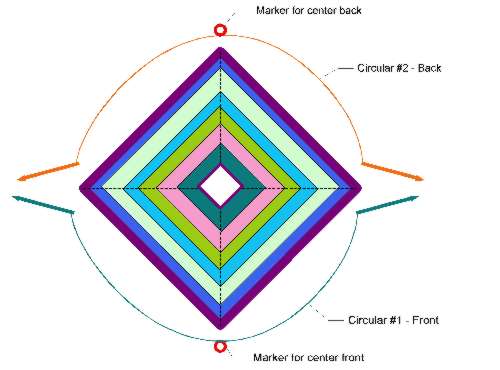
The two ends of Circular #1, shown in teal above,are used to knit the front. #1 **always** stays on the front of the work. The two ends of Circular #2, shown in orange above,are used to knit the back. #2 **always** stays on the back. At no time does the entire piece end up on one circular needle, nor at any time am I working with an end of Circ #1 in one hand andan end of Circ #2 in the other.
One advantage of this method is that the stitches are nice and spread out instead of being jammed onto one needle. I can call the Target Kid over and try the piece on without having to transfer stitches to a piece of string. I can also add another needle or two if the poncho grows too wide to handle with only two needles. While I don’t find this method of special advantage for socks (immodestly, I’d say I’m wicked fast with standard DPNs), I do like it for large pieces knit in the round, and for sleeves.
I’m still not sure if the neck hole is too big or not. It looks o.k. for now, and fits well over my daughter’s head, but I’ve seen ponchos stretch out due to their weight. When the piece is done I’ll check back. I might haveadd a few rounds of K1, P1 rib (with mitered decreases) to tighten up the neckline. If I decide to do so I’ll pick up stitches on the inside at the base of the rolled collar and knit them up from there, leaving the rolled outer edge as a trim detail.
GORE PLACE SHEEPSHEARING FESTIVAL
Hello to everyone I bumped into yesterday at the Sheepshearing festival in Waltham, Massachusetts. Please excuse me for not naming everyone I met, but I am afraid if I try todo so I’ll leave someone out. The sun was bright,andthe air was cool – perfectwool weather. My daughters and I were there from around 10:15 or so to 3:00. If you saw someone in a crayon-bright flash sweater, followed around by a little girl in vertical orange/yellow stripes and a larger pre-teen in blue, that was us. Also apologies that there will be nophotos of the eventhere. I’m not of the pix-as-part-of-the-experience crowd. I never quite remember to stop what I’m doing at the time in order to document it. I had the camera in the backpack, but somehow it never tunneled out from under my day’s purchases, and never saw the light of day.
In spite of the perfect sweater weatherI was disappointed (as usual) to see how greatly Polarfleece wearers outnumbered wool wearers, there were quite a few notable hand knits in the crowd. I saw a couple of really nice mosaic knit cardigans and coats, several hand-done Arans, a couple of Fair Isle style stranded sweaters plus twoScandanavian-style sweaters(one was a Dale Nagano, the otherpossibly from Norsk Strikkedesign), a whole flock of little kid cardigans, hats and pullovers,several very nicely done Intarsia pieces,a long-length coat done entirely in cables, a Surprise-style vest. I also ran into someone buying yarn for a Rogue at one of the yarn booths. There were other great looking hand-knits around (including quite a few pairs of socks). Please forgive me if I neglected to mention yours.
As far as yarn/fiber vendors – there were about eight, including some animal-to-skein outfits outside the main fiber tent and a booth from Minds Eye Yarns, a local Cambridge, MA store catering to spinners, dyers and knitters in with the sheep and llama farm yarn people. One outfit was selling whole fleeces (apparently you could also bid on the fleeces from the Gore Place sheep if you were there at the right time). I got a couple of skeins of rustic styleAran-weight from the At Nick’s Meadow Farm booth. They’ll end up as a felted pillow, similar to the one I described before. I’ve used their wool before, and found it an excellent value for the type. Joie de Vivre Farm,was there too, with some of their Mostly Merino, in fingering, sport, worsted and chunky weights. I did get a little bit of hand-spun fingering weight Merino from the Greenwood Hill booth. I’ve just added the basic info for their yarns to the collection, no reviews yet, though. I’m thinking it may be enough for a couple of simple lace scarves to be lagered away as future gifts.
Verdict? A grand day out in the only glorious day of spring weather we’ll probably get here this year (we don’t usually have many). Meet me there next year!
WORKING REPORT – SUEDE T DONE!
A few zillion ends later, here’s the result. My Shapely T done from Berroco Suede.
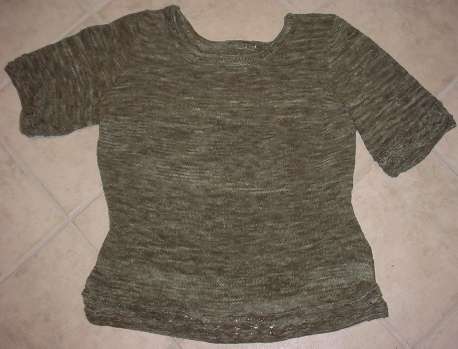
Overall summary – a @*)% to knit, nice effect though. A bit spongy andheavy (meaning weighty) for a summer T, but living in Massachusetts that shouldn’t pose a problem. I sewed up using the yarn itself, in mattress stitch, so the seams are invisible. I used this method to sew on the sleeves (page down the PDF for the English text). Because the yarn is all nylon, I didn’t bother blocking it first. I’ve been warned thatSuededoes stretch a bit in the wash, so I will probably stick to dry cleaning for this piece.
The pattern was excellent. I had no problems using it as a point of departure, tarting it up with additional trim at hems and neckline. I like the lay of the body, the shaping makes it quite comfortable and flattering, but I’m less pleased with the way mysleeves turned out. I did make them longer than the directions specified, but they seem baggy inthis rather un-drapey yarn. Perhaps if I use this pattern again I’ll use one size smaller sleeves. For the record, I knit this following the size 44 directions, so there’s plenty of scope for people who wear larger sizes to use the Shapely T pattern.
What am I going to do next? I’m not sure. I’ve got the Cursed Socks to tuck away, but that’s only a couple of evenings of work. I did indulge myself last week and get some Mountain Mohair Wool Crepein the color "Alpine". It’s listed in the yarn review collection as being a bulky, at 2 stitches per inch for the manufacturer’s gauge, but that seems wildly off. Although my label stats match the entry in the collection, the stuff I havelooks quite fine. Allowing for the boucle texture, it looks like it would knit up at sport or DK weight.
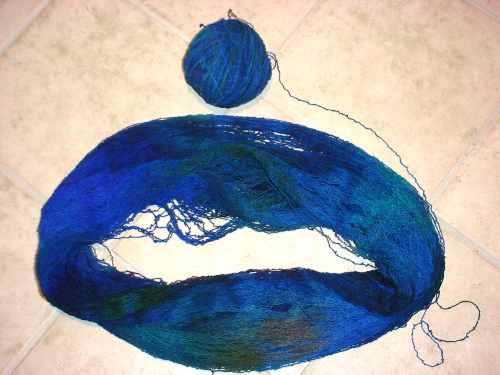
Perhaps the 2spi is a recommendation for lace, as this yarn is most often used for lacy shawls. I plan on making another short-sleeve pullover (I should have just enough if I’m frugal with the drape and keep the sleeves short. I want a more opaque look. I’ll be swatching over the next several days. One thing I want to do is to play with the hand dyed color. (Yes, the blues are as intense as the photo shows.) I’m thinking of knitting something where the colors bounce back and forth in narrow strips, perhaps body-wrapping diagonals or straights.Here are some sources of inspiration from one of my all-time favorite knitting sites (no patterns available):
- Vertical narrow strips
- Another vertical strip, but slightly wider
- Nothing to do with the strip idea, but I love the lines
Off to swatch and stew.
On the house front? We’ve accepted an offer on our place, and have signed the purchase and sale agreement on the new house. We’re on track to move come early summer. And here’s proof that for one brief and shining moment in my life, my desk (wiseNeedle Central) was clean.

PROJECT – ZEN SCARF, HOUSECLEANING
First apologies to the few of you who subscribed to receive notification of site updates. You must have been going nuts since last night because I gave up on Picserver, and ported all of the photos here to a new server. It wasn’t my intent to pepper you with update notes, but I couldn’t turn off the notifications from here. I promise the housecleaning is now over.
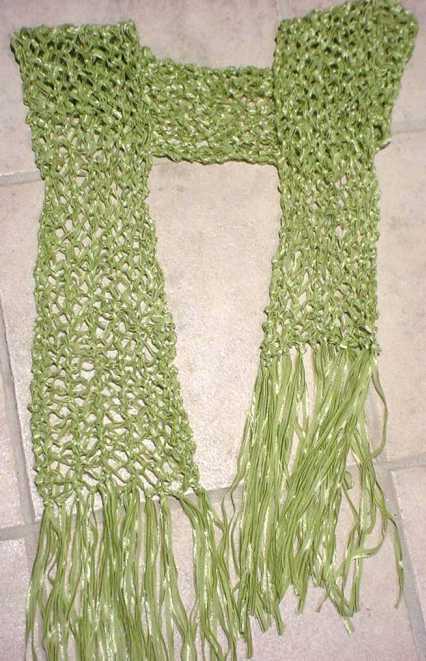
Rick-Rack Mesh Scarf in Berroco Zen
If you’ve ever met me you know I’m absolutely delighted at the prospect of the New Knitter Invasion, but at the same time my eyes are glazing over at all those novelty yarn scarves. I’ve done a few on special request, or as gifts for family and friends – but by and large, I find them pretty but intensely boring (hence my Kombu Scarf pattern).
Still, my pal Pat shop managerat Wild & Woolly in Lexington, MA (my local yarn store) asked me to help her come up with something fun to do with Berroco Zen, a ribbon yarn that’s been overlooked in favor of flashier novelty yarns. I couldn’t say no. (For some reason, Zen is in the yarn review collection twice, so until I get that fixed,there’s another set of reviews here).
Here’s what I came up with:
Here’s the pattern. Eventually I’ll add it to the free pattern pages at wiseNeedle.
<p
Rick-Rack Mesh Scarf in Berroco Zen
Materials:
1 Skein Berroco Zen or approx. 110 yards (102m) of a similar ribbon yarn
US #10.5 needles
Gauge:
Gauge is difficult to measure, but finished scarf will be about 5 inches wide by about 56 inches long (exclusive of fringe).
Instructions:
Using half-hitch cast on or other stretchy cast-on, cast on 14 stitches. Knit one row.
Follow Rick-Rack stitch pattern until scarf measures approximately 56 inches long.
Rick Rack Stitch:
Row 1: K1 (YO, slip one stitch as if to knit, K1, pass slipped stitch over)6x, K1
Row 2: K1 (YO, slip one stitch as if to purl, P1, pass slipped stitch over)6x, K1
Bind off VERY LOOSELY.
Cut remaining yarn into 18-inch lengths, and attach to ends of scarf as fringe.
2004, Kim Brody Salazar, http://www.wiseneedle.com. Not to be duplicated on other websites or in print without permission of the author. Pattern for personal use only. Please contact the author if you wish to make this item up in quantity, even if it is for charitable sale or donation.
PROJECT – FULLED MANOS PILLOW
Still in hurry-up-and-wait mode, I find myself with a bit of extra time so I extend today’s entry.
Here’s a past project that was quick, easy, and turned out quite nicely. It’s a pillow inspired by a similar one appearing in Shangold’s Design Source book of Home Decor. This pillow is sitting on my daughter’s bed. As you can see,my tween-ager hasgot a starry-night/dragons theme thing going in denim blues and raspberry/magenta.

I liked the idea of a tube pillow secured by six buttons as shown, and I happened to have six large mother of pearl buttons on hand. They looked rather lunar to me, so I thought they’d go nicely with therest of the celestial/mythical beast stuffalready in place. I stewed around on the idea for a couple of days before mentioning it to the Target Kid. She was thrilled so I went ahead. (Major hint: Never knit anything as a surprise for someone between the ages of 9 and 19).
In truth I only had a glimpse of the book and didn’t work my pillowfrom the directions, so I can’t speak to whether orthe inspiring object is also knit in the round, but this is how I went aboutmy pillow.I used two partial skeins of Manos left over from previous projects (the magenta and the pale blue), plus I bought one new skein of the indigo blue. I wanted to do symmetrical stripes, but I didn’t want toweigh my yarn and divide it into equal quantities and/or figure out how big each of the stripes should be, so I took the lazy person’s way out.
I don’t have any working notes, but I believe I used either a US #9 or #10 needle, and gotsomewhere in between 3.5 and 4spi in garter stitch before fulling the piece. (A figure of100 stitches around seems to stick in my mind, but I won’t swear to it.) I started with a provisional cast on, and knit a garter stitch tube using my entire skein of the darker blue. Then I wound my magenta and light blue into center pull balls. I "woke up" the stitches at the bottom of the dark blue stripe, placing them ona secondcircular needle. then using both the outside and inside ends of the contrasting color yarn, I worked the same number of garter stitch ridges of the light blue on both ends of the center, darker stripe, continuing until I ran out of yarn. I repeated this with the magenta.When I was doneI had no yarn left over at all, a dark blue stripe in the center, and equal size stripes of light blue and magenta framing it. Ready to full!
First I tossed the finished pillow in the washing machine and dryer, but my washer is too gentle. Even in a hot wash full of towels not much fulling action happened. I ended up beating the daylights out of the piece by hand, plus washing it at a friend’s house in a washer and dryer that arefar more vicious than mine. That finally worked.
The finished pillow is nice and dense, cushy even. It shrank about 40% in length (that’s the direction across the stripes), but only about 20% in width (the directionparallel tothe stripes themselves). Final post-fulling measurements are about 20 inches around the pillow’s belly, and about 15 inches end to end.
After my tube was as fulled as it was going to get, I bought a standard baby pillow form. That’s a pillow about the size of the small onesfound on airplanes. Most of the crafting websites list 12"x16" as being the standard, but I think mine was either a tad smaller, or was so squishy that it easily wadded up to fit.
I sewed on the first three buttons, taking my fastening stitches through both sides of the tube. This effectively closed off the first end. Then I sewed three oversized coat snaps to the inside of the pillow’s other end, taking care to locate them exactly underneath the spots where I would later sew the buttons. Once I had the second three buttons placed, I jammed the mini-pillow into the tube and snapped the open end closed. All done! One finished pillow; one delighted pre-teen, and something for the stuffed dragon to lean upon.

