MARVELS OF MODERN TECHNOLOGY
I’m sure others have blogged about this already – needles with built-in sensors that
log the stitch count for you. There’s a base station that
displays the count, and appears to have holders to park the needles
when they’re not in use.
I can’t find any confirmation that this has moved beyond prototyping
into the realm of a real product, but regardless of development stage I
would have some questions for the maker:
- Are the sensors adaptable to any size needle, or is the knitter locked into using only one size?
- What is that size, and how long are the needles?
- Does it equally sense the movements of both throwers and pickers (British/American and Continental styles)?
- How does it handle complex stitches?? For example, would it
log a SSK as one stitch or three – counting the three movements it
takes to produce it as separate stitches? - Can you dial up or down to readjust stitch count and compensate for multiple movement stitches?
- Is there a memory function?? For example, if I sit down and knit today will it remember where I left off yesterday?
- Is it possible to get interim counts, kind of like the way you
can use trip set on a car odometer to record smaller intervals??
This might come in handy if one wanted to track a repeat in addition to
tracking total stitch count. - Does it handle row count?? (For most knitters, row count is a far more annoying tracking problem than is stitch count).
- Is there an upper limit? For example, if I work a flat piece in a
tiny yarn, I could easily have a couple hundred stitches across, even
on a 14-inch straight. - Does the count span rows, or is it set up to track on a single row basis?
- How sensitive is it to spurious movements?? For example, if
I bobble the needles as I reach for something or flip the work over, will that increment the
count?
I’m not about to run out and buy something like this, even if my
questions were all answered, but it’s very interesting to see some
creativity and technology applied to the problem.
For me, low tech is still the way to go:? my stitch marker abacus
for tracking rows, and for those projects where I need to know count
across at all times (very few and far between), a series of stitch
markers placed every 10 or 25 stitches (or between repeats), as counted
out from the center.
KNITTING NEEDLES VII – BRITTANY, CLOVER AND CRYSTAL PALACE
I have to admit that I’m no longer a big fan of wooden and bamboo
needles. I liked them when I was just starting out, but as I got more
miles under my fingers, I developed a serious desire for speed. These
days I stick to shiny, lethal looking metal needles, and only pull out
the woods and bamboos when I have to tame a particularly nasty and
slippery novelty yarn. Since I detest working with those yarns, my
non-metal needles are no longer part of my first bench team. Still, I
do have some experiences to report. Note that elswhere on String I’ve got more on comparative sizes and their metric equivalents, and on comparative needle lengths for circs.
Crystal Palace
Crystal Palace markets Japanese-made bamboo needles of several types:
- Single point, 9 inches long, size US #0-19
- Single point, 12 inches long, size US#0-19
- Double points, sets of five, 8 inches long, size US#0-15
- Double points, sets of five, 6 inches long, size US#0-8
In
general, these are smooth, nicely finished bamboo needles. The single
points have rounded wooden beads on the non-business end. Tapers are a
bit less pointy than metal needles. I’ve found the smaller sizes to be
a bit less fragile than the same size needle in wood because the bamboo
tends to flex and stay bent rather than bend and (eventually) snap, but
even so – if you are someone who routinely finds that your metal
needles sport a scimitar-like curve after use, you might find these in
sizes smaller than US #3 to be too fragile for extended use.
One
other word about bamboo needles in general, sometimes the tips denature
a bit, especially if they get damp. When that happens the consituent
fibers that make up the bamboo fuzz out a bit and begin catching on
one’s work. I haven’t knit with enough Clovers and CPs to be able to do
a comparison between the two lines, but this has happened often enough
to be noticeable. A smooth down with very fine emery paper helped get
rid of my tip burrs.
Takumi Clover Bamboo
Very
similar to the Crystal Palace bamboos, the Takumi are smooth finish,
with moderate tapers, and wooden beads on the ends of the single
points. The beads are more barrel than round, but the look is very
similar. They come in a wider range of lengths, but fewer diameters
than CP. Current offerings on their home website include:
- Single point 13-inch long, size US#0-10.5
- Single point 14 inches long, size US#11-15
- Single point 9 inches long, size US #3-10.5
- Double point sets of four, 7 inches long, size US #0-10.5
- Double point sets of four, 16 inches long, size US #3-10.5
I also see these other sizes listed at various vendors
- Single point 16 inches long, size US #17-19
- Circualrs 16 inches long, plastic cables, sizes US#3-15
- Circulars 24 inches long, plastic cables, sizes US#3-15
- Circulars 29 inches long, plastic cables, sizes US #3-15
- Circulars, 36 inches long, plastic cables, sizes US #3-15
- Flex (Jumper needles), 20 inches long, sizes US #3-15
The
largest difference between the Crystal Palace and Clover circulars is
the nature of the join. CP uses a metal cowling into which fit both the
needle end and the cable. Clover slots the cable into the butt end of
the needle itself, tapering the cable so that it joins the end of the
bamboo part smoothly. I can’t speak to which is better because I have
not used them extensively. I will say that the Clover cable seems a bit
stiffer than the Crystal Palace cable.
The Clover form factor
I have used quite a bit is the Flex jumper needle. Jumper needles are
sort of a hybrid between circs and straights. They’re used like
straights, but being flexible and whippy at the end allow the weight of
the work to puddle on the lap similar to circs. I have several friends
who prefer straights, but because of limited hand mobility find even
short straights tiresome or painful because of the leverage caused by
the weight of the project on the ends of their needles. They greatly
prefer jumpers to classic straights. I also liked them because I used
to knit quite a bit while riding on the Washington, D.C. subway.
Jumpers minimized the threat level for the rider sitting next to me. No
needle ends were waving about at the edge of his/her space. (Yes, using
circs flat is good for this, too.) I did have problems with my Clover
tips furring, especially in the humidity of a Washington summer.
Eventually I switched entirely over to metal needles, using circs in
the flat rather than jumpers.
Brittany
I
adore the look of Brittany needles. I’ve broken about a dozen over the
years. Some died in the course of normal knitting. Others were in-bag
or sofa-side casualties. Again, while I like the look, these aren’t
among the needles I reach for first.
Brittany makes several styles of needle:
- Single points, birchwood, 10 inches long, sizes US #3-17
- Single points, birchwood, 14 inches long, size US #3-17
- Double points, birchwood, sets of five, 7.5 inches long, sizes US #0-17
- Double points, birchwood, sets of five, 5 inches long, size US #0-17
- Double points, birchwood, sets of five, 10 inches long, sizes US#0-17
The
birch single points have simple but pretty turned ends. Tapers are
slightly less pointy across the line compared to bamboo needles. They
also tend to be a bit more slick than bamboo, but are still nowhere
near as slippery as metal. Some people who are fond of wooden needles keep a piece of nice lanolin-rich fleece or roving around, and rub their wooden needles with it after use. I’m not entirely convinced that this helps, as most of the wood and bamboo finishes used appear to be some kind of polyurethane or other plastic. I doubt the moisture can penetrate the finish, but I guess special care can’t hurt.
Brittany
also used to sell walnut
single points with more ornate turned ends. It doesn’t look like they
still carry the line. I’m not surprised, as my walnut needles did tend
to both dry out and break more than did my birch ones. Over the years I
am responsible for the demise of about five pairs of walnut needles,
ranging in size from US #10s (trodden upon) to US #5s (mashed when my
knitting bag got clipped by a revolving door). I’ve also snapped quite
a few birch single points. I took to using them for traveling back
before
metal needles were added to the list of allowables on US domestic
flights. I must have the finger strength of a moose because I can break
birch up to size US #5 clean through just by knitting with it. I
do prefer these harder woods to bamboo though. They’re smoother,
especially at the tip, and their finish is more satiny. They’re nice tools. Now if
only I could learn to knit gently.
NORMALCY? WHAT’S THAT?
I have now survived my week from hell, managed to recuperate (somewhat); and we have returned the house to something resembling order. It’s not a very close resemblance, as this family’s housekeeping skill set is rather deficient, but horizontal surfaces can now be seen, laundry is no longer threatening to avalanche, and a machete is no longer needed to find the front door.
Add to that some progress on my counterpane:
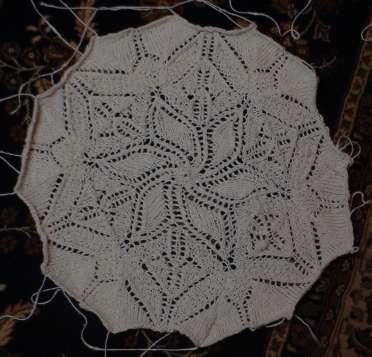
As you can see, I’ve finished the first meta-motif, including seaming in the corner triangles. It’s a bit smaller than my original estimate, but not by much. Plus it will be stretched a bit not only in the blocking, but also by the natural tension of the surrounding motifs once it is in place. One thing I’m pleased with is the lack of cupping in the center hex. Too tight blocking plus that extra seam between the bottom of the squares and the sides of the hex constrained the stretch of the thing the last time around. Working the squares directly onto live stitches around the hex appears to have eliminated that problem.
Now there’s a new thing to consider. I’ve got a dodecagon (a twelve sided figure) here. Right now the triangle units are knit base to tip. But if I figure out a way to flip the design over, it’s conceivable that I could translate the thing into a tip-out piece. AND if I can do that, it’s possible for me to add those units to the squares, already worked center out, and instead of a bunch of smaller seamed pieces, produce the twelve sided meta-unit as a single piece.
Food for thought here…
QUESTIONS – NORTH TRURO COUNTERPANE
How do you start the hexes?
There
are quite a few ways to start off a flat knit piece done both in the
round and center out. I keep gravitating back to the I-cord method.
This piece is a hex, so I start by casting on a three-stitch I-cord,
and working one round (I’d start off an octagon with four stitches). On
the second round of the I-cord, I take my first needle and knit one,
then make an increase in the space between the just worked and next
stitch. If I want a more open center I’ll do a YO. If I want a more
solidly filled center, I’ll do a make 1 lifted bar increase (a devil to
do on the second round of an I-cord). Then I’ll take another needle and
repeat the K1, increase 1 unit. And again on a third needle. Now I have
three needles in the work, each bearing two stitches, plus one in the
hand to work with. At this point I flip over and begin following my
pattern. For an octagon, I’d do much the same, but with a set of five
instead of four needles.
Why bother with the multiple units when you can just assemble the hexes into a perfectly good counterpane?
For pretty much the same reason I make cassoulet instead of being happy with franks and beans.
How big are your motifs?? How many are you planning on making?
It’s
difficult to get a gauge on this stuff, but if forced, I’d say I’m
getting approximately 6 stitches and 8 rows per inch over the
stockinette areas. Unblocked, my center most hexes are about 10 inches
across at the widest point. The squares are about 5.5 inches on a
side. The bases of the triangles are also about 5.5 inches across. One
entire meta-unit of hex surrounded by squares and triangles (unblocked)
is about 21 inches across. I haven’t measured my bed yet, but it’s only
a queen size. Given the vague bed linen sizes posted here
and there, my counterpane should be a square or a rectangle something
between 85 and 100 inches on a side. I’ll need at least 4 units across
and 5 units head to foot. Given my chosen layout, that’s about
four rows of four units, plus three rows of three units, or 28 units.
That adds up to 28 hexes plus 168 squares and 168 triangles. Plus
half hexes, and the smaller units needed to square out the edges
somewhat (they’re never going to be exactly linear), and an edging of
some unknown depth. I’m not quite sure how many of the other shapes
I’ll need yet.
Doing the same size counterpane using only the hex units would mean
making about 10 rows of 8 units, and 9 rows of 7 units – that’s 142
hexes, plus edge half hexes and a border.
This project should keep me busy for a while.
NOTHING DOING HERE, MOVE ALONG
There’s nothing like a flurry of activity at work to make one feel
appreciated. I feel very appreciated right now. My
priorities being in the right place, there’s been precious little
knitting here since my return from vacation. I anticipate things
returning to the chaos that passes for normalcy here by next week.
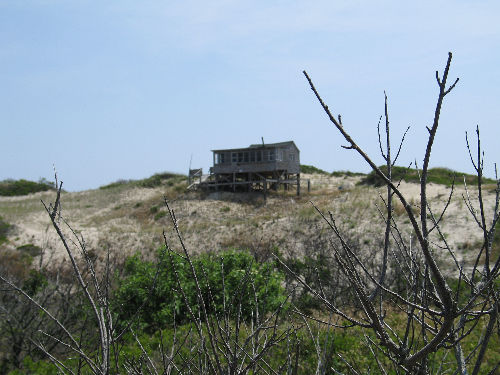
Even though I have no knitting or stitching goodies to share today, I can’t let you wander off unrewarded. Here’s another beach picture to contemplate.
This one was taken last Tuesday by The Resident Male, of a beach shack perched in
the dunes of the National Seashore near Provincetown, Massachusetts.
QUESTION GRAB-BAG
A few knitting and non-knitting related questions from the inbox:
How did Killer Bunnies go?
Tons of fun. We played as a mixed-age group, with the youngest
being 7. We had hoped to get the Red Expansion Pack at Puzzle Me This
in Provincetown, but they were out. We settled for Violet, the
next one in sequence. The game plays more smoothly if you add
them in order because each pack builds on the last, but we were able to
use most of the Violet cards anyway.
What size needles did you use for the two versions of your counterpane?
The old version in the heavier cotton was knit on one of my odd size
needles, it’s a set of old long steel DPNs, they’re probably antique 9s
– and just a bit larger than standard US #4s (3.5mm), but closer to #4s
than #5s (3.75mm). The new piece is knit on 3mm needles, which in
some makers’ lines is a US #2, and in some is somewhere between a US#2
and a US #3.
Did you finish that embroidery doodle while you were away?

Are you planning on assembling the counterpane in the same way as the last try?
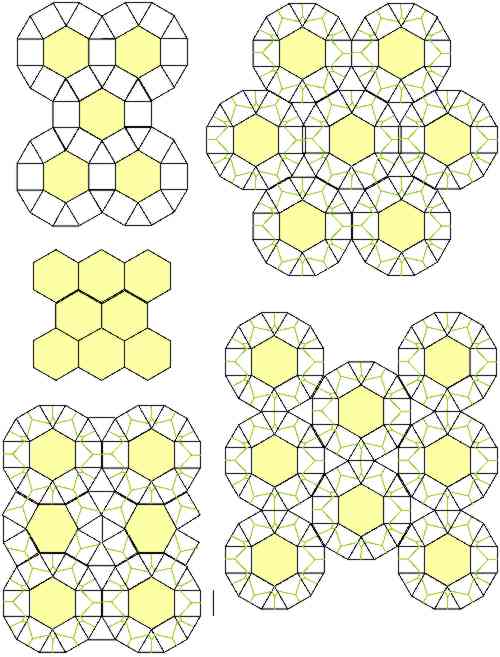
No. These units can be joined in many ways. Last time I
butted the triangles together. This time I plan to join
squares. My goal is to do the layout shown at the upper
right. Last time I used the one at the lower right. Both
use some plain solid triangles in addition to the pattern bearing units.
Where did you buy the counterpane pattern?
I didn’t. I made it up, starting with a standard spiraled
star. I added the outline-like bars to emphasize the motif, and
played with several treatments for the ground behind the star.
This one like my Mountain Laurel counterpane plays with a textured
ground and smooth star, but unlike that piece, plays a bit more with
the ground. I also wanted to do a counterpane that was an
tessellation of more interest than a flat tiled hex or a plain octagon
and hex. That’s why there are four units – the center hex, a
patterned square, a patterned triangle, and a plain triangle. The
layout above is actually an early draft showing how I played with the
concept, looking at ways in which I could use the patterned units to
extend the lines of the center hexes.
Can you send me the pattern?
Be patient. I plan on posting it to wiseNeedle this year –
probably after I’ve gotten considerably more done on the thing and have
a decent representation of the piece’s final look. I’d also like
to noodle up a complementing half hex and border.
RETURN TO REALITY
The only problem with starting out the summer with one’s vacation is that while there’s lots for the kids to look forward to in July and August, to me it feels like summer is already over.
While we had great fun on our week away, the weather wasn’t ideal. I didn’t mind the wet and cold because I was at my favorite place on earth – the beach in North Truro on Cape Cod. This is sunset over Provincetown, as seen from the deck of our room on one of the nicer days.

We had a couple of good beach days at the start of the week, then the weather turned cold and nasty. Luckily we were there with friends, and between good companionship and copiously applied wine, were able to keep both warm and entertained.
I did get in some knitting, but progress was slow. I was re-creating my North Truro counterpane pattern – invented in the very same spot – from my sketchy notes. I got off to a couple of false starts, regraphed some probelm areas, made some of the lines of the piece crisper, and played with various methods of joniing that avoid some need for seaming. Here’s the result:
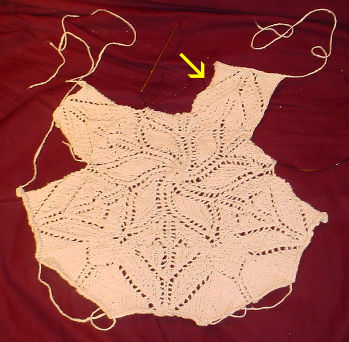
As you can see, I’m mid-motif. The initial unit is the hex in the center. I knit that starting on some 3mm DPNs, moving to a circ as it got larger. Instead of binding off, I purled my final row, and left the thing on the circ. Then I attached my yarn at what looked to be a good corner point, and holding the thing with the reverse side front, knit one side’s worth of stitches. That produced the appearance of two rounds of purl on the front at the base of my soon-to-be-knit side square. I then worked the side square out using two DPNs. I worked my side squares attached like this, one at a time. After I got a couple done, I knit a side triangle separately (it’s worked base to tip) and sewed it into place.
I also experimented with skewing the attachment of the square unit. Since it really doesn’t matter where on the center hex the sides begin and end, I knit one square on katywumpus – aligning its center to the point of the star instead of to the center of the leaf motif in between the star arms. You can see it above. It’s the lone square that I’ve pointed out with the arrow. I’ve decided I like the original orientation better and left it intact just long enough to photograph.
Well and good. Things look like they’re working out. I’ve avoided working all those squares separately and the seams joining them to the hex in the center. My bargain basement Webs-find yarn is working out well, with a very soft slubby cotton hand. I like it a lot. Compare it to my first iteration of this idea:

I don’t know if you can see it, but the older yarn is MUCH heavier. It’s a very dense cotton worsted – almost a twine. The newer yarn is a 90% cotton, 10% acrylic blend, and is somewhere between DK and sport in thickness, plus it’s much less densely structured than the older stuff. The lighter yarn drapes better, plus it shows off the motifs better. All in all, things look quite promising!
ALCAZAR – FINISHED. LESSONS LEARNED
That’s it! I grafted the final row of the edging to the first row to
make an invisible seam. I’m done except for blocking. That will have to
wait a bit as I am swamped right now, with no prospect for a large
block of free time with a floor to hand in order to play with the thing
before the latter part of July. Still, I’m done. Here’s a shot of my
Alcazar in all its rumpled, squished edge, pre-block glory that we can
use for comparison to the (eventual) post-block photo I promise to
plaster up here as soon as it is available.
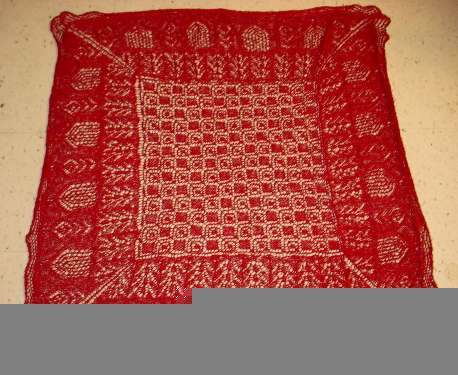
Unblocked
it measures about 40 inches across. If worked in the suggested needle
size with the suggested yarn, this shawl is supposed to block out to be
56 or so inches across. I’ll probably make it to 48 or so, tops because
both my yarn and needle were smaller than those recommended.
Lessons learned:
- Read the pattern and make sure you understand it before embarking on a project.
- Faux
silk (rayon) is a very unforgiving and unstretchy material from which
to knit lace. Care must be taken with gauge because it’s very easy to
knit too tightly. - Did I mention the "read your pattern" thing?
- There
are some minor quibbles in the pivot charts. Occasional one or two
stitch fudging is necessary to make the edging and corners come out
right. While I’d rate the majority of this pattern as "quite
straightforward and quick to knit if you’re comfortable with charts"
and "a challenge mostly because of size, not because of complexity"
those little problems might be enough to set a beginner off his or her
feed. But even a lace knitting beginner, armed with the knowledge of
where those little nuisances might be and the courage to work through
them, could complete this project.
Now what?
I have
the opportunity for some serious knitting time over the next week. I
had hoped that I’d still be working on this shawl, but wonder of
wonders – I finished early. I might pick up the Rogue again, but it’s
not particularly convenient for my target window (why will become
evident in ten days).
To be truthful, I haven’t quite licked
the lace/non-wool knitting bug yet. There are lots of options. I’ve got
some lace-weight linen in the stash. I’ve got a Rachel Schelling
pattern collection here somewhere. I could play with them together. Or
now that I’ve got the cotton to knit my North Truro Counterpane, I could restart that project. Other possibilities are the doilies on Yarn Over.
I have as little use for doilies as I have for shawls. They look fun to
knit, but I haven’t the inclination to use them. I could use a table
runner though. Hmmm.
Round-up – Needle sizes and Kitchener Stitch
Finally,
for those that are asking – I will return to the needle summary as soon
as I have time. Those data notes take a bit of research to write up, and
time hasn’t exactly been plentiful.
And on the Kitchener
Stitch documentation project, I’ve been in touch with a couple of
people active in historical British military kit research. They’re
branching out to their own networks, and have recommended some sources
that might confirm (or debunk) the notion that Kitchener’s revised
clothing specifications included seamless toe socks. No one has offered
up any other citations. So I’m still looking…
EMBROIDERY QUESTIONS
From the inbox:
How did you draw the pattern on the cloth?
I
didn’t. I have the design drawn out on a piece of graph paper. I’m
copying that design onto the fabric, using the weave of the linen as
the equivalent of graph paper. Each unit on my ground cloth is a two
thread by two thread square. I worked from the graph to establish the
outlines in the center motif, then "colored in" the long armed cross
stitch background. I worked the first repeat of the lettuce around the
edges from the graph, but subsequent iterations of it from the piece I
embroidered (much less cumbersome than toting around a book).
Was this stuff actually done on the count in the 1600s?
A
vast amount was. There are a couple of caveats though. Some people
assert that a minority of counted thread pieces worked on very fine
linens used some other method to establish the evenly spaced graph-like
appearance. In particular, they suggest that some sort of evenly woven
but easily unraveled fabric was placed over the ground cloth, and used
as a stitching guide. The stitching was done over the placement aid,
and its threads were later removed from the work. Other people suggest
that pouncing, either over paper or another fabric was used to produce
evenly spaced dots, which were then employed as the spacing mechanism
for the ground. I’m kind of skeptical on the pounced dots thing. That’s
a ton of very smearable dots in a very small space.
Another
exception is theorized for other forms of voided foreground stitching.
(Yesterday’s piece is voided foreground). Some of the panels look more
like someone drew the foreground motifs freehand, then filled in the
background with the covering stitch. Again I can’t confirm or deny
this. Some panels (especially those with repeats) look quite precise to
me – too stitch-precise and weave-aligned to have been freehand
sketches. To my eye, the few pieces that might have been done this way
are pictorial panels that have almost a folk-art type naivety of line
and motif placement. One of these panels is pictured in Bath’s Embroidery Masterworks. While it’s not a probability that all voided foreground works were done this way, it’s not a impossibility that some were.
I’m
sure the total state of research into the origins of voided foreground
styles and Assisi embroidery has gnawed into this problem. I haven’t
kept up my reading in it of late. My long time pal and needlework buddy
Kathryn Goodwyn has an excellent article
on voided foreground stitching on line (this group of styles is her
specialty). She mentions the hand drawn outline variant as a curious
offshoot.
Are the colors accurate?
Green
wasn’t the most popular but it was used. However the natural color, brownish unbleached linen I had on hand wouldn’t have been used. A historical stitcher would have preferred a much lighter ground. The accompanying black
outlines in this piece are also open for debate. Few pre-1700 pieces
employ contrasting color outlining, although most later examples of the
style do. The original of this design clearly employs two different colors in the work. Even in the black and white photo of the original (dated
1560-1625), the background is clearly a different color from the
outlines. The original also shoed background area behind the lettuce
north and south of the main panel as being worked in long-armed cross stitch – something I don’t intend to do.
(Lettuce isn’t a technical term for the extra borders framing the main
panel, it’s just my own term of reference).
Linen thread?
It
is out there. DMC has some. There are linen threads made by other
makers, too. But sometimes expedience wins. I’m not doing this piece as
a totally accurate historical study. It really is a doodle. I’m
playing. I happened to have the Flower Thread on hand, and it worked
nicely with the weave size of my ground cloth.
I’m offended. My 11-spi stitching isn’t "coarse!"
For
me, 11 stitches per inch on 22 count linen is much less fine than the
gauges I usually pursue. I prefer the look of stitching on a really
buttery thick 50-count linen (that’s 25 stitches per inch). Compared to
that work, 11 stitches per inch is as large as logs. My doodle is a
quick study, again not intended for any purpose other than to let me do
some stitching at events, and for the fun of it.
What does the back look like?/Do you use knots?
My
backs are relatively neat, not because I’m a fanatic about making them
so and not because I believe that that’s the way they should be. My
backs are neat because that’s the way I stitch (historical pieces often
have absolutely chaotic backs that would make most modern needlework
judges recoil in horror). And yes – heresy of heresy – unless I’m
working something that’s intended to be totally two-sided, I do use
knots. No – if done carefully they don’t pull out or show through to
the front. Savage me if you must, but I reserve the right to ignore you.
What stitches did you use?
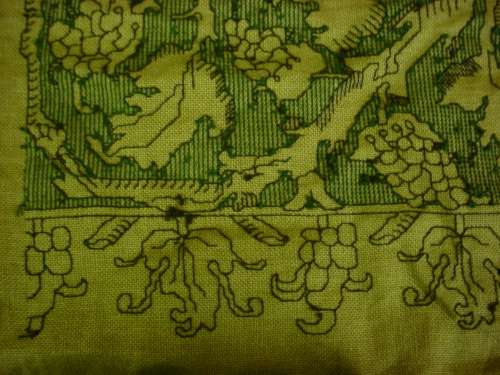
Double running (aka Spanish Stitch, Holbein Stitch, Vorstitch) for the outlines. Here’s a double running stitch mini-lesson
from the Skinner Sisters website. I could also have used back stitch, a
less represented but also historically accurate way to do them on
voided foreground works. Long armed cross stitch is less well known
than it’s X-like cousin with equal length arms, but it’s a very useful
thing. There’s a research article about it here
by Christian de Holcombe (another needlework pen pal), but a short
example of how to (along with quite a few related stitches) at this site.
Doodle?/What’s it going to be?
I
haven’t thought that far ahead. I’ll probably end up mounting this
piece for wall display. I called it a doodle because it’s an offhand
and trivial effort, a time-filler, and bit of life’s marginalia. It’s
not a Big Project, nor a planned project. It’s just… a doodle.
Your book is out of print, it’s o.k. for me to copy it, right?
No.
Absolutely not. Copyright doesn’t last until the publisher decides to
skip town, or drop the item from current inventory. US copyright lasts
75 years. Even if I get hit by a truck, that copyright is part of my
estate and would be owned by my heirs until 2070. Anyone who respects
authors, living or dead, should respect copyright.
I’m not an
ogre, hoarding rights and royalties (lord knows I’ve seen almost none
of the latter). I AM trying to get the thing back into print. One
publisher has turned me down flat in part because his research
indicated that illegal copies were being made.
So don’t do it,
as tempting as it might be. There’s more about copyright – in specific
your rights as a purchaser, as well as the author’s intellectual
property rights at Girl From Auntie and Yarnaholic Confessions.
DOODLES IN STRING
This weekend past we went to a local SCA event. We’re not very active
in the organization any more, but every now and again it’s fun to show
up and partake of the day. This particular day was quite warm, and we
arrived late – missing the most strenuous part of the planned
activities. We mostly sat in the shade and enjoyed various song and
story performances. In the evening a very ambitious dinner was served,
consisting of dozens of dishes from a recently translated 16th century
Italian cookbook.
I
keep a small sampler I work on when I go to events like this. Now that
I’m up to the easily replicated borders, I rarely stitch on it in
between events.
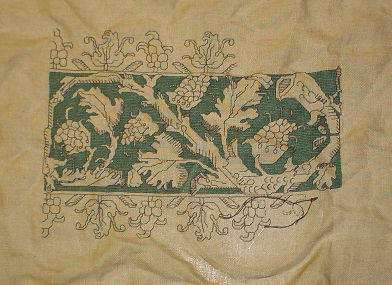
My doodle is worked on even weave unbleached linen, using DMC’s Danish Flower Thread. The
Flower Thread is a matte finish cotton. In construction this thread is a single
strand, as opposed to the more commonly seen multstrand
embroidery floss. Having used both, I find that for small pieces, this
thread mimics the look (but not the stiffness) of linen thread. I’m
working at at the extremely coarse gauge of 11 stitches per inch, on 22
thread count ground. It’s quick and easy to see.
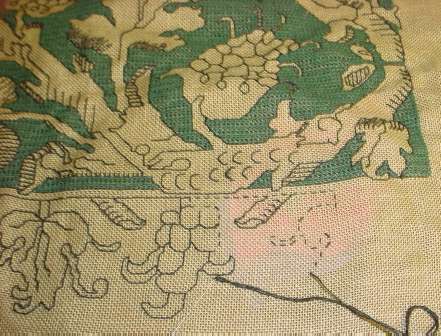
All
of the black lines in the piece are done in double running stitch (aka
Holbein Stitch, Spanish Stitch). You can see the bit in process, where
I’ve established a baseline. All of the "growths" from that baseline
are traced out and filled in again as I go along. The background is
done in long-armed cross stitch, worked back and forth across the piece
to heighten the illusion of a plaited ground. Since I’ve already done a
full repeat of the border, I no longer need to refer to my original
printed pattern. Also, because the whole goal of this piece is "quick
and portable," I’m not working it in a large rectangular frame. Instead
I’m using a plain old 7-inch diameter round tambour-style embroidery
frame. My matte finish single construction thread stands up to the
hoop’s abuse much better than does silk or even cotton floss.
The design is another one from my New Carolingian Modelbook. It’s on Plate 74:1. I graphed it from a photo of a late 16th or early 17th century artifact, appearing in Adolph Cavallo’s Needlework.
(New York: Cooper Hewitt Museum, 1974). What I like about this design
in particular is the way the edges of the work pop past the internal
border. The meaty branches have an almost palpable vitality, as if they
can’t be contained by the formal constraints of the stitching. Working
a solid background (as was done in the original) heightens the effect.
I’ve
only tried out one repeat of the central design. The historical piece
repeated the S-shaped flourish, mirroring it at either end. Since this
is a self-contained unit, it can be either mirrored or it can be
repeated in the same orientation to make a longer length of patterning.
Period embroiders used both methods of composition to construct longer
decorative bands.
 String-Or-Nothing