AMENDS
Modern Assisi work vs. historical voided work. I know that the counted thread stitching community lumps them together, but they are not exactly the same thing. What I call “modern Assisi” is the 19th century revival of voided stitching, that draws heavily on Italian folk and church embroidery styles, which in turn trace their roots back to Renaissance era voided pieces. And that late 19th century revival was again echoed in the 20th century, with the collection and republication of many patterns, and issue of new books on the subject.
Yes, both Assisi and earlier styles include prominent outlines usually done in double running or back stitch. And both feature largely unstitched foregrounds (sometimes with additional ornamentation) that contrast strongly with a stitched background.
One of the key defining characteristics of modern Assisi is the use of cross stitch for the background. That’s “plain old cross stitch (POCS)” – not long-armed cross stitch. The Renaissance era voided styles use many different ground stitches and approaches, but so far after looking at hundreds of extant examples, I haven’t seen any in POCS.
Which is why I got very excited when I stumbled across this piece. Now before you get excited too, I did NOT find the unicorn of POCS in pre 1650-era voided work.

“End of a Tablecloth” 15th-16th century. Italian, Sicilian or Spanish. Metropolitan Museum of Art, Accession 08.48.132
I made the mistake of idly browsing on my phone with its tiny screen, and jumping the gun I posted about the piece before I got back to my laptop and high resolution monitor. Obviously, once I was able to zoom in I corrected my mistake, but I did look like an idiot.
So to atone for my egregious lack of judgement, I charted the design in question, and make the chart available as a broadside, for your own personal, non-commercial use. Please do not republish my redaction or include it in other pattern collections.
CLICK HERE TO DOWNLOAD A PDF BROADSIDE OF THE CHART.
Some notes on this piece.
My redaction is not true to any one repeat of the design. Instead I averaged all of them, evening out replication errors as best I could, to arrive at a single, uniform representation of the motifs. All design elements are there, in correct proportion and placement to each other, but there will be small deviations between the chart above and any one of the artifact’s pattern iterations.
The background is not worked in POCS. It was worked squared and unlike every other example of the squared filling on historical works I’ve seen, the stitches were pulled very tightly, bundling the ground cloth’s threads together. Meshy techniques for grounds were very popular in the 1600s and 1700s, but every other example I’ve seen has completely covered the bundled threads with stitching, making a very hard-wearing totally overstitched square mesh ground. In this case the ground cloth’s weave does show through.
The squared filling was worked up to but not touching the outlines of the foreground motifs. A one-unit “halo” was left around them. I’ve tried to represent that on my chart. There was considerable “fudging” in the way the filling was carried into the nooks and crannies of the foreground design. I’ve chosen the least acrobatic of them to include in the chart. Note that there are a couple of deviation points where a diagonal stitch was used to carry the ground thread up into a narrow area of the design.
Colors. Your guess is as good as mine. The outlines and the ground fill are clearly two different colors. If I had to guess, I would probably opt for black for the outlines and madder red for the fill. But other color combos do exist – not every historical piece was done in black and red.
The outlines – double running or back stitch? It’s impossible to tell from just looking at the front. I do note however that the spots on the leopards are all connected to the outline. There are none just floating in space, which makes the piece easier to execute in double running than a piece with discontinuous bits. The only minor challenge in this one if worked in double running would be that little hunting dog. It’s a small area not connected to any of the rest of the design.
And finally, the complementing edging. Note that the squared background is terminated with little “fingers” that slant up and to the right on the top of the strip, and down and to the left at the bottom. I tried to get the whole repeat on the chart, but I ran out of room. For absolute fidelity, work the bottom fingers exactly as tall as the ones on top. Don’t truncate as I was forced to do.
The moral of the story? Check, double check, and do so on the highest resolution display device you have to hand. Never let your excitement run away with you.
EPIC FANDOM STITCHALONG – BAND 9
Bug eyed monsters waving ray guns in their tentacles! Mid-century era finned spaceships! Coming and going! Run! Hide! It’s an invasion, for sure and cheesy peril abounds. Or capture them for all time, frozen in your stitching. I recommend the latter. It’s far more relaxing to sit and embroider than it is to bolt away in terror.
Time Factor 2 – not particularly complex nor wide as the featured odd number strips go, but there is one small tricky bit. Note that the rockets flip and are symmetrical. BUT the little monsters mirror, alternating orientations where they are firing ray guns to the left or right.
134 stitches wide x 16 stitches tall. 2 blank rows left between this and the following strip. If worked as a continuous band, one full repeat in 23 units.
| Samples | Fabric Used | Stitch | Thread Consumption/ Notes |
 | 28 count evenweave | Back stitch, 1 ply | |
 | 18 count Aida | Back stitch, 1 ply | |
 | 28 count evenweave | Back stitch, 1 ply | About 2 yards |
 | 28 count evenweave | Double running, 2 plies | About 1 yard of red, 1 yard of green, .75 yard of blue, remnants of yellow |
As usual this band plus working notes and hints has been appended to the bottom of the write-up on the SAL page, accessible via this link or via the tab at the top of every page here on String-or-Nothing.
If you are working our Epic Fandom SAL either as a whole or as a strip excerpt, please let me know. It gives me great joy to see how my “pattern children” fare out in the wide, wide world, especially when they meet up with creative, playful people. And if you give permission, I’d be happy to share your pix of this developing sampler, it in its finished state, or derivative projects including one or more of the Epic bands here on String, in a gallery post, with full credit to you as interpretive artist.
Band 10 debuts on the Facebook Enablers group on Tuesday, 15 February and will be echoed here on 1 March 2022. Happy zapping until then!
LOOKING BACK
Two bits of nostalgia and a rant today, but no fine needlework, just some knitting. Apologies for the disappointment.
First a bit of fun nostalgia, and a reminder that family heirlooms needn’t be pricey bits of bling. As I was putting my new backgammon board away I found my chess set. It’s an unusual one, but not by any stretch of the imagination, precious. Except to me.
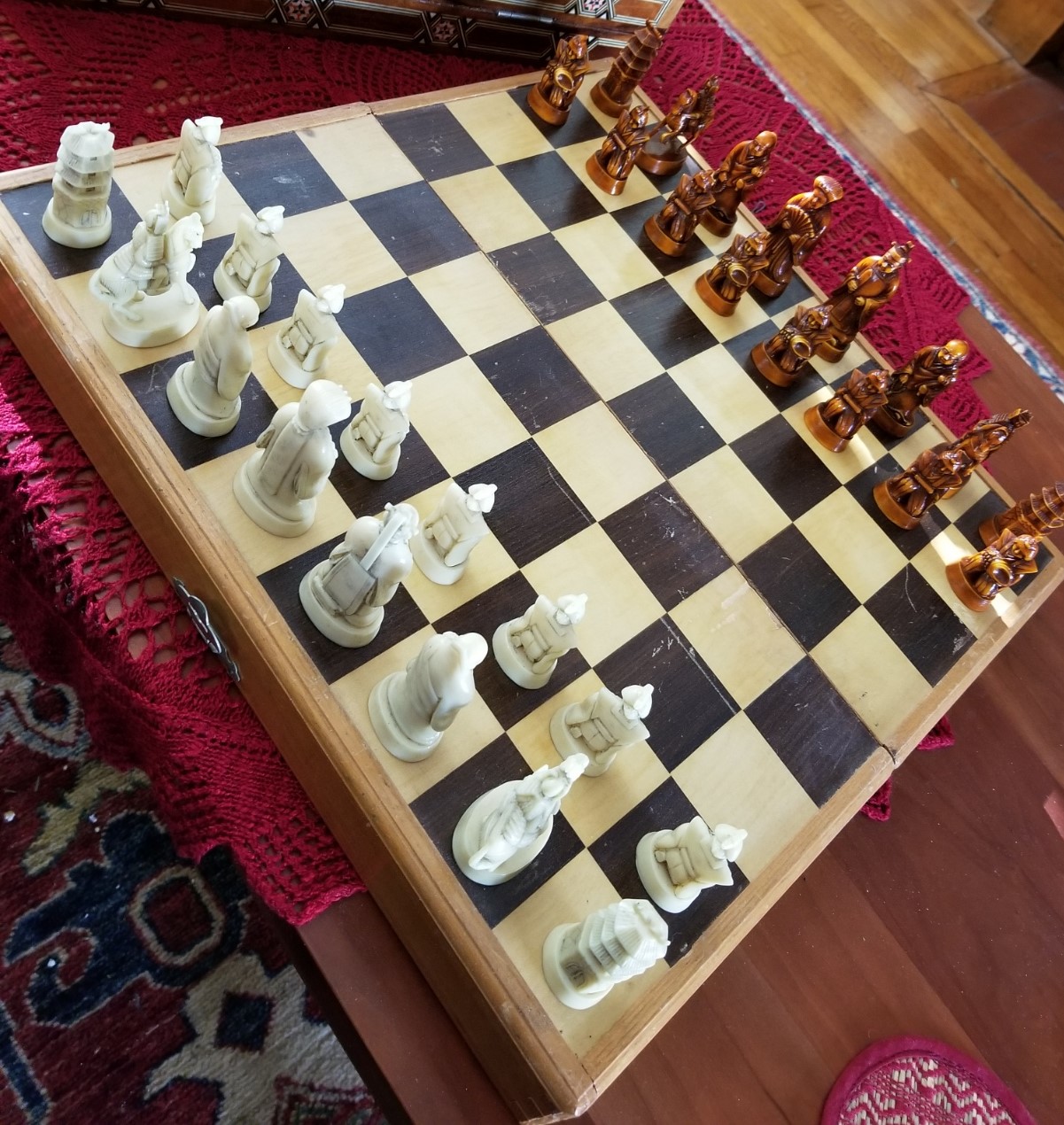
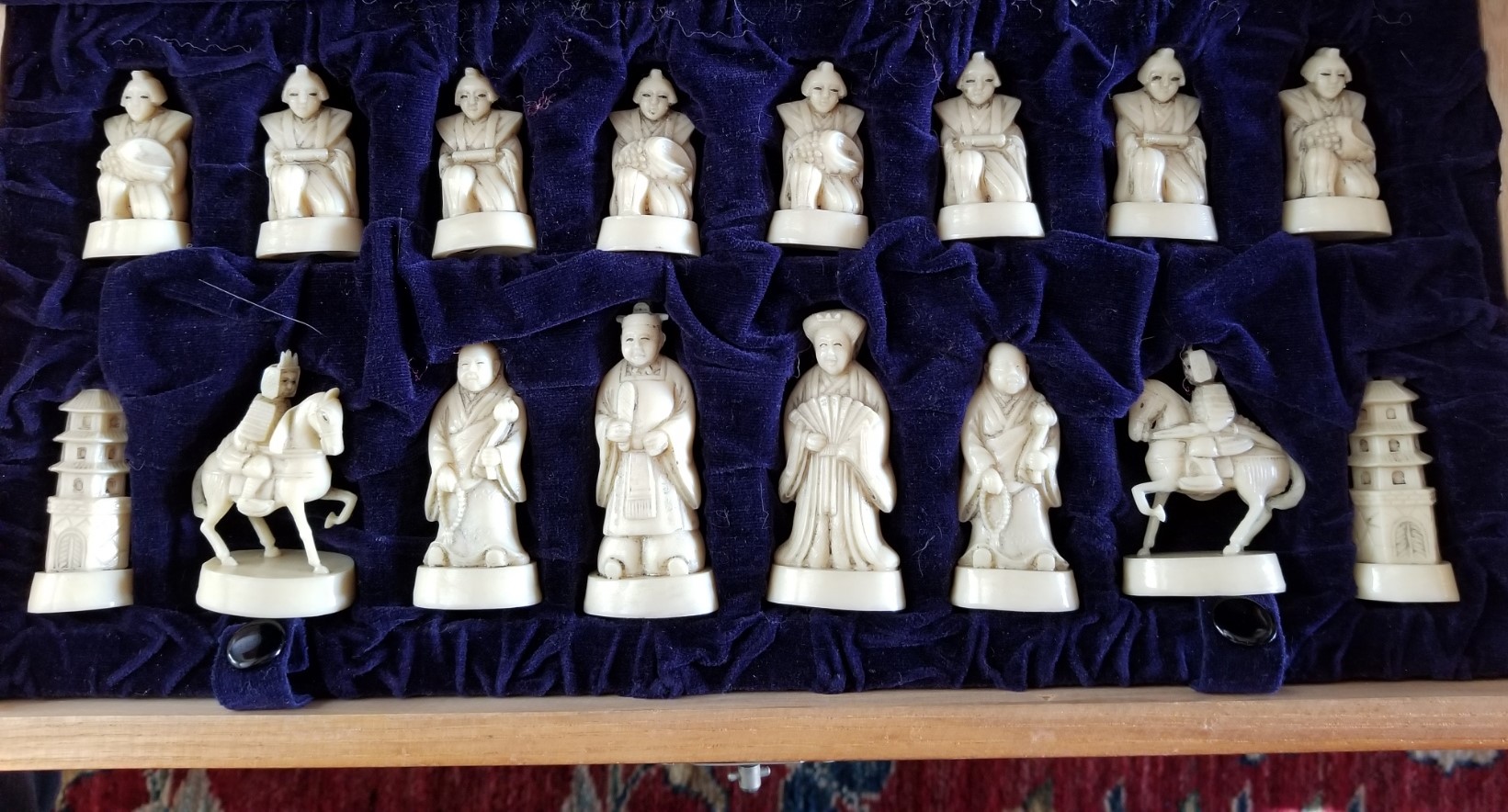

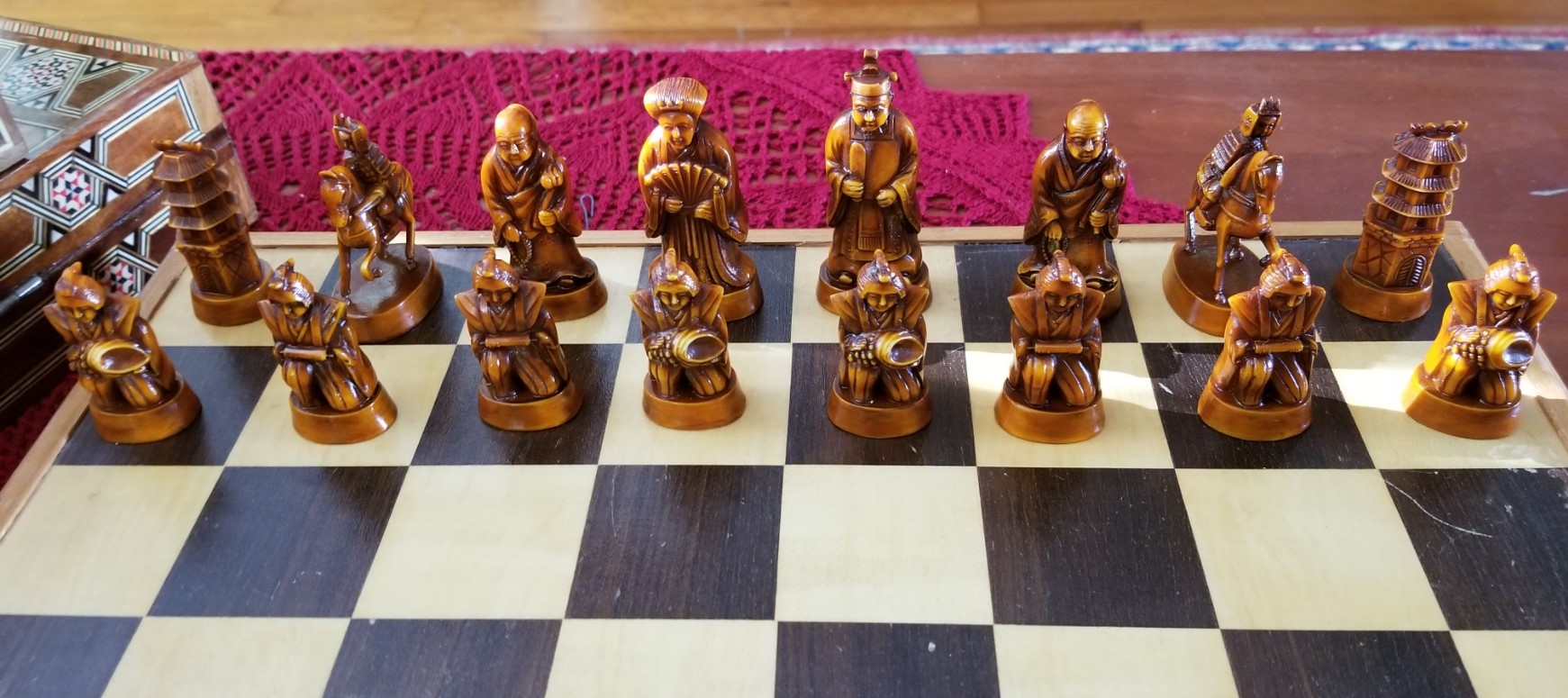
My grandfather Mack gave me the set around my 9th or 10th birthday. He had a jobbing print company back when you needed presses, engravers, and actual lead-set type. The company printed magazines including New York’s Social Spectator; pamphlets, brochures and catalogs; small private run books, luxe bespoken stationary, and even precision hand-engraved items like stock certificates. This chess set was part of a late 1950s/early 1960s catalog of some sort, but I have no record of what company it might have been made for. The board/box in which it came was damaged during the photo shoot, so he was able to keep it.
The set itself is housed in a very ordinary storage case/playing board. The damage is to one of the two velvet lined nests into which the pieces fit, but it’s not fatal. The figurines look to be inspired by fancy hand-carved antique ivory sets, but I believe they are some sort of plastic, each with a little “Made in Japan” sticker underneath. Still they are nicely designed with a netsuke-derived look. Especially the pawns, which come in two flavors – four bearing conch shells and four bearing scrolls.
Now my grandfather didn’t play chess – not to my knowledge at least, but I did. My dad had taught me the rudiments a few years earlier, and I read up on some beginner strategy. I never got good although I have retained a peripheral interest, even hanging out with the chess team in high school (they teased me by saying I was seventh board of a five man team). Younger Offspring is a far better player than I ever was, proving it by beating me soundly three times in a row many years ago, in spite of playing as a 14-year old hospital in-patient with a ruptured appendix, high fever, and under sedation.
I have designated this set as “an heirloom of our house” and in some ways, it’s fitting it’s only plastic.
——————————–
Now on to the rant, plus some wistful but non-visual nostalgia.
I just finished yet another pair of heavy slouch socks – mindless knitting to occupy the fingers while The Resident Male and I campaign through the first computer game we’ve played in more than two decades. I can watch for Imminent Peril, monitor vital statistics, and consult on strategy and puzzle solving, but not while doing more complex attention-sink type handwork. So socks it is.
I admit I was seduced by a yarn that even under best conditions would be marginal. It’s a sport weight polyester/acrylic blend from Lion Brand, “Moroccan Nights.” I was weak; seduced by the colors. I knew it was a long-repeat variegated, and bought two balls of the same color number and dye lot. They looked identical with the same repeat section on the outside of each ball. But….
This yarn is the absolute worst knitting or crochet product I have used in a very long time. So bad I would swear that this yarn was spun from the devil’s own nose hairs.

Yes, these two socks came from two balls of the stuff with the same color number and dye lot number (Magic Carpet, color 514-307, dye lot 16561). I don’t mind a long variation, but the color jumps on these socks are largely NOT due to continuous change in the yarn itself. Instead they are due to multiple knots in each ball that united color discontinuous sections. Every major color transition you see here means that there are two more ends to darn in because the knots were too slippery to trust. One sock has three knot-induced extra end pairs to deal with, the other has four.
In addition to the poor quality control in skeining, the yarn itself is impossibly unruly. It has a severe overtwist which makes it rat-tail around itself. The structure is two very flossy, barely spun strands of acrylic plus one thin thread of mylar or other shiny polyester metallic, wound together to make a rag-style yarn. The flossy strands split and fray, fusing together in the overtwisted rat-tails, and make stitch formation a nightmare. Constant stopping to let the work spin out and ease the overtwist is required. Decreases and increases are wrestling matches because the needles catch on every microfilament.
Yes, I concede that using this yarn for socks was over-ambitious. Perhaps big needles and plain garter stitch or crochet would have been a better choice. But usage aside, the basic twisty, frizzy, fraying, fusing nature of Lion Brand Moroccan Nights makes it an unpleasant experience at any gauge.
Now for the wistful nostalgia.
For many years I ran the on line Yarn Review Collection at wiseNeedle, my former website. It started as a plain text document passed around the old pre-Internet KnitList mailing list, in the early days when email systems were just beginning to branch out and connect with each other. Eventually, with the copious help of The Resident Male, it transformed into a searchable on-line database.
The whole thing was volunteer run. I was the shepherd, confirming yarn detail (gauge, yardage, ball weight, proper spelling/manufacture), and combed retail catalogs entering data for new base entries as yarns were released for sale. Anyone who wanted to could contribute a review, and many did. We appreciated achieved gauge, some indication of what the yarn was used for, and any comments – good or bad – about the experience of using it. Stuff like “tons of knots in each ball”, “yardage seems very short,” “sheds dye on the hands and needles while working,” “falls to pieces in the wash,” were common comments. So were things like “fantastic for the tight detail on a traditional gansey,” and “wonderful stuff, soft, and a at great price.” I even computed a value score, calculating the cost per yard for each review that reported the retail price, so folk could compare relative value.
The Yarn Review Collection ran for 13 years. The wiseNeedle website never accepted direct advertising payments although I did have some general audience ads (tightly controlled) to defray expenses of running the thing. But I took no in kind gifts or monetary payments from anyone in the industry, and refused all planted information – supposed “reviews” furnished by retailers, wholesalers and makers. For the most part wiseNeedle broke even or ran a bit behind, and I floated it from my own pocket. UNTIL.
Ravelry.
When the Ravelry site broke big time, traffic at all independent knitting websites plummeted. People stopped contributing reviews to wiseNeedle, stopped asking/answering questions on its advice boards, and even traffic to its free patterns plummeted. Eventually I was the only person contributing reviews, and my own views represented 80% of my weekly traffic. The String-or-Nothing blog subsection was the only thing that had even minor residual visits. So I threw in the towel, killed wiseNeedle and ported String to a new stand-alone venue.
Why dredge all this up now?
I really wanted to post a review of Moroccan Nights. I added a comment to the Ravelry yarn page for it, but in doing so noted that actual comments about the yarn are not exactly up front and center. You can see data on it and pix of it, see how many people have stashed it, see how many projects people have worked from it, and see a combined satisfaction score of the projects (not the yarn itself); but the comments section is a second tier behind the data cover. What’s presented is superficially and inadvertently deceptive. A 3.9 star out of 5 review for this stuff? Not. Will anyone page through and see the actual feedback? Probably very few.
Moral of the story: If you ever want to use Ravelry’s yarn pages to find out more than simple data about a product, do hunt around for that comments link. Leave comments for yarns you have used if you feel that feedback would help others. And don’t rely on that star rating to indicate actual usability, quality or value of the yarn being discussed. It has nothing to do with the yarn, it’s all about those finished projects.
Am I going to reinitiate wiseNeedle and the yarn review collection? No. It’s too time, money, and materials intensive. There’s no way anyone can catch up with Ravelry, which is now a social and industry juggernaut in its own right. The halcyon days of the non-monetized Internet are over, and I refuse to accept subsidies. By doing so I compromise my principles by becoming a paid influencer.
Nostalgic and a bit exercised? Yes. Today I am. Maybe I need to go and knit something to calm down.
PRESENT TENSE, BUT RELAXED
I have been a very lucky recipient this year, with several fun things to share here.
First was a holiday present from The Resident Male. Noting our stellar lack of success growing a kitchen garden outdoors; our constant consumption rate for of parseley, thyme, dill, cilantro, and other herbs; and the fact that our house has a rather dark interior, he gave me an indoor, self-illuminated hydroponic garden. Which being terminally nerdy, I promptly named “Keiko” after the Star Trek xenobotanist and long suffering wife of Chief Miles O’Brien.

As you can see, Keiko is nearly foolproof. This is a photo of growth at three weeks. Dill is the tall boi. Basil is in the right hand rear grow pod, with Thai basil in front of it. I will report back when we begin to harvest. But so far, so good…
Far less technological but of equal and long lasting delight was a surprise present from Sytske, my Long Distance Needlework Pal (of Antique Pattern Library fame), who lives in The Netherlands. The mail carrier trotted up to my door with the box and rang the bell because it was an International Delivery and he didn’t want to just leave it on the steps. He’s a sweetie who goes above and beyond.
Sytske and I had an email pen pal chat a while ago about an inlaid backgammon board I had bought in Jerusalem while I was in Israel on a summer-long archaeology program between high school and college. She said she had a collection of various items of similar style. We also discussed old needlework tools, and a zillion other things. I was totally surprised at the goodie box I received. And overwhelmingly grateful as well.
First, there was a splendid backgammon board. The one I bought in the summer of 1974 is the smaller of the two. It was the least expensive in the shop, and even so being on a student budget, I bargained for it for the better part of week.
The larger, more ornate and resplendent one is from Sytske. Both are obviously of the same regional and iconic style, very common and extremely popular throughout the whole Middle East region.


The workmanship on Sytske’s board is far more elaborate, with finer inlaid decorations on every surface. Even top edges inside the box and the pieces are embellished. Mine is heavier and thicker, with fewer colors and less detail, and my pieces are plain olive wood rounds.
Now for holiday gatherings, should the yen to play strike us, we can run two games at once. And I think I’ll take some good furniture oil to mine. It’s looking a bit dry and upstaged by the new magnificence.
Wrapped inside the game was a mystery bundle. I unwrapped it carefully and found an entire collection of antique needlework tools!
First there were several bone crochet hooks, three long enough for Tunisian crochet. The tiny hook at the end, even though it’s extremely fine (think crocheting hand-sewing thread fine), I do believe is for crochet and not tambour embroidery because its point is quit rounded.
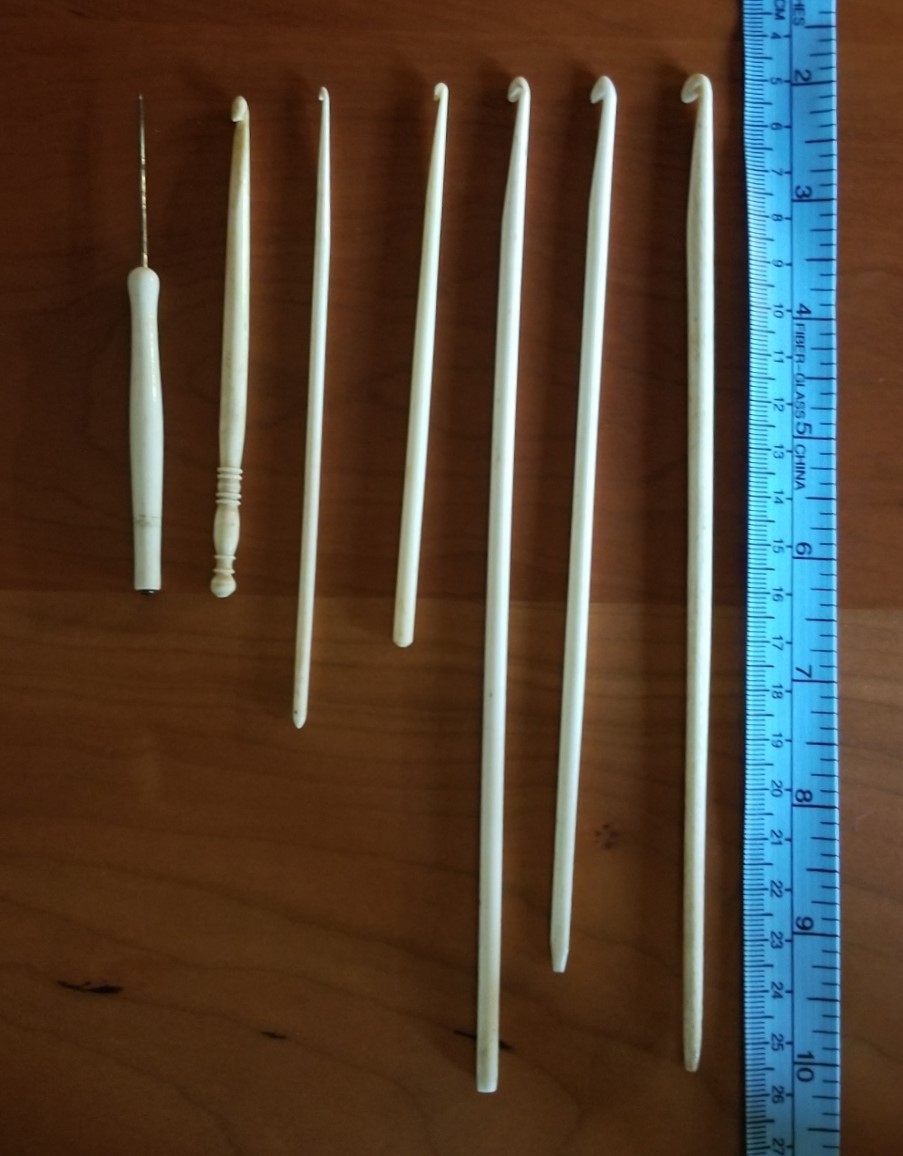
In addition to hooks, I now have a collection of small needlework assist tools. From the top, a laying tool that by its graduated thickness might also do double duty for enlarging lacing holes or forming thread circles to over-crochet; another smaller laying tool; one with a hole in the end that might have had a secondary use as a bodkin to assist in passing a drawstring cord through its casing; and two laying tools/sewing awls with metal points. Below the measuring tape are two other items – a flat “needle” that could also be used as a bodkin for a round or flat tape, but that is going to become my naalbinding needle; and a sweet little bone needle case, probably from the late 1920s/1930s. It’s the only item I can date, and I do so by its Art Deco shape and proportions. It still has a couple of well worn long plain sewing needles in it.

I’m not done yet. There is more! This is a collection of handles that were probably for tambour embroidery needles (aka aari) or for thread crochet hooks. These are truly impressive because (at least here in the US) they are rather uncommon. A couple of the metal ones may be silver, but they are too small for hallmarks or stamps.
The ones above the measuring tape all have little screw-on ends, hiding a storage compartment where the hooks or needles would have been kept. The top one – the white agate also has a screw-on stone finial protecting the attachment’s “business end”. The ones below the measuring tape do not have a storage compartment. The tiny clamp keys on all of them except the red agate one are still functional and turn easily. I need to fetch out my modern tambour hook set and see if I can use the points in any of these.

One other observation – a couple of these antique implements may in fact be ivory and not bone. There is a marked difference in weight and texture in some of them. For example, the dotted tambour holder, the most ornate of the crochet hooks, the largest laying tool and the laying tool with the hole in the end are all much heavier and finer textured by comparison than other items of similar size. If they are ivory, they would be subject to restrictions in sale without firm documentation proving their age. Which is for me at least a moot consideration, since I do not plan on parting with any of these.
Color me gobsmacked. And grateful. Thank you again Sytske! I am totally thrilled to take on duties as curator of this awesome collection!
EPIC FANDOM STITCHALONG – BAND 8
To continue our slither through North American winter I present Band 8 – Snakes! And They’re Plain!
OK. So, this one is a bit more creepy-crawly than it is classic-blackwork-floral-ordinary. My excuse is that I drew it in the run-up to the 2019 Halloween season, adapting it from a design in Ensamplario Atlantio II, one of my free books of blackwork fills and borders. Plus, we should only ignore those who adore campy horror movies at our own peril.
Time Factor 1 for height and the ultra-simple straight repeat. Our scaly friends are all identical, with the second row flipped and travelling the opposite direction. Feel free to work all the right-bound crawlies in one pass, and then all the left bound ones, or hop back and forth as you please. Use one color, multiple colors, or variegated threads, as you prefer. There are no rules or must-do approaches here. One of the beta testers used beads for the eyes – a charming enhancement.
134 stitches wide x 16 stitches tall. 2 blank rows left between this and the following strip. If worked as a continuous band, one full repeat in 23 units.
| Samples | Fabric Used | Stitch | Thread Consumption/ Notes |
 | 28 count evenweave | Back stitch, 1 ply | |
 | 18 count Aida | Back stitch, 1 ply | |
 | 28 count evenweave | Back stitch, 1 ply | About 2 yards Plus 20 beads (See below) |
 | 28 count evenweave | Double running, 2 plies | About 1.5 yards each of light red and light green, about 0.75 yards of light blue and yellow each |
As usual this band plus working notes and hints has been appended to the bottom of the write-up on the SAL page, accessible via this link or via the tab at the top of every page here on String-or-Nothing.
If you are working our Epic Fandom SAL either as a whole or as a strip excerpt, please let me know. It gives me great joy to see how my “pattern children” fare out in the wide, wide world, especially when they meet up with creative, playful people. And if you give permission, I’d be happy to share your pix of this developing sampler, it in its finished state, or derivative projects including one or more of the Epic bands here on String, in a gallery post, with full credit to you as interpretive artist.
Band 9 debuted on the Facebook Enablers group today, and will invade here on or about 1 February 2022. I’m betting you’ll be long finished with Snakes before then.
DETOUR INTO KNITTING – FIREFLIES IN THE WINTER
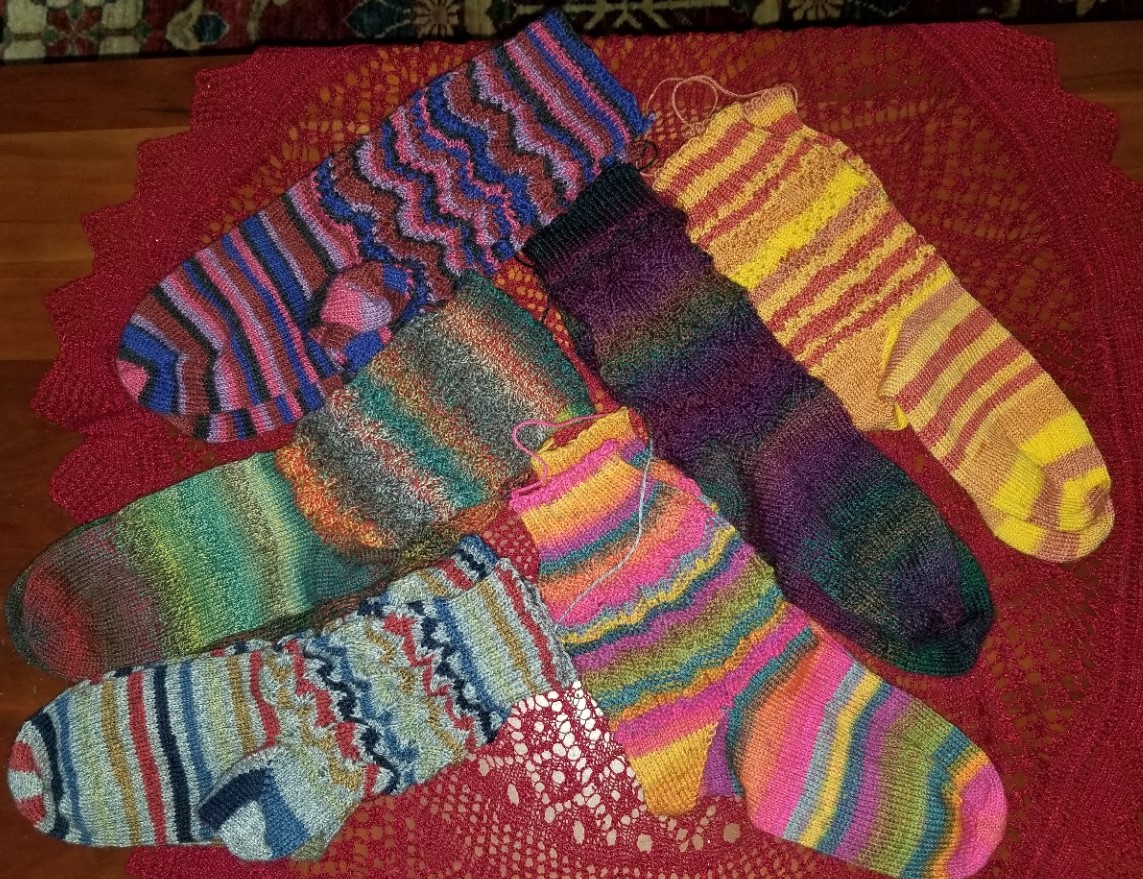
It’s true I haven’t knit in a while. But I did do nine pairs of socks for the holidays this year, some of which are shown below. And while I was at it, I dropped hints to Younger Offspring, who was enthused by the thought of a new pullover.
I first knit this classic Penny Straker unisex design decades ago. It was probably the third sweater I made and was a present for one of my sisters. This is the cover photo from the original leaflet. Note the armhole depth (we’ll get back to that later).

It was the early 1980s – long before blogging, so I don’t have pictures or notes detailing my first attempt, but it was a happy success. I’m pretty sure I used Germantown worsted, in a deep burgundy and a lighter, coordinating plum. I do remember that it was super thick and stiff because of the Eye of Partridge stitch uses a lot of slip stitches, making a double-thick fabric. In fact that stitch often used as a self-reinforcing treatment for sock heels, to make them both cushier and more wear-resistant.
My sister’s sweater ended up being a great outdoor activity wearable – perfect for someone engaged in winter exercise like cross country skiing, and too warm for indoor wear. But as we were flipping through some possibilities it was the one that caught Younger Offspring’s eye. So I downloaded a copy of the revised pattern from the Straker website (it’s now offered in an extended size range) and off we went to Webs, making a small detour out in western Massachusetts on the official Deposit-Child-Back-At-Home-Away-From-Home trip to Troy, New York.
At Webs I found a candidate yarn that came in the desired black and screaming chartreuse colors – Euro Baby Babe 100. It’s a butter-soft acrylic/polyamide (nylon) blend, and at 356 yards for 100g, a great value.

But it’s not a true worsted. It’s a DK. That means that instead of the standard 5 stitches per inch (spi) in stockinette, it works better at 5.5 spi in stockinette.
Complications ensue.
Although the pattern is clearly written for a heavier yarn, but I took a risk and bought the Babe anyway. I swatched until I found a needle combo and gauge that I liked. In this case, 6 spi/8 rows per inch (rpi) on US #7s (4.5mm) in Eye of Partridge instead of the pattern’s specified 5 spi/7 rpi on US #8s (5mm).
I’ve done the math for Younger Offspring’s chosen size (a swim-in-it oversize fit), and have cast on the revised number of stitches, plus two more – I always add selvedge stitches for easy seaming. I will work my new number until I am close to the specified length for the below-arm torso, then I will figure out the raglan shaping, taking notes so I can match the row count on the sleeves. I know that these Straker patterns were all written with very tight armholes by modern standards. It was the style back then. So there is room for me to err on the up side. If I need a few more rows to accommodate the raglan shaping than the original used, that will be ok. The armhole will end up a smidge larger, and that won’t be bad at all.
So to finish this already over-long, stitching-free post, here’s three evening’s worth of progress on the back. The drape is fluid, and the yarn is super soft and luxurious, uncommon in an acrylic. The color contrast reminds me of fireflies on a dark night. With luck this one should knit up quickly into a bundle of fun.

ADVENTURES IN BAKING
As long time readers here know, I have a standing promise to provide ten types of home-baked cookies for the holidays. For the most part, we’ve been evolving a series of family favorites, and year on year are moving those closer to perfection. But this year we’ve opted for a disruption.
Keto baking. Kind of.
We’ve decided to slim down the annual carb-fest that is the holidays. We were not dogmatically inflexible about it, but we did try to make the cookie plate a bit leaner this year, without sacrificing the comforting festive level of indulgence, and leaving some unaltered so we could share them with nut-allergic friends. Some recipes were standards we modded with our own substitutions. Some were new – cognates of known faves, but composed and published specifically for no carb/low-carb baking. Not all were entirely successful, but we did have some very pleasant surprises.
Among our discoveries were the handling properties of the various flours, a disagreement with a claim of 1:1 equivalency for the sugar substitute we used, and what Xanthan Gum actually does. This post may be helpful to others who want to try this adventure. I know it will help me remember this year’s pitfalls if/when I try it again.
As usual, I was greatly aided in this endeavor by Younger Offspring, whose baking acumen now far surpasses mine. The padawan has truly become the master.
First, the group portrait:

1. Earthquakes – more commonly called Chocolate Crinkles. Full octane. We didn’t play with this recipe, this one used standard all purpose flour and real sugar. There are many variations of this recipe out there. Ours, from long time pal Kathryn, uses butter and not shortening. I now use Dutch process cocoa in it for an extra cocoa-kick. Very much like one-bite brownies and much loved.
2. Orange Marmalade cookies. Also not slimmed. After all if the recipe calls for half a jar of marmalade to begin with, there’s very little point in making emendations around that. This is a burst of fresh sunshine, sweet but not overpoweringly so, and a nice contrast to the others. I use this recipe, and with it polish off the jar of marmalade that also contributed to the apple-orange Anonymous Apple Pie back at Thanksgiving.
3. Oysters. My own invention. A hazelnut spritz so named because the first time I did them I didn’t grind the nuts fine enough, and they were weirdly blobby in shape. This year’s are slimmed down from my original recipe, with Swerve sugar substitute standing in for the granulated white sugar, and 3/4 cup of almond flour being substituted for one of the two cups of all purpose flour. I didn’t tinker with the ganache filling with a splash of Frangelico, but we did whip it to make it more airy, mousse like and less dense than usual. The result was very light, delicate, and cake like, much softer and tender than the normal spritz cookie texture. The dough however was a nightmare to put through the cookie press, with three tries and extensive profanity needed to achieve one useable cookie shape. If I do this again next year I might introduce a bit of Xanthan Gum to add more structure to the dough. Even with that painful birth, the result is quite pleasant. Worth further exploration.
4. Keto Linzers. This one is new this year. Although we substituted a reduced sugar, no fructose, whole fruit mixed berry/cherry preserve for the home-made filling, we followed this recipe. We reduced the amount of sugar substitute a bit because we are finding that it is in fact sweeter than cane sugar. The dough was very sticky and rolling between pieces of baking parchment or waxed paper is an absolute necessity, along with lots of extra coconut flour to keep the dough from adhering to the paper. The resulting cookies are delicate (this seems to be a standard characteristic of these alternative flour baked goods). These turned out nicely. A do-over if we bake keto again.
5. Mexican Wedding Cakes. A family standard, this year slimmed down. Except for the confectioner’s sugar on the outside. I used the family standard recipe, much like this one, but substituted 3/4 of a cup of almond flour for one of the two cups of all purpose flour, and Swerve buzzed down in the food processor for the powdered sugar in the dough. They flattened out a bit more than usual in baking, making buttons instead of more rounded/domed usual shapes, but are still as tasty, fitting the bill for this must-have.
6. Cocoa Macarons with White Chocolate Ganache Filling. I was just a observer on this creation. I am very impressed by Younger Offspring’s ability to leap into Fine Baking, and the associated display of piping skills. These by their nature are almond flour and egg white. The results of this recipe are spot-on in taste, with the occasional crackled top being a product of our very imprecise kitchen scale (note to self – this thing is due for replacement). The white chocolate ganache was enhanced by a dollop of raspberry liquor.
7. Cinnamon Swirls. Another specialty of Younger Offspring, these are thin and light, with a profound cinnamon kick that benefits from the addition of orange zest to the dough. Full octane – this one had no subs. The Offspring uses this recipe but leaves out the glaze – the cookies don’t need it.
8. Lemon cut-outs. In previous years we have made the Joy of Cooking sugar cut-outs, with lemon zest in the cookie, and icing made from confectioners sugar and lemon juice. This year we did a total keto cookie instead – this one, complete with icing made from the Swerve sugar substitute and lemon juice. This is the cookie that really demonstrated the difference that Xanthan Gum can make. Although the dough was slightly sticky, the gum gave it structure much closer to that of a dough with gluten-bearing flour in it. It was much easier to handle, roll, and cut than the similar no-gum dough for the Linzers. This dough also retained the cut-out shapes better during baking than the Linzer dough, which spread a bit more.
9. Not Your Average Toll House Cookie. This was our own minor modification. We start with the classic Toll House cookie dough, and we used real sugars and all purpose flour, but instead of loading them with semi-sweet chocolate chips, we used unsweetened cocoa nib chips from Trader Joe’s, plus a handful of the semi-sweet chips, well chopped. The result were these zebra-striped buttons. They are more cocoa bitter than sweet, and intense. An excellent “grown up” chocolate chip cookie that’s delicious with coffee, tea, or wine. I hope TJ’s offers the nibs again next year so we can engineer a do-again (they do have a habit of introducing something wonderful that then vanishes.)
10. Triple Gingers. Again, the ones I invented a couple of years back, but slimmed, with Swerve brown and white sugar substitutes, plus using 1 1/3 cup of regular flour plus 1/3 cup of coconut flour in place of the 2 1/3 cup of flour in the original. I also upped both the powdered ginger and ginger juice a bit. This was one of the first sub-in cookies I tried, and the one in which I discovered that the sugar substitutes are sweeter than real sugar. If I do these again, I would dial back the amount of both brown and white sugars because I prefer a lower sweetness level. (Side note – this was one cookie I had made surplus of last year and froze, so I was able to compare the full octane version and the modded version side by side. The difference was profound, so I do now firmly doubt the Swerve claim of “1:1 substitute for regular sugar in cooking and baking.”
11. Peanut Butter Cookies. Yes, we lost count along the way and ended up with eleven kinds this year. This was a new keto recipe, and by far the least successful of any we attempted. I used this one, with poor results. I used Teddy natural chunky peanut butter, an excellent local product I’ve used in baking for years (ingredients are just peanuts and salt). Note that the recipe did specify a natural style peanut butter. I followed the directions exactly, and used the amount of coconut flour indicated. The resulting dough was a bit softer/stickier than my usual, but not unreasonable to handle, and I was able to roll small balls and press them, although I ended up marking them with a fork as indicated instead of being able to use my usual cookie press (they stuck to that). BUT when I baked these, they exuded gushers of oil – so much that the cookies floated around and oven-fried rather than baked, and the oil overflowed the cookie sheet. I took them out just when they were cohesive and just a tiny bit brown on the edges, and rack cooled them – they were still dripping. After all of the oil lost in baking the result was dry and unappealing, with surprisingly little peanut flavor. I do not recommend this recipe, and don’t think it’s worth any further effort. If we go keto again next year I will look for a different peanut butter cookie.
Bonus Panforte: To round it all out, we did rescue from the freezer the second of the two panfortes I made last year. Obviously not keto – not by a long shot. Younger Offspring again demonstrated piping skills, using the leftover dark and white chocolate ganaches to adorn the top. We didn’t serve it on Christmas Eve, but we will certainly cut into it now, and save a goodly part for New Years Eve dinner as well.

So to sum up – some hits, some with room for improvement, and some misses. And yes – we do now have enough cookies to last forever. Again.
EPIC FANDOM STITCHALONG – BAND 7
We roar back with Band 7 – So Sue Me! What can possibly be more anachronistic than this?
Every movie with a ravenous T-Rex in it looms in front of us now. Let’s see, aside from the obvious, there’s the original King Kong, Lost World, Fantasia, Prehistoric Beast, Land Before Time, Night at the Museum, Land Before Time, Dino Riders, several Dr. Who episodes, and many, many more. How could we continue without including an iconic dinosaur?
And the title? Named after Sue, a very famous Tyrannosaurus Rex specimen now on display at the Field Museum in Chicago, Illinois.
If desired this band, like the Pirates band can be worked voided – with the background filled in using long-armed cross stitch or plain old cross stitch, squared or stepped filling, diagonal filling, or another fill as desired. This is highly optional – no pressure here because the T-Rex strip would look good either way.
If voiding is chosen I think the design would show to best advantage if the background fill was done in a different color than the outlining, because if both were worked in the same thread the slender stems of the flowers curled in the tail would disappear. Remember – voiding eats both time and floss in direct proportion.
Time Factor 3 for height and flip/mirror complexity if only the outline is worked, but Time Factor 4 if voiding is chosen.
134 stitches wide x 30 stitches tall. 2 blank rows left between this and the following strip. If worked as a continuous band, one full repeat in 57 units.
| Samples | Fabric Used | Stitch | Thread Consumption/ Notes |
 | 28 count evenweave | Back stitch, 1 ply | |
 | 18 count Aida | Back stitch, 1 ply | |
 | 28 count evenweave | Back stitch, 1 ply | About 8 yards for outlines, 6.5 yards for voiding |
 | 26 count evenweave | Double running, 1 ply | |
 | 28 count evenweave | Double running, 2 plies | 1.5 yards blue, 1 yard, green, 0.25 yard red, 2 yards of light red for voiding |
The second from the bottom, by guest Beta Tester Robert (known to some of you as Master Geoffrey d’Ayr of Montalban) is actually part of a strip of the design he worked as cuff and collar trim for a shirt – proving the point that many of these designs can be worked as long band repeats.
As usual this band plus working notes and hints has been appended to the write-up on the SAL page, accessible via this link or via the tab at the top of every page here on String-or-Nothing.
If you are working our Epic Fandom SAL either as a whole or as a strip excerpt, please let me know. It gives me great joy to see how my “pattern children” fare out in the wide, wide world, especially when they meet up with creative, playful people.
Band 8 will be released here on or about 18 January 2022, giving you ample time to romp with this one.
EPIC STITCHALONG – BAND 6
A breather after the last rather involved and challenging to count Gameroom panel!
Grape Balloons is another original, loosely based on a historical pattern family. Bands or horizontal columns with lozenges and/or striations are pretty common in strapwork of the late 1500s to 1600s, as are grape clusters. But sprigging them together this way is something I doodled up.
This one should be comparatively easy to stitch, especially after the last no-repeat panel. All you need to do is remember that the slanting bands on the center rod mirror – everything else is a simple flip, either up/down or left/right – no tricky half-drops, or meanders.
134 stitches wide x 16 stitches tall. 2 blank rows left between this and the following strip. If worked as a stand-alone continuous band, one full repeat in 17 units.
| Samples | Fabric Used | Stitch | Thread Consumption/ Notes |
 | 28 count evenweave | Back stitch, 1 ply | About 2 yards of floss |
 | 18 count Aida | Back stitch, 1 ply | About 3 yards of variegated thread (not floss) |
 | 28 count evenweave | Back stitch, 1 ply | |
 | 28 count evenweave | Double running, 2 plies | About 1.25 yards of light blue, 0.5 yards of light red, scraps of red. |
As usual this band plus working notes and hints has been appended to the write-up on the SAL page, accessible via this link or via the tab at the top of every page here on String-or-Nothing.
If you are working our Epic Fandom SAL either as a whole or as a strip excerpt, please let me know. It gives me great joy to see how my “pattern children” fare out in the wide, wide world, especially when they meet up with creative, playful people.
Band 7 was released today in the Enablers Facebook group feed, and will be echoed here on or about 21 December.
#epicfandomsal
EPIC STITCHALONG – BAND 5
The world is starting to open up again, but among us there are folk who felt the lockdown most keenly during convention season.
They missed meeting friends, swimming in a sea of fellow fans – regardless of fandom; reveling in the costumes either as a cosplayer or just an appreciative passer-by; viewing films, trailers, and shorts; listening to authors, famous actors or other community celebrities as they reminisce, lecture, or engage in open panel banter; shopping for that special Something that sings to the inner nerd; and more. Like the Game Room. There’s almost always at least one, where folk compete for the sheer fun of it, or sometimes for prizes.
I know many people who live for game rooms, then bring home their favorite games and introduce them to their circle of local friends. This strip is for them, the gamers, be they lovers of electronic formats, the classic card and board games, multiplayer role playing games like Dungeons and Dragons, or the new set of tabletop/parlor games, like Settlers of Catan.
This strip is 134 stitches wide x 28 stitches tall, including the narrow companion border at top and bottom. 2 blank rows are left between this and the following strip.
| Samples | Fabric Used | Stitch | Thread Consumption/ Notes |
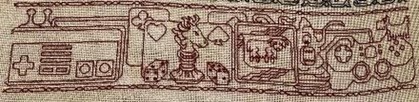 | 28 count evenweave | Back stitch, 1 ply | Pips are French knots |
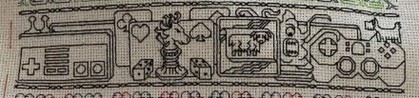 | 18 count Aida | Back stitch, 1 ply | About 3 yards. Pips are French knots |
 | 28 count evenweave | Back stitch, 1 ply | Pips are French knots |
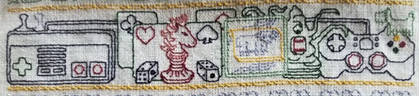 | 28 count evenweave | Double running, 2 plies | About 1 yard of blue, 1/2 yard of yellow, 1/4 yard of red, 1/4 yard of light blue. The snake eyes pips are each 2mm paillettes. Other pips are tiny 1×1 cross stitches |
As usual this band plus working notes and hints has been appended to the write-up on the SAL page, accessible via this link or via the tab at the top of every page here on String-or-Nothing.
If you are working our Epic Fandom SAL either as a whole or as a strip excerpt, please let me know. It gives me great joy to see how my “pattern children” fare out in the wide, wide world, especially when they meet up with creative, playful people.
Band 6 be released on 23 November in the Enablers Facebook group feed, then echoed here on or about 7 December.
 String-Or-Nothing