STRING ON THE MARCH
Yup. We were there with everyone else on Boston Common, for the rally and march on 21 January. I knit hats that travelled to DC and Kansas City, too. These photos were taken by Elder Daughter, who knows her way around a camera. Sadly there are none of her, because she spent the day behind rather than in front of the lens.
First my favorite marcher of the day:

We arrived early, around 10:00, and found the common already full.

Elder Daughter plus friends Christine and Matt and I found a place to stand at the rear center on a small rise – close enough to hear and see the large screen, but not the speakers themselves.


Christine and Matt made us a nifty banner:

The crowd was upbeat and considerate, supportive and non-confrontational. There were no vendors outside the Common hawking tatty merchandise. A few groups produced and carried similar signage, but the vast majority of hats, shirts, sashes, banners, and signs were home-made. Some were quite funny, others strident – but all were from the heart:







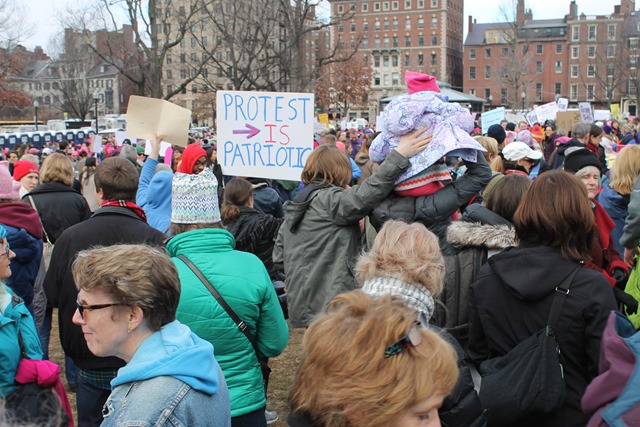
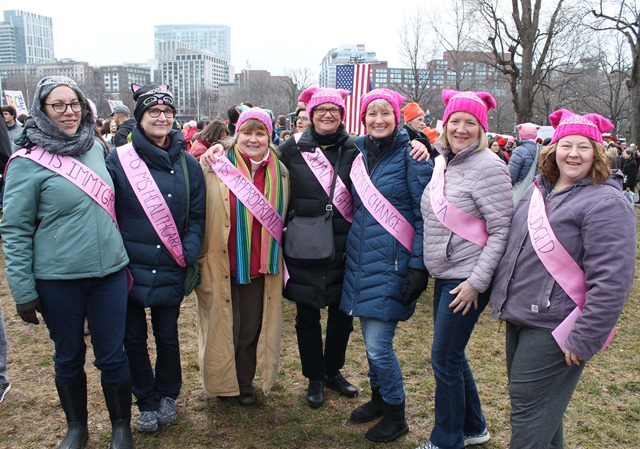

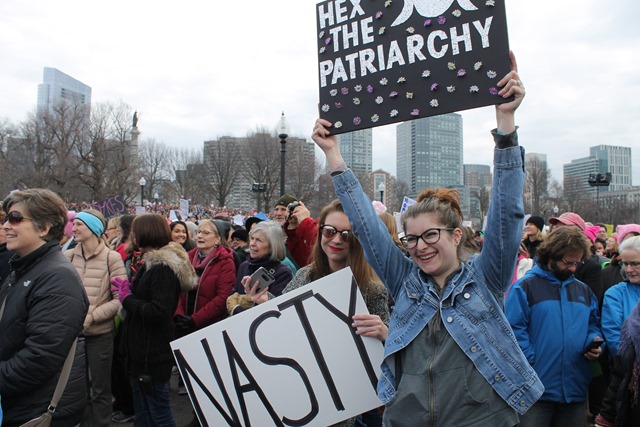

There were so many people packed onto the Common that it took us almost two hours to walk the 30 yards from where we were standing back to the street. We set out on the march route, in roughly the first quarter of the people walking, and noted that by the time we completed the circuit at 4:00, there were still crowds exiting the Common, just starting out.



Elder Daughter’s best shot of the day, taken mid-march. The route was lined with people cheering, some on balconies:

The carillon in the Baptist Church we passed rang out We Shall Overcome, and the national anthem. There were at least two walking groups that accompanied themselves with music – a group made up mostly of Revolutionary War era re-enactors who brought fife and drum, and marched in cadence, wearing proper attire behind their own Phrygian-capped Lady Liberty. There was another group with steel drums whose beat was a bit more syncopated, and whose spirit could not be denied.
Police presence was benevolent and in many cases, charming. We saw more than one officer assisting the disabled, or taking photos of marchers for them. Heavy sand spreaders, and DPW construction and sanitation trucks were used to block side streets. While any barrier would have kept the march on course, those massive trucks were there to protect us from vehicle attack, with their drivers putting themselves in potential danger. We on the route noted this, and share special thanks to all the public safety personnel.
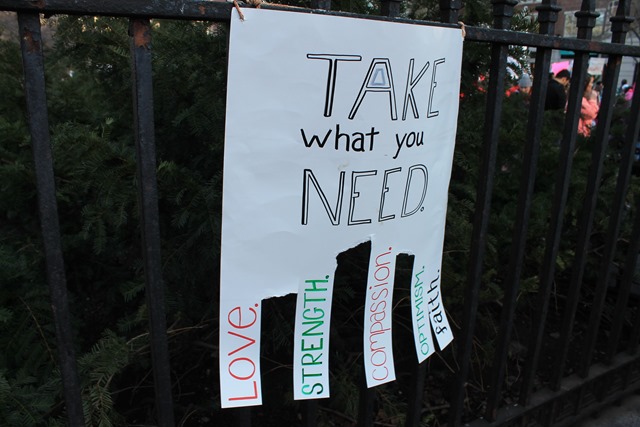
At the end, back on the Garden and Common, many people left their signs along a fence:

I am proud to have been part of this, and note that it is just the first step.
Involvement does NOT end with this march.
TOO BUSY TO BLOG
As ever, things have been very hectic here at String Central. Holidays, work obligations, family – you know the standard round of excuses. But that doesn’t mean that progress is not being made.
In no particular order, I present a subset of the accomplishments since the last post:
The Red Licorice pullover – finished. Amended slightly to meet the recipient’s specifications. Pix on this one are belated, since I gave it to the wearer who scuttled off with it before took photos of my own. I’ll go back and update this post when the pix come in, but I’ve held back publishing this long enough.
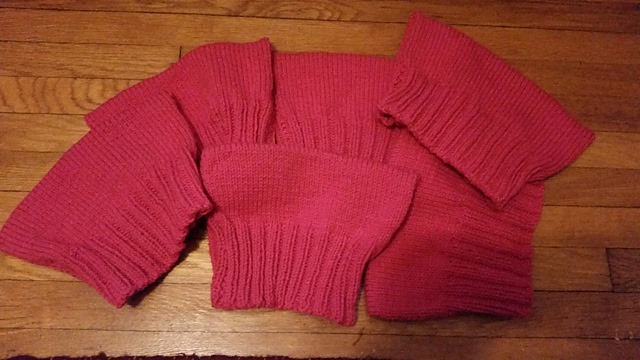
Six Pussyhats for the upcoming marches.

The now standard run of ten types of holiday cookies:

If you must know, clockwise from the top, they are coconut macaroons dipped in dark chocolate; chocolate chips; chocolate crinkles (aka Earthquakes); peanut butter, stamped with suns; hazelnut spritz with chocolate ganache filling (aka Oysters); raspberry jam filled vanilla wafers; Mexican wedding cakes; lemon cut-outs; bourbon/cocoa balls; and iced spice spritz cookies. In the center is homemade fudge, with and without hazelnuts. I also did two panfortes. Recipes for any/all available on request
And of course there were latkes (this year done in goose fat):
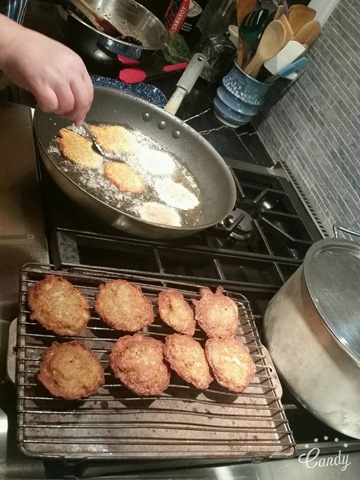
And of course over the three-holiday-week there were the donor goose; some heavenly fish quenelles (think gossamer gefilte fish and you would not be far wrong); a fantastic cassoulet made with duck confit we put up back in the summer; leek and potato soup; a home-made paté/terrine type loaf; our own sourdough bread; and an amazing spread of cheeses. Most of the heavy lifting cooking was done by The Resident Male.

We’re still eating the cheeses – there was so much that was (and still is) SO good. Thanks again to Cheese Gifters, Kim and Mike; and a shout-out to the Cheese Makers, Jonathan and Nina at Bobolink Dairy. If you love well-crafted, delicious cheese and have not tried theirs, you are missing out.
Along the way, I also started a couple more projects. First – curtains for the library. I’ve been threatening to do it for years, and have the linen and trim on hand, the trim being one of the embroidered things I treated myself to in India:

I’ve done all the calculations, pre-washed the linen, and ironed out the first panel of four. I’ve also obtained and pre-shrunk the lining. Next is to calculate placement of the trim and stitch it on to the first panel, prior to doing final assembly and hemming. I intend to use rings to hang the panels, from black iron or iron-look rods. Those will either be clip- or pin-type, so tabs are not needed. Parking these mysterious secret sauce numbers here for future reference (90, 10, 3).
And having finished the sweater and hats, I embark on another knitting project – Sandra’s Shawl, pattern by Sandra Oakeshott. This one features lots and lots of nupps – little multi-stitch bobbles. I am not a fan of making them, so instead of the nupps, I’m using beads. I’m using some really intense variegated green Zauberball Lace yarn (pix shamelessly borrowed from unrelated retail website):

And the beads are silver tone. As you can see, I’m already well into this one, past the unadorned center and out into the infinity rows where the beaded fun happens:
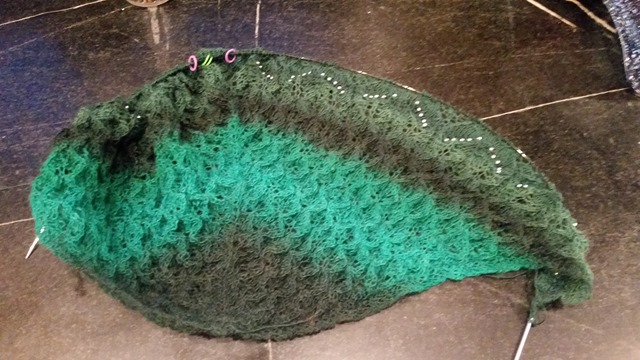
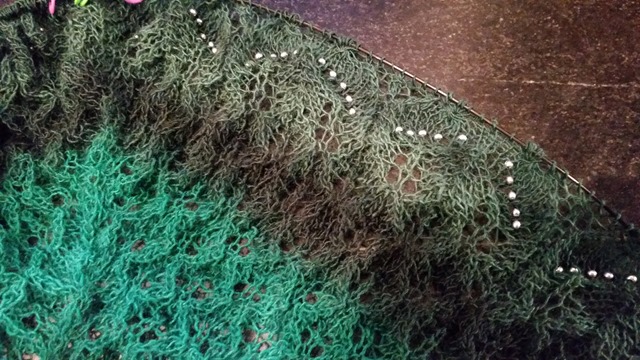
I can say that the pattern is well-crafted and easy to follow. I suggest putting markers at the beginning and end of the pattern repeat, to segregate out the edges in which the design is a bit perturbed by the increases required for shawl shaping. Some may wish to use markers between each pattern repeat, but I found it wasn’t necessary for me – the thing is easy to proof visually as one knits. And I most heartily recommend the use of beads rather than the fiddly nupps. Apologies to the designer, of course for using a non-traditional/alternative interpretation of her excellent pattern.
LONG HIATUS, BUT NOT INACTIVE
A frantic interlude of work related deadlines later, I return to this page.
And the recipient of the Crusher pullover, modeling it with standard ironic teenage attitude during Thanksgiving break:

Eye roll aside, she loves it. Really. Especially the three-quarter sleeves and front pocket. She’ll wear it with a collared denim or chambray shirt underneath, so the wide neckline and shorter sleeves (for rolled up cuffs) is spot on what she wanted. So armed, Younger Daughter returns now to college, full of turkey, and cocooned in wool.
On the knitting front, I am well into a Licorice Whip pullover possibly for me or Elder Daughter. I’m still trying to fit The Great Stash Largesse into my yarn boxes, so to make room, I’m doing up some quick knits from the bulkiest lots in them. This one is to use up some Araucania Nature Cotton, an Aran-weight thick-and-thin, kettle dyed cotton I’ve had on hand for at least six years. The skeins are not uniform, not even within dye lot (probably why I was able to snag it on special sale), so I am working from two of them at the same time, alternating to meld the colors and avoid any visible horizon likes (like the deliberate one in Crusher, above, where I used to strong contrast yarns on purpose).

The color is sort of washed out in the photo above. Red Licorice is really a very bright candy-apple red, veering to orange. The cotton is cushy and soft, but prone to shedding. It will most certainly be a gentle hand-wash garment when it is done.
In other news, two more pairs of briefcase-sox accomplished using Great Stash Largesse yarn. Standard figure-8 toe/short row heel, 76 stitches around, plain feet/interesting ankle. One brown pair already with its recipient, the other pair is mine, mine, mine:
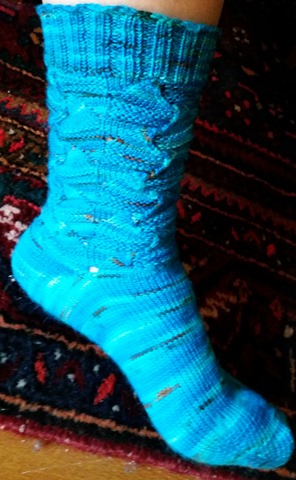
Yummy!
I also completed two baby sweaters, for Salazar Clan grandchildren born last month. One is with its target baby, the other is here in my basket, awaiting word of where to send it to rendezvous with the target great-nephew. Both are the same Lopez Island pullover and use same long stashed yarn in two different colors. Red is a 6 month size, and Blue is a 9-12 month size:.


In other knitting news, I will be needing a small project to carry with me on a trip the week after next. The bulky red pullover being too big for in-flight knitting. For that one, I’ve settled on Sandra’s Shawl, using a shaded deep to medium green laceweight from an earlier shipment of Largesse. I’ll knit up the larger size. However, I’m not a big fan of working nupps (the little bobbles that accent the edgings). Instead I will use silver beads. Cast on for this will be sometime this week, so I will be well enough along for relaxed knitting on the plane.
And finally, progress on the long stalled Second Carolingian Modelbook project. As I feared, in the format I had chosen, parallel to the original book, production – even in electronic format – will be prohibitive. I am now redrafting for release as a series of shorter works. The first of these will be a very short pilot folio – probably only five or six plates worth. By contrast, the book as I originally conceived it was 75 plates. If that works out well, I will continue with similar scheduled releases.
WITHOUT A NET
I’ve finished the no-pattern/no-gauge pullover I started the last week of September, at the beach:
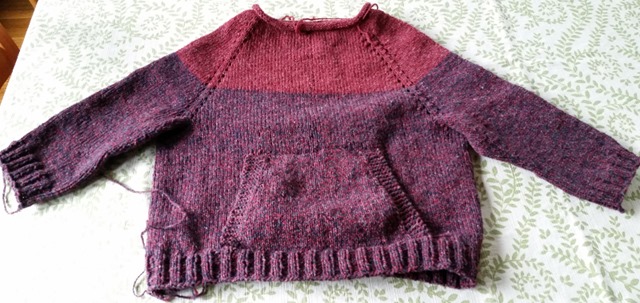
It’s a short but not cropped front-pocket/baggy-fit raglan pullover, knit in rustic New England style two ply Aran weight wool. The only seaming was grafting the top of the front pocket to the body. The thing is knit top down. Had I decided to add a pocket when I got to that point, I’d have worked it in, and knit the bottom edge into the body, and obviated any need to sew at all.
Younger Daughter has first dibs on the thing. It should fit her nicely, and if not – I’m sure I’ll find another family member or friend to wear it.
Here’s a working-method summary. I hesitate to call it a fully developed pattern because I haven’t calculated sizes, made exact measurements, or estimated exact quantities.
Wesley Crusher Unisex Pullover – A Method Description
Fits size 44 chest
Gauge: approx 18 stitches = 4 inches (10 cm) in stockinette
Recommended needle size: US #10 (6mm) circular for body, or size to get gauge; US #8 (5mm) circular for ribbing. You may wish to start the neck and finish the cuffs using DPNs of the same size.
If working the optional hand-warming pocket, either an additional US #10 (6mm) circ, or a pair of US #10 (6mm) straight needles, and a piece of contrasting color string, preferably a cotton in fingering weight or thinner, that will be used to baste the row to which the pocket is grafted, for better visibility in keeping that seam straight..
Materials: One skein of Bartlett Yarns 2-Ply Aran weight rustic wool (about 210 yards/192 meters) in shoulder color. 3.5 skeins of the same yarn in a contrasting color (about 735 yards/672 meters) for the body.
Other tools: 5 stitch markers, two large stitch holders or spare circular needles (any size) to hold the sleeve stitches while the body is being completed. Yarn sewing needle to darn in ends.
Neckline:
Using smaller needle, cast on 100 stitches, join in the round and work in stockinette for approximately 2 inches (a bit over 5cm). Switch to larger size needle.
Raglan Increases:
Place marker, knit 35 stitches (front); place marker, knit 15 stitches (sleeve top); place marker, knit 35 stitches (back); place marker, knit 15 stitches (other sleeve top). Knit one round. The four markers indicate the center point of the raglan increases. There will be one marker left over. We’ll use it later.
Increase round #1: *K1, YO, knit until one stitch remains before the next marker, YO, K1, move marker*. Repeat this three more times.
Increase rounds #2 and #3: Knit.
Continue working increase rounds 1-3 until you have enough depth on the shoulders so that the under arm area ends about under the arm (don’t worry if there isn’t enough depth for the front and back raglan “seams” to meet. We’ll be adding stitches under the arm, and working them into gussets. I did my raglan increase set 18 times (making 18 holes in a rows down my raglan “seam,” and ending up with 71 stitches between my front markers, and 51 stitches across each sleeve). Be sure to finish after round 3.
Separate out the sleeves:
Knit 36 stitches. Place the fifth marker. Continue knitting across the front to the first raglan marker. Set it aside. Take a stitch holder or spare circular needle (or a piece of string threaded onto a yarn needle) and slide the 51 stitches of the sleeve onto it. We’ll revisit them later. Set aside the next raglan marker.
Returning to your working needle and replace the marker. Holding the sleeve stitches out of the way, cast on 16 stitches, preferably with a half-hitch cast-on to minimize bulk. Place marker. Continue in stockinette, knitting to the next marker. Set it aside.
Set aside the stitches for the second sleeve in the same way, sliding them onto a storage device, replacing the marker, casting on 16 stitches, and placing the remaining marker after the cast-on stitches.
You should now have a marker indicating the center front, plus four markers – two at either side, isolating the cast-on stitches. Continue in stockinette to the center front marker. We are going to use that marker at the center front as the “begin round” point from here on.
Work the body:
Knit one round in stockinette.
Gusset Decrease Round #1. Knit to the side marker, move marker, SSK. Knit until two stitches before the other side marker, K2 tog. move marker. Knit across the back of the piece until you reach the other side marker. Move it, SSK, knit until two stitches before the next marker, K2tog, move marker, knit to the center front marker.
Gusset Decrease Rounds #2 and #3: Knit.
Repeat Gussett Decrease Rounds until only two stitches remain between them. On the next row, knit to the marker, take it off, knit one stitch, put it back; knit one stitch and set the second side marker aside. Repeat this for the back. You should now have a tube with about 176 stitches in total – 88 for the front and 88 for the back.
Continue knitting the body tube until it is as long as you want, minus 2 inches (about 5 cm) for the ribbing.
Optional hand warming pocket:
You will need a second ball of your body yarn at this point, or you will need to work from both ends of your current skein. I’ll call this secondary source the “pocket yarn.”
Using your original body yarn, knit all the way around your piece until you reach the marker for the second side. Move it and knit 19. 25 stitches should remain before the center marker. Holding your original yarn and your pocket yarn together, knit to the marker, then knit 25 stitches after the marker. Drop the pocket yarn and continue around with your original yarn (don’t worry if you’ve mixed them up – it makes no difference). Make sure that the pocket yarn emerges from the PUBLIC side (the knit side) of the work after you drop it, before you continue around with the original yarn. Stop when you get to the start of the doubled stitches.
Take your second #10 needle (straight, circ, whatever). Working carefully with your original needle, knit one stitch of each doubled pair and slide its brother onto your second needle. When you are done you should have 50 stitches on the pocket needle, and the same original 88 for the front (plus 88 for the back) on your original body needle.
Knit one round on the body, just to make sure everything is snug and safe.
At this point you can either finish the body or continue on to the pocket. Your choice. If you opt to finish the body first, skip below to Ribbing, then return to this point.
For the pocket – you will be knitting flat, back and forth. This means that to achieve stockinette, you will be knitting on the right side of the work, but purling on the journey back.
Turn the sweater upside down. We will be working from the bottom back to the shoulders for the pocket.
Pocket Row #1: Knit 5. Place marker. Knit 40. Place marker. Knit 5.
Pocket Row #2: Knit 5, move marker. Purl 40, move marker. Knit 5.
Pocket Row #3: Knit 5. Move marker. SSK. Knit to 2 stitches before the next marker. K2tog. K5.
Pocket Row #4: Knit 5. Move marker. Purl to next marker. Move marker. K5.
Pocket Row #5: K5. Move marker. Knit to next marker. Move marker. K5
Pocket Row #6: Knit 5. Move marker. Purl to next marker. Move marker. K5.
Pocket Row #7: K5. Move marker. Knit to next marker. Move marker. K5
Pocket Row #8: Knit 5. Move marker. Purl to next marker. Move marker. K5.
Repeat Pocket Rows #4 through 8 until 38 stitches remain on the pocket needles, or the pocket is deep enough. If you want it deeper, work remaining rows without decreasing. When done, DO NOT bind off the stitches. Instead, break the yarn leaving about 2.5 feet for seaming.
Keeping the pocket stitches on the needle, smooth it out against the front of the sweater. Note the row where the pocket should be grafted. On the row ABOVE that, take your piece of marking string, thread it onto your yarn sewing needle and run it through that row for the width of the pocket. This will make identifying the row for seaming easier. If you are confident in being able to graft a straight seam, you can skip this step.
Using your extra long tail end left over from the pocket, graft the pocket stitches to the row immediately below the one you have carefully marked with basting. Invisible horizontal seaming works nicely for this, uniting the live stitches off the working needle with the body stitches.
Ribbing:
Return to the original needle holding all of your body stitches. Take your smaller ribbing needle and working from the original needle onto the new smaller needle, start from the center front marker, and work K1, P2,* K2, P2* ending with K1 for the stitch immediately before the marker. Discard the larger needle and using the smaller one, continue in this K2P2 ribbing until you’ve worked 2 inches (about 5 cm) or the ribbing is long enough for you. Bind off in pattern.
Sleeves:
Take your #10 needle and transfer the stitches for your sleeve to it. Take your body yarn and starting at the left point of the stitches you cast on underneath the arm, place marker, pick up 8 stitches place the center sleeve marker (suggest this be a different color), pick up another 8 stitches to finish filling in the gap, place the third marker, and knit around the sleeve. Knit around until you have returned to the center sleeve marker. NOTE: As you continue the sleeve from this point you may find that it gets uncomfortable to use a larger diameter circular, even if you “loop out” the excess cable as you go. Feel free to switch to DPNs or a two-circ method at any time during completion of the sleeve.
Sleeve Gusset Decrease Row #1: Knit to 2 stitches before the next marker, K2tog, move marker. Knit around the sleeve until you reach the other sleeve gusset maker. Move it. SSK, knit to the center sleeve marker.
Sleeve Gusset Decrease Row #2 and #3: Knit
Repeat Sleeve Gusset Decrease Rows #1 to 3 until only two stitches remain between them (one on either side of the centermost marker). At this point you should have 53 stitches. You can remove the two sleeve gusset markers and continue working until you sleeve is long enough (minus 2 inches for ribbing). On the final row before starting the sleeve ribbing, start the row with a K2 tog, so that you have 52 stitches. Switch to the smaller needle(s) and starting at the center sleeve marker, K1, P2, (K2, P2)*, ending with a K1. Work this K2P2 ribbing for about 2 inches (5 cm). Bind off in pattern.
Darn in your ends, and you’re done.
FINISHING OFF A HANGING SAMPLER
OK, I promised I’d write this up, and it has taken me a while, but here it is.
My thought here was to create a quick and easy way to finish off a hanging sampler, using a method that did no harm to the stitched piece, that was inexpensive to do, and required no special equipment or components that can’t be found in most crafts stores.
Why “no harm?” Because many inexpensive framing solutions do exactly that. They place fabric under stress, encase it in moisture-trapping glass, matt it or line it with acidic materials that over time discolor or eat away at the ground cloth, or place the fabric up against wood or metal that can corrode or mark the cloth.
This solution is far from ideal, but it manages tension to avoid stretch or strain in hanging, isolates the stitched piece from any wooden or metal framing elements, can be quickly picked out without harm to the original work, and is very inexpensive.
Here are several examples (the center one is mid-process):


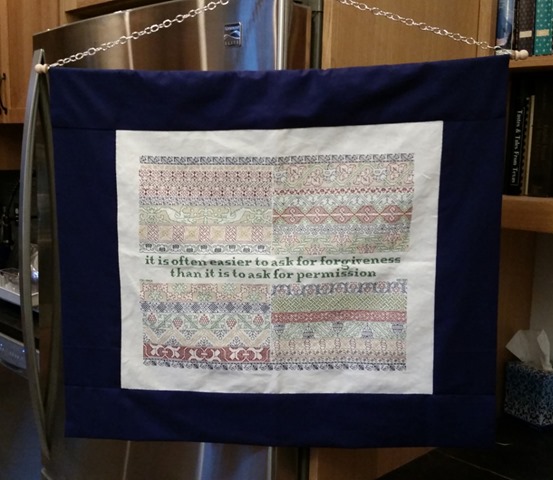
In all cases, a larger piece of backing fabric has been used to encapsulate the stitched item. The hanging bar (wood or metal) and bottom-weighting only touches the backing fabric. All are totally sewn by hand – no machine stitching.
Note that you don’t need to have actually stitched a sampler to do this. It would be useful to finish off a decorative tea-towel, heirloom doily, cloth map, or small pieced patchwork as a hanging, or (for my SCA pals) to mount a painted or printed banner for display.
To do this you need:
- Your display piece.
- Backing fabric. I used plain old quilting cotton. Any fabric will do, although for the “no harm” bit, I suggest washed cotton or linen rather than polyester or other synthetic. Size needed calcs below.
- Plain old cotton sewing thread that matches the backing fabric.
- A hand-sewing needle – a sharp with a small eye is recommended.
- A metal bar or wooden dowel for a top support (fancy finials are optional, but can be handy for fixing hanging strings or chains in place so that the hanging mechanism doesn’t compress the top edge of the hanging).
- The aforementioned hanging string or chain.
- An iron and ironing surface.
- A pair of scissors
- Straight pins
- A ruler and a tape measure
- Standard office stapler
- Optional weights for the bottom edge. I have used a length of brass chain, threaded onto an old ribbon, and small zinc drapery weights (small bars of zinc enclosed in a synthetic fabric envelope). These are sold in packs of two or six, in the curtain-notions department. Avoid the lead ones just on principle – the world does not need more free-range lead. In a pinch, coins sewn into little fabric pockets will do. If you are using drapery weights or coins, you only need two.
I found the backing fabric, dowel, wooden finials, the drapery weights, and the chain all in my local JoAnne’s fabric/crafts store.
First, decide how you want to frame your piece. A large area top and bottom, with narrower areas on the sides? Equal frame all the way around? The general size will inform your fabric purchase, although one yard of most quilting fabrics will be MORE than enough for all but the very largest samplers.
For the Permissions sampler, I decided I wanted a blue frame about 3.5 inches all the way around, and to preserve about 1 inch of unworked ground between the stitching and the edging I put pins in my sampler to mark that distance from my stitching, and measured the “to be shown” dimensions of my piece. About a half inch of my sampler, all the way around, will be hidden inside the backing.
Let’s call my display width 20 inches, and my display height 16 inches (to be truthful, I didn’t write down the real numbers). I know I want 3.5 inches of framing edge to show on all sides. Plus I need a hem allowance, let’s call that 0.5 inch. Here’s the logic:
| Hem |
Edge |
Display Area |
Edge |
Hem |
|
|
Width |
0.5” |
3.5” x 2 |
20” |
3.5” x 2 |
0.5” |
|
Height |
0.5” |
3.5” x 2 |
16” |
3.5” x 2 |
0.5” |
So, by doing the addition, I need to cut my backing cloth to be 35” wide, and 31” high, which is what you see is half-way done here (I’ve cut the width but not the height yet):
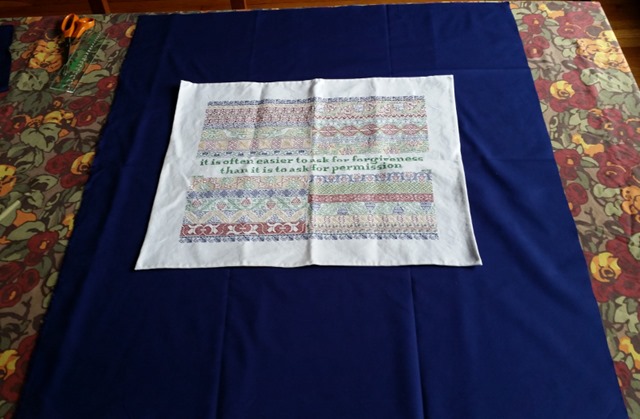
The next thing to do is iron in the 0.5” hem all the way around. Note that the “right side” of the backing fabric (such as it is, is DOWN). I chose to iron in mitered corners for tasty neatness, but that’s optional, and there are a ton of video tutorials on doing that.


Then I positioned my stitched piece on top of my backing fabric, making sure that it was correctly placed (the edge of my stitching was 8 inches from the now-folded edge of the backing – I should have left in my dimension measurement pins but I forgot, and took them out.)
Once the stitched piece was correctly positioned. I folded the left and right edges in, carefully aligning them (measuring the distance from my embroidery), and finger pressing them down and pinning. Because I stitched on even weave, I was able to use the count of my ground fabric for **perfect** alignment without having to mark the fold-to line on my sampler.
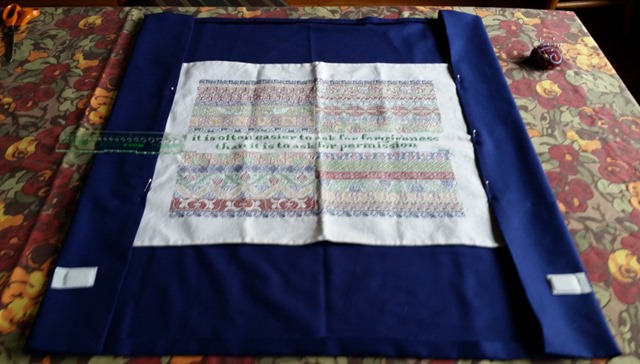
Those two little white tabs? Those are the drapery weights – note that they have little tab ends that are handy for stitching. That’s where they will go, encapsulated in the edging/backing, far away from the stitching. Next I folded in the top and bottom and pinned them, too. Once all edges were pinned, I lightly touched up the folds with my iron, to make them slightly crisper. Then I slid those drapery weights in and pinned them into place.
Here’s the thing, ready for hand stitching.

You’ll notice that there are simple lapped corners – I didn’t miter them. By doing this I can use the flap-over on the top as my hanging pocket. I do not need to engineer a separate hanging method for attaching the bar or dowel.
Now for the hand-sewing. Yes, I could have done this by machine, but hand stitching is easier to pick out in the future, and easier for me anyway to keep neat and aligned. There’s no real reason (other than speed) to do this by machine. And yes – I probably should have basted, but hey, what’s the fun without a tiny bit of risk. 🙂
Starting at the lower corner where the bottom and side flaps meet, and working first completely around the stitched sampler part, ignoring the flapped areas at the corners, I worked a simple hand appliqué stitch, catching a tiny bit of the edging, passing through the ground cloth but not the ultimate backing – at a diagonal, ready to make my next stitch. Here’s a tutorial on the appliqué stitch.

Note that I used the even weave’s threads to keep my hem nice and straight.
After I had worked the appliqué stitch around the entire visible area of my sampler, I used the same stitch to affix the two lower corners – the places where the bottom folded edge lapped up and over the folded-in sides. As I did each of these two corners, I worked from the visible sampler area back out to the edge. When I got to the side, I turned the corner and used a tiny whip stitch to seam together the front and back edges. When I got to the place where the weight was pinned, I wiggled it up so that I could just nip its flapped edge in as I was whip stitching:

I worked the top two corners similarly, but instead of working all the way down to the tip of the corner as I whipped the front to the back, I stopped about 0.5” from the top on both the left and the right. This left an opening through which I could pass my dowel. A small bit of finesse was needed to thread it through (I used another scrap of dowel to nose the hem allowance out of the way on the inside).
To make the hanging stick, I used a 1/4 inch dowel. I probably should have used a metal rod or a thicker dowel, but that’s what they had in the store. I bought a little pack of finials, and ended up having to shave down the ends of my dowel just a tiny bit so that they fit into the holes on the finials. I also bought a length of inexpensive craft chain, intended for chunky necklaces, with links large enough to fit around the dowel.
I cut the dowel to the width of my finished piece, plus about 0.5”. Using a regular office stapler, I stapled the chain to my dowel, about a quarter of an inch from the end. I dotted the inside of the first finial with wood glue and forced it onto the dowel and over a bit of the staple, so that the chain was butted up against it. Then I threaded the dowel through the top of the hanging, squishing up the hanging a bit to keep it away from my working end, I stapled the other end of the chain to the dowel, then forced on the second finial.
Taa daah!

ESCAPE KNITTING
So here we are at the beach again, seizing a weekend unoccupied by renters, to enjoy our place in North Truro. It’s not as warm as it can be in full summer, but it’s plenty comfortable enough for lounging on the beach, wandering the shoreline, and nosing around Provincetown.
And what’s lounging on the beach without a knitting project? It can be difficult to knit from a complex pattern on the beach – hard copy pages get damp, and tend to blow around. It’s often too bright to knit from designs stored on the iPad, the screen washes out in the sun. So I tend to look for projects that are mindless, memorized, or free-form.
So here’s the latest, photographed in full sun on our deck.

I’m working entirely without a pattern, using a rustic style Aran weight wool. I’ve got several skeins of well-aged Bartlett two-ply Maine wool, that are taking up all to much room in my stash boxes I’d prefer to put to other use.
I have a couple of heathered garnet red; a couple that are ragg-mix of one ply of the garnet, and one of a navy; and a couple of a medium blue which is too light to use in combo with the others. None are enough for an entire adult sweater but it’s time they earn their keep. Also the ragg style blue/red mix would overpower most texture work. So what to do?
A unisex, simple raglan, worked top down was the obvious choice. No pattern, no gauge. I started by casting on 100 stitches, and working a rolled stockinette collar on a US #8 (5mm) needle. I changed to a US #10 (6mm) needle. I’ve now got about 172 stitches around – roughly a 44-45-inch chest circumference. The fit is slouchy and sweatshirt-like, and the high lanolin content rustic yarn (though a bit itchier than Merino, and hand-wash) guarantees a hard wear sweater ideal for cool weather hiking, and winter sports. It’s a bit small for me, but between spawn, and a huge army of nieces and nephews, plus lots of outdoorsy friends, it’s bound to fit someone.
So, what do I call this no-pattern piece? The Wesley Crusher, of course. Named for the ubiquitous shoulder-colorblock casual sweaters and uniform blouses worn by him and the rest of the STNG crew.
Minor discovery during the course of this one. Many circular needles in larger sizes have a noticeable “bump” where the needle part slims down to the cable’s thin diameter. It can be annoying to shuffle stitches up that steep incline as you knit in the round. But you can minimize the problem if you are using an interchangeable needle set. I’ve outfitted one of the circs with a size #10 on one end, and a #8 on the other. Since stitch size and gauge is dictated by the needle you are using to form the stitches (as opposed to the one being knit from), the smaller size needle sits on the “feed” side of the round, and its slightly smaller diameter presents less of an impediment when shuffling the stitches around into “knit me” position. Give it a try!
And in other knitting news, I have finished the leaf shawl/scarf:
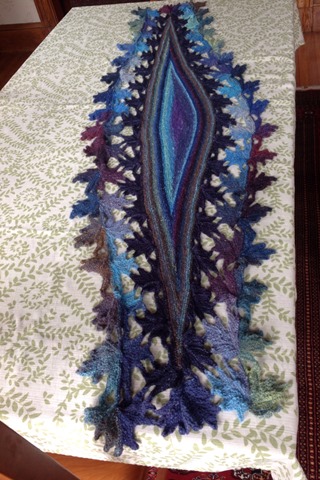
It looks like work/home will crawl back to a more manageable schedule, so I hope to be posting more regularly again in the weeks to come. Next up is a tutorial on a simple method to finish out a sampler into a backed hanging.
BELATED FINISH
A very hectic month, between work and other obligations. I’m glad to say we’ve gotten Younger Daughter off and installed at college, purple hair and all:

And I finished her vintage shrug:
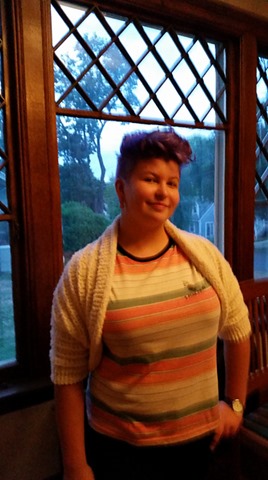

An interesting project, this was a very quick knit, but it did take a bit of attention in finishing. The instructions for seaming in the original are pretty rudimentary. Here’s what I did, in case you want ot make one of these for your own:
- Leave stitches live instead of binding off the final row
- After blocking, graft live stitches to the cast on edge, taking care to match the drop stitch ribs.
- Next, sew up the two sleeves, using grafting along their finished edges. Again, match the ribs.
- You now have the final seam left. Carefully match the center back seam to the center of the shoulder strip, and pin.
- Use mattress stitch to join the two strips together.
In effect, what you end up with is a T-shaped seam in the back, with the horizontal running between the lower edge of the armholes, and a vertical seam at the “spine” of the lower strip forming the center back. Both are hard to see in my photo of the back because (to brag) I took great care with my grafting and seaming.
Quite pleased with this one. Younger Daughter is into swing dancing, and will wear it not with t-shirts as shown, but with her 1940s/1950s-style dance dresses.
CATCHING UP
It’s been a while since I posted last. Hectic doesn’t begin to describe it. Kitchen finish, work-related deadlines, college graduations, and last – a blissful vacation week on Cape Cod in our new beachside condo, full of kayaking, golf, good food, and the active pursuit of doing absolutely nothing. All in all too many things to accomplish, with too little time to document any of it.
But through it all, a modicum of sanity-preserving handwork has happened: three pairs of hand-knit socks (my default no-thinking project of choice); plus some others.
First, thanks to the generosity of Certain Enablers who shall remain unnamed – a vintage shrug. I began working on this just before the vacation break. On US #9 (5.5mm) needles, this one was a quick knit. At left is the photo from the pattern. At right is my piece.

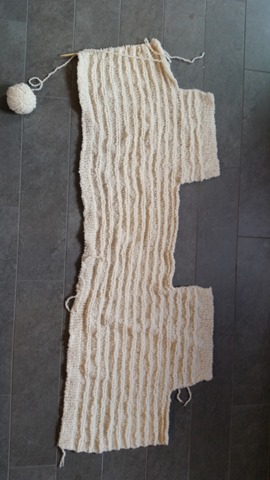
Those projections on the side are the sleeves. Obviously, I haven’t seamed the thing up yet. A bit of pretzel-type manipulation is slated to happen that will result in a T-shaped seam in the back, and the graceful drape of the simple drop-stitch rib pattern curving in the front. Or so we hope. I have the piece left on the needle because I haven’t decided yet on whether or not I will be doing some sort of live-stitch seam. It’s hot and sticky right now – too hot to sit with this tub of alpaca boucle on my lap. I’ll go back and finish this piece off when it cools off a bit. I’ll have to rush though, so Target Recipient can take the completed garment off to university with her next month.
Second is also a time-linked project. The first of two, in fact. I am edging off the two inspirational samplers I did for the girls, backing them and readying them for simple rod type hanging. Here’s the first. I’m hand’ hemming the backing/edging cloth to the stitching ground. The backing cloth is in one piece, strategically folded to be a self frame. I’ll baste a length of chain threaded on some thin woven tape in the bottom fold to provide weight, and leave small gaps in the two top corners for insertion of the hanging rod:
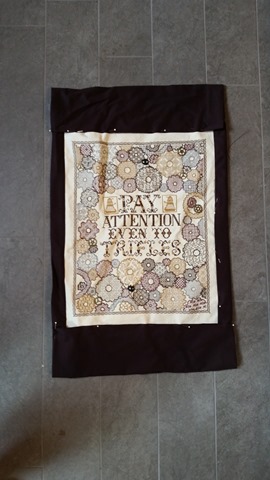
The second one will be close behind – the other sampler I did this fall/winter past. Also finished out for hanging from a rod. More on that after I’ve laid it out. In fact, if folk are interested, I’ll use the second one to illustrate the folding and stitching logic required to do this.
And finally, just for fun with no deadline attached (so you know what I’ll be working on tomorrow evening), an Autumn Lace shawl out of some unknown Noro fingering weight yarn, augmented by some Noro Taiyo Sock. The unknown Noro was also from the same Enabling Anonymous Donor, and was perfect for a project I’d been planning on working up for a long time:
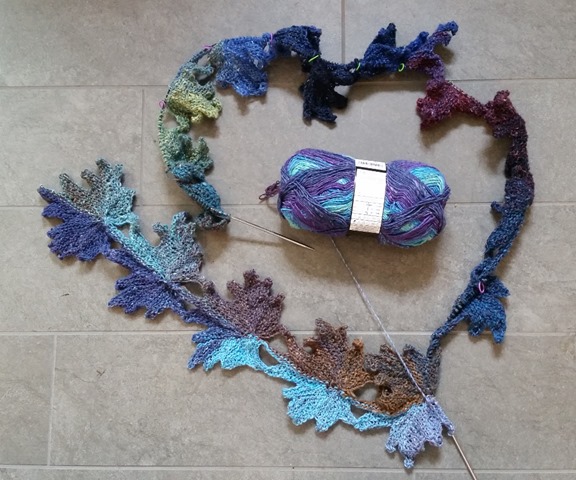
Here you see the first course of leaves (worked bottom half, then top half). This is not a particularly difficult pattern, but it is an exacting one, with a pattern that has to be closely followed, and that is not within my capability to memorize. More on this one as it develops.
THE BEACH PLACE
And now, a blatant advertisement from the Management of String.
WANT BEACH? WE HAVE IT, AND YOU CAN STAY THERE.
Seriously – we are now the happy owners of a beachfront condo in North Truro, Cape Cod – just one shuttle bus stop away from the Provincetown line. Our newly renovated two-bedroom upstairs unit is available for week-long rentals for the balance of the summer and through into September/early October.

As you can see from this sand-side photo, the building is right on the beach, on the quiet bay side. Our unit (indicated) has a covered private deck. It sleeps six total, with two bedrooms (a queen size bed in each), plus a new queen-size sleeper sofa in the living room. One bedroom has views of the bay beach, the other looks out on Pilgrim Lake.
It comes with a full, new kitchen, including a four-burner stove, oven, dishwasher, full size fridge, plus coffeemaker, blender and toaster. There’s a full bathroom with both a stall shower and whirlpool tub; and an in-unit washing machine and dryer.
The great room has an eat-in table that seats a cozy six, and the aforementioned sofa in a comfy seating overlooking the bay. The unit is also air conditioned, with WiFi and cable TV (including HBO) in the living room, and additional flat screen cable TVs in both bedrooms.
Outdoor amenities include full access to the private beach; two numbered, reserved parking places; a grill/picnic area open to all residents; bicycle racks; and a stop for the Provincetown shuttle bus directly in front of the building.

The address is 556 Shore Road, Unit #12, North Truro, MA in the Shoreline development (the map arrow points back to Wellfleet, and ultimately, the mainland.)


UPDATE: We have changed our rental agent. You can reserve the unit on-line via Kinlan-Grover – the unit code is WSALA.
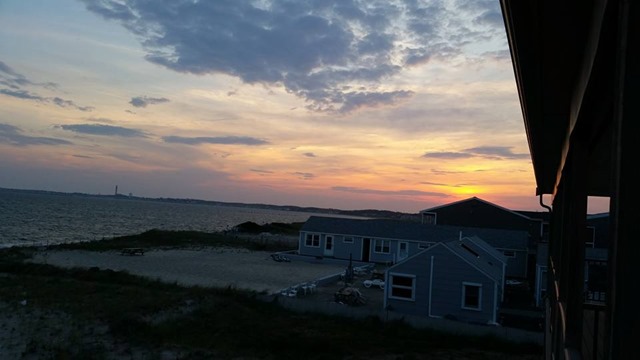
I leave you with a sunset picture of Provincetown, taken from our deck. Admit it – you really want to get away and admire this view in person.
A HECTIC WEEKEND, WITH MORE TO COME
We’re in the final glide path to high school graduation here, plus birthdays. We spent the weekend cleaning and gardening like crazy – and there’s still a ton to do.
That means removing a frosting of construction dust from every surface of the house; unpacking and placing the remaining kitchen goods (sorting out stuff to save for future spawn-apartments, or for charitable donation); washing all the floors; replacing the rugs stowed away from the chaos; waking up the garden from winter doldrums; building the new bean trellis out of last year’s giant grass canes; planting the beans; attacking the colonizing blanket of unwelcome weeds in the flower beds; staking the peonies; scrubbing down the bathrooms (similarly affected by construction dust); and generally putting everything to order. We didn’t finish, but we put a huge dent in it all. That means no time spent on detailed photography of the new orderly and in-service kitchen, and precious little time on needlework or knitting (although I did finish the last of my stack of Birthday (and Un-Birthday) socks in time). Plus the normal weekend regimen of cleaning and cooking for the ensuing week. I am now exhausted just tallying it all up.
Here is what I can report photographically.
The kitchen works! This is old news already – The Resident Male making short ribs last weekend:

Younger Daughter and The Denizen got all decked out for the Senior Prom. The went with a herd of friends, and had a great time.


Spiffy, no?
And we had an amazing joint birthday cake – home-baked, of course, courtesy of Younger Daughter. She used the America’s Test Kitchen Salted Caramel Chocolate Cake recipe in her first trial run of the new ovens. Oh, so good!

 String-Or-Nothing