INTERNATIONAL GLOSSARY!
The international glossary of knitting and crochet terms formerly posted at wiseNeedle is back up! It will be a permanent part of the standing offerings here, accessible via button from every page.
Enjoy!
STEP FORWARD, STEP BACK
As you can probably tell by the off-the-end-of-the pier style of my knitting and stitching projects here, not everything is fully swatched, graphed out, or perfectly planned before it’s realized. This may horrify some readers, but it’s the way I think. I prefer to learn on the fly, and don’t mind ripping back or starting again. For me, exploration is more fun than final product.
Case in point – the latest Wingspan. Let’s critique this thing to shreds:

Things I like:
- The basic Wingspan pattern
- The larger needle size/gauge for this particular yarn
- Using dice to determine hole size and placement
Things I don’t like:
- The color progression of this particular yarn
- This yarn in garter stitch
- The overall (near) finished look
- The combo of color, stitch and technique is too busy
One thing that made the last two Wingspans so dramatic was the long and gradual shading of the Zauberball Crazy. This was achieved by Zauberball’s dual strand ragg plies each cycling independently through their color ranges. In this full strand as opposed to ply-dyed yarn, color change is abrupt and the colors themselves are high-contrast. Speckles of the next color dot each block. (Now I remember starting socks with this ball, and not liking them either). The holes look less like airy bubbles, and more like the savaging of a demented moth army. And the eyelets, which work nicely in stockinette, look sloppy in garter stitch.
In total, I was Not Pleased. So this has been totally ripped back. I may play a bit with other stitches and this yarn, but in spite of it being a looonnnnngggg repeat, I am not confident that it’s right for a garter stitch Wingspan. However, the technique of placing eyelets in a fabric using a randomizing device to determine placement is still gnawing at me, as is thinking about other possible Wingspan variants. As a single project, this is a failure, but as a learning experience, it was valuable.
In other news, I’ve added to our house arsenal:

It’s a Korean-made sickle, sharp and sturdy. Similar ones have been used in Japan for centuries. They often figure in Anime, Samurai (and gangster) movies, both in their agricultural context and as weapons. We are close-in suburban here at String Central, and not out in the land of gentrified sprawl, so why do we need such a thing?
Giant grass:

I cut the patches on the side and front of the house each fall, just after they bloom but before they scatter seed. I don’t want to be responsible for colonizing the neighborhood with the stuff, and I don’t want it to sit looking forlorn and frowzy through the winter. To date I’ve been clipping each stalk with a pruner, but that’s painful and time consuming. I am hoping that this tool will allow a swifter handful by handful harvest.
For those concerned with possible waste – I strip the leaves off the stems and re-use the stalks to build my bean trellis each spring. The leaves go to town composting. I also post about availability of (free) plant stakes each year on the local mailing list, and put them out on the curb for other gardeners to take.
LIKE WATCHING PAINT DRY
Mid-blocking. Waiting for her new Wingspan scarf to dry:
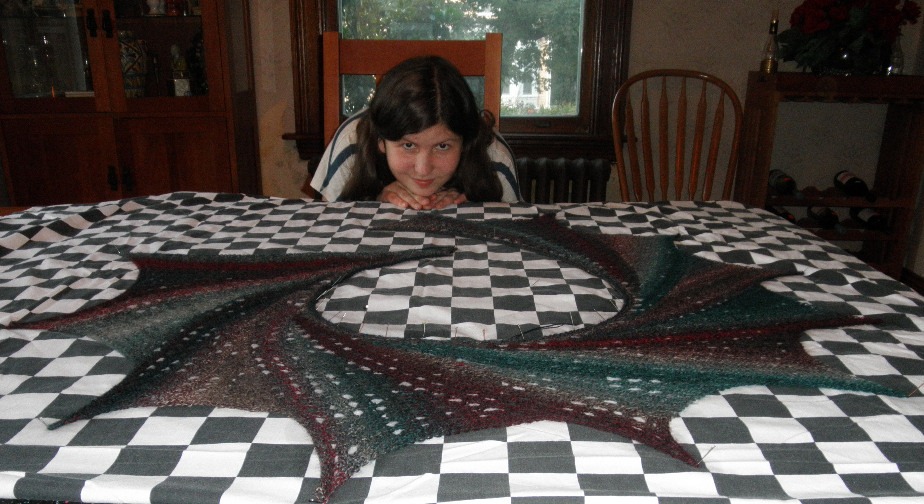
Before blocking, and the op-art horror of pinning out on a checked ground:
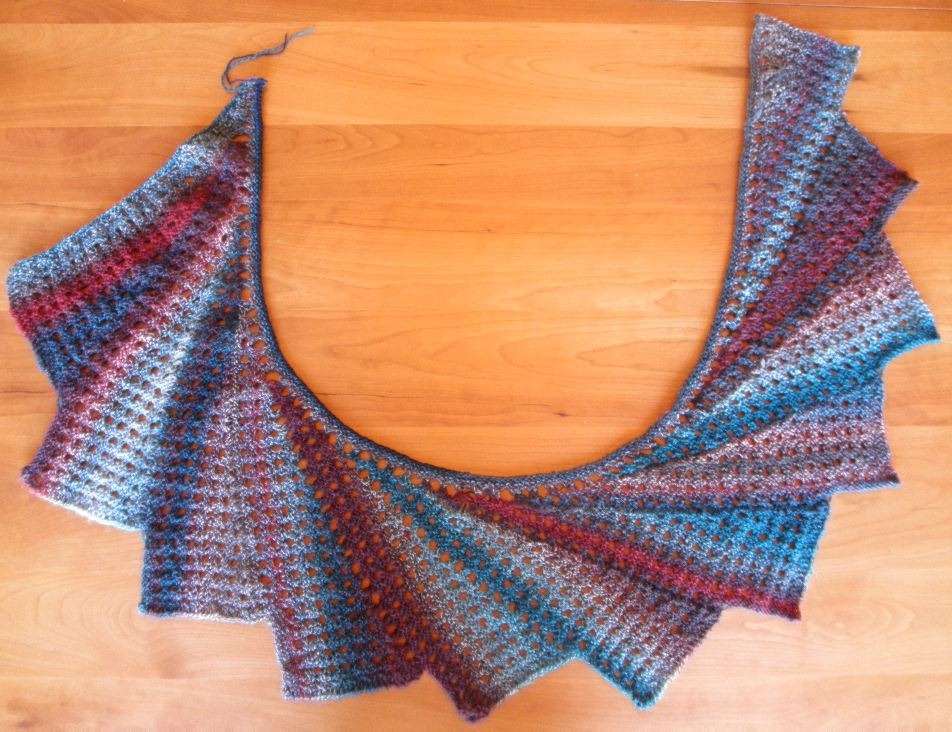

The actual color of this Zauberball Crazy is more like the two pinned out than it is in the dawn-light picture on the wood background.
What fancy blocking set-up am I using? Four rubber jigsaw-edged floor cushion tiles, with a rally check sheet laid out on top of them – all on the dining room table. I’ve got two twin size flat sheets like this, bought for pennies at a local salvage store. The regular 2-inch square checkerboard pattern may make eye-blasting photographs, but it’s fantastic for blocking to dimensions. Large checks come around every so often, most often in kids’ bedding, intended for proto-race car drivers. Oversize gingham and Tattersall plaids are ultra-trendy right now. They would also work well as blocking backgrounds.
Talk Nerdy To Me
I haven’t worked this Wingspan pattern out of my system yet. I’ve got one more ball of long-repeat hand-dyed sock weight yarn. My new yarn is mixed neons – very circus balloon like. This one has lost its tag, but I’m certain I found it at Wild & Woolly about a year or so ago. I like the lattice work double eyelet texture I used for this second scarf, but I want to try something more… unexpected.
I want to play with eyelets and this design, using a multicolor. But I don’t want to do the same regular lattice that I just finished.

I want to make something more like Swiss cheese, with eyelets of random size and spacing, to pick up on the airy, light-hearted colors. You can just make out a couple large and small eyelets in the purple stripe.
How to achieve random size/placement? Remember these?

Stand proud, you knitting dungeon crawlers of the past! That same set of dice so often used for exploring graph paper on dorm room floors, armed only with friends, a bag of Doritos and a bottle of Diet Coke, can also be harnessed as a knitters’ tool.*
I’m using a d20 and a d4 to determine hole spacing and size. I roll the 20-sided die, and the number rolled determines how many stitches I knit before I make an eyelet. The d4 by landing on an odd or even number, determines whether I make a large or a small eyelet. (Yes I could use die of any even number of sides for this, but why not employ that lonely, underutilized d4 for something for a change.)
The small eyelet is defined as a K2tog-YO2-SSK unit, with the YOs worked KP on the next row (a two-row double eyelet). Large ones are a bit more complex. They take three rows to complete – K3tog-YO3-SSSK as the base eyelet unit. On the next row I do another YO3 when I get to the hole. On the third row I work KPKP into the bottom YO3, encasing the horizontal strands left behind working both YO rows, and restoring stitch count to the original number. Yes, that’s a YO3, not a YO4, even though I’m working four stitches into the open space. I found by trial and error that YO3 made a less floppy, neater looking hole.
I haven’t seen this particular three-row mega-eyelet documented anywhere else, but as with all knitting – I refuse to believe that I’m the first to think it up. I’m sure there’s a reference book citation for it somewhere.
And using dice to introduce randomness isn’t an original idea either. There’s a whole school of aleatoric and indeterminate music that in addition to encouraging performers to take a major role in deciding how a piece is played, often employs mechanisms of chance (including dice) to add immediacy and uncertainty to its base compositions. Other knitters have used dice to determine stripe width or repeat, motif placement, or color choice.
So there you have it. Second Wingspan finished. Third, if luck holds out and this method produces something attractive, will be a bubbly, swirly Swiss-cheese of candy colored neon. If it does I’ll have to find a recipient whose idiom encompasses bubbly neon color scarves. And if it doesn’t I’ll rely on one of knitting’s prime virtues: The ability to reduce worked materials to their pre-project state, ready to begin something else.
* Another knitting-related use for polyhedral dice is as row counters. Put one next to you and advance it one number for each row (or stitch) that needs tracking.
TAKING FLIGHT
Playing with the Wingspan pattern here, I post progress. Wingspan #2 is almost finished.
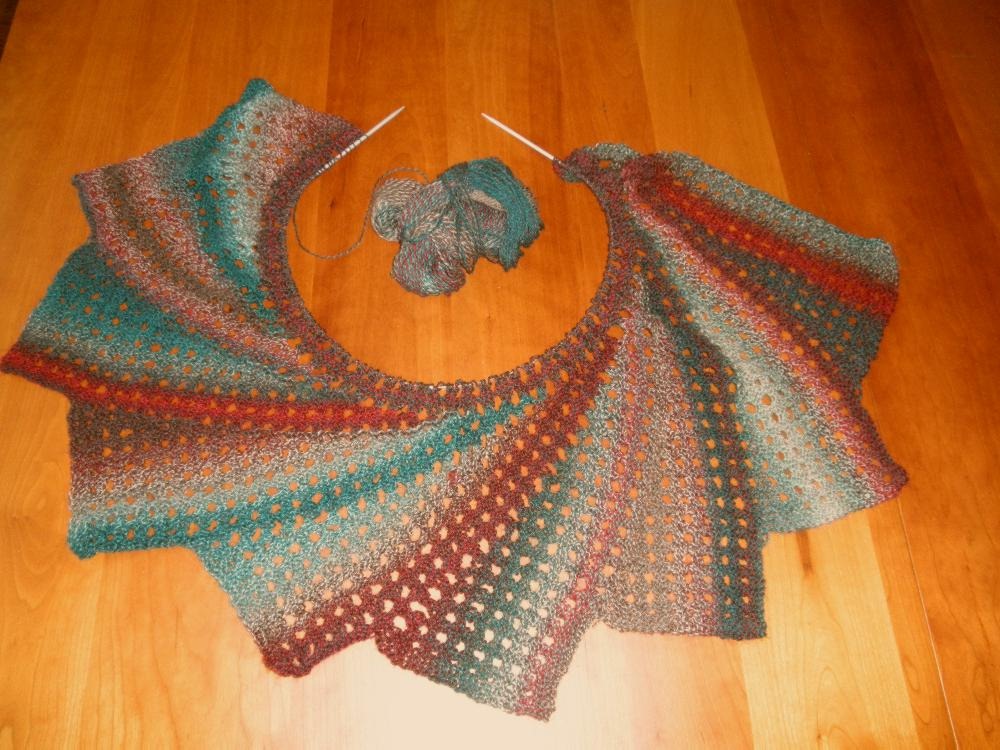
Mine is narrower than the original pattern – 75 stitches instead of 90; and has one extra point. Oh, and Swiss cheese holes (double YOs, followed by Sl2-K1-PSSO center double decreases, although first and last one in the row is a single YO to maintain stitch count). I could probably have gotten away with knitting a tenth point, but I wanted to have a wider inside strip to finish. As you can see, I had a very wide red/blue ragg section, and I used it to do a row of decrease-framed diamonds across the whole top. I’ll finish out the ball flat, without additional eyelets. And if I don’t like that, I’ll rip back and do that last point. The next post will show my completed Swiss Cheese Variant Wingspan, mid-block.
For those who have asked, the Wingspan pattern is available as a free download on Ravelry.
More patterns posted
For those of you who may not have noticed, I’m continuing to post the accumulated free patterns previously published on wiseNeedle and here on String. All will be available as PDF downloads at the Knitting Patterns and Embroidery Patterns tabs, at the top of this page. Some incorporate additional advice on the pattern or technique harvested from the associated pattern discussion posts.
Highlights of the knitting pattern collection include:

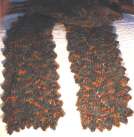


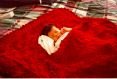

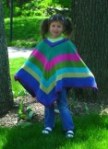


Embroidery charts include but are not limited to:


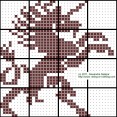


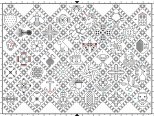
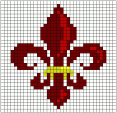
Note that the block unit graphs presented as embroidery patterns are also suitable for knitting, mosaics, crochet, and other work that’s commonly done off a gridded design.
FLAPPING ONWARD
The quick side trip to knitting is being just as quick as I thought. Here’s Wingspan (Angel Variant), finished and blocking out on some rubber mats on my dining room table:
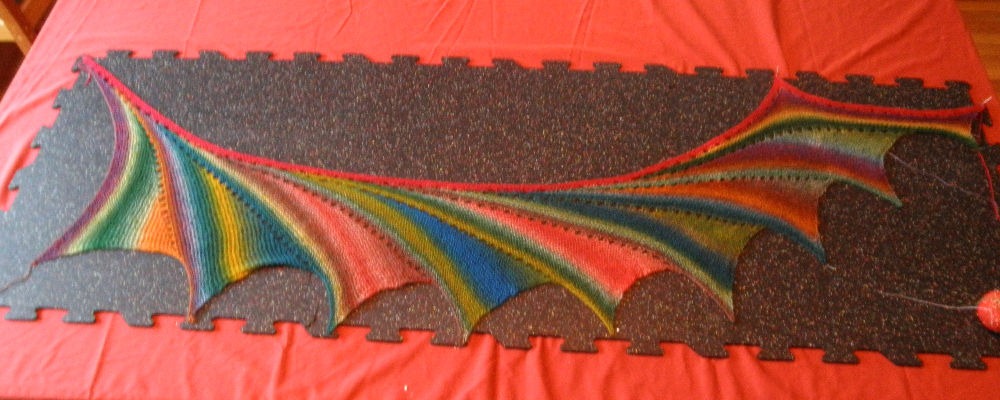
(Yet another traditional blurry String photo, taken at dawn.)
The colors are a bit red-shifted, but you get the idea. A prismatic bat wing. I do confess that I would have had a little bit left over at the end had I finished off where the pattern said to stop – after point #8. But the color change in it was among the nicest in the ball, so I kept going, using every bit of the precious Zauberball Crazy, and finishing off with some leftover red sock yarn from my stash. I’m pleased with it, and as soon as it’s dry and I can darn in the ends, I’ll be rocketing it off to Elder Daughter. Unless she declines because she wants the fun of knitting her own.
Wingspan #2 is now on the needles. Younger daughter requested the darker color ball. She also asked that her scarf be narrower, with lots more holes. So I’m playing with the concept. Instead of one row of eyelets to close out each point segment, I’m working eyelets every 6th row; and I’m making them larger by doing them as S2-K1-PSSO center double decreases, followed by double yarn overs.
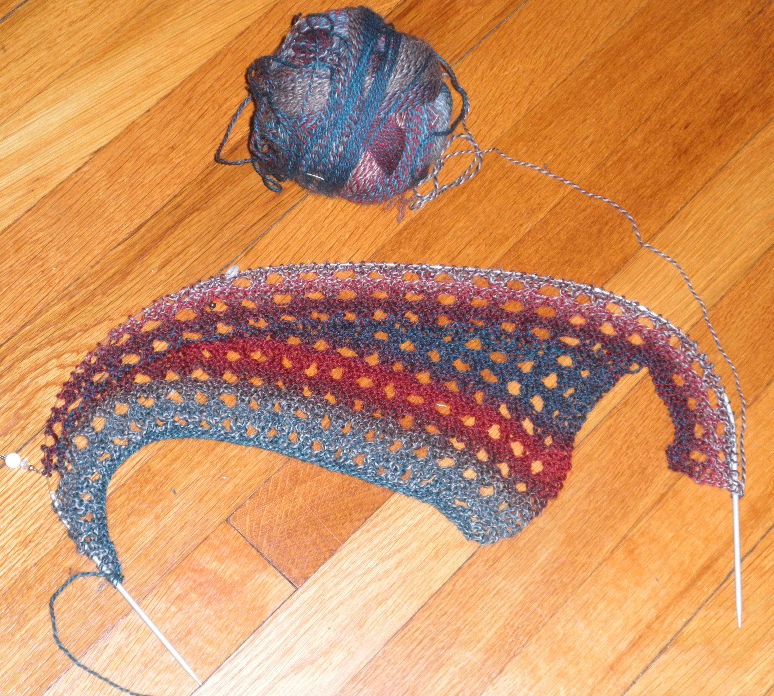
Some fudging is going on, all on the fly, to make a garter border around the growing point ends, and to fit the eyelet progression into the short row edge shaping. Just enough (in combo with watching the colors change) to keep my interest.
<begin curmudgeonly rant>
In other news, we ran away for a bit of fun this weekend. Younger Daughter, her pal and I went to King Richards’ Fair in Carver, MA – the local renfaire. The kids dressed up and had a great time, being new to small stage jugglers, acrobats, and general comedic banter.
I will say that I was less impressed. For all of the staff’s efforts, the charm of the thing is largely gone when compared to my memories of eight or so years ago. There was only one artisan working in the compound – a fellow doing lamp work glass. I missed seeing more of that – the leatherworkers, the folk at the forge, and the like.
The mounted “jousts” were the only things there that were free.
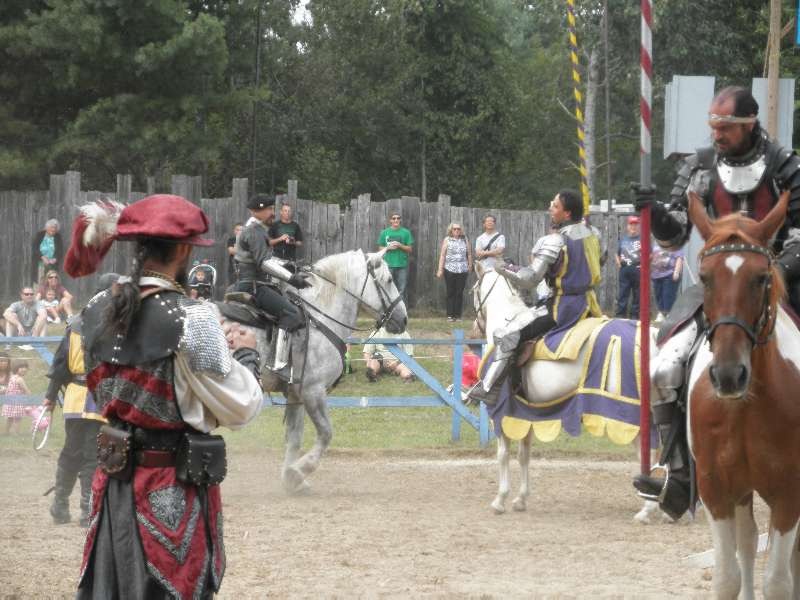
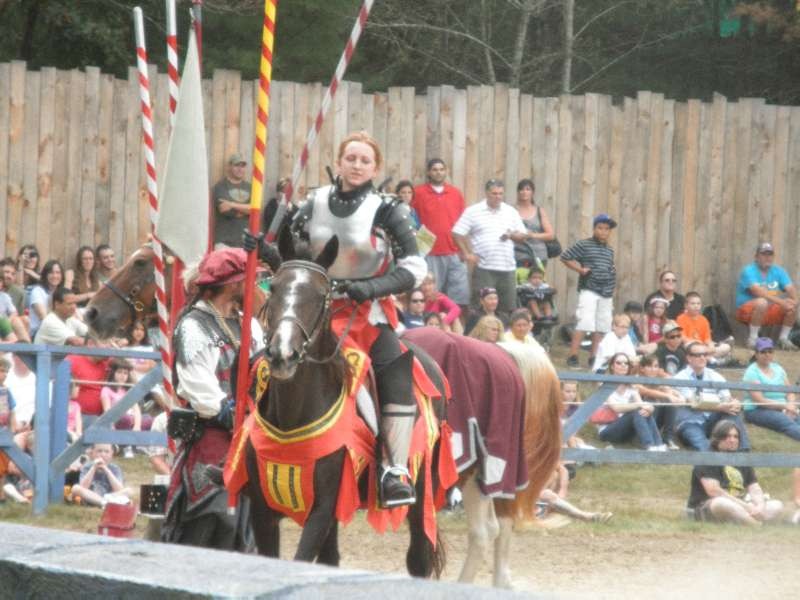
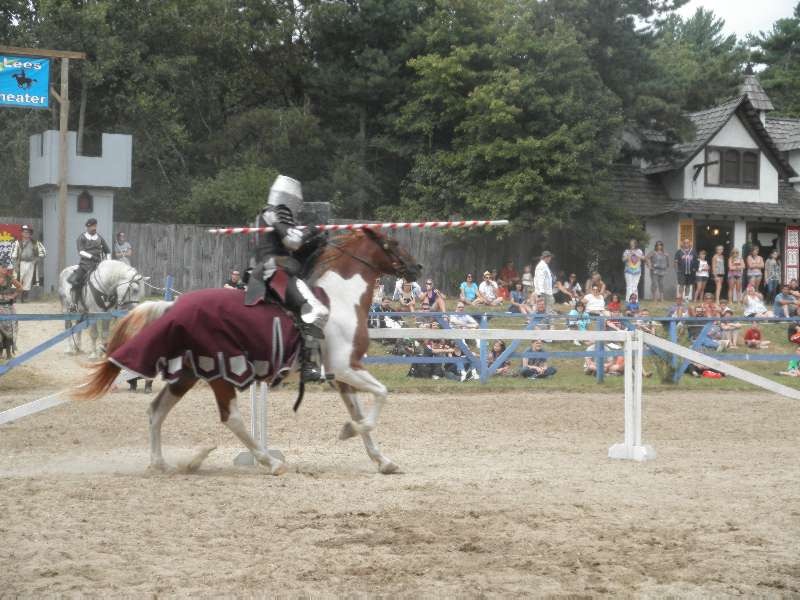
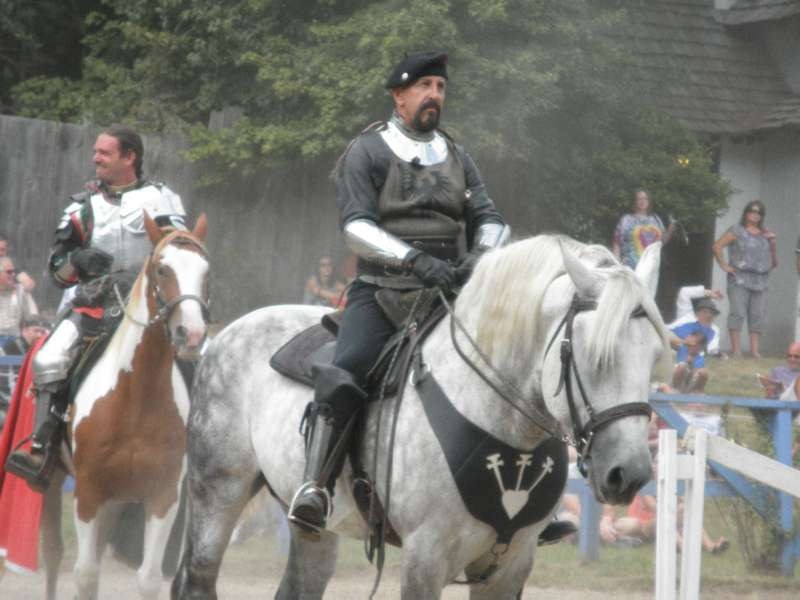
Younger daughter was camera wrangler, so it’s no surprise that our pix are all of the horses. The show we saw started with tilts at target and rings, and ended with lance to lance on horseback. It was highly staged (which we didn’t mind, given the risk of injury if the combat were more real), and fun to watch.
From the start, I was mildly miffed. Although I brought cash with me, I was annoyed that in none of their ads or websites anywhere is the fact that the faire is cash-only listed. I heard more than one attendee retreat from the ticket window, to drive back to town to find a bank rather than use the exorbitant fee ATM machine at the gate.
Once you’ve paid your $27 per person, inside the faire you’ll find that everything costs money. Food is on a ticket system, sold in $5.00 blocks of tickets only. They’re 50 cents each, although (again) this isn’t posted anywhere. A bottle of water is seven tickets ($3.50), a child’s plate of chicken fingers and fries is 17 tickets ($8.50), a sausage on a roll is 19 ($9.50). And the prices of foodstuffs are arranged so that it’s difficult to not have a few tickets left over that you can’t redeem. I saw one guy hassled by staff when he tried to sell his leftover four tickets to another visitor.
All rides, attractions, or other events (again except for the horse-related arena stuff) come with an additional fee. $2.00 for the maze. $4.00 for archery, $3.00 for a kiddie ride, and so on. It would be easy to go with two kids and without eating a thing, spend $100 on top of admission just in an hour of walking around. It’s clear that even the small stage performers are largely paid by passing the hat. They did deliver amusing, well rehearsed performances that we did enjoy. I did feel sorry for them and pony up, but again – you’re opening your wallet for everything other than breathing.
I was also disappointed at the large number of adults who seemed to be there in order to drink while walking around. This was a holiday weekend, and the Faire’s opening weekend. I expected to see more renfest geek kids – herds of teens in costume; and families with children over stroller age (strollers are difficult to push on the uneven ground). But about three quarters of the crowd were adults in their late 20s through 30s, wandering around in advanced states of tipsy. Not what I expected.
On the merchants – based on the prices, I assume that the Faire charges steep rents for those kiosks and stalls. What I saw was very pricey. Lots of stuff catering to folk dressing for the next renfest, of course, which I did expect. $75. light cotton elastic waist skirts I could make out of a remnant for under $5.00. $300 wench bodices. $150 capes. $100 pewter cups. $75 leather notebook covers. There was some jewelry and toys in the $15-30 range, but you had to hunt for it.
Again, I will say that the kids had fun. I did too in spite of being annoyed, and for that I thank the individual small-stage performers. They made the day. But the Faire as a whole has gotten more expensive and cheesier than I remember.
We won’t be going again.
<end rant>
MORE WORDS FROM ANOTHER WORLD
Here are some more words and terms I’ve stumbled across during my India-migration preparations. Again – I point these out not because they are laughable or substandard, but because they are new to me, and illustrate the fact that English while common bridge among many speakers, can befuddle as well as unite. Please note that my sample is skewed to the sensational, because most of my sources are newspapers.
Here are three from local news coverage that all have to do with social action. There’s probably nuance or hierarchy of severity here that I’m missing. I’m inferring definition from context, and I don’t have tons of data points to figure out finer shades of meaning. Please chime in with corrections if you have them.
Bandobast – I love the sound of this one. From the usage it appears to be an ad-hoc group pursuing a common purpose, especially a grass-roots one, as opposed to that of a standing organization. There appears to be a nuance of self-organization, individual action, and spontaneity to a bandobast. A group of volunteers picking up litter after an arts festival or handing out water to marathon runners might be considered to be bandobasts. But not all bandobast actions are benign.
Morcha – A morcha seems to be used when a group of people self-organizes to pursue a specific social or political agenda. Although I see traffic-blocking street protests referred to using “bandobast,” “morcha” seems to be used more for organized actions we’d call labor strikes or work slowdowns. I’m unsure if the Occupy Movement’s actions in various US cities this year past would be considered bandobasts or morchas.
Bandh – This appears to be a major form of organized protest – a universal strike, in which the entire population of a region stays home, eschewing all work, school, commerce, or travel. It’s a powerful tool of civil protest. I’ve found through further reading that it has been banned, although calls for bandh actions are still made.
And some more general terms:
Godown – From context, seems to be a storage facility or warehouse district. I’ve seen some articles that use ‘godown’ to refer to industrial buildings of indistinct past use but large size, now repurposed to serve civic needs.
Octroi – I know this one from Medieval history. In historical usage, it’s a tax, levied on the goods moved between states; not exactly a customs duty, it’s more like a custody transfer tax. In the India context I’m unsure if this is a commercial tax, paid by corporations and possibly by municipal entities, although I think it is – as opposed to a direct tax paid by individuals. (That’s not to say that costs aren’t trickled down.)
Corporators – the closest I can figure is that these are local representatives. In the US, depending on the type of local governance and size of the local area, these might be ward representatives, town meeting or city council members. I am unsure if Corporators are appointed or elected. More reading is warranted.
Scheme – this is a nuance difference in usage. In the Indian newspapers, scheme appears to be used as a synonym for plan. For example, municipal corporations (city governance organizations) can have schemes for handling various civic challenges. However in the US, a scheme would have a sinister connotation, with an undertone of illicit secrecy. It’s a word used in the US more to designate the plans of evildoers and malcontents, than it is used to describe honest and forthright actions taken to benefit others.
I’ll keep on posting these from time to time, to entertain and edify. Perhaps some future expat will find these posts useful.
COMPULSION
Today I try to appease both my constituencies – stitchers and knitters.
First, for the knitters, I make confession that I’ve been seduced. I recently came into possession of a true one-skein wonder, two balls of Skacel’s Zauberball Crazy. One is an addled mix of red, turquoise, yellow and green (#1701), the other is chocolate, teal, cranberry and according to the official photo, on the inside somewhere – tan (#1507). It’s a lofty and soft fingering weight, 100g/459 yards per ball, enough to knit a pair of socks for me. Here are Skacel’s own photos of the two, at a color fidelity much better than I could achieve:


But looking at this stuff made me want to do something other than socks. Given the number of variables in play right now, I decided I didn’t want to take time to design my own pattern, so I began poking around the ‘net and found the Wingspan scarf. I’m working up this variant. It’s all garter stitch, with the demonstrative shaping formed by short rows. You can see the play of the extra long color repeat even in this traditional blurry String snap, taken at dawn:

A quick knit, totally on autopilot, with a clever system of traveling markers that make it impossible to make a mistake. More on this as the thing grows.
And on the Big Green Sampler, I’m inching along the fiddly bits at the bottom edge, filling in my voiding. The tightly drawn two-sided Italian cross stitch goes more quickly in an open field. Around these odd little bits – especially the Y-shaped extensions in the top and bottom borders (a detail done exactly this way in the museum original) – it’s a slow and exacting ride:

The little empty rectangles at the base of each Y are especially tricky to leave unworked. Still, I am making incremental progress none the less.
Now, why did I start the knitting project?
Compulsion. Plain and simple. I do 98% of my yarn acquisition at Wild & Woolly, my local yarn shop – a heaven on earth for knitters. But driving across the state to drop Elder Daughter off at college put me within striking distance of Webs, the Northampton, MA yarn hypermarket. My rule is not to buy stuff elsewhere that I can find locally, so Younger Daughter and I took a quick jaunt through the place looking for stand-outs – things I haven’t seen anywhere else.
That’s where I was attacked by the Zauberball. It fairly leapt of the shelf in a direct assault on my magpie color sense. It’s hard to describe this compulsion to a non-crafter. I HAD to get it, and I HAD to find something good to knit with it, and I HAD to cast on right away. That’s the way the best projects work – the absolute mandate to watch the piece take shape. Time flies on its own. Any encountered problems melt away. I look down and see more done than I realized was happening. Oddly enough, the final product while valued, is not the goal. It’s the process, the journey, the materials, and the sense of progress.
I’ll split my time between these two. Maybe I’ll figure out something myself to do with Zauberball #2. Or maybe not. But in any case, both balls have to be cooked, chewed and digested before I return to normal.
ALL GOOD THINGS
…the saying goes, must come to an end.
So goes the summer of 2012.
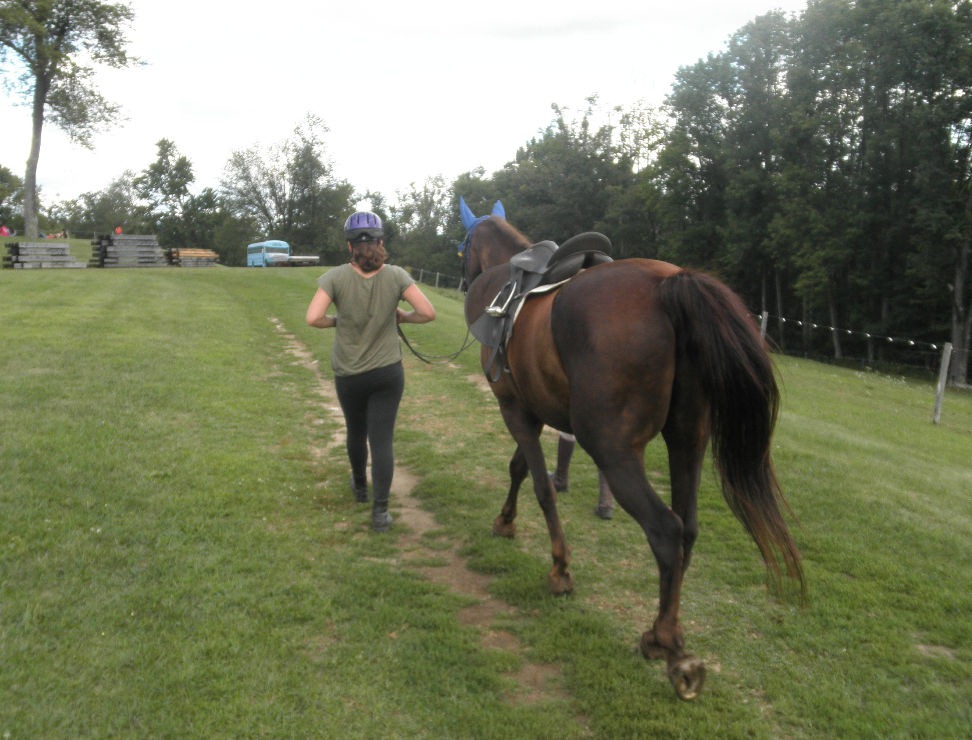
One sure sign of summer’s end is retrieving one or more kids from Roads End Farm, the summer camp they both love. As ever, much fun was had. We’ve found there’s a direct correlation between how dirty they are at pick-up, and how great the summer was. Let’s just say that this year we transported a little ball of filth with a big smile. Here’s that same smile, up on Yuma.

Dante, star of the pix below was having a bad leg day, and was returned to the paddock rather than being pressed into service:

That’s Sue in the background, riding instructor extraordinaire. However you’ll note that Dante is sporting a fashion accessory. It was a very fly-filled season, and to give the horses some relief, they have been wearing fly bonnets. However in the farm’s price range for pre-made, they only come in one-size-fits-all. I don’t have a shot of Elliot, REF’s largest horse, but at well over 16.5 hands, he towers over the farm’s 76-horse mostly Morgan herd. Stock fly bonnets would not fit him – not easily. So I made him one, custom:

He was turned out to graze the morning we visited, otherwise I’d have a shot of the thing being modeled. I used the crochet pattern from Nordic Mart, picking up stitches after the crochet was done to knit the ear socks. I used some old Austermann Record 210 remnants and a size 4mm (US G) hook, approximately 4 skeins total.
A NEW VOCABULARY
As part of the preparation for our grand India adventure, I’ve been reading everything I can about Pune and the surrounding area. This includes on-line editions of local newspapers, history books, and blogs. I’m learning a lot, finding facts, trends, and rumors – the hard and soft aspects of our soon-to-be home and its stew of cultures.
My primary sources are the web-available English language newspapers. I admit that they provide a skewed viewpoint. I know that I would not want someone to draw vast conclusions about the US by reading any one or two papers here (especially the tabloids or political slush papers). Still, slanted as they are in reporting eye catching, sensational crime stories, or presenting views tinted by biases I do not yet understand, they are a fascinating source of words, turns of phrase, references, and names of institutions that are new to me. These usages are just as current, legitimate and topical as any writing or speech anywhere else. I am reporting these not because they are strange, but because they are novel to my ear.
Dacoity – This one was reported by the Resident Male. In the US it would be called “armed robbery” or in an older time – alleybashing. Someone sticking up the local convenience store would be a dacoit.
Sharp weapons – Also reported by the Resident Male. We’d say “edged weapons.” Knives, mostly. Seems to be the favored arsenal for dacoity.
Nullah – A steep sided gully through which infrequent (but dangerous) storm water surges flow. If a natural feature, depending on the part of the country here we’d call it an arroyo, canyon, gully, gulch, or gorge. If man-made it might be a culvert or storm drain.
Housing society – In the US it would be a housing cooperative or “co-op” for short. A building or neighborhood in which the owners share the pooled cost of common area maintenance and general services for all. Like here though, there are maintenance fees and (when needed) special assessments. “Society” is also used to mean the grounds of the housing complex itself, especially enclosed communities formed of single family houses with walled gardens, inside a larger gated perimeter.
Overbridge – Overpass, like a highway overpass or a traffic fly-over.
Municipal Corporation – Depending on the size and organization of the city or town in the US the equivalent would be the city or town council and mayor’s office. I’m still working this out, but it appears that civic governance is not by direct election of representatives to the municipal corporation, but I may be wrong. More on this as I learn myself.
E-Way – The equivalent here would be a expressway, major highway or turnpike, probably a major Interstate or state route.
Lokshahi din – Grievance sessions held by a Municipal Corporation. Citizens with a compliant about municipal function or services delivery can submit it in writing, then go to a hearing where a municipal commissioner can render a judgement, to which all parties are bound. These tend to be held by civic zone (what we’d call city ward or district).
Jawan – I deduce this is a security guard, policeman, or soldier on security detail. Jawans are deployed on the trains to maintain security and order. I’m unsure if the male uniformed guards checking bag contents and running metal detectors outside of most public buildings would also be called jawans, or what (if any) the equivalent term for a female officer might be.
Chowki – This one caught me by surprise but shouldn’t have. It’s a local police station or jail. I’d always wondered where the Brit/US slang “chokey” for the local slammer came from. Now I know.
Chowk – by contrast, this is a town square. I guess in India, Arlington Center would be known as Arlington Chowk.
I’ll continue to vacuum up what I can, posting occasional vocabulary updates as my linguistic dust cup fills.
HALFWAY!
I had occasion to unroll the big green sampler last night in order to adjust the padding that was between the layers of previously stitched work. While it was out and open, I took some progress pix:


You can see that the entire piece spans the width of my dining room table. I’m more or less at the centermost strip, and at (more or less) the middle of that strip. The penny on the shot at the right will give you an idea of scale. I’m pleased with the density and patterning so far. I’m also pleased with the pulled background of the latest bit. But it is taking a VERY long time to stitch, and I’m looking forward to figuring out what will be next. Perhaps something in quick-to-finish double running, perhaps something a bit more geometric and very open. We’ll see!
In other news, I’m continuing to add both knitting and embroidery patterns to the patterns buttons at the top of the page. I’m going back through prior posts and standardizing formats, putting everything into convenient buckets for ready access. If you’ve got a request, let me know and I’ll bump it up in priority. Enjoy!
 String-Or-Nothing