STILL MORE WORDS FROM ANOTHER WORLD
Having sent off our household goods shipment in advance of our great migration, here’s another installment of words and usages from India that are new to me. Again – these are skewed to the sensational and seasonal because my main sources are all newspapers, which there like here tend to lead with grabbers on taxes, violence, scandal, tragedy, alongside gossip and pieces on communal celebrations.
Hoardings – Large scale printed media advertising, especially billboards, although the extra big, freestanding ones appear to be called “gantries.” Trucks whose body is a large sign rather than a cargo payload are “mobile hoardings.”
Tender Rate – Hard to tell from context, but this appears to be a tax rate or licensing fee. I found it in an article on government crackdown on illegal hoardings (above), in which a higher tender rate was recommended, coupled with increased enforcement, including removal of illegal (unpaid) displays.
Lakh and Crore – Indian currency (rupees) are individually quite small in value. At the time I write this, the exchange rate is roughly 1 rupee = 1.9 cents US. Therefore prices for big ticket items – cars, houses, jewelry – are expressed in very large numbers. One lakh = 100,000 rupees, or at today’s exchange rate, about US $1,886.79. One crore = 10,000,000, or US $188,679.00. It’s very common to see headlines like “Rs 1.5 lakh of jewelry stolen,” or “Rs 4.3 crore seized”. The abbreviations are lk and cr.
Names for cardinal numbers – Numbers in general in Hindi and Sanskrit (two of many languages there) are handled differently than in English. We have unique number words for numerals 1-12, then use a combo form to make the rest of the teens; then have a unique word for tens place numbers (20, 30, etc.) but form compound words for the numbers in between them (21, 33, 67). In India each number to 100 has a unique name.
Body offences – A broad legal class of crimes that appears to cover the equivalent of the US terms “Bodily harm,” and “aggravated assault” although the definition also includes armed robbery, extortion by threat of injury, poisoning, slavery, and kidnapping
Various common British usages – Thrash instead of beat (“Dacoits thrashed the victim with a stout rod”); shift instead of move (“I shifted the furniture, but I didn’t think you’d mind.”); dustbin instead of trash can; attach instead of confiscate (The Enforcement Directorate attached all remaining funds, after the embezzler was identified.”)
Ota – Earthen platform or raised mound. A temporary structure used as a platform for devotions, especially during religious celebrations.
Pandal – A structure or enclosure erected for religious purposes. These can be permanent, but at this time of year, festival season in India, many are temporary. The legal definition includes structures that serve business purposes, too, although newspaper citations I’ve seen have all been about temporary shrines erected for celebrations, where they are, or what provisions/fees are being levied for electrification, or other infrastructure and public safety support for them.
REINTRODUCTIONS
Welcome to the flood of folks directed here by the generosity of Mary Colbert, over at Needle ‘n Thread! She blogged about Ensamplario Atlantio, and the visitor count here ballooned from about 70 per day to over 5,000.
Given the large number of new folk, I thought I’d make a general re-introduction of myself and the site.
My name is Kim Brody Salazar. I’ve been knocking around the web since it first crawled up from the primordial pre-Internet seas. Professionally, I’m a proposal manager specializing in engineering and high-tech. I escape from project pursuit deadlines into needlework, SF, good cooking, and halfhearted attempts at domesticity. Past passions include the Society for Creative Anachronism. I rarely attend SCA events these days, but is still home to many of my closest friends; and Aikido. I am abetted in these efforts by Elder and Younger Daughters, and by The Resident Male, the husband whose programming ingenuity was responsible for the plumbing behind wiseNeedle. As a family we are currently preparing for an extended sojourn in India, where he is now working.
I’ve done many types of needlework, but my favorite stitching techniques remain the counted styles – especially from the great Modelbook Era (1520s-1650s). I adore blackwork in all its manifestations, and strapwork (the long strip patterns found on household and body linens).

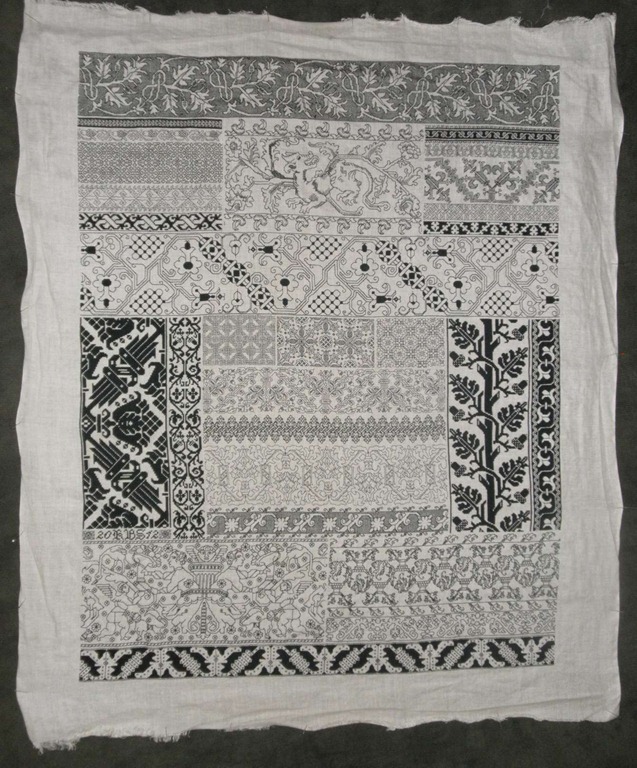

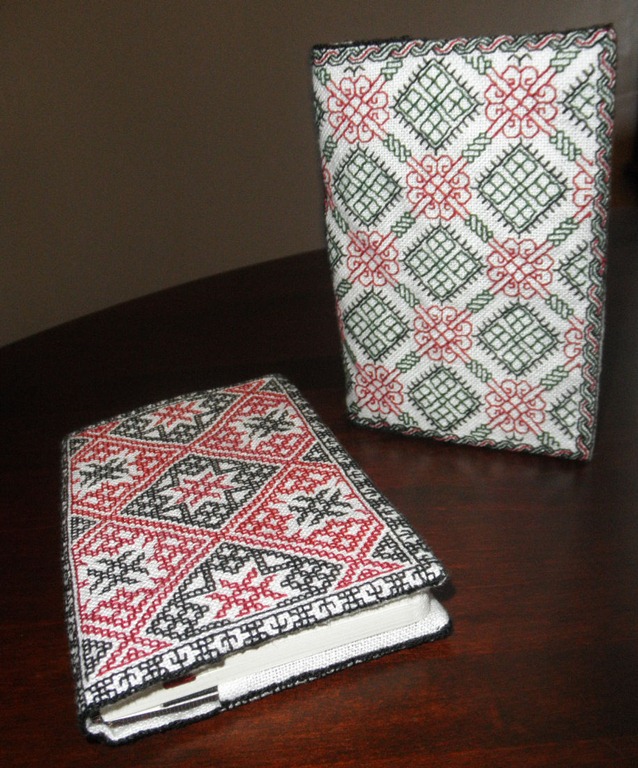
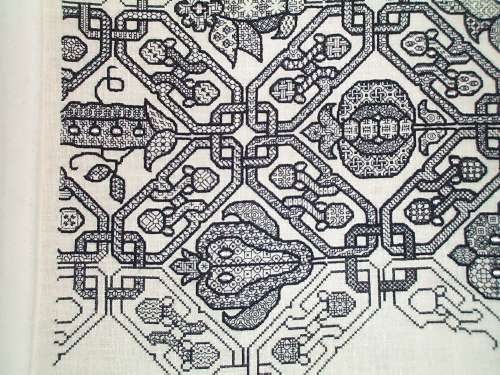


I’ve also played with several forms of needle lace and crewel, but in the days that pre-dated photo blogs.
I am an avid though haphazard researcher, drafting up historical patterns from artifact and early book sources. I’ve put together several pamphlets of these designs. The most recent complete book was The New Carolingian Modelbook: Counted Designs from Before 1600. It was published for an SCA audience, but to my great surprise was discovered by the stitching community at large. I won’t go into the details, but TNCM is now out of print. I am working on a sequel, which I hope to have out soon via a print on demand or self-publication service. The Second Carolingian Modelbook: More Designs from Historical Sources will not duplicate the designs in my earlier book.
Along the way, just for fun and to refine the methods I wanted to use for T2CM, I drafted up Ensamplario Atlantio. It’s a collection of filling designs for inhabited blackwork, along with quite a few that have stand-alone or strip application. I’ve released it for free as a series of PDFs, along with other free embroidery patterns, here.
I also knit and crochet. I’ve done a bit of amateur design, and have had several of patterns published by Classic Elite, KnitNet, and Schaefer Yarns. I ran the wiseNeedle knitting info website (in various incarnations) from 1995 until just earlier this year. wiseNeedle featured an extensive needlework advice board, plus the glossary and patterns now here, along with a huge database of user-contributed non-sponsored yarn reviews. The yarn review database was salvaged by Nimblestix. Please feel free to consult to it and add to it over there. I also release knitting patterns for free here on String.
In terms of technique, I tend to favor texture knitting over stranded colorwork (although I like them both). I especially like lace knitting, and mining the 16th century sources and late 19th/early 20th century knitting publications for designs elements, which I toss into the creative Cuisinart.
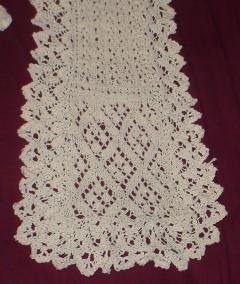
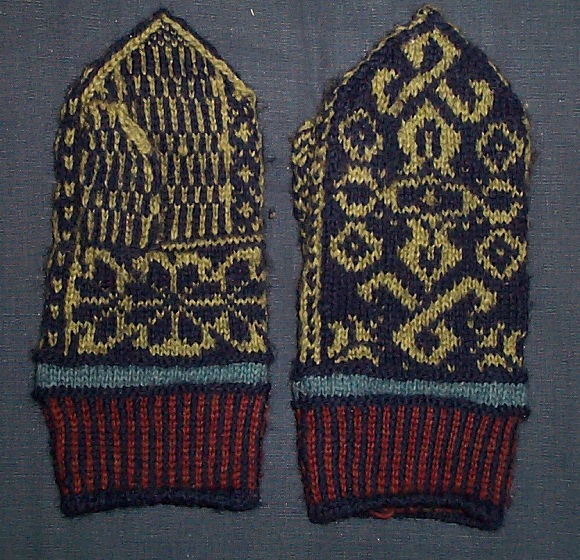

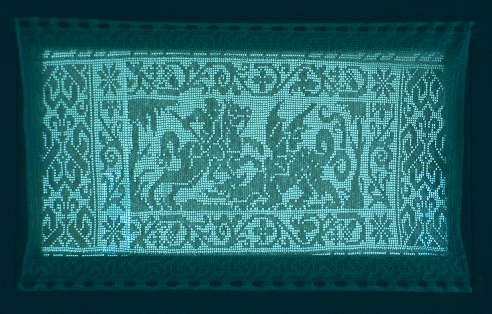
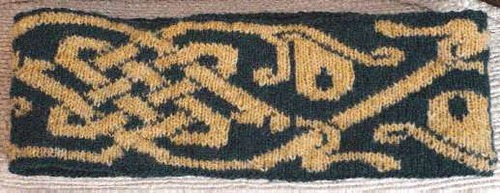

That pretty much sums up my approach to all needle arts. I love the intricacy of many traditional styles, but I am not all that interested in producing stitch-literal reproductions. Instead I prefer to add to my design vocabulary to produce new works. Some of these I hope that – if they were to be TARDIS-transported back through time – would be accepted as just another piece in the target style, without being a dead-on copy of an extant artifact. Others are more playful, taking designs intended for one needlework medium and using it in another, or sneaking in incongruities just for fun. If you’re a needlework purist, I’m sure I’ll ruffle your feathers, and we’ll have lively debate. This is a good thing, because it will expand both our horizons.
I also do not believe the common line that modern needleworkers have no skill or patience for large, intricate projects. I find the dumbed-down tone of most mass market stitching, crochet and knitting books to be patronizing and demeaning. If passion and interest are there, no skill curve is too steep to climb, and there’s no reason to set the bar of attainment artificially low. Steps up are good, but too many instructors top out on the lower plateaus, never expecting their students to advance beyond threshold skills, or offering up the higher levels as anything other than impossible high bars that we today can never achieve.
Time can be found for whatever you want to do or whatever skill you want to perfect, even if (like me) it’s only 15 minutes here or there. Needlework is like music or the martial arts – practice is required, there are no instant skills or guaranteed outcome. But like any training pursuit, the act of committing to the training hones the mind and the character, and teaches far more than the mechanics of the skill itself. I encourage everyone to set high goals for themselves. It’s the reaching that makes it worthwhile, whether or not the goal is grasped. I may never reach mine, but I’m sure having fun on the journey up.
In any case – enough rambling. Welcome to my new readers and any long-lost friends!
GALAXY OF WINGSPANS, MORE KOMBU
Where have I been? Busy, mostly.
I’ve been getting our India-bound household goods shipment organized – buying what’s needful, and sorting the rest out from our domestic inventory. There are tons of details that have to be settled before we go, and not enough time to do them, of course.
But that doesn’t mean that stress abatement isn’t happening. I’ve taken to watching Dr. Who with Younger Daughter, after dinner is picked up and homework is complete. I’ve worked a bit on stitching, but mostly knitting. Holidays are coming up after all, and there are gifts to be stockpiled. Plus in all of the rushing around there’s a fair amount of “hurry up and wait.” I don’t do that well, so I always go armed with some sort of handwork. My big frame isn’t portable at all, so small knitting projects have been accompanying me on my rounds.
So far the tally for September/October is two pairs of socks, four Wingspan scarves (three were my variant on the basic pattern), and two pairs of booties. The socks below – finished yesterday – are my standard 72 stitch circumference short-row heel/figure-8 cast on toe-ups, with an improvised Old Shale/Feather and Fan variant on the cuff. The other pair of socks is making its way cross country to Elder Daughter (chasing the first Wingspan, sent several weeks ago), and the booties have been distributed. The two remaining Wingspans will be blocked this weekend.


Last night and this morning in the splendor of the Sears auto repair shop waiting room I worked on an old friend – my Kombu Scarf.
I’ve knit a few of these since first posting the pattern in 2004. The initial one was in Schaefer Little Lola, a space dyed mix of greens and browns, that combined with the undulating shape of the center, gave the scarf it’s kelp name. Since then I’ve done it up in other yarns, ranging from sport to worsted weight.
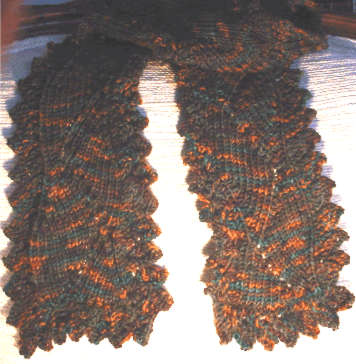
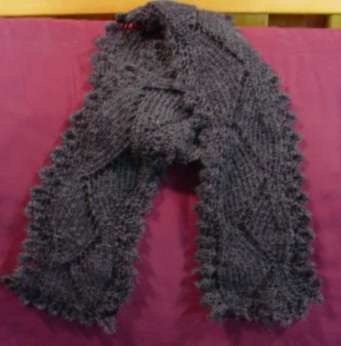

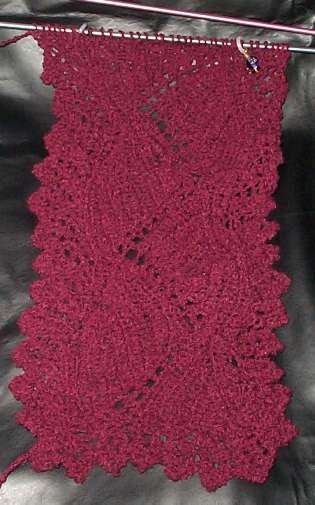

Kombu is a graceful, narrow scarf that can be made from as little as around 280 yards of yarn. The design is both bold and a bit fluttery. The pattern knits up well in every fiber I’ve tried (cotton, wool, acrylic, alpaca, cashmere blend). It’s reversible, attractive on both front and back. There’s no seaming – the bottom edging is knit as a narrow strip, then the scarf body is picked up and knit north from there, with the side borders worked at the same time as the scarf center. At the end, the final bit of edging at the top is worked across as a finish on the remaining live stitches, right from the needle. There’s no need to sew on or pick up and knit an edging, and if done from a large ball of yarn – there are only two ends to darn in when it’s done.
Here’s the latest. It’s in Marks & Kattens Indigo Jeansgarn – leftovers from one of my all time favorite projects.
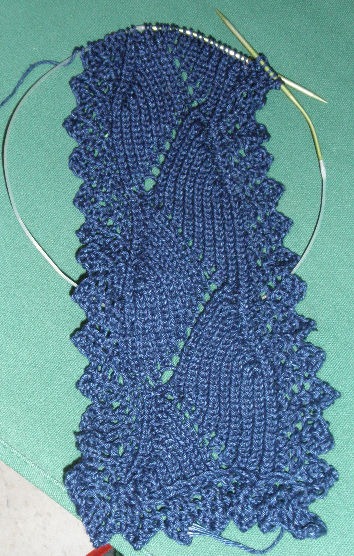
I started this one in part because I needed something on the needles, and I wanted to add to my pile of presents-to-be. But also I got a shout out from a Ravelry reader who was wrestling with her own Kombu project and needed help. It’s been a while since I knit one of these, I had to cast on in order to lend a hand. Happy to say, she appears to be over her problem, and is now knitting away again.
If you’re interested in the Kombu pattern, it’s available as a free PDF download, at the “Knitting Patterns” link at the top of the page. There’s a German language version there, too.
LATTICE WINGSPAN VARIANT
LATE BREAKING UPDATE: The Lattice Wingspan Variant instructions are now available as an easy-to-download PDF, at the Knitting Patterns link, above.
Another Wingspan. I’m trying to codify what I have been doing because I wanted to post it as yet another enhancement to the pattern, hence the multiple iterations. UPDATE: Test knitting complete, pattern corrections are now in!
Before and After (pre-blocking):
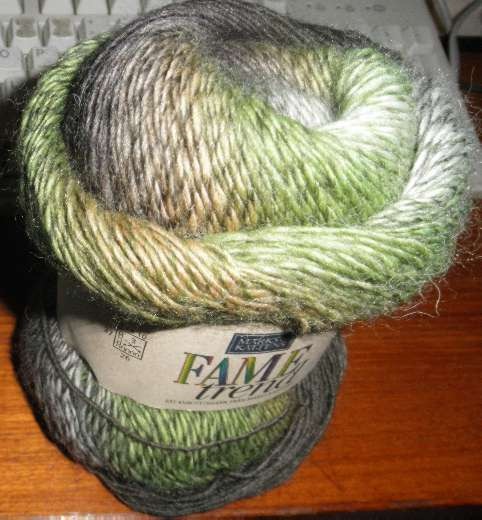
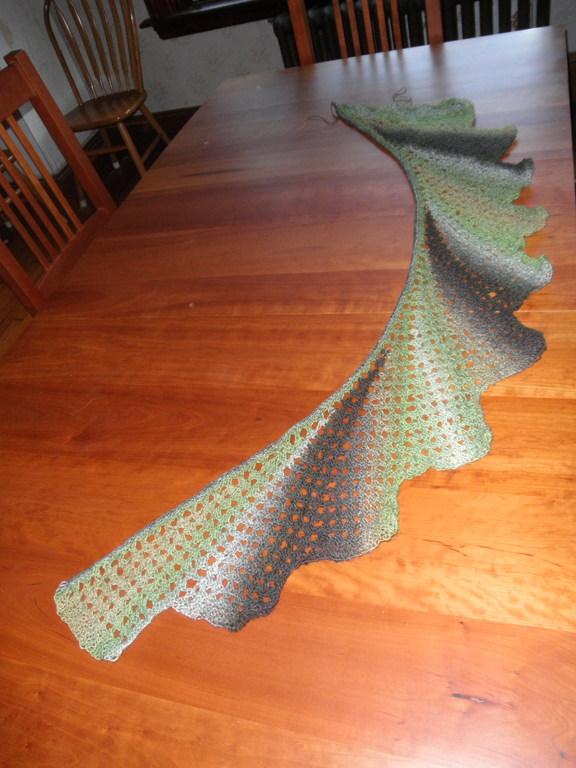
This one was knit from Marks & Kattens Fame Trend. Its labeled as a heavy sock yarn to be knit on 3mm needles, at 26 stitches = 10 cm, but it’s really somewhere between sport and DK, with some thick-thin variability. What drew me to it was the very long repeat – evident in the skein. I like the way extra long color gradations play out in this project, and the slow progression from green through olive, warm chocolate and tans played well. Because this yarn is heavier than the original recommended yarns, I used a 5mm needle, instead of the recommended 3.5mm.
I knit my Fame Trend Wingspan starting with a cast-on row of 75 because I wanted my piece longer and more scarf-like than Maylin’s Tri’Coterie shoulderette mini-shawl original. Here are my mods. I was inspired by Lenora’s Angel Wingspan variant, and decided to take the eyelet idea to the extreme, using larger eyelets and lots more of them, plus adjusting stitch count to work better with the project’s natural tendency to “clump” into three-stitch units. I also transposed this to all garter stitch because I liked the way the welts framed the double eyelets.
Again, the basic concept and shape here is Maylin’s. Click on the link above to retrieve her free pattern (free Ravelry sign-in required). You’ll need it to use my supplement, below. And the idea of piercing it with holes came from Lenora. I just took their concepts and ran with them.
LATTICE WINGSPAN
If you are using standard fingering weight yarn, use a needle larger than the 3.5mm needle recommended for the original, in order to increase laciness and yield a softer more fluid drape. For my Zauberball Crazy edition of this variant (true fingering weight), I used a US #5 (3.75mm). For the Marks & Kattens Fame Trend I had to go up to a US #8 (5mm) before I got the result I liked.
Triangle 1:
Rows 1-4: Work as per original instructions, rows 1-4
Row 5: Sl1p, K2, YO, *SS-K1-PSSsO, YO2*, until 6 stitches remain before the marker. Finish last 6 stitches by SS-K1-PSSsO, YO, k3, remove marker. Turn. (If you like any other double decrease may be used instead of the slip-slip-knit one-pass-both-slipped-stitches-over, I’ve experimented with K3tog and SSSK, and both look fine)
Rows 6 and 7: Work as per original instructions, row 3-4, but knit instead of purl – working a K,P in each double yarn over and a K in each single yarn over when you encounter them. Advance the traveling marker as described in the original on each wrong side row, until you work a final wrong side row with only 3 stitches, and have no place to put it.
Triangle 2:
Row 1: Sl1p, YO, *SS-K1-PSSsO, YO2*, until 6 stitches remain before the marker. Finish last 6 stitches by SS-K1-PSSsO, YO, K3. Turn
Row 2: Sl1p, K2, place non-traveling marker. K3, place traveling marker, knit to end, working a K,P in each double YO, and a single K in each single YO. Cast on 18 stitches.
Row 3 and 5: Work as per triangle 2, row 3 of the original.
Row 4 and 6: Work as per triangle 2, row 4 of the original, but do it in all knit rather than purling.
Repeat rows 1-6 until the traveling marker walks all the way back to the starting edge.
Triangle 3 and all subsequent triangles:
Row 1: Work as per Triangle 2, Row 1 above, until 24 stitches remain before the marker. Finish last 6 stitches by SS-K1-PSSsO, YO, K3. Place a new non-traveling marker, and turn. After you place the non-traveling marker, there should be 18 stitches between it and the previous non-traveling marker.
Row 2: Work as per Triangle 2, Row 2 above.
Continue working Triangle 3 (and subsequent triangles) in the method established for Triangle 2, following the original pattern’s logic. Because my version of the Tri’Coterie pattern is narrower and uses big eyelets, you should get 9-10 triangles out of a 420+ meter skein of fingering weight or sport weight yarn, instead of the pattern’s described eight.
Finishing:
After the completion of a triangle, when you decide your piece is long enough, and you still have about a third of a triangle’s worth of yarn left, it’s time to finish.
Row 1: Repeat Triangle 1, Row 5 above across the entire backbone of the piece, removing all markers as you encounter them.
Rows 2-4: Sl1p, knit to end. AT THE END OF EACH ROW OF GARTER STITCH REASSESS YOUR REMAINING YARN. Depending on available yardage, needle size and gauge, I’ve been able to knit at least one row of garter stitch prior to the bind-off row. You will need approximately 4 times total project width for that final bind-off row. The Marks & Kattens had enough for me to work four rows of garter prior to bind-off. Noro Taiyo had enough for two rows of garter prior to binding off.
Bind off loosely. Because of the big eyelets, damp block this piece to within an inch of its life to make them spread. Try to do it following the design’s natural helix for best effect.
Hope someone else is tempted by this project in my variant or in the original. It’s dramatic, quick, and not as difficult as all those abbreviations make it look. It’s a great one-skein holiday gift project that uses yarns that are tempting/beautiful in the ball, but are a true challenge to use effectively. And like the best of those, is as addictive as potato chips.
Next post will muse on the changing nature of the on-line knitting community, with sincere appreciation to some old coteries who helped me think it through, and who wrote to me to express support. Stay tuned!
INTERNATIONAL GLOSSARY!
The international glossary of knitting and crochet terms formerly posted at wiseNeedle is back up! It will be a permanent part of the standing offerings here, accessible via button from every page.
Enjoy!
STEP FORWARD, STEP BACK
As you can probably tell by the off-the-end-of-the pier style of my knitting and stitching projects here, not everything is fully swatched, graphed out, or perfectly planned before it’s realized. This may horrify some readers, but it’s the way I think. I prefer to learn on the fly, and don’t mind ripping back or starting again. For me, exploration is more fun than final product.
Case in point – the latest Wingspan. Let’s critique this thing to shreds:

Things I like:
- The basic Wingspan pattern
- The larger needle size/gauge for this particular yarn
- Using dice to determine hole size and placement
Things I don’t like:
- The color progression of this particular yarn
- This yarn in garter stitch
- The overall (near) finished look
- The combo of color, stitch and technique is too busy
One thing that made the last two Wingspans so dramatic was the long and gradual shading of the Zauberball Crazy. This was achieved by Zauberball’s dual strand ragg plies each cycling independently through their color ranges. In this full strand as opposed to ply-dyed yarn, color change is abrupt and the colors themselves are high-contrast. Speckles of the next color dot each block. (Now I remember starting socks with this ball, and not liking them either). The holes look less like airy bubbles, and more like the savaging of a demented moth army. And the eyelets, which work nicely in stockinette, look sloppy in garter stitch.
In total, I was Not Pleased. So this has been totally ripped back. I may play a bit with other stitches and this yarn, but in spite of it being a looonnnnngggg repeat, I am not confident that it’s right for a garter stitch Wingspan. However, the technique of placing eyelets in a fabric using a randomizing device to determine placement is still gnawing at me, as is thinking about other possible Wingspan variants. As a single project, this is a failure, but as a learning experience, it was valuable.
In other news, I’ve added to our house arsenal:

It’s a Korean-made sickle, sharp and sturdy. Similar ones have been used in Japan for centuries. They often figure in Anime, Samurai (and gangster) movies, both in their agricultural context and as weapons. We are close-in suburban here at String Central, and not out in the land of gentrified sprawl, so why do we need such a thing?
Giant grass:

I cut the patches on the side and front of the house each fall, just after they bloom but before they scatter seed. I don’t want to be responsible for colonizing the neighborhood with the stuff, and I don’t want it to sit looking forlorn and frowzy through the winter. To date I’ve been clipping each stalk with a pruner, but that’s painful and time consuming. I am hoping that this tool will allow a swifter handful by handful harvest.
For those concerned with possible waste – I strip the leaves off the stems and re-use the stalks to build my bean trellis each spring. The leaves go to town composting. I also post about availability of (free) plant stakes each year on the local mailing list, and put them out on the curb for other gardeners to take.
LIKE WATCHING PAINT DRY
Mid-blocking. Waiting for her new Wingspan scarf to dry:
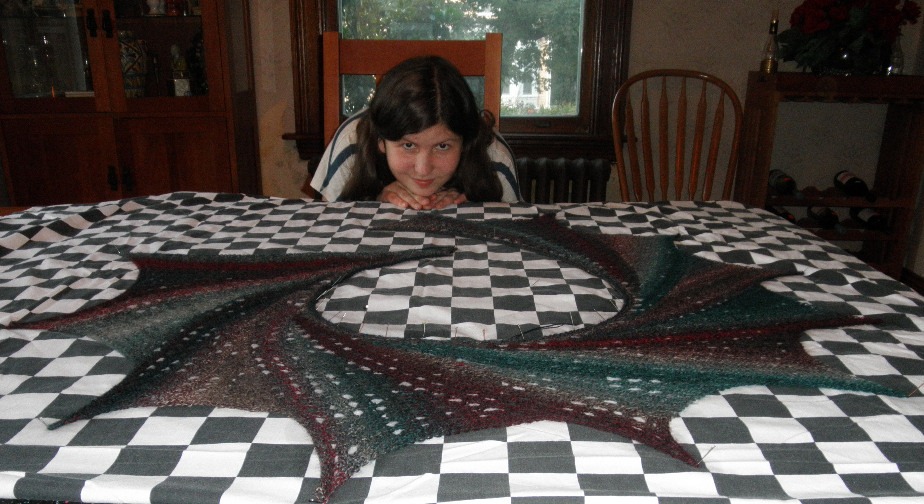
Before blocking, and the op-art horror of pinning out on a checked ground:
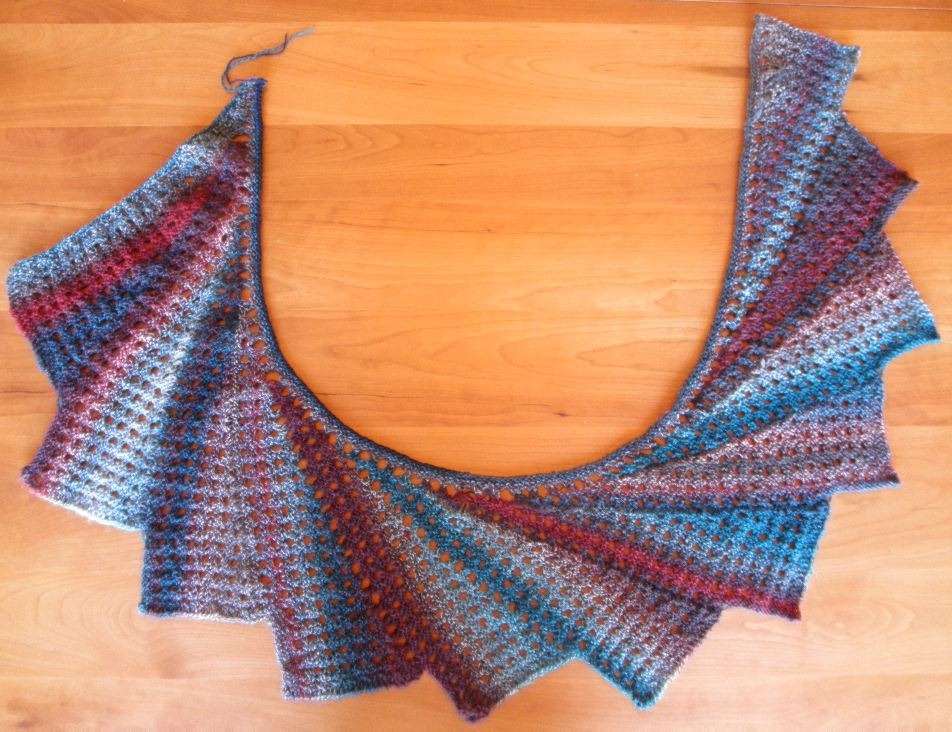

The actual color of this Zauberball Crazy is more like the two pinned out than it is in the dawn-light picture on the wood background.
What fancy blocking set-up am I using? Four rubber jigsaw-edged floor cushion tiles, with a rally check sheet laid out on top of them – all on the dining room table. I’ve got two twin size flat sheets like this, bought for pennies at a local salvage store. The regular 2-inch square checkerboard pattern may make eye-blasting photographs, but it’s fantastic for blocking to dimensions. Large checks come around every so often, most often in kids’ bedding, intended for proto-race car drivers. Oversize gingham and Tattersall plaids are ultra-trendy right now. They would also work well as blocking backgrounds.
Talk Nerdy To Me
I haven’t worked this Wingspan pattern out of my system yet. I’ve got one more ball of long-repeat hand-dyed sock weight yarn. My new yarn is mixed neons – very circus balloon like. This one has lost its tag, but I’m certain I found it at Wild & Woolly about a year or so ago. I like the lattice work double eyelet texture I used for this second scarf, but I want to try something more… unexpected.
I want to play with eyelets and this design, using a multicolor. But I don’t want to do the same regular lattice that I just finished.

I want to make something more like Swiss cheese, with eyelets of random size and spacing, to pick up on the airy, light-hearted colors. You can just make out a couple large and small eyelets in the purple stripe.
How to achieve random size/placement? Remember these?

Stand proud, you knitting dungeon crawlers of the past! That same set of dice so often used for exploring graph paper on dorm room floors, armed only with friends, a bag of Doritos and a bottle of Diet Coke, can also be harnessed as a knitters’ tool.*
I’m using a d20 and a d4 to determine hole spacing and size. I roll the 20-sided die, and the number rolled determines how many stitches I knit before I make an eyelet. The d4 by landing on an odd or even number, determines whether I make a large or a small eyelet. (Yes I could use die of any even number of sides for this, but why not employ that lonely, underutilized d4 for something for a change.)
The small eyelet is defined as a K2tog-YO2-SSK unit, with the YOs worked KP on the next row (a two-row double eyelet). Large ones are a bit more complex. They take three rows to complete – K3tog-YO3-SSSK as the base eyelet unit. On the next row I do another YO3 when I get to the hole. On the third row I work KPKP into the bottom YO3, encasing the horizontal strands left behind working both YO rows, and restoring stitch count to the original number. Yes, that’s a YO3, not a YO4, even though I’m working four stitches into the open space. I found by trial and error that YO3 made a less floppy, neater looking hole.
I haven’t seen this particular three-row mega-eyelet documented anywhere else, but as with all knitting – I refuse to believe that I’m the first to think it up. I’m sure there’s a reference book citation for it somewhere.
And using dice to introduce randomness isn’t an original idea either. There’s a whole school of aleatoric and indeterminate music that in addition to encouraging performers to take a major role in deciding how a piece is played, often employs mechanisms of chance (including dice) to add immediacy and uncertainty to its base compositions. Other knitters have used dice to determine stripe width or repeat, motif placement, or color choice.
So there you have it. Second Wingspan finished. Third, if luck holds out and this method produces something attractive, will be a bubbly, swirly Swiss-cheese of candy colored neon. If it does I’ll have to find a recipient whose idiom encompasses bubbly neon color scarves. And if it doesn’t I’ll rely on one of knitting’s prime virtues: The ability to reduce worked materials to their pre-project state, ready to begin something else.
* Another knitting-related use for polyhedral dice is as row counters. Put one next to you and advance it one number for each row (or stitch) that needs tracking.
TAKING FLIGHT
Playing with the Wingspan pattern here, I post progress. Wingspan #2 is almost finished.
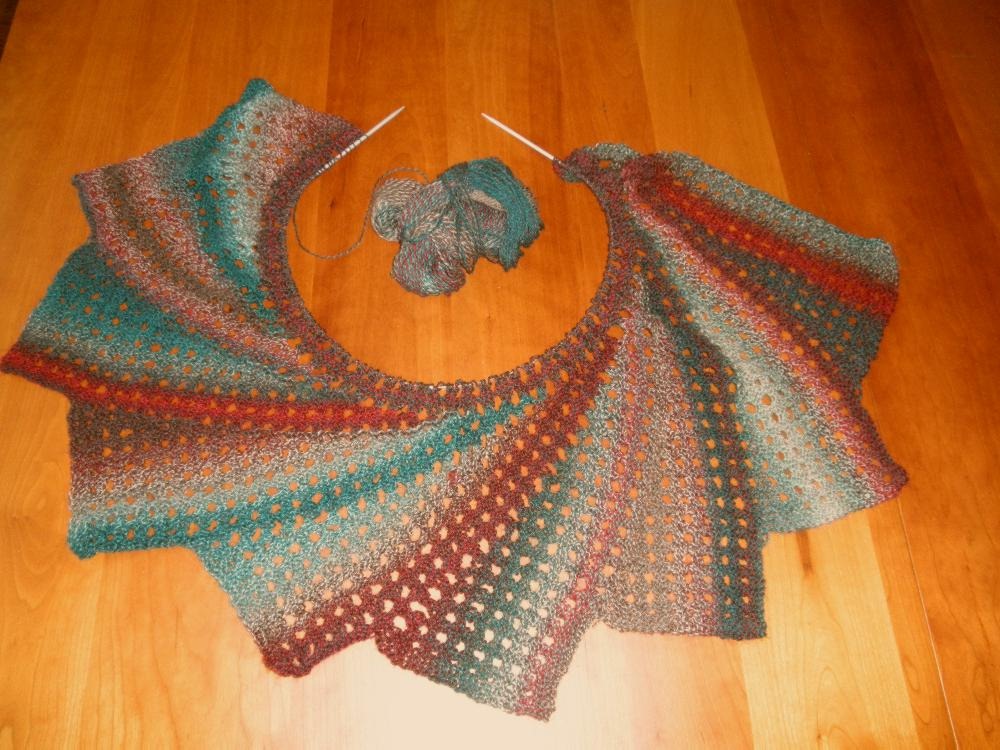
Mine is narrower than the original pattern – 75 stitches instead of 90; and has one extra point. Oh, and Swiss cheese holes (double YOs, followed by Sl2-K1-PSSO center double decreases, although first and last one in the row is a single YO to maintain stitch count). I could probably have gotten away with knitting a tenth point, but I wanted to have a wider inside strip to finish. As you can see, I had a very wide red/blue ragg section, and I used it to do a row of decrease-framed diamonds across the whole top. I’ll finish out the ball flat, without additional eyelets. And if I don’t like that, I’ll rip back and do that last point. The next post will show my completed Swiss Cheese Variant Wingspan, mid-block.
For those who have asked, the Wingspan pattern is available as a free download on Ravelry.
More patterns posted
For those of you who may not have noticed, I’m continuing to post the accumulated free patterns previously published on wiseNeedle and here on String. All will be available as PDF downloads at the Knitting Patterns and Embroidery Patterns tabs, at the top of this page. Some incorporate additional advice on the pattern or technique harvested from the associated pattern discussion posts.
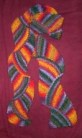
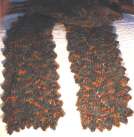
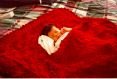
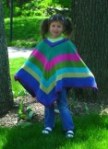
Highlights of the knitting pattern collection include:






Embroidery charts include but are not limited to:


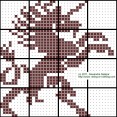


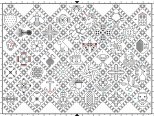
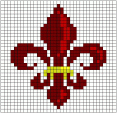
Note that the block unit graphs presented as embroidery patterns are also suitable for knitting, mosaics, crochet, and other work that’s commonly done off a gridded design.
FLAPPING ONWARD
The quick side trip to knitting is being just as quick as I thought. Here’s Wingspan (Angel Variant), finished and blocking out on some rubber mats on my dining room table:
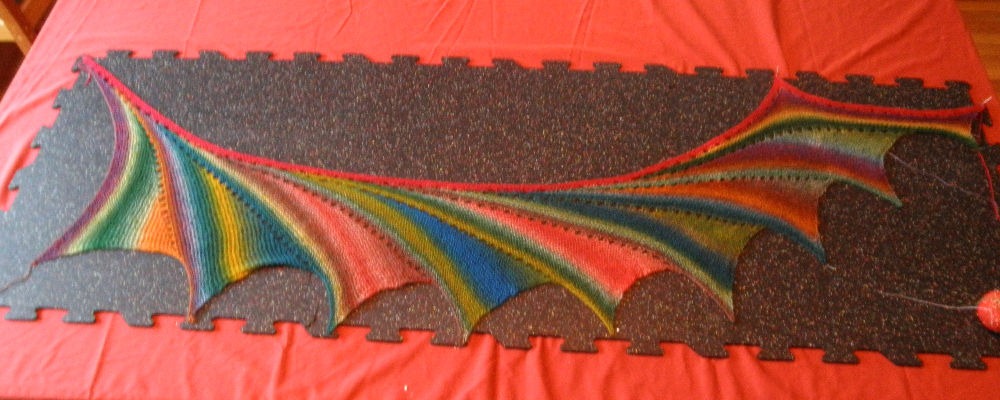
(Yet another traditional blurry String photo, taken at dawn.)
The colors are a bit red-shifted, but you get the idea. A prismatic bat wing. I do confess that I would have had a little bit left over at the end had I finished off where the pattern said to stop – after point #8. But the color change in it was among the nicest in the ball, so I kept going, using every bit of the precious Zauberball Crazy, and finishing off with some leftover red sock yarn from my stash. I’m pleased with it, and as soon as it’s dry and I can darn in the ends, I’ll be rocketing it off to Elder Daughter. Unless she declines because she wants the fun of knitting her own.
Wingspan #2 is now on the needles. Younger daughter requested the darker color ball. She also asked that her scarf be narrower, with lots more holes. So I’m playing with the concept. Instead of one row of eyelets to close out each point segment, I’m working eyelets every 6th row; and I’m making them larger by doing them as S2-K1-PSSO center double decreases, followed by double yarn overs.
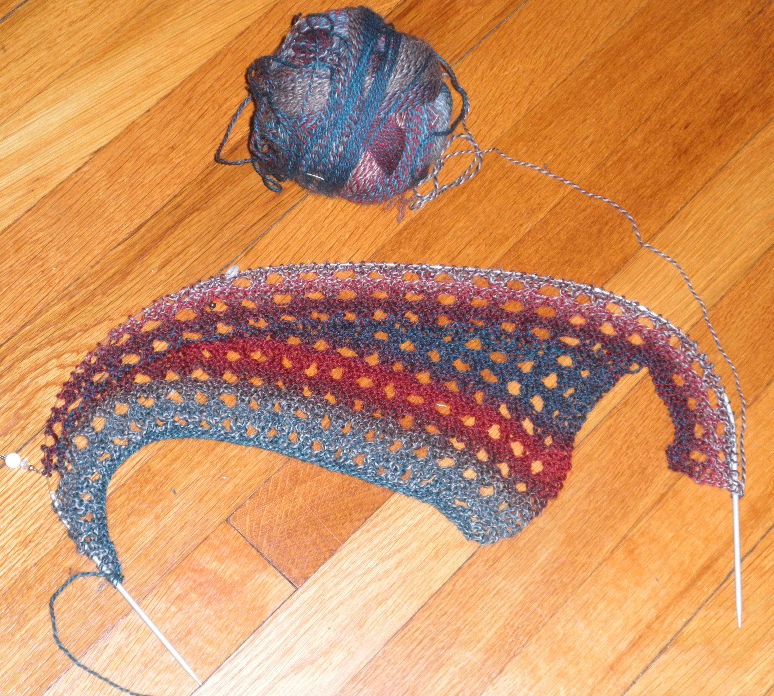
Some fudging is going on, all on the fly, to make a garter border around the growing point ends, and to fit the eyelet progression into the short row edge shaping. Just enough (in combo with watching the colors change) to keep my interest.
<begin curmudgeonly rant>
In other news, we ran away for a bit of fun this weekend. Younger Daughter, her pal and I went to King Richards’ Fair in Carver, MA – the local renfaire. The kids dressed up and had a great time, being new to small stage jugglers, acrobats, and general comedic banter.
I will say that I was less impressed. For all of the staff’s efforts, the charm of the thing is largely gone when compared to my memories of eight or so years ago. There was only one artisan working in the compound – a fellow doing lamp work glass. I missed seeing more of that – the leatherworkers, the folk at the forge, and the like.
The mounted “jousts” were the only things there that were free.
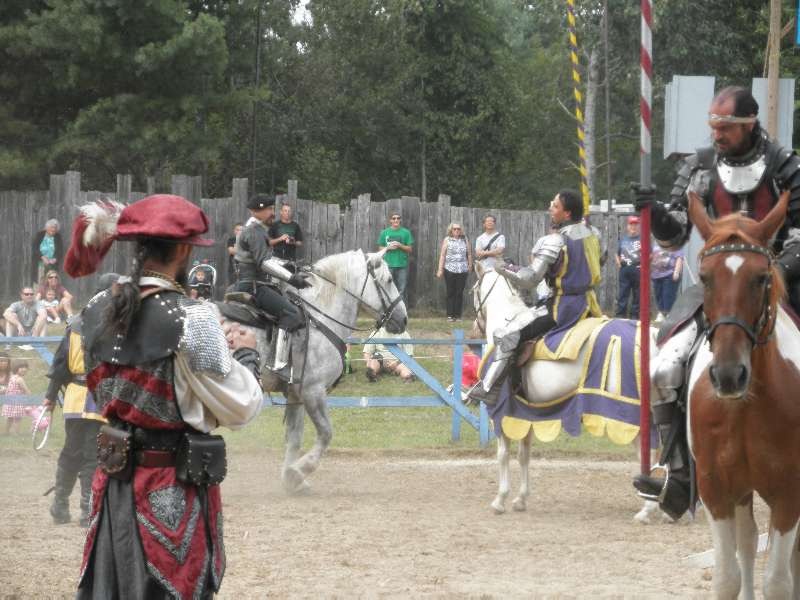
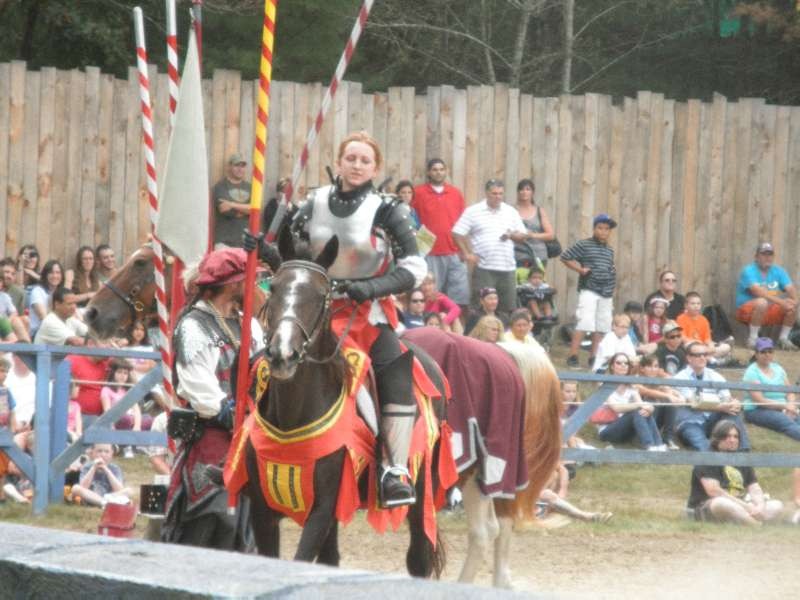
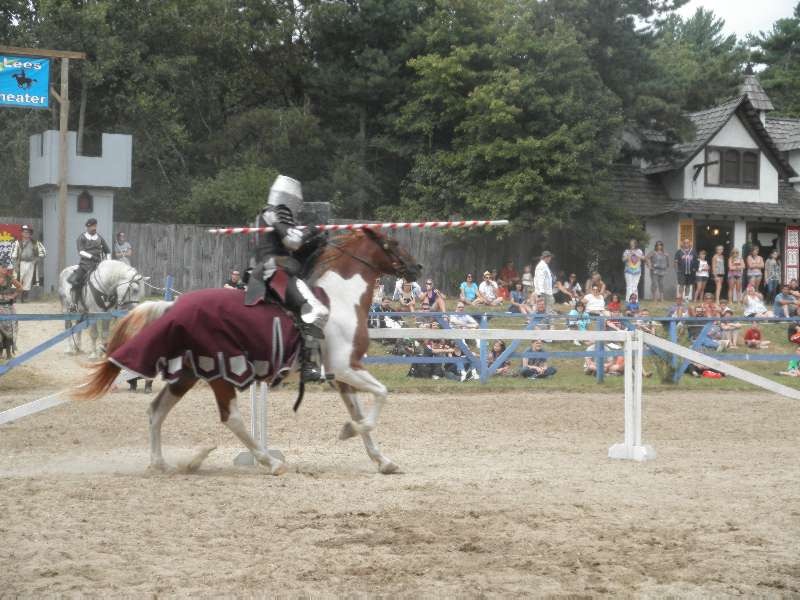
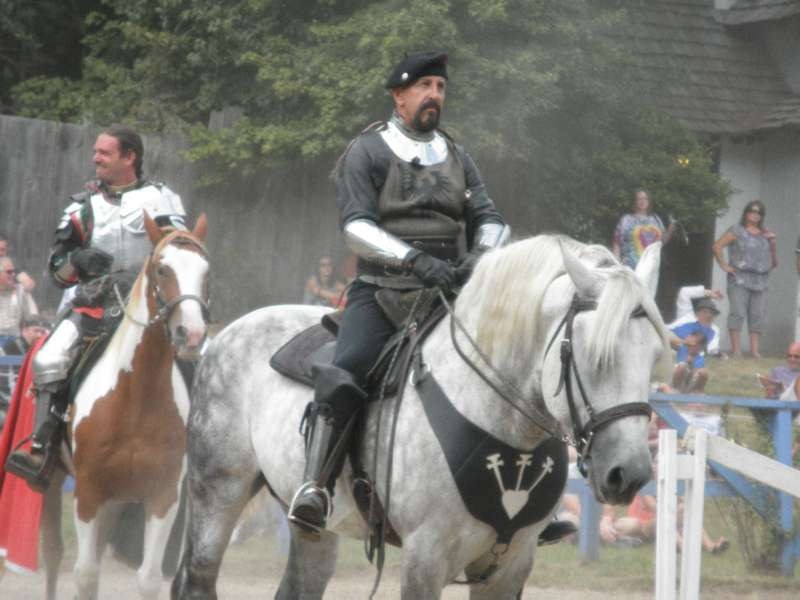
Younger daughter was camera wrangler, so it’s no surprise that our pix are all of the horses. The show we saw started with tilts at target and rings, and ended with lance to lance on horseback. It was highly staged (which we didn’t mind, given the risk of injury if the combat were more real), and fun to watch.
From the start, I was mildly miffed. Although I brought cash with me, I was annoyed that in none of their ads or websites anywhere is the fact that the faire is cash-only listed. I heard more than one attendee retreat from the ticket window, to drive back to town to find a bank rather than use the exorbitant fee ATM machine at the gate.
Once you’ve paid your $27 per person, inside the faire you’ll find that everything costs money. Food is on a ticket system, sold in $5.00 blocks of tickets only. They’re 50 cents each, although (again) this isn’t posted anywhere. A bottle of water is seven tickets ($3.50), a child’s plate of chicken fingers and fries is 17 tickets ($8.50), a sausage on a roll is 19 ($9.50). And the prices of foodstuffs are arranged so that it’s difficult to not have a few tickets left over that you can’t redeem. I saw one guy hassled by staff when he tried to sell his leftover four tickets to another visitor.
All rides, attractions, or other events (again except for the horse-related arena stuff) come with an additional fee. $2.00 for the maze. $4.00 for archery, $3.00 for a kiddie ride, and so on. It would be easy to go with two kids and without eating a thing, spend $100 on top of admission just in an hour of walking around. It’s clear that even the small stage performers are largely paid by passing the hat. They did deliver amusing, well rehearsed performances that we did enjoy. I did feel sorry for them and pony up, but again – you’re opening your wallet for everything other than breathing.
I was also disappointed at the large number of adults who seemed to be there in order to drink while walking around. This was a holiday weekend, and the Faire’s opening weekend. I expected to see more renfest geek kids – herds of teens in costume; and families with children over stroller age (strollers are difficult to push on the uneven ground). But about three quarters of the crowd were adults in their late 20s through 30s, wandering around in advanced states of tipsy. Not what I expected.
On the merchants – based on the prices, I assume that the Faire charges steep rents for those kiosks and stalls. What I saw was very pricey. Lots of stuff catering to folk dressing for the next renfest, of course, which I did expect. $75. light cotton elastic waist skirts I could make out of a remnant for under $5.00. $300 wench bodices. $150 capes. $100 pewter cups. $75 leather notebook covers. There was some jewelry and toys in the $15-30 range, but you had to hunt for it.
Again, I will say that the kids had fun. I did too in spite of being annoyed, and for that I thank the individual small-stage performers. They made the day. But the Faire as a whole has gotten more expensive and cheesier than I remember.
We won’t be going again.
<end rant>
MORE WORDS FROM ANOTHER WORLD
Here are some more words and terms I’ve stumbled across during my India-migration preparations. Again – I point these out not because they are laughable or substandard, but because they are new to me, and illustrate the fact that English while common bridge among many speakers, can befuddle as well as unite. Please note that my sample is skewed to the sensational, because most of my sources are newspapers.
Here are three from local news coverage that all have to do with social action. There’s probably nuance or hierarchy of severity here that I’m missing. I’m inferring definition from context, and I don’t have tons of data points to figure out finer shades of meaning. Please chime in with corrections if you have them.
Bandobast – I love the sound of this one. From the usage it appears to be an ad-hoc group pursuing a common purpose, especially a grass-roots one, as opposed to that of a standing organization. There appears to be a nuance of self-organization, individual action, and spontaneity to a bandobast. A group of volunteers picking up litter after an arts festival or handing out water to marathon runners might be considered to be bandobasts. But not all bandobast actions are benign.
Morcha – A morcha seems to be used when a group of people self-organizes to pursue a specific social or political agenda. Although I see traffic-blocking street protests referred to using “bandobast,” “morcha” seems to be used more for organized actions we’d call labor strikes or work slowdowns. I’m unsure if the Occupy Movement’s actions in various US cities this year past would be considered bandobasts or morchas.
Bandh – This appears to be a major form of organized protest – a universal strike, in which the entire population of a region stays home, eschewing all work, school, commerce, or travel. It’s a powerful tool of civil protest. I’ve found through further reading that it has been banned, although calls for bandh actions are still made.
And some more general terms:
Godown – From context, seems to be a storage facility or warehouse district. I’ve seen some articles that use ‘godown’ to refer to industrial buildings of indistinct past use but large size, now repurposed to serve civic needs.
Octroi – I know this one from Medieval history. In historical usage, it’s a tax, levied on the goods moved between states; not exactly a customs duty, it’s more like a custody transfer tax. In the India context I’m unsure if this is a commercial tax, paid by corporations and possibly by municipal entities, although I think it is – as opposed to a direct tax paid by individuals. (That’s not to say that costs aren’t trickled down.)
Corporators – the closest I can figure is that these are local representatives. In the US, depending on the type of local governance and size of the local area, these might be ward representatives, town meeting or city council members. I am unsure if Corporators are appointed or elected. More reading is warranted.
Scheme – this is a nuance difference in usage. In the Indian newspapers, scheme appears to be used as a synonym for plan. For example, municipal corporations (city governance organizations) can have schemes for handling various civic challenges. However in the US, a scheme would have a sinister connotation, with an undertone of illicit secrecy. It’s a word used in the US more to designate the plans of evildoers and malcontents, than it is used to describe honest and forthright actions taken to benefit others.
I’ll keep on posting these from time to time, to entertain and edify. Perhaps some future expat will find these posts useful.

