COMPULSION
Today I try to appease both my constituencies – stitchers and knitters.
First, for the knitters, I make confession that I’ve been seduced. I recently came into possession of a true one-skein wonder, two balls of Skacel’s Zauberball Crazy. One is an addled mix of red, turquoise, yellow and green (#1701), the other is chocolate, teal, cranberry and according to the official photo, on the inside somewhere – tan (#1507). It’s a lofty and soft fingering weight, 100g/459 yards per ball, enough to knit a pair of socks for me. Here are Skacel’s own photos of the two, at a color fidelity much better than I could achieve:


But looking at this stuff made me want to do something other than socks. Given the number of variables in play right now, I decided I didn’t want to take time to design my own pattern, so I began poking around the ‘net and found the Wingspan scarf. I’m working up this variant. It’s all garter stitch, with the demonstrative shaping formed by short rows. You can see the play of the extra long color repeat even in this traditional blurry String snap, taken at dawn:

A quick knit, totally on autopilot, with a clever system of traveling markers that make it impossible to make a mistake. More on this as the thing grows.
And on the Big Green Sampler, I’m inching along the fiddly bits at the bottom edge, filling in my voiding. The tightly drawn two-sided Italian cross stitch goes more quickly in an open field. Around these odd little bits – especially the Y-shaped extensions in the top and bottom borders (a detail done exactly this way in the museum original) – it’s a slow and exacting ride:

The little empty rectangles at the base of each Y are especially tricky to leave unworked. Still, I am making incremental progress none the less.
Now, why did I start the knitting project?
Compulsion. Plain and simple. I do 98% of my yarn acquisition at Wild & Woolly, my local yarn shop – a heaven on earth for knitters. But driving across the state to drop Elder Daughter off at college put me within striking distance of Webs, the Northampton, MA yarn hypermarket. My rule is not to buy stuff elsewhere that I can find locally, so Younger Daughter and I took a quick jaunt through the place looking for stand-outs – things I haven’t seen anywhere else.
That’s where I was attacked by the Zauberball. It fairly leapt of the shelf in a direct assault on my magpie color sense. It’s hard to describe this compulsion to a non-crafter. I HAD to get it, and I HAD to find something good to knit with it, and I HAD to cast on right away. That’s the way the best projects work – the absolute mandate to watch the piece take shape. Time flies on its own. Any encountered problems melt away. I look down and see more done than I realized was happening. Oddly enough, the final product while valued, is not the goal. It’s the process, the journey, the materials, and the sense of progress.
I’ll split my time between these two. Maybe I’ll figure out something myself to do with Zauberball #2. Or maybe not. But in any case, both balls have to be cooked, chewed and digested before I return to normal.
ALL GOOD THINGS
…the saying goes, must come to an end.
So goes the summer of 2012.
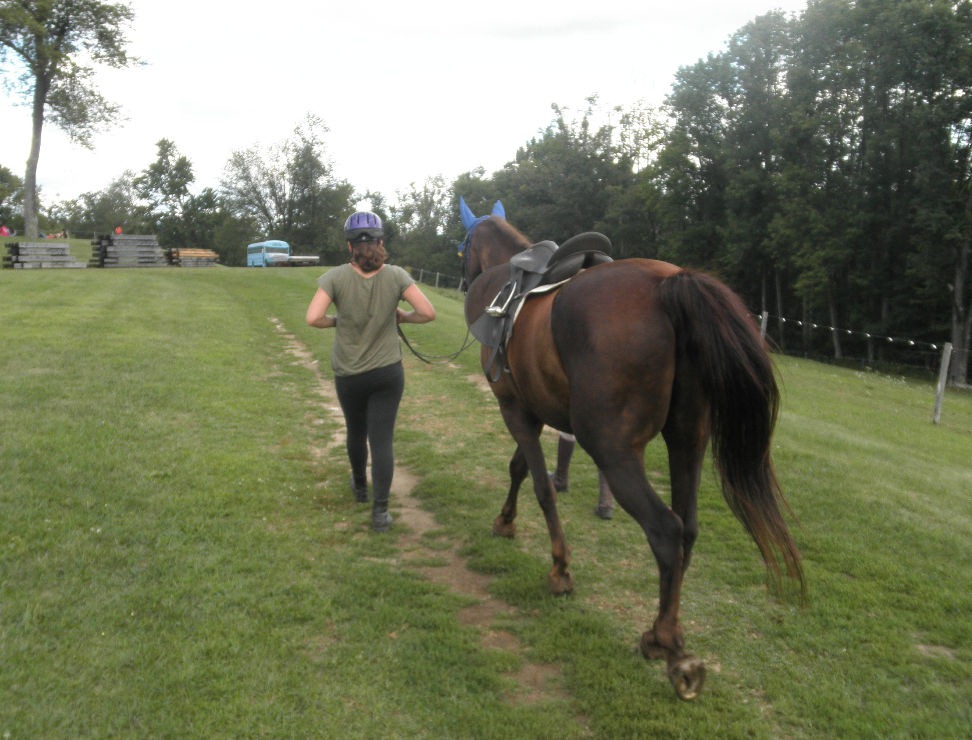
One sure sign of summer’s end is retrieving one or more kids from Roads End Farm, the summer camp they both love. As ever, much fun was had. We’ve found there’s a direct correlation between how dirty they are at pick-up, and how great the summer was. Let’s just say that this year we transported a little ball of filth with a big smile. Here’s that same smile, up on Yuma.

Dante, star of the pix below was having a bad leg day, and was returned to the paddock rather than being pressed into service:

That’s Sue in the background, riding instructor extraordinaire. However you’ll note that Dante is sporting a fashion accessory. It was a very fly-filled season, and to give the horses some relief, they have been wearing fly bonnets. However in the farm’s price range for pre-made, they only come in one-size-fits-all. I don’t have a shot of Elliot, REF’s largest horse, but at well over 16.5 hands, he towers over the farm’s 76-horse mostly Morgan herd. Stock fly bonnets would not fit him – not easily. So I made him one, custom:

He was turned out to graze the morning we visited, otherwise I’d have a shot of the thing being modeled. I used the crochet pattern from Nordic Mart, picking up stitches after the crochet was done to knit the ear socks. I used some old Austermann Record 210 remnants and a size 4mm (US G) hook, approximately 4 skeins total.
A NEW VOCABULARY
As part of the preparation for our grand India adventure, I’ve been reading everything I can about Pune and the surrounding area. This includes on-line editions of local newspapers, history books, and blogs. I’m learning a lot, finding facts, trends, and rumors – the hard and soft aspects of our soon-to-be home and its stew of cultures.
My primary sources are the web-available English language newspapers. I admit that they provide a skewed viewpoint. I know that I would not want someone to draw vast conclusions about the US by reading any one or two papers here (especially the tabloids or political slush papers). Still, slanted as they are in reporting eye catching, sensational crime stories, or presenting views tinted by biases I do not yet understand, they are a fascinating source of words, turns of phrase, references, and names of institutions that are new to me. These usages are just as current, legitimate and topical as any writing or speech anywhere else. I am reporting these not because they are strange, but because they are novel to my ear.
Dacoity – This one was reported by the Resident Male. In the US it would be called “armed robbery” or in an older time – alleybashing. Someone sticking up the local convenience store would be a dacoit.
Sharp weapons – Also reported by the Resident Male. We’d say “edged weapons.” Knives, mostly. Seems to be the favored arsenal for dacoity.
Nullah – A steep sided gully through which infrequent (but dangerous) storm water surges flow. If a natural feature, depending on the part of the country here we’d call it an arroyo, canyon, gully, gulch, or gorge. If man-made it might be a culvert or storm drain.
Housing society – In the US it would be a housing cooperative or “co-op” for short. A building or neighborhood in which the owners share the pooled cost of common area maintenance and general services for all. Like here though, there are maintenance fees and (when needed) special assessments. “Society” is also used to mean the grounds of the housing complex itself, especially enclosed communities formed of single family houses with walled gardens, inside a larger gated perimeter.
Overbridge – Overpass, like a highway overpass or a traffic fly-over.
Municipal Corporation – Depending on the size and organization of the city or town in the US the equivalent would be the city or town council and mayor’s office. I’m still working this out, but it appears that civic governance is not by direct election of representatives to the municipal corporation, but I may be wrong. More on this as I learn myself.
E-Way – The equivalent here would be a expressway, major highway or turnpike, probably a major Interstate or state route.
Lokshahi din – Grievance sessions held by a Municipal Corporation. Citizens with a compliant about municipal function or services delivery can submit it in writing, then go to a hearing where a municipal commissioner can render a judgement, to which all parties are bound. These tend to be held by civic zone (what we’d call city ward or district).
Jawan – I deduce this is a security guard, policeman, or soldier on security detail. Jawans are deployed on the trains to maintain security and order. I’m unsure if the male uniformed guards checking bag contents and running metal detectors outside of most public buildings would also be called jawans, or what (if any) the equivalent term for a female officer might be.
Chowki – This one caught me by surprise but shouldn’t have. It’s a local police station or jail. I’d always wondered where the Brit/US slang “chokey” for the local slammer came from. Now I know.
Chowk – by contrast, this is a town square. I guess in India, Arlington Center would be known as Arlington Chowk.
I’ll continue to vacuum up what I can, posting occasional vocabulary updates as my linguistic dust cup fills.
HALFWAY!
I had occasion to unroll the big green sampler last night in order to adjust the padding that was between the layers of previously stitched work. While it was out and open, I took some progress pix:


You can see that the entire piece spans the width of my dining room table. I’m more or less at the centermost strip, and at (more or less) the middle of that strip. The penny on the shot at the right will give you an idea of scale. I’m pleased with the density and patterning so far. I’m also pleased with the pulled background of the latest bit. But it is taking a VERY long time to stitch, and I’m looking forward to figuring out what will be next. Perhaps something in quick-to-finish double running, perhaps something a bit more geometric and very open. We’ll see!
In other news, I’m continuing to add both knitting and embroidery patterns to the patterns buttons at the top of the page. I’m going back through prior posts and standardizing formats, putting everything into convenient buckets for ready access. If you’ve got a request, let me know and I’ll bump it up in priority. Enjoy!
GONE AWAY, GONE AHEAD
No, this isn’t a Teaching Song moment. Although I try to keep this blog focused on creative things, occasionally life intrudes. In this case – intrudes in a big way.
The Resident Male has accepted a company posting in Pune, India. He leaves this afternoon for a two-year stint. I and Younger Daughter will follow him after the holiday season. She will be finishing 9th grade over there. Elder Daughter will continue on to her senior year of college, and we’ll all be back for her graduation in the spring. After that plans get hazy, but some or all of us will be resident over there with him until he returns.
What does this mean for String? You’re looking at it. Ease of remote maintenance and pre-trip streamlining were two of the reasons for the big port we just completed. I intend to keep on stitching and knitting, posting about it from here or Pune as circumstances dictate.
What’s Pune like? I did accompany him on a whirlwind one week house hunting trip there earlier this summer. Most of what I can report is massive sensory overload. It’s a trip to another world, as surely as any interplanetary trip from a Jack Vance novel. I’ve always wanted a Grand Adventure, and now I’m really looking forward to having one.
I can say that Pune is largely part of New India, the India that has so 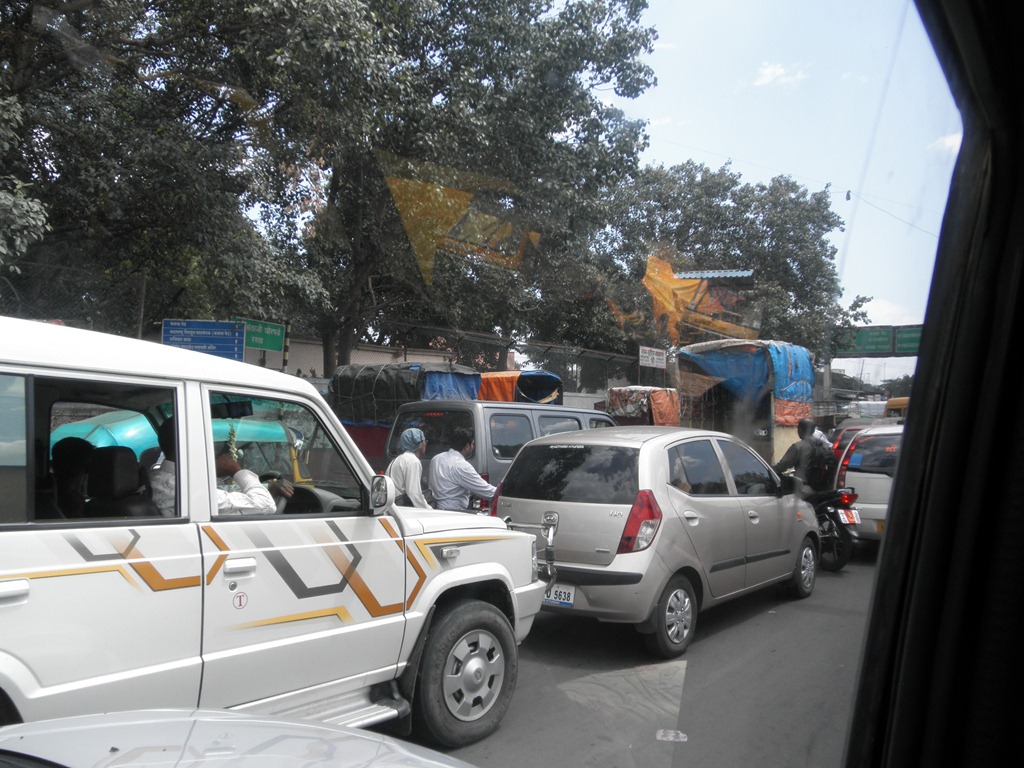 avidly embraced a high-tech economy. It’s a city in the hilly region about a three hour drive east and a bit south of Mumbai. Like Mumbai is part of the state of Maharashtra. Pune is known for its industry (especially automotive), technology companies, universities and teaching hospitals. In the latter three, it thinks of itself as the Oxford (or Boston) of India. Like most of urban India, it’s crowded and noisy, especially by US standards, but it’s also vibrant and very welcoming.
We didn’t get much time to tour the city, but we were able to visit a museum and a historical site on the weekend we arrived. The Resident Male described those bits. I found it all fascinating.  Things happen there that just don’t happen here. For example, while we were there, a conflux of two major pilgrimages occurred. Hundreds of thousands of people walked through Pune in devotion to two Hindu Saints, streaming through the city on every major road. My picture captures only a tiny group of pilgrims on a side street. The main body of walkers totally filled boulevards and bridges, shoulder to shoulder – group after group, as far as the eye could see. Each group began with respected leaders, yellow flags and revered images at the front, followed by a body of men in white suits. After then came a body of women, many carrying bundles of supplies. Lining many streets were well wishers and people who volunteered to tend to the walkers’ needs, offering medical care, snacks or water. Yet as singular as this was to me, it was just another annual happenstance in Pune. It got minimal attention in the local newspapers, and the residents weathered the major transportation disruption with little more than a shrug. When asked, most of the people I spoke to said, “It’s just another religious event.”
While we were there we did find an apartment. Touring the possibilities was more like speed-dating for housing than a considered quest. We looked at lovely stand-alone bungalows, full of quirky romance and surrounded by lush gardens. But when amenities were considered, reason overcame romance and we selected a modern flat. Here’s the view from our balcony-to-be. It’s in the Koregaon Park Extension neighborhood, overlooking a military athletic facility where many members of the Indian Olympic Team train. It’s quiet, with privacy – no road noise intrudes because the back of the apartment complex abuts the military reserve, and there’s no neighbor across the way to peer into our windows.
So there it is. The Resident Male has gone away, gone ahead to pave the way. I continue to prepare, and will follow, to whatever adventure awaits.
(Extra points to those who know the origin of this post’s title).
GREEN CONTINUES
[UPDATE: A pile more patterns have been added to the Knitting Patterns page (Button above).]
Yes, I’m still porting old site content over here, but to reassure my embroidery audience, my massive green sampler is still in the works. With the quickie book covers out of the way, I’ve turned back to it:

The pulled background fill does go slowly, but progress is being made. You’re looking at about half of the strip. The large downward pointing clump of lettuce at the left is actually the center. So I’ll be working on this one for a while.
Extra bonus: See that dangling thread? That’s how I end off without adding more knots, or adding bulk that obscures the drawn mesh effect. I take several running stitches down the center of an area that will be tightly overworked. Then after I do that stitching and the loose end is captured, I snip it close to the work. Starting a new thread is done in the same way.
Extra extra bonus: If you click to zoom on the photo, you’ll see a little arrow pointing out a mistake. I’ll be ripping that little bit out. My work isn’t perfect, just proofread.
UPDATES CONTINUE
Added several more rescued patterns from wiseNeedle to the Knitting Pattern link above, including:
- Firefighters’ Socks
- Impossible Socks
- Pine Tree Toe Up Socks
- Jelly Bean Toe Up Socks
- Ch’ullu Hat
- Knot-a-Hat Earwarmer Band
- Spring Lightning Lacy Scarf
Will continue to plug away. Reminder – please, if you are thinking of linking to these, please link to the source page rather than the individual PDF. I can’t guarantee that the PDF links won’t change.
KNITTING PATTERN PAGE UPDATED
Ported over patterns for
- Kombu Scarf
- Justin’s Octagon Crib Counterpane
- Mountain Laurel Crib Counterpane
- Kids’ “Chain Mail” Coif and Hauberk
- Simple Toe-Up Socks in Four Sizes
Click at “Knitting Patterns” link at top of this page to view.
Stay tuned! More are coming.
BOOKED!
[NEWS FLASH: Kombu Scarf, Justin’s Counterpane and Mountain Laurel Counterpane patterns have been ported over. All are under the “Knitting Patterns” button above.]
The embroidered notebooks are finished and ready to send off to the recipient:

Each one took a bit over two weeks to finish out. The stitched area is approximately 5.3” x 8.25”, made to slipcover a standard 5”x 4” pocket journal style notebook (Moleskine is the most well known brand, but these were “work alikes” I found in Staples). Before you ask – they’re the same front and back – completely stitched. 🙂
Website Port
Thanks to everyone who sent encouragement on the port. The first three knitting patterns I reformat and post will be the Mountain Laurel blanket, Justin’s Octagon Blanket and the Kids’ Faux Chain Mail. I wish it were an instant process, but a bit of redrafting is in order. I’ll have all up ASAP.
Also thanks to the folks at Craftgossip.com who picked up the folded ribbon trim method I used on the Steampunk dress. If you’ve found String due to their link, welcome! I’ve got a lot more to show you.
SURPRISE!
Wondering what we’ve been up to?
Well… You’re looking at it.
After a good run, we’ve closed down wiseNeedle. Sustaining it was no longer possible. I’ll be rescuing the patterns and most of the articles from it, and reposting them here over time. And the yarn review collection will become part of the data trove at (as yet stealthy) Nimblestix. They’re still in Beta, but if you log on with “wiseneedle” after your user name, you’ll get a priority spot in their admission queue.
All String content is here. There will be some inevitable cleaning up as we settle into a new set of internal links. Most but not all links here from external sites should work. We’ll try to fix as many of the broken ones as we can. In the mean time, please take advantage of the much-improved category index and search features.
What have I been stitching?
On our trip to India and on our vacation at Cape Cod I busied myself with small, hand-held stitching projects: two quick book covers for small pocket sized appointment/jotting notebooks.
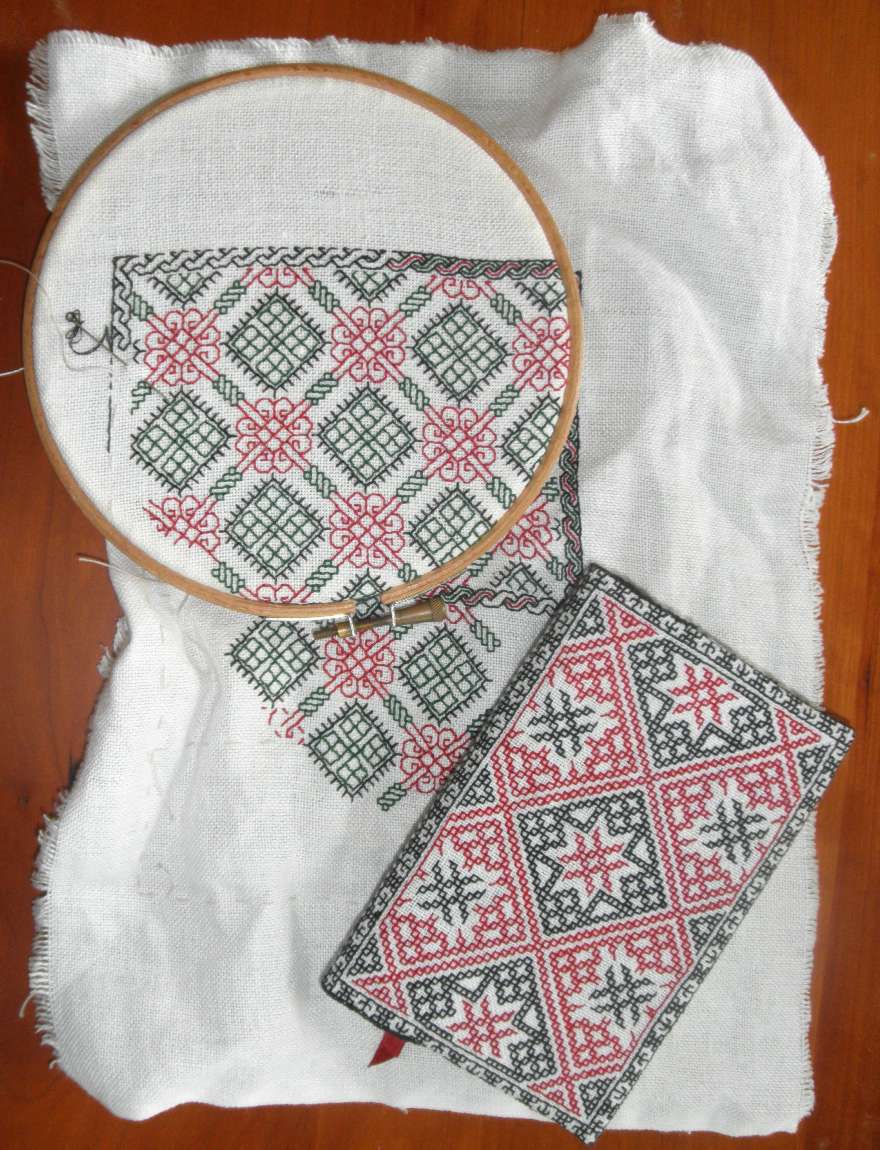
The finished book cover is adapted from two patterns that will be included in TNCM2. The one in process is a multicolor rendition of a filling in Ensamplario Atlantio, with a twist edging adapted from a larger design, also in TNCM2.
So. Be welcome! Let me know what you think of this new site and about what parts of wiseNeedle should be at the top of my rescue-me queue.

