WHERE LOTS OF SOCKS HAVE GONE BEFORE
Of late my life has been ruled by deadlines. The pressure should abate somewhat soon because we’ve managed to find another proposal person at work. I am looking forward to evenings and weekends again. Also knitting.
In the mean time more in the manner of keeping sanity rather than making any real progress, I dashed off another pair of socks last week. This one was on huge-as-logs 2mm needles, standard toe-ups with the figure 8 toe and short rowed heel, on only 64 stitches (not my usual 72-80) . No fancy patterning, no nothing. Just mindless stockinette to let the yarn’s native colors play. The result looks rather Star Trek – with the standard Trek swoosh – albeit sideways – in crew uniform colors on a dark navy background.

The yarn’s official name is Regia Galaxy 4-Fadig Color. I suspect that in Europe it’s sold as Regia Jupiter, because of the small blurb about Jupiter inside the label. I worked it on such large needles because the color repeat didn’t work very well at my standard smaller gauge. The label recommends 2-3mm needles. As you can see, the swoosh factored in nicely enough at 2mm.
I’m not quite sure what larger project to begin next. I’m still finishing Elder Daughter’s Kyoto sleeves. But that’s my downstairs project, for when I have time to sit with the family and play video games or watch movies. My upstairs project sits in the library, where the adults of the house take their relaxation after the kids have gone to bed. That’s usually the most involved thing I am working on at any one time, and the project for which I now find myself in need of inspiration.
WOMEN IN ENGINEERING – THE FUTURE?
UPDATE: THE PANEL INSERTION PATTERN BELOW HAS BEEN ADDED TO THE PDF COLLECTION AT THE KNITTING PATTERNS LINK, ABOVE.
Like most parents, I spend a lot of time rolling my eyes at what passes for homework and school assignments. There are way too many feel-good tasks – making posters and collages, even well into high school. Where are the analytical reading pieces? Where is learning how to write a convincing essay? But every once and a while something engaging and creative is requested.
This month Smaller Daughter (now 9) had to construct a Rube Goldberg device, with a goal of popping a balloon. I sat on my hands and watched her experiment for the better part of a week. She scribbled out her designs and went down several possible paths before settling on her device components. She constructed (and re-constructed) each station scrounged from toys and oddments at hand, testing out each one individually, then assembled them into her final chain reaction. Eventually, after much tinkering she got it just right, and the whole thing worked as intended.
I wish I had a video camera, but you’ll have to use your imagination. Especially the part where the balloon makes a satisfying pop, and she leaps up in triumph.
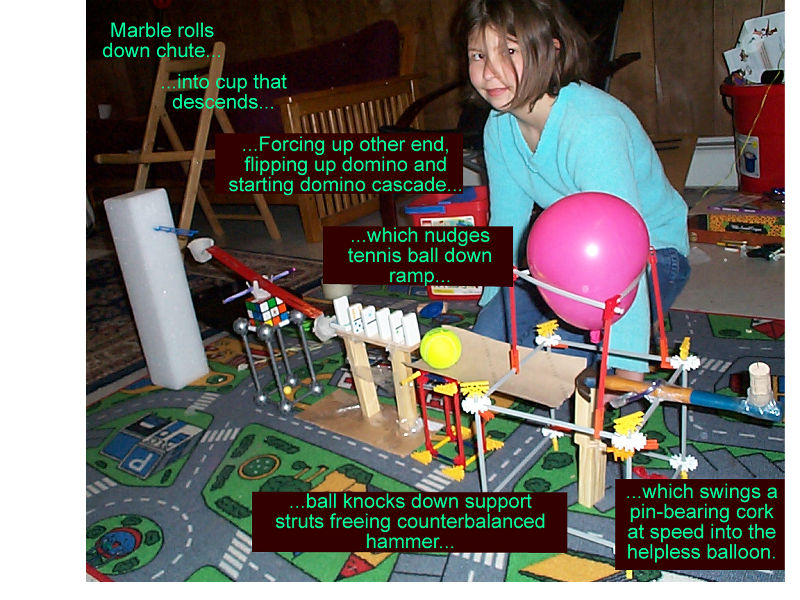 Click on any thumbnail on this website to see detailed pix.
Someday I will loose this proto-engineer on the world. I hope the world will be ready.
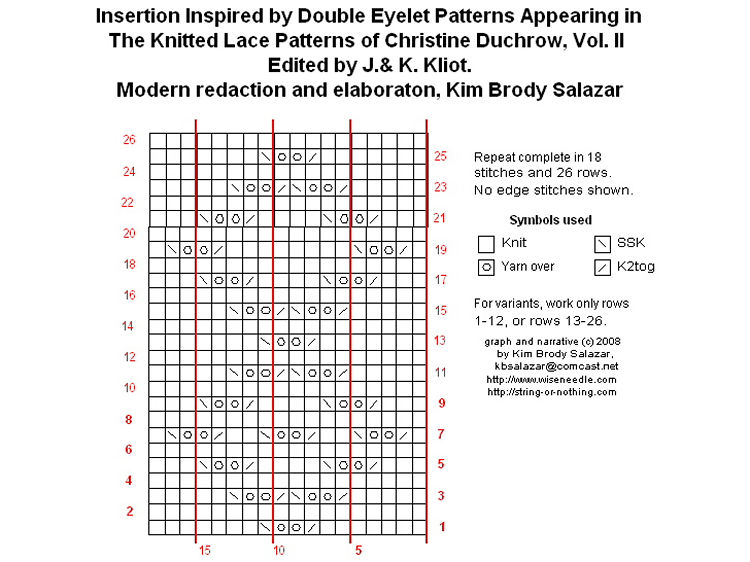
In knitting news – not much. I’ve been working like a demon. All I’ve had time to do over the past two weeks is one mindless sock. For me to take two weeks to knit one sock says a lot. This one is a standard 72 stitch sock with a figure-8 toe and short rowed heel, worked using five DPNs. That calculates out to 18 stitches per needle. My insertion strip is 18 stitches wide as graphed below, so I do the pattern in its entirety once on each of the four working needles. I’ve stuffed a piece of white paper inside the sock so you can see the diamond patterning. and provided a chart for the simple design .
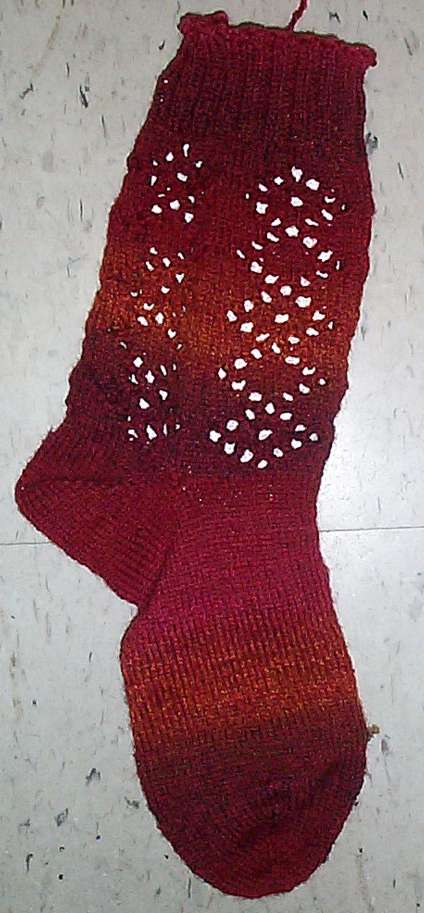
I used Meilenweit Mega Boot Stretch, knit at about 9spi. The shaded reds with the touch of orange is color #709. I’m not wild about this yarn. It feels nice and cushy knit up, but I don’t enjoy tensioning it. The stretch is throwing my gauge off a bit, especially on my heel’s purl rows. It also is rather lofty unstretched, and prone to catch and split on needle tips. I’ll post a review of the stuff when the pair is finished.
THINKING AND WAKER’S LEARN TO KNIT AFGHAN
I’m not sure what the next challenge should be. I really should finish the Galaga hat. I’m still working on the Kyoto (finished with the body pieces, now about a quarter of the way through the two sleeves). But having partially finished things has never stopped be from beginning something new before.
One possibility is to do something lacy taking advantage of the color properties of Noro’s Kureyon sock yarn. I couldn’t leave Wild & Woolly (in Lexington, MA – my favorite yarn shop) without it because these colors latched on to my magpie self and refused to let go.
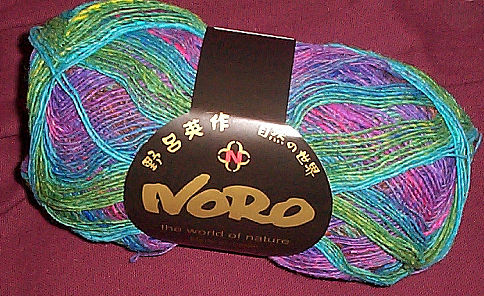
I’ve been told that some folk think this yarn is too twisted and just a little bit harsh for socks. While not Regia smooth, it’s not particularly harsh to me. I suspect that like most Noro yarns, while they never achieve Merino softness, washing will make a tremendous difference. And for my purposes, rewinding to reduce twist and in the process increasing loft, isn’t optimal. I like my lace yarns to be tightly twisted.
But there remains the question of what to do with it. Something directional might work well with the repeat lengths, but so many other people have done Entrelac in these yarns. The same method I used for the Kureopatora’s Snake might be an idea – upping the number of stitches across to yield the same finished dimensions in the smaller gauge – but I want to do something else that’s more airy. Mating lacy stitches with the riot of hues is always a big challenge because textures tend to fight with the patterns produced by the yarn’s transition among colors. I’ll have to do more thinking on this one.
My other looming temptation is one of two tightly twisted little knots of Malabrigio Merino laceweight. I bought two – one in Emerald Blue (blues and teals) and one in Amoroso (a stunning garnet/cherry blend). I wound the blue into a ball last night.
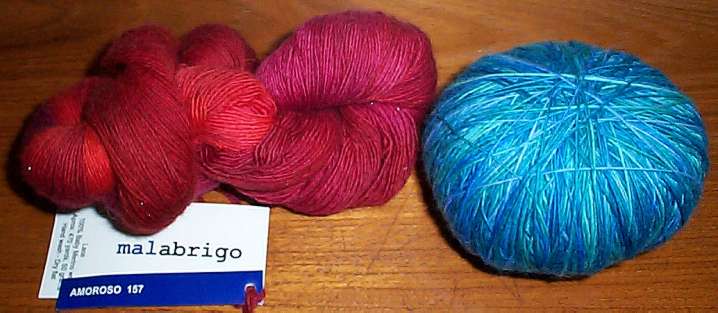
The super-soft single-ply yarn relaxed and got considerably more lofty in the process – a bit of a disappointment for me, but not fatal. It just means I will have to use a much larger needle than I originally anticipated. Also some teasing apart was necessary because the thin strands were in the process of mating with each other, and some were slightly fulled into their neighbors. Thankfully I did not have to break the yarn to tame it. This slightly variegated yarn presents a smaller color challenge than the Noro, but a larger one due to skein length. 470 yards should be more than enough for a small scarf. To be sure that I will not run out mid-project, I will need to work it differently than the pieces I’ve been doing. I would revert to the method I used for Kombu – first knitting a narrow width of edging (the bottom), picking up stitches along the top and then knitting both the body and the left and right edgings at the same time. That way I could see how much I had left at all times, and maximize the scarf’s length by continuing until I had just enough yarn left to do the small strip of edging at the top. Or perhaps I’d chart out something with two decorative ends and included borders…
In the mean time, going back to a single color world – I can report that Elder Daughter is making excellent progress on her Walker Learn to Knit Afghan Book project. She’s using Cascade 220, all various greens and creams, bought one skein at at time from the orphan end of dyelot bin. She is going more or less in order, with skips ahead dictated by how much of what color she has on hand at any one time. I suspect that she’ll soon start improvising because she’s beginning to accumulate a stash of little leftover balls too small to use even for the book’s two-tone squares. Here’s the collection to date:

and a few close-ups (unblocked):
1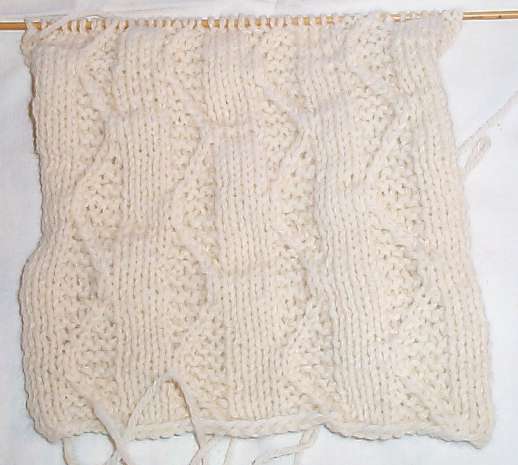 2
2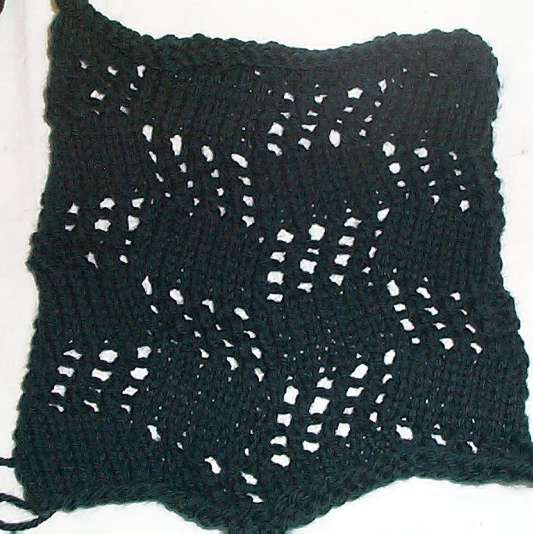 3
3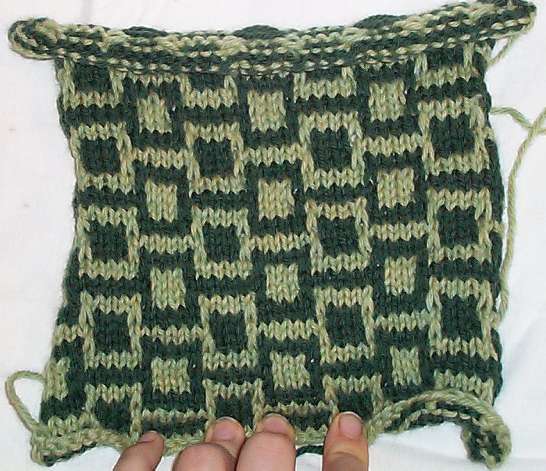
4 5
5 6
6 
So far she’s covered basic knit and purl (4 above), twisted stitches (1), simple directional decreases (2), yarn-overs (2), simple increases, cables (5), mosaic knitting (3,6). All in easy to digest aliquots and explained well enough that she’s been able to noodle it out all on her own. To be fair, I did show her a couple of tricks for 1×1 twisted stitch cables, but that was just a hands-on for the same methods described in her book. If you’re an experiential learner and you’re looking for a nice survey course in basic knitting, you might benefit from this classic bit of instruction. My only criticism of it is that it was written before Walker moved to charting – a vital skill these days as more and more resources rely heavily on that technique.
Needless to say, I’m quite proud of Elder Daughter and her ongoing project.
DUCHROW MUSINGS AND FINISHED DOODLE SCARF
As promised yesterday, pix of the Doodle Scarf – finished and visible on a light-color background:


The whole thing blocked out to be nine feet long, and point to point, about 17 inches across. I combined lace patterns from the Duchrow series (as described before), one edging and one insertion strip. I mitered the corners on the fly, not bothering to graph them out until after the fact. I am quite pleased with the way it turned out, and will probably keep this one for myself.


There’s some clear congruity to be seen among patterns in these books. Here are some other things I’ve done from insertions and edgings adapted from these books – another scarf and the big shawl from laceweight, and two baby blankets worked at DK gauge:


(A couple of the edgings were cribbed from Heirloom Knitting). I seem to have taken my inspiration so far from the family of diamond-based patterns. There’s lots of other stuff in there, including some in-the-round pieces. I think it’s time to branch out and try some of the patterns based other motifs.
Is anyone else out there playing with the Duchrow books? Or combining other older or traditional patterns into original lacy pieces? Or might be interested if I were to issue some or all of these in a leaflet?
MORE BLOCKING
I’m still chugging my way through my blocking pile. Here’s my Jang Print ‘o Wave piece, finished and blocked. I admit I could have done a better job blocking the thing, but it’s not horrible.

Due to the yarn and needle size I used, it ended up being stole sized rather than conforming to typical scarf dimensions. As I noted in my earlier posts, the endorsed rate of attachment is a bit ruffly. I prefer a flatter piece. The corners however turned out better than expected. The ease factor I used was (for the most part) enough to flare nicely around the corner in my non-stretchy linen, but “going round” rather than mitering does make the ends of the stole flare out a bit. If I were to knit this again, I’d work out a complementary mitered or fixed piece corner instead of just easing the edging around.

If you are thinking of working this pattern, too, I did post a minor bit of errata for the original pattern. My own Jang Wave will be headed out as a present for a family member.
And on presents – a great pal of mine, co-conspirator, sometimes employer/sometimes co-worker/sometimes employee, fellow Kim, leader of the pack, and all around kindred spirit deserves a pair of fingerless mittens:

These were adapted from my previously shared Fingerless Whatevers pattern. Although they’ve missed the worst of winter’s weather, they’re on their way.
The blocking joy never stops. (Perhaps that’s why I put it of forever). Here’s the most current piece, pinned out and drying:

This is the Black Lace Doodle scarf I was working on a month or so ago. To be fair, it’s not entirely black, it’s more of a deep gray/tobacco color, knit from leftovers from my big Woven Diamonds shawl. Better pix away from the checky blocking sheet in the next post (promise!)
Finally – a private note to friend-from-elder-days, Wendy. I tried leaving a comment on your blog about your offer of the ancient photo, to no avail. I’d love to see the thing. I might even have one of you (of similar vintage) in trade. All my best to the family, two and four-footed, alike.
BLOCKING
As you can see from the traditional String blurry pictures, the Zig-Zag Baby Blanket is done. Although it’s acrylic, I blocked it out to stretch the lace and flatten out the edging. And I spare you from squinting only at the Peter Max image of the thing mid-block on my checked sheets:

Now you can see what I was talking about in the last note – I took the single zig-zag insertion framed by diamonds as presented in the text, used one column of diamonds as a center “spine” and mirrored another zig-zag on the other side. I also improvised a matching edging adapted from the main design’s zig-zag and quad eyelet motifs. The thing is a square approximately 37 inches across from point tip to point tip – a useful size for a travel or basket blanket, although at tad small for a crib blanket. It’s knit in a DK weight yarn and sports a stockinette gauge of about 5.5 stitches per inch. Stitches used are knit, purl, K2tog, SSK, and YO. If you can manage them and read a chart, you can knit this thing. (While keeping place in the admittedly large chart can be a minor challenge, given sufficient sticky notes or magnetic bars, that problem is very manageable.) If anyone is interested in making one like this I’ll consider writing up and posting a pattern. One caveat – this piece is a gift and will be leaving the house within the next two weeks. Requests made after that time will have to rely entirely on my shaky memory.
Because I had the blocking sheet out and had some room, I grabbed another piece from my done-and-waiting pile and blocked it, too. Here’s Red Doily #3, knit last year, pinned out and presented done (but with some ending off still on the horizon)

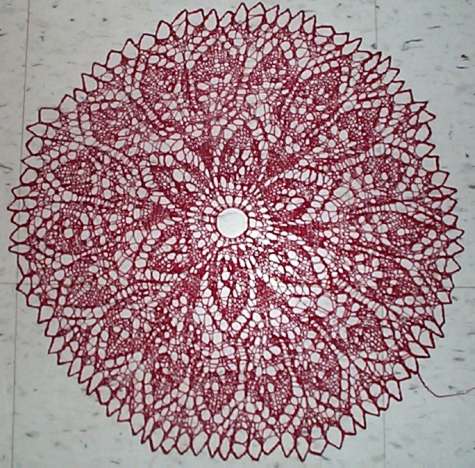
To embarrass myself, I went back through blog archives looking for when I knit this third red doily but didn’t find it. I think was knitting this piece back in the fall of 2006, and it has been sitting in the blocking pile ever since. That’s so long ago, I’m not sure where the pattern is from, but I think it might have been from Patterns for the Art of Lace Knitting: The Complete Works of Rachel Schnelling, compiled by Gloria Penning.
Only three more items in my to-block stack…
ZIG ZAG BABY BLANKET
Still not much time for knitting around here, but I did get to finish off my doodle lace scarf (pix when I get a chance to block it), and do up a quick baby blanket.The blanket is still in process, but I’ll be posting more details of the finished pattern here if people are interested. I’m also still chugging away on the Kyoto for Elder Daughter. I’m about a third of the way through the sleeves. All that remains is to finish off the sleeves, piece the thing together and knit the collar strip.
On the new blanket – I am still enthralled by my Duchrow trilogy, so I went trolling through the pages of those books looking for candidate strip and coordinated edging patterns to do up in a large gauge yarn. Large for me, that is. I found something interesting in Knitting Patterns of Christine Duchrow, Volume 1 on page 30 – a large zig zag. The zag is shown as one big Z shaped insertion, framed by two columns of diamond lozenges, pierced with eyelets. As printed, the one repeat edge to edge is 63 stitches. I decided to toy with it a bit, using one column of diamond lozenges as a centerpiece, framed by symmetrical repeats of the zig-zags. At my gauge of 5.5 spi the framed zig-zag made a nice size for a small basket/car seat type utility blanket. To finish off the piece, I scaled down the edging featured in Duchrow, eliminating the extra column of lozenges, opting for one fewer side to side zig-zag elements. For those of you who are still wary of charts, doing something like this with a knitting pattern written out in prose is a relatively difficult exercise. Editing down a charted edging is easy. Slap two sticky notes on the thing, one masking out unneeded vertical columns, and one to keep one’s place row by row, and (provided you’ve not cut off the inception spot where the entire thing is narrowed or increased – you’re good to go. (Let me know if you want more details on this.)

The picture shows the edging, plus one half of the blanket, from the edging to the line of lozenges that form the center. The big zig is mirrored on the other side of that center spine. It’s bundled up snood style because I’ve picked up stitches all the way around the perimeter, using two circs; and am now knitting the edging onto the body. I’d estimate this piece so far (center plus one side of the edging) has taken me about six actual hours of knitting time, spread over two weeks, which for a lacy blanket is pretty quick, even given my dismal work schedule.
As to what I’ve knit this piece from – I’m not entirely happy with it. I’m working at consuming some of the yarn that I have here in the house. A dear friend of the family recently gave me a huge bag of mixed acrylics that she had accumulated from yard sales and flea markets. It included a number of skeins of 1993-vintage Lion Jamie Pompadour. It’s marked at 20 stitches and 28 rows = 4 inches or 10cm. I’m getting DK standard gauge of 5.5 stitches per inch in stockinette on US #7 needles. While it does knit up quickly, I’m not that pleased with the feel. It’s a Sayelle acrylic with a shiny rayon binder strand. The feel is rather spongy and a bit plastic like as opposed to woolly. The drape is relatively stiff given the yarn’s density and weight. Still, yardage per skein is high, it’s not itchy, it is machine washable, the color is pleasant if you like baby pastels, and having been stored well over the years none of the yarn is discolored, snagged, stained or smelly. I’ll probably use all of my inherited skeins for baby blankets for people I know might not have the time or inclination to hand-wash. For the record, the center of the blanket took a few yards more than three full skeins of Jamie- I’d estimate it as having eaten about 525 yards. The edging along one long side has taken a little over 3/4 of another skein. Final consumption figures will be forthcoming when I’m closer to the end.
BEST FRIEND DORM SWEATER
Just because I was eaten by work doesn’t mean there was no knitting going on at my house. I’m very proud of Elder Daughter (currently in 11th grade), who completed her first sweater this weekend past.
She used Sirdar Denim Ultra – a very soft and lofty cotton/acrylic blend, and made a top-down original, working off a pattern produced using Sweater Wizard. She did all the steps – knitting gauge swatches until she had one with a hand she liked, then calculating the gauge; taking body measurements; inputting the gauge and measurements into SW, and then tinkering with different lengths, eases, and necklines until she got the look she liked (comfy/baggy, for relaxing after class). Then she cast on and followed her pattern to the end.
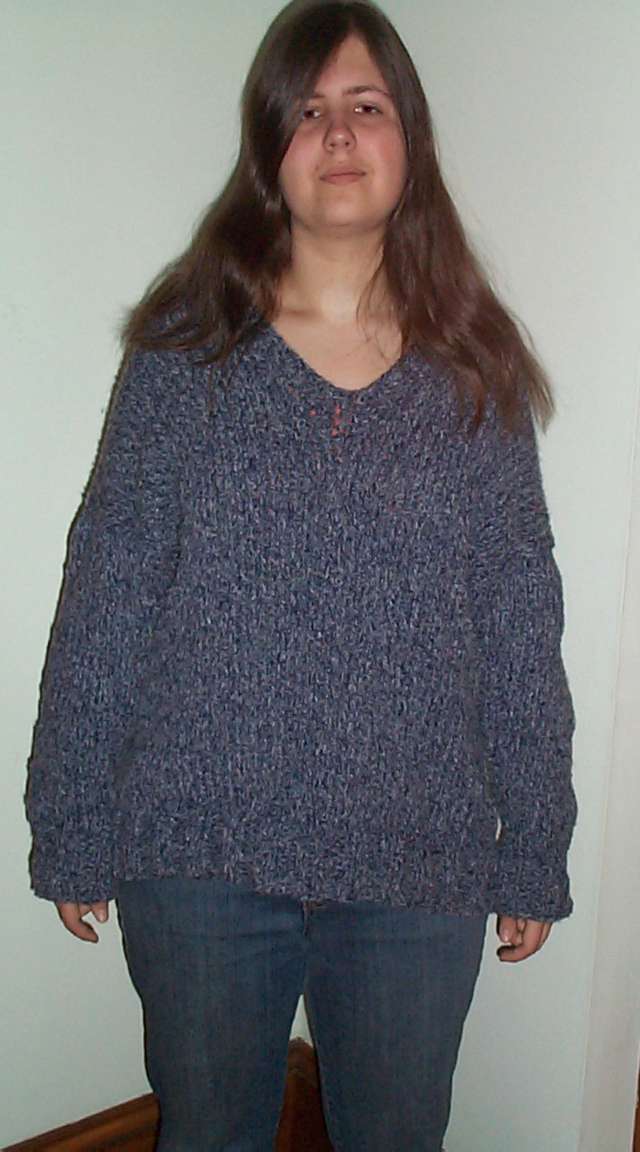
She had a ton of fun working through the project, and is extremely happy with the end result. Her only criticism of the yarn is that it’s a bit splitty, and being composed of lots of individual smaller strands, does have a tendency to catch on things.
I know that Sirdar Denim Ultra is discontinued now, but in the chance anyone has a similar lofty acrylic/cotton blend that works up to 10 stitches/12 rows for 4 inches or 10cm, Elder Daughter shares her pattern:
My Best Friend Dorm Sweater
Needles: 11, 13 Size: 40 Gauge: 2.5 sts 3 rws per 1″ Estimated Ydg required: 718
Note: Sweater begins at the top back and is worked to underarm back. Cast on sts are picked up to work to front underarm. Remainder of garment is worked in the round.
Start Back
With larger straight needle, using a provisional cast on 54 sts. Work Back to Underarm Working back and forth, work until piece measures 10.5″. Place sts on a string.
Front Shoulder & Neck Shaping
Slip 19 left shoulder sts (from cast on string) on needle, skip 16 back neck sts. Slip 19 right shoulder sts onto needle. Using two balls of yarn, begin neck shaping as follows: Inc 1 st at neck edge every 3 rws, 3 x. Then every 4 rows, 5 x. Complete Front Top: Work even until piece meas same as back. Slip front body sts onto scrap yarn.
Work Sleeves.
Pick Up Sleeve Sts [pick up 4 sts, skip 1 row] 4x [pick up 5 sts, skip 1 row] 2x to shoulder. From shoulder down [pick up 5 sts, skip 1 row] 2x [pick up 4 sts, skip 1 row] 4x (52 sts) ending at underarm. Place marker, join.
Shape Sleeve
Work 1 rnd. Begin sleeve shaping: Dec 1 st on each side of marker every 2nd rnd 6x, then every 4th rnd 8x. Cont in pat st until piece meas 15.5″[rnd 46]. Change to smaller needles for cuff. Sleeve-to-Rib Dec Round: [Work 7 k2tog, work 6, k2tog] 1x, work 7. Work rib for 10 rounds[3″].Bind off 22 sts.
Work Body
Slip front and back body sts onto a circular needle. Work across front, pm(side seam), join front and back, work across back, pm (beg of rnd). Join. With larger needles, work one RS row. Begin shaping: Dec 1 st each side, every 20th rw 1x. Inc 1 st each side, every 20th rw 1x. (108 sts).Cont until piece meas 14″ from underarm
Work Ribbing
Body-to-Rib Dec Round: [Work 8, k2tog.] 10x, work 8. (98 sts) Change to smaller needles. Estab rib pat: *
K2
, P2. Repeat from * to end. Work 10 rnds.[3″]. Bind off.
Standard Neck Finishing
With smaller circular or dp needle and RS facing, pick up 16 sts from back neck, pick up 22 sts from left neck edge, place center marker, M1 st in center, pick up 22 sts from right neck edge, place end of round marker. (61 sts) Rnd1: work in k1, p1 ribbing to within 2 sts of center marker, ssk, pm, k1, k2tog, work in k1, p1 ribbing to end of round. Rnd2: work in estab ribbing to within 2 sts of center marker, ssk, pm, k1, k2tog, work in estab ribbing to end of round. Repeat rnd 2 for approx. 1″. Bind off loosely in ribbing.

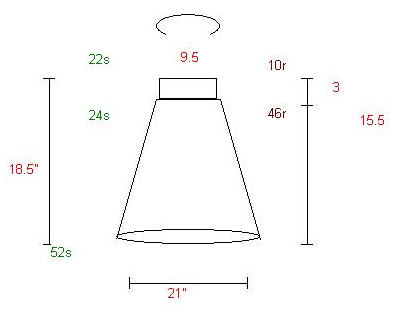
Pattern and schematics produced using Sweater Wizard software. Pattern copyright 2008, Alexandra Salazar and Kim Brody Salazar.
MORE DOODLING – DUCHROW HEART EDGING AND MITERING A CORNER
Yet another spate of horrific deadlines has washed past me. I survived (barely), but I haven’t had much time to knit.
I’m still working on that second lace doodle scarf – the one composed from patterns out of the Duchrow books. (Which I wholeheartedly recommend for lace fanatics.) I’ve finished the center panel, and have applied the edging down one long side, around the narrow end, and am now starting back up the second side:
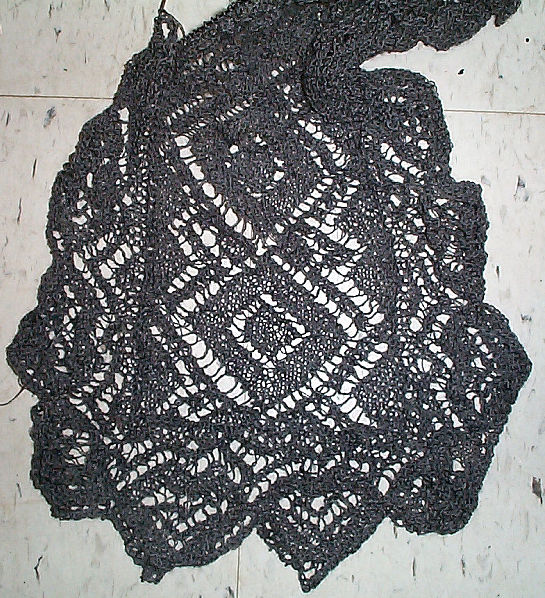
The edging in this case is a bit unusual. It’s predicated on motifs that are somewhat heart-shaped, and sports a very deep dag. I managed to fiddle around with the attachment rate so that I ended up at the corner of the body at the exact narrowest point of the edging repeat. That let me miter the corners using short rows. I wish I’d stopped and taken pictures of that process, but I’ll try to explain it sight-unseen.
To miter the corner on this symmetrical lace, I knit this edge onto my main body piece, either directly calculating the pick-up ratio, or (more likely) fudging the rate of attachment so that I ended with my narrowest row (the valley between two points) at the exact corner stitch of the corner I wish to go around. Sometimes this is easy – if I’m a stitch or two off, those can be made up in the last repeat just before the corner. If I’m more than just a couple of stitches off, I might need to rip back a repeat or two and space the required extra rows or skips (or k2togs) over a larger interval. Obviously, it’s easier to fit an edging with fewer pattern rows into any given arbitrary length than it is to fit a longer one, because there are fewer rows between the widest and narrowest points of the repeat.
Back to actual performance. Arriving at the narrowest point of my edging in concert with reaching the absolute corner of my piece, I’d knit the next right-side row of my edging as usual. BUT on the return journey instead of working all the way back to my attachment point, then purling the last stitch of the edging together with one from the body, I’d wrap that attachment stitch (Row 2, Column A). Then I’d turn the work over and head back on the next right side row, taking care to keep my place in the edging pattern. I’d continue like this, but on each successive wrong-side row, I’d work one fewer stitch, and wrap the next one prior to turning. All of this is complicated of course, by the increases and decreases that form the lace pattern itself. Liberal fudging is usually in order to maintain the pattern as established – or a close to it as is possible.
Eventually I’d reach the row that on a “normal” repeat, would be the longest row – the one that happens in the centerpoint of one of the protruding dags. My actual row worked is much shorter than usual because I’ve been wrapping stitches to form my miter. It’s at this point I go back and begin the second half of my short row sequence, working each row one stitch farther along, waking them up one by one by working them along with the wrap at their base. If I’ve done this correctly, by the time I have reawakened all of the stitches on my row, I’ll also have arrived at the narrowest row of my lace edging repeat, and all of my previously parked short row stitches will have been reincorporated. When that happens, my mitered corner is complete, and I can I begin resume working the edging along the side of my piece.
I’ve taken the liberty of translating the historical pattern from Duchrow into modern notation. She doesn’t present a mitered corner for this edging, but I’ve noted where the short row shaping should take place so you can see (more or less) what I am writing about. Click on the image below for a full size pattern. Apologies for the file size.

HOCKEN SHTEINER
You know your life is chaos when you look at a two-hour school opening delay due to snow and say “Great! I finally have a chance to update the blog!”
Life here has been subsumed to work, right through the Thanksgiving holiday. We managed to cook and serve a great meal, and enjoy the company of old friends, but after that it was back to what my grandmother would call “hocken shteiner” (Yiddish for breaking stones ). I’m weeks behind in holiday shopping. We haven’t a candle or a potato in the house for Hanukkah, and my annual cookie fest hasn’t even hit the planning stage yet.
But for all of that, little bits of knitting have happened. Not any of the gift socks I’ve promised this year though. I will most certainly be visited by Franklin’s Ghost of Christmas Knitting this year. But I can report some small progress.
First, on specific request, I’ve begun Knitty’s Kyoto for Elder Daughter. But I’m working it in a DK weight tweeded alpaca. I’m using Grignasco Top Print in color #29974 – a ragg type mix of soft antique pink, pale turquoise, lavender, apricot, pale brown, ecru, and sea green. The “distance read” on it is sort of fallen cherry blossom, somewhat pink/lavender with a touch of pale brown, with the natural streaks imparted by the ever changing tweed.
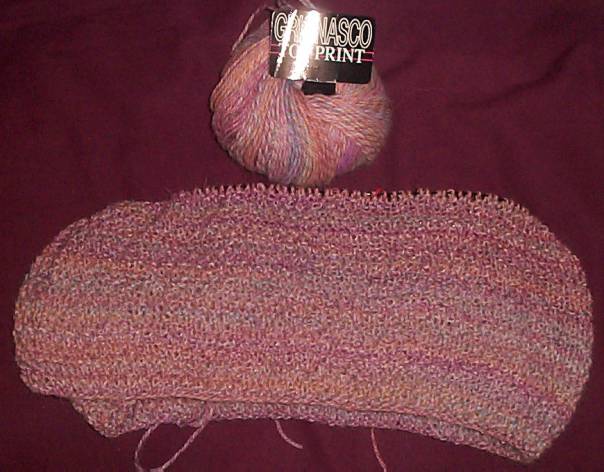
Gauge is hard to get with this stuff (I agree with the review posted in the yarn review collection, above). The label reads 30st x 38 rows = 4 inches/10cm on #3.5-4mm. I’m getting 19 x27 with #5. The pattern gauge is 20×27, so I’m making some small adjustments. Also, this is the most incestuous yarn I’ve ever used. It comes in evil mushroom puffball style 50g balls. The yarn is so soft and supple that it falls off that put-up at the slightest provocation, and so surface fuzzy that it twines around itself and sticks given any opportunity at all. With that level of fraternization in the bag, I’m surprised that reproduction hasn’t occurred and that I still have only 14 balls.
The other bit I’m working on is a second doodle scarf, using two more stitch patterns from the Duchrow series. That’s done in some of the leftover from my big woven diamonds shawl. It’s not exactly zipping along, given the complexity of the pattern and my limited knitting time, but it is progressing. I’ve finished the center strip, picked up all the way around the outside, and I’m on adding the edging.

 String-Or-Nothing