IDLE BROWSING – KNITVID
I am always the last to find out about these things.
http://www.youtube.com/watch?v=M6ZjMWLqJvM&eurl
http://video.google.com/videoplay?docid=-5299855665083820396&q=knitting&hl=en
http://video.google.com/videoplay?docid=8068663008782254608&q=knitting&hl=en
Oh. And if you search on any of the video clip services you’ll find a ton of how-to videos, too.
WAVE SCARF, CONTEMPLATING CURTAINS
Yes, I’m still knitting. I’m in the “I’ve memorized the pattern repeat and up to churning out yardage” part of the project. The center area of my scarf/stole is approximately 3 feet long. Another two feet and I’ll be ready for the edging:

On the other needlework project contemplations, I wrote to ACP Textiles (the linen source I cited in my first post on the curtain project), asking them about thread counts of their products. They were gracious enough to reply immediately. Here’s the data in case you’re looking at their products, too:
- Flax Canvas 28 x 24 – 52″ wide
- Craftsman Linen 20 x 18 – 55″ wide
- Osnaberg 40 x 45 – 58″ wide
- Irish linen 40 x 32 – 55″ wide
- Belgian linen 34 x 38 – 54″ wide
- Raw linen 34 x 38 -54″ wide
That’s one set of vital data points necessary for further contemplation of this project. The remaining two are what stitching design to choose, and how and to what size specifications will the curtains be made
Stitching pattern
I am contemplating using one of three historical patterns from The New Carolingian Modelbook – all done in monochrome: If you have a copy, here are the citations.
Plate 33:1 – an extremely long block unit repeat, which I would embroider in voided style (working the background, not the foreground) in either cross stitch or long-armed cross stitch. This one is of a complicated interlace sporting grape leaves, and columbine flowers.The strip is 53 units wide, and the entire pattern repeats in about 308 units, center to center. The first publication I found of this was in a modelbook printed in Lyons dated 1533, although it was reprinted at least once by a different publisher in Venice in 1546.
Plate 63:1 – one of the more open straight stitch unit motifs, not suited for knitting or cross stitch but perfect for double running stitch (aka Spanish stitch, Holbein stitch) work. This one is an interlace with pomegranate and acanthus motifs. It’s also 53 units wide, but the repeat is complete in 146 units. This one was graphed from a photo of a boy’s shirt, circa 1540.
Plate 69:1 – another straight stitch motif. This one is of grapes and grape leaves, 65 units wide, with a repeat complete in 127 units. If you happen to have a copy of Drysdale’s Art of Blackwork Embroidery, the original 16/th/17th century Spanish artifact this was graphed from is also shown there on page 33.
Window size and curtain construction
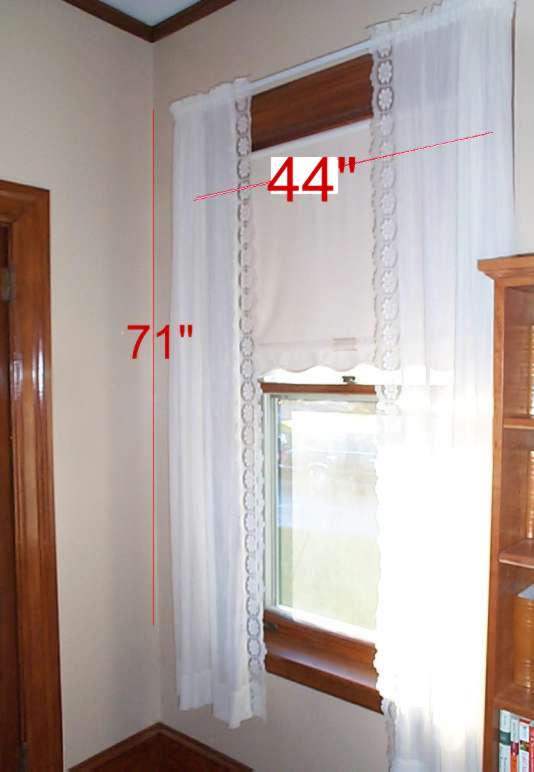
My window is pretty big, original to the house. And it’s one of two. Here it is, adorned with the tired dime-store lace curtains and tobacco-stained roller shade left by my predecessor
I have not sewn curtains before, but it should be pretty logical. Especially for something this plain. I’ve you’ve done this and have warnings or spot flaws in my thought processes, please chime in.
I want flat panels with little or no extra width compared to the window. I want to sew little brass rings on the top that will be threaded onto a narrow brass rod, so I don’t have to allow for a header. I am also going to line the curtains to improve drape, give a bit more privacy, make the back neater, and increase their thermal retention (such as it will be). My window is 44 inches across, from one edge of the sill to the other. My window is 71 inches from top of the casement to the surface of the sill, and 74 inches from top of the casement to the bottom of the casement. It looks like any of the fabrics listed above would be wide enough to provide the two panels I need for the window side by side.
Since I would be hanging the things from a rod attached to the casement, about .75 of an inch below the top, and the rings are likely to be about an inch in diameter, I’d subtract about 2 inches from the 71 for total finished length. That gives me two mirror image panels about 23 inches wide x 69 inches long. I have enough width in my fabric for seam allowances. My guess is that for stability and drape, I’d want a hem of about 2 inches at the top, and about 4 inches at the bottom. That means that for each window I’ll need to buy about 2.25 yards of linen, plus an equivalent amount of lining fabric.
Now which fabric would be suitable for which of my motifs, and how would I go about placing them on the curtains, and how would I treat the right-angled corner when using designs that don’t provide that detail? Obviously more public contemplation of this project will appear here.
ETERNITY AS A FUNCTION OF AVAILABLE WALL SPACE
My list of future (someday) projects keeps getting longer.
Contemplating our living room, The Resident Male and I have decided that the perfect thing for over the fireplace would be a tapestry. So we went looking at various tapestry reproductions sold on-line. The ones in our price range are pretty uniformly horrible – bad cartoons (the drawing on which the weaving is based), cheap looking materials/bad drape, and garish color choices predominate. I won’t even mention the awful chenille surface type and printed things that look more like stuff that along with 8-foot tall inflatable teddy bears are normally sold out of the back of vans parked at busy intersections in the summer.
As we were looking we also saw some of the painted canvases intended for needlepoint. Big ones that encompass scenes or details of historical woven tapestries. The better ones imported from France seem to offer more faithful reproductions of their inspiring works than do all of the modern woven reinterpretations.
Now I’ve done needlepoint before. It’s not my favorite, but technical implementation of the style is not a barrier. Plus I know exactly how long (read forever) it takes to do one of these. My mother did a a needlepoint tapestry reproduction in the early 1970s, working a rendition of this classic bit of canvas:

She did it in DMC embroidery floss, stitching the details including the hunter’s face, gloves and tassels, plus the hound, songbird, and hawk all in petite point. It’s heavy from all that cotton, but substantial enough (and mounted well enough) to resist distortion or curl. That she did most of it in basketweave rather than tent stitch has helped it keep its shape. The thing is a bit less than a yard wide and a bit more than 4 feet tall. It took her the better part of a year. Maybe a bit more. It’s roughly the same size as the one that caught our eye – a reproduction of a French woven tapestry from the mid 1500s (the clothing style is early 1500s, but the weavers may have been deliberately trying to imitate earlier works):

In canvas, even with the full thread kit, this one would be within my price range. Not counting a year or more to stitch it, of course. Will I end up doing this? Will the curtains I described yesterday come first? Will I stay true to knitting, and deaf to the enticements of other needle arts? Only time will tell…
POST-HOLIDAY QUIET
No knitting today. It was a happy but hectic holiday weekend here at String, full of family and food. Needless to say nothing beyond the targeted activities was accomplished. Still all are fed and happy, with grandparents spoiled beyond their expectations and back on their grand tour road trip.
Just as all of this was getting underway, I received a package from Long Term Needlework Pal Kathryn. She sent me glossy print catalogs from Bradbury and Bradbury, an outfit that offers reproductions of historical design wallpapers. She’s right in that some of their offerings are spot on for our 1912 house. I’ve not trembled to a halt on any of the offered designs yet (although several are very tempting), but I can say that after leafing through the catalogs I am in the early stages of project lust for something else.
Curtains for our library.
The bulk of the pictures from the catalog are available on line. You can see the type of curtains there that hit me. Plain linen rectangles of simple line, hung from narrow brass rods threaded through the top (or through small brass rings rings). But I don’t want unadorned curtains. I want to embroider mine. I happen to have on hand a huge set of counted thread border patterns of various widths at my disposal. Plus a pretty good idea of how to go about it all.
I want to put a pair of curtains on each of my two windows, each stitched with a border parallel to the center and bottom edges. Kind of like this:

If you happen to have a copy of The New Carolingian Modelbook to hand, I’m thinking of doing the full giant repeat of Plate 33 – the daSera grape leaves and flowers meander. Possibly in deep hunter green on natural linen. At four curtain panels to cover two windows that are about 5 feet tall by 3.5 feet wide, yes I’m nuts. So nuts in fact that I have to do more serious contemplation as to whether or not I will have the fortitude to take something like this to completion. But I’ve already started looking into linens…
Once more Kathryn leads me astray!
WAVE SCARF – PROGRESS
As you can see, I’m making progress on my Print of the Wave scarf/stole thing. It’s roughly 24 inches long. I figure I’m a tad under half-way home.

I am now contemplating whether or not I want to do the center back graft thing recommended by the author. The advantage is that the highly directional orientation of this texture design would then present the same way on both ends when worn.
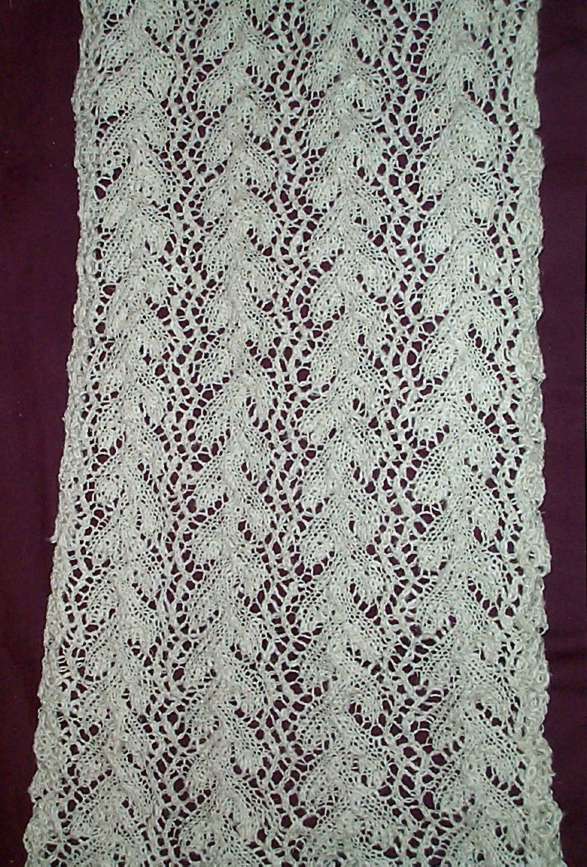
They’d match, with the vine-like bits growing up from the each end. On the other hand, there would be a noticeable seam across the center back – another area of visual focus.
And the jury is still out on how to edge the piece. Part of me says that working the narrow complementary edging specified in the pattern would be quick and easy. And part of me says “Easy. Heck. Just think of the challenge of edging the thing with an 8-inch wide mitered border using at least three different stitch designs and THEN putting on an edging.” We’ll see which one prevails – sense or the lack thereof.
As an aside – if you’ve had problems with sporadic access to this site or leaving comments here, please send me a note at admin [at] wiseneedle [dot] com. I know that moving is disruptive and that when you move part of the audience is lost, but the silence here is deafening. Of course shouting out “Where did everyone go?” in an empty field is an exercise in absurdity. Sort of like thinking about adding a complex 8-inch border to what amounts to a spur of the moment knitting doodle. In any case, a safe, healthy and prosperous New Year to all!
FIRST LACE PROJECT
Knitsy asked two questions – what was my first lace project, and why lace at all since I’ve said I am not really the lace-wearing type. I’ll try to answer.
First Lace Project
In the best tradition of flinging one’s self off the end of a pier in order to learn how to swim, my first lace project was the Rose of England cloth from Kinzel’s Second Book of Modern Lace Knitting. It was back in the days BI (before Internet), when aside from my mother, I didn’t know anyone else who knit. While I had no one to ask questions or provide help, I also had no one to tell me that I might be just a bit overambitious for someone who had just picked up needles a year or two before.
It turns out that I wasn’t overambitious at all. The pattern was clear and logical, with no errors. All I had were simple increases and decreases to worry about. Yes, the project was big, but even so it wasn’t a bad choice for a first timer.
I have to admit however (sheepishly) that the thing isn’t finished. I have one more round of petals to do and I have to end it and block it. Why has it sat in the closet all this time? Several reasons. First, it was a first project. While there are no structural errors in the thing my stitches are less than even. Second, lace yarn wasn’t readily available. I used cotton crochet thread, and didn’t have a clue as to how much I needed. Even that was hard to find. As a result there are supposedly similar weight white cottons from three makers in the piece, bought at three different times. And I still need more! The spots at which I transition from one lot of thread to another are very evident both in texture and even color (not all white is white). Third, until recently I had neither dining room nor place to block something so large. I can’t use this excuse any more because now I have both (although the table is rectangular rather than circular).
My long time pal Kathryn has twitted me many times about letting this one languish. But I’m not entirely sure it deserves to be finished. Sure, I’ll have finished off the piece, but I won’t be happy with it. I know every time I look at it I’ll think of what might have been or how it could have been done better. Is it worth it to invest the extra time if the result will be only disappointment? What would you do?
In a conservation of things lost moment, my copy of Heirloom Knitting being found, the bag with my unfinished Rose has now disappeared. Otherwise I’d show a picture of that sad resident of my Chest of Knitting HorrorsTM. Instead I’ll give you happier eye candy. Here’s a link to the incomparable Judy Gibson’s finished Rose. I melt in shame for my own shortcomings. I still love that pattern, but perhaps it’s time to toss in the towel on attempt number one and re-knit the thing for real.
Why Lace?
Why not? Actually, there’s more reason than that. I find the way patterns build in lace fascinating – how the charts or prose directions translate into the visual impact of the actual work. The more involved or complex the design, the better. Even more so if there are almost no row for row repeats in the piece. Plus I have to admit that making things with no garment shaping or final fit to worry about is wonderfully relaxing. So what if my flat lace pieces end up being a bit bigger or smaller than target? They’re splendid just as they are.
WAVE, LOOKING UP YARN MAKERS
Working away on the Wave scarf. Looks much as yesterday, but longer. I have however found my Heirloom Knitting book. I’d swear the knit gremlins stole it and then replaced it because it turned up on the shelf where it was supposed to be, in a spot I had checked a half-dozen times before. I am sorely tempted to use one of the wider Wave family border variants shown in the book instead of the elegant but simple one included in the pattern. We’ll see what happens when I get there.
In the mean time I continue to work on wiseNeedle. I’m tinkering with the KnitWiki’s structure (on paper). I want to get the skeleton logically organized before leaping into populating the thing. I’ve also been answering old advice board questions. There’s a spotty backlog of about a year, mostly inquiries that were stuck behind the junk entries. I am sure I’ve surprised some folk who posted their questions years ago, requesting that answer notifications be sent to them by eMail, who then never got an answer. More than a few out-of-the-blue notifications have arrived this week past.
On the yarn review side, I’m slowly adding basic info for as many of this season’s yarns as I can find. I’ve put in about 130 this week past, but have barely scratched the surface. I do note that people continue to be confused about the yarn maker list. There are hundreds in the collection – far more than the top 10 or so that appears on the drop-down list. In an effort to clarify how to use the thing I repeat some of the info from the how-to page.
The list of makers that appears on the drop down is a list of convenience only. It’s automatically generated, and changes as more yarns and reviews are entered and posted. We do not alter this list in response to manufacturer requests, nor do we put forward this list as a “short list” of recommended manufacturers – it’s based on a flat-out census count of yarns in the database only.

To look up a manufacturer that is NOT on the top-ten list, we provide a handy search utility. Click on the “Lookup/Add” button next to the “Manufacturer” field. A small secondary window will pop up.
Type in the first few letters of the manufacturer’s name and then click on the “Search” button in the little window. A list of manufacturers with similar names will pop up. Select the one you are interested in by clicking on its blue code name.

Some manufacturers are particularly arcane due to mergers, acquisitions, licensed “celebrity” names, national-market specific branding, or sub-lines. Here’s a list of the more arcane:
- Alice Starmore is listed under Broadbay
- Babajoes is under Merino Sheepskin Co, Ltd.
- Cestari is under Christoper Sheep Farm Yarns
- Dalegarn is under Dale of Norway
- DGB is under Difference G. Brui, Inc.
- Galler is under Jospeh Galler
- Holiday is under Robert Bremen
- KFI is under Knitting Fever
- Filtes King is under King
- Knit One Crochet Two is under K1, C2
- Kraemer is under Robert Kraemer, Bremen/Holiday
- Lady Fair is under Eaton
- Lily is under Spinrite
- Lewis is under John Lewis
- McGregor is under JL McGregor, Ltd.
- Peter Pan is under Wendy
- Pierber is under Laines Pierber
- Plassard is under Laines Plassard
- Trend Collection is under On Line
- Triola is under Bonnie Triola
- Vittidini is under Adrienne Vittidini
- Zitron is under Atelier Zitron
When you click on the manufacturer’s blue code name, the little search window will close and the “Manufacturer” field on the main form will be filled in with your choice.
BAKE SALE AND WAVING ON
It was cookie time here again at String Central. School Bake Sale season is upon us. I know there are some readers here from outside the US and Canada who may not have run into this custom before, so in the interest of sharing the joy, I share the joy. (I do hear that the UK shares this particular custom, too although it’s more centered around church groups doing good works than it is civic groups and schools.)
On election day most polling places in the US are in public buildings – very often county, town, or city-run schools. School parent committees see all that foot traffic as opportunity, so on most election days they mobilize as many parents as possible to make edible goodies to sell as fund raisers – always with some lofty goal or another. Send the band to the regional competition; refurbish worn-out playground equipment; send supplies to a sister school in a disadvantaged area; buy books for the library, a van to transport special needs children, robes for the choir, violins for the orchestra, or uniforms for the sports teams- the list is endless and every cause is deserving.
Most often it’s hapless non-baker moms who are dragooned, and interminable plates of cake mix brownies and slice-to-bake chocolate chip cookies are prepared by those with generous hearts and more volunteer spirit than time or baking knowledge to spare. Zucchini (vegetable marrow) season is especially feared because of the flood of zucchini breads and muffins that overflow the sale tables. I don’t think there’s a parent of a school age child in the US who has not heard “Oh, and we need to bring something to school today for the bake sale” ten minutes before the bell rings. You can find those parents buying cupcakes at supermarket bakeries on most bake sale mornings.
Needless to say, it’s local/state election day tomorrow and the clarion call for cookies has been made. This time around I made icebox cookies: half and halfs – chocolate and cinnamon. Seven dozen. On a work night. Thankfully I had advance warning and mixed the dough and refrigerated it on Saturday. Which explains in part why time was at a premium this weekend past. Even so, I’m cookied out.
Knitting? Yes I did some of that, too. As you can see, my Wave scarf grows:

Working with this linen of forgotten provenance is interesting. It’s relatively soft – no sharp bits of cuticle like some linens I’ve used. There are some fluffy slub like areas, and some places where the stuff is sewing thread fine. I am not having any problems working the lace pattern in it, and the result is surprisingly soft for something as slash-your-fingers-before-breaking durable as the the yarn actually is. I’ve got a ton of it. My foot or so of lace has made no discernible dent in the ball.
PRINT O’ THE WAVE SCARF
Well, it’s obvious that talking about wiseNeedle is a sure-fire way to keep people away from this blog, so I’ll give the topic a rest. Back to knitting.
I’m swamped again at work so discretionary knit time is at a premium, but I did manage to cast on for a Print o’ The Wave scarf. The body pattern is relatively simple – a 12 row 16 stitch repeat, with half-drop symmetry. That means there’s only three substantive rows to memorize, plus the fact that after three rows they’re repeated with an 8 stitch offset. I’m not sure whether or not I’ll bother with the author’s specifications for grafting two pieces together in the middle thing to make the two ends symmetrical. Perhaps instead I’ll just pick up stitches and work out in the other direction. Or maybe I’ll just keep going. It depends on how mindless everything end up being and how bored I get without other sections or pattern changes to look forward to.

The yarn is a nameless lace-weight linen I bought aeons ago at a Maryland Sheep and Wool Festival. You can see some of the texturing it has if you click on the thumbnail above to pull up the larger image. No stretch in the stuff of course, which will make blocking interesting, but it’s butter soft. I’d estimate that it’s about 15 inches across with minimal on-needle smoothing out.
I have to admit that one of the reasons I like complex lace knitting is that there’s always something interesting and new happening. It’s fun to watch the pattern build row by row, accumulating each new texture and design. This scarf by contrast is a long strip of a single stitch pattern. We’ll see how I as a knitter with the attention span of a mayfly handle this challenge to perseverance.
On the domestic front, my Heirloom Knitting book is still AWOL and I’m at sixes and sevens over it. I wish I could blame Franklin’s Delores, but she was no where near Boston during the week it disappeared. Besides, she’s not my hallucination. I’ll have to get both more creative and entertaining before I come up with an excuse half as amusingly incorrigible.
ADVICE BOARD POSTS
Another reason we moved String over here to wiseNeedle was to help me stay focused on wiseNeedle maintenance. I’ve spent my discretionary blogging time this morning answering wiseNeedle advice board queries, so I feel minorly useful so far today. Again apologies to those who have been waiting for answers – questions were stuck in a morass of spam that was jamming our to-be-processed box. We’ve winkled them out and all have been posted. But not are all visible.
One advice board feature people may not know about is that readers can rate answers (anonymously, of course). Questions remain on the open list until the aggregate score of all accumulated answers is high enough that we are reasonably satisfied that the question has been answered. So even if you aren’t intending on providing answers yourself, feel free to go over and review what has been posted. More unanswered queries lurk below the ones that have been addressed, but won’t be visible until items above them in the Open Questions queue are judged adequate.
Oh. And if you want to answer queries, please know that your assistance is greatly valued, not only by the original posters of questions but by everyone in the future who may search the collection looking for similar advice. Plus we remain open for new questions. Feel free to send them in, too.
On the knitting front, I didn’t get to do the grafting on the big red doily last night. My assistant photographer in residence had too much homework to help out, and barring growth of two more hands I can’t manage a camera and grafting at the same time all by myself. I did do some swatching for the Print o’ Wave scarf,. I am narrowing in on my chosen needle size for full implementation, but have no actual product to show off yet.
 String-Or-Nothing