GOLD FISH!
After an annoying lapse of personal preparedness, I am now back from vacation – at home where I left my gold thread. Sadly, no fish-stitching happened during my break because I was without it.
Goldwork is temperamental, exacting, and oh so rewarding. I don’t pretend to be very good at it, especially compared to The Masters. I bumble around at best.
I did play with metal thread embroidery decades ago, when I first encounted the SCA and began looking into historical styles. I did couched work, direct embroidery with passing threads, and or nuée – a style that involves laying the gold threads across the entire width of the image-to-be, then overstitching it with colored threads to create pictures, almost in raster style, that glimmer as the gold peeks through. But I had a goal back then – to advance embroidery in that organization, and all of these styles have a high learning curve. Happily, I stumbled across blackwork – something that’s easy to learn and easy to teach. I haven’t climbed back out of that hole in the years since.
Back to the project at hand – it’s clear that hooping over gold would destroy it, so for this phase of the work I have moved Two Fish to my flat frame.
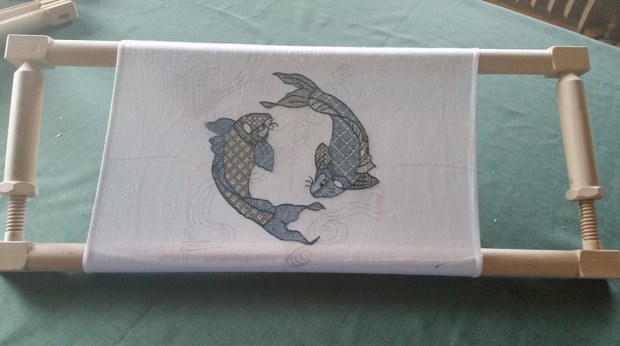
The rather unusual scrolling flat frame is a Millennium from Needle Needs in the UK. It’s a bit on the pricey side, but worth every penny. Although the design isn’t centered in this early fit, I do not think that the minor bit of scrolling I may have to do will damage the work – for example, there’s no point where I would have to lap stitched fabric entirely around the top and bottom bars.
It became evident very quickly that an extra hand would be needed to do this part of the project. Or two. So I hauled out my ancient Grip-It floor stand. I prefer a side stand rather than a trestle or tilt-top support that sits in front of the worker, and but side-supports are hard to find.
Ancient Grip-It works ok, but its main two drawbacks are that is easily overbalanced by a large frame like this, even when front mounted; and that the jaw is wimpy and doesn’t hold very well – and at the same time, I am concerned about pressure it puts on the finely turned wood sidebars of the Millennium. Here’s my sadly overmatched Grip-It in action on an earlier piece on this same frame. You can almost hear the joints squeaking as it strains to keep itself upright. To be fair, since I sit in a Morris style chair as I work, the off side of the frame does get extra support from my left side chair arm.

I’m on the hunt for a replacement floor stand, so if you have a candidate to recommend, feel free to post a comment.
As far as the stitching itself goes, I’ve begun. Even with the floor stand, I find I need additional hands.
I want hand one to manage the stitch-down thread (one strand of gold-color silk floss, well waxed) poised on top of the work; one hand to receive the stitch-down thread’s needle below the work; one hand to provide gentle tension on the gold threads to keep them flat and even as I go along; and one hand to manage a laying tool to keep the two strands being couched in flat alignment to each other, and not crossing over each other. That’s two more hands than I currently have…
I can double up the stitch-down needle hand, stabbing the thing into the work on each stitch, then re-positioning the hand above or below and drawing the thread through the ground; but I haven’t found a graceful way to tension and direct the gold yet. Since I haven’t worked this way in over 20 years, extensive re-training/re-familiarization is needed, and the going is slow but steady.
A CURIOUS APPLIQUE TECHNIQUE
I’ve long been been fascinated by one type of pattern that shows up in a couple of modelbooks. It’s a strip design, done positive/negative, such that cutting down the center line would yield double yardage of the repeating motif.
Here are some examples, quoted from Kathryn Goodwyn’s redacted editions of Giovanni Ostaus, La Ver Perfettione del Disegno, from 1561 and 1567.


I have tried to use this technique myself, with very unsatisfying results due to the stretchy nature of the unsuitable fabric I was using, lack of sufficient stabilizer, and imprecise cutting.
But I’ve finally found a historical example, and it’s pretty close to one of the Ostaeus 1561 designs – amusingly enough, the exact one I tried and failed so badly to use.

The full citation for this piece is
Compare it to this from the 1561 edition of Ostaeus (p.36 in this redacted edition):

As to technique on the CH band – it works just as I envisioned. This is velvet, carefully cut and appliqued to a ground, with the cut edges covered by a couched heavy metallic thread. You have to admire the efficiency of this method; not a scrap of that green fabric was wasted.
So. Has anyone seen other examples? Has anyone attempted the technique, either in fabric as shown here or (probably easier) glovers’ type very thin real or faux leather?
UPDATE – 30 October 2023:
I have finally spotted an instance of this technique, used as clothing detail on an Italian painting, dated to the 16th century. It’s entitled “Portrait of a Girl with Coral Earrings”. This link will take you to the listing on Mutual Art, where you can view and zoom in on a high quality image.

The strip along the closure at the center of her bodice is spot on for this double-length/negative-positive, no waste applique production technique. The strip on the sleeve cap less so, but I’m betting that the waste from the repeat shown would have an equally effective life as decoration as does the bit that ended up being used on this gown.
UPDATE – 16 March 2024
A double sighting! Grace Gamble is to blame. She posted this in-progress shot on Facebook – a piece of negative/positive applique work. I’ve added it here with her permission.

It effectively illustrates the working method – the precision cut strip being delicately appliqued to a base ground. Lively discussion and well deserved admiration followed. Grace pointed to the source for her work, and for the gown she is replicating for SCA wear

This portrait is in the Getty Museum Collection, accession 78.PB.227. It’s entitled “Portrait of a Woman with a Book of Music,” and attributed to Bachiacca (Francesco Ubertini), probably painted between 1540 and 1545. You can see strips of black adornment on shoulders, bodice front and (possibly) around the hem of the dress. I posit hem because I don’t see a place where the applique work meets the waist, so it’s probably not vertical. The pattern of the black adornment on the gown isn’t quite the positive/negative double yardage from one cut approach that’s laid out in the pattern books but the look is VERY congruent with it. Kudos to Grace for hitting on this economical and historically precedented method for her rendition.
And apologies to Grace for not knowing the name or form of address she uses in the SCA. While her face is very familiar and we have many mutual friends, memory of names and titles has largely deserted me. In spite of my ignorance, may her project continue to successful conclusion, and may her fame among needle-wielders ever increase!
 String-Or-Nothing