QUARTER FOR YOUR THOUGHTS
No, not inflation – at least not overtly. I’m just about 25% done with the frame around the outer edge of my Italian multicolor piece. Closeup posts of the bit currently under the needle are going to be repetitive from here on in, so I present the full canvas of this “painting.”

If it looks to you like I’ve sped up production – I have. I had wanted to mount this piece on my big Millennium frame, but I had no extra wide twill tape on hand. In person shopping being a bit unwieldy right now and not wanting to rely on goods sight-unseen I’ve stuck with the hand hoop, the sit-upon hoop being an inch wider across and even less suited to close-edge work than this smaller one. But I decided to stick the little hoop into my Lowery floor stand. That lets me work two-handed, one above and one below. And working that way for me is about half again as speedy as holding the hoop in one hand and stitching with the other. So one “up” repeat including initial outlines, meshy fills, and Montenegrin lines took about an evening and a half to stitch using the floor stand, but took three+ evenings with the hoop in hand.
The sharp-eyed will note that the center of the repeat currently in the frame does NOT align with my basted line that marks the center of the cloth as a whole, while the center of the repeat along the short edge, where I began does line up with the horizontal center line.
This was on purpose.
I took pains to do the math for the short edge, hoping to get close enough to the final diagonal needed to make a graceful improvisation for the corner. At that time I hadn’t realized that the original stitcher fudged the corner that most resembles what I wanted to do. I made it without that fudging, but at the expense of stitching further towards the serged edge of the cloth than I would otherwise prefer. You can see how low in my hoop my stitching is – a very inefficient and precarious placement that barely grasps the lower end of the fabric as I try to achieve and maintain optimal tension.
Since I hadn’t graphed out the corner and had only a rough estimate of depth, and knowing that my plans for a neat turn might not fit, instead of beginning the piece along my original posited outer edge (the basted line at left), I skimped on the edge area there, too. Not quite as much as along the second edge, but enough to make a difference. My logic was that when I continue around, if I need extra width or some odd bit of kludging to get to a neat corner on the second turn, I’d have more options. And if I didn’t, I wouldn’t be inconvenienced by the extra unworked cloth, and could cut it off in my finish.
Having narrow margins around the stitching (however inconvenient) and removing any excess play into my plans. My intention to finish this piece is to imitate the original, with “poetic interpretation” of what little remains of that treatment – a narrow turned hem, with neatly spaced blanket or buttonhole stitch and corner tassels. The hem-covering stitch of the original is probably plain old blanket stitch due to the way it has deteriorated. I would think that the edge reinforcement of tightly twisted knot like bits along the free edge in buttonhole stitch would have been preserved better, resisting large runs if snagged. But little remains. It’s very hard to see in the photos I took and the museum’s own shots, but there might even be a very narrow, barely there strip of needle lace along the edges – not wild stuff with dags and picots – just a simple solid band. I’ll be squinting at the photos to see if I can learn more. I’ve done that type of edging before, on The Resident Male’s SCA fighting shirt, in black, long ages ago, so it would not be a stretch to do it again. In any case, plain stitched hem or fancified hem, there will be little reveal of plain cloth between it and the established stitching. There will be plenty of linen left for the hem, regardless of how wide or narrow the stitched part ends up being.
Now where the true vertical center point of the piece as a whole is will matter when I get to the wide bar I am planning to add. That will span the middle, across the short dimension. It may be aligned with the center of the pattern iteration I’m currently stitching. That’s about an inch left of the basted line. BUT if I get near the other end of this side and I decide to devise ANOTHER corner treatment, and that treatment needs additional width, it might move either closer to the cloth’s original centerline, or to another point in that general direction. No clue right now what I will be doing, so stay tuned!
….Isn’t the suspense of Bungee Jump Stitching furiously exciting?
NOT QUITE EXACT, BUT GOOD ANYWAY
So. More examinations of the corners of the big towel from the MFA, and my first corner. Here are the four corners of the original
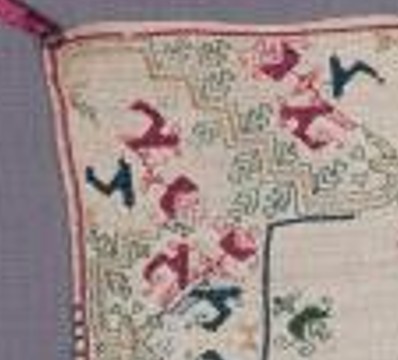
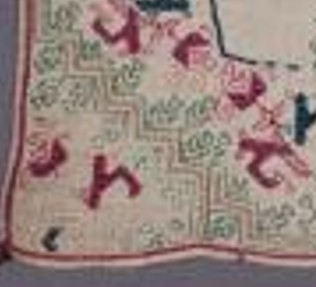

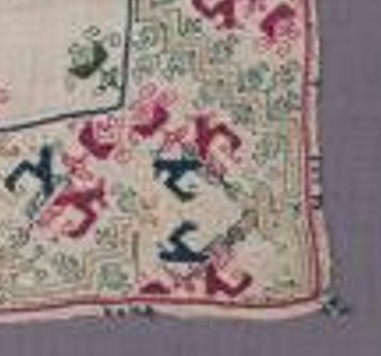
Not quite aligned but all there. Now my stitched corner as of this morning:

It’s closest to the one on the lower left, above. But not exactly. Look at this bit.
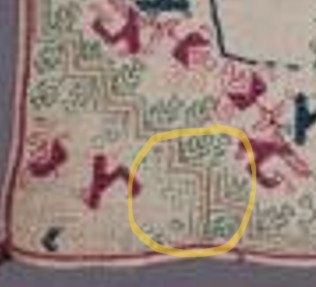
That’s a clear kludge. Not to brag, but my join is cleaner than this. I can’t deduce where the stitcher (or stitching team) began, but it’s clear that either the vertical bit on the left side of the photo, or the horizontal bit on the right was already laid down when that corner was rounded. The stitcher did their best, but the pattern doesn’t line up. For that matter, no two of the original corners ARE the same. But I bet you didn’t notice when you looked at the thing as a whole.
I will continue around on my mini-version. I haven’t decided yet if I will limit the width to multiples of the whole design, so I can replicate my corner exactly for the remaining three. Or if I will just make do, in a celebration of the heedless joy of the original.
And how far do I have to go to get to the next corner? Here’s my full cloth, so you can see the proportion of as-yet-not-done to the bit completed:
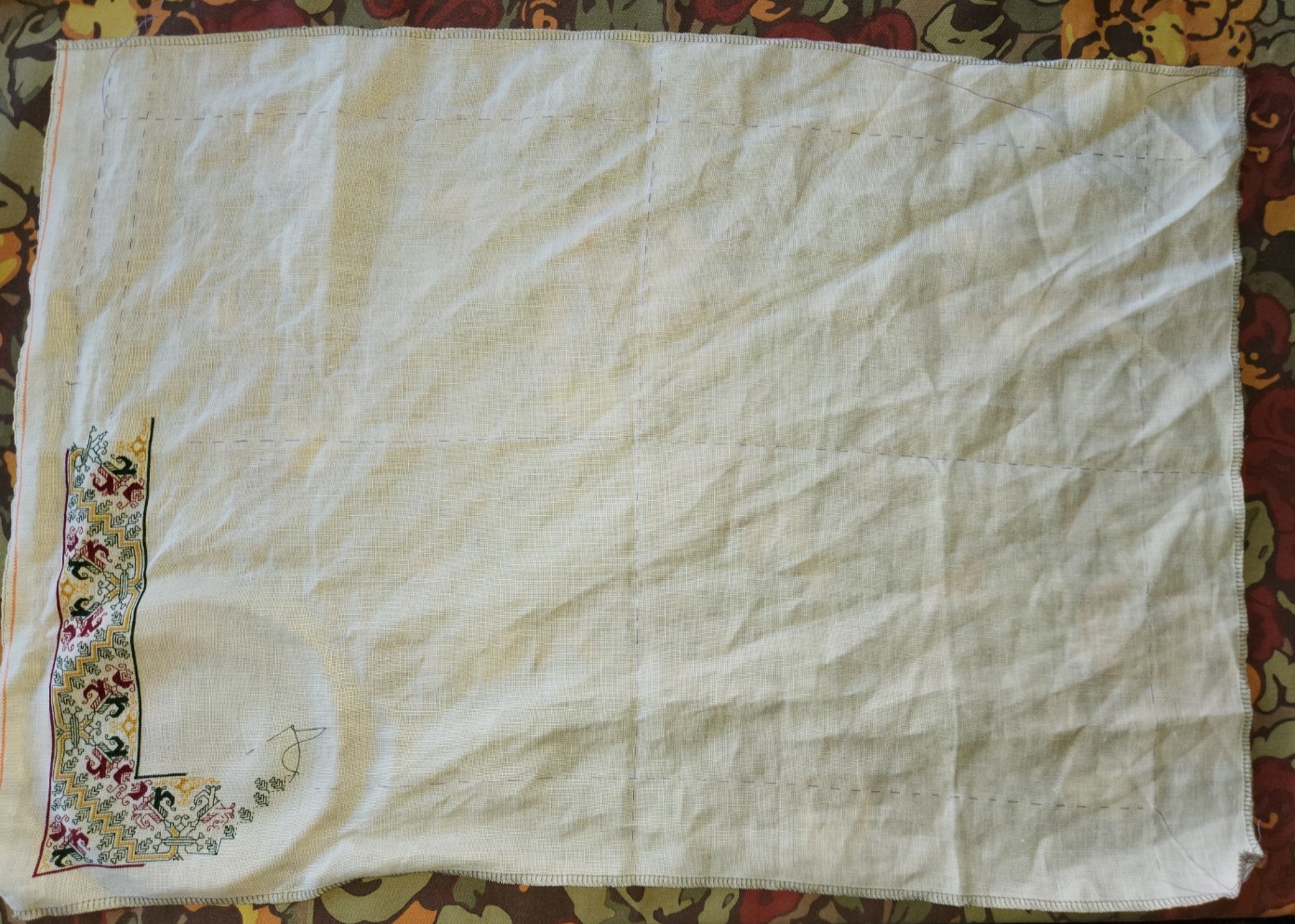
Quite a ways.
Aside from the corner challenge, upcoming decisions include a supplemental treatment spanning the center. Here’s the original again with two double width strips and two narrow single width ones across the center.

Examining those bars, I can conclude that they were done after the framing, and were aligned with the cloth’s horizontal centerpoint, because the band design is truncated (more or less) at the same point where it meets up with the frame, both north and south. But note that the centers of repeat along the long sides of the frame itself do NOT align with those bars, nor do they align with the measured center of the cloth. Again I bet you didn’t notice.
My smaller cloth may have enough room for one wide center bar; two narrow center bars; or one wide bar flanked with two narrow ones. Lots to think on there, but I won’t get to that part until after the frame around the edge is complete. And then there’s their alignment to consider. (I’m leaning towards filing them under Chaotic Neutral for the time being.)
On the healing front, I’ve completed Day 23 of radiation therapy. 17 more to go. No major perturbations, just the slog of rising before dawn to drive downtown and back before major traffic. Not that I’m counting or anything…
CORNER AND TASTY MILESTONE
My improvised corner on the current piece appears to be working out. And it looks like the original stitcher(s) hit upon the same notion, and did something very similar. Here’s what I have:

Note the extension of the zig-zag frame to a full iteration of the pattern, but one headed off on a right angle to the initial bit. And the beginnings of another red flower section in the triangle made by the border. Looking back at the original, although all four of its corners are treated differently (and a couple of them quite awkwardly), one does appear to take a similar approach:
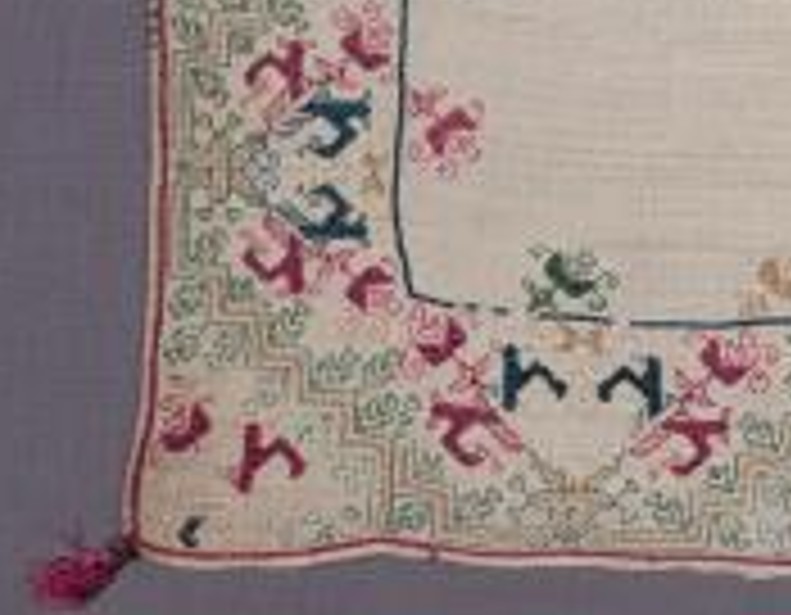
We will see if this gets me into any unforseen trouble, because looking at the original, I do see some kludges that address the variance in placement between that truncated corner flower and the framing zig-zag. Fingers crossed. Still it’s fun to see that I seem to be sharing the thought process of someone else, from way back then in time.
As to Meshy in cotton – I’m getting better at it as I learn more about the thread’s breaking point, and how much the ground cloth weave can be compacted by tight stitching.

The openwork texture doesn’t show well in such narrow spaces. It’s also hard to see in person without backlighting and practically putting one’s nose against the work, but the open mesh effect is there. I’m increasingly pleased with this, but I still don’t know to what purpose I will put the finished cloth.
Milestones
It’s no secret that since The Great Excavation and subsequent rehab/recovery, I’ve been living entirely on the labors of my Resident Male. While he has always handled the bulk of the cooking, I did contribute every now and again, with daily cleanup, baking special treats (especially during the holidays), and doing the occasional leftover reheat/repurposing, mid-week. But I have been a true freeloader since mid-March, and have only recently resumed unloading the dishwasher and doing other minor household tasks.
But yesterday and today I baked!
We are having some friends over tonight for dinner. I decided it was time to step up, and volunteered to make small ramekin chocolate cheesecakes
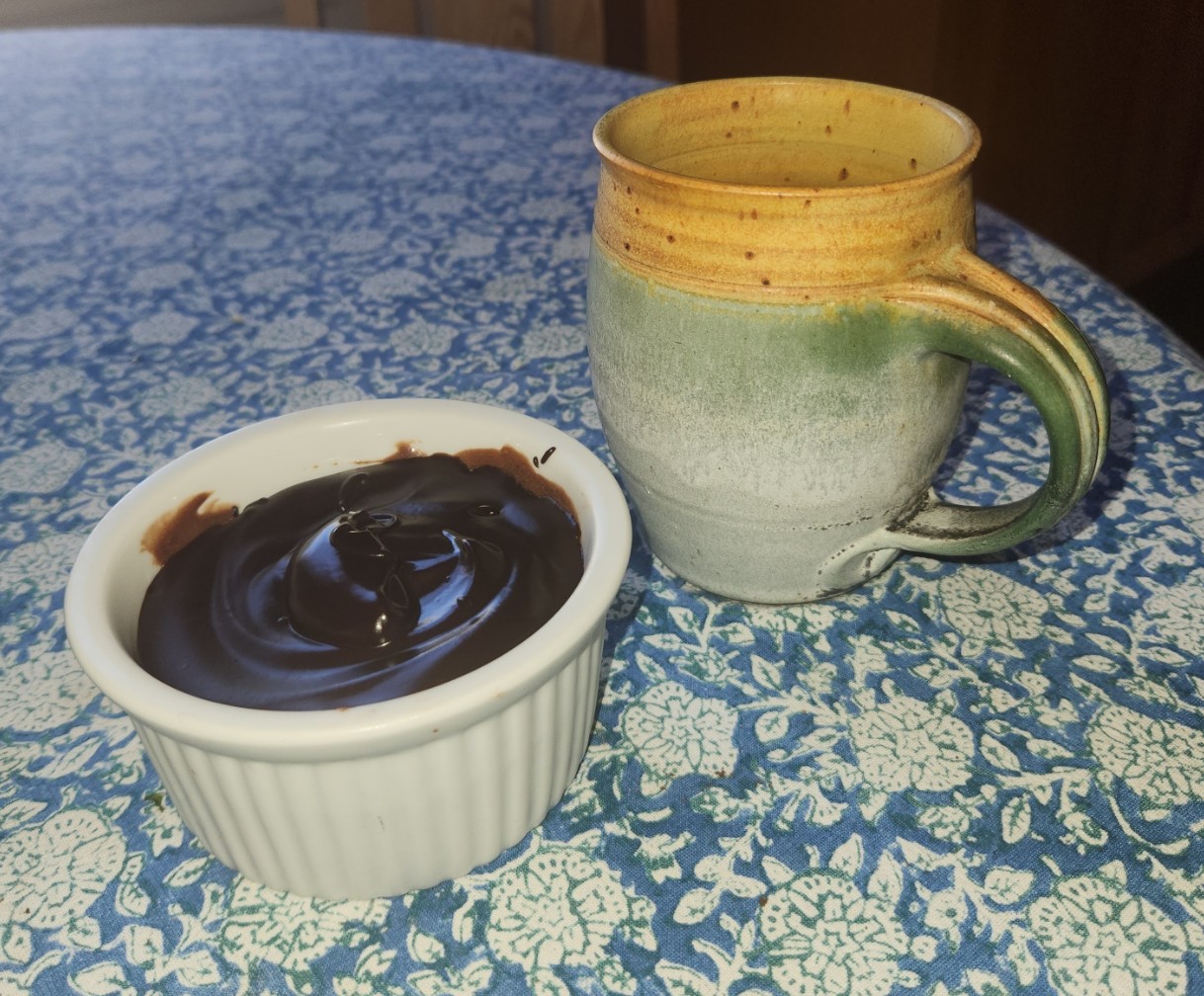
I made six of these little guys. They have three layers, and are a mash-up of several recipes. I used keto ingredients so they are low-carb, low-sugar, but not low-fat. And yes, I will clean up the edges a bit for presentation.
The bottom layer is a cocoa shortbread, made from King Arthur Keto wheat flour (no exotic nut flours, our guests are allergic), butter, cocoa, and faux sugar (Swerve brand, confectioners style). Next is the cheesecake part – standard full fat cream cheese (the bagel’s best friend), no-sugar dark chocolate baking chips (Choc Zero brand), heavy cream, eggs, vanilla, and a touch of salt. On top is a standard proportion ganache made from the same baking chips and heavy cream.
I did them in three stages with a small rest between the base and shortbread, then finished them with the ganache this morning. I was mildly tired after being on my feet so long yesterday, but not truly fatigued. While the shortbread and ganache I winged on my own, the cheesecake part is a combo of several keto cheesecake/chocolate cheesecake recipes.
I’m pretty confident that these will be acceptably tasty, with a dense but not rock solid texture. If not, I’ll report back, tweak my notes and in the future try again. Still, I’m proud of my dessert and happy to have cleared another recovery hurdle.
TRUE CONFESSIONS
I am very glad that I didn’t focus on making this piece two-sided.
At the outset, I thought about it. Hiding the ends on both Montenegrin Stitch and Meshy (Two-Sided Italian Cross Stitch, pulled tightly) are easy. Lots of real estate overstitched in which both beginnings and endings can be camouflaged. Double running is a bit more difficult, especially when one strand is used. Yes, I know various termination methods to do so – one-strand loop start and waste knots to begin; back-trace stitching, and threading through the existing line to end – but they are annoying to do, especially on a large piece. I made a half-hearted stab at it, but abandoned double sided double running early on, But I never thought it would be the two solid techniques that would be giving me trouble.
Here’s the front:
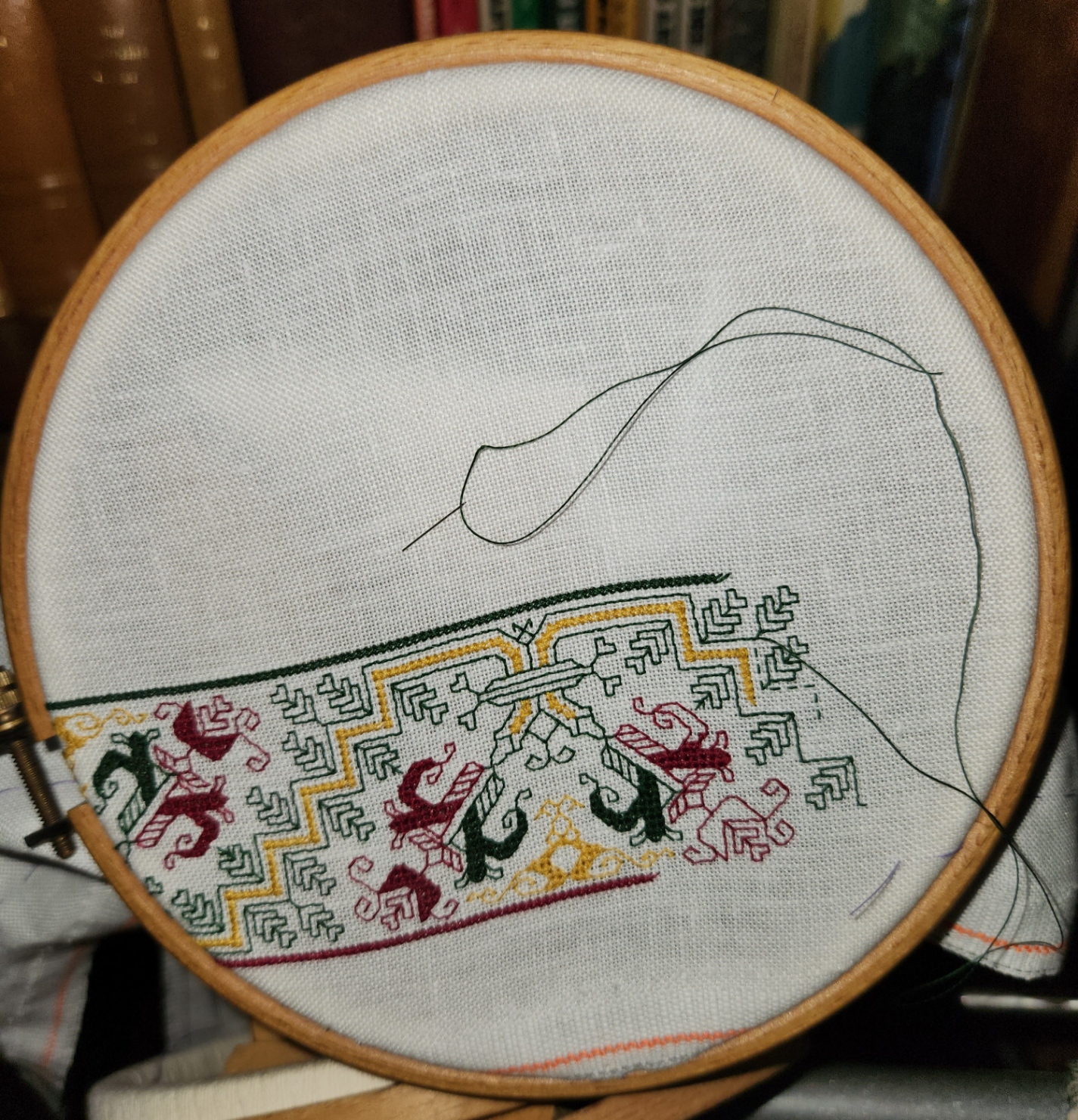
Here’s the back:

Montenegrin is working well. There are just a couple of bald spots where I lost track, mostly in angle changes. I blame resuming the habit of watching TV while I’m stitching. Occasionally I get caught up in the action, and miss a turn. Then don’t realize it until I am long past. Had I still been reverse-side-display focused, I would have done more diligent checking, and would have ripped back and redone the less than perfect bits.
Meshy on the other hand… Ouch.
The two-sided Italian cross stitch works best over large areas, like backgrounds in voided style pieces. It isn’t as cooperative when its playgrounds are small, as they are in these flower parts. It’s like working nothing but the bits where voided stitching bumps up against a foreground line, with no respite. Working these small parts I never quite get the rhythm – it’s all compensation stitches, with very little chance to display the openwork texture. That also means that coverage on the back gets slighted as working direction changes to adapt to the shape of the field being filled. Add to that the tension limitations of the cotton floss (more fragile than silk, believe it or not), and in spite of cotton’s fluffier nature, we have lots of bald spots on the back. Far from optimal for double sided display.
Finally then there’s my own general laziness. I’ve made a couple of mistakes that I’ve had to pick out. But instead of picking out large areas, I’ve mostly opted to pick out just the “broken” bits, tying off loose ends, or fastening them with overstitching on the back. Most of the fat or knotty looking spots above are from fixing mistakes. Sometimes the errors encroached on Meshy sections, and those are notoriously difficult to frog. Sometimes I ripped out small segments and replaced them because I didn’t feel like re-creating the large, accurate sections they were in, just to get at a couple of errant stitches.
So my back is a relative shambles. I will of course continue on, focusing on the front. But especially for those of you who tell me that my pieces are inhumanly perfect, please know that you usually only see the after photo, and lots of corrections and creative editing went into making the project look like that.
My Italian Fall
No international or domestic tumbles involved. Only, just like that, my fall project begins.
Yes, I am sticking with a project inspired by the big Italian towel/cover in my last post. I’m working it on a much smaller piece – a quotation rather than a full reproduction. I’m using the 19 x 27 inch (48.26 x 68.58 cm) piece of 40-count linen I mentioned earlier. That’s obviously less than the 381.89 x 582.68 inches (970 x 1480 cm) of the original. It’s very hard to make out the stitch or thread count of the original, but it does look like (most of the time) stitches happen over 4 threads. I couldn’t get close enough to get a dimensioned or scale-related photo of a strip, but I can say that I am working over 2×2 threads, and my individual motifs are smaller than on the original.

Although the size makes it a hint at the original, the design snippet I use will be a “larger” representation of the whole than it would have been if I had hit the stitch size of the original. More stitches per inch may make my pattern rendition smaller north/south and east/west, and will allow me to fit more repeats on my smaller cloth. Still nowhere near the repeat scale of the museum piece, though.
Now on to the stitches. I am using Montenegrin for the solid lines of green, red, and yellow. The Amy Mitten booklet Autopsy of the Montenegrin Stitch, Exhumed is invaluable for guidance on the various directional angles and corners needed. I used it before while stitching my long green sampler. It was what got me through the maze of this design:

I chose the squared back version of Montenegrin for the band above, but Mitten presents two versions, and I am using the other with a solid strip back for this one. Mostly for variety, and to see how the two compare.
Another stitch I used on Long Green is also present on this one. I call it “Meshy” but it’s official name is two-sided Italian cross stitch. I am using it for the solid infilling on the flower-like parts. Although it’s not called out in the MFA description, the closeup photos I took clearly show the mesh structure of the stitch, when it is pulled extremely tightly. Because of silk’s tensile strength, it works especially well for this stitch. You can see that mesh at large scale, with all ground threads bundled (none cut), completely covered by the silk in the Meshy part of my long, green sampler:
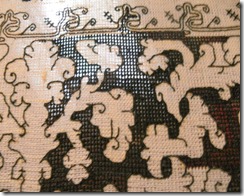
However, for this piece I’ve chosen DMC cotton floss – one strand. I wanted to work from stash, and to guarantee washability. In retrospect silk might have been a much better choice, allowing greater delicacy over all and a better defined mesh; but it’s pricey, and would be a new purchase. I’m putting off buying imports until a sane US international trade policy manifests.
Cotton doesn’t have the oomph of silk. Yanking on it to maximize the mesh effect can lead to breakage, and its bulk makes the filling more bead-like than lacy, especially in the narrow spaces of this design. Still, it’s not that far from the original, and if I’m careful I can teeter on the edge of destruction without actually shredding the thread. And working the narrow petal shapes in this stitch is proving out to be its own challenge. It shows and works much better in larger, open spaces.
I had toyed with making this truly two-sided. Meshy is two-sided, and the Montinegrin variant I picked has a not-exactly-the-same but close-enough reverse. And double running can be two sided. But I’ve already made enough mistakes and corrected them without pulling everything out (very hard to do with Meshy) that the back is compromised. I will settle for MOSTLY double-sided on this one.
Obviously there’s a ton more to do on this cloth.

I may move it to my largest Millennium scrolling frame. It’s just a hair too wide in its short side dimension (bottom in the photo) to fit on my next-to-largest one. But to do that since I have measured and placed my beginning to maximize the stitched field, I will need to add waste cloth or wide twill tape around the top and bottom. I need to add “real estate” for the scrolling rods to bite. And depending on how much tension I can achieve in the east west direction using my shortest set of extenders, I may want to add some twill to the long edges to accommodate lacing, too. But for now I’ll continue with the hoop. Working with it is much slower, but it is more portable, and I wander around the house quite a bit now as I stitch, to take advantage of changes in sitting venue.
Stay tuned, there will be LOTS more progress reports on this one. I hope they won’t be too boring. The pattern will remain mostly the same throughout the piece, but I do have several challenges coming up. For example, how to handle corners, and how to divide the framed plain linen center using double or single widths of the design. And if I do so, graphing out the supplemental edging sprigs, and how to place and space them.
On the health front, all continues well. Preventive radiation continues. No side effects ill or beneficial so far, although the superpower of magnified vision would come in handy. Mobility, sitting stamina, and general energy levels are increasing. I can make it around the house without a cane now, and only use it for going outside, or up and down the stairs. I’m a lot slower than I used to be, but even slowly, I can now get there. All is good.
AHA!
I’ve finally figured out what to stitch!
Two years ago Friend Merlyn and I went to the Boston Museum of Fine Arts, and saw an exhibit that featured (among other things) this Italian masterwork.
It’s described as a towel done in Punto Scritto and Punto a Spina Pesce MFA Accession 83.242, Italian, 16th century, silks on linen. In terms of size, this piece is big enough to be a table spread to seat eight, much bigger than anything I’d think of as a bath towel.
These stitch terms are used in MFA descriptions, but not many other places, and probably haven’t been updated since the initial acquisition and accession in 1883. Punto Scritto is clearly double running stitch. Punto a Spina Pesce (as far as I can figure) appears to be what we would call a form of long armed cross stitch (LACS) because the stitches that form each adjacent unit employ the same insertion/emergence spots, although modern stitches using that Italian name appear to spread the entry/exit points out, like herringbone stitch. I also note that the directionality of the individual stitch units as it rounds corners makes me think that execution was most like the Montenegrin stitch variant of LACS (more on this below).
I shared several photos of this at the time of our visit. And I put it on my list for redaction. Well, now is that time. I’m going to chart this one up, and then use the designs on a MUCH smaller cloth of my own. And as I look closer at this one, I think I will try to use a similar range of colors (but in cotton for washability), and the stitches I think look the closest to those of the original. At least on the front. I don’t see any photos of the back on the museum page in order to make totally accurate identifications, and am not impelled to write to request any. One thing I did note is that for the solid filled areas, the tightly pulled two-sided cross stitch variant I call Meshy was used. That isn’t credited on the museum page.
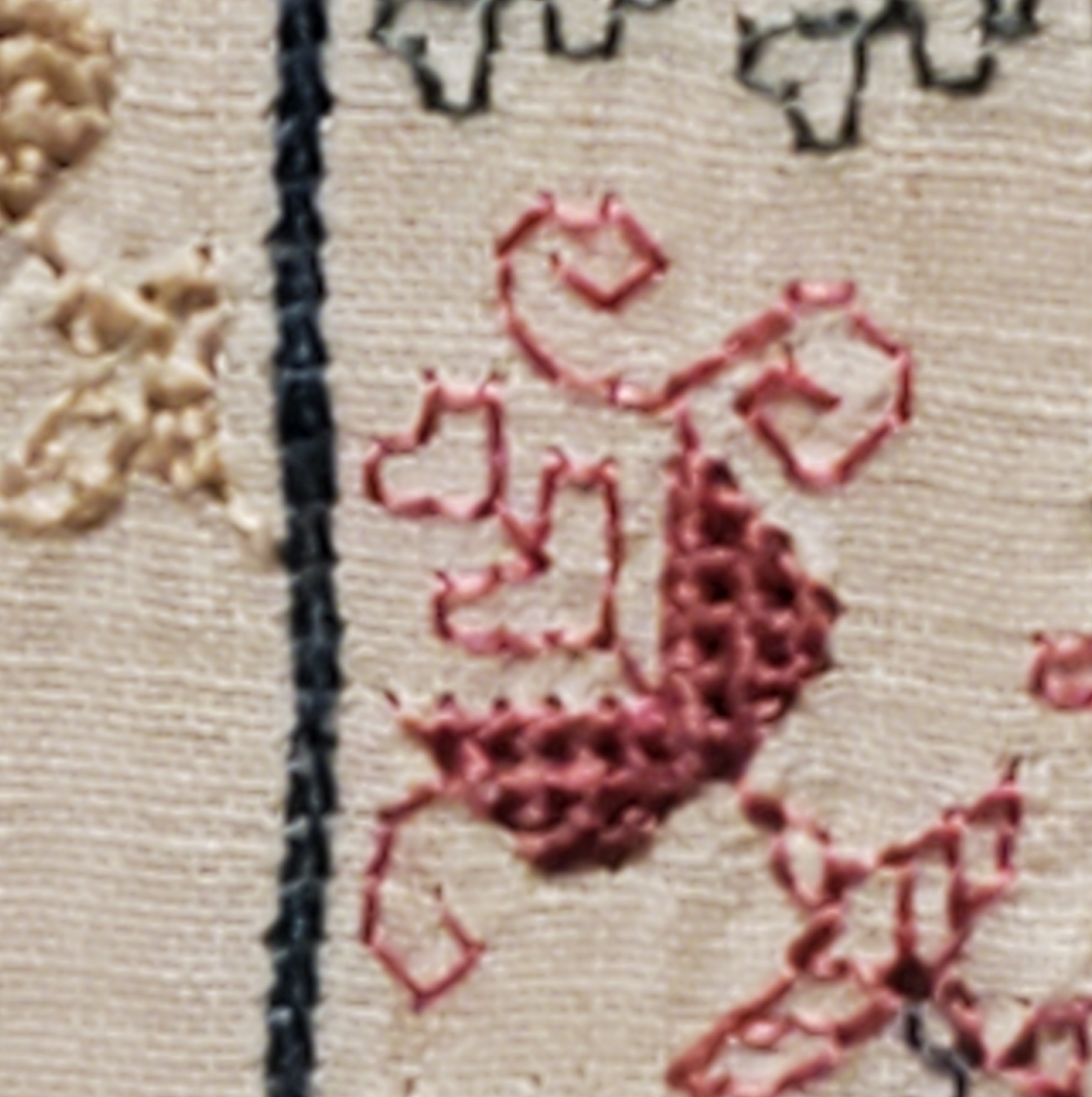

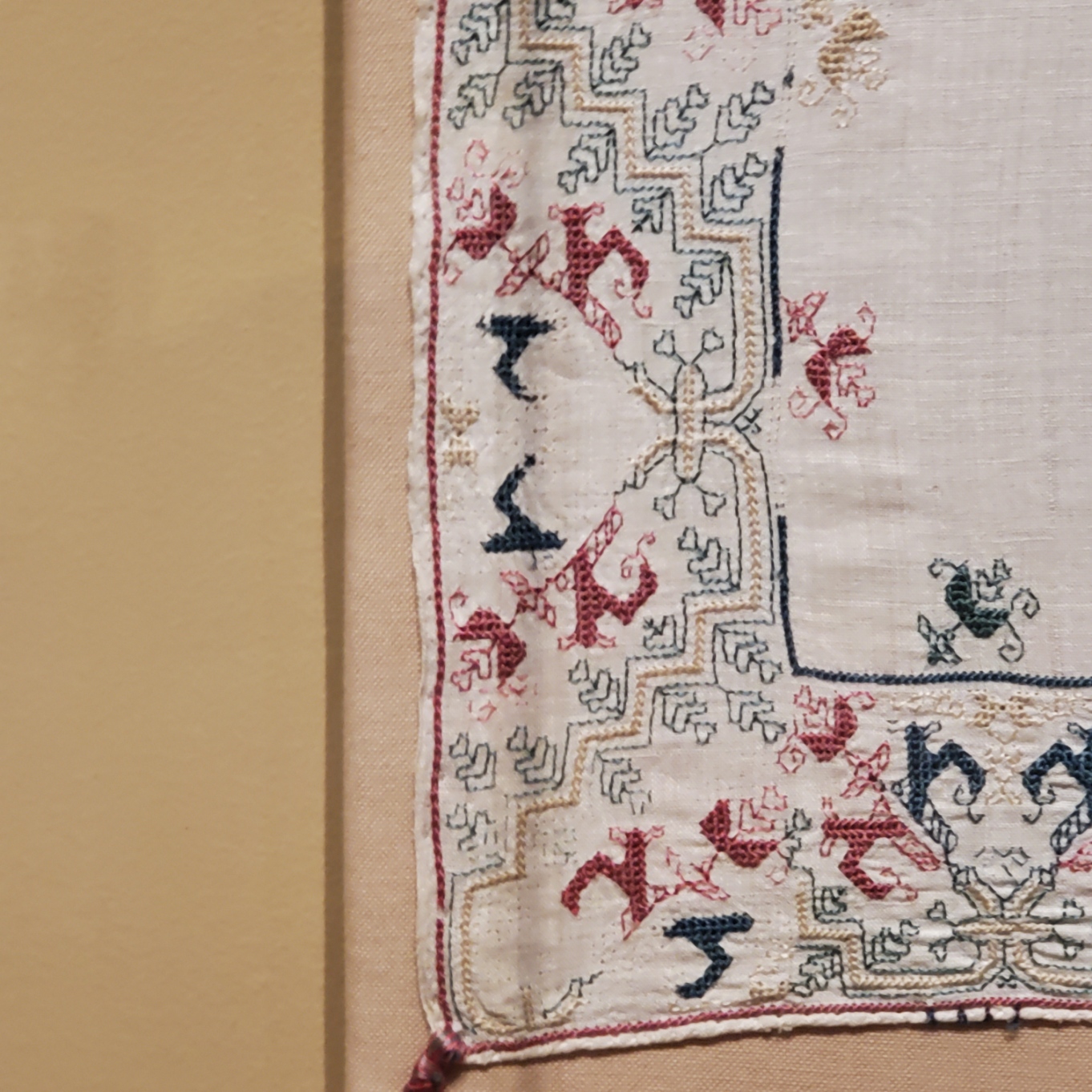
Another thing my close-ups show is that the piece was stitched over squares of four by four threads. There appear to be quite a few mis-hits and subsequent corrections where four by three or three by three threads were covered. This seems to pop up mostly in the curly bits that spring off the lily like flowers. I don’t know the actual count of the ground, and obviously couldn’t get up close enough to take a dimensioned photo, but I think that 2×2 on my 40 count linen will look close to the scale of the original.
Given that the Meshy and double running stitch bits can be done truly double sided, I have to think further on the use of something in the LACS family that is presentable on both sides. I’ll probably settle on Montenegrin. Both front and back of that are presentable, although the front does feature an additional vertical bar. It’s hard to make out on the photos, but some of the solid lines, especially the dark green ones that run the length and width of the piece do seem to sport a bar in places. But the deep yellow bits that run inside the motifs, don’t. Maybe the stitcher, noting the difference between the appearance of the two sides of the stitch chose to use the more open “reverse” on the front for the yellow bits, and what we consider the front of the stitch’s more solid effect for the framing lines. Fortunately, I have both practice with the stitch plus Amy Mitten’s excellent flip book on executing Montenegrin, covering all possible directional angles, so the transitions in this design will be easy, even upside down.
Now off to chart, and once the main motifs are captured, figure out how to compose them into a viable “small snapshot” piece on my 19 x 27 inch (48.26 x 68.58 cm) cut of linen.
CONTINUING EXPERIMENTS
The Grand Experiment of splitting the individual plies of my vintage six-ply Pearsall’s silk floss into component strands continues. So far it has worked out. I’ve only lost one of the separated strands, and that was to it catching on something after I had unwound it, but before I restored some twist by finger spinning, and a very light application of beeswax to set the new spin.
I’m liking the look of the separated strands. Very much a historical look, with the long staple fibers being shown to advantage, and the occasional thick-thin variance of the finger-spun strands. Note that in the photo below in the salmon thread you can see the kink set by the original spinning, but that the kinky texture is not evident at all in the stitched diamond filling. A win.
Too bad the Pearsall’s is such a discontinued unicorn. I don’t think I could do this with Au Ver a Soie’s Soie D’Alger. The staple isn’t as long, and the twist is both different and tighter.
One thing I did to eke out my colors was to work with two at the same time, alternating color stitches on the baselines, and working sprigs and inner ornaments in one color or the other. I hadn’t tried this parlor trick before.

You can see at the bottom of the motto rectangle that I hop-scotched the two colors – working one a bit along, then filling in the other. There are also TWO baselines in this strip due to the use of two colors. One handles the edge along the diamond infilling, plus the alternating squares-and-diagonals inside the border strip, and the other handles the top line and alternating sprigs. That’s because logic prevents doing the top and bottom edge PLUS the sprigs in two colors off of one baseline. In alternating colors you have to keep going forward along a line unless you want it to be solidly one color or the other. I could do the single color wreath sprigs easily, but those three stitches between them (or between the bottom legs of the squared diagonal boxes) would also have to be a single color because they would require doubling back to fill. Therefore, two baselines. Not a problem, and pretty easy to parse for quick stitching, once I realized the problem and stopped stitching myself into cul de sacs.
Except for the dark outlines of the letters, all of the stitching so far has been done with the split strand Pearsall’s. And I intend to continue working that way for the rest of the project, because of the look, my need to stretch my very limited quantities, and the challenge of doing something new and unexpected.
The next design will be one I’ve done quite recently, but worked up a bit differently. I did this Tolkein-sketch-inspired strip on the sampler I did in tribute to the Resident Male’s novel Treyavir. I worked the outlines in navy blue, and then went back and filled in selected areas of the design with squared filling, in a deep gold-tone yellow.

This time I’ve added a corner (very easy to do because of the clear diagonal elements). I’m plotting out a way to do it in multicolor because I don’t really have enough of any one (or two) colors to ensure that I can stitch the entire thing all the way around as a full frame. And I certainly don’t have enough of any one color to do a fill treatment as I did before. Doing multicolor will be problematic because of the design itself, too. The long diagonals “cap” the petal like elements. Possibilities include:
- Skipping over the end cap petal stitches and using a separate color for the top and bottom lines, and to work any stitches between petal caps on the diagonal. All petal elements will be entire, with no truncated end caps.
- Dividing my colors into two groups – possibly cool (blues, greens, purples) and warms (oranges, salmons, tan – no true reds in the pile to speak of). Working triangles in one direction in cools, in succession, alternating with warms, BUT letting the cool color triangle edges dominate, letting the warmer colors recede.
- Working the top and bottom baselines and hard diagonals in the same color throughout (possibly two very close shades of the same color, alternating stitches), then filling in the rest of the triangle patterning in alternating warm and cool colors. All cap stitches will be done in the outline colors.
- Some variant of 1, 2 or 3, with the smaller center triangles being worked in a different tone or possibly even the opposite color group from the larger, outer triangles.
Now to finish off the salmon diamond fill behind the letters, plus the remaining bits of the wreath sprig two-tone edging on that box. Then on to the outer frame.
Also, I will write more on two-tone double running history in the next post (with special acknowledgement to the ever generous Melinda Sherbring who shared copious notes and examples with me) – but I can only sit for so long at a time, and that’s an entire saga all on its own.
AND SO WE BEGIN AGAIN…
Never will I be someone who has a long hiatus between projects. Aside from the fact that I always have several concurrent ones, the final phases of any project are usually fueled by advance planning for the next one.
As I mentioned in the last post, I was prepping the ground for RELENTLESS FORWARD PROGRESS, the piece I am doing as a thank-you for the therapy and nursing staff at Vanderbilt Rehab/Newport Hospital. I’ve finished the truing, decided on a size, hemmed all the way around, and basted my centers and edge borders. I also completed the atypical (for me) task of plotting out 90% of the chart for the entire piece, and started in on the stitching:

I did the extreme layout because I wanted to center the motto properly, inside a surround that used as little fudging as possible. This meant working up corners, and making sure the repeat count was congruent with my usage, and with the available space. Oh, and the lettering. I didn’t find a vintage alphabet with the right flavor, so I decided to make the piece rather abstract, with a quasi-futuristic typeface, instead. I went looking for Just The Right Thing, and didn’t find it among charted alphabets, either. So I drafted up my own. Taking four or five different vaguely science-fiction-movie style typefaces, I rammed them together and drew up my own outline-only interpretation. Before you ask, I don’t have the whole alphabet – only the letters I needed for the motto. But except for an H and I, I have all of the top ten letters from the frequency table, and those two are easy extrapolations.
As the photo above shows, I’ve matched up the center of my chart with the center of my cloth, and started in on the stitching. If you look reaaalllly closely you will see the pink basting threads marking my center lines. And even just starting out I am loving the Pearsall’s. Smooth, sleek, easy to stitch – a dream to work with.
My intent is to do a narrow inner frame around the lettering. Inside that frame I will do very open voiding, possibly just diamonds in a complementary but lighter color. I might experiment with the Pearsall’s 6 ply floss. Each of the separable standard plies is clearly made up of two constituent strands. The silk itself is quite long staple and very strong. I may try to separate a standard ply and work those background diamonds with just one of those strands – what is in effect a half-ply of silk. That would stretch my limited supply, and keep the lettering in front as prominent as possible. Stay tuned for that experiment. I’m not there yet, and have to finish the motto first.
As for my continuing rehab from surgery – I am still improving. Every day a bit stronger and more capable. I can walk further, sit longer, and do far more things on my own than I could in May when I came home. At the end of this month I will start a program of Proton Beam Radiation aimed at eliminating any last possible but otherwise undetectable cancer precursor cells; to knock the chance of recolonization way down. It will run through October and be a daily appointment, Monday through Friday. An inconvenience for sure, but anything that tips the odds even more in my favor is most welcome. In the mean time, my job is to get as strong and as fit as possible prior to radiation commencement. I am taking that job VERY seriously.
JOYOUS ENDING
I’ve finished the latest piece – the sampler in tribute to the Resident Male’s nascent book Forlorn Toys. He is still writing it, so I won’t give spoilers beyond what I have already cited: the motto, the very obvious panel of aforesaid toys, my attempt at spaceships, and the band with the curious feathery rabbit like creatures.

All in all, I am quite pleased with it. Joy now goes to join my Wall of Shame – the place where my completed but as yet unframed/not-ready-for-public-display pieces live side by side with my unfinished projects. As you know this one like so many others is stitched on reclaimed household linen. I did not notice a bleach-weakened bit along a patch of the edging at the lower left. When that was hooped over and tension applied, the neatly done hem stitching failed, leaving a hole. I will eventually mend that, but other priorities assert themselves.
First among those priorities is a piece I promised to the community of therapists and nurses that tended to me at Vanderbilt Rehab Center at Newport Hospital. It’s fueled by a gift of silk floss from Occupational Therapist Abbey. She admired the work I brought with me intending to stitch. She had an inherited stash of silk threads but no use for it, and asked if I would like it. Always happy to have such things, I agreed, and she sent me a wonderous assortment of Pearsall’s silk floss – long discontinued – in jewel tones.

A princely gift, indeed. And only fitting that I use it for a gift back to the caregivers who got me back on my feet and moving again.
I’ve selected a tinted linen to use as ground for this one. I am not sure who gave me this because I didn’t put a note into the package (possibly my spawn, so apologies if it was). It’s custom dyed Zwiegart 36 count linen (big as logs for me), from Hollis Hands Create – a frosty barely blue tint called Silver Moon.
The first step is to begin the design of the motto. In this case “RELENTLESS FORWARD PROGRESS,” furnished by the Vanderbilt Physical Therapy team. Done. And then to begin thinking about how the rest of the piece will be worked. Not a band sampler this time, it will be a “framed” piece, with one or more bands of design running around all four sides of the motto, complete with corners and any improvisations to make the bands’ designs work out correctly with minimal fudging. Therefore I will be doing a some on-screen work to prepare for this one. More than I would have needed had this been a simple band sampler. For example, those corners will have to be drafted out even if I chose band designs I’ve previously devised. And I will have to plan to use multiple colors effectively because while there are many hues in my bag of silks, there are no duplicates, and most of the skeins are partials. It will be fun to figure out how best to use my limited quantity treasures.
And then there’s selecting a size for the piece and preparing my ground. For that the first bit is to true the edges of the linen cut. To do that I find and pull the warp or weft thread at the narrowest point of the cut, withdrawing it entirely from narrow end across to the widest end. This gives me a clean line along which to cut, and ensures that my edges are parallel. On this piece of ground with one selvedge edge, you can see that the left and right sides perpendicular to the selvedge each are slightly skew, one by about an inch, and the other by about 3/4 of an inch.
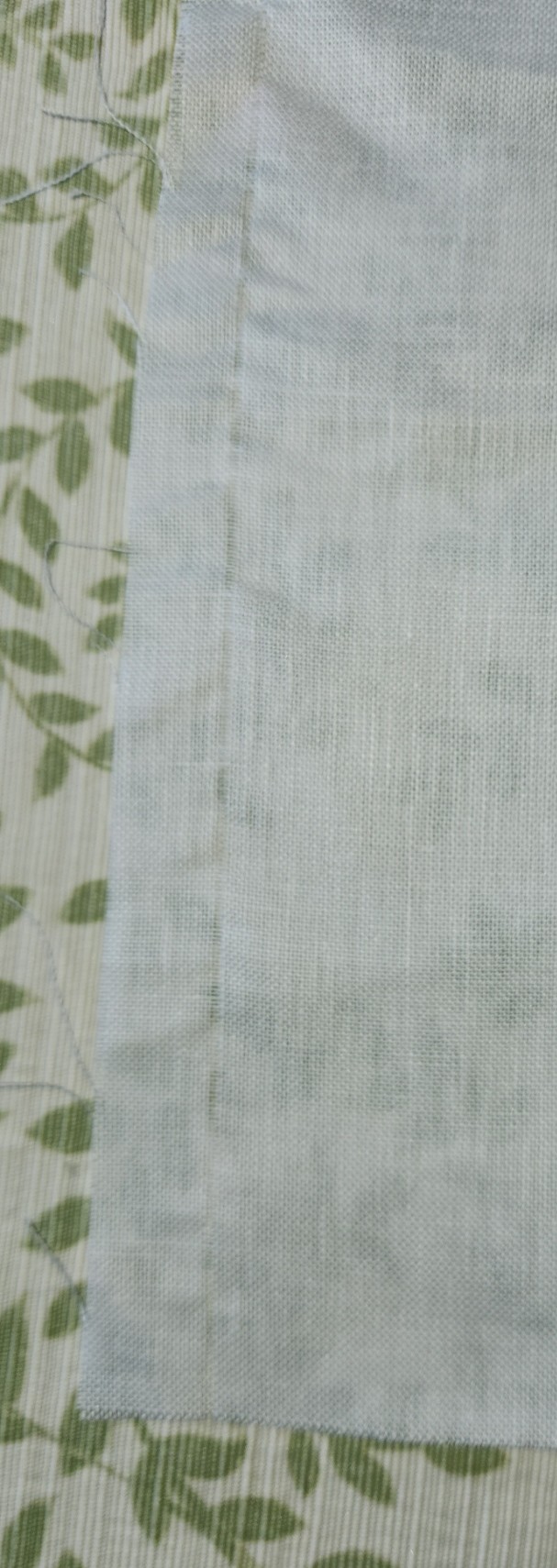
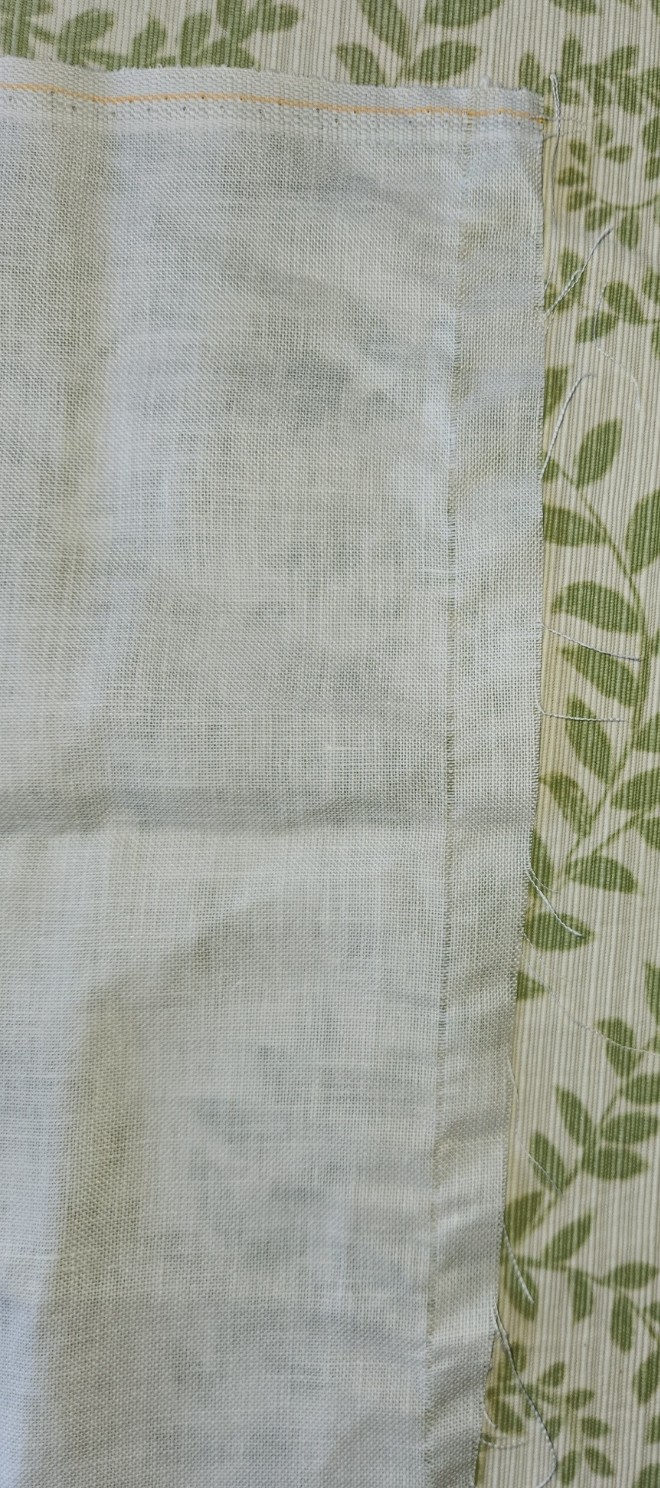
Note that regardless of the retail source, or whether or not the edges are serged or otherwise finished, if I buy a cross bolt full width cut or a fat quarter I always inspect the edges and true them in this manner. I have yet to receive any cut that was done completely congruent with weave direction. Sometimes the deviation is minimal, and there is only an inch or so lost all the way around. Sometimes, especially with lower price precuts sold in big box crafts stores, up to four inches can be wasted all the way around
This is why if you purchase pre-cut yardage, even if you have added on extra width to allow for easy hoop use and framing, it doesn’t hurt to add an additional inch or two all the way around. You never know when you will get a cut so skew that after the cloth is trued parallel to the weave, the cloth ends up being much smaller than you thought you were buying. Charles Craft prepackaged cotton and cotton blend evenweave was notorious for skew cuts. Their products started me doing this “proofing” step, and I have not regretted it since.
I won’t be using this entire fat quarter on this project. I will measure my ground cloth piece after it’s cut and the left and right edges are hemmed. I’ll decide then on the orientation of my sampler, cut my ground accordingly (also on a pulled thread line), and hem that last edge. The remaining bit will be returned to stash. And I will get a start on selecting my framing pattern(s) and drafting up my new corners.
On the non-computer work side, while the design work is going on but after I get my piece of cloth sized and hemmed, I will baste in guidelines: centers and stitching area edges. The final count of the available stitching real estate between the area edge marks will help inform final design tweaks.
I don’t think of all this pre-work as being very complex or onerous. The physical prep is mostly mindless and gives me plenty of headspace for the rest of the planning.
Now off to select my patterns… I toyed with using icons representing progress from sitting to walking, but I decided that was too limiting. The rehab therapies offered go far beyond simple sit to stand to walk, and I wanted the piece to be as inclusive (or non-specific) as possible. And the logos for the various institutions and professional certifications involved are too fussy to be easily charted at my scale. So it’s a mix of florals, geometrics, and possibly a pet or mythical beast or two thrown in. After all, who doesn’t identify with dragons or kittens?
PLAYING WITH TOYS
As I mentioned before, there’s no point in honoring a book called Forlorn Toys without showing some of the toys. So I drafted up a representative sample.

I’m still filling in the background stars, but that should not take long. Then another plain band of long armed cross stitch, and selecting the first of what will probably be the last two strips on this piece. The final touch will be to revisit the motto section, adding themed elements left and right of the lettering, and perhaps jazzing up JOY a bit so that it doesn’t look so pitiful against the darker typeface used for the rest of the lettering.
As to the remaining strips – I’m actually running out of material. I either have to spend more time drawing, or stitch slower. But in the interim I have decided that designs used on pieces I have given away, never to be seen again are now fair game for repetition. So if you see something that piques a sense of deja vu, you are exactly correct. Done before, but not precisely in this way. An old friend returning for a repeat visit.
After this one on to the next. No clue yet as to what that might be. I have a couple of outstanding promises in queue. Possibly one of those. And those teddy bears… I may doodle up a couple of strip variations featuring just them, for folk who want to do up birth commemoration samplers, or bibs and toddler clothing trims for particularly favored children. Provided there is interest, of course.
 String-Or-Nothing