ONE FOOT IN FRONT OF ANOTHER
Just because things are a bit in the air here at String Central right now, doesn’t mean that our dedication to Relentless Forward Progress has been put aside. There are things to do, things to make, and accomplishments waiting to be notched and acknowledged.
First, we did have a wonderful weekend of low key celebration here. The Resident Male (and Executive Chef) outdid himself. He did homemade gravlax (the Jacques Pepin overnight cure version); grilled boneless lamb with garlic and rosemary; and roasted cauliflower and red onions. I pulled my weight by baking four small chocolate pound cakes, one of which we split for dessert, stowing the other three in the freezer for future treats. But I have promised to detail my adventures in low carb baking, so I will elaborate here a bit.
Low Carb Chocolate Pound Cake
I started with this recipe – Keto Chocolate Pound Cake, from the All Day I Dream About Food blog site. The thing was pretty straightforward if you happen to have the ingredients in the house, which we did. Note that this recipe uses almond flour, monkfruit-based brown sugar substitute, butter, baking powder, eggs and sour cream in addition to the items mentioned below in my summary of deviations.
First change, instead of one standard size loaf pan, I used this one – a four mini-loaf thing I got years ago when I was a regular contributor to school-based fundraising bake sales. It takes a standard size loaf cake recipe and turns it into four more saleable and storage friendly smaller units.
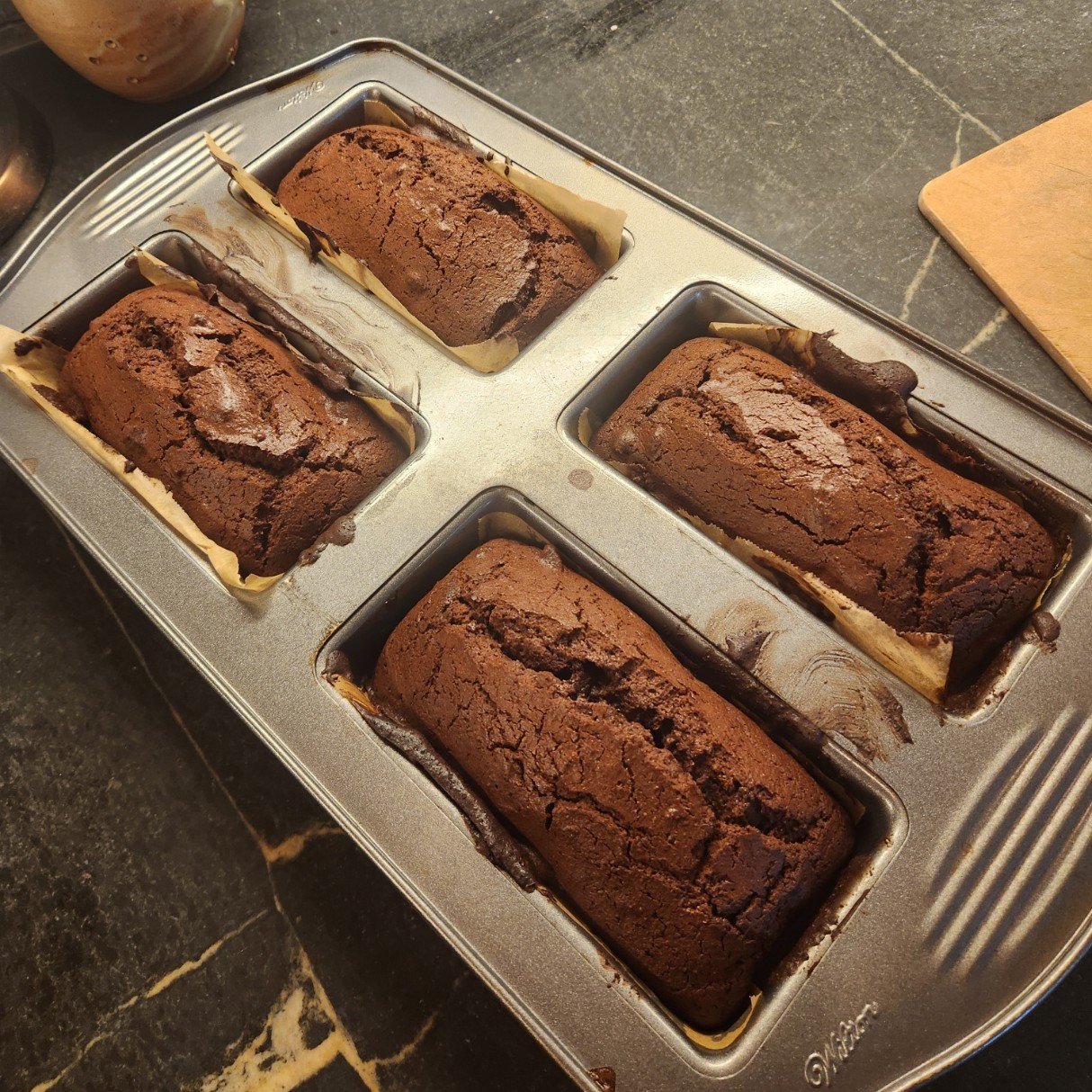
I am pretty sure I found this pan in a yard sale, but I do see them sold in cooking supply and on line sources. And yes, I buttered each little loaf hole and lined it with a piece of buttered baking parchment to make removal easier. From prior experience I know that this pan in my convection oven bakes faster than a full depth loaf pan. To compensate I did my bake at the recommended temperature, but only for 50 minutes – not the 60 to 75 cited in the recipe. I tested the cake with a skewer for doneness.
Second, and this is a personal preference – I detest coffee flavor in my chocolate. The recipe calls for two kinds of cocoa – regular and “black”, chocolate flavor whey protein powder, plus espresso powder and a quarter cup of room temperature, strong coffee. We had the whey powder on hand, no problem. I used just one kind of cocoa, combining the specified quantities for both together – a Dutch Process, known for its deeper/stronger chocolate flavor, and the only one on my pantry shelf right now. I skipped the espresso powder, and in place of the coffee (clearly needed to hydrate the rather thick batter) I used the same quantity of very strongly brewed unsweetened black Assam tea, also cooled to room temperature.
Third, I tossed two large handfuls of coarsely chopped toasted pecans into the batter before spooning it into the pan.
Fourth, I omitted the chocolate ganache glaze entirely. I knew I would be freezing the three extra cakes, and I know from experience that ganache can get chalky when that happens. Given that the four little loafs were moist and tender, and we would be eating one right away, I didn’t see the need. I can always whip up a little bit of glaze when we defrost a survivor if I think the extra moisture is needed.
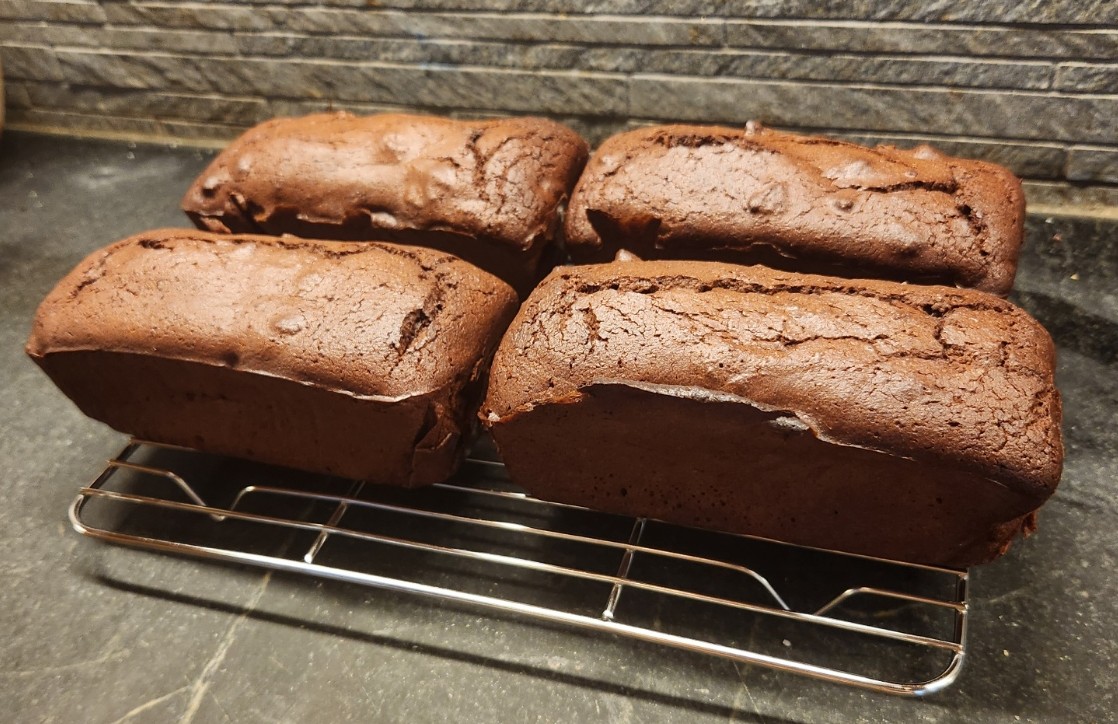
Here is the end result. A definite do-again. Moist, dense without being heavy, with a deep cocoa flavor. The toasted pecan bits were a welcome addition for both flavor and texture. Each little cake makes two very generous portions. Perhaps next time I will also add a handful of zero-sugar chocolate chips. But that would be truly decadent. Based on this result as opposed to many truly dismal Keto baking experiences I have had, I may explore the site of origin to see what else is up there.
Booties
I had a special request to knit some booties for a the sister of a friend of a family member – the first of that particular friend circle to have a baby. My favorite bootie pattern is a quick knit. I can do a pair in about four hours, so why not.
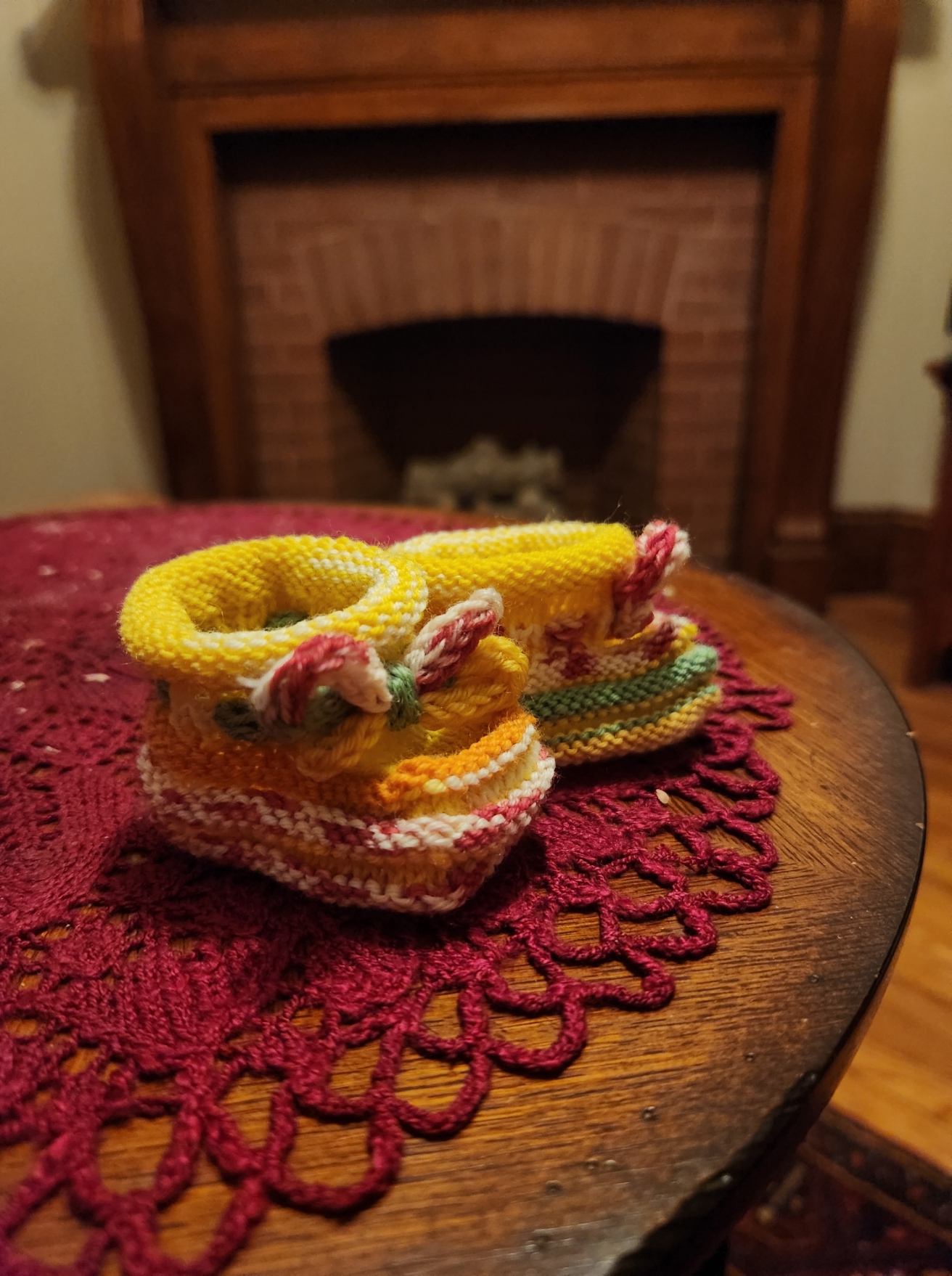
These are from the same pattern I used easily thirty times over a few decades to make items for my own spawn, plus baby gifts for friends, family, and co-workers. The original pattern was posted by Ann Kreckel in 1995, to the ancient email based KnitList mailing list back in the days when the Internet was still climbing out of primordial seas. It can still be found via the Internet Archive’s Wayback Machine utility – Click here to retrieve it.
In the past I’ve posted a mini-tutorial on making these, and invented and shared a hat to match.
Reading over the instructions it occurs to me that even with my mini-tutorial many knitters today might have a problem following the pattern as Ann originally shared it. Not that there are mistakes, but I do note that the level of comfort with written instructions in the general knitting community has declined sharply in the video era; and the terms and logic of the thing might challenge a newer knitter. I think I could make the pattern more accessible with a simple re-write and merge with my mini-tutorial. But it’s not my design, so I am not comfortable just doing so.
I have tried tracking down Ann to ask about updating and hosting her pattern as a free offering, but so far I haven’t gotten a response. If any of the old KnitList gang reads this and knows how to find her, please pass along my sincere wishes for happiness and health, and my request for pattern editing and republication permission.
Socks
Hating to just sit there, no matter where I am, over the past two weeks at home, waiting in doctors’ offices, and after my last procedure I kept busy knitting a pair of socks. They are going to be a present for someone who went above and beyond during a regional emergency – not to aid me, but to help someone near and dear. I won’t spill the beans because there is a remote chance that they might see this post. But I did do a whole pair, start to finish, and will be casting on for another before the coming hospital sojourn. Sanity before all other things, and keeping busy keeps me sane.
Stitching – Playing with Faux Buratto
Another bit of sanity-preservation. I wanted a stitching project to bring with me, too. Something small, easy to see, and easy both to follow and to stitch. Something I can slap in a small hoop and support with minimal kit. Yet something that holds interest, and would be enough of a challenge to tempt me to curious activity. I have teased this on Facebook, but here is the full story.
A while back I -lucked into a curious bit of textile. A sieving/bundling cloth used in traditional Korean kitchens as part of food preparation. HMart had it on a rack in the housewares section, and I noticed the weave immediately. I did a blog post on the discovery a while back,
I want to try out a few designs on this cloth. The first step of course was to establish a normed edge. Like most textiles the retail cut rarely aligns with the weave structure, so I basted the largest possible rectangle I could, and added guidelines for vertical and horizontal centers. Then I just started in on an outline. I’m keying off the use of deep red and yellow-gold in a couple of museum artifacts. I’m going to try out establishing my outline for this strip and then do one of several possible fill methods. This style is later 1500s into the 1600s. Then I will try one of the monochrome type designs. from the earlier half of the 1500s. After that probably another multicolor but using a different scale and fill style. It’s a small cloth and there isn’t room for a ton of strips on it, but I will use the available real estate to best advantage, picking on the fly as I usually do.
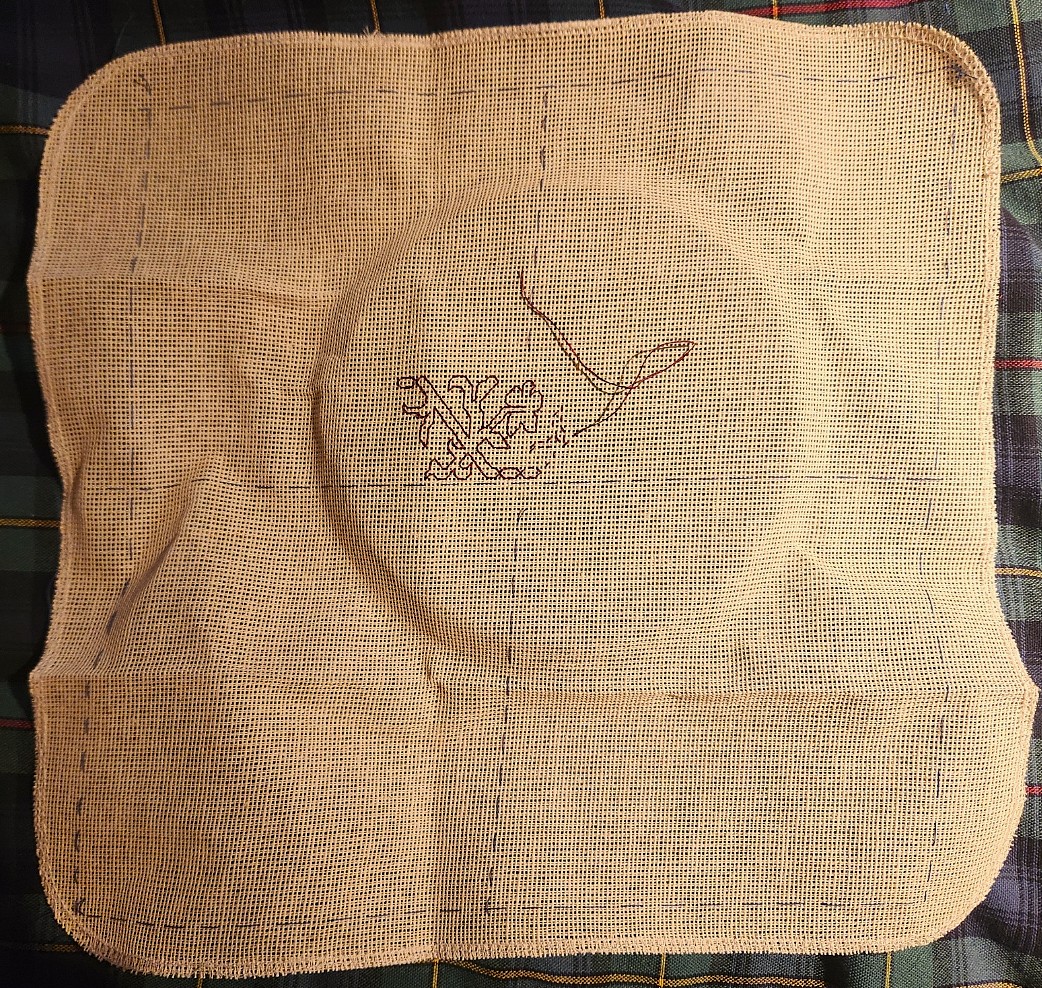
What you see here so far is simple uncounted basting in blue, marking out margins and centers. Those skew cut edges and the amount of area wasted does annoy me a bit, but this piece of cloth was never intended for the purpose to which I am putting it. Just above the center line you can see my start – double running in crimson faux silk (rayon). The design is already 100% established and from this point I can go left and right “off book” just by copying what I’ve already laid down. And I will have T2CM with me, electronically, just in case.
General Health Status Update
Yes, I know I alarmed a lot of you yesterday, for which I deeply apologize. But obfuscation has never been my strong suit. To clarify at this moment, aside from the facial numbness that triggered the hunt for the Danger Lentil, I feel pretty good. I have bounced back from the prior biopsy with no ill effects. I am back to my regular exercise routine. I am pretty much day-to-day advancing the new normal as I have been for many months now. Stamina is excellent, and I have no problems sleeping or eating. I have no headaches, nor blurred vision, auditory or balance problems. In general given my past year’s journey I am in excellent health.
I have every confidence that the team will figure out what’s going on, and that a treatment plan will be devised AND that I will weather that, too. So I do thank you for your words of support and comfort. I have both battle fury and the strength to put it to best employ. Know I keep all of you in my thoughts, and I do appreciate that you are thinking of me, too.
ANNIVERSARIES, CHALLENGES, AND PERSISTENCE
For those who have followed me for a while, you may remember that a year ago this week past I was hospitalized for major cancer surgery: the removal of a chordoma – a rare type of spinal tumor and the bone it compromised in my sacral area, and the implantation of a system of internal braces to carry my weight and enable movement. Over the past year I’ve clawed my way back to a new normalcy, relearning how to stand, walk and sit, and edging back into full independence. My radiation was completed back around Halloween, and I rang the traditional bell at the last session.
These things are always asymptotic, but I am proud of how far I’ve come considering where I was on 20 March 2025. I only rely on a cane as safety insurance for long distance walking over rough terrain or inclines. I need no aid indoors, and can go up and down stairs at whim. I can drive a car, sit long enough for air, automotive, or train travel; and at need have even climbed a ladder. And I was under evaluation for the reversal of plumbing modifications that needed to be made to access the affected area.
We are celebrating my Liberation Day and eviction of my invader this weekend, with a bit of extra spoiling, special dinners, and general good cheer.
But I am afraid that I have to reclassify myself again. I have to move back from Cancer Survivor status to that of Cancer Patient.
Between investigation of a bit of unusual jaw/cheek numbness and the full scans required as part of the great plumbing restoration project we have discovered that I have a small anomalous mass sitting on a major facial nerve just behind my right eye. I’ve nicknamed this one The Danger Lentil, and we are proceeding at full speed to classify it and formulate a treatment plan.
A week ago Friday I had a needle biopsy – an extremely small hole drilled above my ear and a probe inserted to retrieve suspect material for analysis. Unfortunately the test was inconclusive, so later this coming week I go in for what’s called an open biopsy – a larger hole that allows eyes-on observation and larger tools for sample extraction. Needless to say, the plumbing project is now on indefinite hold, so as not to insult both ends of the organism at the same time.
As to my mindset – I am just as determined as I was before, if not more so. I refuse to be defined by what I can no longer do. My bombastic statement of record is “I am a shieldmaiden of the East. I do not bow to infirmity or pain.”
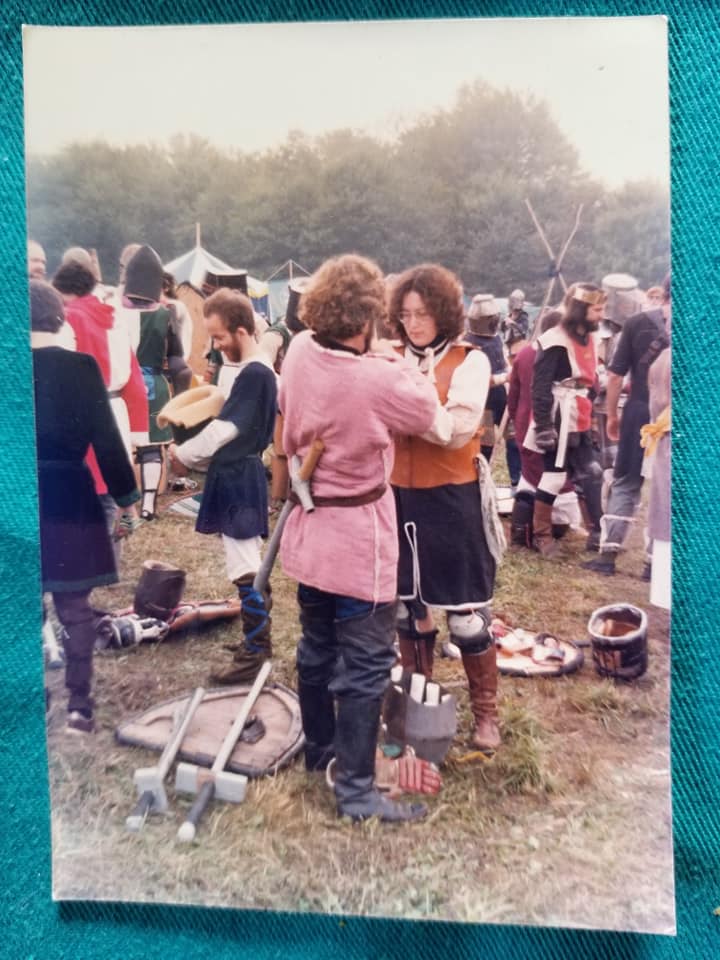
(Photo from a Pennsic War long past. My helm, shield, sword and other gear are on the ground behind me.)
So if you don’t see me on line, offering up unnecessary advice, or marveling at someone else’s work, please don’t be alarmed. I’m just taking a few days out for a bout of literal physical introspection. I will be back. Plan on it. I’ve even started a new project so I have stitching of my own I need to return to the moment I am able.
In the mean time, be well, and don’t let the spiraling state of the world get you down. We will need every hand to heal and rebuild, and I for one intend to be here for that, too.
COOKIE COUNT-DOWN FOR 2025
And as promised, the family shot of our 2025 cookie plate, with prep notes. Half for the entertainment of those who follow our misadventures, and half so I remember what the heck I did next year, when cookie time rolls around again.
To start, we did two sets, more or less divided between keto/slimmed (lower carb) cookies, and “full octane” ones. You can’t call any of these truly-free, even if they are marked slimmed or keto. I’ve noted below what non-standard ingredients or deviations we took to make the slimmed set.

Starting on the left with the full sugar/regular all-purpose flour set:
Triple Ginger – This is one of the cookies we do every year. My own invention. In previous years I have tried to slim this one, but since there is no such thing as sugar free white chocolate chips, and I wasn’t fond of the texture of the drop cookie style dough when using keto flour, we went with the original recipe. However, this year I used a chopped bar of white chocolate instead of the bagged, pre-formed white chocolate chips. A clear improvement.
Earthquakes – Another of the must-have bunch. This is one of the many chocolate crinkle style cookies. Again, full-octane, no slimming. Just an intensely deep chocolate, almost brownie like cake-cookie, nicknamed because of the fault line cracks that form in the powdered sugar outer layer during baking. This King Arthur version is a good jumping off point.
Samoa-Alikes – Every year we experiment with at least one new kind, to audition it for future inclusion in the standard run. We used this recipe but will probably not do it again. While the cookies were faithful renditions of the coconut/chocolate/caramel/shortbread cookie of Girl Scout fame, we did find them a bit too sweet, and the melted caramel candies were difficult to handle. But the base shortbread cookie was excellent. Able to be rolled super thin, held the cookie cutter shape extremely well, and on its own was buttery, crisp, and an elegant alternative to heavier sugar cookie cut-outs. The extra base cookies on which we just drizzled the dark chocolate after the coconut/caramel topping was all used up were the first ones gobbled down. The intricate work in creating these was largely done by Younger Spawn, who is a cookie baker of enduring excellence.
Mexican Wedding Cakes – Our favorite pecan butter cookie. This is the standard version, full sugar. Enhanced this year due to the princely gift of top quality New Mexico crop pecans from a dear family friend. Ambrosia. Recipe in last year’s round-up.
Cinnamon Swirls – One of our newer faves, and a specialty of Younger Spawn. I stand in awe of the absolute precision of that spiral. And as good as they look, they taste even better. The base recipe is now only available via the Wayback Machine. Skip the optional icing, and use your strongest, most flavorful cinnamon. You won’t be disappointed.
And the slimmed set, last label on the left, and all of the right side:
Slimmed Cocoa-Raspberry Cordial Balls – You can’t call any cookie that’s loaded with booze, truly keto. We happened to have some well-aged raspberry cordial made by another family friend. These things take a while to mellow out, and we’ve been watching it and tasting it for a few years, waiting for it to peak. It did and was glorious. But I wanted to share the last of it with as many folk as possible, so I used it for a batch of cocoa/pecan no-bake cookies. Well, not exactly no bake. I made the keto flour/monkfruit sugar cocoa cookies to crumble to get the crumbs for this and for the bourbon balls, below. One big cookie, actually. Since the whole thing was ground for crumbs, I just rolled out one massive piece, baked it and then threw the pieces into the food processor. The recipe for final assembly is the same as the bourbon version, below.
Keto Iced Lemon Rounds – We usually do a lemon cut-out with painted color sugar icing. But that’s a lot of time on my feet right now, so I opted for a shortcut – plain flattened rounds with simple uncolored brush-on icing. These are a new recipe – keto flour, monkfruit sugar substitute, and I iced them with confectioner’s grind monkfruit sugar sub/lemon juice/lemon zest. I like the way they turned out. Will probably repeat this in the future.
And sad news on this one…. Our fridge is infested with quality cheese mold. I’ve tried vinegar wipe downs, but pretty much any cheese or butter put in there in time will mature into a rinded cheese. It must live on other surfaces, too. I grabbed an older lemon for juice and zest. I rinsed it off prior to zesting, but that wasn’t enough. I theorize that mold spores were on it. While they are killed in anything baked, the icing for these was just the monkfruit sugar, lemon juice, and a bit of zest. Spores from the zest colonized the cookies, and in three days time (two days after the photo) the cookies developed blue cheese mold mottled spots. Not harmful, and not enough to ruin the flavor, but enough to make them unsightly and somewhat suspect. So next year, I will keep the zest lemon out of the fridge, and just to be sure – scrub it down with vinegar and rinse well with water.
Keto(ish) Mexican Wedding Cakes – It would be cruel to Certain Family Members to make a holiday cookie plate with only the full octane wedding cakes. So I did a keto-ish batch. This really should be labeled slimmed, not full on keto. It’s a mix of mostly King Arthur Keto flour, with a bit of AP flour for improved texture. This year I also added a tablespoon of heavy cream to the recipe I posted last year. That also made them a bit more luscious.
Slimmed Peanut Butter Cookies – Another family fave, but lightened. Like last year I started with the Joy of Cooking classic. Teddy natural chunk peanut butter all the way for flavor. But I used the 3:1 ratio mix of Keto:All Purpose Flour; and the monkfruit brown sugar/white sugar, minus about 10% in volume of the white to compensate for savage sweetness. And they worked out well, again.
Slimmed Oysters – Like last year this is pretty much my original hazelnut sprintz/chocolate ganache filling sandwich cookie, but with a couple of differences. I used 2/3 cup of granulated monkfruit based white sugar substitute, and 2/3 cup of the same brand powdered sugar substitute. In all of these bakes, I have I found the monkfruit sugar sub to be sweeter than regular cane sugar, so when I sub I use a tad less. In addition, I find that the granulated if used solo in a baked product can produce a bit of a gritty texture, so I go thirds to halfsies with their powdered sugar equivalent. That’s cornstarch-free, so it’s really just the same product, ground much finer. For these I used a mix of 1.5 cups King Arthur Keto baking flour, and a half cup of regular all-purpose flour (APF). This year’s addition was two tablespoons of heavy cream to loosen the dough a bit, for better performance in the cookie press. The filling this year was a 50/50 mix of Trader Joe’s 70% cacao dark chocolate and the ChocZero sugar-free keto chocolate.
Slimmed Cocoa Bourbon Balls – The other half of the keto cocoa cookie crumbs, pecans, powdered monkfruit sugar, cocoa, and bourbon. This is more or less the recipe I started with, but I prefer to use chocolate wafer cookies to vanilla ones (I will use crushed Nilla Wafers in a pinch). Again, this used the powdered monkfruit sugar, and to hold it together instead of light corn syrup I used agave syrup. Still sinful, but slightly less so than the corn syrup.
Keto Chocolate Chip – Another offering towards full-octane/slimmed parity. This is the chocolate chip cookie that’s printed on the ChocZero chip bag. It satisfies the chocolate chip cookie itch with a slightly cakey, not overly sweet bite. It does miss a bit on the caramel tones that develop in the traditional full octane recipes, but that’s a varietal difference – not a fatal flaw.
So there it is. FOURTEEN types this year. Some hits. Some near misses. And one solid OOPS. But a good group, none the less.
CORNER AND TASTY MILESTONE
My improvised corner on the current piece appears to be working out. And it looks like the original stitcher(s) hit upon the same notion, and did something very similar. Here’s what I have:

Note the extension of the zig-zag frame to a full iteration of the pattern, but one headed off on a right angle to the initial bit. And the beginnings of another red flower section in the triangle made by the border. Looking back at the original, although all four of its corners are treated differently (and a couple of them quite awkwardly), one does appear to take a similar approach:
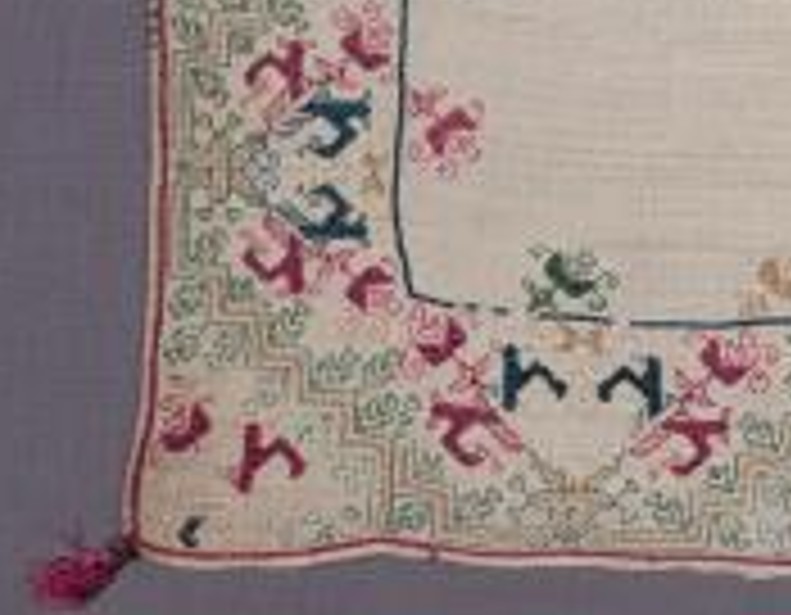
We will see if this gets me into any unforseen trouble, because looking at the original, I do see some kludges that address the variance in placement between that truncated corner flower and the framing zig-zag. Fingers crossed. Still it’s fun to see that I seem to be sharing the thought process of someone else, from way back then in time.
As to Meshy in cotton – I’m getting better at it as I learn more about the thread’s breaking point, and how much the ground cloth weave can be compacted by tight stitching.

The openwork texture doesn’t show well in such narrow spaces. It’s also hard to see in person without backlighting and practically putting one’s nose against the work, but the open mesh effect is there. I’m increasingly pleased with this, but I still don’t know to what purpose I will put the finished cloth.
Milestones
It’s no secret that since The Great Excavation and subsequent rehab/recovery, I’ve been living entirely on the labors of my Resident Male. While he has always handled the bulk of the cooking, I did contribute every now and again, with daily cleanup, baking special treats (especially during the holidays), and doing the occasional leftover reheat/repurposing, mid-week. But I have been a true freeloader since mid-March, and have only recently resumed unloading the dishwasher and doing other minor household tasks.
But yesterday and today I baked!
We are having some friends over tonight for dinner. I decided it was time to step up, and volunteered to make small ramekin chocolate cheesecakes
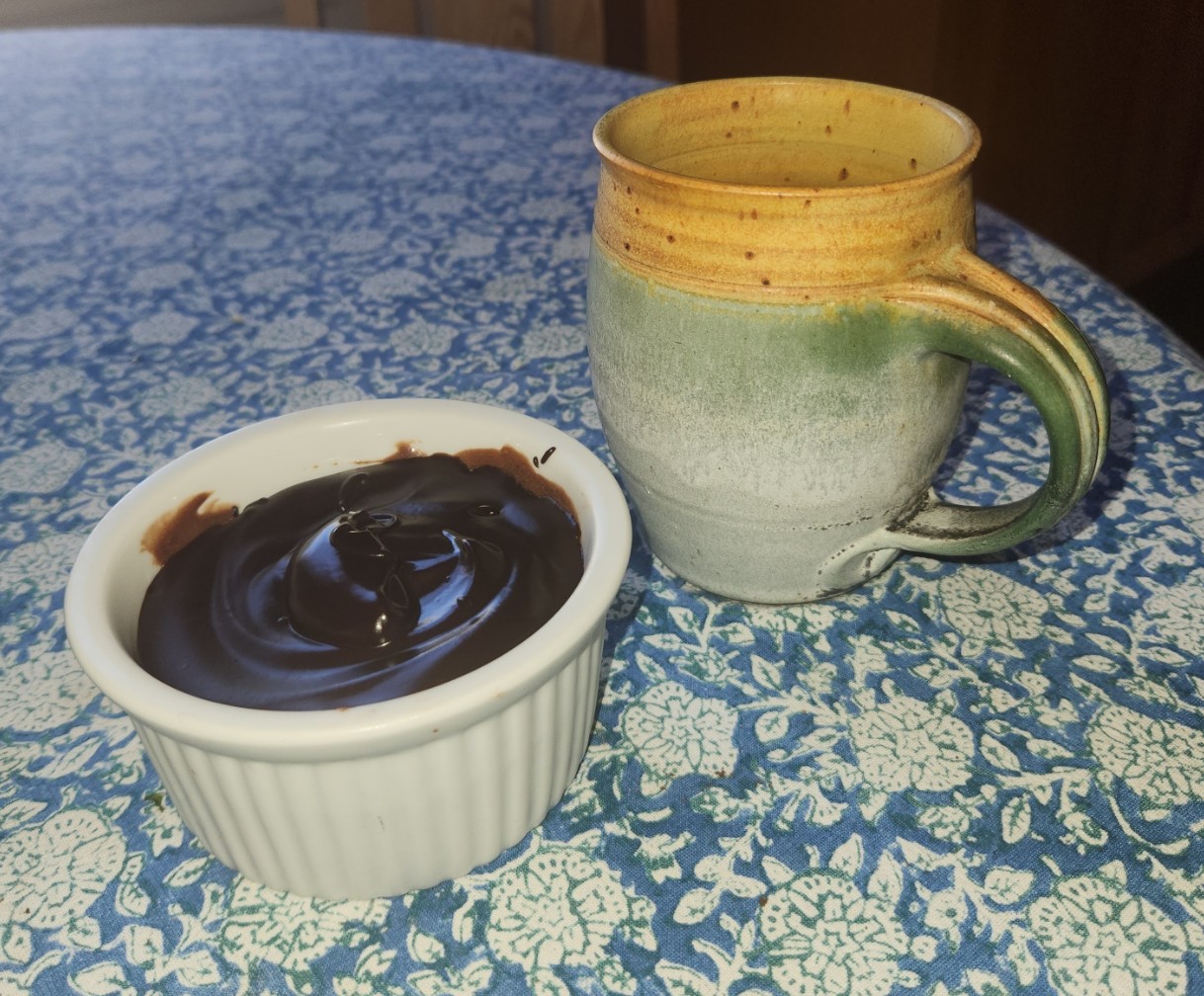
I made six of these little guys. They have three layers, and are a mash-up of several recipes. I used keto ingredients so they are low-carb, low-sugar, but not low-fat. And yes, I will clean up the edges a bit for presentation.
The bottom layer is a cocoa shortbread, made from King Arthur Keto wheat flour (no exotic nut flours, our guests are allergic), butter, cocoa, and faux sugar (Swerve brand, confectioners style). Next is the cheesecake part – standard full fat cream cheese (the bagel’s best friend), no-sugar dark chocolate baking chips (Choc Zero brand), heavy cream, eggs, vanilla, and a touch of salt. On top is a standard proportion ganache made from the same baking chips and heavy cream.
I did them in three stages with a small rest between the base and shortbread, then finished them with the ganache this morning. I was mildly tired after being on my feet so long yesterday, but not truly fatigued. While the shortbread and ganache I winged on my own, the cheesecake part is a combo of several keto cheesecake/chocolate cheesecake recipes.
I’m pretty confident that these will be acceptably tasty, with a dense but not rock solid texture. If not, I’ll report back, tweak my notes and in the future try again. Still, I’m proud of my dessert and happy to have cleared another recovery hurdle.
DITHERING
I am still not sure what to stitch next. As part of the stash archaeology portion of the planning process, I did a quick rummage through my accumulated threads. And I’ve been collecting them since grade school.

This box holds a mix of all sorts of things. Most date back to about 1966 when I first got an allowance, but it’s mostly full and partial skeins of J&P Coats Deluxe 6-strand embroidery floss and DMC 6-strand embroidery floss. I’ve got some older bits in there, too – legacy from my grandmother Pauline’s stash.
There is also a handful of Madeira 6-strand floss mixed in. I’ve never actually bought that brand, so I suspect it was second-hand stash that was given to me, or that I found at a yard sale. An interesting detail is that Madeira is now known for specialty packaging (in addition to thread quality), but the put-up I have in this scrum is all pull skeins. I can find no information on when the company changed over to the specialty packaging, but I suspect I acquired these stray skeins no later than 1985.
Other oddments include some soutache left over from SCA dresses done in the late 1960s, plus hose spools of variegated color silk (or possibly rayon) machine embroidery thread. They are end spool spoils, discarded as being insufficient for industrial use, but salvaged by my grandmother Minnie (the union seamstress/machine operator) for personal use, before she retired in the mid 1960s.
The oldest in the collection? These.

I have about a dozen different colors of the that JP Coats Deluxe, all with the 10-cent price on the skein band itself, but this indistinct tannish grey one had the clearest label. From the price and the color (purchased to stitch a bunny on a pair of 6th grade jeans), I can say with authority that I bought it in 1968.
The purple one is Lily 6-ply cotton floss, one of the grandma-Pauline-hand-me-downs. Although embroidery floss is still marketed under that name, it hasn’t been made by Lily itself since the 1960s. From the style of the typography on the wrapper, my guess is that this was purchased in the 1950s. The blue skein is Cynthia 6-ply cotton floss. I can find nothing about that brand or the possible maker. Dating again from the typography, I’d say that one is even older than the purple skein, and is another Pauline-leftover.
But that’s not all. In the past 10 years or so I’ve been the recipient of quite a few stashes, as friends and coworkers came into crafts supply inheritances they were not interested in keeping. And I’ve pursued several free trades or secondhand purchases via the local on-line yard sale lists. For example, some of the thread below was tossed in when I bought my second Lowery floor stand.

This material is a jumble of leftovers. Some of it is wound on bobbins (not my preferred system of storage), other is still in the original form factor. Most of it is single or partial skeins. Almost all of it is standard cotton floss, mostly DMC and Anchor. A small amount sparkly fleck special effects thread is mixed in, but no true metallics. There’s also a bit of white-labeled “craft floss” – inexpensive imports sold in multicolor packs at big box crafts stores. That’s best suited for braiding friendship bracelets since it’s usually short staple, and not of proven washability. Of note is that special packaging for Madeira, right there at the center bottom. That’s quality stuff, all full packs, and probably what I would use first of all of this bounty.
Now, my two leading possibilities for ground.

First, a lovely 19 x 27 inch (48.26 x 68.58 cm) piece of 40-count linen – a holiday present from my spawn, who enable me when they can. I’m very impressed by the vendor, whoever it was. Not only is the stuff cut exactly on true, it’s also neatly serged on three sides, with the fourth being selvedge. Usually I have to true the piece and hem myself. From the particular form of the orange stripe and line of blue stitching along the selvedge I think it might be Newcastle linen, but other firms do orange stripes, too.
The candidate on top of the linen is a yet another free trade/adoption acquisition. I have two lengths of this edged narrow weave, both about 6.25 inches x 5 yards (15.87 cm x 4.57 meters). The effective stitching area however is 4.875 inches wide (123.83 cm) due to the fancy brocaded borders.
I had been thinking of doing a squared off blouse yoke with it, but that would work better if the stuff was narrower. I’m not up for doing curtains or edging a trailing hem with this. The width is also a bit problematic for many other uses on clothing. About the only thing I can imagine is running it across the top of two wingspan wide to-the-knee lengths of linen, and fastening it at strategic points to make a peplos-like summer swing top/beach living cover-up. Hmmm… that might just work. And summer wearables should be done in washable thread, not the red silk. I don’t have enough of any one color in my ancient stash of cottons, although I’ve got plenty of black in my current on-deck stash….
So, what am I left with after this open bit of nostalgia and mental dithering?
If the peplos idea doesn’t firm up, I’ll probably prep the linen for stitching – establishing basted edges and center lines for the embroidery, but I’m not sure WHAT to stitch. Inhabited blackwork like the Unstitched Coif? Another randomly composed piece combining bands, motifs, and fills, done at whim (but with no motto)? In the Madeira colors, or in red silk?
Yet another wall hanging. A one of a kind wearable just for me. Decisions, decisions….
Input, other ideas, hoots of derision all gratefully accepted.
SERIOUSLY, FOLKS…
This is post that’s not easy to write.
Some of you have wondered about my rush to release both Ensamplario Atlantio III, and the single-download edition of my Epic Fandom Stitch-Along. And there may be more coming out in the next few days. There is a reason.

In gamer’s parlance, sadly I’ve rolled a 5. Not a 1, thank heavens, but nothing good.
I join the legion of folks who have been handed a surprise cancer diagnosis. In my case it’s another over-engineered and uncommon Salazar project – not breast, lung, or any of the usual suspects. I’ve got a chordoma – an exceedingly rare form of bone cancer that’s eating my tailbone (coccyx) and the area immediately above.
The bad news is that I’ve been subject to this invader for a while, with the symptoms it generated being masked by the all too normal day to day annoyances many post-menopausal women have, most notably lingering lower back pain. (Side hint – if you have pain that the oft resorted to palliative modalities like physical therapy and medication don’t address, insist LOUDLY that your doctor engage diagnostic mode. I it would have been better off had I done that earlier.)
The good news is that while my growth is large, it’s contained, has not spread, and is operable. I will be headed to the hospital later in March to have at it. Best outcome is that I although I will be physically diminished, I will regain basic mobility. With healing I should be able to sit, stand, walk, and climb stairs. Some bodily functions and systems will also be compromised, but nothing that modern medical technology cannot address.
I choose to fight, and fight hard. I will not let this thing daunt me. I will pass through, and emerge much as I am now, although I will be moving more slowly, and with more care.
What can you do to help? There’s not much, but I know I will appreciate your companionship, dark humor, and distraction as I move through post-op and rehab. I will especially enjoy seeing what you’ve been up to playing with my knitting and stitching “pattern children.”
I know folk feel awkward at times like this, but please don’t be shy about contacting me. I might not answer right away (especially in the weeks just before, during and immediately after the procedure), but your notes, memes, embroidery/knitting/crochet/other hobby pix, and assorted shenanigans will brighten my day. One thing though, please don’t send flowers. The sentiment is deeply appreciated, but they make me sneeze.
Oh, and look out for Fernando (aka, The Resident Male). He’s going to be especially grumpy.
I leave you with a thought from the science fiction TV show Babylon 5, from the character Ranger Marcus Cole:
“I used to think it was awful that life was so unfair. Then I thought, ‘wouldn’t it be much worse if life *were* fair, and all the terrible things that happen to us come because we actually deserve them?’ So now I take great comfort in the general hostility and unfairness of the universe.”
DEJA VU, BUT WORSE
A serious digression from stitching, knitting, crochet, and general blather.
Back in 1981 I was an eager young space cadet, a staff technical writer in the employ of The New York Institute of Technology. I was working on grant proposals and on research contracts the school had, mostly with US Federal agencies.
Among the proposals and grants were ones that funded the NYIT computer graphics lab – the staff of which eventually moved up and on to become Pixar; and a fantastic early intervention math and sciences augmentation program aimed at assisting minority kids, but especially girls and young women from middle school, then up and into college for tech/science/math. It included full NYIT scholarships for those who prospered in the program. Sally Ride was the speaker at the initial kick off banquet for that one. I’ve always wondered what became of those kids…
On the general editing/compilation side beyond LOTS of grad school grant requests and assorted small publications, this one really stood out.

The effort was led by Dr. King Cheek, a dean of NYIT and brother of the then president of Howard University. Dr. Shannon was a noted researcher in labor economics and education. I was the foot soldier going where they sent me, collecting data on index cards, alphabetizing, condensing abstracts for inclusion, and typing the volumes for printing on a Selectric (this was before NYIT got early DEC word processors). For this they both graciously suggested my name appear first because their reputations were already established – another publication wouldn’t mean much; but for me as a 25 year old, it would be quite valuable.
It was 1981, still in the pre-Internet, pre-automated/accessible collections era. Annotated bibliographies on specialty topics were quite common, as were resource lists. The two volume set was intended to be updated annually, and was funded by the US Department of Labor, Office of Youth Programs.
All well and good. The bibliography clocked in at 363 pages, with about 1560 entries. The resource list, 159. Both volumes were indexed. The set from kickoff to print took about 18 months to achieve. Other than a temp typist to help in the last three weeks to make deadline, and copious guidance/improvement suggestions from my leaders as they read through each day’s additional content, it was all me. We printed something like 750 sets, with the Office’s intent to distribute to DOL locations, academic libraries, and other stakeholder/interested parties.
While the books were being duplicated and bound, then President Reagan abolished the Office of Youth Programs.
While we had gotten paid for the contract, there was no one to whom to submit the books. We were directed to box them all up and ship them to a Federal Archives location. And so with the exception of my two copies (one my mom has for bragging rights); the copy retained by each of my co-authors, and (possibly) one at Howard University, these books were never distributed, in fact – never seen again.
So for me at least, current events bring a wave of deja vu. But not the pleasant, nostalgic kind. The kind that sizzles against antagonistic blundering about, and produces intense anger.
We’ve been here before. It wasn’t as blatant then, but it isn’t new.
Something has to change, and change can’t happen soon enough.
THE 2024 HOLIDAY COOKIE WRAP-UP (MORE OR LESS)
Time for the annual cookie roundup.
First, here is the cookie plate, photo courtesy of the Resident Male. Two plates, actually – one for the slimmed down cookies made at least in part with reduced carb ingredients, and a smaller one for “full octane” bakes, made with conventional sugar, all purpose flour, and chocolate.

We’re getting better at lowered-carb baking here, but in all honesty, the originals are better. For those on more restrictive diets than ours, note that this is LOWERED carb, not zero carb. I would not recommend my mods for someone who is under a strict regimen. We for example are not banned from carb consumption, we are just trying to cut down, not eliminate them completely. So with that, here’s the roll, with notes on changes to what happened before, and on the travails of lowered carb baking.
Lowered-Carb Plate
- Oysters. This is pretty much my original hazelnut sprintz/chocolate ganache filling sandwich cookie, but with a couple of differences. I used 2/3 cup of granulated Swerve white sugar substitute, and 2/3 cup of Swerve powdered sugar substitute. I find that the Swerve monkfruit sugar sub is sweeter than regular cane sugar, so when I sub I use a tad less. In addition, I find that the granulated if used solo in a baked product can produce a bit of a gritty texture, so I go halfsies with their powdered sugar equivalent. That’s cornstarch-free, so it’s really just the same product, ground much finer.
I also used a mix of 1.5 cups King Arthur Keto baking flour, and a half cup of regular all-purpose flour (APF). The Keto flour has a bit of a rye-like/bran-like flavor. It also absorbs liquids and fats differently. Some recipes require additional moisture. Some are overwhelmed by the fat content. The use of a little APF vastly improves cookie texture and flavor in both cases.
For the filling I made a standard 1:1 ganache with heavy cream and Choc Zero no-sugar chocolate baking chips. And a splash of vanilla. Worked quite well, but I recommend microwave melting for the Choc Zero – not stovetop melting. It scorches very easily. More on this later. - Buffalo Bourbon Balls (which we sometimes make with rum and not bourbon). Here is a similar recipe for a full-carb cookie. My modifications ended up being a two step process. Since using store bought vanilla or chocolate wafers was right out, I had to make my own to crumble for the base of this no-bake cookie. I used a recipe similar to this one, rolling the dough out into two giant rounds. Since I was going to crumble them up after, there was no reason to form individual cookies. I ended up having enough cocoa cookie crumbs both for this recipe, and for the base of a cheesecake I plan on making next week.
Other mods on this one included substituting toasted walnuts for pecans (no pecans were available the week I made these), using the Swerve confectioner’s sugar in place of the standard issue (and shorting that by three tablespoons), and using a scant quantity of agave syrup instead of corn syrup to glue the whole mess together. Please note though that even with these changes, a cookie with agave syrup and a significant quantity of booze cannot be considered truly slimmed. - Chocolate chips. Not the best success, but edible. Again, the standard Toll House cookie recipe, but using a 3:1 mix of Keto flour to APF; subbing in the Swerve equivalents of the brown and white sugars; and using the Choc Zero chips in place of standard bittersweet chips or chunks. On the sugars, I took the make-it-less-sweet bite out of the quantity of white sugar, leaving in the brown for flavor. I also divided the remaining quantity of white sugar in half between the Swerve granulated and powdered products.
Obviously these did not spread like standard drop cookie style choc chips. That has to do with the way the fake sugars play with the butter and moisture in the cookie. Next year I will add more liquid to the batter to see if that helps. Also the Choc Zero chips scorched a bit in the 375-degree-F oven. Next time I will not bake anything containing them at hotter than 325-degrees. Still, edible and not horrible. - Peanut Butter Cookies. I didn’t try to slim down the peanut butter component in these. I started with the Joy of Cooking classic. Teddy natural chunk peanut butter all the way for flavor. But I did use the 3:1 ratio mix of Keto:APF; and the Swerve brown sugar/white sugar, minus about 10% in volume of the white to compensate for savage sweetness. This is the first year I’ve done a slimmed down peanut butter cookie without having the baking sheet absolutely awash in oil, dripping down into the oven, making a mess, and threatening a fire. The texture on these was good – perhaps a bit less tender and more “digestive biscuit” like, and the flavor was spot on.
- Triple Gingers. Slimming down another of my originals here. With no zero-carb white chocolate chips to hand, I just used the regular. Ditto with the minced crystalized ginger. But for the rest I proceeded as per the chocolate chip drop cookie batter. Keto:APF; Swerve brown:white sugars (-10% of the white), and the rest. Like the chocolate chips, they retained their craggy ball shapes instead of spreading out nicely like my original recipe, but they have good flavor and texture.
- Russian Tea Cakes. The ethnic attribution on these overlaps so strongly that it’s hard to differentiate. But I will call this set Russian Teacakes because it used toasted walnuts in place of pecans (another victim of the Great Pecan Shortage this year). Again the Keto:APF flour ratio was changed, and the Swerve powdered sugar was deployed. The finished product was good, but the pecan-rich Mexican variant is so big a family fave that disappointment ensued. (See recipe below.)
- Earthquakes. Only minorly slimmed. I started with this one before departure, but I decided to use regular Trader Joes 60% cacao bittersweet and not the Choc Zero stuff for this one because the flavor and texture areso dependent on the cacao solids:cocoa butter ratio of the chocolate component. But I did do the keto:APF and sugar subs as with the others. Not quite as fudgy or crevasse ridden as the standard (like other keto flour containing cookies they don’t spread as well), but also in the acceptable range of results.
Full Octane Plate
- Brown Butter Chocolate Chunk Cookies. A specialty of Younger Offspring. No attempt to mod this recipe because it’s one of the all time best chocolate chip cookies out there, at the perfect intersection point of crisp and soft. Younger Offspring coarse chops the chocolate. It flakes and breaks, with the chocolate dust being just as valuable as the chunks to the finished product.
- Mexican Wedding Cakes. Miracle! Pecans presented themselves, and we HAD to do a do-over. This is the same base recipe as the Russian Tea Cakes above, but look at how well they spread. And they were just as tender, nut-rich, and luscious as they always are. (Recipe below)
- Orange Marmalade Cookies. No point in slimming these, either. Not when the recipe includes a full cup of orange marmalade. A nice light, citrusy compliment to the rest of the rich cookie plate.
- Cinnamon Bun Cookies. Yet another specialty of Younger Offspring. These are a wonderful rolled refrigerator slice and bake cookie. But the write-up has vanished off the original website and the recipe can only be found via the Wayback Machine. Skip the icing on this one. There’s absolutely no need for it. And how to get that magnificently even swirl? Surely it’s practice, Younger Offspring having made hundreds of these for charity fundraisers, but also this isn’t a two-dough cookie. It’s one dough, rolled out uniformly thin, and then smeared with a paste of cinnamon, sugar, and butter that’s about the consistency of peanut butter. Then rolled and fridged prior to careful cutting and baking.
Recipe – Mexican Wedding Cakes (also Russian Tea Cakes)
I posted this recipe about 20 years ago but the file appears to have been corrupted. Here is a refresh, with both the original and the slightly slimmed down version side by side. I can’t call the slimmed version a true keto or diabetic-diet-acceptable offering, and I can’t tell you caloric/carb count values. Just that it isn’t as impactful as the full octane version
I can’t even tell you the exact number of cookies that this will make. Lots. Enough to fill an 8-inch tin with a few left over. Especially if you make them the size I prefer for holiday cookies. Since we offer up so many kinds on one plate I make all of them rather small, so folk can taste several different types. I have a two-tablespoon cookie scoop (like an ice cream scoop but smaller). I take one scoop-full then divide it in half and roll both halves into small balls. I get about four sheets of 16-20 cookies. If I were to make these as part of an afternoon tea spread I would probably make them twice as large.
Ingredients for Regular Version
- 1 cup unsalted butter (not margarine)
- 3/4 cup confectioners sugar (plus more for rolling later)
- 1 tsp vanilla
- 2 1/4 cups all purpose flour (King Arthur recommended)
- 1/4 tsp salt
- 1 cup finely ground pecans (walnuts, or hazelnuts may be used but pecans are best)
Ingredients for Slimmed Version
- 1 cup unsalted butter (not margarine)
- 1/2 cup plus 3 tbs Swerve confectioners/powdered sugar equivalent or similar monkfruit based sugar substitute (plus more for rolling later)
- 1 tsp vanilla
- 1 3/4 cups King Arthur Keto baking flour
- 1/2 cup all purpose flour (King Arthur recommended)
- 1/4 tsp salt
- 1 cup finely ground pecans (walnuts, or hazelnuts may be used but pecans are best)
Cream butter. Add sugar (or sugar sub), and vanilla. Mix together thoroughly. Stir in flour and salt until mixture is uniform in texture. Stir in ground nuts. Chill until the dough is easy to handle.
Heat oven to 400-degrees F (around 204-degrees C). Roll dough into small balls of approximately 1 tablespoon each. Place dough balls on ungreased sheet of baking parchment on baking sheet. They can be placed about two inches apart because they will spread a bit into dome shapes, but shouldn’t flatten completely like chocolate chip cookies. Prepare a soup bowl or small mixing bowl with a quantity of your chosen powdered sugar for rolling the cookies.
Bake 10-12 minutes, until just set (watch these like a hawk after about 8 minutes). Cookies should look pale with just a tinge of browning around the bottom edge. They should NOT be brown all over. Let cool on baking sheet for a couple of minutes, then roll immediately in the prepared powdered sugar and set them on a baking rack to cool. When cool, roll them again then store in a plastic wrap lined cookie tin or similar storage solution. If kept covered they will be tender for about a week and a half, then slowly dry out. They will still be edible, just no longer soft.
MUSEUM DISPLAY OF CROSS STITCH WITH ART
This week past we were in the Buffalo, New York area, visiting family and friends. We had a splendid time, and one of the things we did was pop over to the newly expanded and refurbished Albright Knox Gallery of Art, in the Delaware Park section of Buffalo. The museum itself is a little jewel box of contemporary art, with a surprisingly comprehensive sampling of works by most of the 20th century’s biggest names. Now it has the room to better display its collection, and additional space to stage specialty exhibits.
Right now they are offering After the Sun – Forecasts from the North – a collection of works by contemporary artists from the greater Scandinavian/Nordic/Icelandic sphere, as they contemplate the effects of climate change on the northern/Polar bordering landscapes and society. The works were done in many media, everything from traditional oil paint on canvas and carved wood/stone or cast sculpture, to stretched scraped membranes, and even a presentation of scented oil. And to my surprise it included a suite of cross stitched pieces. While it’s not uncommon for embroidery to be displayed in a museum, it is more usual for it to be seen by itself, and not as common for it to be displayed alongside other pieces outside of a historical context (like a “life in the 1500s” type exhibit). This was a general arts collection, with the stitched pieces being given the same respect of place as those done in more represented media.
The items below were composed and stitched by artist Vidha Saumya, a resident of Helsinki, with roots in India. Her exhibit’s blurb is below. I wasn’t able to get detailed shots of all of the pieces, but they are shown after the blurb.

Pieces 1-4

A close-up of #4 – Still the Day May Live. I apologize for the skewed perspective. These were hung both above and below eye level, making it difficult to grab a photo.

Pieces 5-7

And Pieces 8-11

Again I apologize for the poor photos.
I don’t pretend to be an art critic (especially not of non-representational art) but I was moved by these. They seemed both immediate and unspecific in time – like dream images barely remembered upon waking, inhabited by an overlay of dread and nostalgia, with flecks of wishful joy.
I want to express appreciation for the curators of this collection, and I wish Ms. Saumya every success. I was very happy to see the medium both given respect, and being used to such good effect.
BUSY END TO THE YEAR
No doubt it has been a hectic end of year, what with the standard end of year activities plus the finish on the coif project, and the lightning trip to the UK to view the final exhibit. But that doesn’t mean that other things have languished.
First, because the holiday can’t happen without cookies, even if I am not around to make them all, I present our 2023 cookie plate. Some slimmed down to lower carb versions (with varying levels of success), and some expertly baked by Younger Spawn, whose oven-acumen now far exceeds my own. Luckily Spawn’s job is work-from-anywhere remote and allowed early arrival the week before Christmas. While we were in Sheffield we had a happy house-sitter, tree waterer, and master baker in residence. And said HHS/TW/MBIR had run of the place, its kitchen, library, and media without clumsy parents cluttering available time and space. A win all the way around.

Starting from around 11:00 and spiraling into the center we have:
- Brown butter chocolate chunk cookies. A specialty of Younger Offspring, with grated chocolate bits, chunks and dust instead of commercial chips. To die for.
- Low carb peanut butter cookies. After all sorts of failures trying customized Keto recipes I fell back on the old reliable Joy of Cooking one, but subbed in King Arthur Keto flour and monkfruit-based sweeteners. I have always used Teddy no-sugar peanut butter, too. A slightly stickier dough than usual because the KA Keto flour and it isn’t as absorbent as regular all purpose flour. A bit more oil release on the baking pan, but this time the cookies turned out pretty close to usual – not dry and crumbly, although I couldn’t get the cookie stamp I usually use to work well and fell back to the traditional fork-tine checkerboard. They were pronounced acceptable by my core audience.
- Earthquakes (our name for chocolate crinkles). Full octane. These were made by Younger Offspring, and are especially luscious this year because the batter became the receiving point for ganache left over from another recipe. Not to many fault lines in them this year, but oh so good.
- Mexican Wedding Cakes. Another old family favorite done perfectly by Younger Offspring. Lots of pecans in a buttery shortbread base.
- Lower carb Buffalo Bourbon Balls. This is a family recipe that usually starts with a box of Nilla wafers or other similar vanilla or chocolate flavor plain commercial cookies buzzed to fine crumbs. But commercial low carb cookies are hard to find and maddeningly expensive. So I improvised my own, making large blobby plain cocoa cookies using the Keto flour and fake sugar, plus butter and Dutch process cocoa. Then the next day I ground them up and made the usual, but rolled them in a mix of the cocoa and granulated fake sugar instead of the confectioner’s version of the same monkfruit sweetener. (I wanted to save the powdered stuff for other baking because it works better for most of it than the standard). I used agave syrup in place of corn syrup for these. Plus bourbon this year instead of rum, mostly because that was what we had on hand. These actually turned out to be the best lower-carb cookie I’ve made so far. I will have to do it again so I can write up the recipe because it’s worth sharing and replicating in the future.
- Jam thumbprints. Another winner from Younger Offspring, who has sneaky ways of setting the raspberry jam in the shortbread base so that it is a neat, non messy, intensely fruity bite.
- Slimmed down Oysters. A take on my own invention, using my usual recipe but subbing in the King Arthur Keto flour and monkfruit sweetener into the standard along with the usual avalanche of ground hazelnuts. Those were hard to come by this year, but luckily I had some in the freezer, left over from last year. I was very happy at how the batter worked with the cookie press. And these were a collaborative effort. I did the cookies, but Spawn did the ganache and filled the sandwiches. The ganache is full octane.
- Lemon macarons with lemon curd. All Younger Span, all the way. These are classic, intensely lemony, and lighter than air. An accomplishment far beyond me. Again, to die for.
- Lower carb triple gingers. Obviously the white chocolate chips in the cookies are not slimmed and there is minced candied ginger in there, but the rest of the cookie is my usual recipe, subbing in the low carb flour and sugars. I’m a bit disappointed in these because as a drop cookie they are supposed to spread. These didn’t, remaining the rocky shapes in which they were spooned onto the baking sheet.
- Lower carb chocolate chip with cocoa nibs. This is new this year. I started with a keto shortbread cookie recipe, and added keto chocolate chips, plus no-sugar cocoa nibs (left over from last year). The result is pleasing but also a bit disappointing. The texture and taste of the cookie part is too much like a store-bought Chips Ahoy. I had hoped for something more like a home-baked Tollhouse. But they are not too sweet (a common problem with keto baking because the fake sugars are more intense than their standard counterpart). Good enough, but not great.
- Unseen – a keto lemon cheesecake in place of our standard Panforte, which could not by any means known to man or woman, be slimmed down. In fact, if I went on a forced march through Middle Earth and could pick only one food substance to sustain me, the Panforte, packed with nuts, dried fruit, and carbs would be a space/weight efficient substitute for Lembas.
Obviously for cookies to happen we also had to hit Max Festivity. Again Younger Spawn leapt in and took over the orchestration of the tree, and deployment of the M&M Man Army:

And to round it out, presents were exchanged. I was well prepared with gift socks, mostly knit since I mailed the coif. This photo omits the two last pairs, along with a nifty folding basket that was a present last year, and has been adopted as my knitting bowl for sock production.

Not to brag, but I am delighted that my family knows me so well. Among the puzzles, wearables, and adornments they gave me this year, were stitching things: a quarter yard of 40 count cream linen, a sweet little tabletop caddy box for needles and pins (I will use it for needles and orts), a small cigarette box that is a perfect traveling needle and thread safe, and a chatelaine.

As you can see I’ve already put my favorite laying tool, fine needle threader, and scissors on the chatelaine. I put a slice of beeswax in that little snap purse.
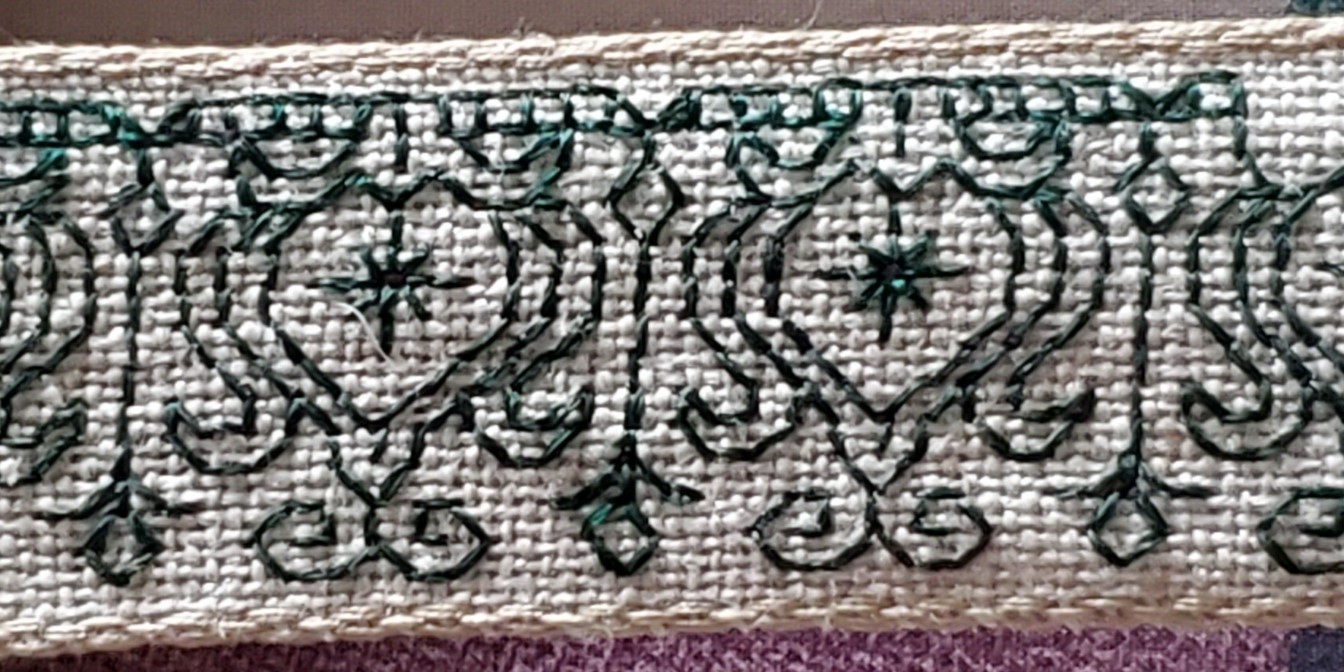
The rose header for it has a sturdy pin on the back. But since I am usually found in T-shirts these days, the weight of the thing might be problematic. This gave me an excellent reason to go stash diving and retrieve a length of evenweave stitching ribbon that I bought at Sajou in Paris when we visited there about seven years ago. A quick trip to the computer to doodle up a new pattern for it, and I’m off and running. It will be an award-ribbon style around the neck piece, with a 90 degree angle in front where the ends overlap. The chatelaine will be pinned to that triple layer of sturdy linen, and the loop will go around my neck. Problem solved. Or it will be as soon as I’m done with the stitching and assembly.
 String-Or-Nothing