PATTERNS PLATE 13
Lucky Page 13:

This is the last of the pages that mostly contains patterns from my first booklet. You’ll recognize #73 as having been on my Eve Was Framed unfinished sampler as one of the collection of strip patterns. The others are all on my blackwork underskirt.
Let’s start talking about how I did these.
I’m using GIMP. It’s an open source drawing/drafting/graphics editing program. I won’t got into the technical details of the thing, but the important points to know are that it’s available for free, it’s implemented for Windows in English, Spanish, French, German, Italian, Japanese and several other languages. It’s also widely used by Linux people, who often have it as part of their standard software set. GIMP also can run on Macs. You can download it here (click “show other downloads for Linux and Mac). User and tutorials manuals are here.
To be honest, GIMP is a little bit intimidating if you’re not used to programs like Photoshop or Illustrator. If you’ve only used Powerpoint type graphics or dedicated stitching programs, I’d suggest saving sitting down with GIMP until you have some quiet time, no deadlines, and a calming cup of cocoa. I don’t profess to know this program at more than entry level. I have only tinkered with a very limited number of features, for only one specific purpose, so please don’t write to me asking for help. Pretty much everything I know will be contained in the next several posts. But these should be enough to get others started using it for graphing line unit patterns.
Lesson One tomorrow.
PATTERNS PLATE 12
Here’s the 12th page:

#69 is a new one, doodled up as I was working on #68. Very similar structure, but as you can see from the thumbnail, a very different distance “read.” These thumbnails are quite useful for evaluating the overall effect of a pattern when seen from far away. The rest on this page are either in my old booklet or graphed up from my blackwork underskirt.
I could keep going with these forever, but I sense that most folks have a more limited attention span. Right now I have 25 pages finished – that’s more than 150 individual patterns (some of the later pages feature more than one pattern in a square). I’m going to keep posting them one page a day until all 25 are up. Then I’ll release the booklet. In the mean time, I won’t be idle. My pattern drafting boot camp exercise has been very effective. I’ve now mastered the method and have moved on to work on my sequel to TNCM.
In other news – it’s cookie time here at String. Long time readers know that each December the kids and I bake 10 kinds of cookies. Today we started, with the improved-by-long-curing Bourbon cocoa cookies taking their traditional place as our kick-off. This year’s line up (subject to change at our collective whim) includes these standards:
- Chocolate chip
- Mexican wedding cakes
- Peanut butter
- Buffalo rum balls
- Chocolate crinkles (aka Earthquakes)
- Oysters (a hazelnut spritz/chocolate sandwich)
- Decorated sugar cookie cut-outs
- Gingersnaps
New this year, we go for a multicultural pair to round out the ten:
- Benne Wafers – a sesame, brown sugar cookie loved in the Southern US
- Koalcky – A Hungarian cream cheese/jam cake/cookie, sort of like a fold over rather than rolled Rugalach.
Oh. And Ms. Jean’s fudge.
PATTERNS PLATE 11
Page 11:

#65 is another eye-bender, calculated to drive stitchers insane. #66 is a new doodle. Other than that, all appear on my previous projects or in my first booklet.
PATTERNS PLATE 10
Page 10.
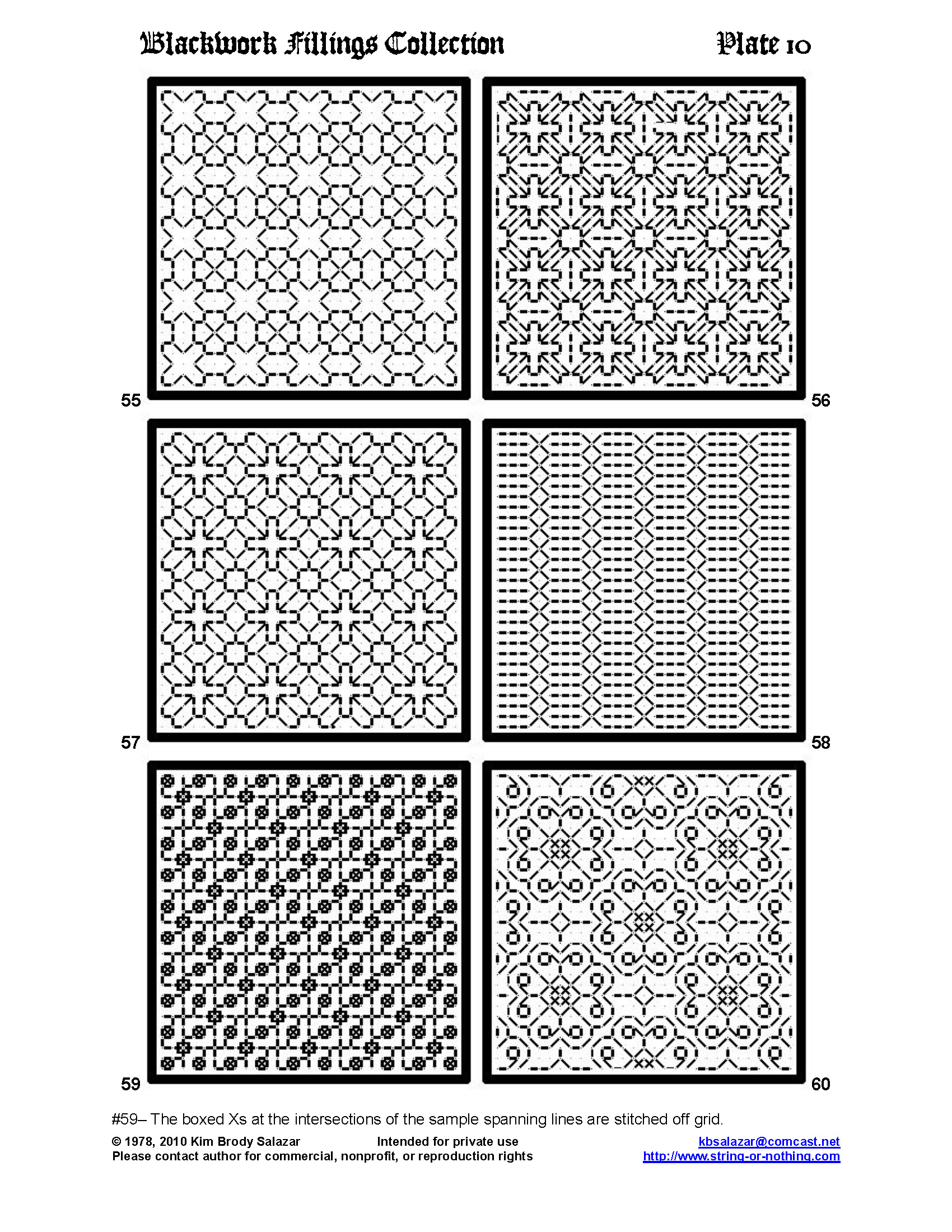
#59 in this set is a bit odd. If you look at it, you’ll see that the basic unit is a square, with a boxed X in the center, in alternate rotations. Where four of these squares meet, there’s another boxed X, worked skew on the grid. The rest present no special challenges – no half stitches or other oddities.
PATTERNS PLATE 9
Plate 9. Lots more to go!

More interlaces! Three on this page. No special notes about working any of these. These are still patterns first published in my 1978 booklet.
If you’re new to blackwork, it’s not so much a single monolithic style as a collection of styles popular over about 150 years, and in many cross-pollinating countries and regions. It’s a term loosely applied to monochromatic or limited palette embroideries. Black was very popular. So was deep crimson (although I have no examples below). Other colors were not unknown and works were often further enriched with metal embroidery or spangles. The one main unifying characteristic seems to be an aesthetic of strong contrast, a white or near white linen ground.
Some examples are clearly done on the count, others freehand. In one sub-style florals or geometrics are described with a solid color, often heavy outline, and then infilled using one of several techniques. The patterns I’ve been presenting are representative of the small diaper patterns typical of one of the filling techniques.
If you’re looking for a nice visual survey on the various types of stitching that are commonly clumped together under the blackwork label, one source is the Blackwork Gallery maintained at the Medieval & Renaissance Material Culture website by Karen Larsdattir. There are many other good sites out there and I hope to share links to some of them over time, but this site has assembled links to a very representative artifacts and artwork showing blackwork on clothing and accessory items. If you have hours to lavish on the subject, I’d start there.
If you’ve got less time to spend and want the 200-foot overview, I present these links, gleaned from Karen’s page, along with minimal commentary.
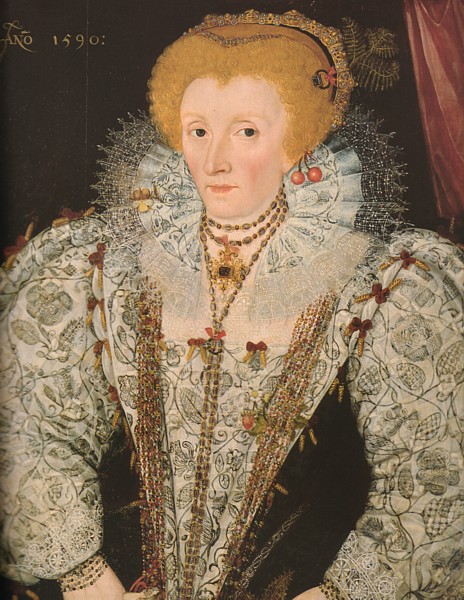
First, the style that my pieces are in, sometimes called “Inhabited Scrolling Blackwork,” the heavy outlines, geometric fillings variant. Unknown lady, 1587, Queen Elizabeth, 1580
Here’s a similar style, but with a single very simple filling stitch –Forehead Cloth, 16th, 17th Century,
And one done with totally freehand fillings, shaded and mottled like shading with ink stippling – V&A T.4-1935, 1620s
And ones done with what may be a mix of counted and freehand fillings – V&A T.113-118-1997, 1575-1585 (also here); Mary Cornwallis, 1580
Scrolling blackwork in two colors – Unknown lady, 1595, Coif attributed to Anne Boleyn (but it looks later to me)
Totally freehand scrolling, no fillings at all – Lady Kytson, 1540-1546
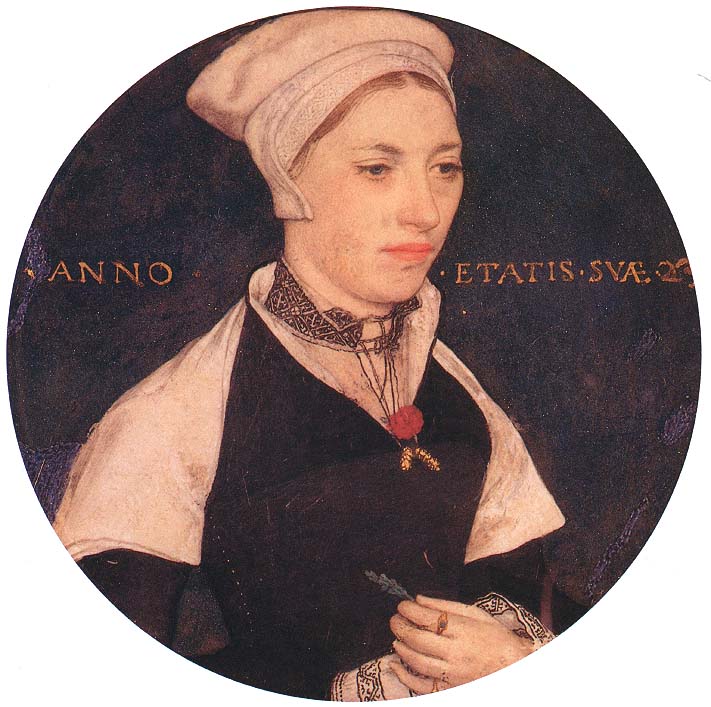
Then there is the more linear strip or strapwork blackwork style. The strip patterns on the samplers I’ve done over the past year are of this broad subfamily – Young girl, 1525-1540, Portrait of a Young Lady, 1520-1530, Mrs. Pemberton, 1540.
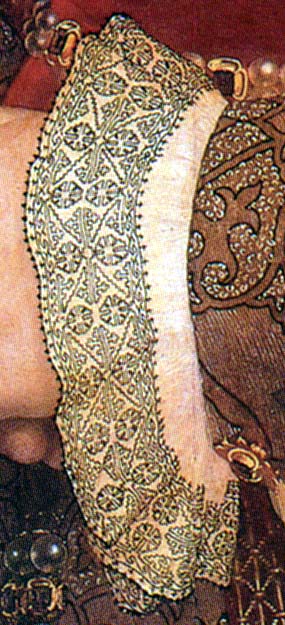
Of course there are Jane Seymour’s famous cuffs, 1536
This man’s shirt is the source of one of the patterns I used on a recent sampler, V&A T.112-1972. Also you’ll note that it greenish blue. I don’t believe that it has faded from black because the color is uniform all over the piece. (Note the simple twist on the cuffs – look familiar?)
I really like this lady’s underskirt or smock skirt. You can just make out the large scale strapwork, crisp enough to have been countwork – Courtesan, 1530-1535
But not all of the strip type patterns were worked on the count – Man in Red, 1520
Proof that not every collar seen from both sides was worked double sided. This one clearly has different patterns on the inside and outside of the same garment – Lady in Green, 1528-1532.
Some blackwork is hard to identify as being either done on the count or freehand. I’d say that this lady’s sleeves and cuffs were probably done counted, but her collar is harder to pin down. It’s a nice example of a scrolling pattern though, that may or may not be infilled, inhabited blackwork style – Lady of the Bodeham Family, 1540-1545
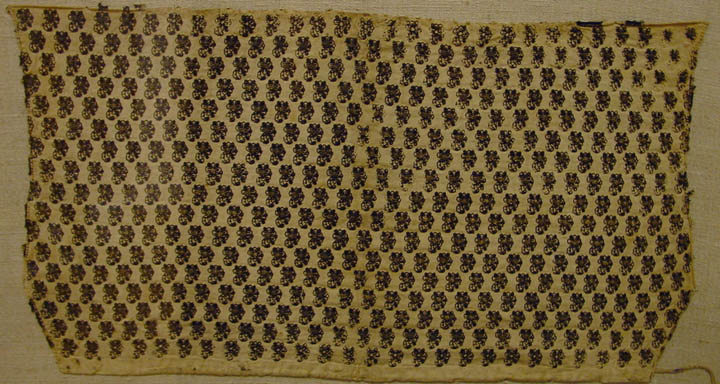
And then there are pieces that show all over patterns, either scattered or, well – all over. These look counted to me – Coif, 1600, Lady, 1593
Chronologies are hard to pin down because fashions migrated and slowly from region to region, mutating as they traveled. Still it’s safe to say that the strip type styles tended to be popular earlier and longer than the scrolling styles, and were popular across a wider range of geography, spanning all of Europe. Eventually some of them came down to us through both the Old and New World sampler traditions; with a multigenerational, transoceanic game of Telephone blurring their patterns slowly over time.
The scrolling stuff doesn’t seem to be well represented before the 1550s or so, but really came into vogue over the ensuing 50 years. The inhabited scrolling styles seem to have achieved their greatest popularity in England and areas of English influence. Finally, the stippling style of fillings seem to have evolved at the end of classical blackwork’s reign of popularity, although freehand fillings sit happily side by side with counted ones from the earliest appearances of the scrolling outline style.
I’ll post more on this as time and space allow.
PATTERNS PLATE 8
Page 8, as promised:

This one features a nice assortment of contrasts. The lattice interlace in #43 is a simple pattern I use again and again. You’ll see as this collection moves on there will be LOTS more interlaces, some open like #48, some more twisty and dark.
PATTERNS PLATE 7
And here’s page 7:

A rather boring one for sure. But lots of highly useful smaller repeat patterns, good for small areas or contrast with the busy, larger ones.
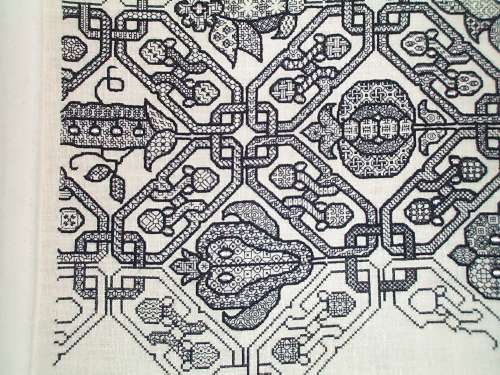
I’m having fun drawing these up, combing over the stitched pieces and drafting out what was stitched. And making up new ones. But not these. These are all from my notebooks, and all appear on my big blackwork underskirt and Forever Coif. #39 and #40 are especially useful for small areas. My coif has lots of those:
PATTERNS PLATE 6
On to page 6. Remember – you can click on the page images to get a US letter size full page printable JPG. A PDF compendium of the whole set will be issued after the last page is posted here.
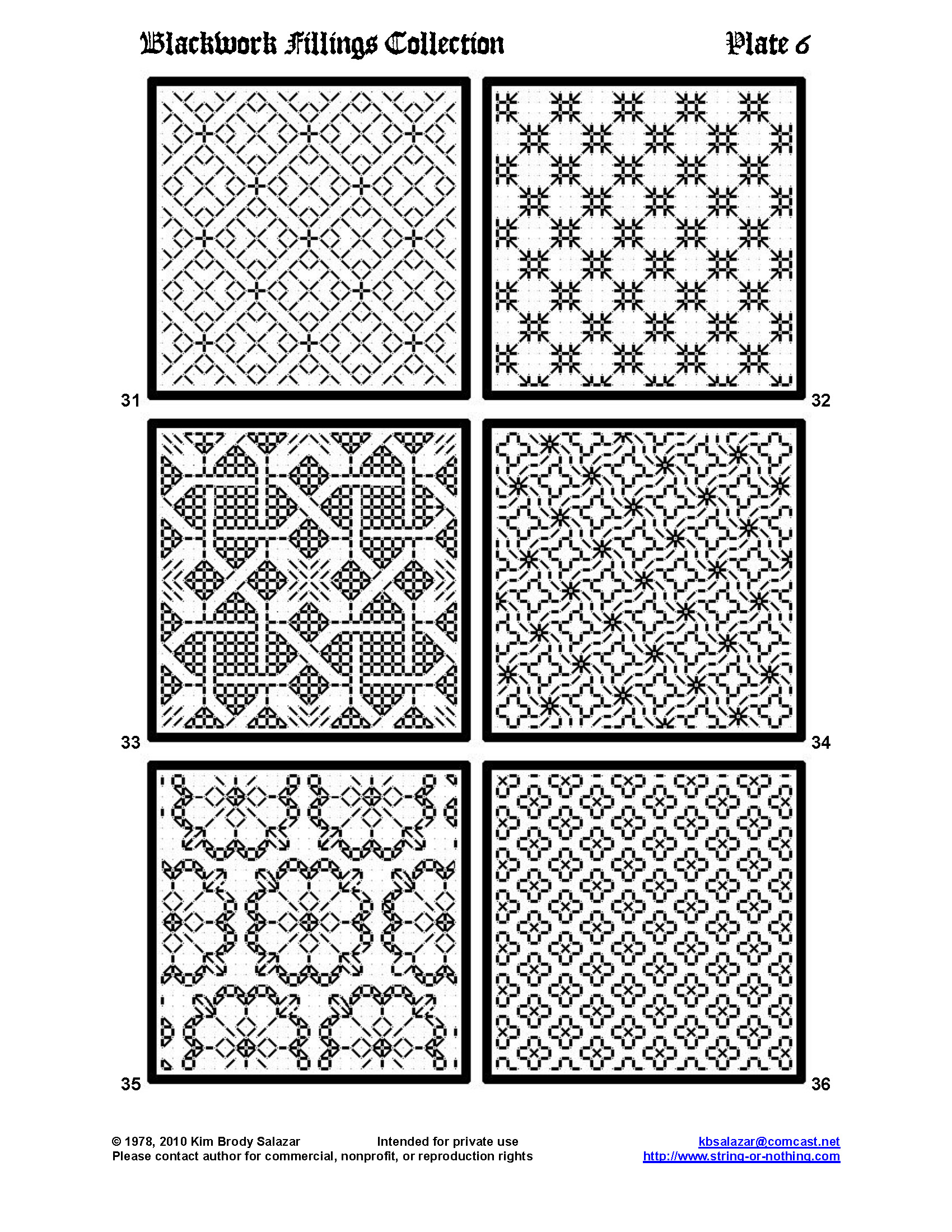
I’m also fond of #31, #34, and #35. #34 is calculated to drive you dizzy while stitching. It takes a bit to wrap the brain around the eccentric spacing on the repeat. But it’s worth it. I’ve used it dozens of times, sometimes with little crosses sporting a centered cross stitch when I wanted something more uniformly visually dense. I’m not wild about the interlace in #33. It’s too skinny, although at a distance (mocked up by the tiny thumbnail above) it looks better than it does close up.
If enough folk are interested, I’ll post an illustrated tutorial on using open source/free GIMP for this style of charting.
PATTERNS PLATE 5
Page 5:

This is turning into quite a holiday present. I’ve now posted five pages (30 fillings), and because I’m continuing on to graph up other patterns I’ve improvised as I stitched my projects, plus others in my notebooks, I can safely say that I’ll be posting a page a day through the mid-December at the least. Possibly longer.
On today’s page you’ll see a couple of my favorites. #27 and #29 I’ve used again and again. I like the voided flowers formed by #27, and I like the movement in #29. #28 is also an old fave. That same spiraled band appears in all my booklets as a simple border, sometimes published with a corner. You can see it (with corner) on my ancient pre-SCA “Eve Was Framed” unfinished sampler, circa 1975 or so:

More about this old, unfinished piece here.
PATTERNS PLATE 4
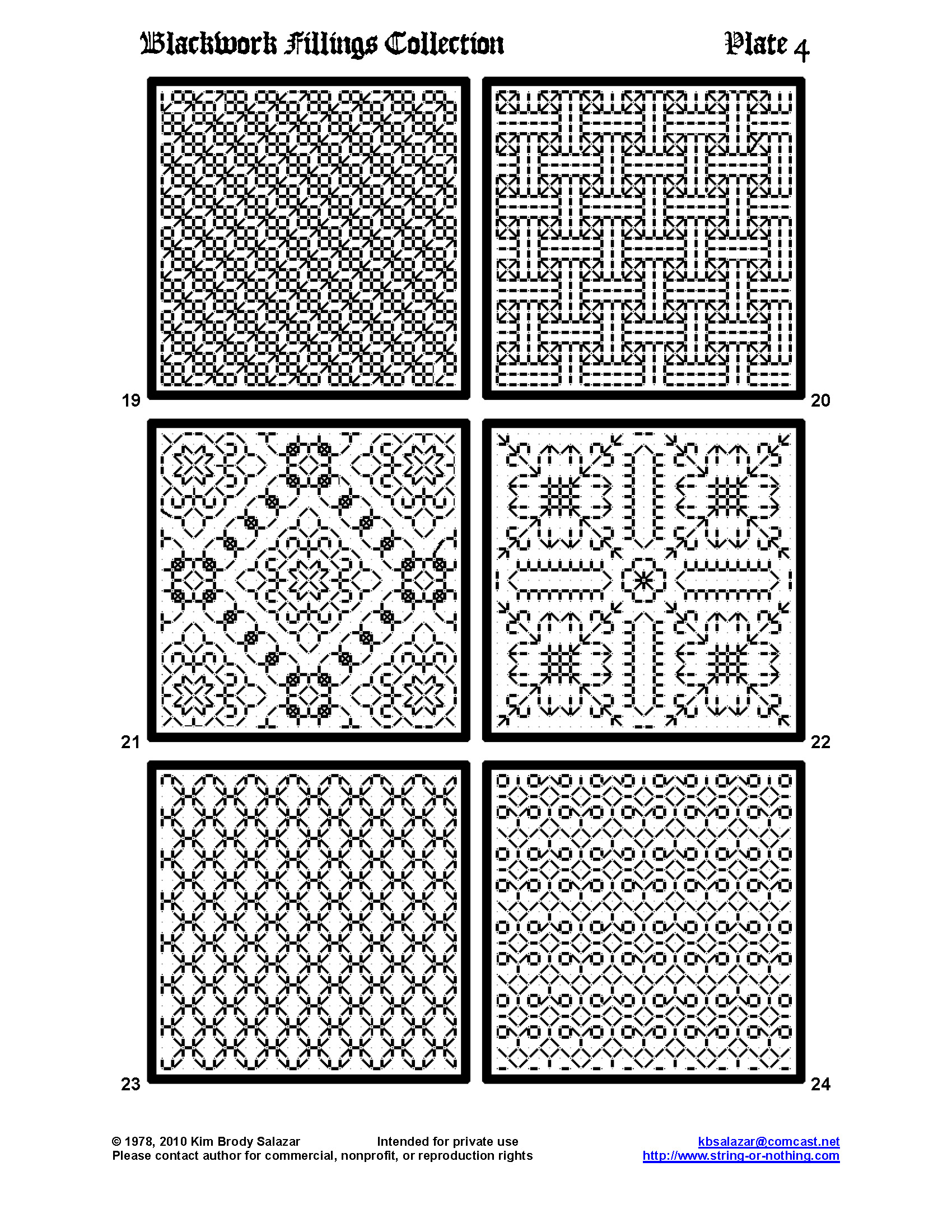
As promised I return to the keyboard and post the fourth page of blackwork filling patterns. Again these are patterns originally published in my 1978 booklet, redrafted and re-issued here.
More thanks to those not mentioned yet who have offered encouragement and thanks, including (but not limited to) local Carolingian Ygraine; String readers TexAnne, Pam, twerp, Cailee, fourdny2, PamC, and Annanna; and Yahoo Blackwork Group members Sherry, Linda, Annabelle, Anita, Esther, Sharon, Gail, Millie, Nicole, Viv, Elspeth, Georgia, Susan, Audrey, Rebecca, Nancy, Heather-Joy, Gaz, Viji, Magda, Elizabeth, Sorcha, Isabella, Maria, Liadain, Jean, Millie, and Shirley. Apologies if I’ve left anyone out.
More tomorrow!
 String-Or-Nothing