CLOTH #2 – FINISHED, PLUS BONUS DOODLE
Waaayyy behind on my blogging, I’m now not only finished with the stitching on the first Forehead Cloth, I’m finished with the second one, too.
Because I have only a limited supply of the excellent hand-dyed thread, and the first triangle had a voracious appetite, I decided to work the second both smaller in size, and with only two plies of the four-ply silk floss. I am not sure that the thread maker intended it to be used stripped into plies, but with patience and gentle encouragement, I was able to do so with minimal tangling and no losses. Gentle finger spinning counter to the direction that the plies were assembled helped, as did tension on the strand while separating. And it worked! I have more than enough to finish, as you will see below.
On the design – I went through a couple of iterations. I started with one from my forthcoming book:

I liked the larger motif, but not the smaller one. It has a very prominent cross, and while it might not have been so apparent when a large area was worked, I noticed it. I am not comfortable wearing crosses, so I drafted up a new companion motif to use in its place. You can see the old one just peeking out at the top of the photo below, for comparison.

I liked the visual balance of this one better. While I lost some of the light/dark checkerboard effect of the original, I gained an interesting play of curves and frames. Considering that this pattern conforms to the 45-deg/90-deg/180-deg composition rule found in just about every historical piece of linear stitch count-work (“Knight’s Move” two-over-one up stitches are exceedingly rare), seeing curves at all is almost an optical illusion.
Here is the final, plus a bonus doodle on top, which I’ll discuss in a bit:
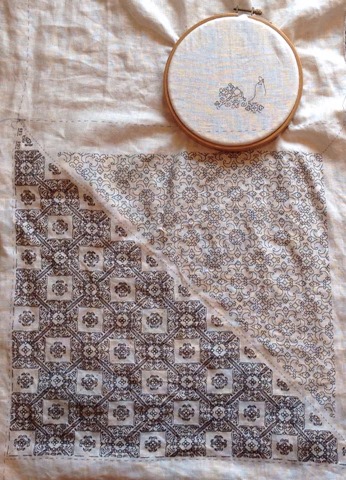
After I finish the bonus bit on top, I will remove the basted guidelines, gently clean my stitching, and draft out the lining and strings. I’ve got some pre-shrunk muslin I’ll use as the lining. I may use a length of this even weave, folded or rolled into a quarter-inch strip for the ties. That appears to be the treatment most like the extant historical pieces. The other option is using some purchased woven tape, which I think would look clunky and mismatched, by comparison. In any case, there is no needle lace trim, adornments on the tie strands, or other embellishments for these. I suppose I could add paillettes to this one, but I’ll save that bit of effort for a future matched coif-cloth set.
On to questions from my inboxes:
You said you proof against established work. What do you mean by that?
I cue my work off established, stitched areas. Unless there’s no way around it, I rarely establish a very long outline or outlying branch teetering off into as yet unstitched territory. I tend to bend my working logic so that I am usually stitching relatively close to finished bits. That way I can easily confirm that I am still on-count and parallel to the rest of the piece. If I am off, it’s almost invariably because I missed count on a diagonal, going over or up an extra thread (sometimes both). I can reduce the chance of error if I do that diagonal by eyeballing a one-stitch horizontal or vertical displacement from an established grid point, rather than making the diagonal with no point of nearby reference. In this way I am constantly checking my work for “true.”
Another way to proof off established work is to work attachment point stitches when they are encountered, if I intend on finishing up that divergent design segment and making that meeting later on from another direction. It’s much easier to see and meet up with a little “twig,” and to spot potential deviations early on, than it is to meet up with a solid line of stitching, where identifying the individual stitches can be tricky, later on.
What thread are you using/Where did you get it?
I got it at Birka – four ply filament silk hand dyed using iron and tannin (full disclaimer here) by my Stealth Apprentice. She is launching a small venture producing historically inspired Roman jewelry, plus embroidery threads and ribbons dyed with historically accurate materials and methods. I am helping by being an early customer, sponsor, and “beta tester” for the threads.
Now on to the doodle.
That little lump in the hand-held frame above the two triangle-shaped forehead cloths… What the heck is that?
It’s a doodle. I had thread and ground fabric left over after I finished the two cloths, so I decided to just aimlessly stitch away, trying out some of the larger fills or smaller all-overs that rarely have scope to come out and play (like those on the forehead cloths themselves). This particular design is from my free collection of fills, Ensamplario Atlantio. No plan here, just idle stitching while the ground is still in one easy-to-handle piece. Along the way over the past week or so, my doodle has decided it wanted to bear a motto and become a mini-sampler. So here is progress to date:
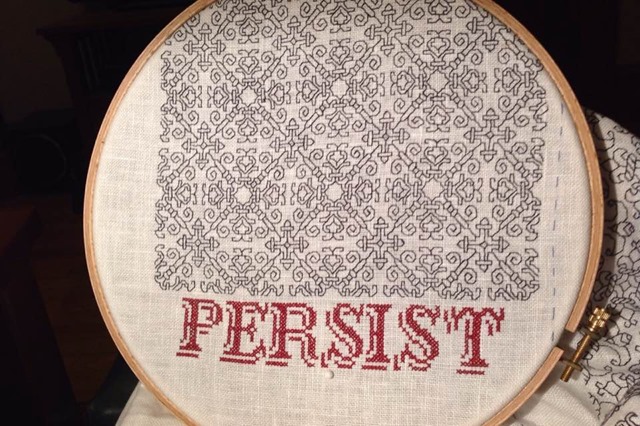
I’m not sure what will be below the motto, but whatever it is will keep me doodling for another week or two. For those who want more info, the alphabet I used is here.
ALMOST THERE
As you can see, progress on the first blackwork forehead cloth has been quite swift:
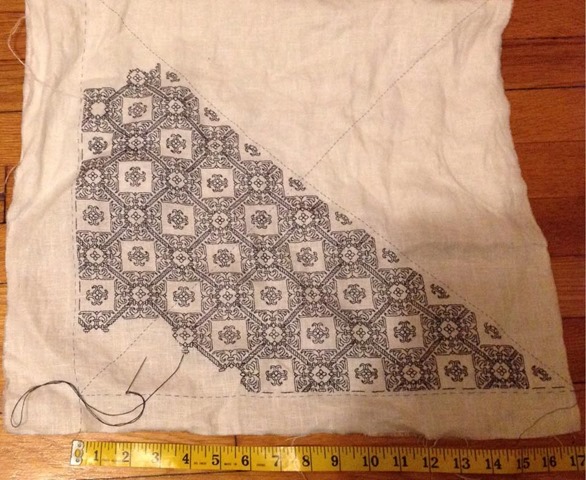
I have just two corners left. Although I have been using my sit-upon tambour (round) frame for this project, I will now switch to a hand-held hoop. That’s because it’s significantly smaller, and better able to get close to the edge of the cloth.
On thread consumption – I started out with a 100-yard skein of the hand-dyed filament silk. What you see here is the entire thing. Every inch. Luckily, I have another and will use a bit of it to complete.
Here are some more answers to questions posted here and other places where I’ve shown this piece.
What does the back look like?
Pretty much the same as the front:
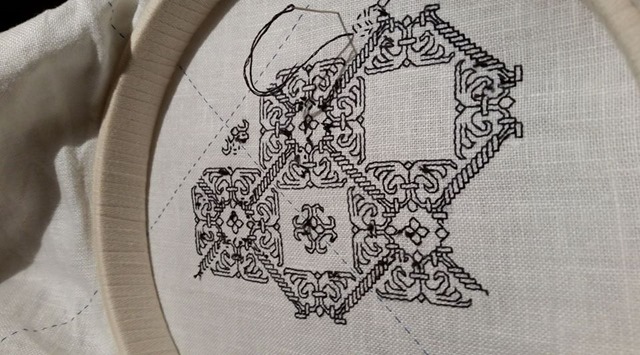
That’s because I’m primarily working this in double running stitch, which the assiduous can make entirely double sided. I am not bothering (note the presence of Evil Knots) because this cloth will be lined.
How do you keep your knots from pulling through?
I never just make a knot, then push my needle up through the ground cloth, trusting entirely on the bulk of the knot to keep the stitch in place. I either knot around a bit of established work, or if no previous stitch is handy, I make a knot at the end of my thread, stitch up, then down again leaving about an inch not pulled through to the front. Then I use my needle to pierce the working thread. I gently pull the thread into place, snicking up that inch of extra, and manipulating the just-made noose-join so that the knot isn’t in peril of being pulled forward. Yes, I could make a waste knot on the front, then trim the thread back in a more traditional method, but in this case at least, the thread is prone to shedding color, and I prefer not to make a mark “outside the lines.”
On the terminal knots, I run the thread under an established stitch and do what amounts to a double hitch knot, then use my needle to pierce the newly made knot, pulling the thread tight. This acts as a second lock and prevents unraveling or pop-through.
How do you determine your double-running baseline in a complex design like this?
I know I’ve written extensively about finding the baseline, but in this case, there isn’t just one stitching logic. There are many, and they are all situational. Do I want to go “out and back again” so that the active end of my line of stitching ends up near the point of origin? Do I want to just head out in one direction until I run out of thread, then follow up with a second strand, filling in my every-other-stitch? Do I want to establish the location of a design element, then go back and fill in detail later; or do I want to do every detour and departure on the first pass, leaving only a minimal amount of work for the second pass? How much thread is left in my working strand? Lots? Just a little? All of these thoughts combine and influence my path planning. I can say that the stitching logic in no two of these repeats was identical – it was all done to optimize the remaining thread, cover the design without omissions, and to make counting and alignment as easy as possible; and the mix of those factors at any one time varied wildly.
However there is one thing that ended up being of great help in keeping everything properly lined up and accurately on-count. When I have a T-intersection, on the first pass I include the “attachment stitch,” so that when I come back and link up to that segment, the exact spot is easy to find. Otherwise, if I continued straight along the top of the T, when I came back later and had to add the vertical, it would be harder to know if my alignment was correct; if the new addition had synched up correctly to the prior work.

You can see this in several places on the snippet above. Look at the heavy stacked diagonal at 1:00. On its base, where it joins the circular plume-flower medallion, I’ve left a little vertical hanging off the foundation 1×3 rectangle. That’s an attachment point. As I near it on my next stitching pass, I can cue off it to proof my work as I go, and know that I am on target for an absolutely aligned attachment point. That’s also why I have those little barbs sticking out on the base of the as-yet-to-be-stitched diagonal at 5:00.
What are you going to do with the rest of the cloth?
It would be a shame to cut out my completed triangle, leaving a difficult to handle remnant. So I am going to stitch a second, smaller triangle opposite this one, leaving cutting room between them. After I’ve finished #2, I’ll assemble both forehead cloths. Not sure what motif to use on the second one, but likely it will be less dense, because I have less thread.
What are you using for the ground? Do you like it?
I’ve had this piece of MCG Textiles even weave in my stash for at least a year, maybe two. It was the last bit of 32-count linen ground on the shelf at a local JoAnn’s big-box crafts store. I do not recommend it.
I have to say that I’m spoiled by higher quality linens at this point. I am finding too many irregularities – thick/thin threads, slubs, surface matting, and the like, that are affecting the look of the finished project. There’s one area in particular that drove me crazy – a segment of a few inches in which every other thread was super narrow. Countwork there was not fun at all. In addition, it’s not really an even weave. There’s a distortion if you compare north-south to east-west. (I can’t tell which is warp and which is woof because the bagged segment had no selvedge on it). I grabbed it off the top of the stash when I started this because it was a nice coarse count, the size of the piece was suitable (minimal waste), and I wanted to begin quickly, without ordering or hunting for materials.
FOREHEAD CLOTH/KERCHIEF PROGRESS
This is working up to be a quick stitch:
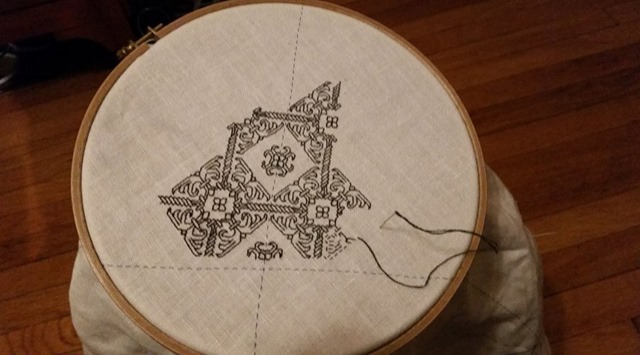
I attempt to answer questions submitted via email and on-line. If you have other questions, please feel free to post and ask. There are no secrets here.
Where/what is this pattern?
It’s one of the many designs in T2CM. It’s quasi-original, based on a 15th century strip pattern from my all time fave V&A sampler, the famous (and infamous) T.14.1931. I presented the strip in TNCM, but here have morphed it into an all-over. There are only two designs in T2CM that revisit some aspect of a pattern from the first book. This happens to be one of them.
Here is the original historical design in strip form, as worked on my Clarke’s Law sampler:

What stitch are you using?
Mostly double running, with short hops in “Heresy Stitch”. But I’m not being slavish about the double-sided/double running protocol. I am using knots, and I am strongly considering a muslin lining for my forehead cloth. I think it will help it wear better, by reducing stress on the ground fabric. Therefore, with the back well hidden, I am under no pressure to do a perfect double-sided parlor trick. That being said, I do tend to stick to double sided logic for best thread economy and minimal show-through.
What thread and ground are you using?
The ground isn’t fancy – it’s a prepackaged linen or linen blend even weave, with a relatively coarse thread count of 32 threads per inch. It is stash-aged, and parted company from the packaging long ago, so I am not sure of the brand name it was marketed under, or the retail source. I’m stitching over two threads, so that’s about 16 stitches per inch. I tried stitching over three, but thought the look was too leggy.
I am using a special treat thread – a small batch hand-dyed silk from an SCA merchant. I got it at Birka, and I hear it will be intermittently available at the Golden Schelle Etsy shop*. The thread is dyed with iron, tannin, and logwood, and is a warm black in color. In thickness it is roughly equivalent to two plies of standard Au Ver A Soie D’Alger silk, although it is not a thread that can be separated into plies.
Do you wax your thread?
Yes. For double running stitch work, even in silk, I wax my thread lightly with beeswax; paying special attention to the last inch for threading through the needle. While I would not as a rule wax the entire length of the silk for work that depends on sheen (like satin stitch), at the very short stitch lengths used in double running, loss of sheen is minimal. Waxing keeps the thread from fuzzing against itself as it is pulled through the same hole more than once, and (if you are working with multiple strands) minimizes the differential feed problem, without resorting to using a laying tool – which I find tedious for such short stitch lengths. Others adore laying tools, so use of them is a matter of personal preference.
What needles do you use?
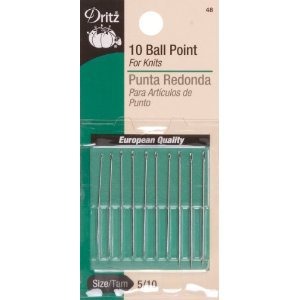
I favor a rather unorthodox choice for single strand double running – ball point needles intended for hand sewing on tricots and fine knits. They have a nice, rounded point, that slides neatly between the threads of my ground fabric, and a small eye. Blunt pointed needles intended for embroidery often have large eyes, which make thread management for a single strand unwieldy, allowing it to slip out of the eye too readily.
How do you know when to “go back again” in double running?
A lot of people think that working double running means you head in one direction, then turn back and retrace your steps. They carefully calculate the length of their stitching thread, and when they get to the half-consumed point, turn around and go back. This works, but tends to cluster thread ends. If you cluster your ends you end up with (for double-sided work) a large number of ends to hide in a very small space, or (for single sided, with knots) an untidy zone, with many knots and ends in the same place, which can show through to the front.
Instead I just keep going. I use up my length of thread, following my stitching logic, headed in one direction. Then I begin a second strand,staggering my starting point from my original start, first filling in the previously stitched path, and then extending the design further. Since I tend to do offshoots and digressions as I come to them and these do eat more thread as I trace them out from and then back to my main stitching line, I rarely have more than two ends at any one point in my work, and those two-end spots are widely distributed, rather than clustering in one small area.
How do you determine the baseline and stitching logic in an all-over?
There’s a little bit of catch-as-catch-can, but the basic concept is dividing the work into zones. In this piece the zone is flexible, and can be centered on either square area bordered by the spider flowers, connected by the twisted framing mechanism; or on the smaller area defined by the “root zone” of those spider flowers, again connected by the twisted framing. I go around either one of those, hopping between them as needed. In either case, the small center elements – the tiny quad flower, or the quad flower with the elongated tendrils, is worked separately, with no jumps back to the main motif.
And speaking of that tendril-flower – I am not entirely happy with it. I may pick it out and draft something else to go there. For the record, the nice, large square it inhabits would make a nifty place for initials, heraldic badges, whimsical creatures, original motifs, or other personal signifiers.
Why are you using a round frame?
Because I have two flat frames and one round (tambour) sit-on frame, in addition to several round in-hand hoops. I have works in progress on both flat frames, and don’t want to dismount them to do this quickie. My tambour frame has a padded bottom hoop, and when time comes to move the fabric and squash bits of just-done embroidery, I will pad the work with some muslin to protect it on the top as well as the bottom side. Again, working short stitches with no raised areas – even in silk – makes this a less risky proposition than it would be for other stitching styles.
Can I see the back?
In the next progress post I’ll include a shot of the back.
* In the interest of full disclosure (and the no-secrets here thing), the un-named proprietor of Golden Schelle is my Stealth Apprentice. Shhh. It’s a secret.
ADAPTING FOR MODERN USE
Yet another post only a stitching/historical clothing geek would love.
Forehead cloths.
What were they? Why do I care?
Forehead cloths were triangular kerchief type items, often matched with a coif (a close-fitting cloth hat) produced during the 1500s and 1600s. Some still exist today in set with their coif, some are separate – possibly parts of sets, now orphaned over time. They appear to have been quite popular based on survivals, and surprisingly for a popular item – how they were worn is not an entirely settled issue.
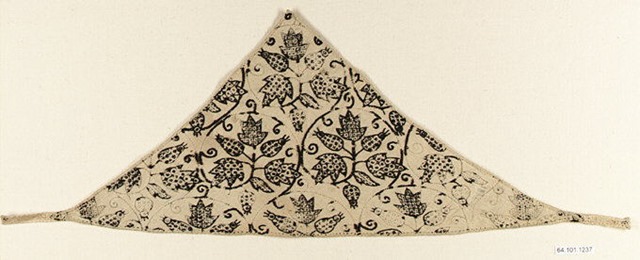
Blackwork forehead cloth in collection of Metropolitan Museum of Art
British, last quarter of 16th century – roughly 14.5 x 16.5” (36.8 x 41.9cm)
Accession 64.101.1237
Some suggest forehead cloths were worn underneath the coif, tied or pinned firmly behind the head under the wearer’s bunned-up hair. In this configuration, the cloth would keep the hair contained, and provide a firm foundation on which to pin the coif itself. Having worn coifs and hoods of the time, this is very logical to me, and makes perfect sense.
Others suggest that the cloth may have been worn over the coif; or even instead of it, for sleeping or indoors-at-home informality. I do note that in coif-cloth sets where metallic or linen lace trims the coif, the accompanying forehead cloth is rarely adorned to match. This makes sense if the cloth was worn under the coif, but would be odd if it was worn covering the coif’s fancy trim. Were they ever worn alone? No one knows…
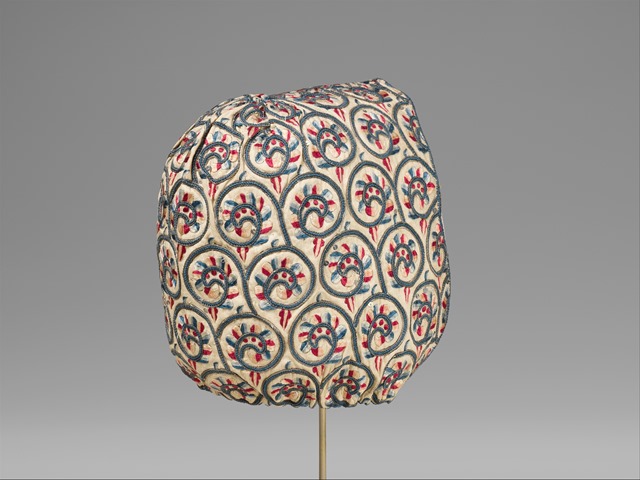
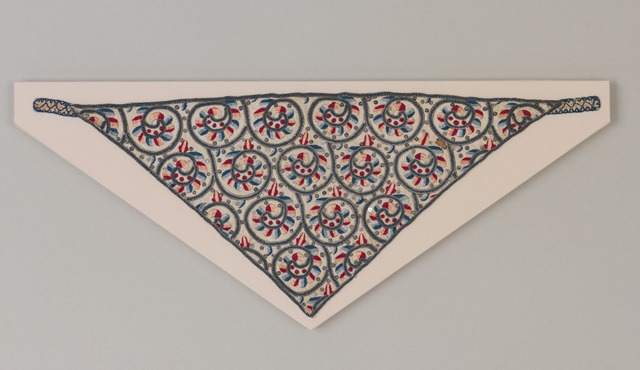
Polychrome forehead cloth and matching coif, also Metropolitan Museum of Art
British, 1600-1630, cloth roughly 7 x 17.5” (17.8 x 44.5cm)
Coif – Accession 64.101.1242 Cloth – Accession 64.101.1243
What we do know about forehead cloths is that they come in as many stitching styles as do coifs – blackwork, other monochrome, polychrome, counted, freehand stitched, fancy with metallic threads and sequin embellishments or plainer; standard Elizabethan/Stuart era scrolling flowers and vines (with or without insects and birds); all-over repeat or geometric patterns – you name it. Some. like the one below, even look like they are remnants of larger embroidered items, cut down and re-used.
 Stippled blackwork forehead cloth from the Victoria and Albert Museum
England, 1625-1650.
Accession T.42-1938
About the only thing I haven’t seen yet is one that is mostly plain ground, stitched just along hypotenuse edge rather than being entirely covered with pattering. Some cloths (like the first two above) have small tie strings, some are just triangles, with no tabs, ribbons, or strings (although those may have become disassociated over the decades).
Now, why am I so interested? I rarely get to SCA events these days, and don’t have an outfit (or a finished coif) to match a forehead cloth.
I want to make one for mundane day-to-day, modern wear.
I like wearing a bandanna or kerchief to keep my hair out of my eyes, especially during “down times” on weekends, or when we visit windy Cape Cod. It strikes me that a purpose-built forehead cloth would serve well, and be a bit more distinctive than a plain old paisley bandanna. Being small, it would not be onerous to stitch, and would be a fun thing to adorn with one of the larger all-over or infinity repeats that I’ve charted over the years.
I’m laying out the size of the piece now, basting my dimensions onto ground cloth. More news on this as the project develops.
ACCOMPLISHMENTS
And its the cold, snowy part of the Boston seasonal experience. Which is not improving my outlook much. But there are bright spots. We do what we can.
Here’s a free offering (also available via my Embroidery Patterns tab, above). This motto just cries out to be a sampler, the irony of using an art that in and of itself requires intensive perseverance to accomplish is just too sweet. Click on the chart image to get the full JPG, formatted for 8.5 x 11 inch paper. (Finished stitching sample courtesy of long-time friend Gillian, who was the first to post a finished piece picture. Her’s is on 14-count Aida, finished post-wash size of stitched area is about 7″ x 9″.)


And here’s the finish from Edith Howe-Byrne on even weave, showing her variant treatment of the concept, using other counted stitches and beads (she’s leaving in the gridwork so she can use this piece as a reference for additional projects):
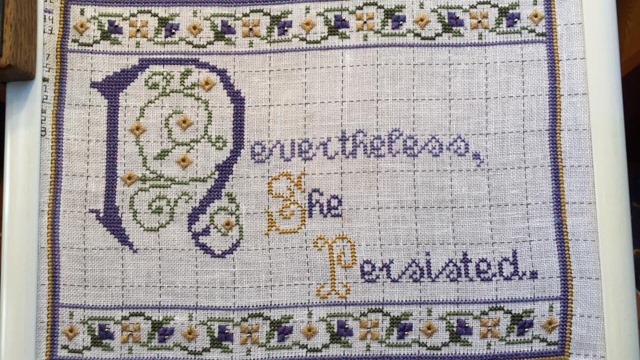


The alphabets used are (more or less) contemporary with the women’s suffrage movement – found on Ramzi’s Patternmaker Charts site, among his collection of vintage Sajou and Alexandre booklets. The particular one I used for all three alphabets is here. The border is adapted from one appearing in a 1915 German book of cross stitch alphabets and motifs, in the collection of the Antique Pattern Library.
We all do what we can, and I encourage anyone with heartfelt opinions to use their time and skill set in service, as they see fit. Even if you don’t agree with me, filling the airwaves with positive messages rather than caustic imagery can’t hurt.
If anyone stitches this up and wants me to showcase their effort, please let me know. I’ll be happy to add pix of your work to the gallery here.
On my own end, I have been productive as well.
First finished (but not first started) – a quick shrug. Possibly even for me.

This is knit from the generous bounty resettled upon me by the Nancys, for which I continue to be grateful. The multicolor yarn is older Noro Nadeshiko, a blend with a hefty dose of angora, along with silk and wool. It is soft and supple, and although I am generally not a fan of desert colors – is superbly hued, with just enough rose, sage, cream, and grey to be perfect. The accent edge is done is another of their gift yarns – two balls of a merino wool variegated single, worsted weight. I held it double for extra oomph. One thing to note about the Nadeshiko though – it sheds. A lot. And the Office Dogs where I work like to sniff it (it probably smells like a bunny).
The pattern is Jennifer Miller’s Shawl Collar Vest – a Ravelry freebie. It is a no-seam, quick knit, written for bulky weight yarn. The thing fairly knit itself. Four days from cast-on to wear-ready. My only criticism is that the XL size is really more of a 12/14. I can wear it, but it’s very tight, and tends to emphasize attributes with which I am already more than proportionally blessed. My answer to this problem will be to unravel the green finish rounds, and add about 2 inches of stripey, then re-knit the green.
The nifty pin is an official heirloom of my house. Long ago and far away, SCA friend Sir Aelfwine (now of blessed memory) made it for me as a cloak pin. Obviously I still treasure it and wear it when I can.
On the needles is also yet another pair of Susie Rogers’ Reading Mitts, another free pattern available from Ravelry. I’ve done four pair of these, but never for me. I rectify that oversight now.

Obviously, the first one is done. Now for the second.
The yarn is yet another denizen of the Great Nancy Box – a worsted weight handspun alpaca – chocolate brown with flecks of white and pale grey, from Sallie’s Fen Alpacas. The photo doesn’t do the yarn justice. It’s butter on the needles, and gloriously warm. The only mod I make to the original pattern is using a provisional cast-on, then knitting the cast-on edge to the body on the last pre-welt row (to eliminate seaming).
My typing fingers will be toasty when #2 is done.
FINISHING OFF A HANGING SAMPLER
OK, I promised I’d write this up, and it has taken me a while, but here it is.
My thought here was to create a quick and easy way to finish off a hanging sampler, using a method that did no harm to the stitched piece, that was inexpensive to do, and required no special equipment or components that can’t be found in most crafts stores.
Why “no harm?” Because many inexpensive framing solutions do exactly that. They place fabric under stress, encase it in moisture-trapping glass, matt it or line it with acidic materials that over time discolor or eat away at the ground cloth, or place the fabric up against wood or metal that can corrode or mark the cloth.
This solution is far from ideal, but it manages tension to avoid stretch or strain in hanging, isolates the stitched piece from any wooden or metal framing elements, can be quickly picked out without harm to the original work, and is very inexpensive.
Here are several examples (the center one is mid-process):


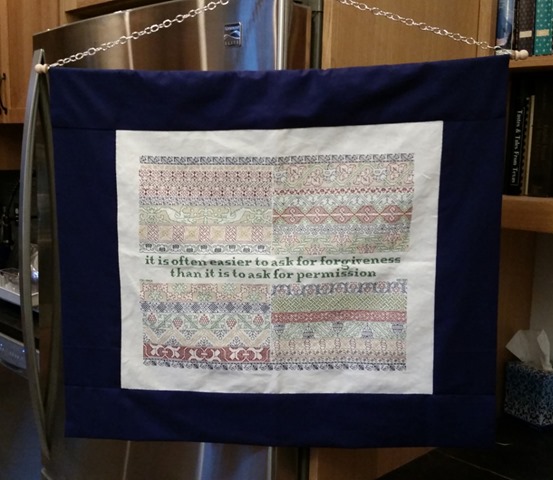
In all cases, a larger piece of backing fabric has been used to encapsulate the stitched item. The hanging bar (wood or metal) and bottom-weighting only touches the backing fabric. All are totally sewn by hand – no machine stitching.
Note that you don’t need to have actually stitched a sampler to do this. It would be useful to finish off a decorative tea-towel, heirloom doily, cloth map, or small pieced patchwork as a hanging, or (for my SCA pals) to mount a painted or printed banner for display.
To do this you need:
- Your display piece.
- Backing fabric. I used plain old quilting cotton. Any fabric will do, although for the “no harm” bit, I suggest washed cotton or linen rather than polyester or other synthetic. Size needed calcs below.
- Plain old cotton sewing thread that matches the backing fabric.
- A hand-sewing needle – a sharp with a small eye is recommended.
- A metal bar or wooden dowel for a top support (fancy finials are optional, but can be handy for fixing hanging strings or chains in place so that the hanging mechanism doesn’t compress the top edge of the hanging).
- The aforementioned hanging string or chain.
- An iron and ironing surface.
- A pair of scissors
- Straight pins
- A ruler and a tape measure
- Standard office stapler
- Optional weights for the bottom edge. I have used a length of brass chain, threaded onto an old ribbon, and small zinc drapery weights (small bars of zinc enclosed in a synthetic fabric envelope). These are sold in packs of two or six, in the curtain-notions department. Avoid the lead ones just on principle – the world does not need more free-range lead. In a pinch, coins sewn into little fabric pockets will do. If you are using drapery weights or coins, you only need two.
I found the backing fabric, dowel, wooden finials, the drapery weights, and the chain all in my local JoAnne’s fabric/crafts store.
First, decide how you want to frame your piece. A large area top and bottom, with narrower areas on the sides? Equal frame all the way around? The general size will inform your fabric purchase, although one yard of most quilting fabrics will be MORE than enough for all but the very largest samplers.
For the Permissions sampler, I decided I wanted a blue frame about 3.5 inches all the way around, and to preserve about 1 inch of unworked ground between the stitching and the edging I put pins in my sampler to mark that distance from my stitching, and measured the “to be shown” dimensions of my piece. About a half inch of my sampler, all the way around, will be hidden inside the backing.
Let’s call my display width 20 inches, and my display height 16 inches (to be truthful, I didn’t write down the real numbers). I know I want 3.5 inches of framing edge to show on all sides. Plus I need a hem allowance, let’s call that 0.5 inch. Here’s the logic:
| Hem |
Edge |
Display Area |
Edge |
Hem |
|
|
Width |
0.5” |
3.5” x 2 |
20” |
3.5” x 2 |
0.5” |
|
Height |
0.5” |
3.5” x 2 |
16” |
3.5” x 2 |
0.5” |
So, by doing the addition, I need to cut my backing cloth to be 35” wide, and 31” high, which is what you see is half-way done here (I’ve cut the width but not the height yet):
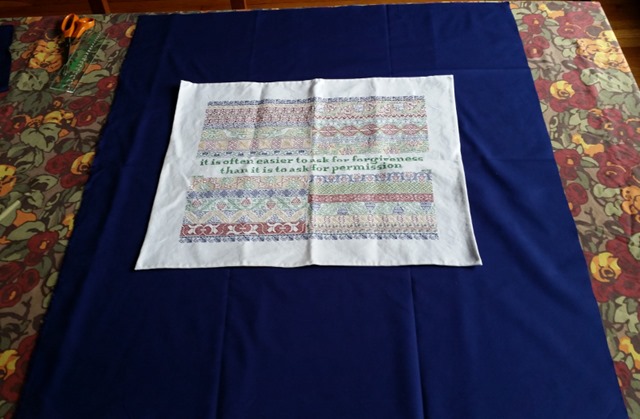
The next thing to do is iron in the 0.5” hem all the way around. Note that the “right side” of the backing fabric (such as it is, is DOWN). I chose to iron in mitered corners for tasty neatness, but that’s optional, and there are a ton of video tutorials on doing that.


Then I positioned my stitched piece on top of my backing fabric, making sure that it was correctly placed (the edge of my stitching was 8 inches from the now-folded edge of the backing – I should have left in my dimension measurement pins but I forgot, and took them out.)
Once the stitched piece was correctly positioned. I folded the left and right edges in, carefully aligning them (measuring the distance from my embroidery), and finger pressing them down and pinning. Because I stitched on even weave, I was able to use the count of my ground fabric for **perfect** alignment without having to mark the fold-to line on my sampler.
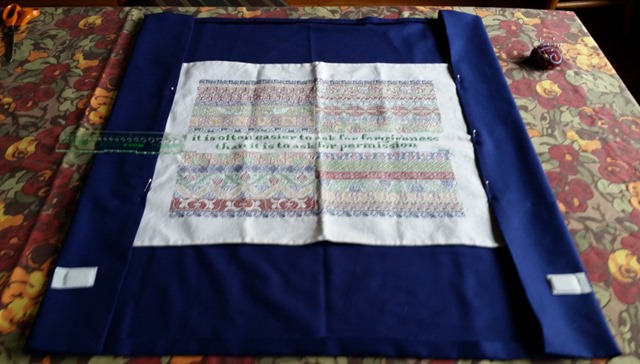
Those two little white tabs? Those are the drapery weights – note that they have little tab ends that are handy for stitching. That’s where they will go, encapsulated in the edging/backing, far away from the stitching. Next I folded in the top and bottom and pinned them, too. Once all edges were pinned, I lightly touched up the folds with my iron, to make them slightly crisper. Then I slid those drapery weights in and pinned them into place.
Here’s the thing, ready for hand stitching.

You’ll notice that there are simple lapped corners – I didn’t miter them. By doing this I can use the flap-over on the top as my hanging pocket. I do not need to engineer a separate hanging method for attaching the bar or dowel.
Now for the hand-sewing. Yes, I could have done this by machine, but hand stitching is easier to pick out in the future, and easier for me anyway to keep neat and aligned. There’s no real reason (other than speed) to do this by machine. And yes – I probably should have basted, but hey, what’s the fun without a tiny bit of risk. 🙂
Starting at the lower corner where the bottom and side flaps meet, and working first completely around the stitched sampler part, ignoring the flapped areas at the corners, I worked a simple hand appliqué stitch, catching a tiny bit of the edging, passing through the ground cloth but not the ultimate backing – at a diagonal, ready to make my next stitch. Here’s a tutorial on the appliqué stitch.

Note that I used the even weave’s threads to keep my hem nice and straight.
After I had worked the appliqué stitch around the entire visible area of my sampler, I used the same stitch to affix the two lower corners – the places where the bottom folded edge lapped up and over the folded-in sides. As I did each of these two corners, I worked from the visible sampler area back out to the edge. When I got to the side, I turned the corner and used a tiny whip stitch to seam together the front and back edges. When I got to the place where the weight was pinned, I wiggled it up so that I could just nip its flapped edge in as I was whip stitching:

I worked the top two corners similarly, but instead of working all the way down to the tip of the corner as I whipped the front to the back, I stopped about 0.5” from the top on both the left and the right. This left an opening through which I could pass my dowel. A small bit of finesse was needed to thread it through (I used another scrap of dowel to nose the hem allowance out of the way on the inside).
To make the hanging stick, I used a 1/4 inch dowel. I probably should have used a metal rod or a thicker dowel, but that’s what they had in the store. I bought a little pack of finials, and ended up having to shave down the ends of my dowel just a tiny bit so that they fit into the holes on the finials. I also bought a length of inexpensive craft chain, intended for chunky necklaces, with links large enough to fit around the dowel.
I cut the dowel to the width of my finished piece, plus about 0.5”. Using a regular office stapler, I stapled the chain to my dowel, about a quarter of an inch from the end. I dotted the inside of the first finial with wood glue and forced it onto the dowel and over a bit of the staple, so that the chain was butted up against it. Then I threaded the dowel through the top of the hanging, squishing up the hanging a bit to keep it away from my working end, I stapled the other end of the chain to the dowel, then forced on the second finial.
Taa daah!

CATCHING UP
It’s been a while since I posted last. Hectic doesn’t begin to describe it. Kitchen finish, work-related deadlines, college graduations, and last – a blissful vacation week on Cape Cod in our new beachside condo, full of kayaking, golf, good food, and the active pursuit of doing absolutely nothing. All in all too many things to accomplish, with too little time to document any of it.
But through it all, a modicum of sanity-preserving handwork has happened: three pairs of hand-knit socks (my default no-thinking project of choice); plus some others.
First, thanks to the generosity of Certain Enablers who shall remain unnamed – a vintage shrug. I began working on this just before the vacation break. On US #9 (5.5mm) needles, this one was a quick knit. At left is the photo from the pattern. At right is my piece.

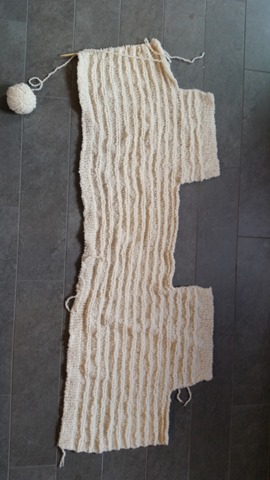
Those projections on the side are the sleeves. Obviously, I haven’t seamed the thing up yet. A bit of pretzel-type manipulation is slated to happen that will result in a T-shaped seam in the back, and the graceful drape of the simple drop-stitch rib pattern curving in the front. Or so we hope. I have the piece left on the needle because I haven’t decided yet on whether or not I will be doing some sort of live-stitch seam. It’s hot and sticky right now – too hot to sit with this tub of alpaca boucle on my lap. I’ll go back and finish this piece off when it cools off a bit. I’ll have to rush though, so Target Recipient can take the completed garment off to university with her next month.
Second is also a time-linked project. The first of two, in fact. I am edging off the two inspirational samplers I did for the girls, backing them and readying them for simple rod type hanging. Here’s the first. I’m hand’ hemming the backing/edging cloth to the stitching ground. The backing cloth is in one piece, strategically folded to be a self frame. I’ll baste a length of chain threaded on some thin woven tape in the bottom fold to provide weight, and leave small gaps in the two top corners for insertion of the hanging rod:
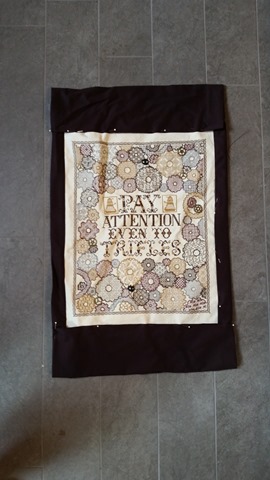
The second one will be close behind – the other sampler I did this fall/winter past. Also finished out for hanging from a rod. More on that after I’ve laid it out. In fact, if folk are interested, I’ll use the second one to illustrate the folding and stitching logic required to do this.
And finally, just for fun with no deadline attached (so you know what I’ll be working on tomorrow evening), an Autumn Lace shawl out of some unknown Noro fingering weight yarn, augmented by some Noro Taiyo Sock. The unknown Noro was also from the same Enabling Anonymous Donor, and was perfect for a project I’d been planning on working up for a long time:
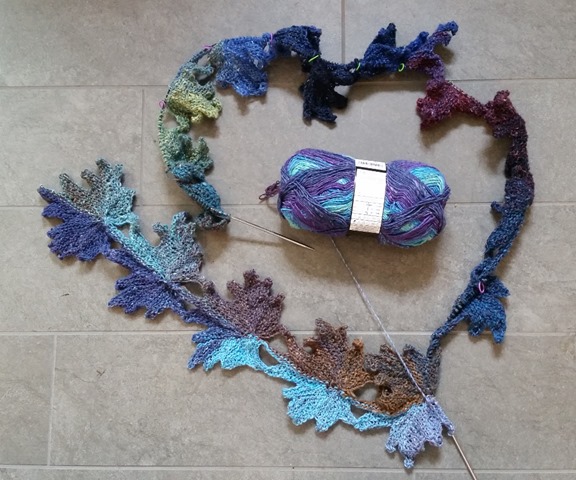
Here you see the first course of leaves (worked bottom half, then top half). This is not a particularly difficult pattern, but it is an exacting one, with a pattern that has to be closely followed, and that is not within my capability to memorize. More on this one as it develops.
STILL BARE AND BARREN
OK. The kitchen rehab enters the beginning of the “we’ve taken it all away – now we put it back” phase.
As I reported on FaceBook, those remaining walls and ceiling bits had to go. The previous homeowner, in a typical fit of doing things in the cheapest, and most stupid way, used a low grade of plain old wallboard underneath the skim coat plaster when he ripped out the original lath and plaster during his redo of the room in the early ‘80s. That means that they were not salvageable. We had not planned on taking down the parts that were not going to be modded, but we were forced to because the walls were crumbling. Oh well… There’s no such thing as a renovation of a vintage house that does not involve an Unexpected Surprise.
What’s there right now looks more or less like it did when this picture was taken on Friday.

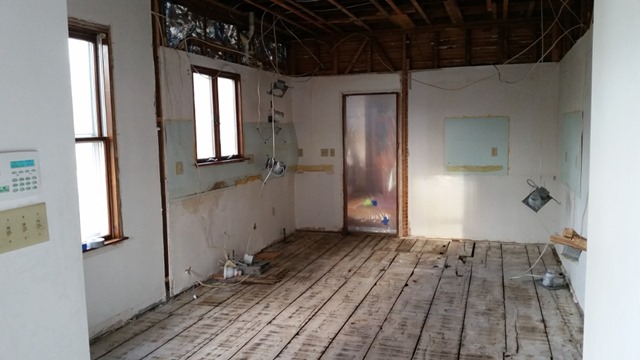
All the way back to the studs that used to support the lath and plaster, everywhere (with the previous stage picture provided for comparison.
Monday the crews came back, and removed the last bit of flooring underneath the radiant heater where the sink used to be, the room radiator and washing machine/dryer – disconnecting the water lines to do so.
They also roughed in the main plumbing lines. We are moving the sink from underneath the window to the other side of the room. While it’s nice to have the window view, moving the sink gives us a large span of prep counter adjacent to the rangetop, and allows us to put the dishwasher on the right hand side – much more convenient for us right-handed folk. But to do this, they had to relocate the main water and waste lines, and remove the unused components from the old location.
So progress towards reconstruction has officially started. From now on in, things should start to appear, rather than disappear.
Aside from the continuing drama of living in a construction zone, I did get to peel off this weekend and have some fun. I went to an SCA event – the Hrim Schola held in Barony Beyond the Mountain, on Saturday. For my non SCAdian friends, the day was a roster of classes in technique and history, focused on needlework, weaving, knotting, knitting, and allied techniques and tools. It was held in southern Connecticut.
First of all, I have to thank Needlework Pal Mistress Kathryn Goodwyn (she of “too many centuries, too little time”) for providing me with a suitable dress. I have been an SCA recluse for many years, and really and truly had nothing to wear. Since the day is done in historical dress, I could not have gone without her assistance. Sad to say, although I promised to take a photo of her Anne of Brittany dress and hood, I forgot… Still, many people admired it and gave me compliments on it, and were delighted to find out that it came from her hand, so many years ago.
Second I want to thank Lady Eadgyth for prodding me to attend, and to Aaradyn, Lady Ysane, and the rest of the Occasional Weekend Sewing Circle for helping me mend the gown and dress me in it (it takes a committee to do this).
I had a ton of fun, learning how to do Elizabethan-era plaited braid stitch in metal thread, seven or eight variants of lucet cord (I lost track of how many we covered), and swinging a hammer to dish out a small copper thimble from a disc of copper. While I can’t swear to the efficiency of metalworking while wearing a corset, I did produce a result. The teachers of these classes also deserve copious thanks for making the day worthwhile – respectively, the talented Elaine Howys, Lady Eadgyth, and the very patient Anton Leflamme. (Apologies if honors or names are mangled).
And one thing made the day even more special. I finally met my Stealth Apprentice. This green belt, when finished, will be for her:
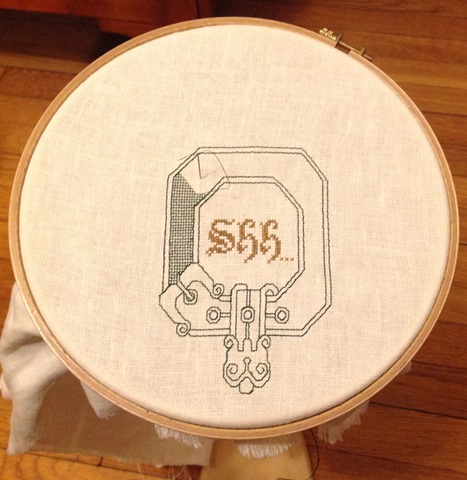
Yes, it’s more conventional to give an actual green belt rather than a representation of one, but I’ve always been unconventional. And this way she can choose the style of her belt herself, to match whatever period garb she prefers.
Her name? Well, she is a Stealth Apprentice, after all. I’ll let her chime in if she so desires. 🙂
PERMISSION GRANTED, MORE OR LESS
Here it is, totally finished, and with a vaguely decent picture (but as yet, unsigned and un-mounted).

The recipient is thrilled, which is always gratifying.
UPDATE: People want the specs on this piece so they don’t have to hunt through previous posts. 30 count evenweave linen ground, stitched over two threads (15 spi). The 6-strand floss is man-made “silk”, rayon actually; a vintage find brought back from India, slightly thinner than standard DMC floss. I stitched all of the foreground using two strands. Some of the background I did in single strand for contrast. Pattern strips with one exception are all from my forthcoming book The Second Carolingian Modelbook. The alphabet is from a vintage Sajou booklet #104 reproduced at Patternmakercharts.blogspot.com. I hemmed my linen by hand before starting.
The reason I haven’t done the last teeny bits is that I’m trying to finish off some end-of-year gifts for the spawn.
First up and already done was the new pair of Susie Rogers’ Reading Mitts, done in a sparkly yarn for Younger Daughter. She’s a fan of the surreal Welcome to Night Vale podcasts. One of their taglines is “Mostly void, partially stars.”
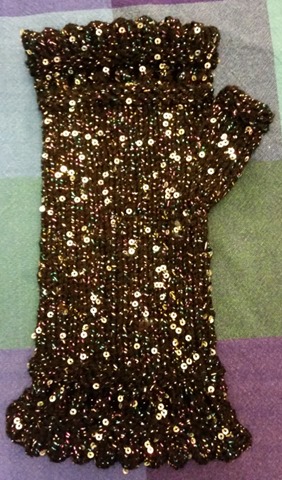
To get the partially-stars look, I used Loops and Threads Payette – an acrylic with a running lurex thread and small paillettes (flat sequins). Both inspiration and enablement are courtesy of Long Time Needlework Pal Kathryn, who sent this stuff to me. Just seeing it sparkling at me kicked off this project. Kathryn’s initial intent was to knit socks from the Payette, but that effort was a no-go. And rightly so. The stuff is not fun to work with, and would make supremely uncomfortable socks. The base black yarn is waxy feeling. The lurex thread breaks easily and is scratchy, and the paillettes can make stitch formation difficult – especially on decreases. Oh, and forget about ripping this stuff back. The lurex snaps. But the look can’t be beat, especially for a big-box-store available yarn.
Yarn aside, this project is a great quick-knit. Both mitts together took two evenings. I used the Payette doubled, and knit the smallest size, which fits perfectly. The only change I made to the original design is eliminating the bulk of cast-on and cast-off. To begin, I work a figure-8 or provisional cast-on. When I get to the last row before the cuff welt, I reactivate the bottom stitches and fold them up, knitting one bottom edge stitch along with its live pre-cuff counterpart. This melds the bottom into the work, and eliminates the final bit of sewing up, and cuts down on pre-cuff bulk.
To cast-off, instead of making a finished edge and then sewing it down, I leave a long tail and fold the live edge inside the work. Then I use that to secure each last-row stitch to its counterpart in the first row after the fancy welting on the upper edge.
Final verdict – the kid loves these. The original design’s pretty welt and eyelet detail is lost in the sequined look and it’s over the top sparkly. But it fits in perfectly with the Nightvale-inspired theme.
Next on the needles is a new scarf for Elder Daughter. As I mentioned in the last post, I’m enchanted by Sybil R’s designs and was determined to make one or another of them. At first we contemplated a different scarf, but rummaging through my stash, we came up with yarn better suited to her Mixed Wave Cowl, an exercise in nested short row enhanced stripes. Here you see the bare beginnings of mine:
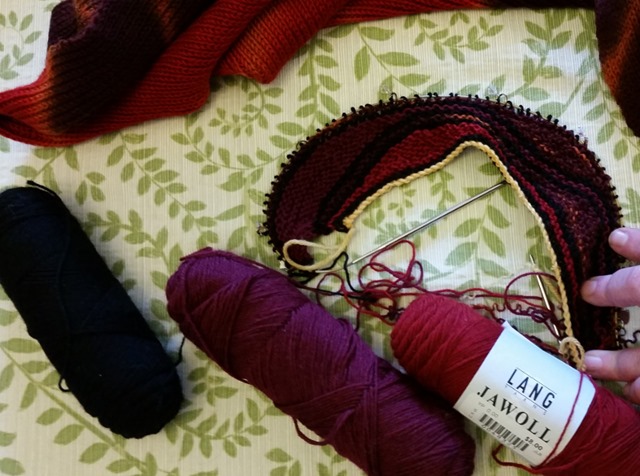
I’m using an eclectic mix of well-aged stash denizens, plus a more recent variegated yarn seen here in a rather blue-shifted photo. The black and russet are both Lang Jawoll bought who-knows-when. The claret (again not as purple as it looks here) is Froehlich Wolle Special Blauband, which I’m pretty sure I had when we moved back to Boston in ‘95. The variegated scarf thingy is Regia Creativ one of the unravel-me-and-knit dyed strips, in a mix of autumn colors including chocolate, russet, claret, and burnt orange. The pattern is written for DK, on rather small 3.5mm needles. I’m using fingering-weight sock yarn on 3.0mm needles, which is making a slightly looser fabric.
More on this one as it grows…
SO CLOSE I CAN TASTE IT
Alllmmoooosssstttt there….
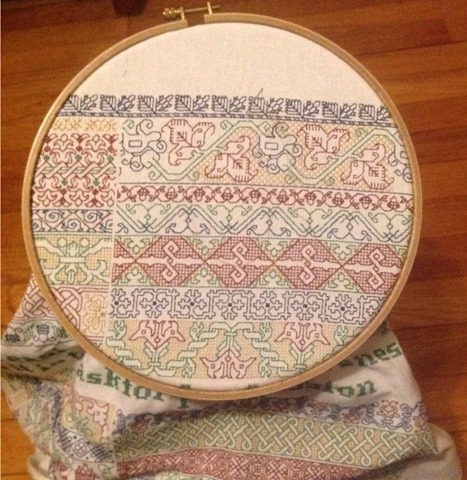
This is the last quadrant. I’m using yet another non-historical fill behind the scrolling flowers. This one is just cross stitches, arranged on the diagonal so they form on-point squares. I also worked this filling (and for that matter – all of the other fillings) using only one strand of my floss, so the shading is quite light. By contrast, all of the foreground stitching is done with two strands. You can see this quite clearly in the red lozenge twist, about five strips down. The foreground is two strands of red, and the simple box treatment background is only one strand of red. I’ll post a whole-sampler shot when that last stitch is complete.
So what’s next?
A couple of things. First, I have another sampler promised to a pal. This one will be heavy on the words, with far fewer accompaniments. I haven’t composed it yet, but I’ve been playing with concepts in my mind. One idea that keeps popping up is to work the thing more or less like a manuscript page, with a very demonstrative single large capital letter in the upper left; the phrasing flowing down from there; possibly with a single figural strip across the bottom, but a foliate edging of some type all the way around. Oh, and it will probably be monochrome or nearly so – a darker, unbleached natural linen ground, with deep forest green stitching. I’m not ruling out accents in another color yet, but the predominating color will be the green.
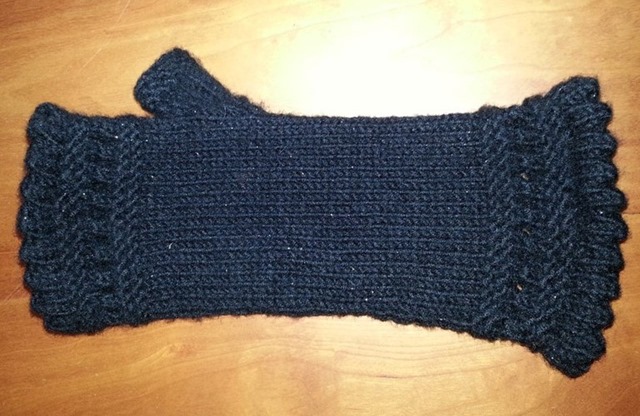
I also have promised some knitstuff to the spawn. It’s cold-hands time here in Massachusetts, so Younger Daughter has requested a replacement for her pair of fingerless mittens (muffatees). Long time needlework pal Kathryn has sent me some sequined black yarn that just cries out to become a pair of Suzie’s Reading Mitts. I’ve made this design before, and I know it knits up quickly and looks great, especially in black. Here’s one from the last iteration, knit as a gift for my niece:
And Elder Daughter has loved her angel-variant Wingspan scarf to pieces. It was the first one I did, and she’s been seasonally-inseparable from it since 2012. Here it is in less frayed times:

I’m considering several candidates for this project, but right now the leader is the Stripes, Stripes & Stripes Scarf from Knitting-and-so-on.blogspot.ch. I think Sybil Ra’s stuff is pretzel-clever, and with some screaming orange fingering weight, plus some wild but coordinating variegated, I think I can make an eye popper for sure. After this I’d probably attempt one of her even more dramatic pieces, for myself. 🙂
 String-Or-Nothing